Mandatory Shelter in Place Drives More Opportunity

Life goes on on the ranch

Today, our governor Gavin Newsom issued an order for all Californians to shelter in place, stay home, not to be near others, to limit the transmission of covid-19 virus. Although this is disconcerting, I appreciate data-driven decision making and the leadership of our state. David and I have been sheltering in place since it was a recommendation – especially David, who has the underlying medical issue of asthma. One of the good things coming from staying at home, for me, is the increase in time I have to focus on a number of tasks. I run around quite a bit, which takes up considerable time. Staying at home is giving me more time to focus on the Monarch Project…and to clean my house…and to organize my paperwork….and to get rid of old files…and….and…

For the Monarch Project, I seeded additional salvia plants and alyssum. I learned of additional funding through the Healthy Soils Program, and have been working on a grant to expand the work I am planning to do. Again, winter does not mean a stopping of work.
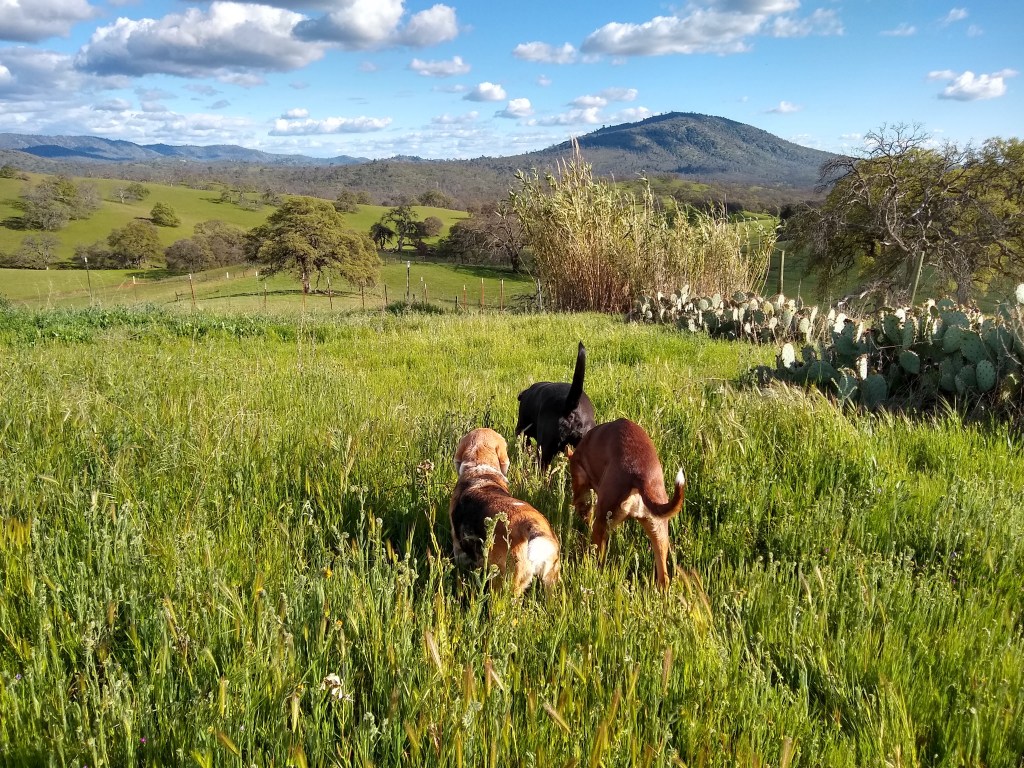
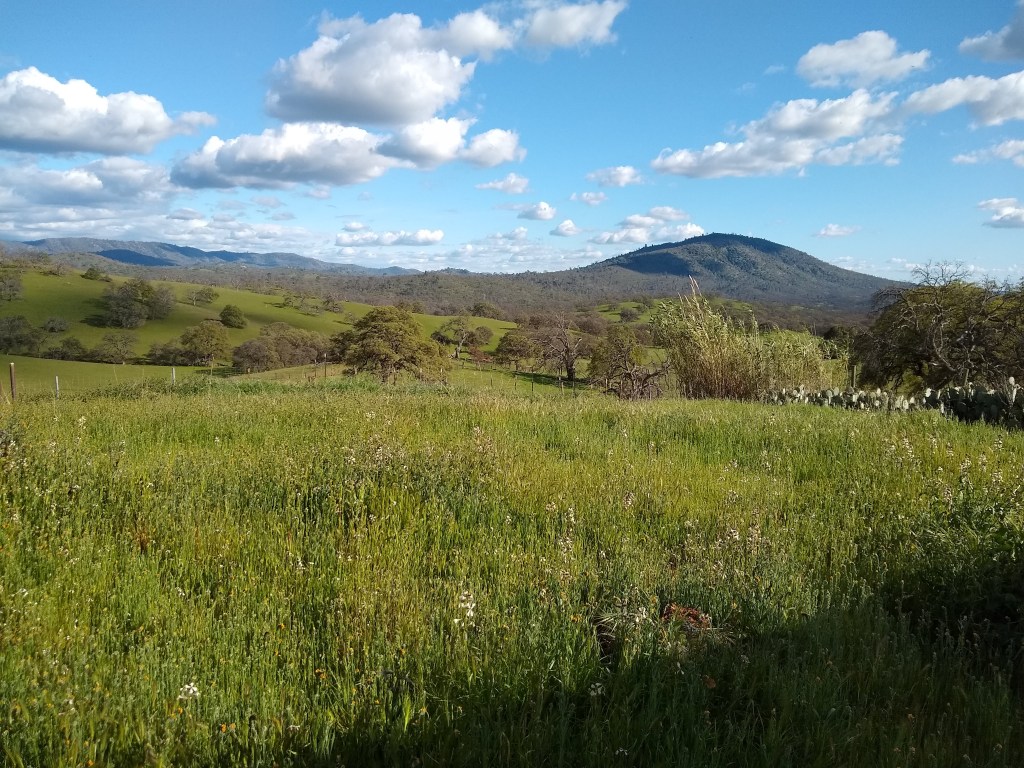
Starting off on a hike to ID more milkweed locations.

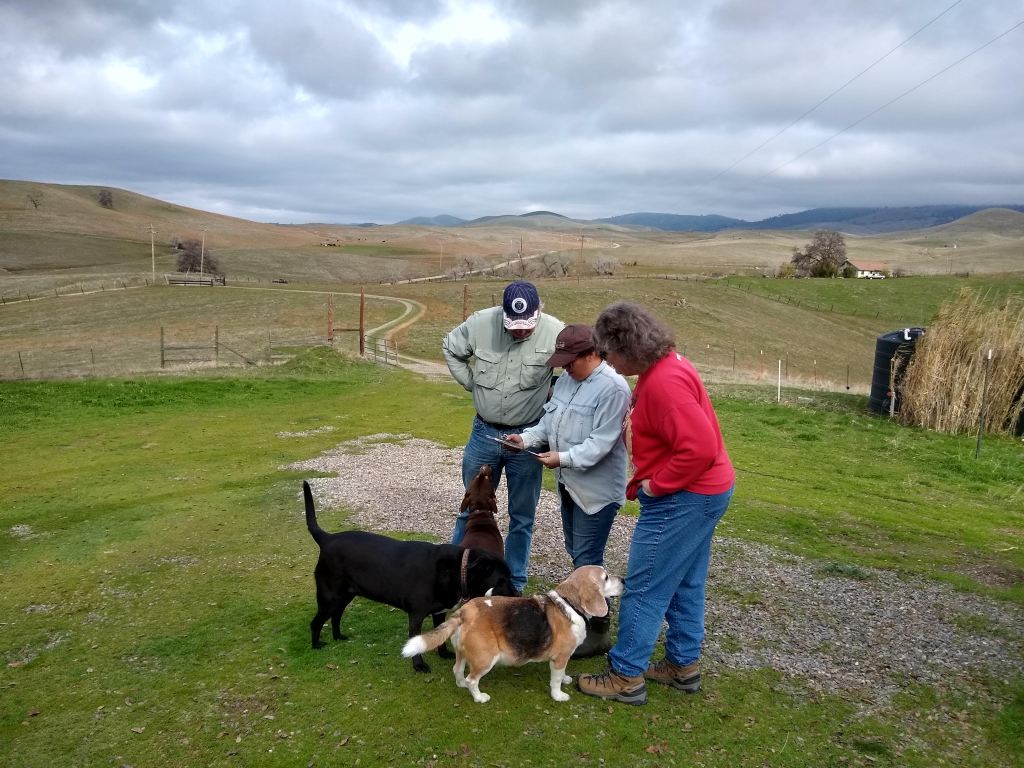
The dogs and I started off on a hike to identify additional plots for milkweed and nectar plants. We are focusing on creek beds, arroyos and drainages because of their more lengthy moisture content after the rest of the ground is dry. Hornitos/Catheys Valley is dry country in the summer. With climate change, I anticipate hotter and lengthier dry months. Choosing the drainages will keep moisture available to the plants longer allowing for their survival and, hopefully, aligning with the timing of the Monarch migration. This is the theory. As part of my project, I will be keeping a close eye on health of the plants to learn what they like best.

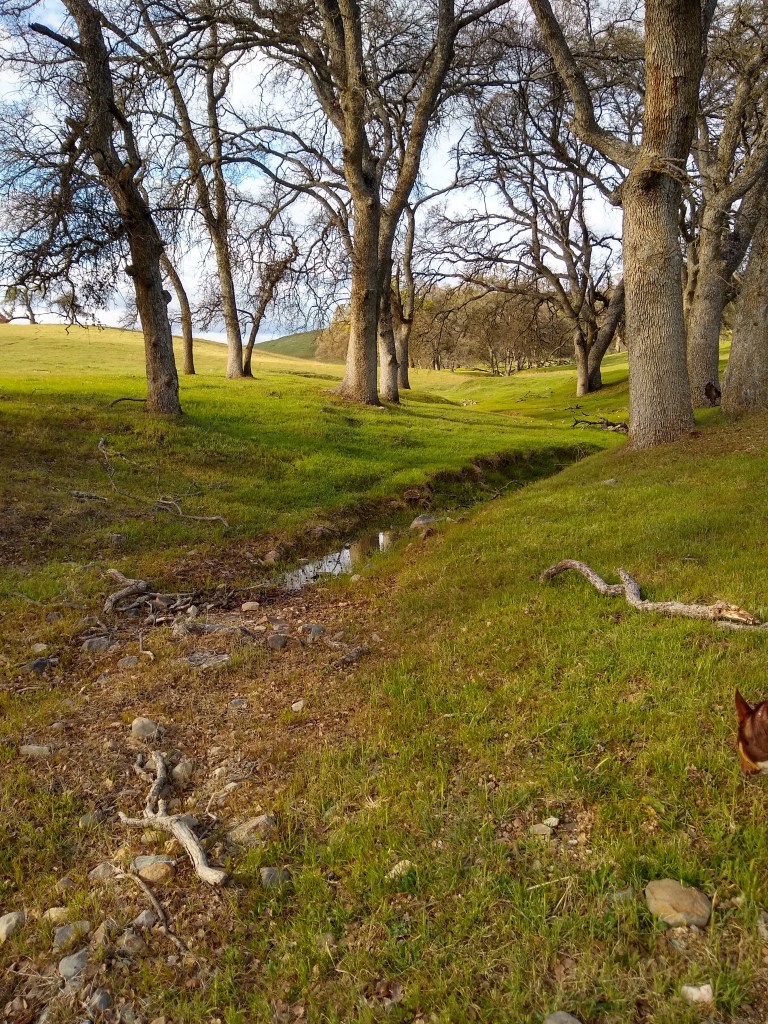
The lower part of the spring-fed creek where it gets shallow.
Lower part of the spring-fed creek with standing water.

The newest grant project I am writing, will expand monarch plantings further down and up the creek from the spring site. When appropriate, we will choose the north facing or east facing side of the drainage, again, to limit the exposure to the heat so moisture is retained longer.
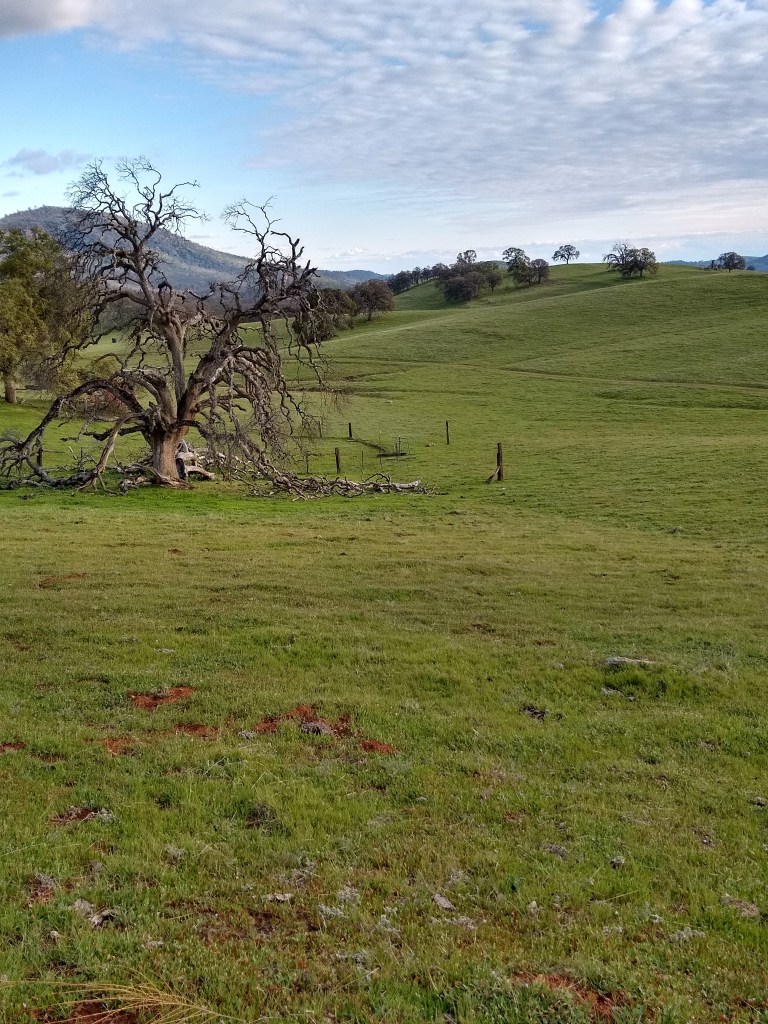
The south side of the ranch property.

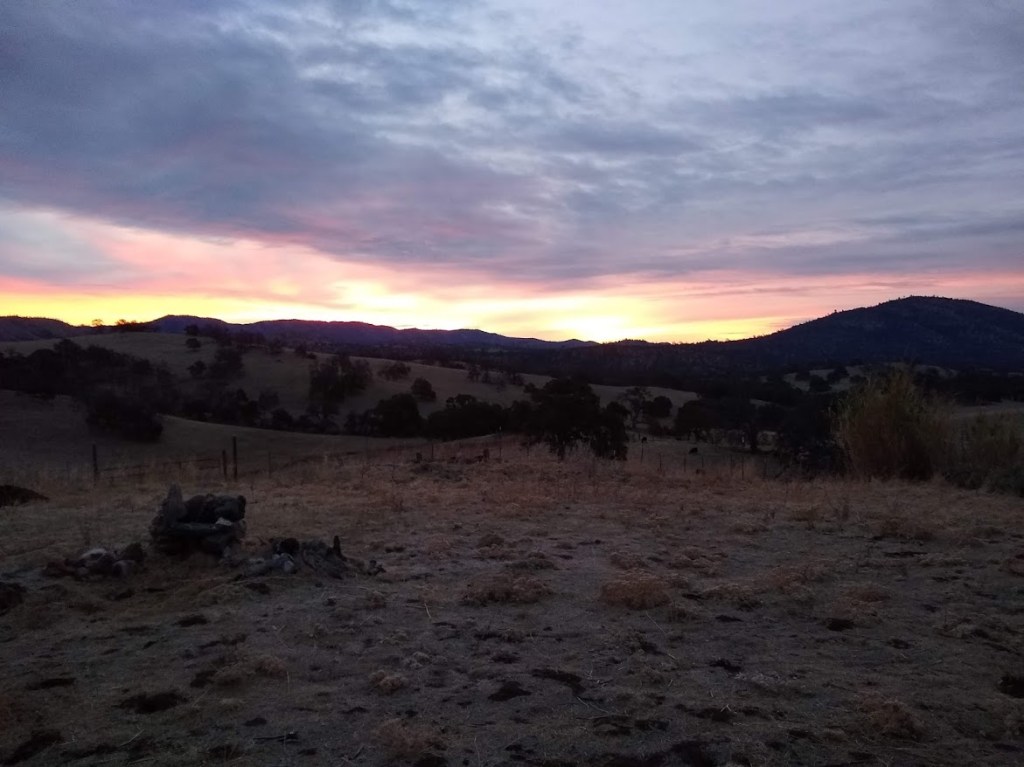
One area I have not explored as much for planting is the south side of the ranch property boundary. As seen in the photo above, there is a shallow drainage that stays green and moist longer into the summer. Where it flattens out, by the pasture fence, could be a good growing site. It is not my first choice because of its shallowness (think: longer exposure to the heat), but it could be manageable due to the moisture level. I will watch this site more closely this year.

This weekend, I will start more seeds for other nectar plants. Fortunately, there are a proliferation of wildflowers due to the series of small storms (and one larger one) we received over the last week. We are up to nearly 11 inches now for the winter. There are still more possibilities for storms through April -a and we will need them. Technically, California is in a moderate drought in my location. It is not getting much news due to the virus, but it can be devastating in its own way. The State reports also show that our snow pack is only at an average of 47%. Not good news for water thirsty California. David and I already began conservation measures back in February when we did not have rain for several weeks. Although we always practice conservation of water, we are adding additional practices to further save this precious resource. If you want to track this issue, here are the official website links: https://www.drought.gov/drought/states/california AND http://cdec.water.ca.gov/snowapp/sweq.action
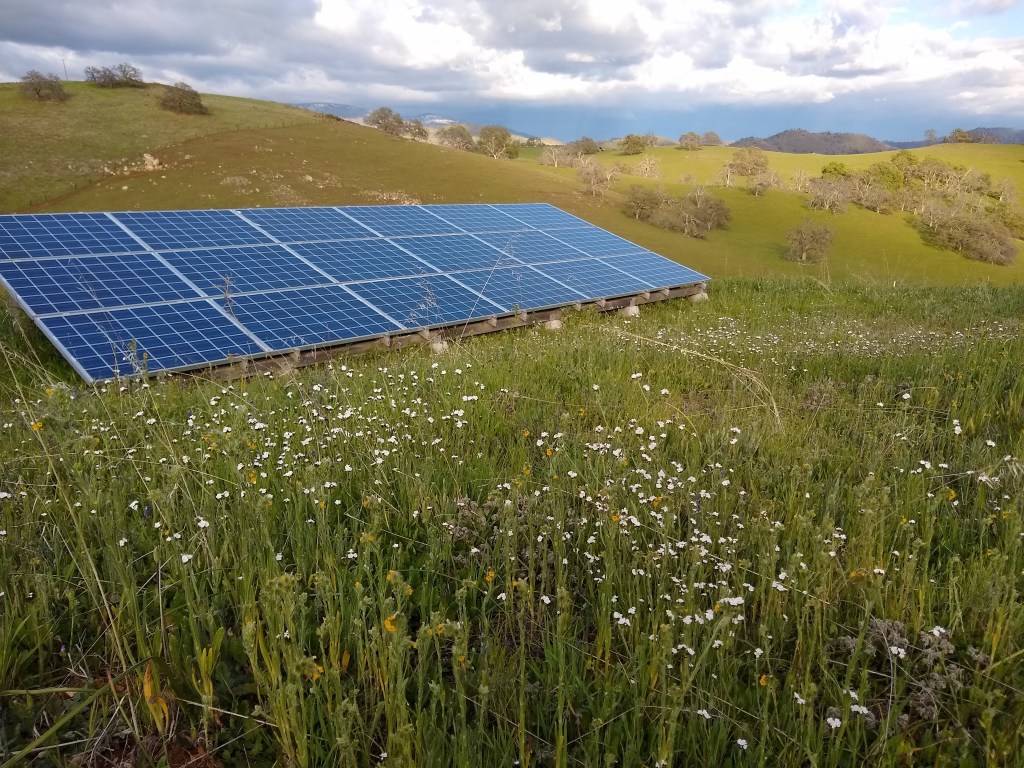
Proliferation of wildflowers by the solar array.

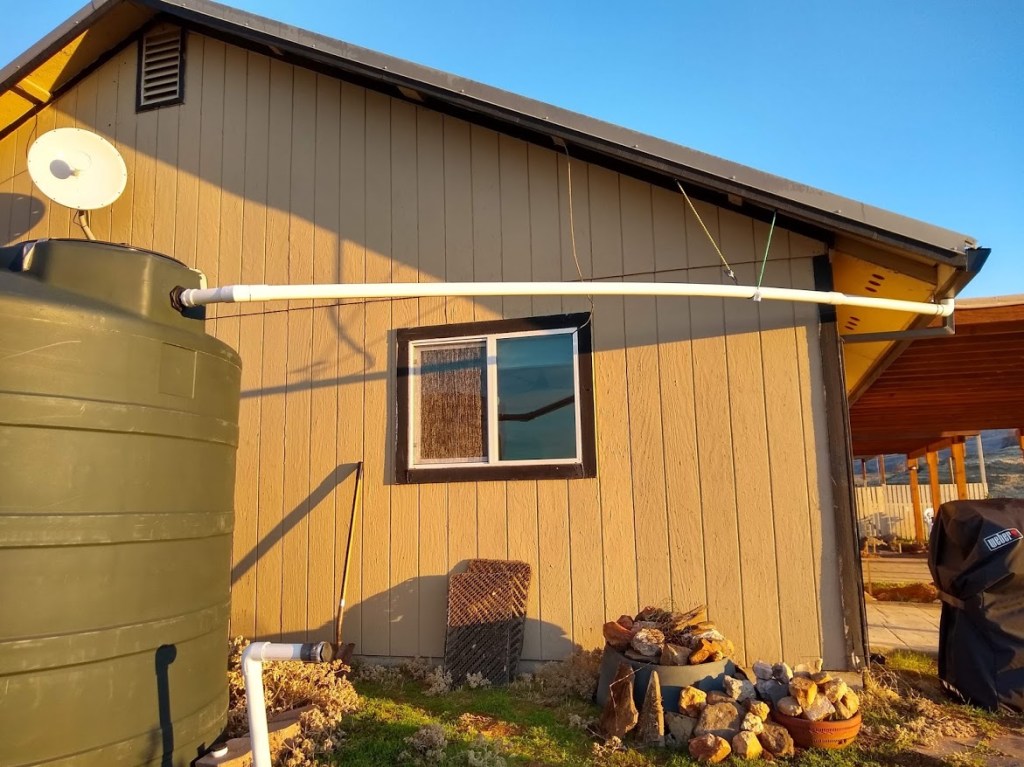
Also thanks to the storms, we are nearly at capacity in our rain water tanks (photo below). We will need every drop if we continue at our current drought levels. So far, we have collected 7,000 gallons. We have about 500 more to go before full capacity. My system is not pretty, and I would love to have an underground cistern system, but it is functional and what I can afford. It gets the job done.

Keeping Spirits High With Nature

Millie longing for freedom.

In the history books, March 2020 will be characterized as the lost month – perhaps so will April and May. With school closures, shut down of commerce, recommendations as well as mandates in some places to shelter in place, to distance ourselves socially, covid-19, a coronovirus, has been teaching us patience, community and respect for nature.

At the ranch, covid-19, and has not altered life much. Rural people are used to challenges to the modern, softer way of life. As a child, I remember a large storm knocking out the power. We were snowed in with no electricity. My parents stoked the fire in the fireplace and took out the camping gear – the lanterns, the coolers, the propane stove – and, along with our well-stocked freezer and pantry, we continued with life as usual – albeit more challenging for cleaning and bathing. For fun, we played games by lantern or firelight. We told stories. We shared our thoughts, goals and feelings. We were a family, slowed in time, in it together.

Fast forward to the last few years of wildfires and floods. Power was out each time. Danger was around each corner – literally. People came together to help one another. Life goes on. Work has to get done.
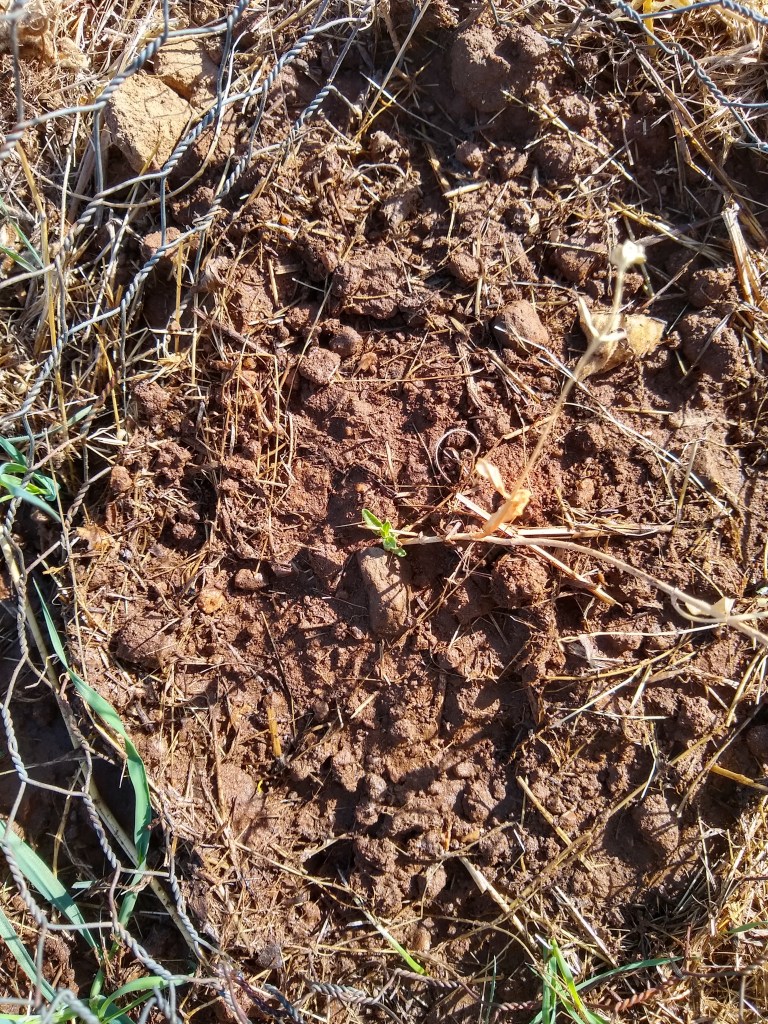
The only change covid has brought is the cancellation of my 50th birthday planting party. Not so much a birthday party, it was going to be a celebration of the Earth and what we as humans can do to regenerate and make positive change. My goal is to get 400 plants planted – 200 milkweeds and 2o0 nectar plants. That would have been much easier with another 70 sets of hands, but public safety comes first. The plants will get planted. I am determined. It will just take a little longer.

Some friends have asked if there was a place they could make a donation, in lieu of working directly to plant milkweed on the ranch. Yes, and thank you! Xerces Society has been a phenomenal resource assisting me in planning and executing this project. They are in the lead helping preserve monarch habitat. You can donate from their website or through this link.

Salvia Sprouts

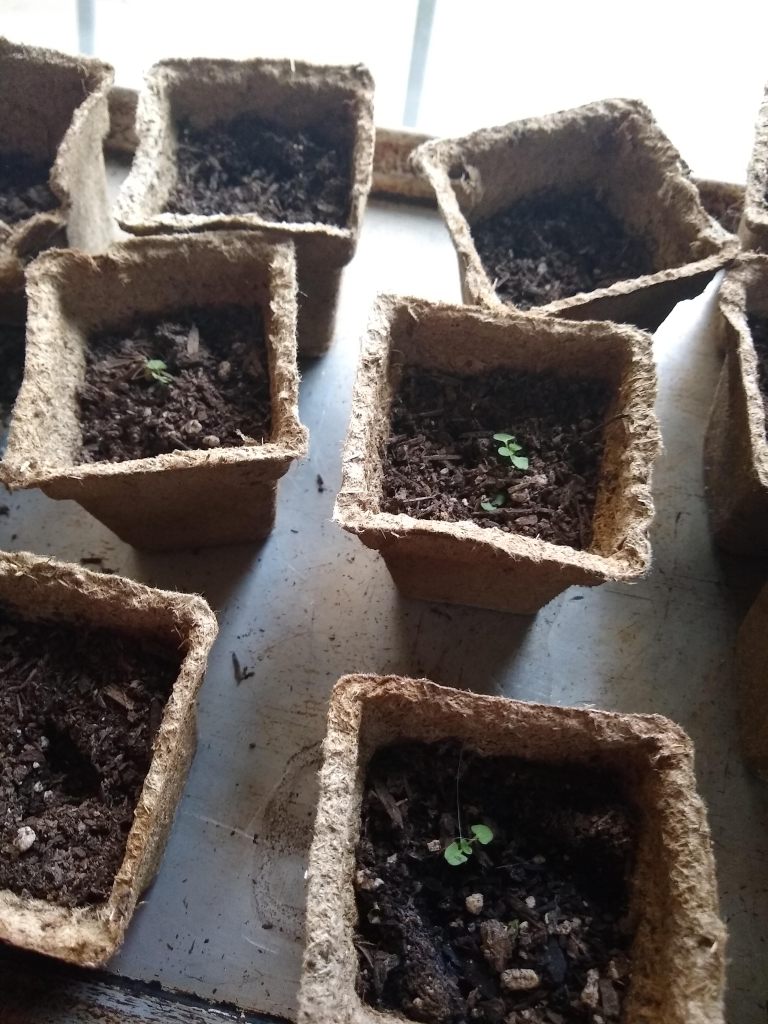
Several weeks ago, as you know if you read this blog, I started seeds. Well, about one week ago I got some sprouts. Not as many as I wanted – but I am grateful for what I have. I will definitely need to purchase more mature nectar plants, and will continue to sow seeds in a staggered way to make a continuous supply of nectar plants.

Fortunately, with the rain we have a natural supply and abundance of wildflowers. Some will serve monarchs, like the salvia and marigolds I planted last year, and others will be an attractant for different butterfly varieties and pollinators.

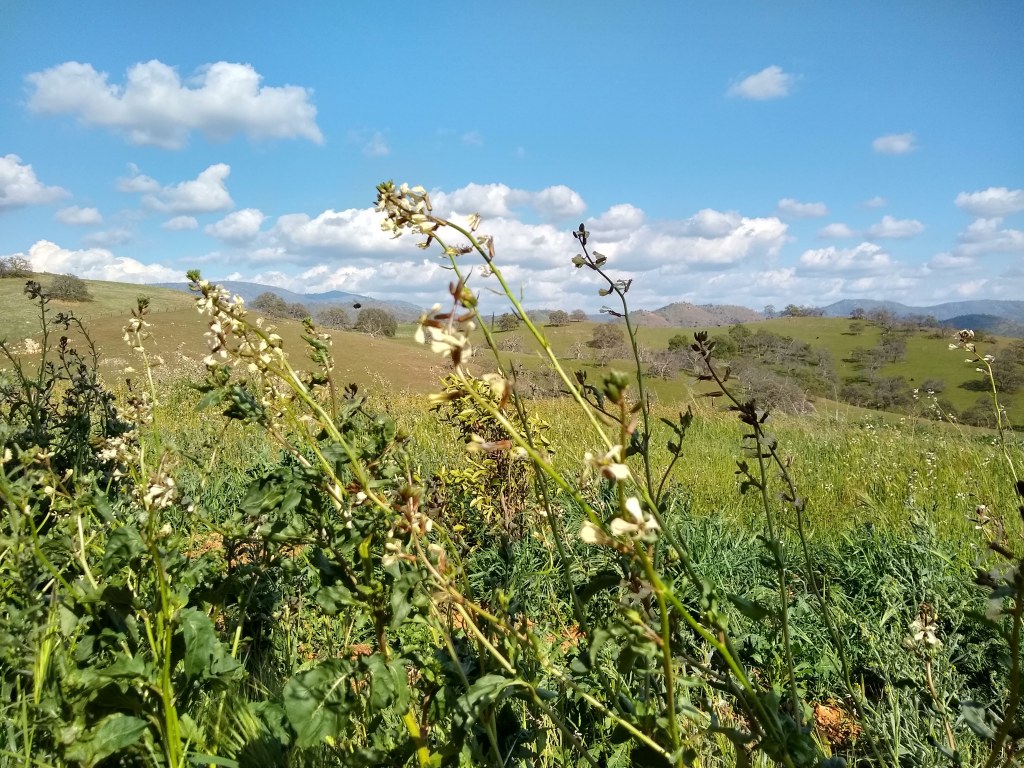
Arugula blowing in the wind
Popcorn flower
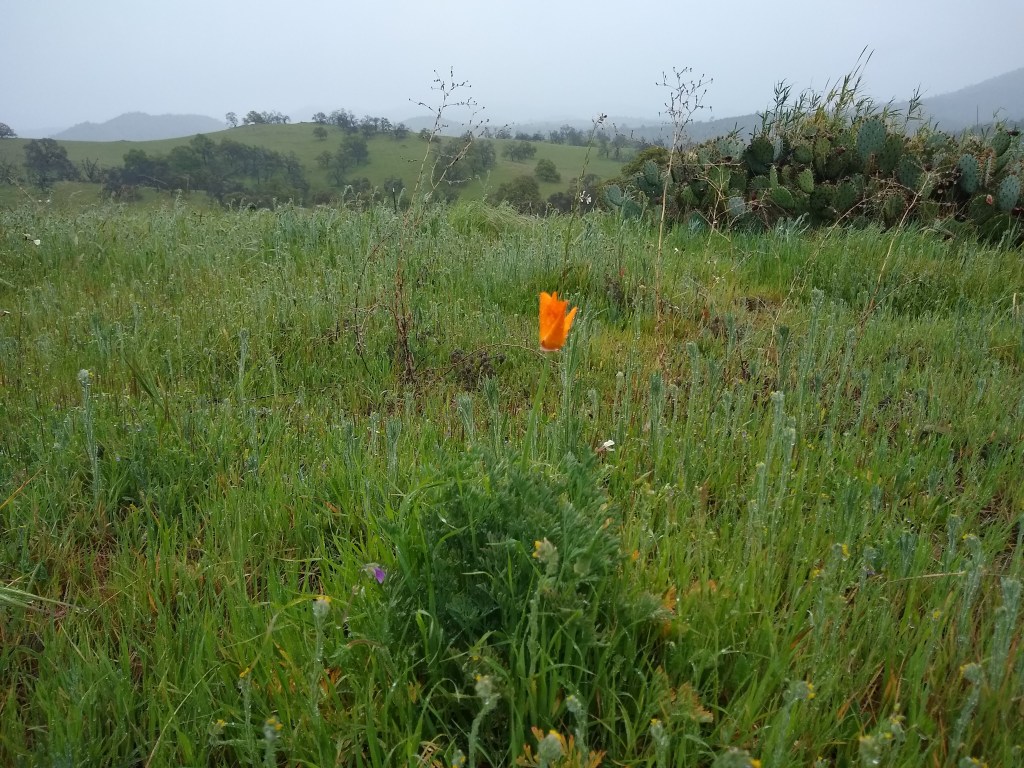
A poppy and other flowers
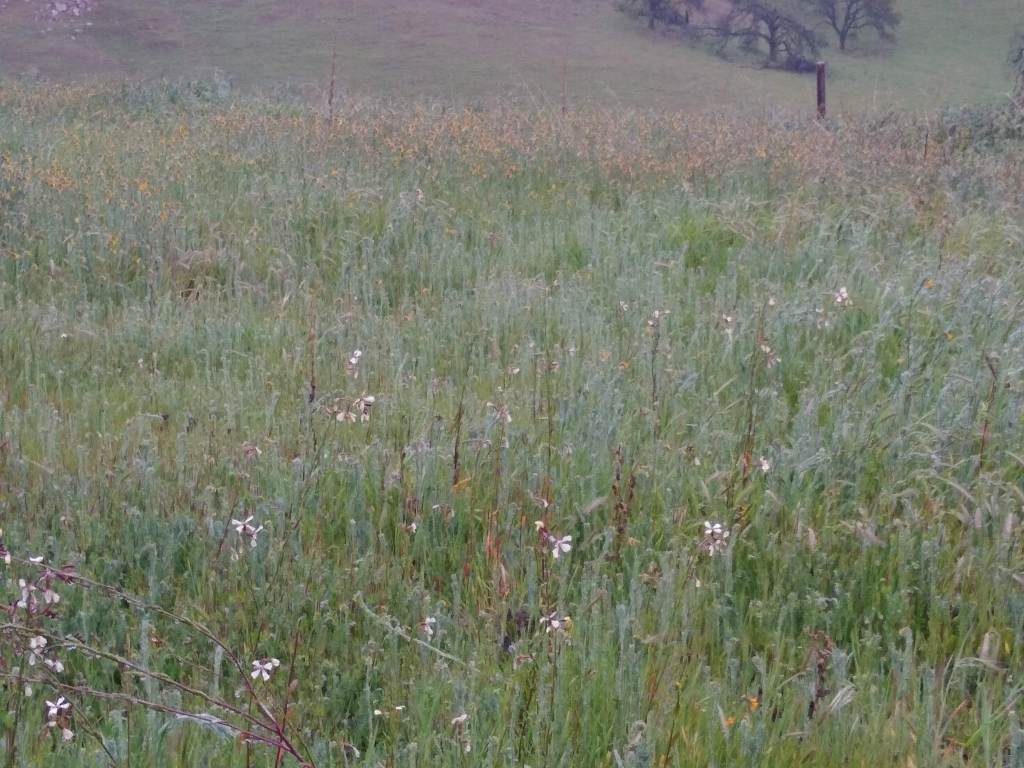
Wildflowers on a rainy day

I will be seeding more nectar plants over the next few weeks. I have a lot of work to do. Covid-19 has slowed my life down a bit, and given me back some weekends I had planned to travel. For those concerned, anxious and stressed, find peace in nature. Do something that can improve our world even as it appears it is falling to pieces around us. When you shelter at home, you can still go out on your balcony, patio, back or front yard and plant some seeds, weed a patch. You can learn something new on YouTube that you’ve been wanting to know. As I mentioned to friends, the sun will set and rise again. Life, though challenging for many, will go on. You have the power to keep yourself well, to thrive even. Raise your spirits through nature. In honoring her, you honor yourself. Be safe. Be well.

Starting Nectar Plants

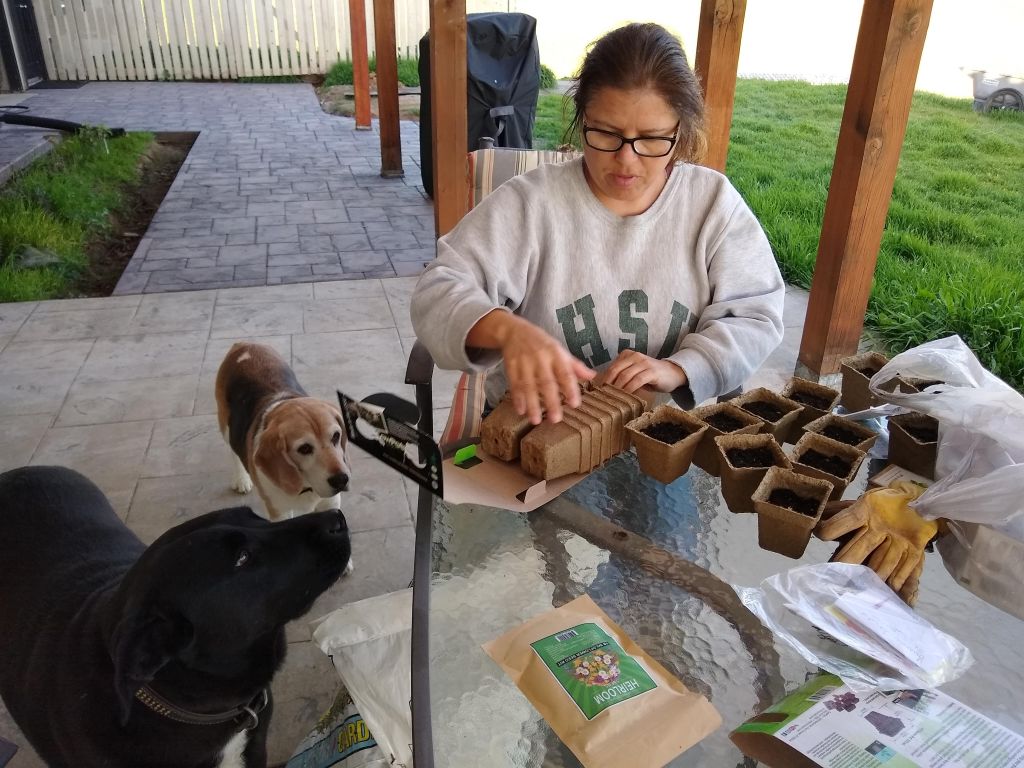
Heather sows the seeds of nectar plants while the fur-babies look on. No, there is no food here for you!

So many things in life require good project management skills, certainly growing plants requires advanced planning and attention. Yesterday, I started yarrow and salvia plants. They require 6 to 10 weeks of lead time for growth before the last frost. Despite what the books say about when the last frost is here in Hornitos, I use my experience. There always seems to be a last cold storm in April. I never plant seedlings outdoors before the second week of April.

Nursery plants are expensive. To make this project more economical, I am trying to grow as many nectar plants as I can in advance. I will likely need to purchase some older ones for the first planting, but I may have many larger plants to put into the ground in the Fall.

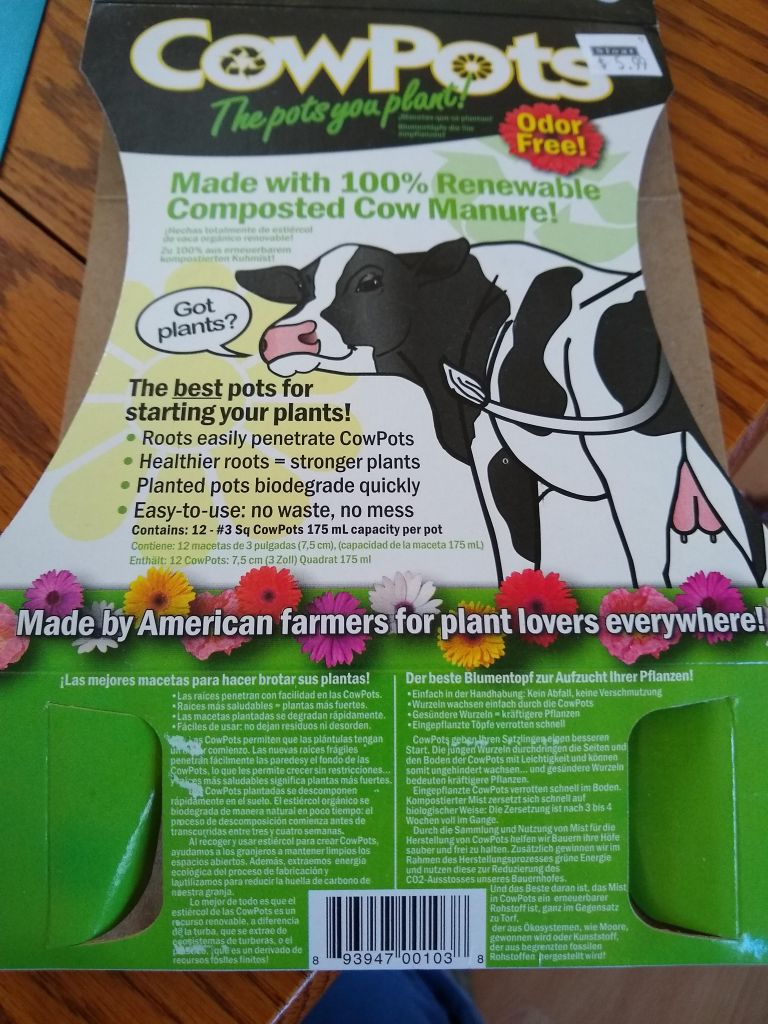
Cow Pots packaging for those interested.

To grow the seedlings, I am using small pots made from manure. I found these neat small pots at a nursery store and LOVE the idea of using cow waste as pots. The manure provides nutrients and the pot degrades within the first year. I checked out their website. They are a dairy farm on the East Coast that is really focused on sustainability. They have a certification for humane treatment of animals. The dairy is not organic certified, but I am thinking it is better than plastic pots and peat moss for a variety of reasons. I sent them some questions that I did not see answered on the website – so I may have more to report on using these in future posts.

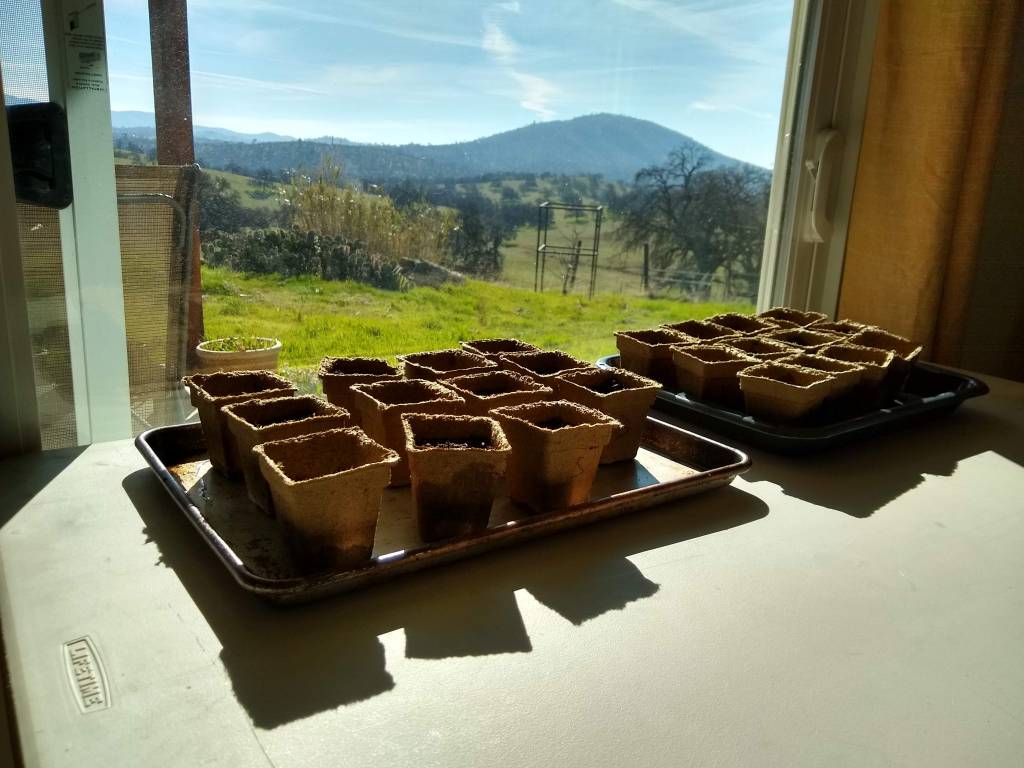
Potted seeds in the “greenhouse” – otherwise known as my master bedroom.

Once the seeds are potted, they need to be kept indoors for the 6-10 weeks. The best place for that is my master bedroom. It is located on the southeast of the house and has a floor to almost ceiling sliding door. The seeds will receive water daily, direct sun exposure for part of the day and heat throughout the day. When my husband saw me bringing the table in, then grabbing our cookie sheets and broiler pan base, then bringing in the manure pots with seeds – he said “What are you doing?!” I told him not to worry, the pots don’t smell and I will scrub the sheets with boiling water after 10 weeks. Ten weeks? Oh, if I had a photo of his face to share…! He just shook his head and left the room. He must love me.

If you want to check out the pots, go to cowpots.com.

Preparing for the Big Planting

Heather looking over the site plan with UC Master Gardener Ron Allen and Mariposa Native Plants co-owner Bev Andalora.

It is Sunday February 2, months away from planting day, but there is much still to prepare. Ron and Bev arrived in the morning so we could identify some milkweed sites. We went over the site plan, and walked along the arroyo and little creek choosing good locations. The site plan will not only be useful for planning, but I will need it for grants I plan to write on work on with other stakeholders. I decided to go for it big! I plan to scale the growing sites as large as my financial capacity can accommodate. If I am able to attract more grants, I can expand the number of plots throughout my acreage and the properties of other interested people. Together, we can make a large area attractive to Monarchs to raise their young and rebuild their populations.

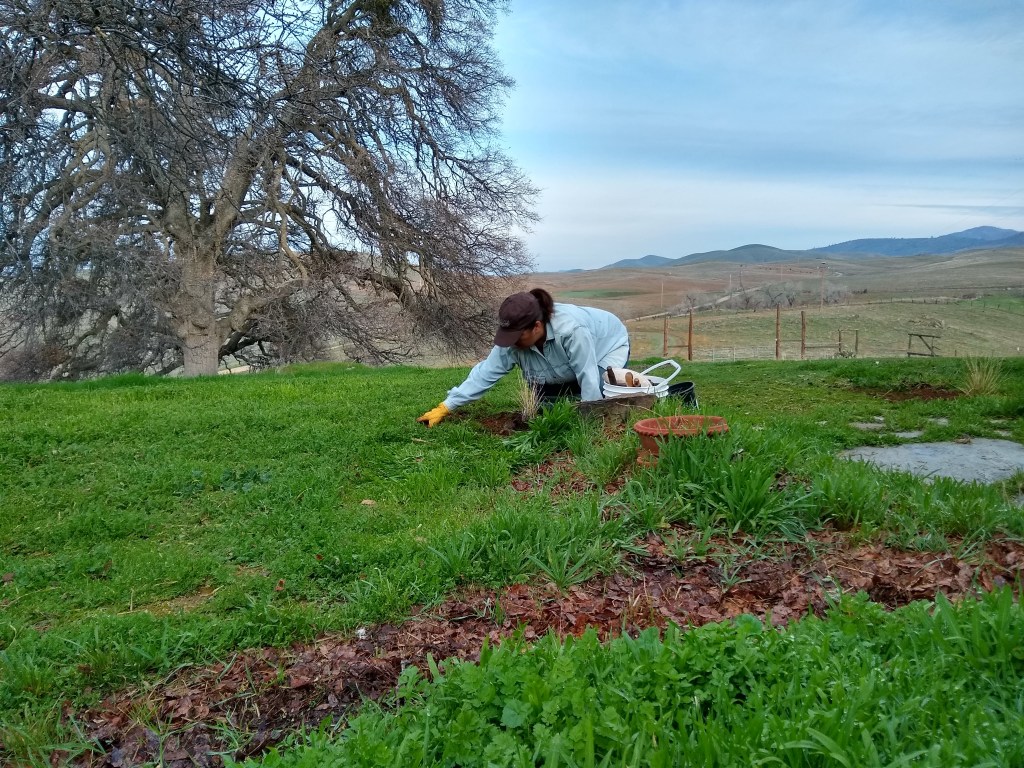
Heather planting one of the deer grass plants.

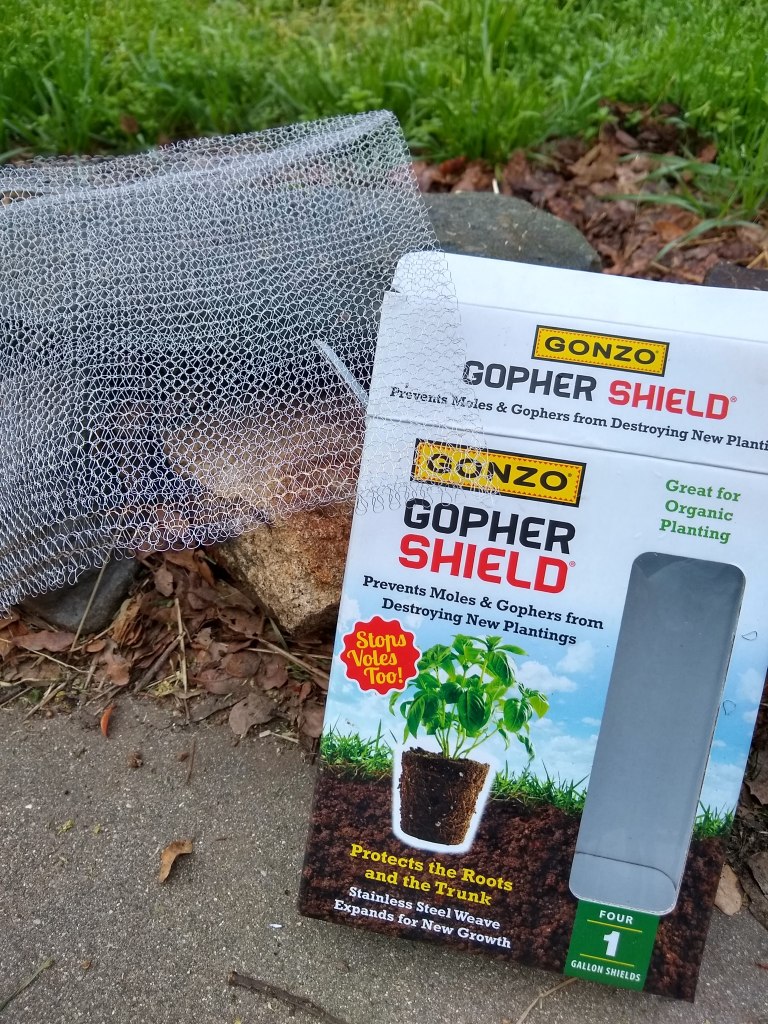
This morning, I also planted some of the deer grass I purchased from the Tuolumne Mi-Wuk Native Plant Nursery last month. I planted some close to the house so I can monitor their progress and to test the gopher screen I purchased.

The gopher screen I hope will work.

The screen I found is stainless steel. It is a bit stretchy and does not stick up outside the ground as firmly as I think may be needed. But – we will see how they do. We really need to find a solution that will give the native plants a fighting chance when not planed near moist ground.

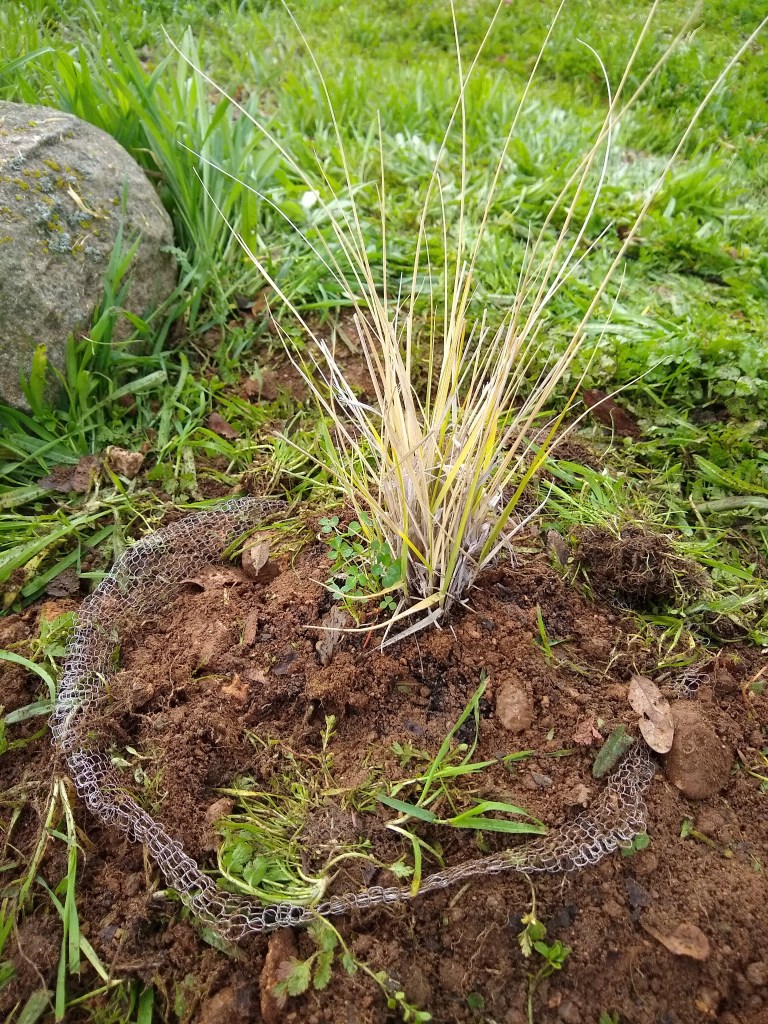
Deer grass in the new gopher screen.

As visible in the image above, the screen is a bit flimsy when sticking out of the topsoil. It curls over a bit too. It was not easy to ensure that the screens were able to be above ground. I had to do much straightening.

I am so excited about this project and grateful to be a small part of what I hope will help the monarchs. In Mexico, where some of the monarchs over-winter, two men who started butterfly preserves were found murdered. They were working to protect this critical species from wholesale exploitation by area logging interests and avocado growers. They paid for this selfless and crucial service benefiting us all with their lives. Why is greed so powerful?! Why can’t industry work to scale harmoniously with Native uses? This is why responsible regulation is necessary to help ensure that some balance is achieved. Without it, we are making our world worse, unhealthy and eventually, unlivable for our children. Read the story here: https://www.cbsnews.com/news/monarch-butterfly-activists-found-dead-in-mexico-ocampo-michoacan/

Adding More Habitat and Nectar Plants – Winter

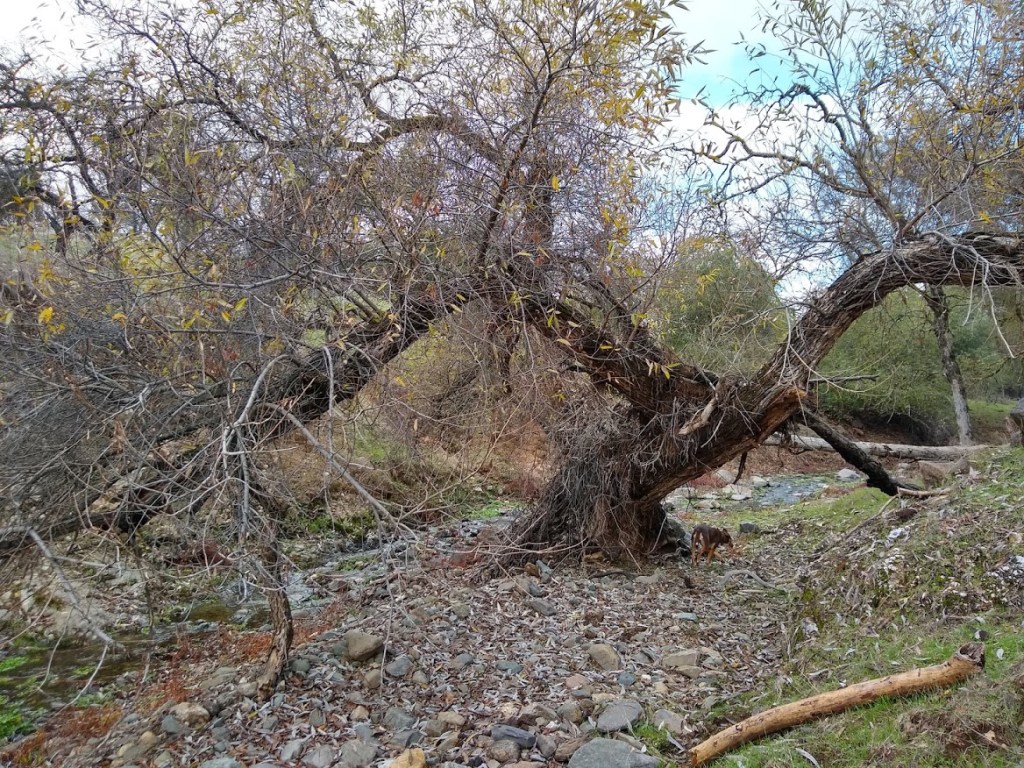
Sandbar Willow, Mid-Ranch Area

According to the Xerces Society, willow and buckeye are one of many plants that can be used for nectar and habitat. They provide an extremely useful plant guide on their website, which I highly recommend. The guide specifies arroyo willow. I believe I have only sandbar willows on the ranch. I plan to take a cutting of the sandbar willow that is in Odom Creek and plant it in the tributary creek. I am hoping that this will be as acceptable as arroyo willow. I do have concerns that the willow will take more water than my tributary creek can provide – and continue flowing from its spring. The biologists did not seem to be concerned. I will double check with them again before planting. Maybe what I think is a sandbar willow is actually an arroyo willow. I will ask about that as well.

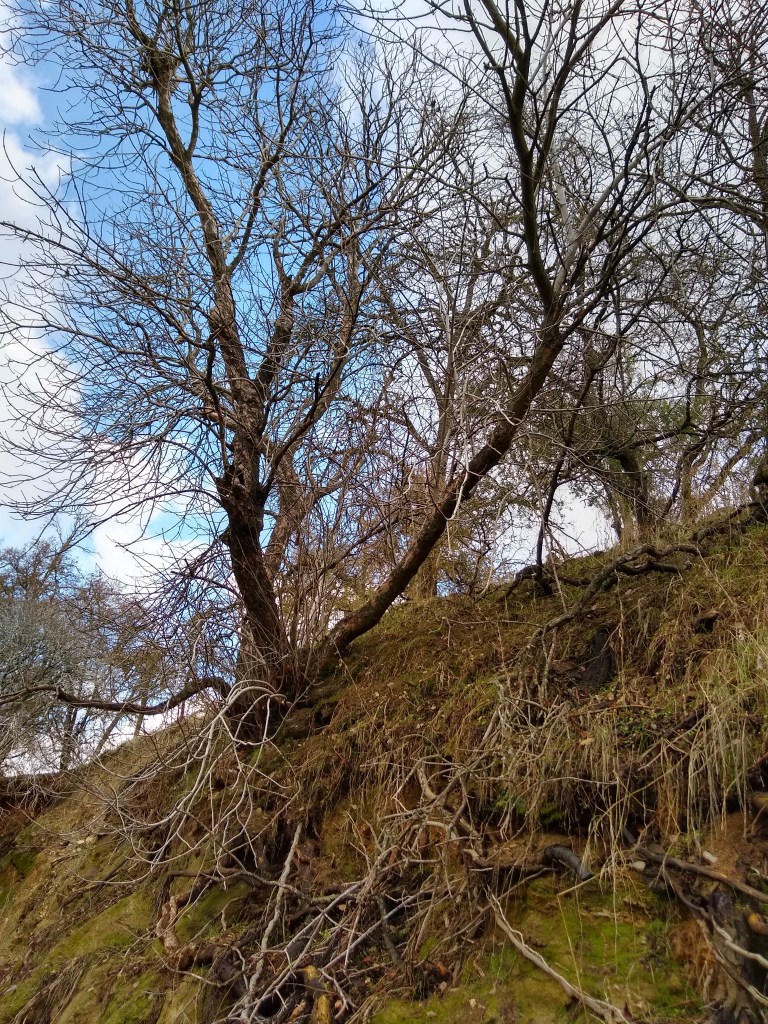
One of the Buckeye “Donor” Trees. Note the Root System Holding Together the Creek Bank.

Over the holiday season, my sister, who was visiting, and I hiked to the mid part of the ranch to look for buckeye seedpods. My sister Sarah and I found many options from two different trees. I will attempt to grow buckeyes from the seedpods and plant it in my tributary creek. The tributary creek has some erosion issues from heavier cattle use. The banks have limited to no vegetation in some areas causing run off of the soil. Planting the buckeyes, willows and deergrass will help with erosion control, soil and water quality.

Close-Up of the Buckeye Seedpods

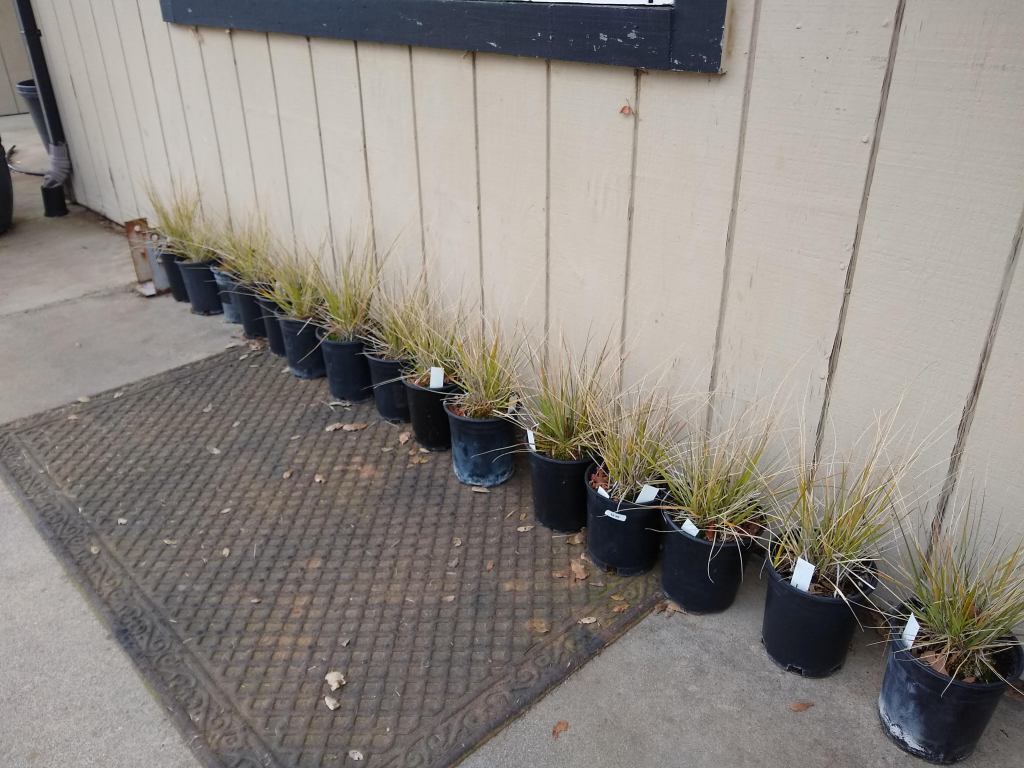
I bought deergrass from the Four Seasons Nursery an enterprise of the Tuolumne Band of Me-Wuk Indians. They do a great job, and the plants look really healthy. Although the primary role of the deergrass is erosion control, according to the Xerces Society Plant list, they are also host to another type of butterfly and are a location for nests. This guide really is good. Take a look.

Line-Up of Deergrass Plants on the Patio

It is really important to understand that there are two groups of monarchs that migrate through the US. There is the Eastern group, which is large. There is also the Western group, which is the group that was counted with 90% less adults than typical. The Western Monarch Milkweed Mapper is a citizen scientist, self-report tool that helps biologists understand what is happening among this remarkable group of butterflies, their habitat and at the caterpillar stage. Please check this out and participate in documenting sightings.

No Pause for Winter – Still Working

Morning Frost by the Cactus

This morning, we had our first frost of the season. It was so cold that I dusted off my real winter jacket to work outside. I know 30 degrees seems balmy to people who live outside California – but hey, cut us some slack. We are used to sunshine. I did my graduate studies in Wyoming, so I do know cold (which is why I have the massive jacket). Today, I am grateful for that jacket and for the warmer temperatures (relatively speaking) where I live.

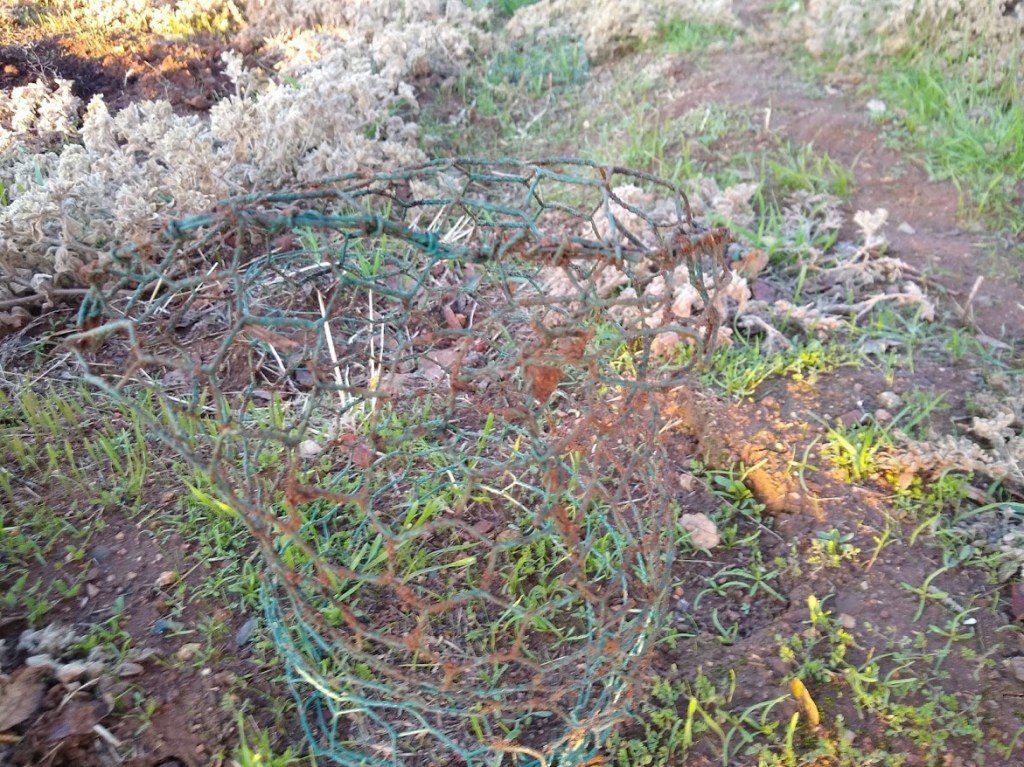
Intact Basket

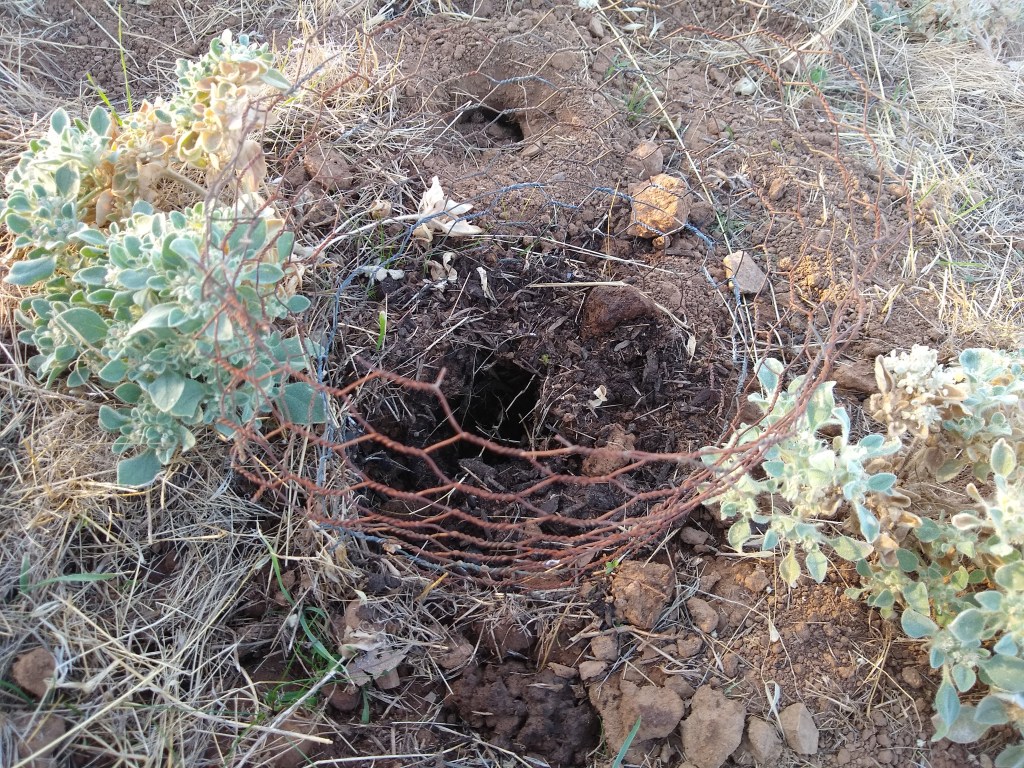
We have had 5.15 inches of rain since it started raining late in the season on November 26, 2019. The ground is nice and soft. I took the opportunity to dig out on of the baskets where a milkweed was replaced by a big hole in the middle. I wanted to see how the gopher had intruded. After digging the basket out, I saw that the bottom and sides were still intact.

A couple weeks ago, I had biologists at the ranch from NRCS and Xerces Society to evaluate some projects I am hoping to implement and/or participate in, including this Monarch Project. One said he would not be surprised if the baskets were intact when I dug them out. He said the holes were big enough that a gopher could get through. He also said they could climb over the height of the basket I allowed to be above ground. This, along with the evidence provided by the intact basket, reinforced that we will be using metal mesh next year.

I did speak with the biologists about an idea I had to plant milkweeds along the wet area of the arroyo near the house. Ron had thought the most of the milkweeds would not like it since they generally like drier conditions. They certainly did well on the hill near the house. However, the biologists said that they see milkweeds along creeks, and recommended I try it planting the Mariposa species along the banks. I will do this. I did not see any gopher mounds near the arroyo. The biologists pointed out that gophers do not like moisture.

Poor Girls Rainwater Capture

Speaking of moisture, right now is prime time to capture rainwater. This is what I use to irrigate my plants through the end of the growing season, water the dogs and make available for wildlife. I also use it to flush my toilets. The water is good enough to drink as well, with some filtering and boiling. Although I have dreams of the type of rainwater system I would love to design and build, that takes capital. I am not wealthy – so I stick with what I call my “poor girl’s” rainwater system. It isn’t pretty, but it is effective. With my husband, we designed a direct capture system that goes from the downspouts to poly tanks. We started off with just over 500 gallons of capture in 2003, and have grown it to 7550 gallons. I don’t mind hauling water. It gets me out from behind my computer and is good for my body. Also, the dogs and plants seem to prefer it to the well water.

Gophers 16 – HB 5

North Plot December update. Lost two more plants to gopher predation.

Spring will be almost a complete start-over. Of the 21 original plants, I have lost 16. Most lossess have been due to gophers. I lost two of my largest, strongest plants to gophers a couple weeks ago. The three other plants have been spared so far, I think, because they had already curled up and gone dormant. It is a theory anyway. Next spring, I will be using metal mesh bags. In my other plantings, the commercial baskets have prevented plant loss. I wonder if the gophers found weak points in the bottom of the baskets we made – even though the ends were tightly connected with wire.

Rain clouds looking east.

The rains began at the end of November. This means that the plots no longer need me to hand water them. I will be capturing more rain water for next year. Tank 1, adjacent to the North Plot, still has water in it from last winter. We used only a few hundred gallons of the 2500 gallons in there. Tank 2 also adjacent to the North Plot is empty. Tank 3, adjacent to the South Plot, has only 100 gallons remaining. We will be hooking up piping to the tanks at the next break in the weather. Just because the plants go dormant does not mean the work stops.

Now the North Plot is Attacked

Gophers “disappeared” two milkweeds in the North Plot

Either the chicken wire holes are too big too, or there was a weakness in the construction of the baskets. I was devastated when checked on my North Plot to find holes in the center of two baskets where healthy, happy milkweeds once were. The gophers are trying to get into the others too – so far, unsuccessfully. I see holes and mounds adjacent to all the other baskets as well. Next year, we will be planting them in metal mesh and see how that holds up.

A healthy milkweed in the North Plot surrounded by evidence of gopher attempts at intrusion.
A milkweed in the North Plot begins to shut down for the winter.

Several of the remaining plants are beginning to die back for the winter. The daytime temps have been unseasonably warm, but the nighttime temps have been fairly cold – in the 50s. I continue to water, per Ron’s instructions, to ensure the root system has enough moisture to be able to come back next year.

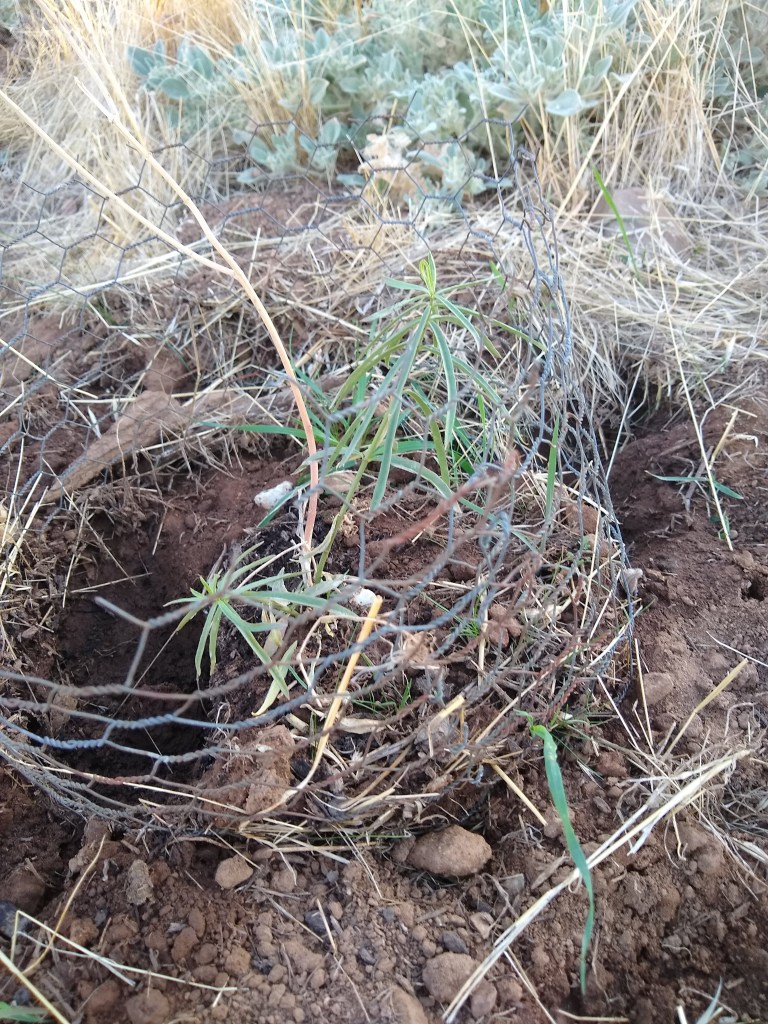
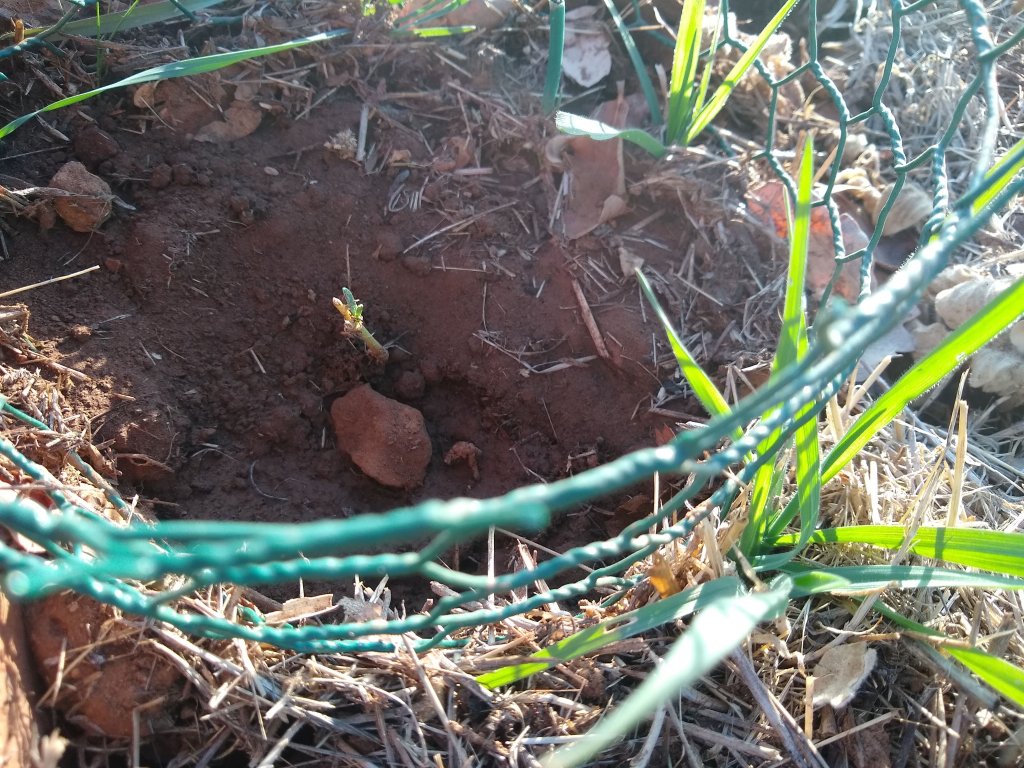
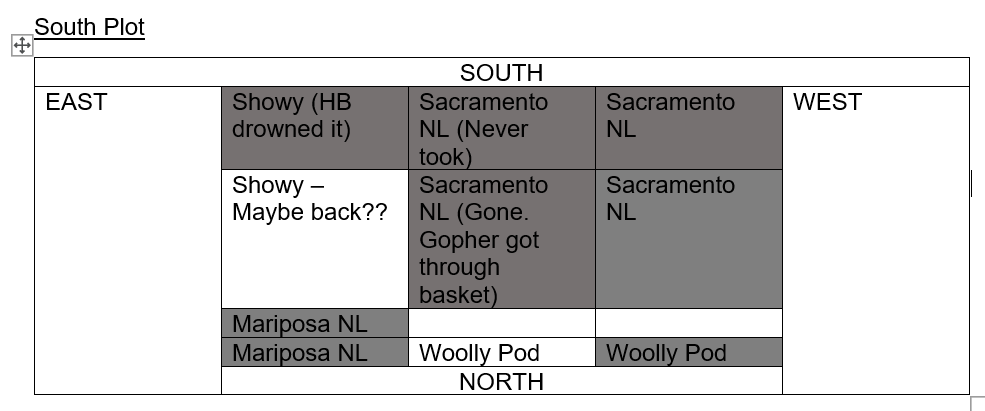
Some hope. A stick emerges in the South Plot where most baskets were infiltrated by gophers.

With the new gopher attack in the North plus the attrition I’ve mentioned on this blog previously, it brings down my milkweed census in the North Plot to 5 visible plants. In the South Plot, there was only one visible plant until yesterday. This little guy (photo above) emerged from the soil. This was one of the baskets where there was no hole, but the plant was clipped from above. As Ron said, milkweed roots are alive under the soil even if the plant looks dead or there is just a stick above ground. Hopefully, the gophers don’t get this little guy. I may try to dig it out and place it in a new chicken wire basket. I will need to ask Ron if that kind of shock during the Fall will kill it.

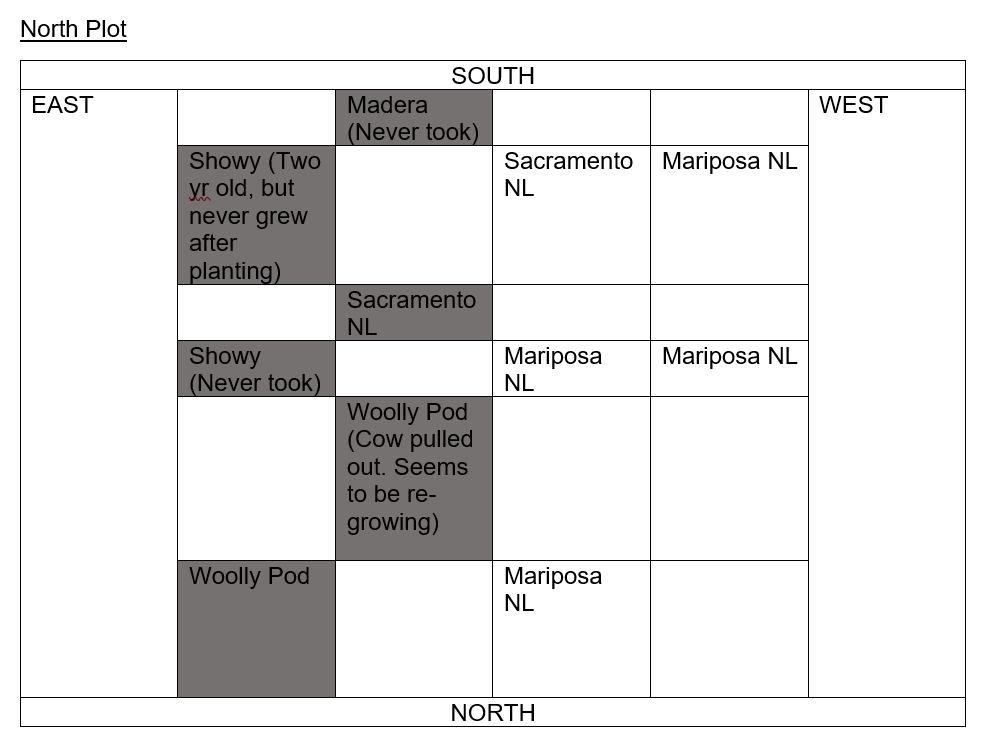
Below are the latest species map updates:

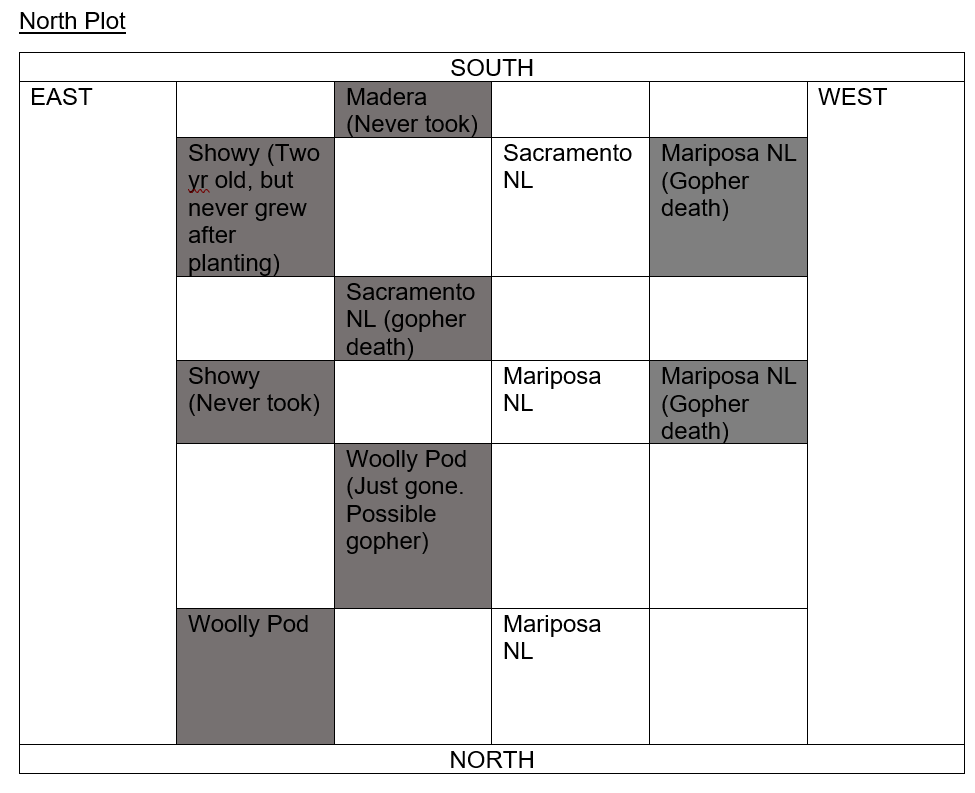
North Plot status
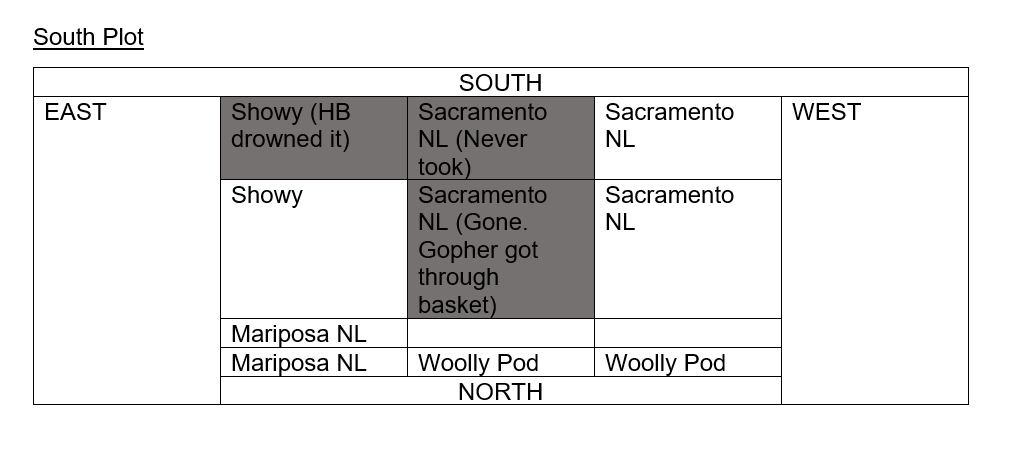
South Plot status

Decimated by Gophers

Dark cells are disappeared plants.

It has been very sad to watch my healthy, gorgeous milkweeds disappear one by one. The cages built for this plot had too big of holes to offer the best protection from underground creatures. I spoke to Ron about this, and he will have more plants to restock in the spring. The Showy on the east side appeared to be eaten but not pulled out from below, which means we have a chance that its roots will be established and regrow next spring. The others appear to be completely “disappeared” – attacked from underground.
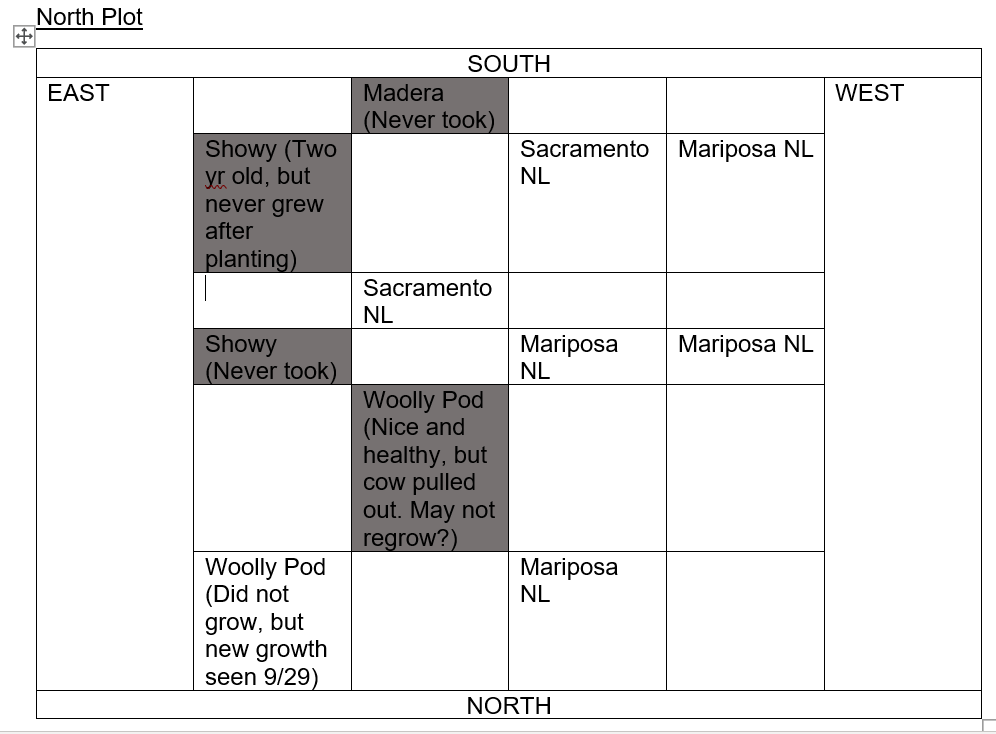
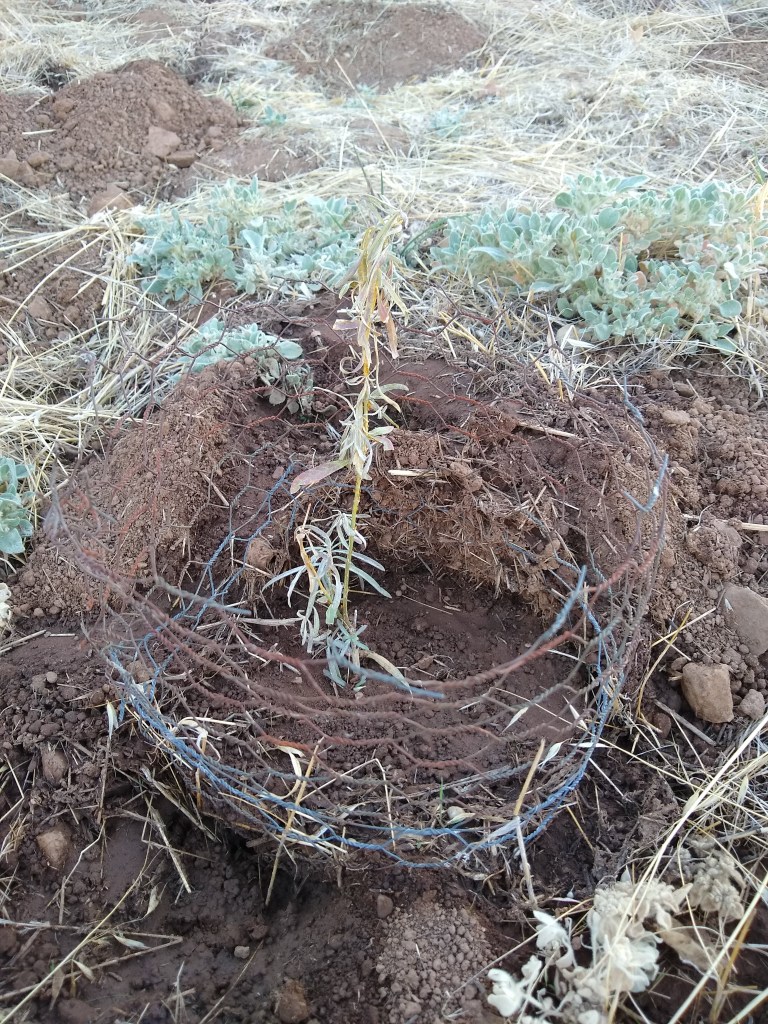
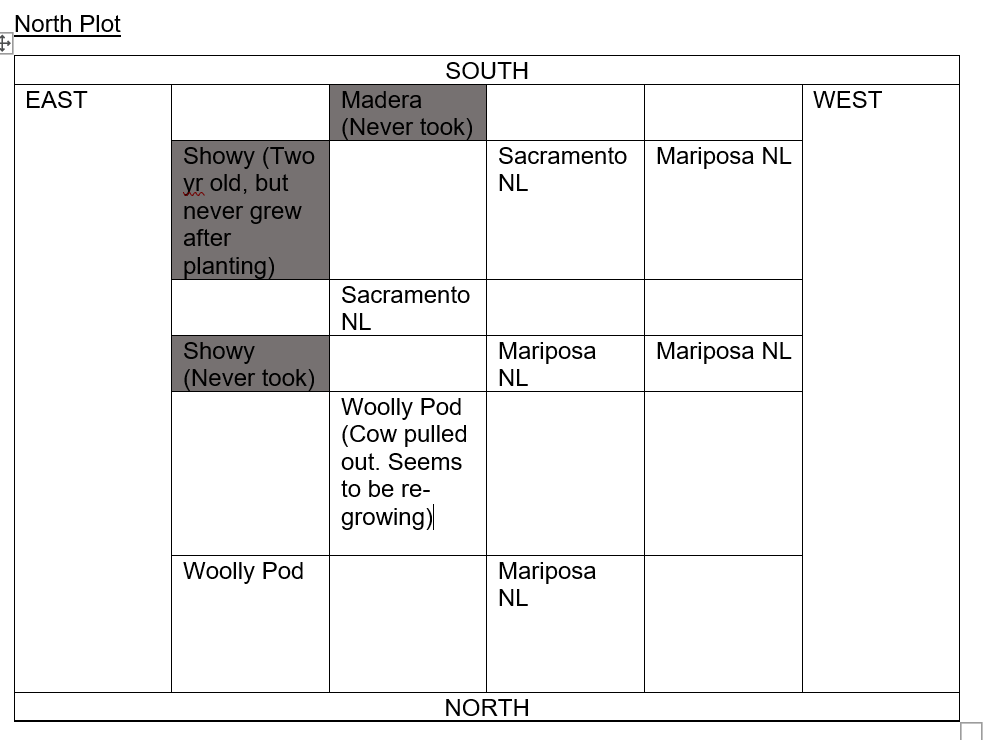
Less attrition. I’ve reclaimed the Woolly Pod the cow tore out!

The North Plot is doing much better. David and I used chicken wire we had laying around to build the baskets. There are gopher holes but no attrition thus far. Some good news – the plant that was pulled out by the cow, it appears to be regrowing. I have changed the cell from gray to white to indicate survival (see plot map above).

Just like with farming, you can only do the best you can. Every season is a learning opportunity and has a new foe. Some years are good, some devastating. There are no guarantees, but we must try.

9-30-19 Plant Update

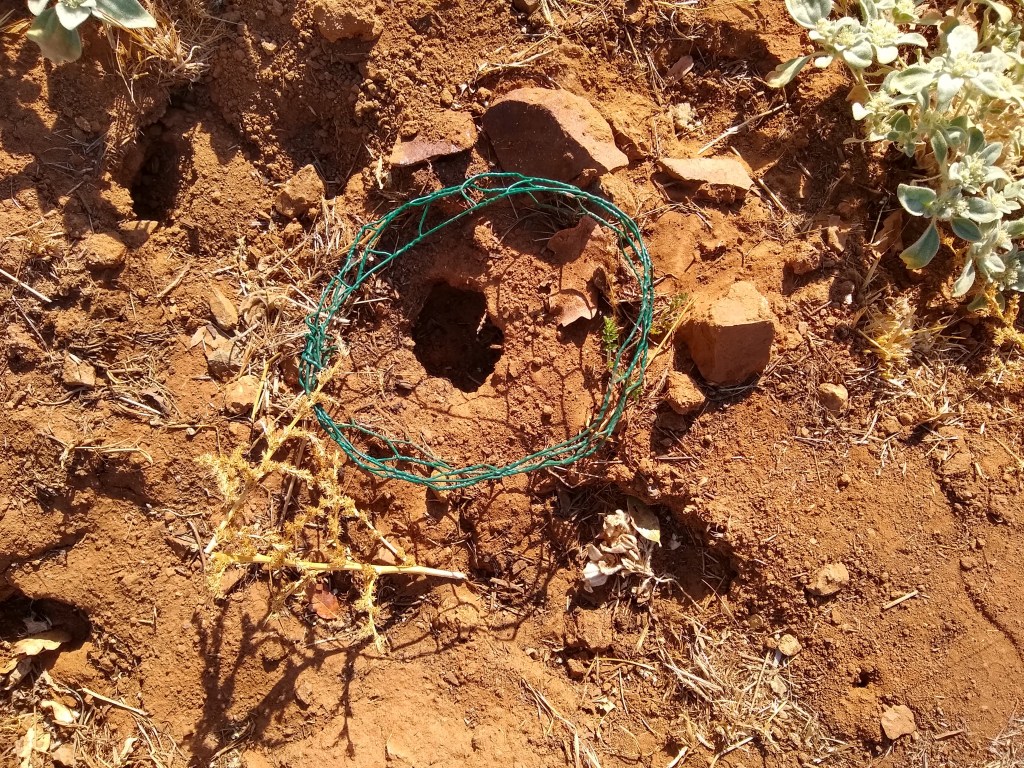
Gopher hole in the middle of a basket.

There has been some attrition. Mostly, some of the plants just transferred hard and never grew. In three other cases, there were some preventable errors. An industrious gopher got through one of our homemade baskets and got a milkweed (see above photo). Ron (The UC Master Gardener milkweed expert) thought the gophers would not like the bitter taste of the plant and leave them alone. Unfortunately, the gopher not only tasted the roots, but the entire plant disappeared! To Ron’s credit, he wanted us to use gopher baskets “just in case”. This probably prevented more loss. Thanks Ron! In another case, I drowned a plant after leaving the rainwater hose on too long. Finally, as described in my last post, a friendly cow came along and attempted to graze a plant – then spit it back out. Although I replanted, I am not sure it will survive.

Some great news: I found some growth on one of the plants that transferred hard and never grew. That was exciting – although it decided to grow just as the season is winding down and the leaves will begin to drop (see the photo below). A main lesson from this is to keep watering. I kept watering all of the plants/basket areas even if they looked dead or had disappeared.

New growth at the base of a milkweed stem.

Below are the planting plot maps I created with dark gray cells for those I’ve lost – or at least think I’ve lost. I give a status on some of the plants.


Overall, I am happy. I knew there would be some attrition, but had hoped it would be minimal. Cannot wait to see if the butterflies choose to have babies in these patches!