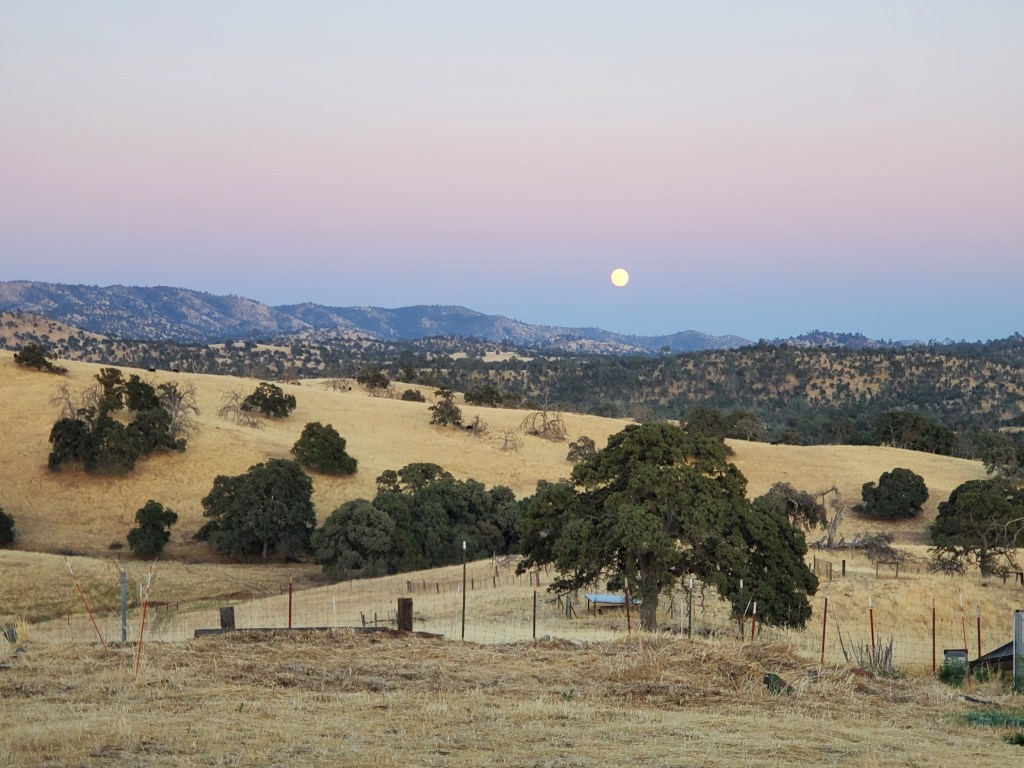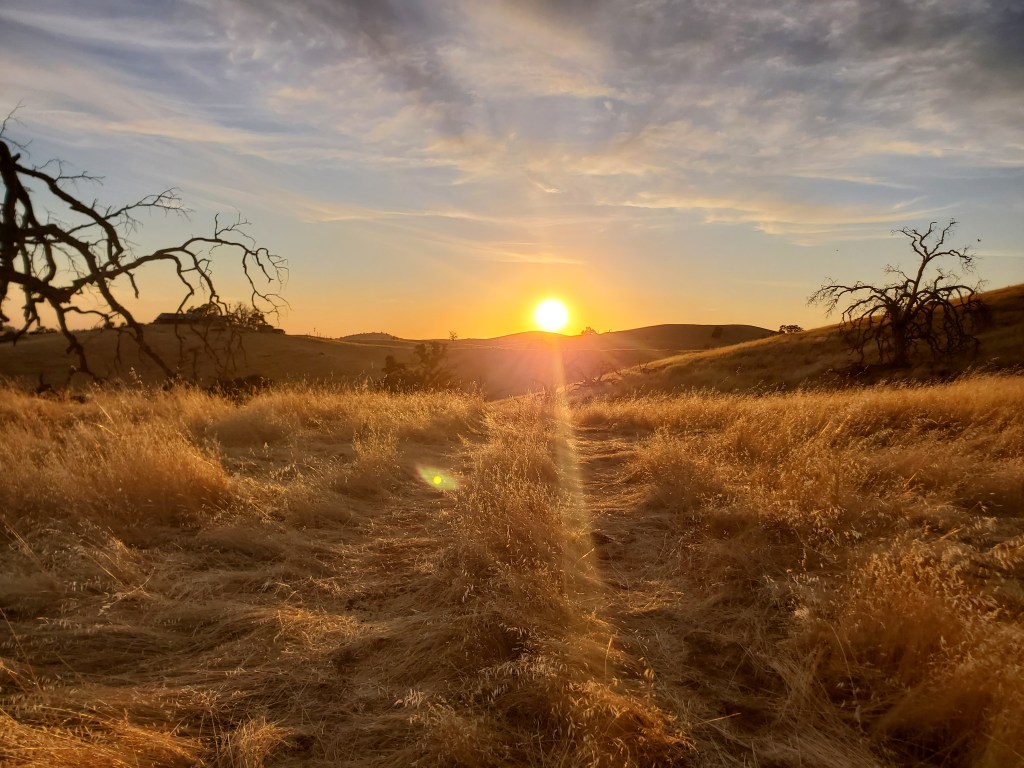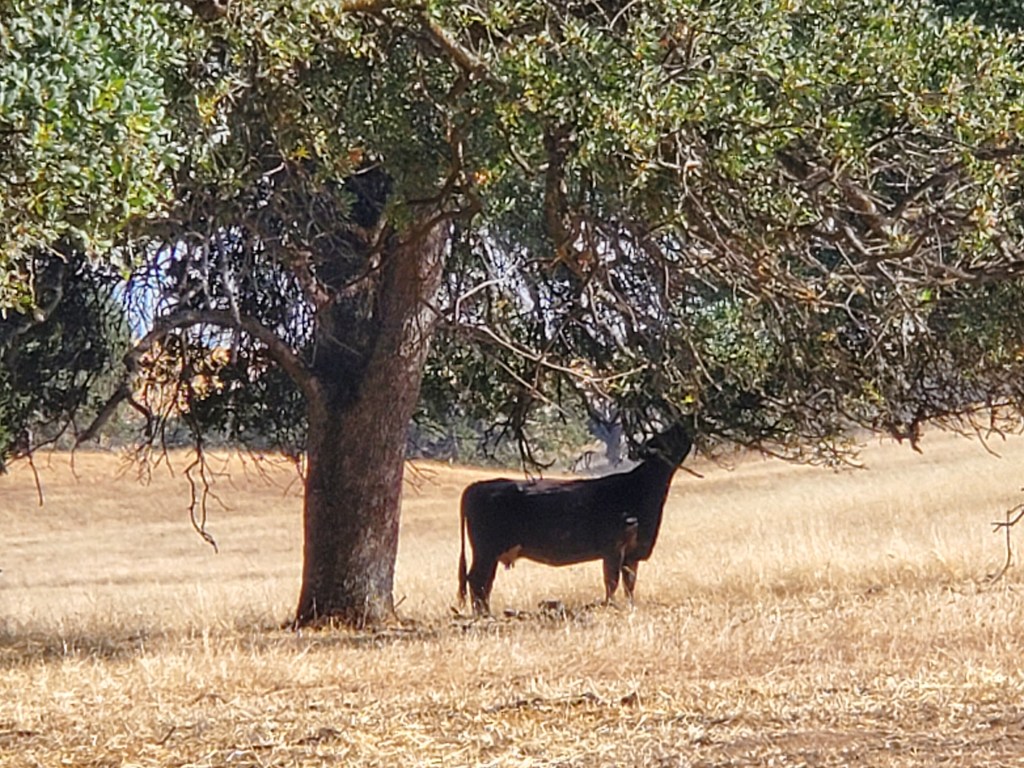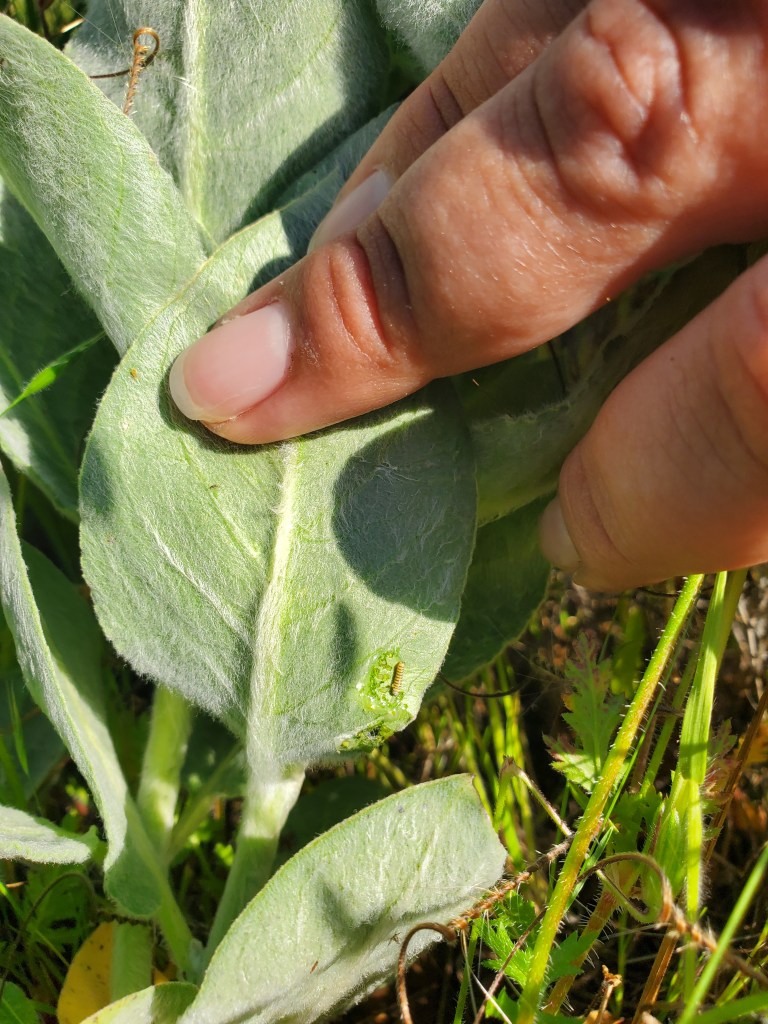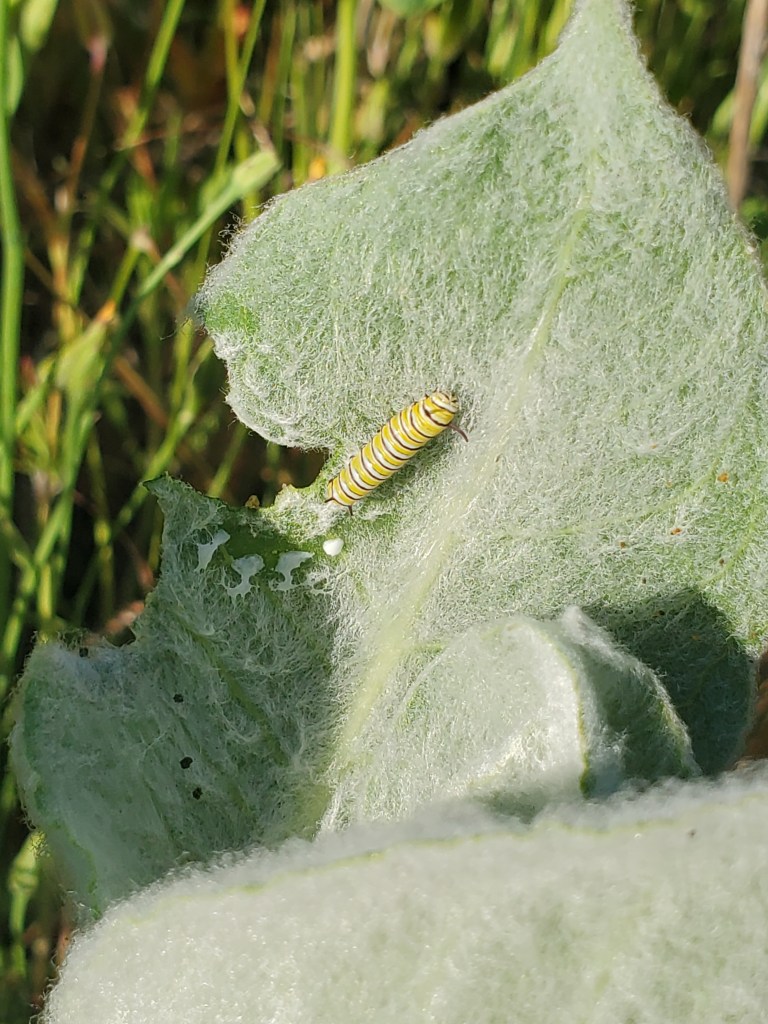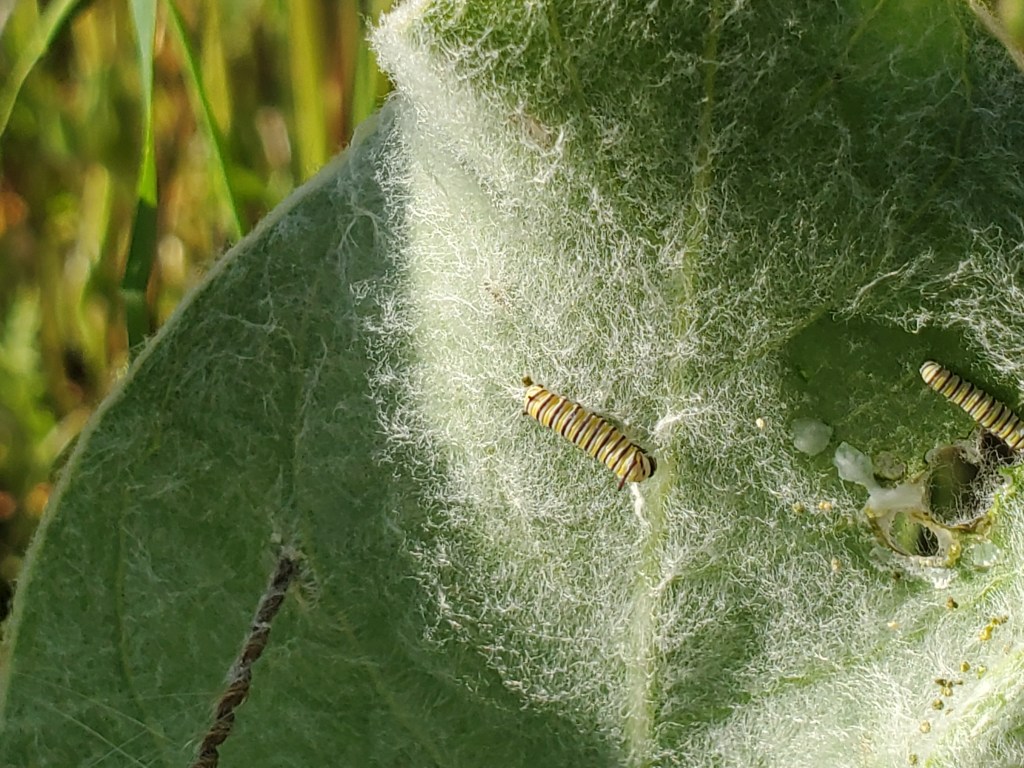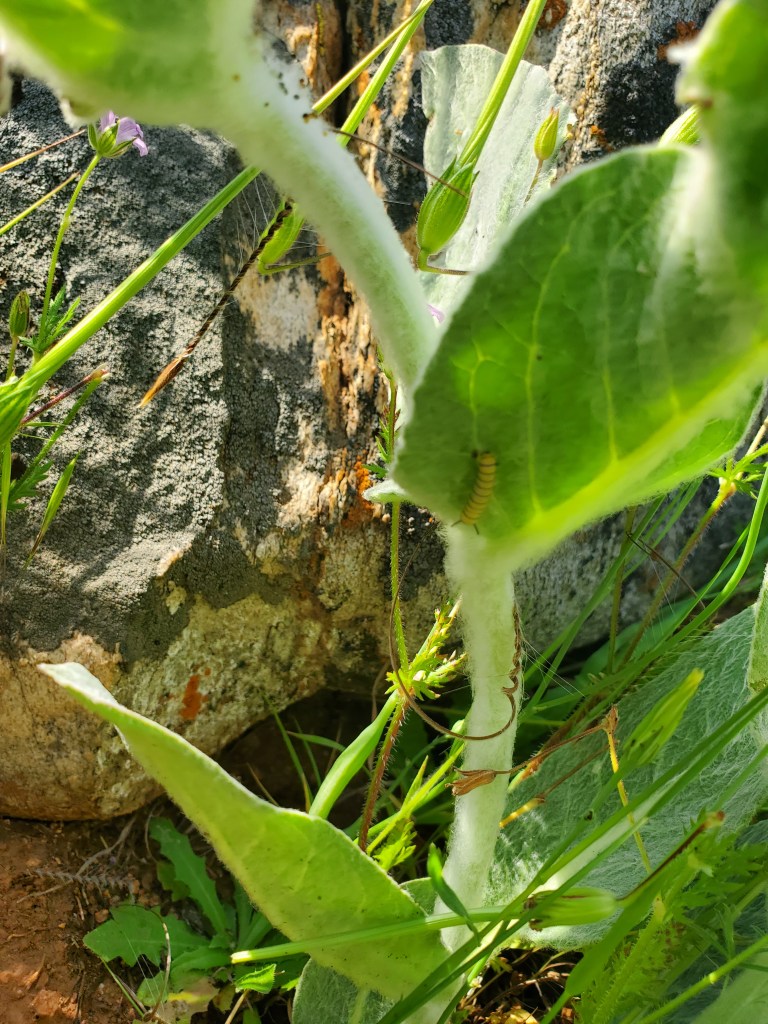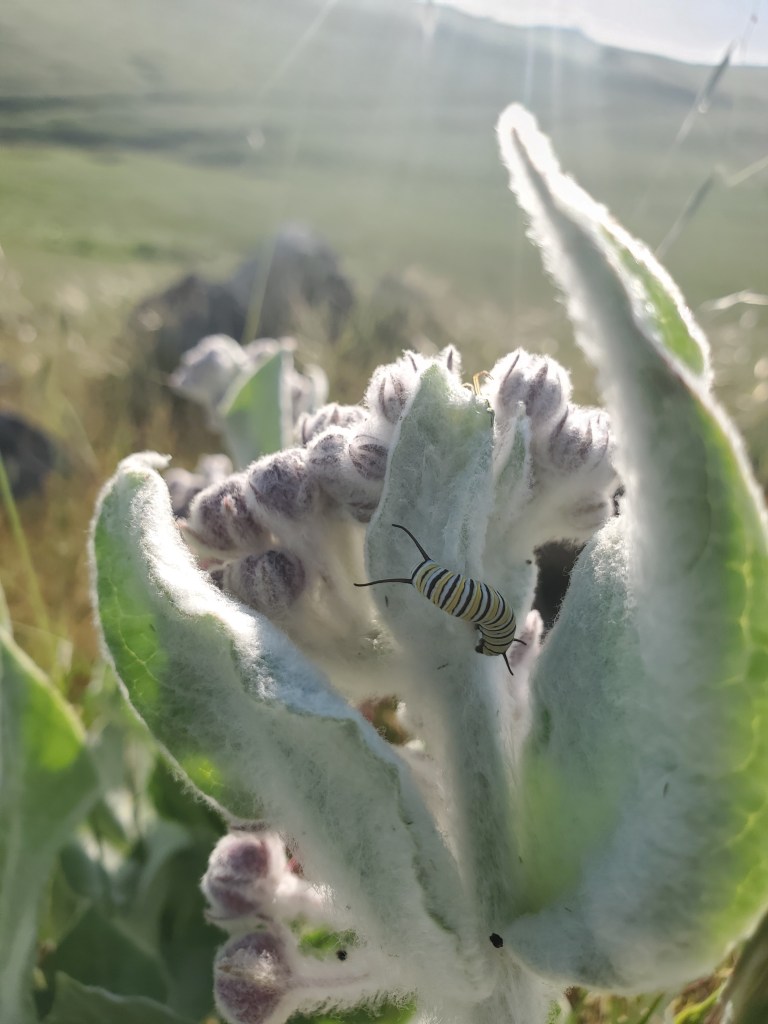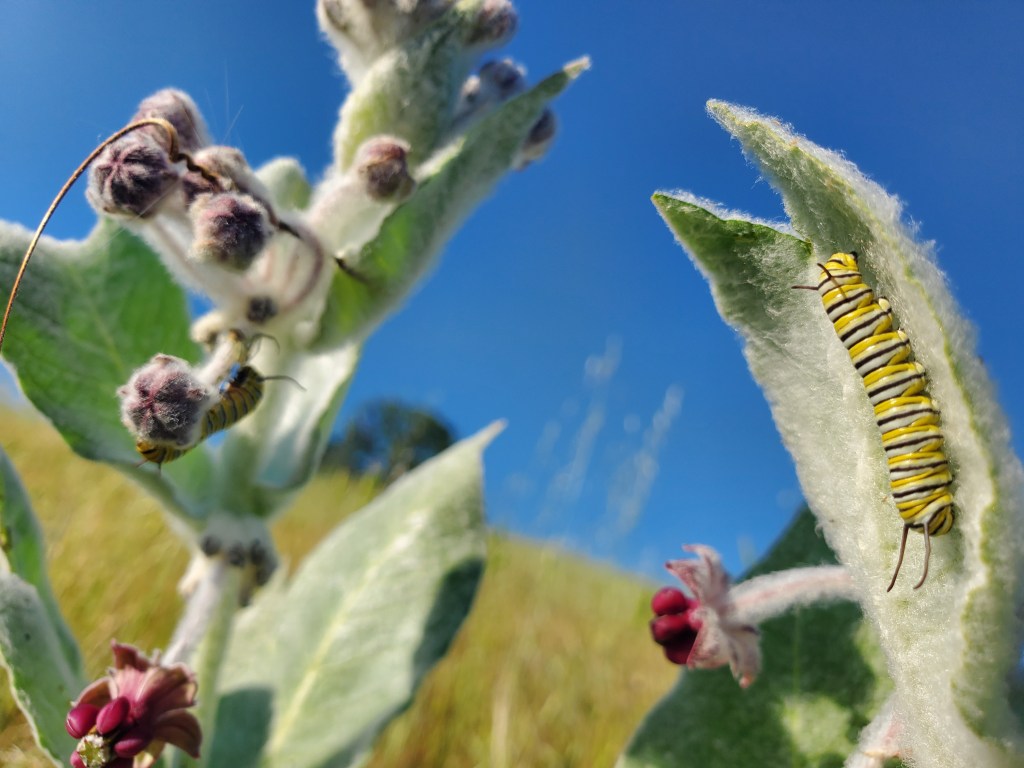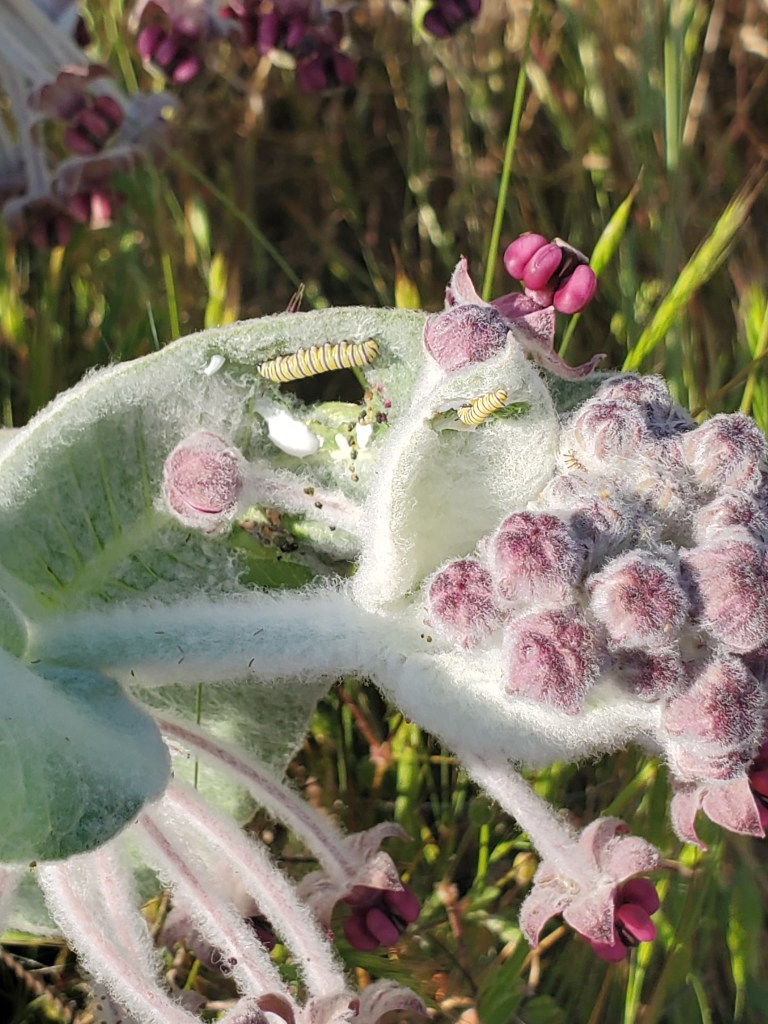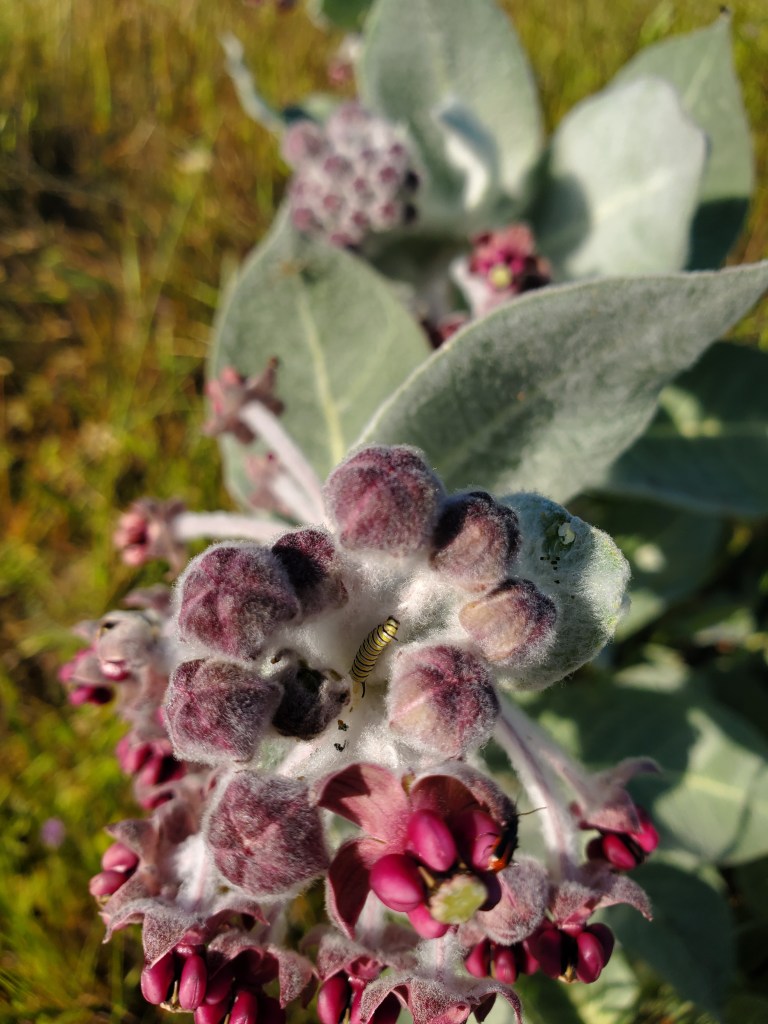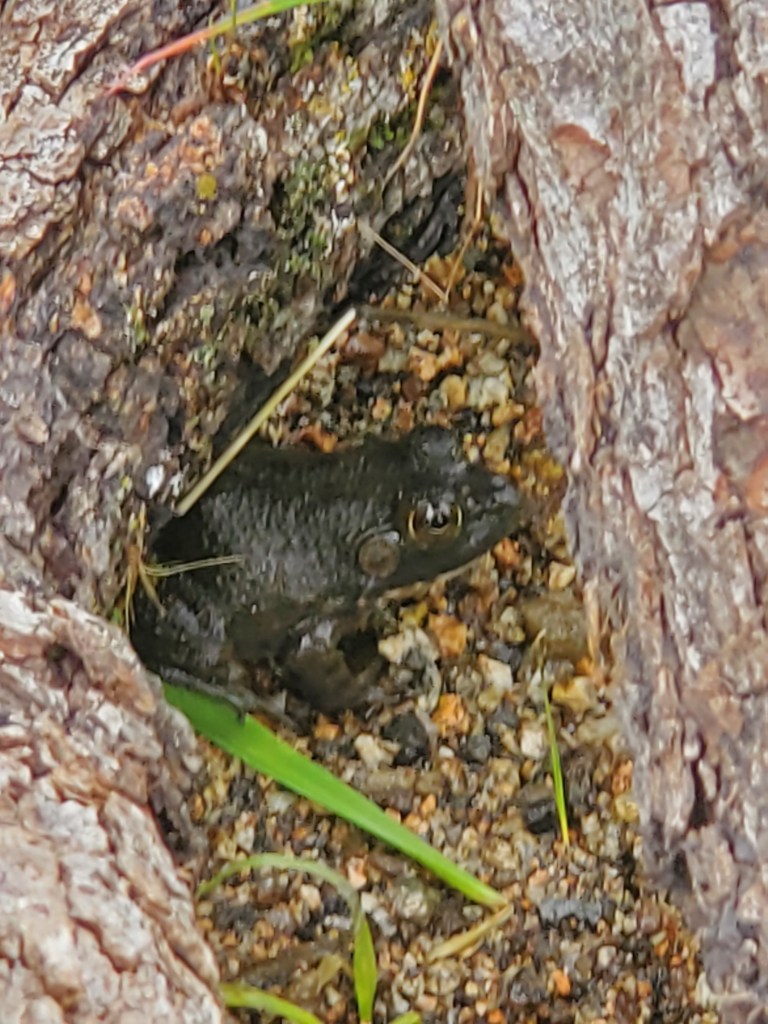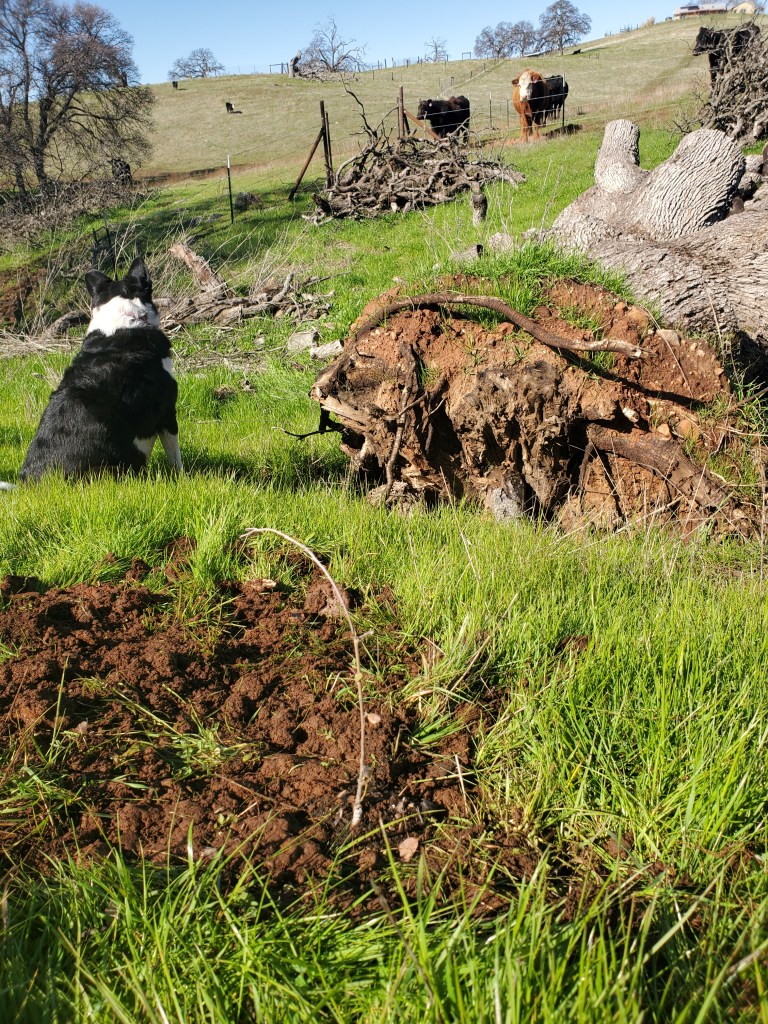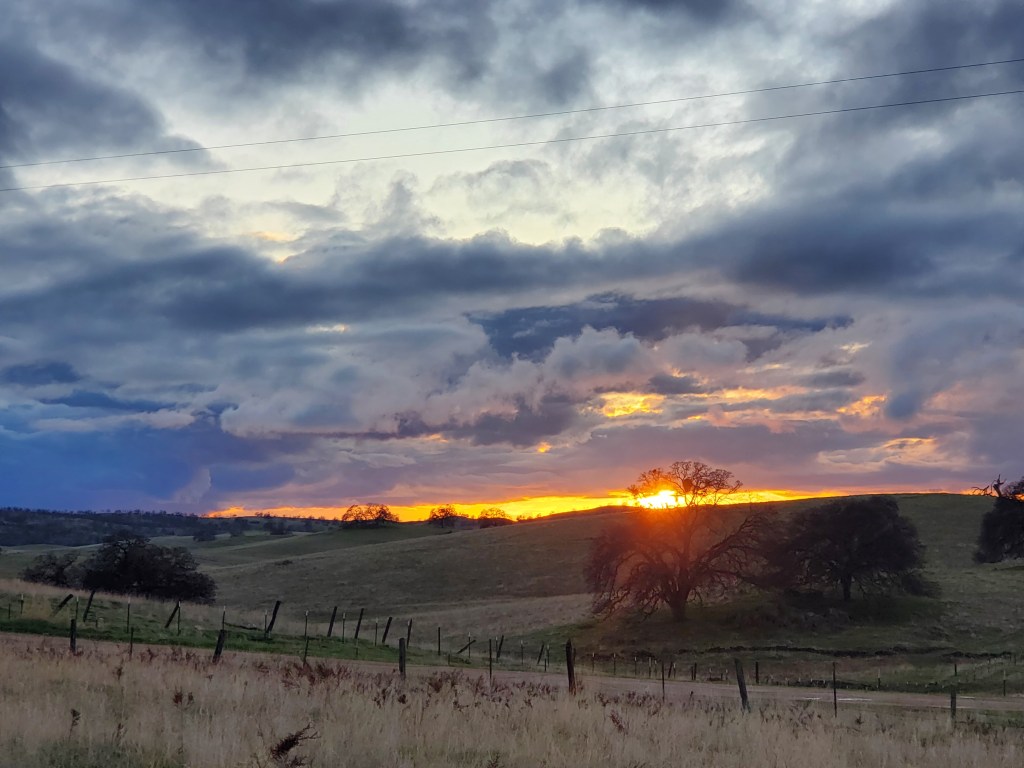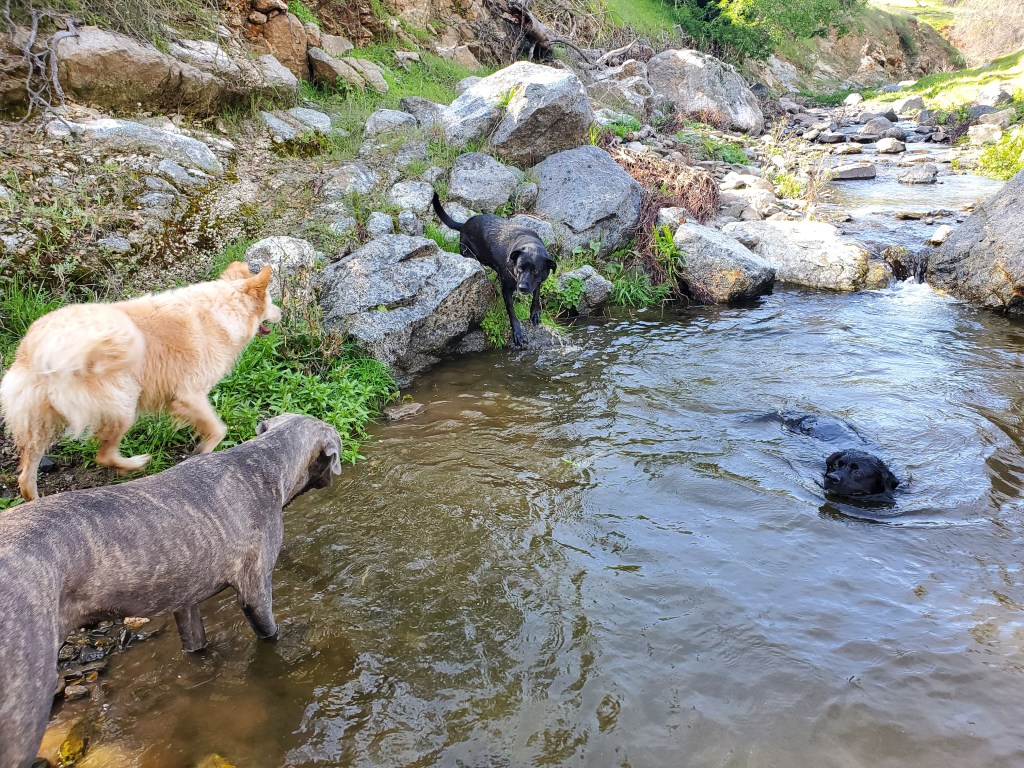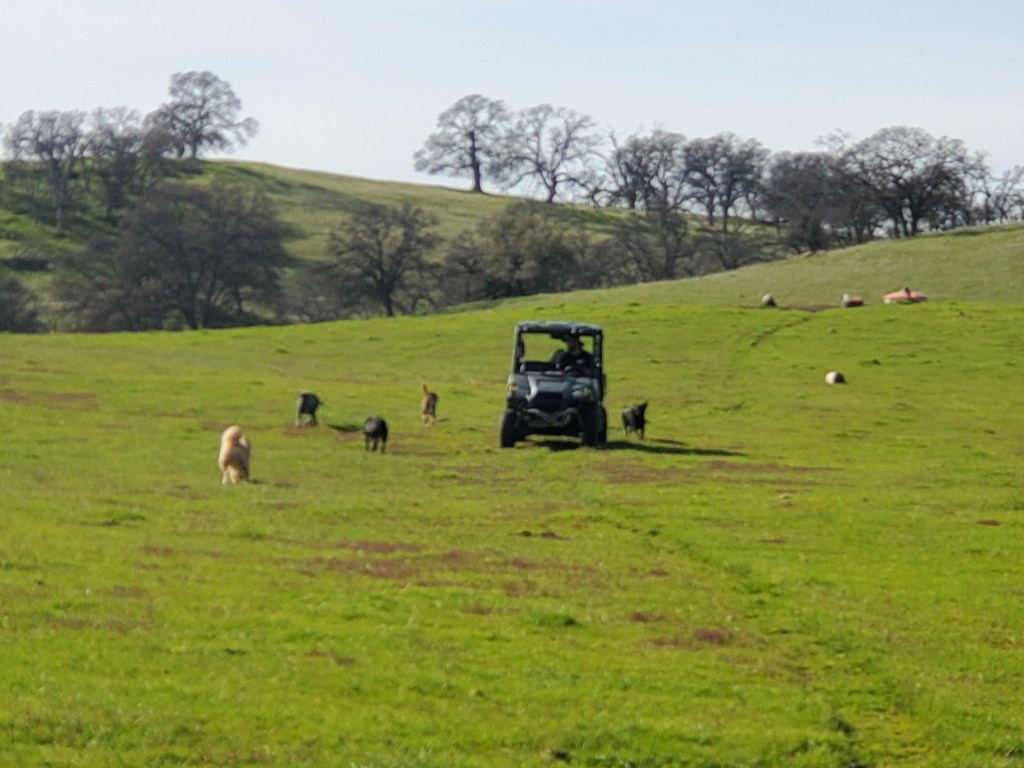
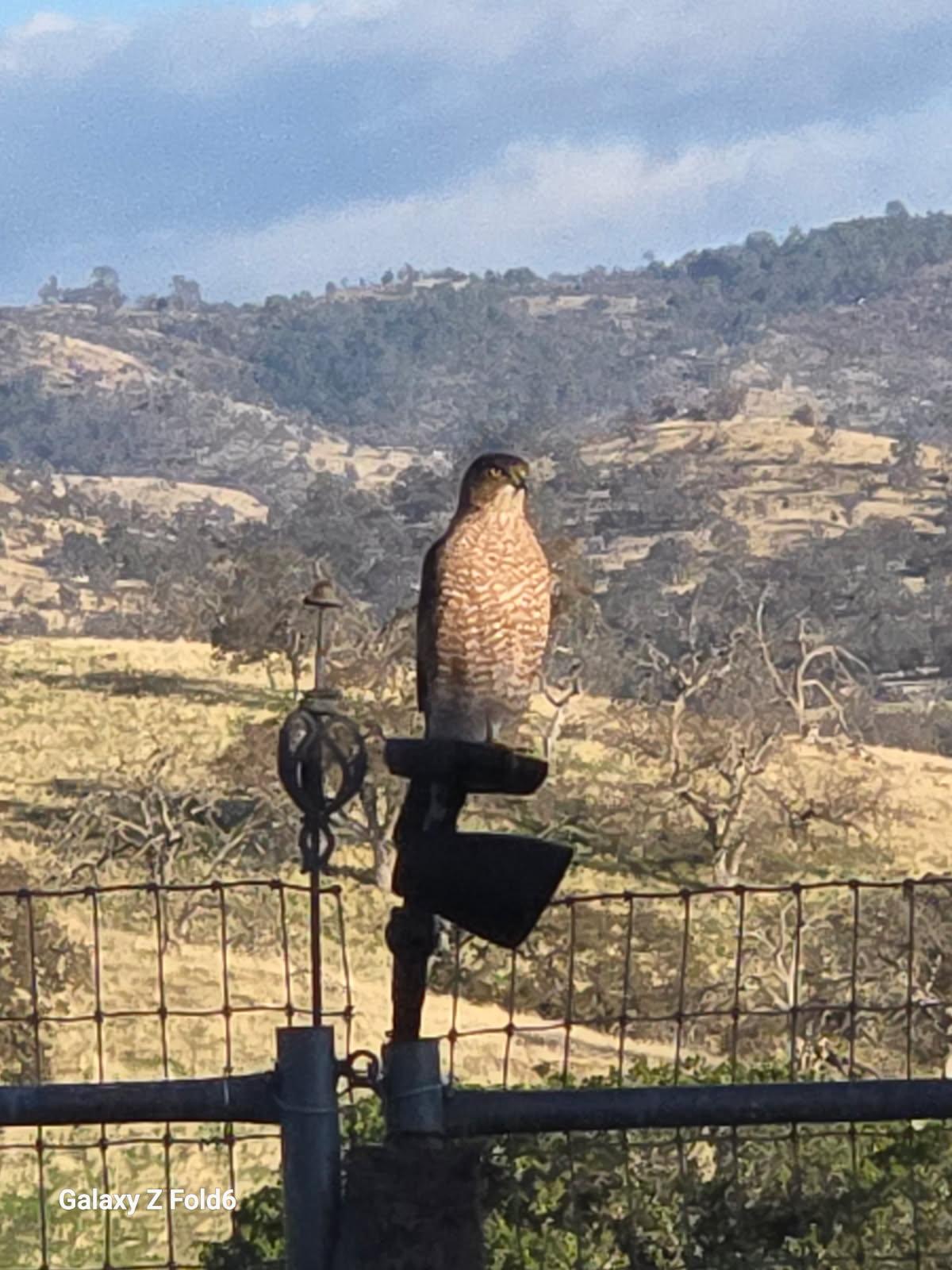
Milkweed Establishes in Creek After 5 Years | High Workload | Cow Break-Out

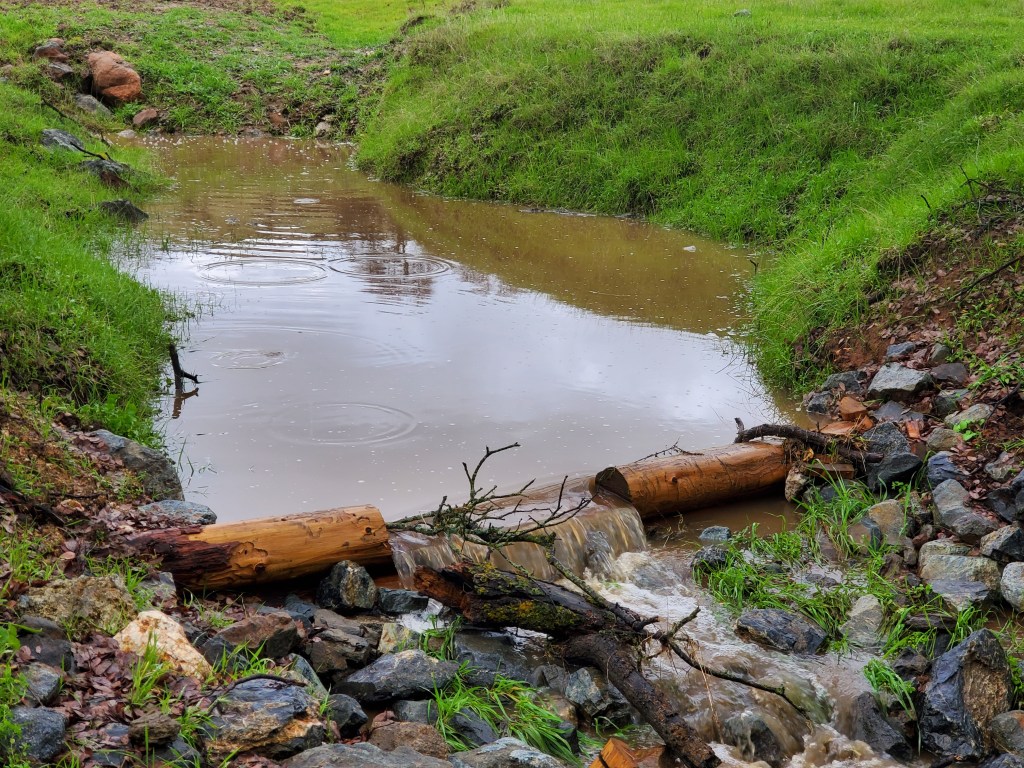
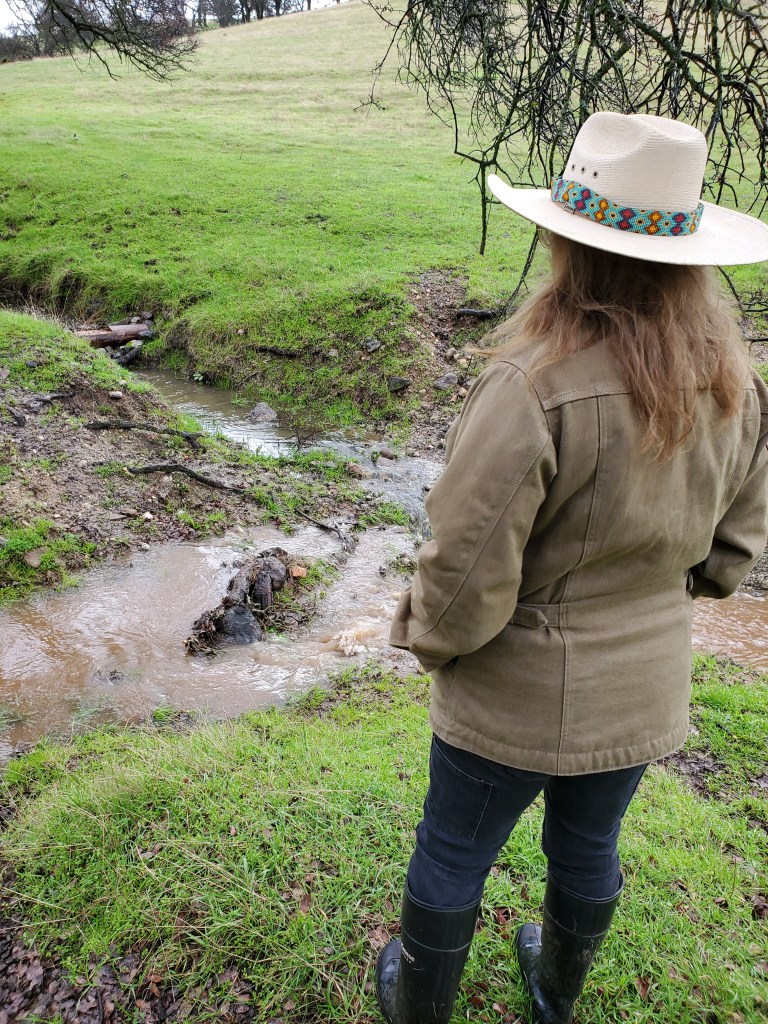
I planted my first milkweed plugs in the Spring Creek riparian exclusion zone in 2020. Since then, I’ve planted more plugs and seeded the heck out of the area. Every year, there is something more I do to make that riparian space a monarch, and other pollinators, paradise. Flood waters, epic flows likely upending seeds and plants, wild pigs, grasshoppers, and extreme heat have all thwarted the success of the plantings.

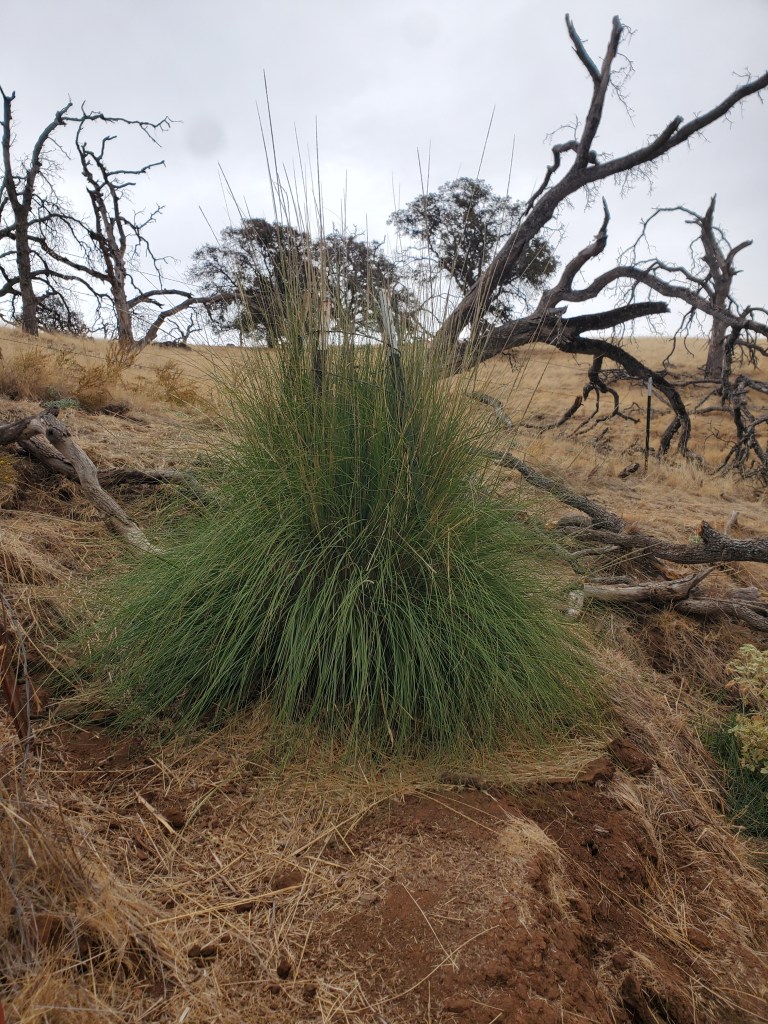
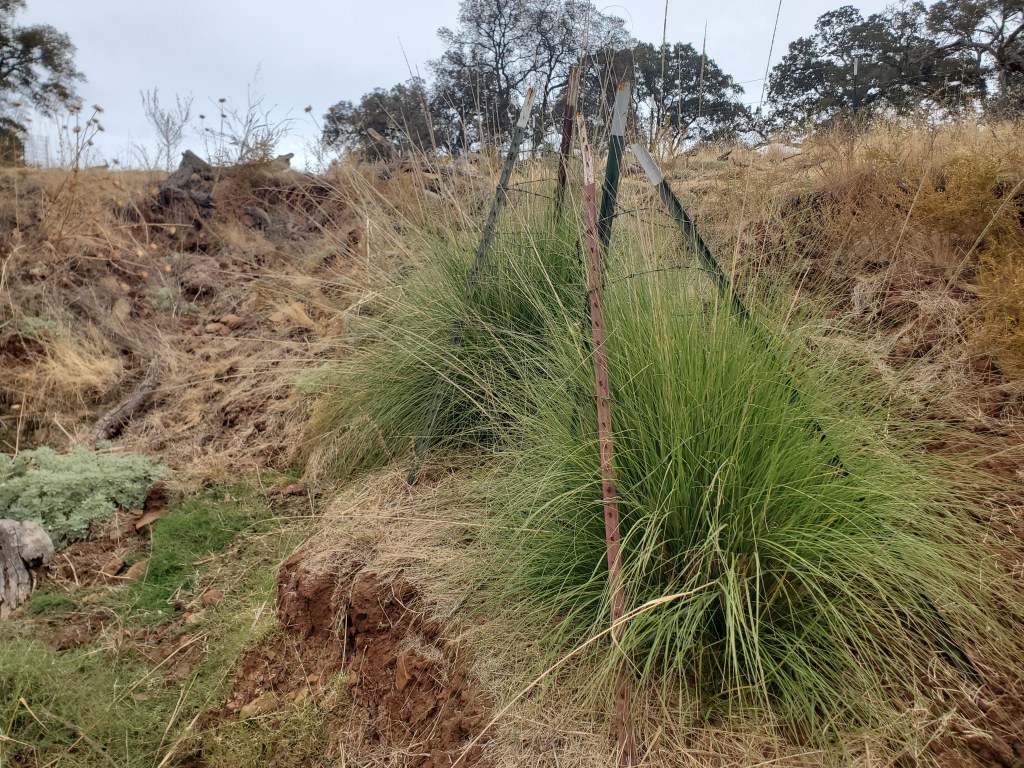
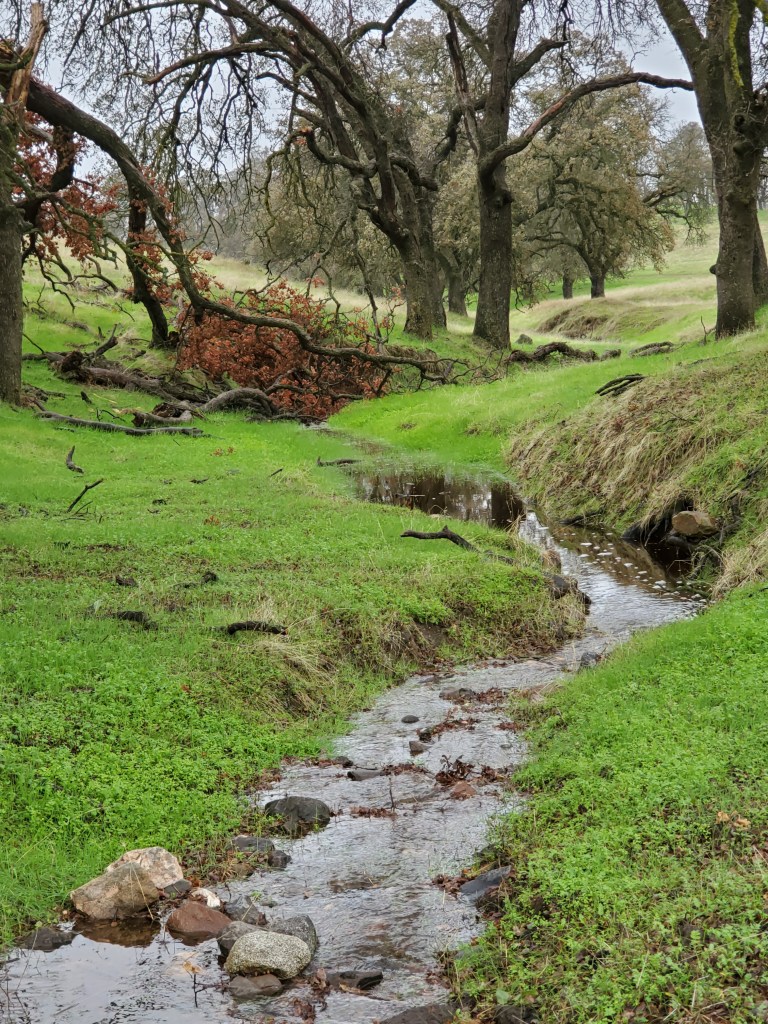
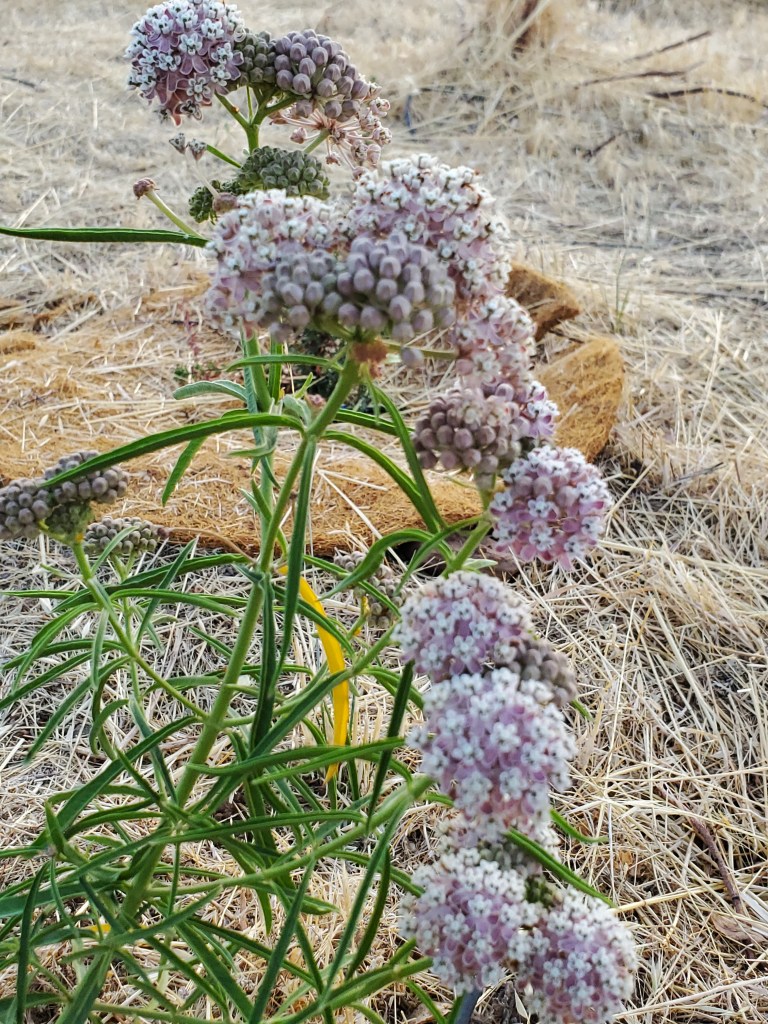
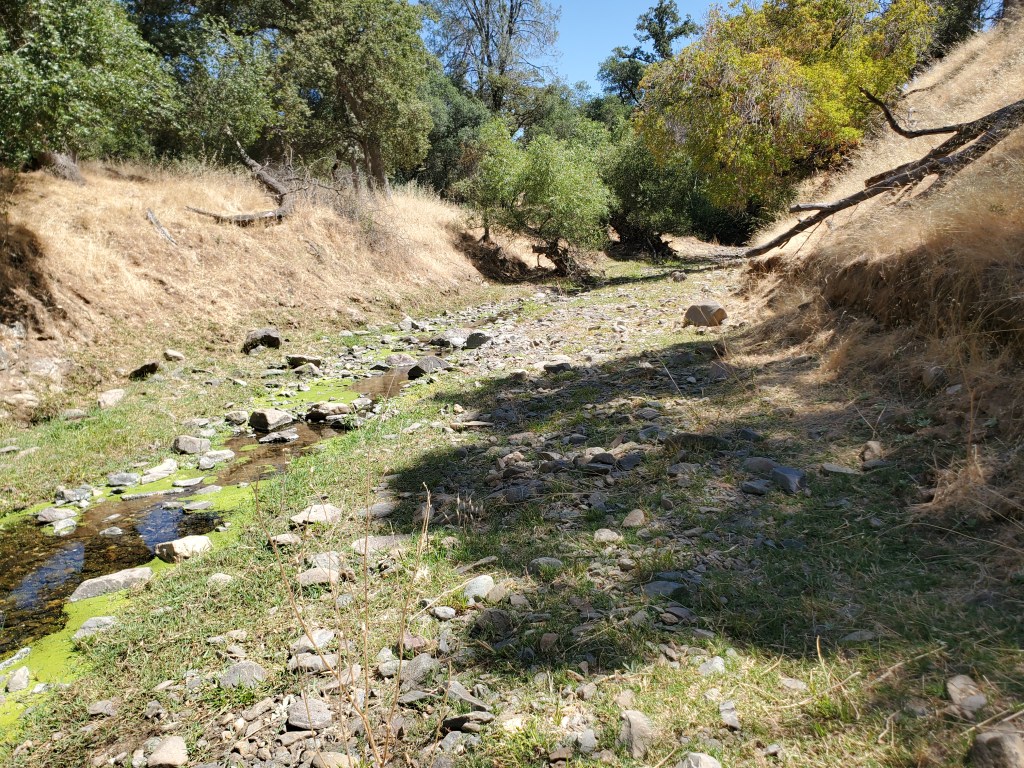
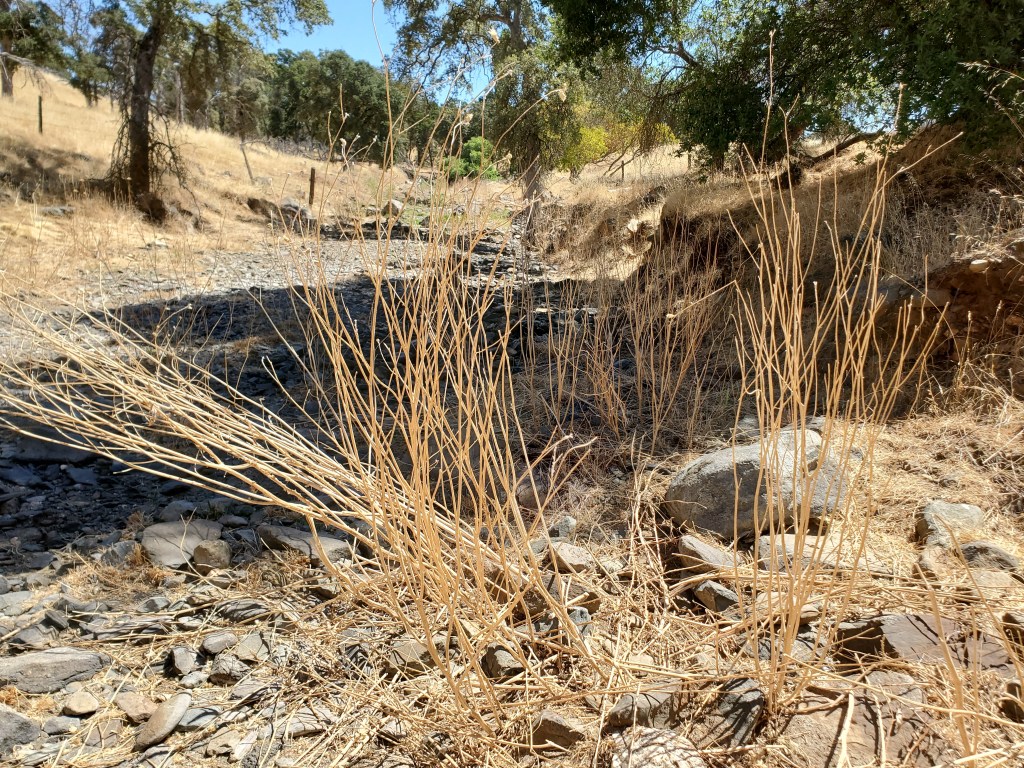
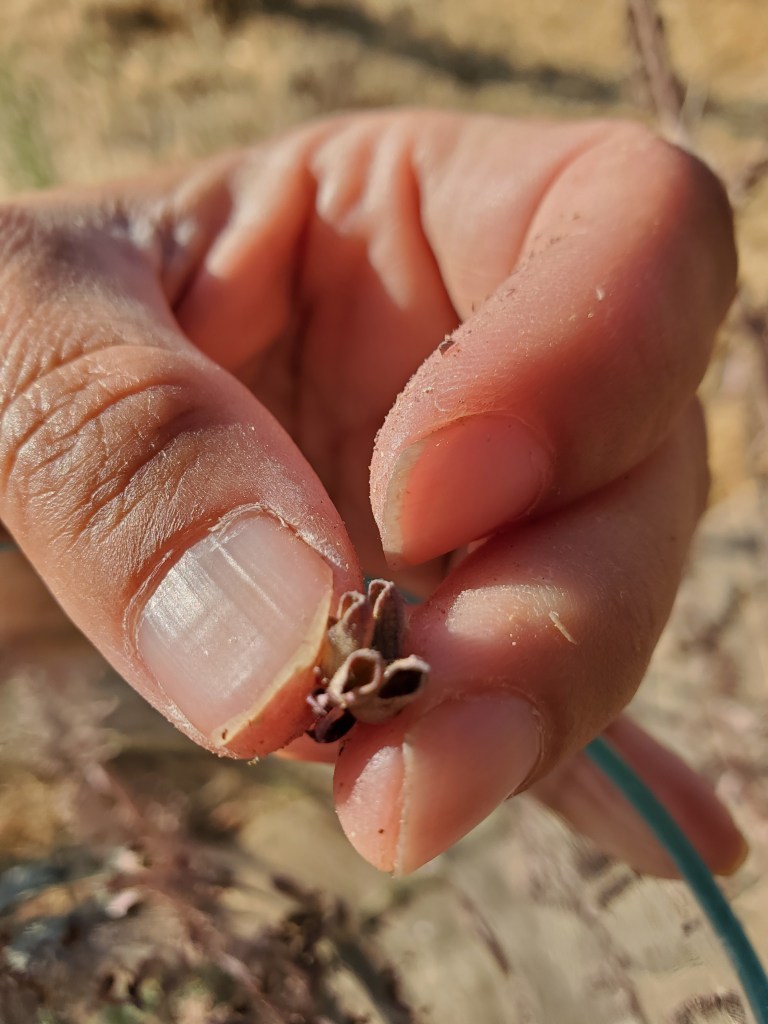
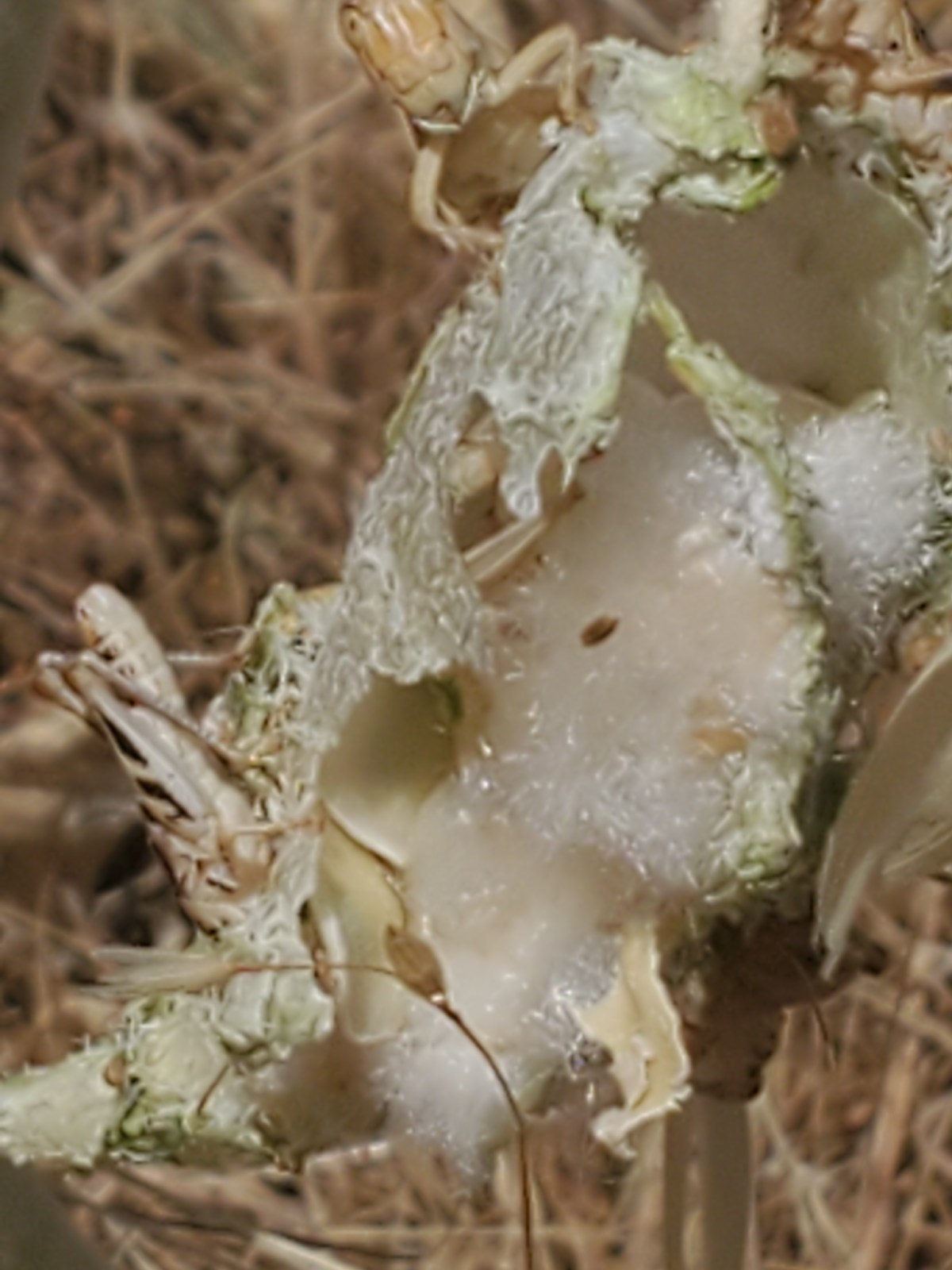
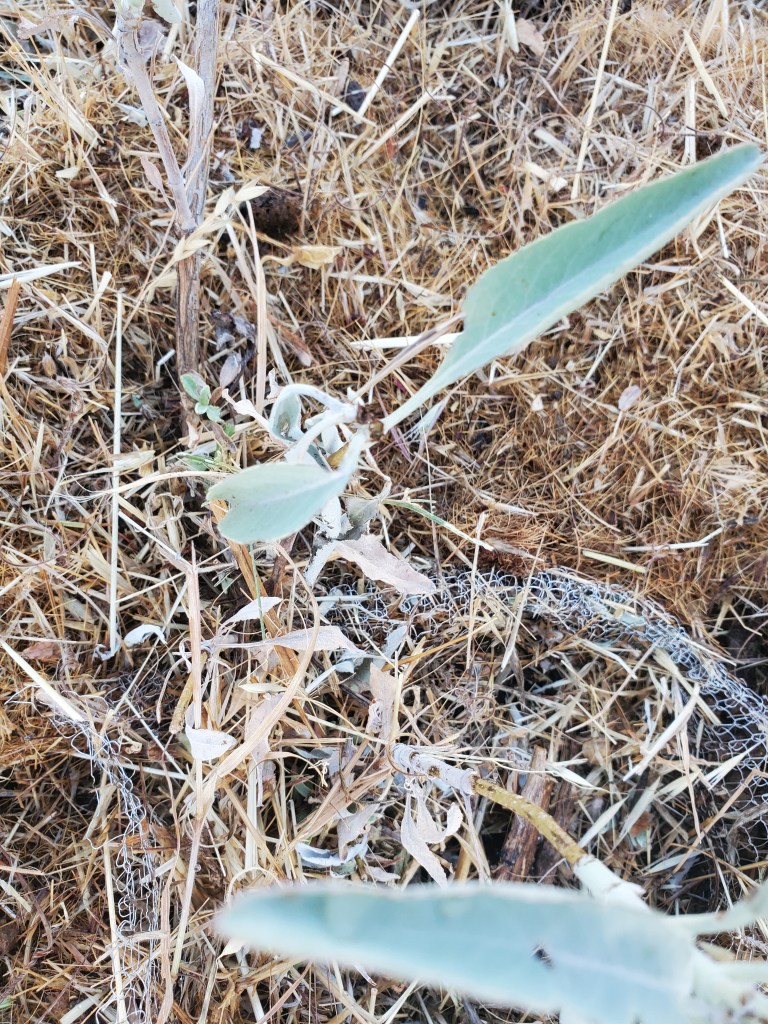
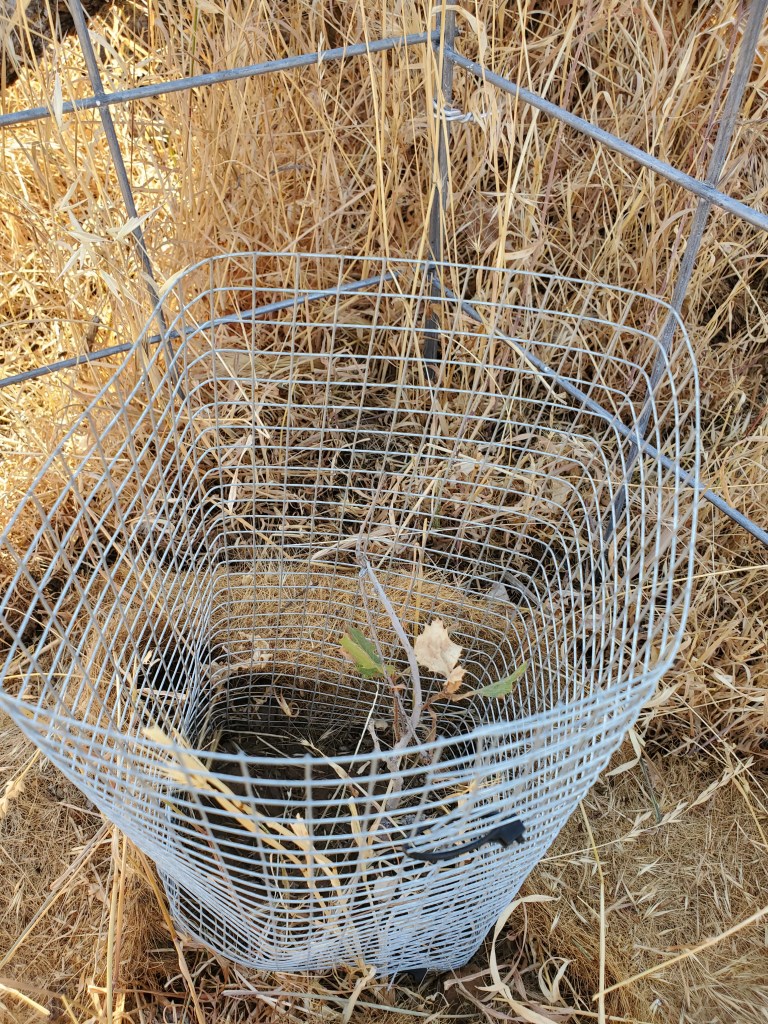
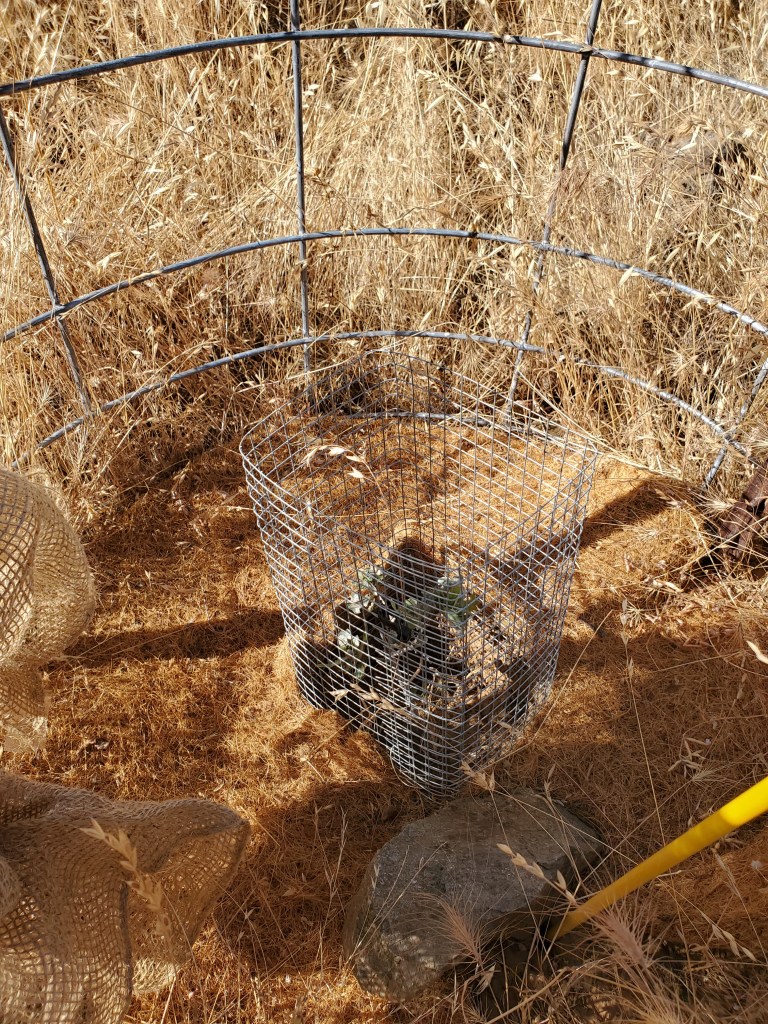
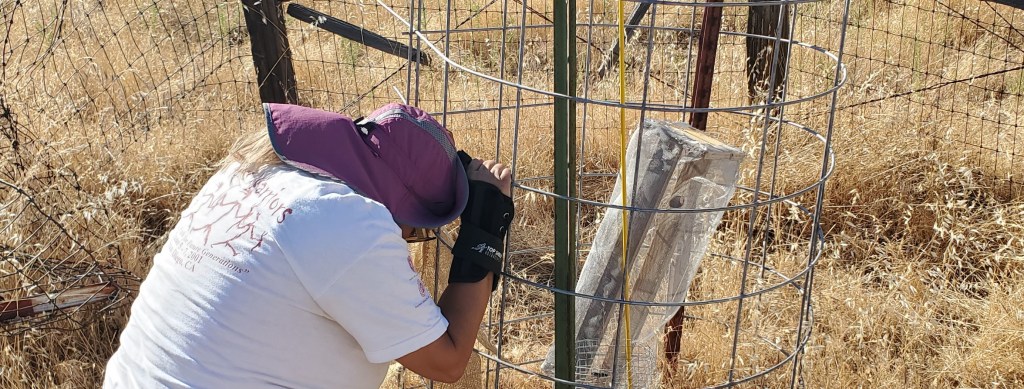
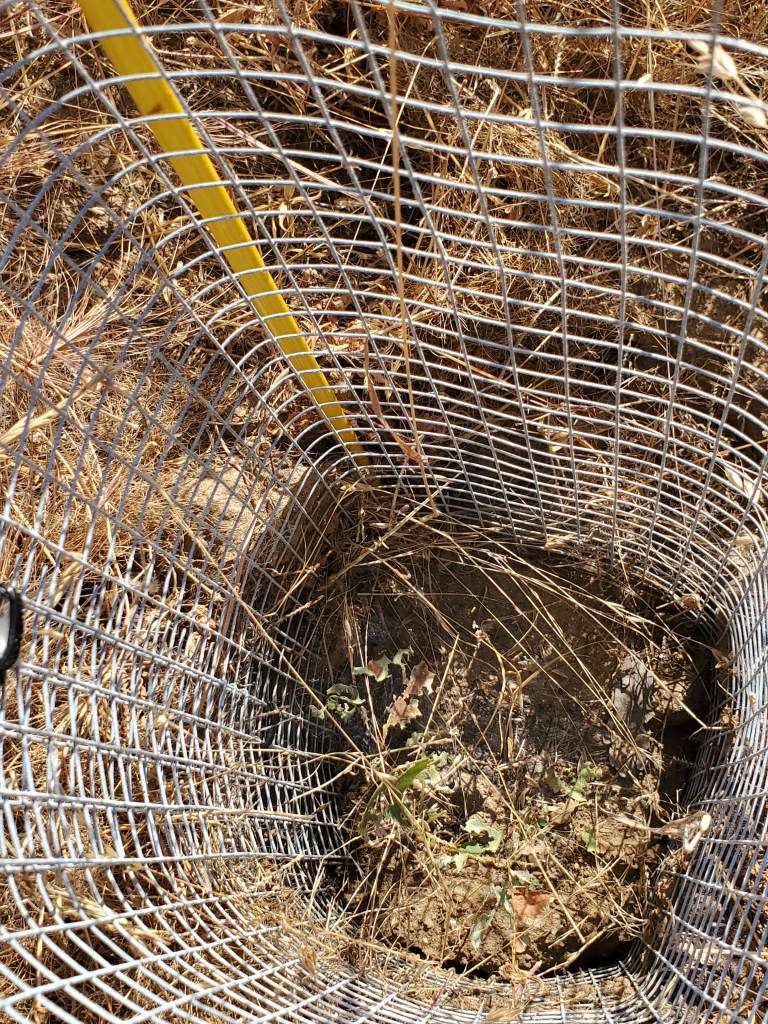
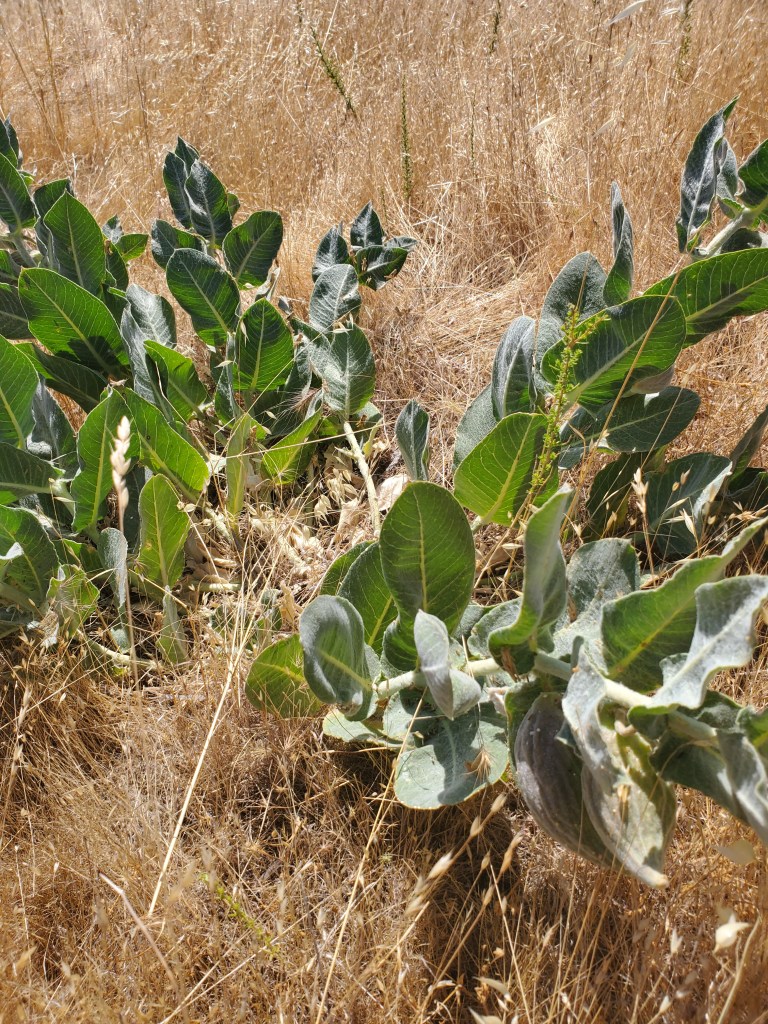
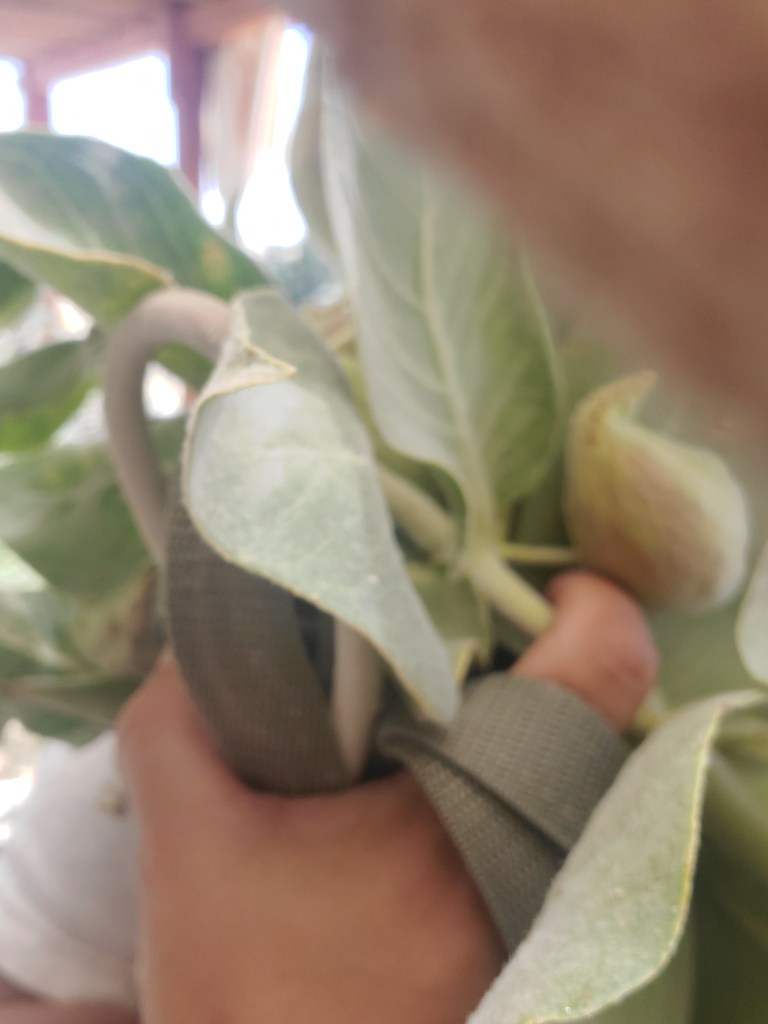
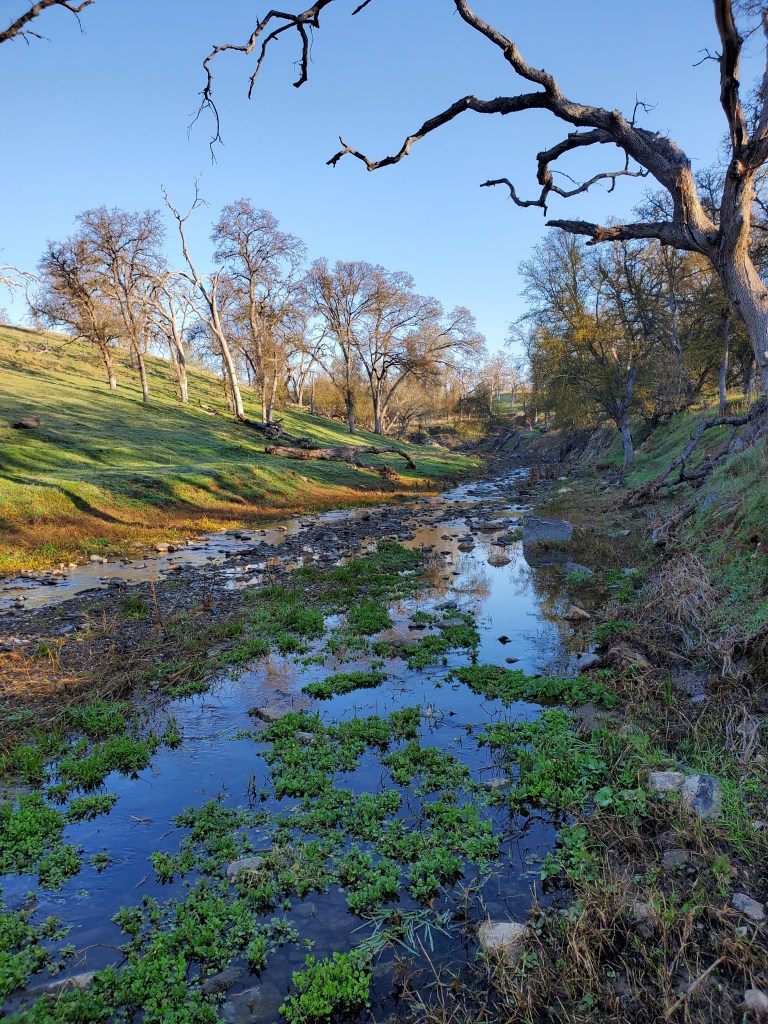
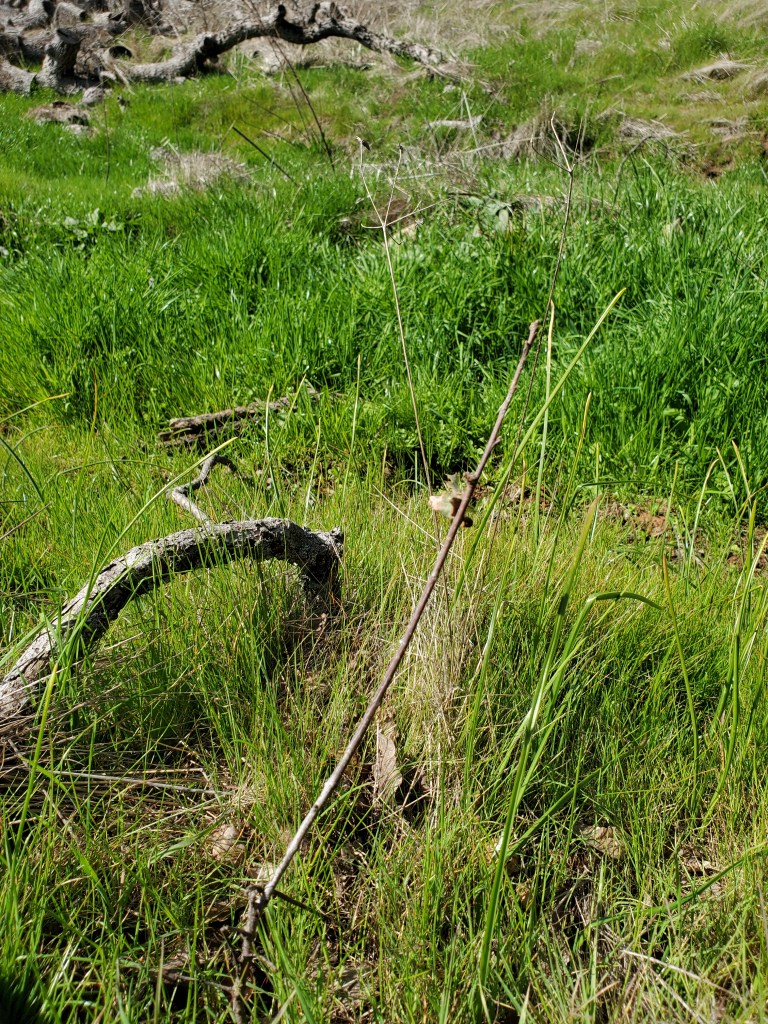
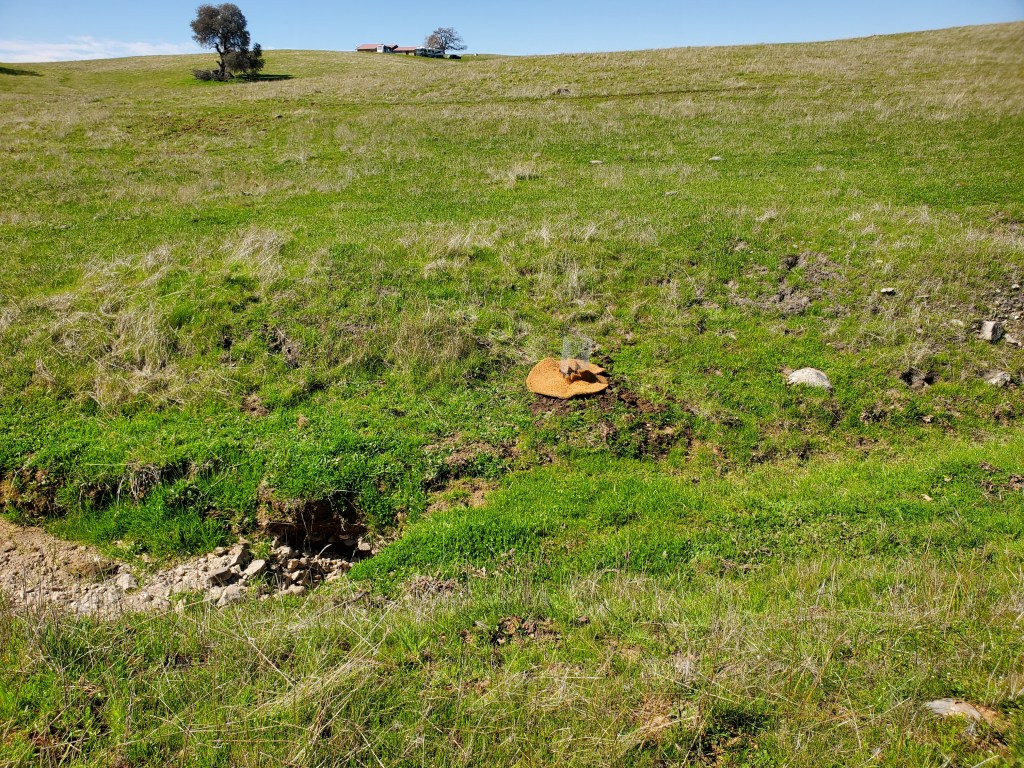
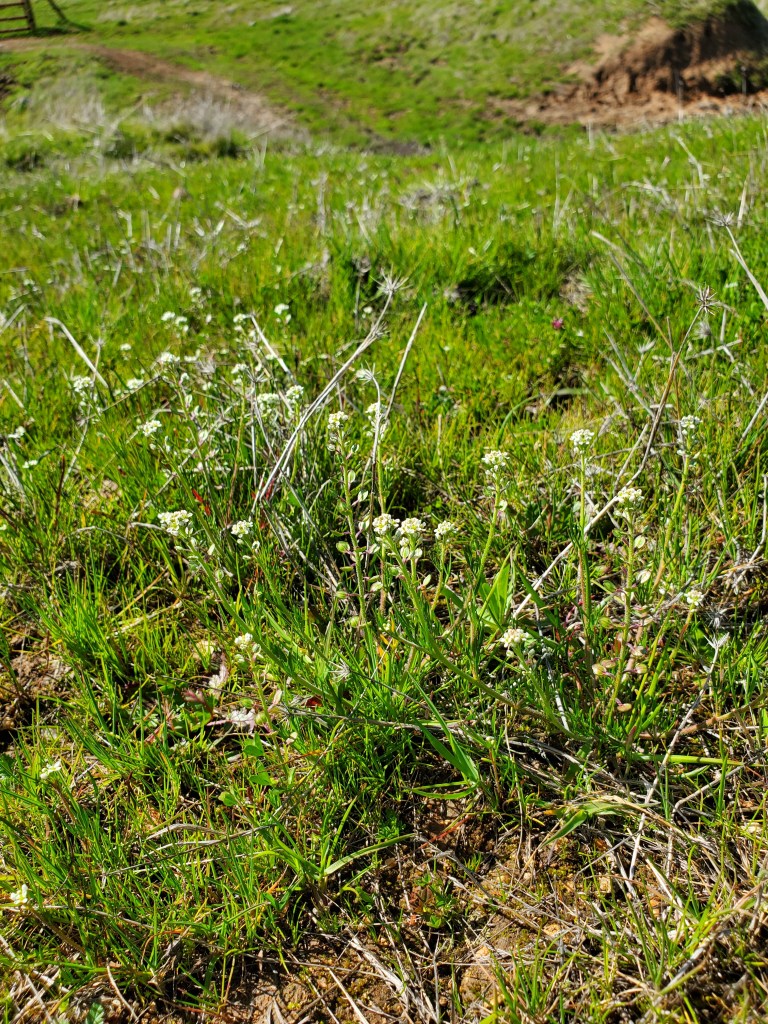
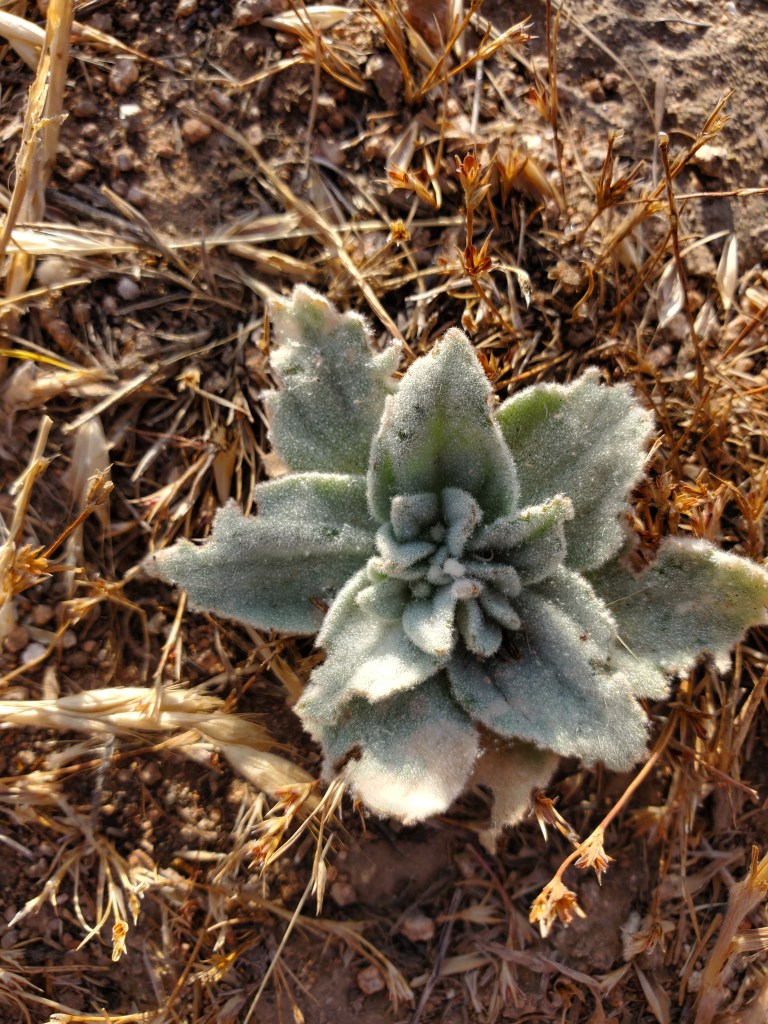
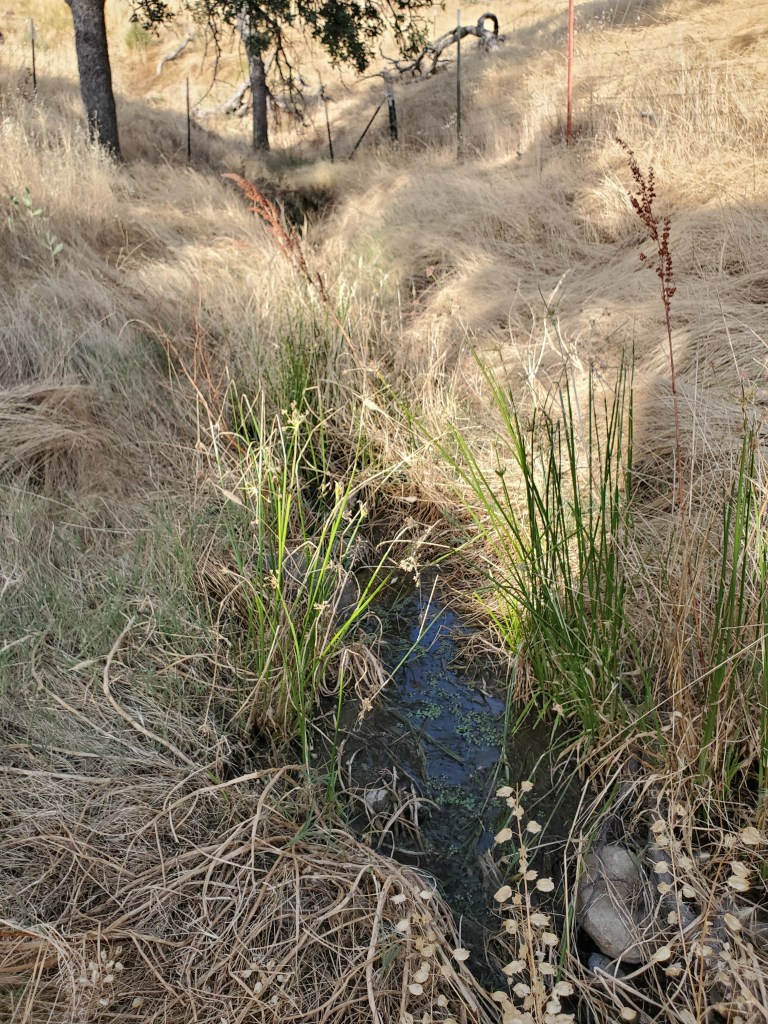
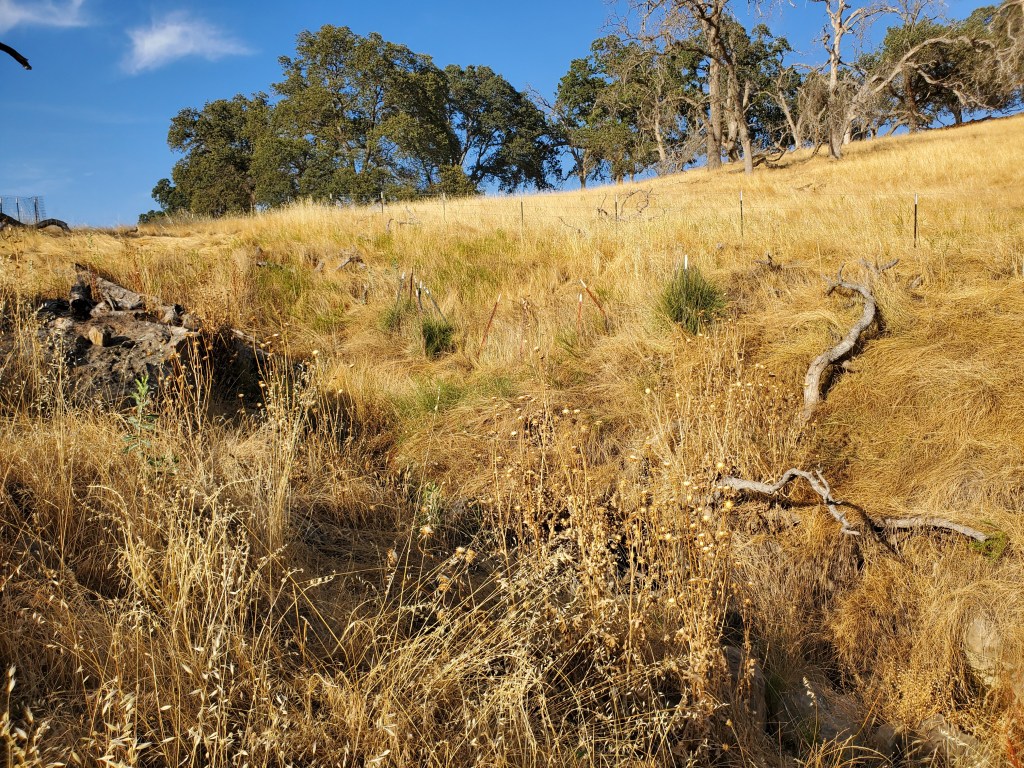
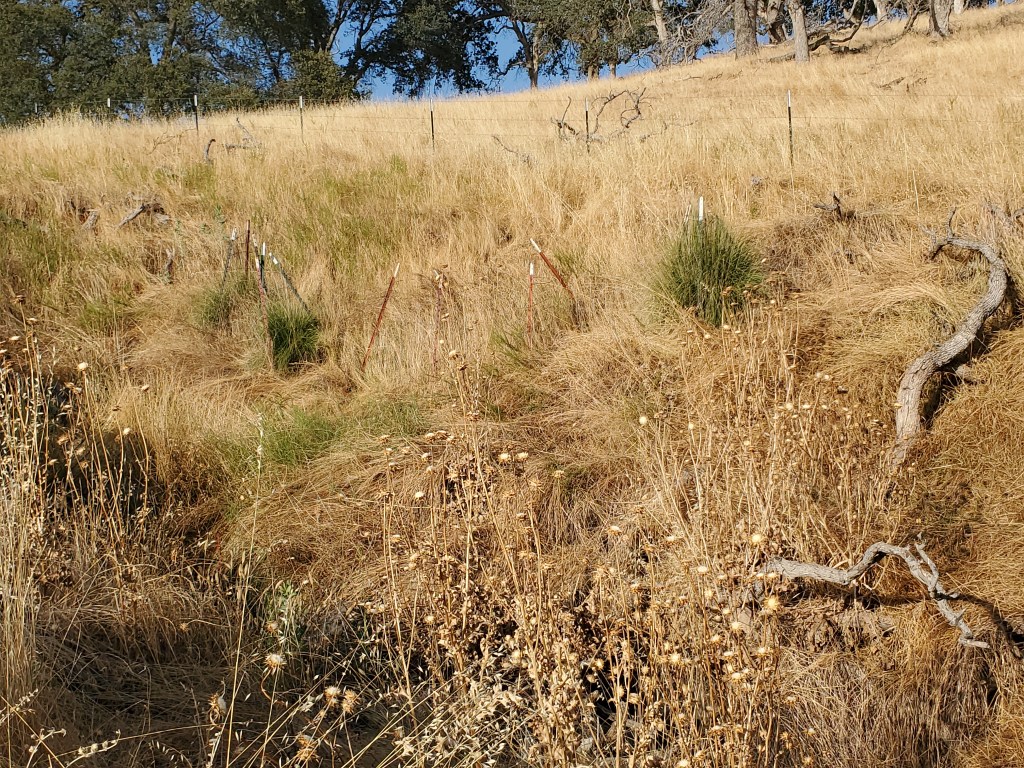
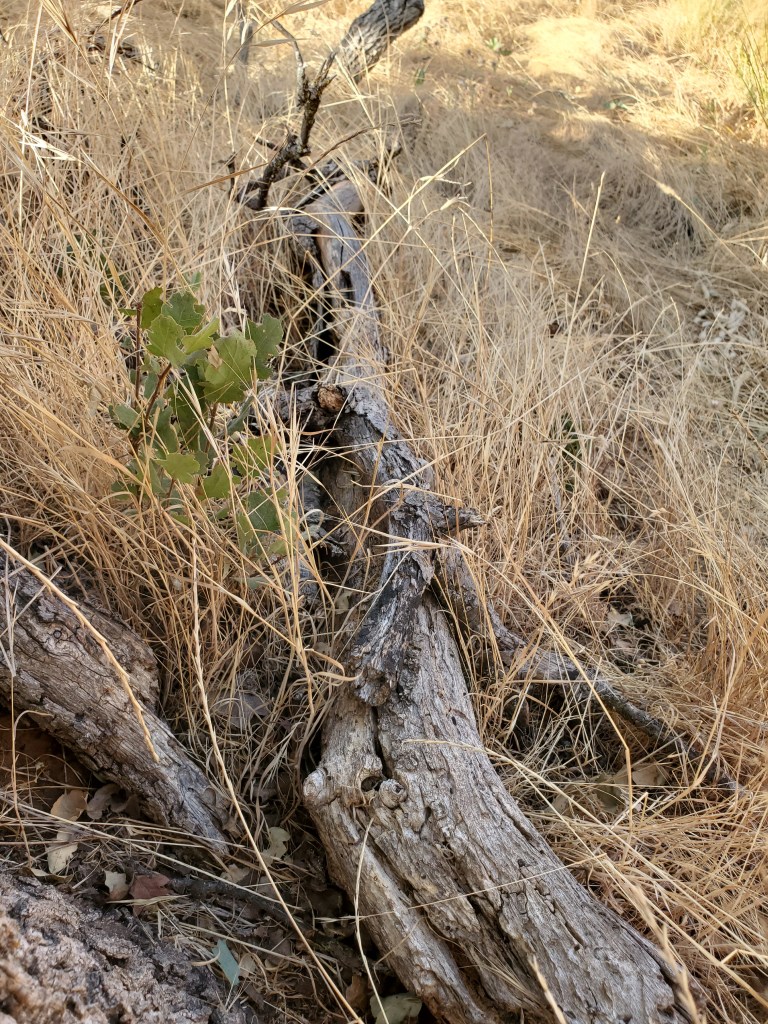
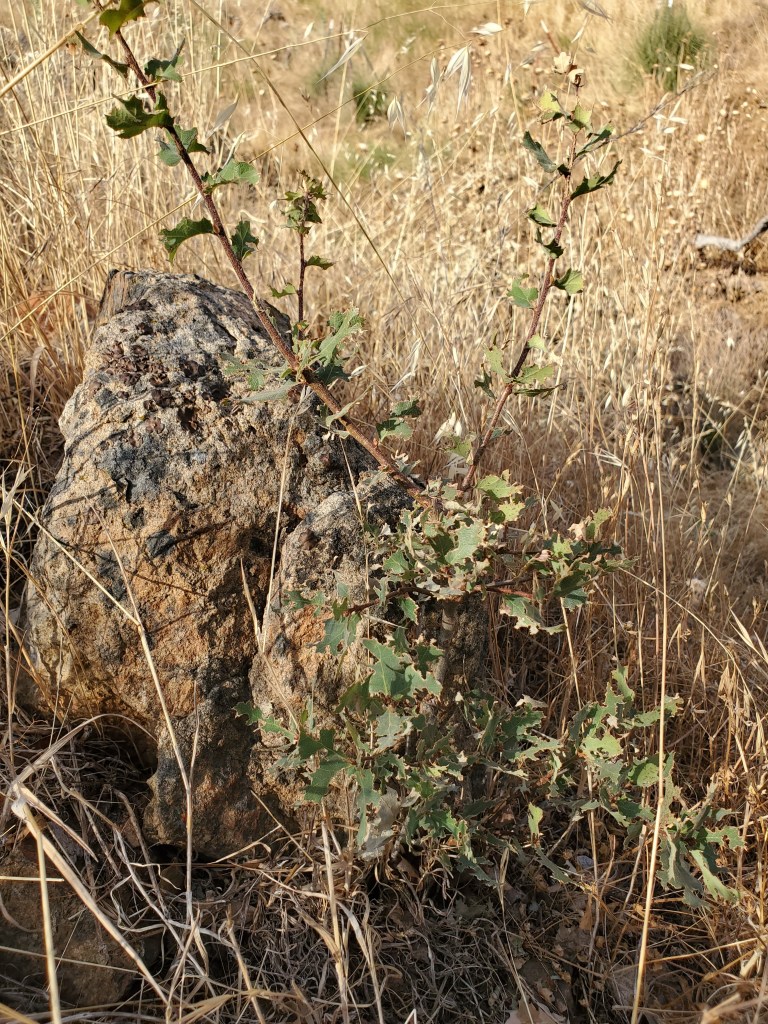
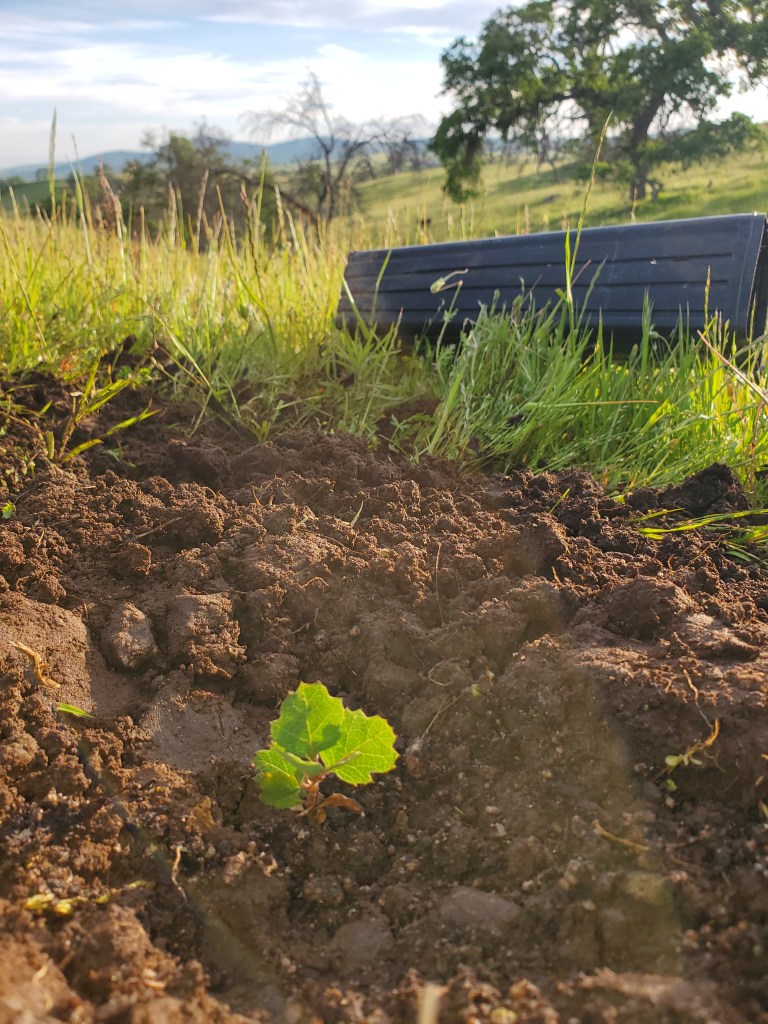
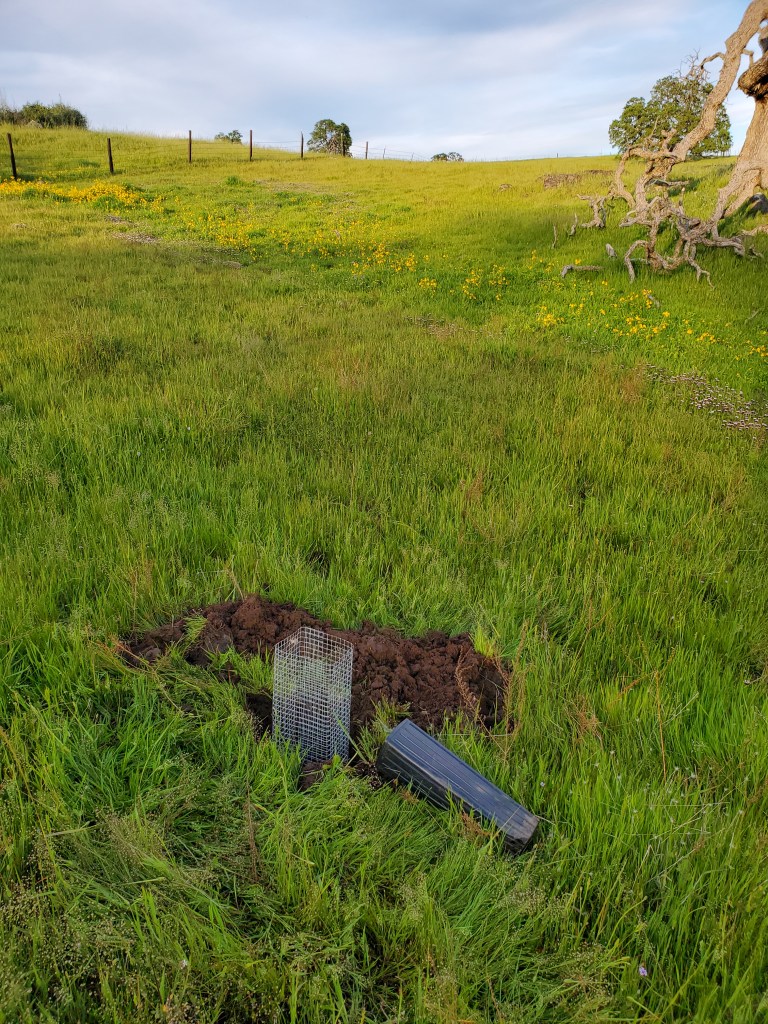
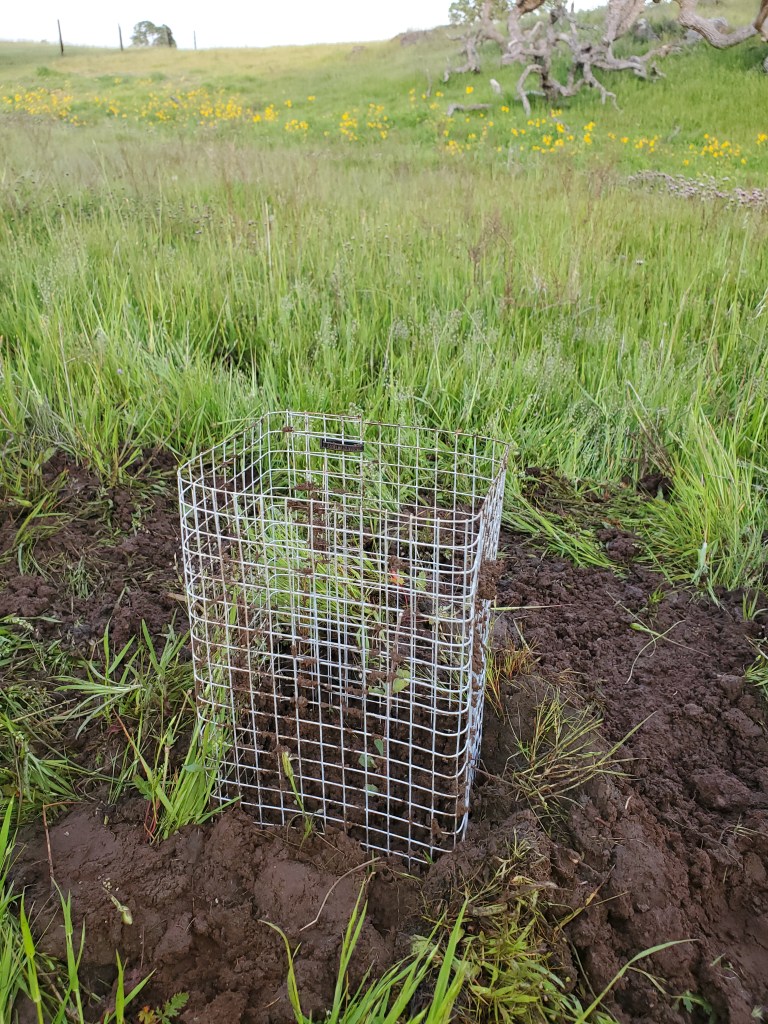
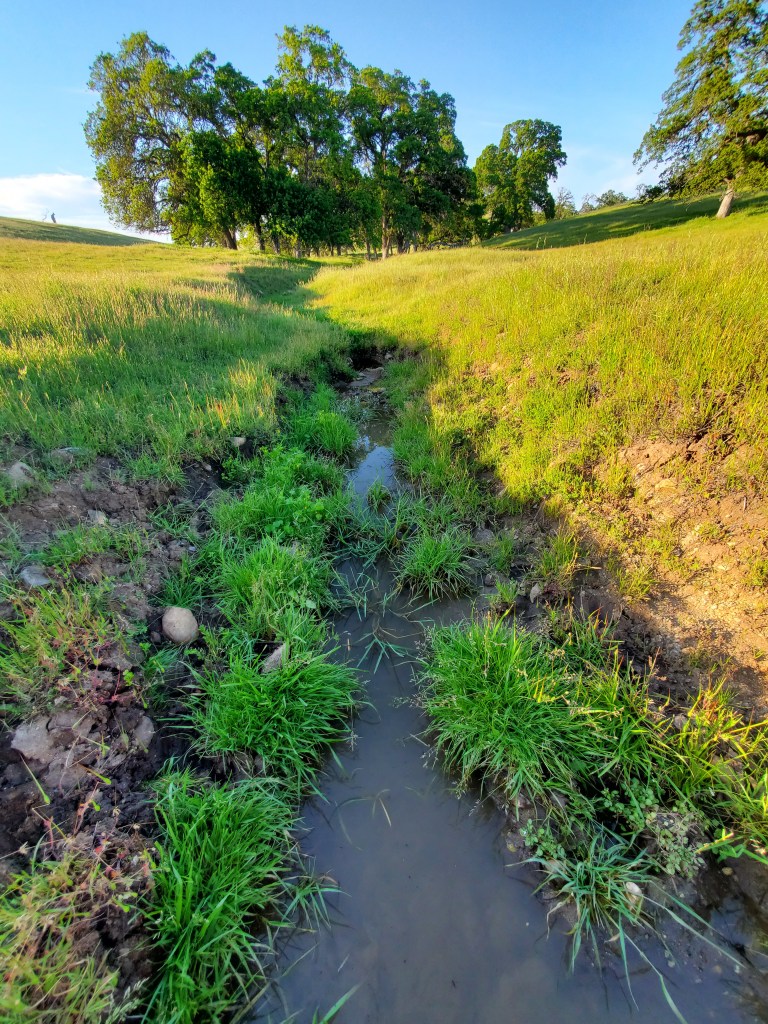
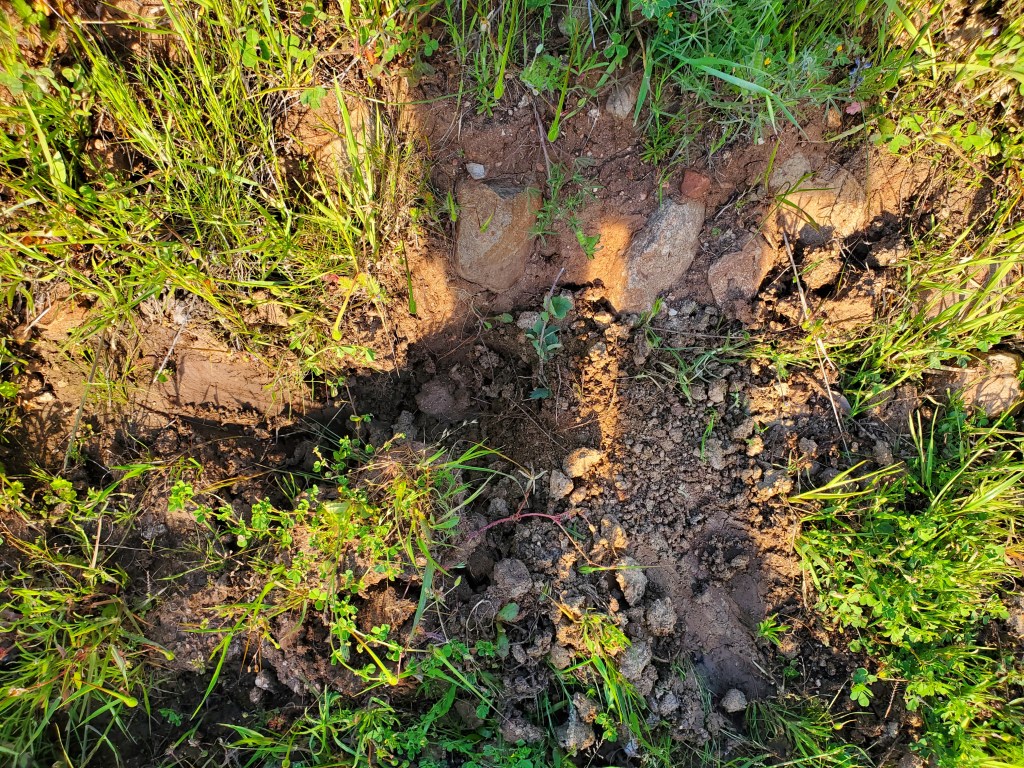
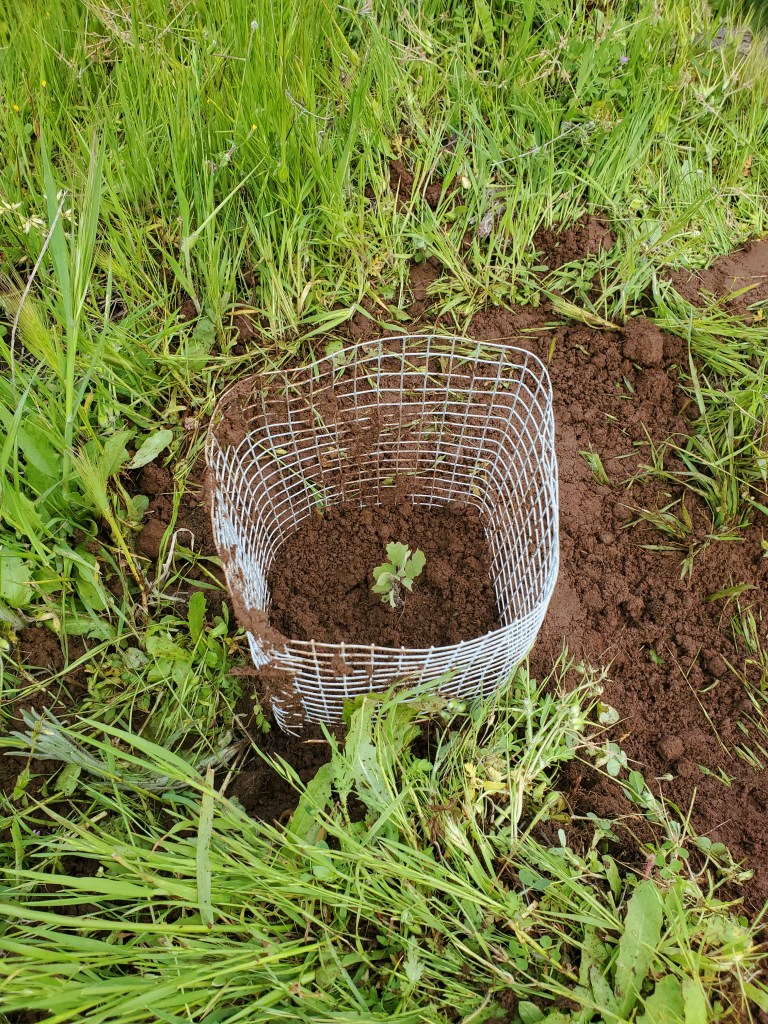
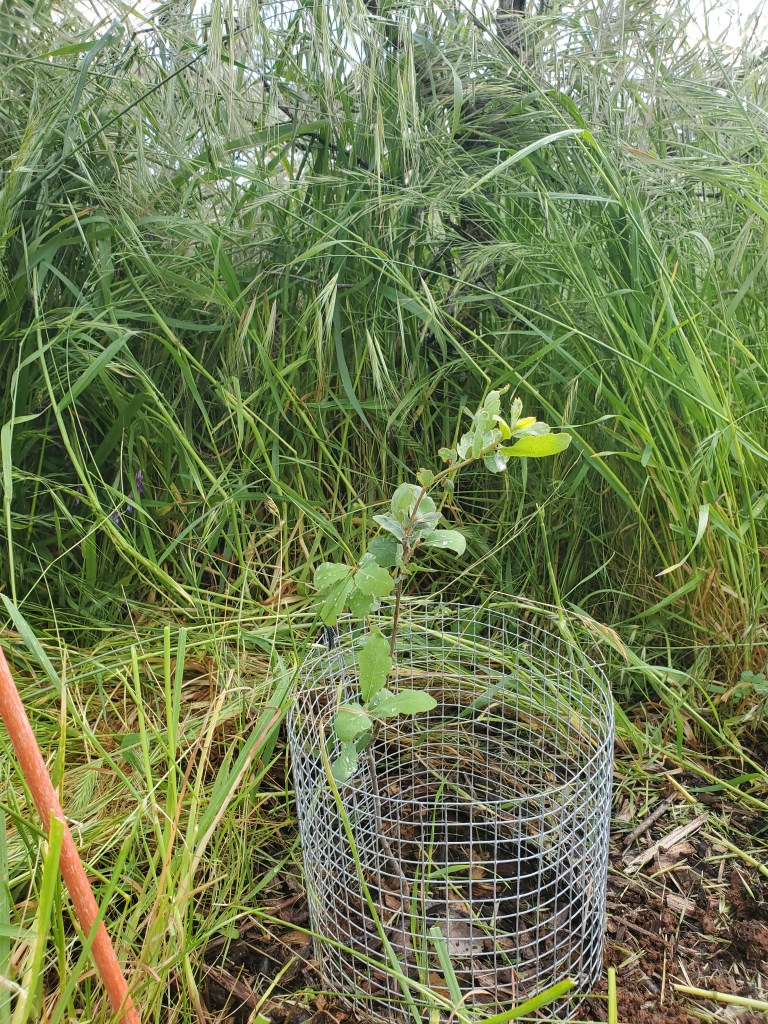
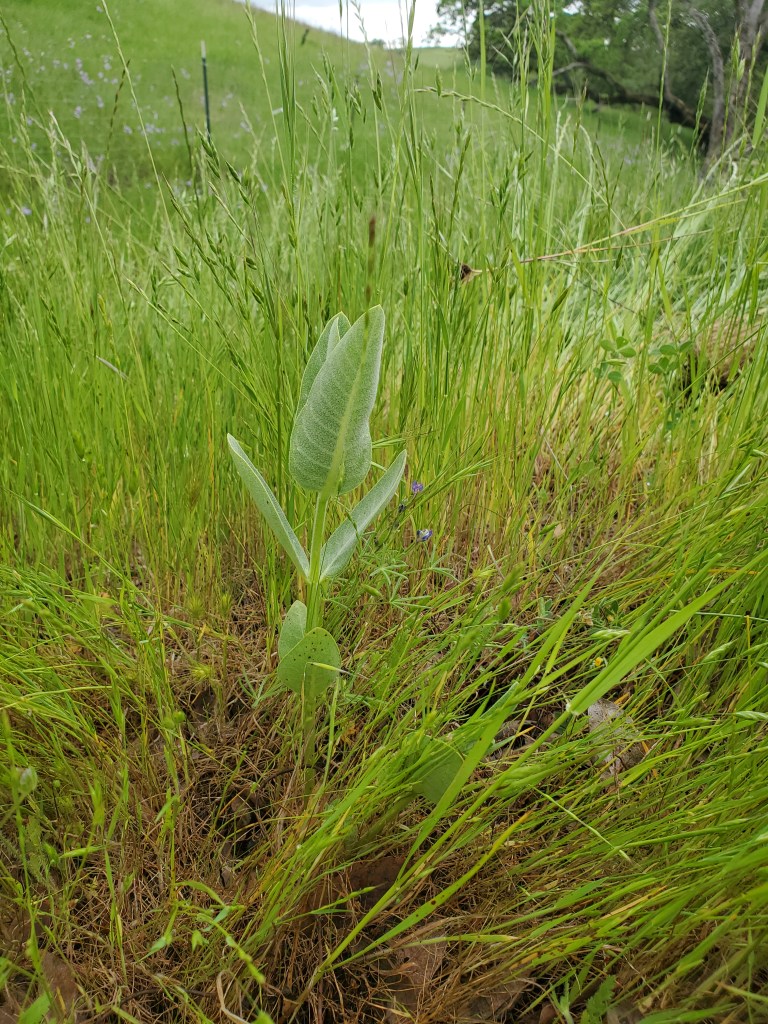
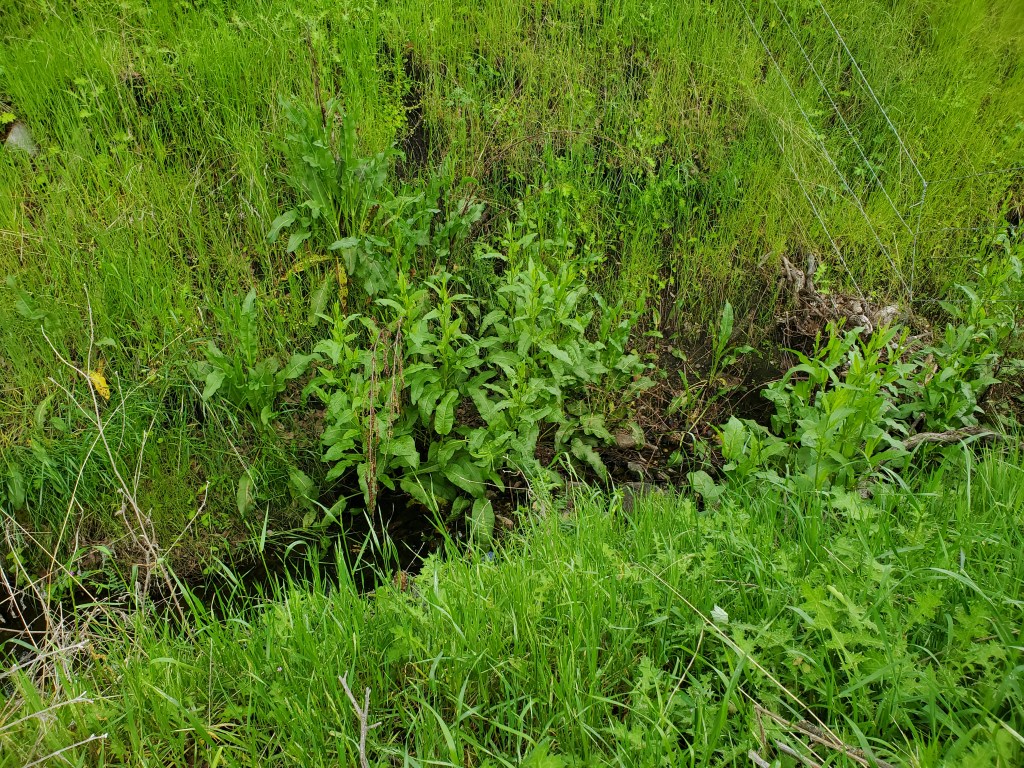
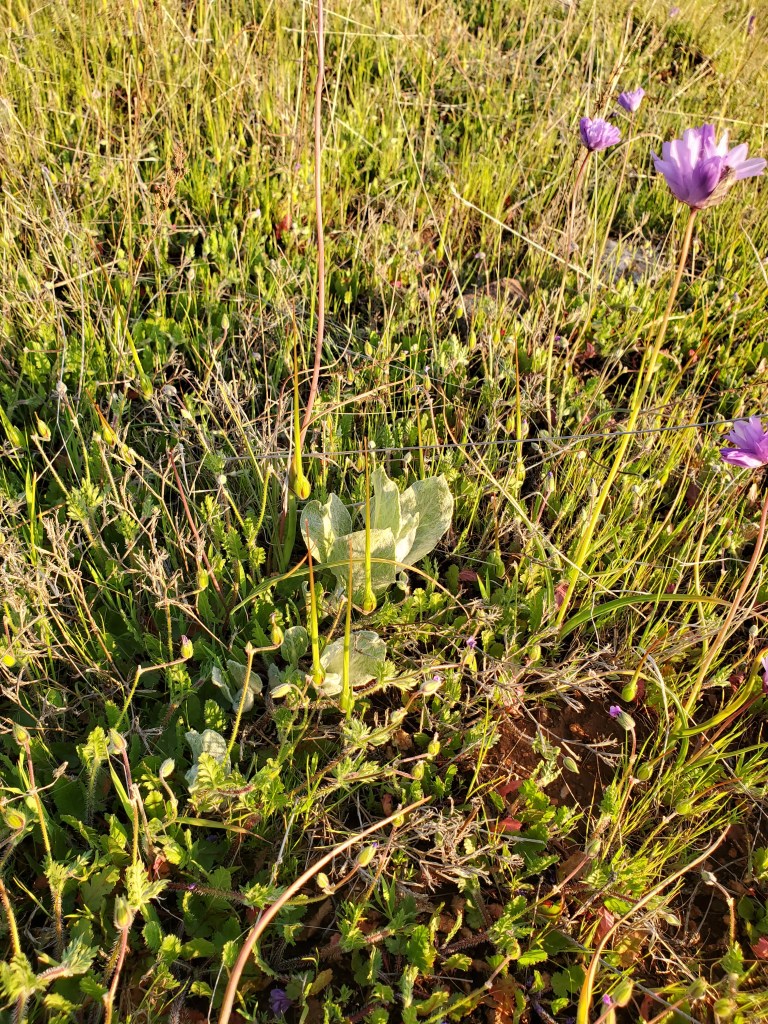
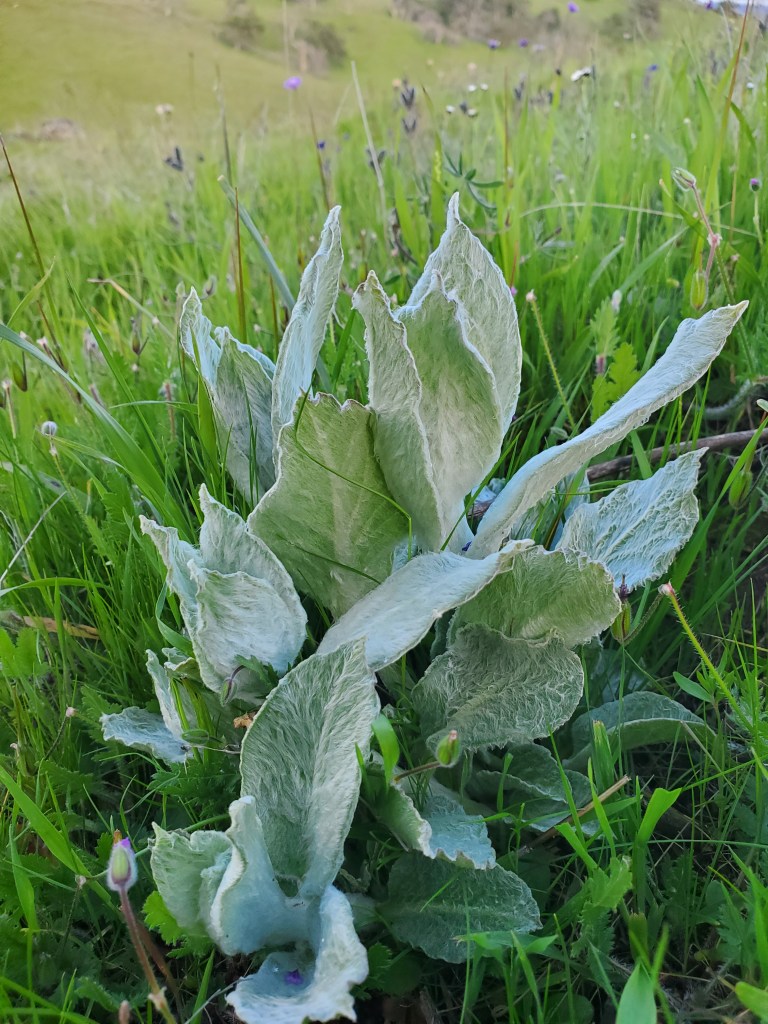
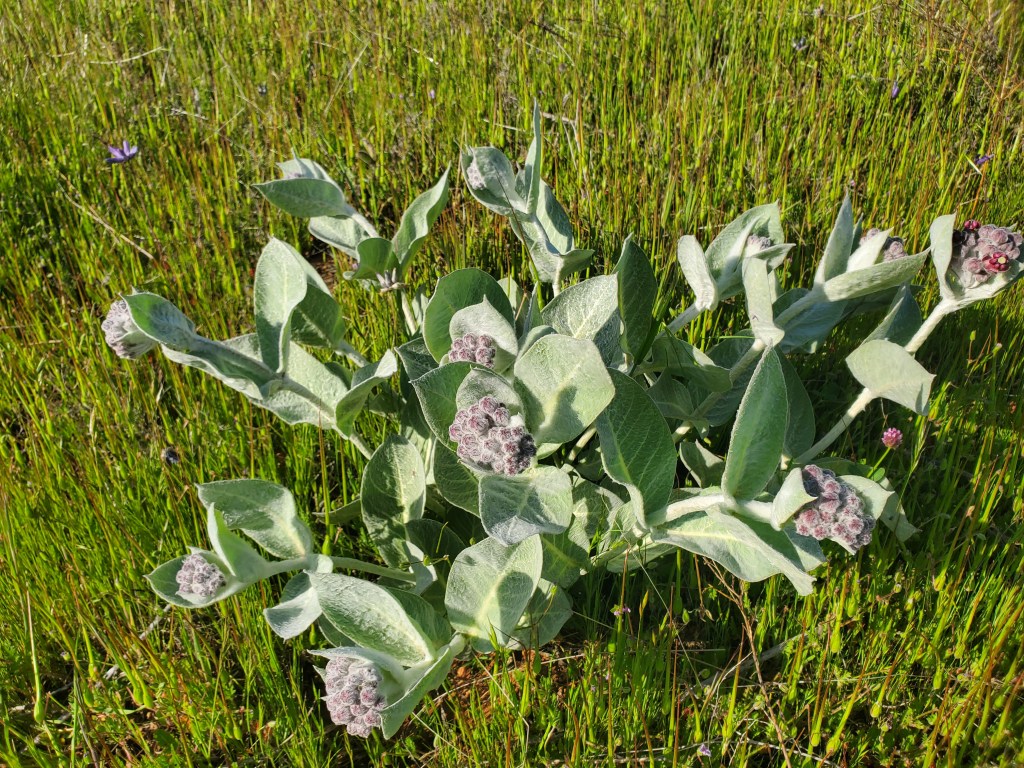
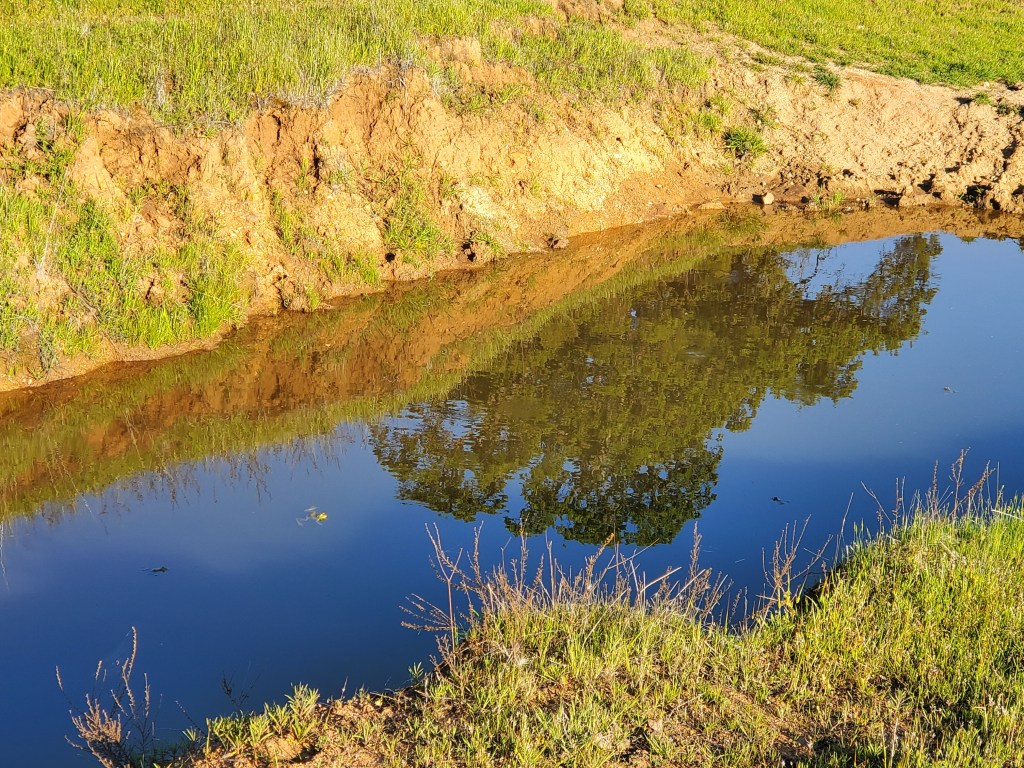
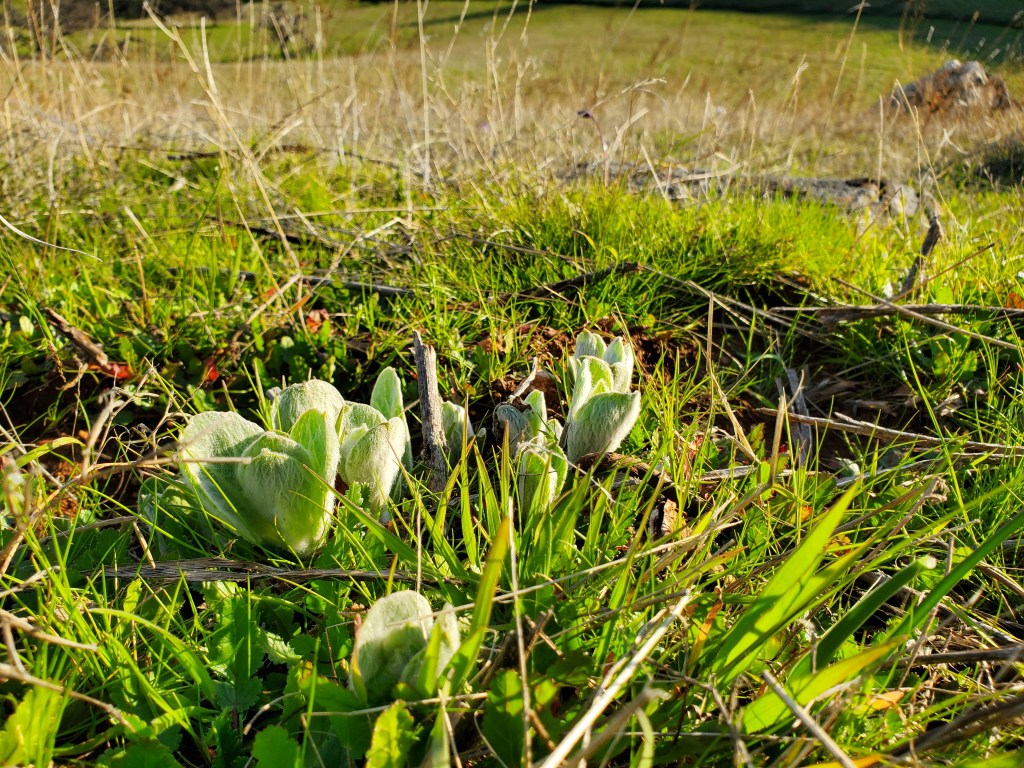
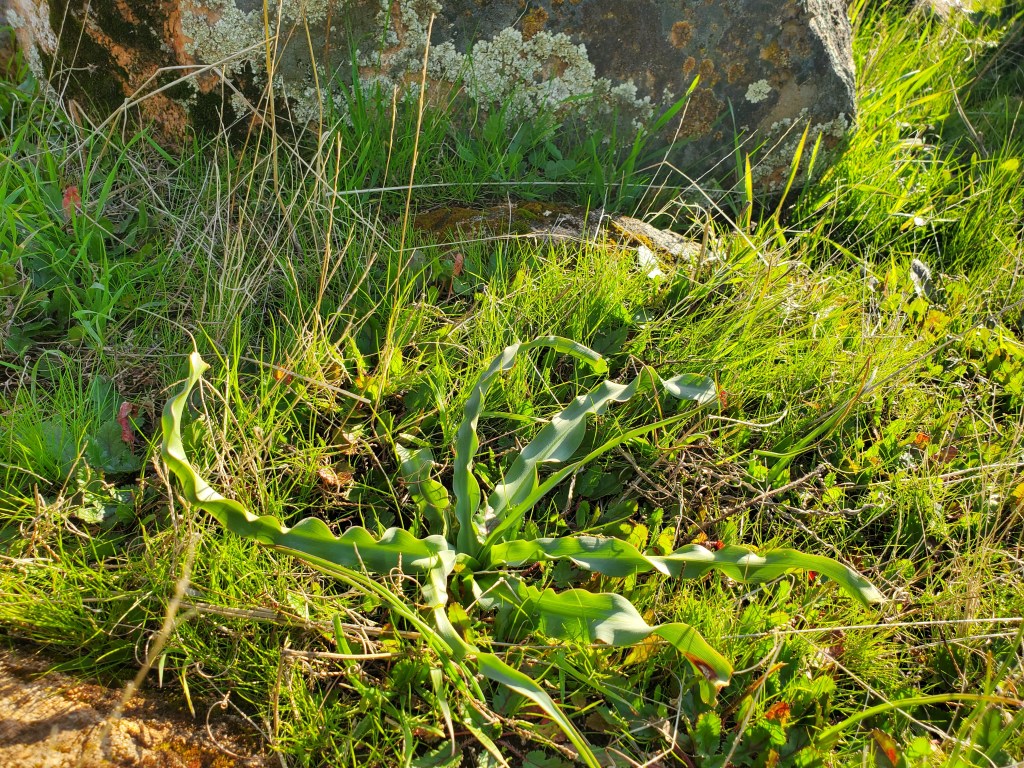
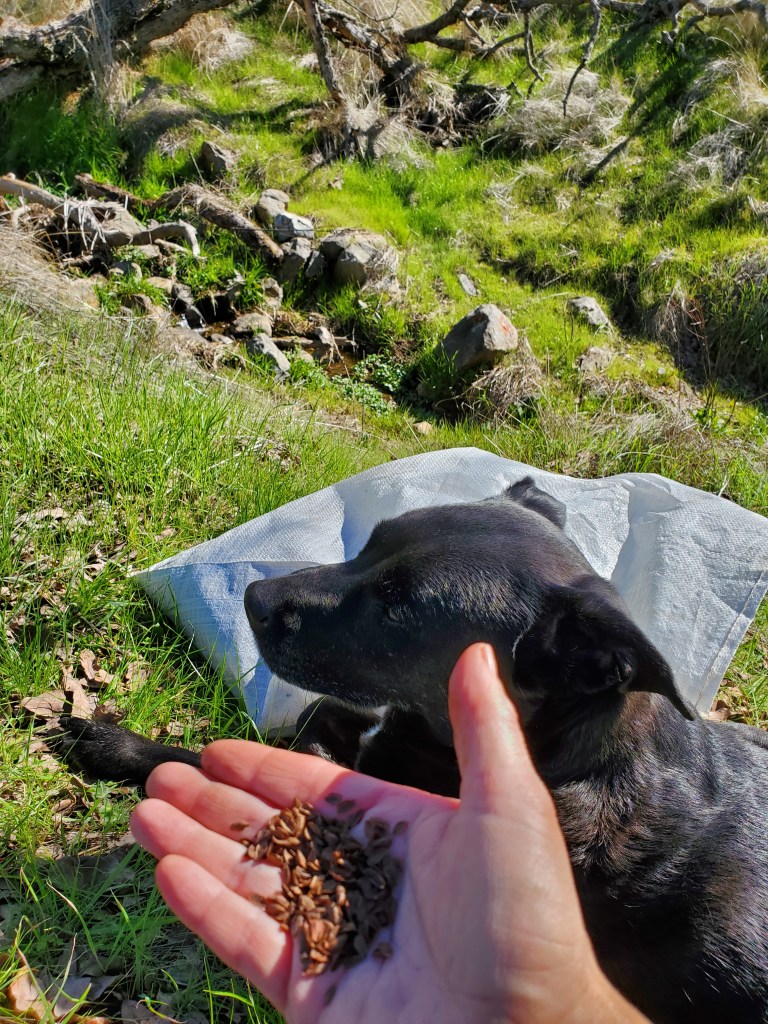
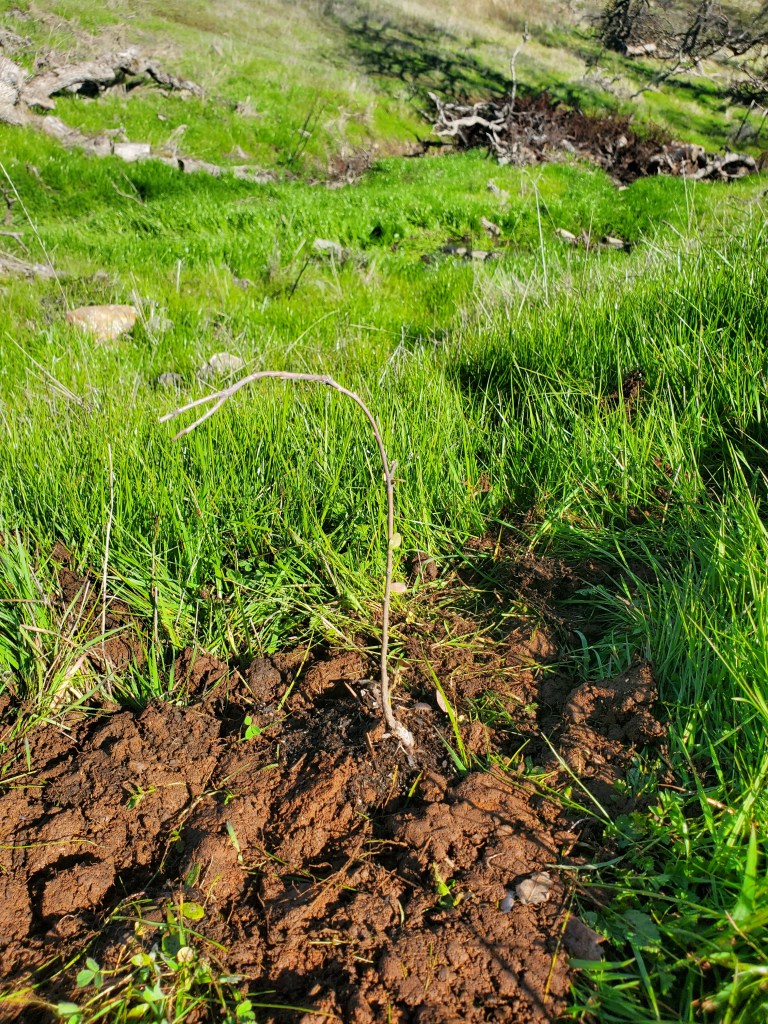
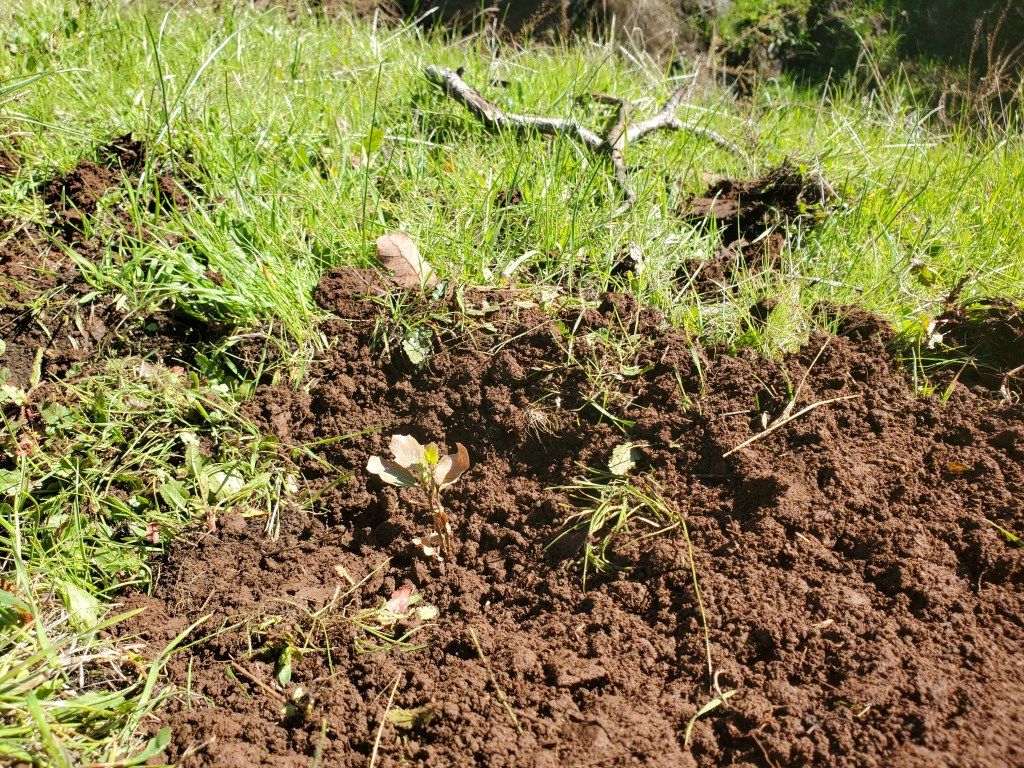
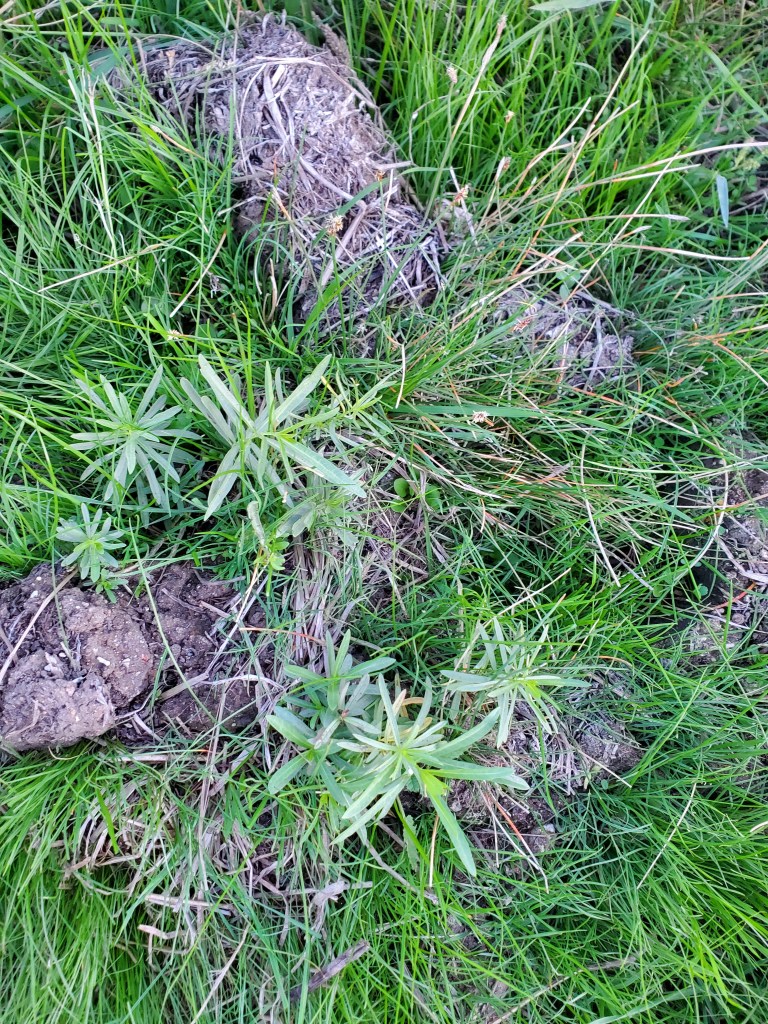
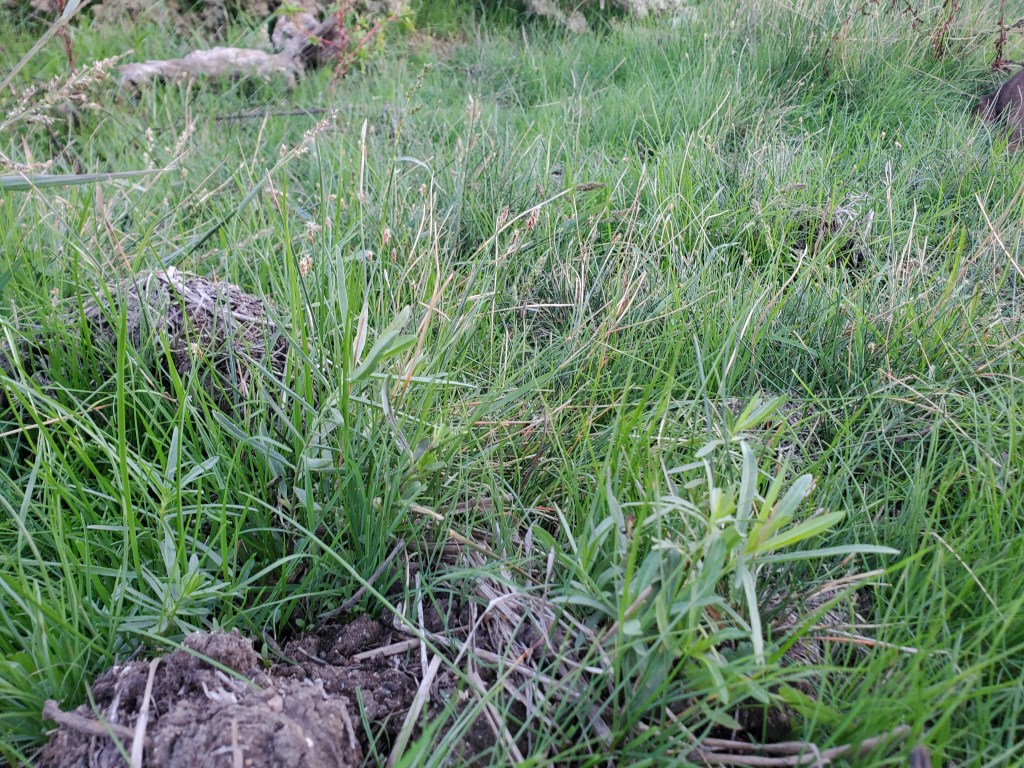
Finally, as I was monitoring the area last month, I found milkweed in the creek, well downstream from the 20lbs of milkweed seed I planted last December 2024/January 2025! It was interesting that it was still healthy looking and green. All others have shriveled up by now. In truth, it has been a mild autumn with some fairly warm days. Even my tomato plants are still delivering. It has been a dream for me to establish milkweed in that riparian area. With all the hardship, you would think my mood would be tempered. Absolutely not! With one plant seen, my joy is uncontainable.
October: Wildlife and Work

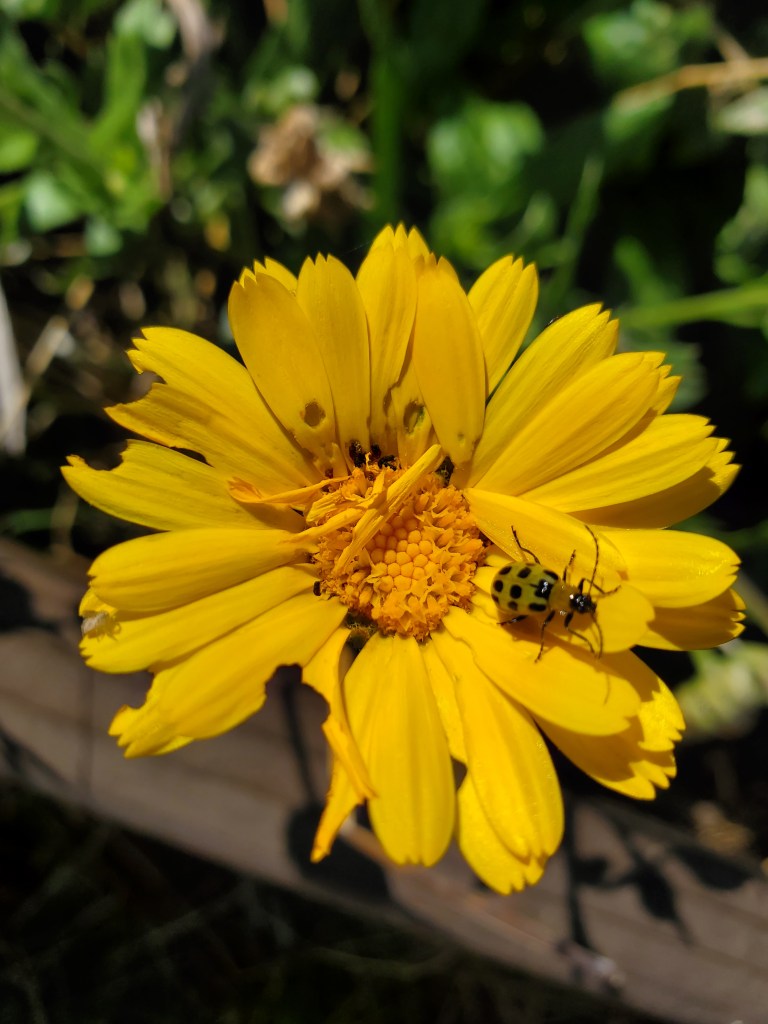
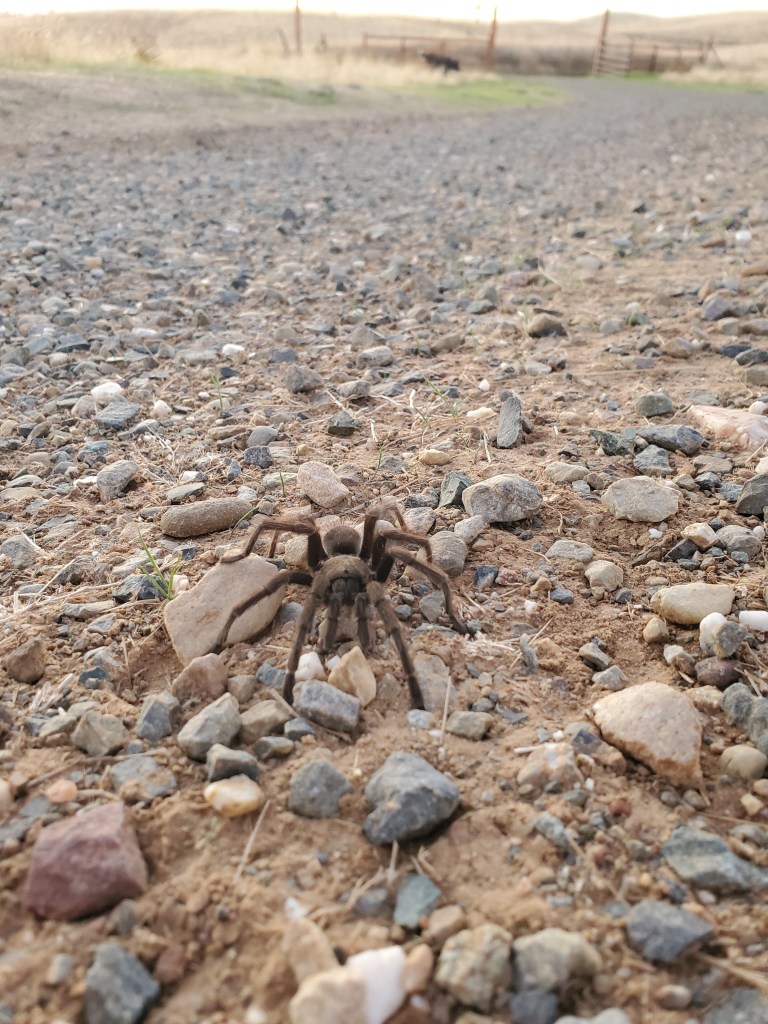
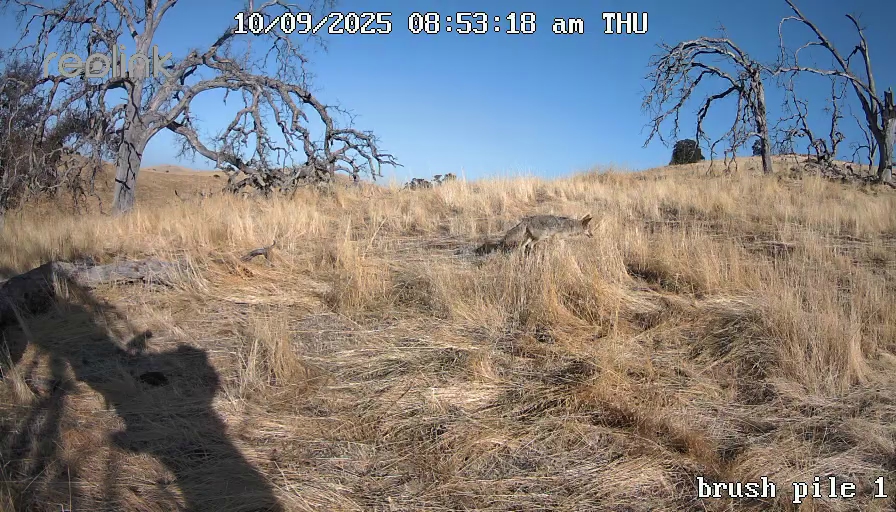
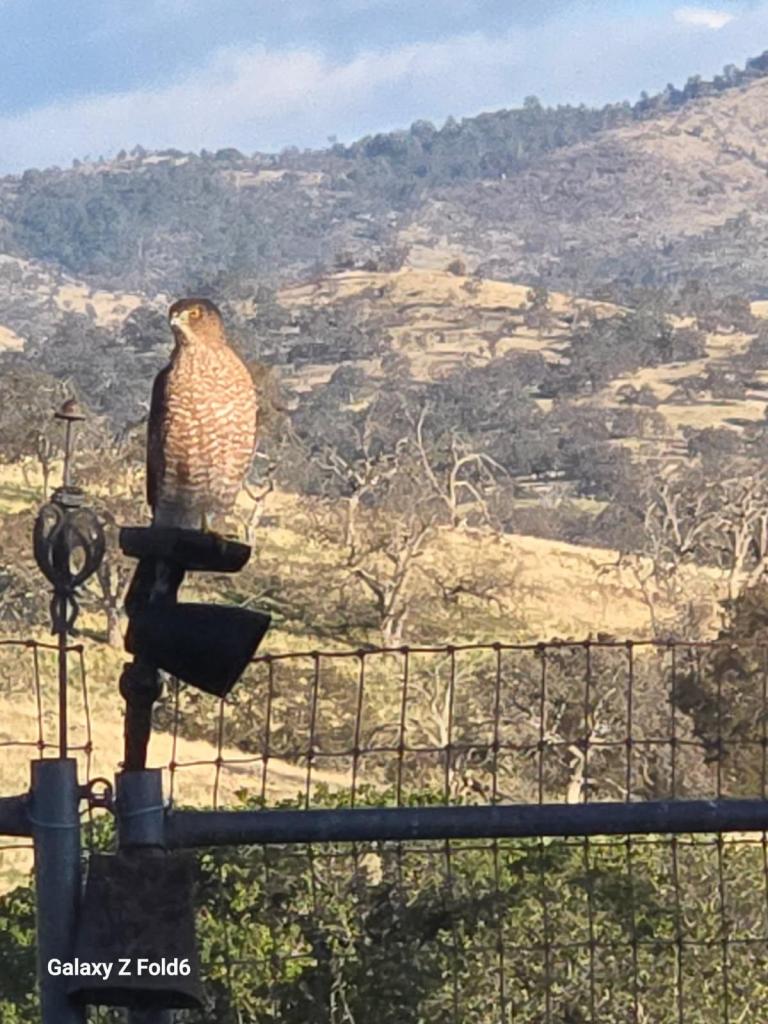
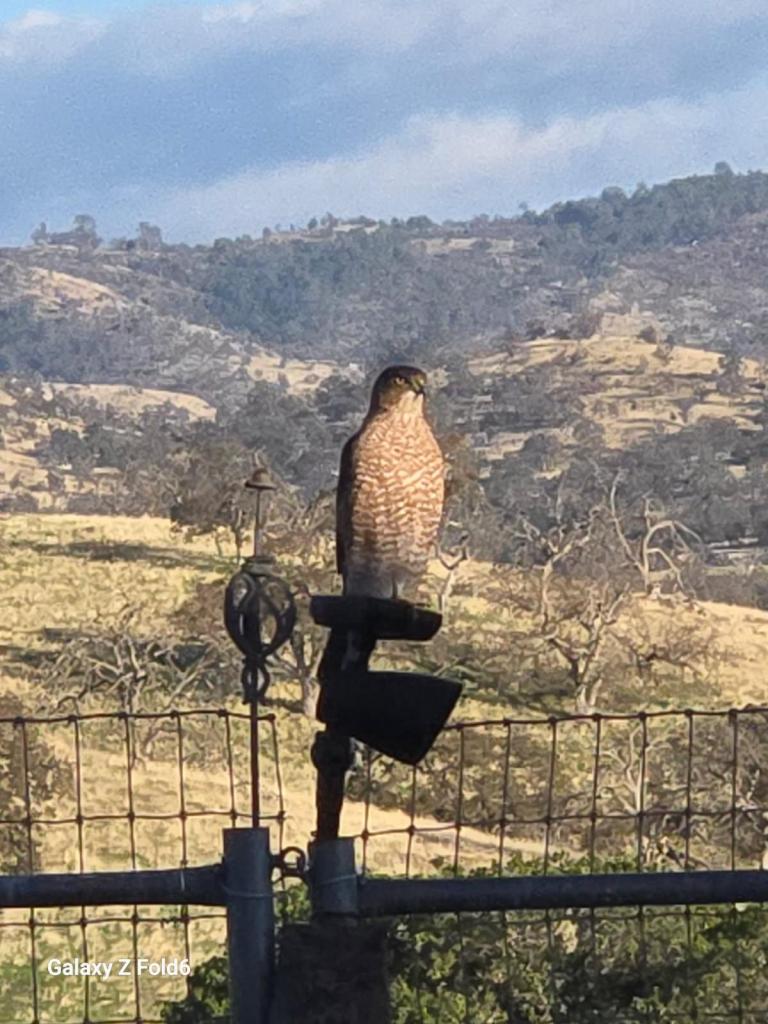
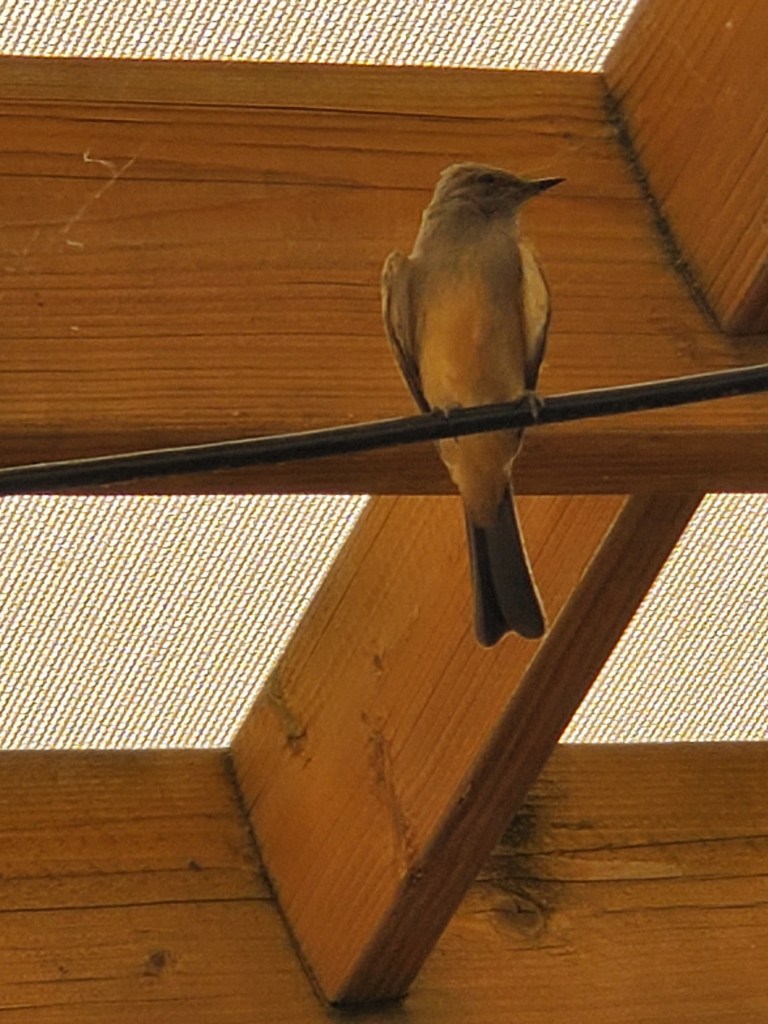
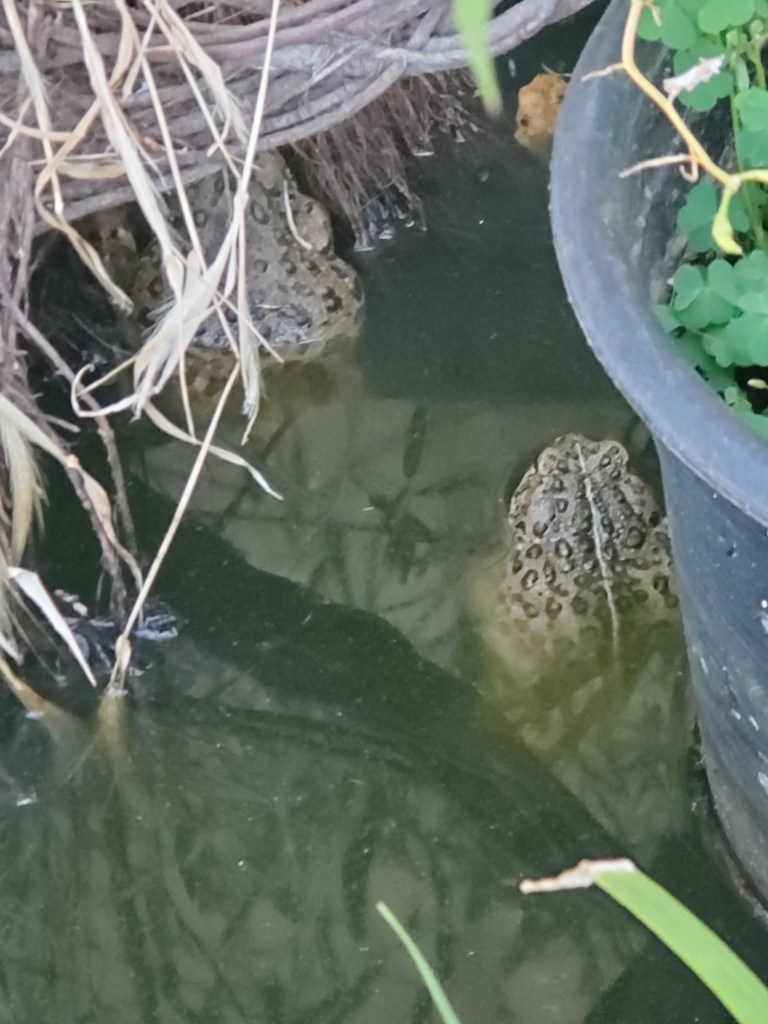
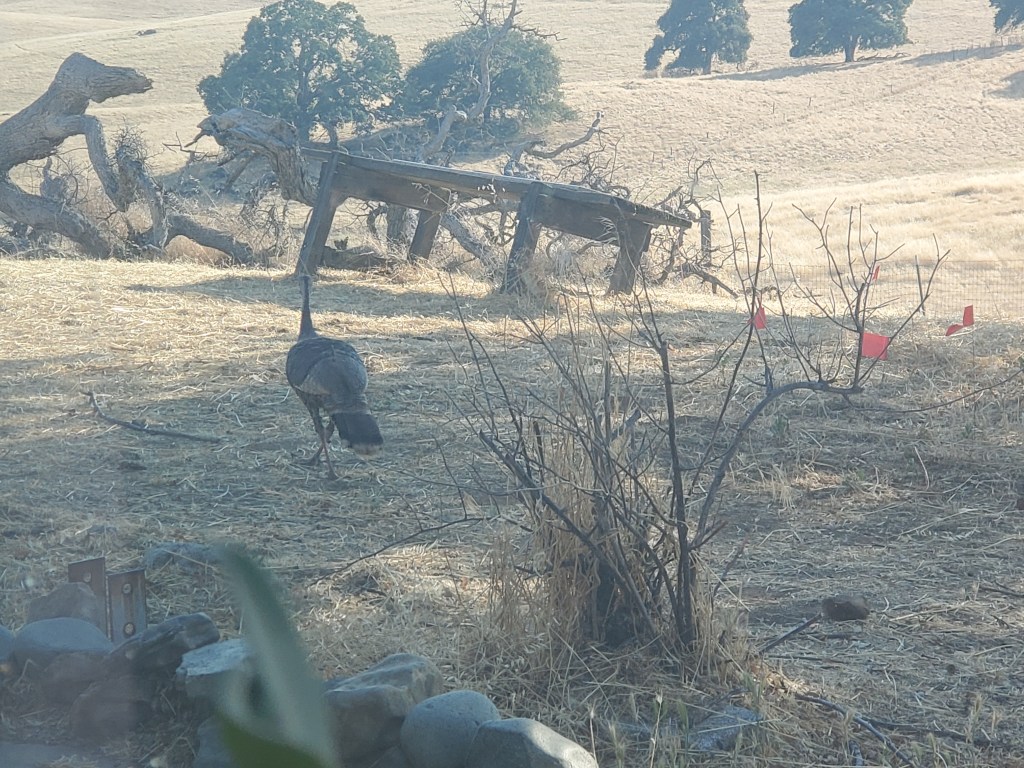
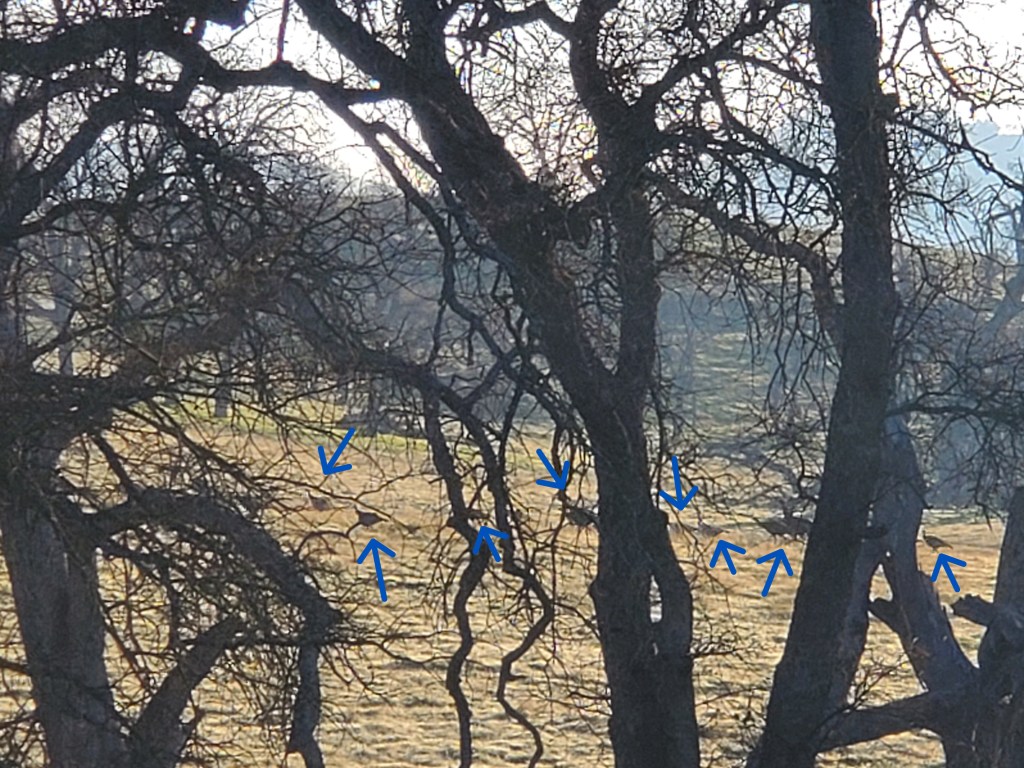
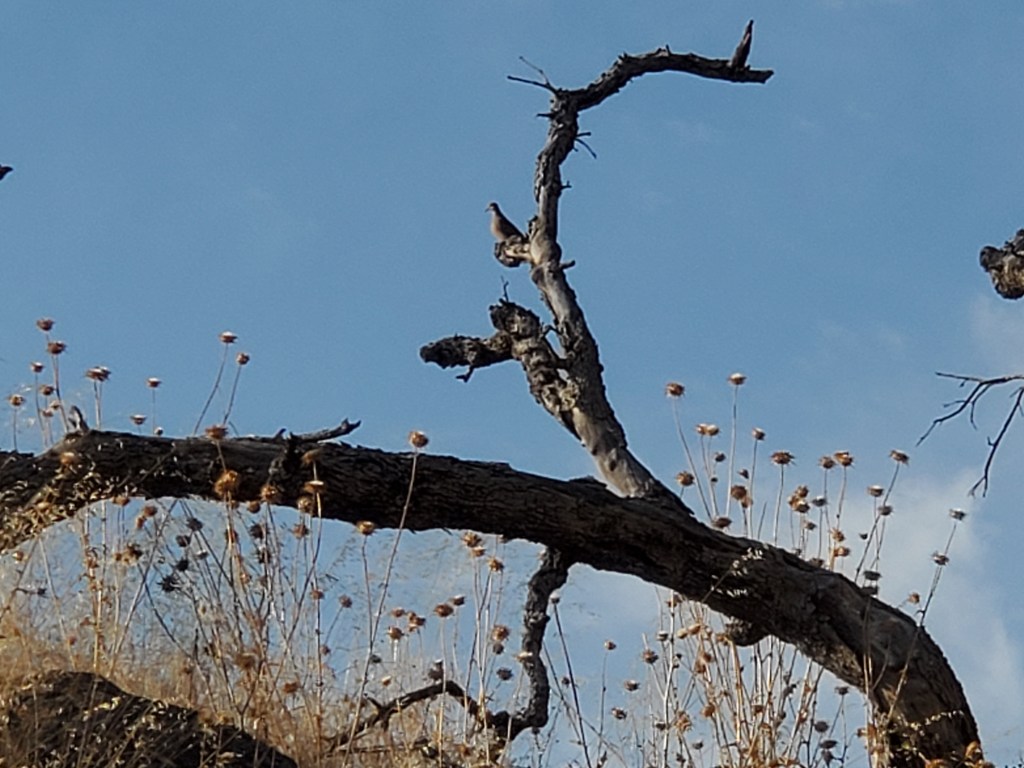
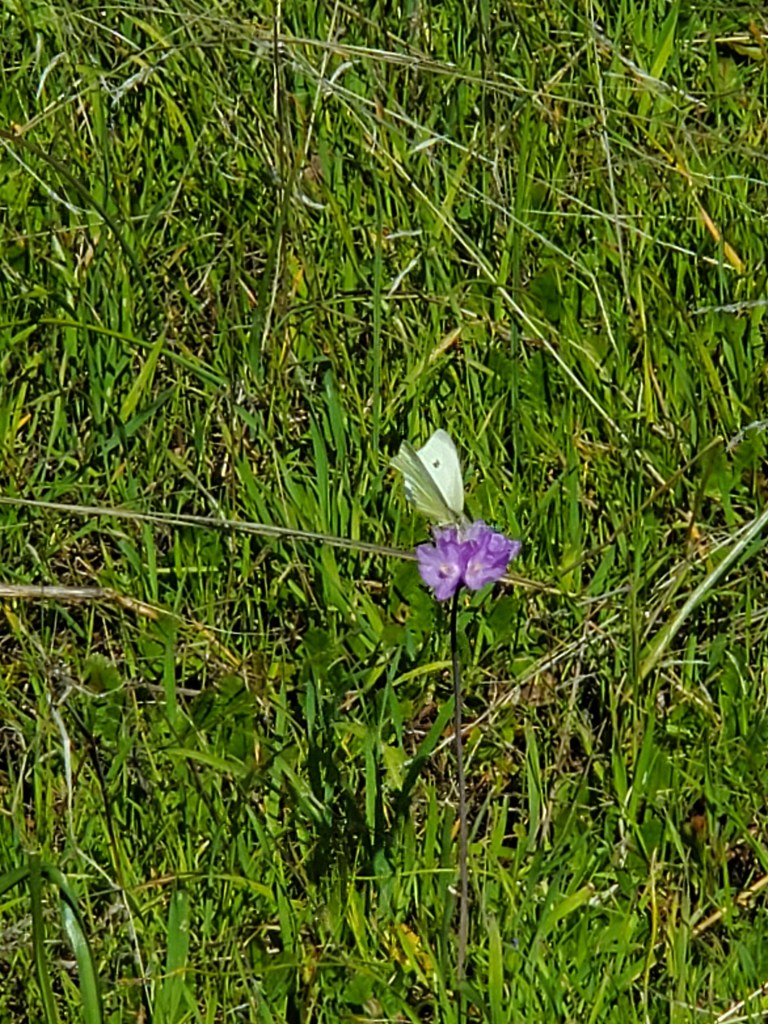
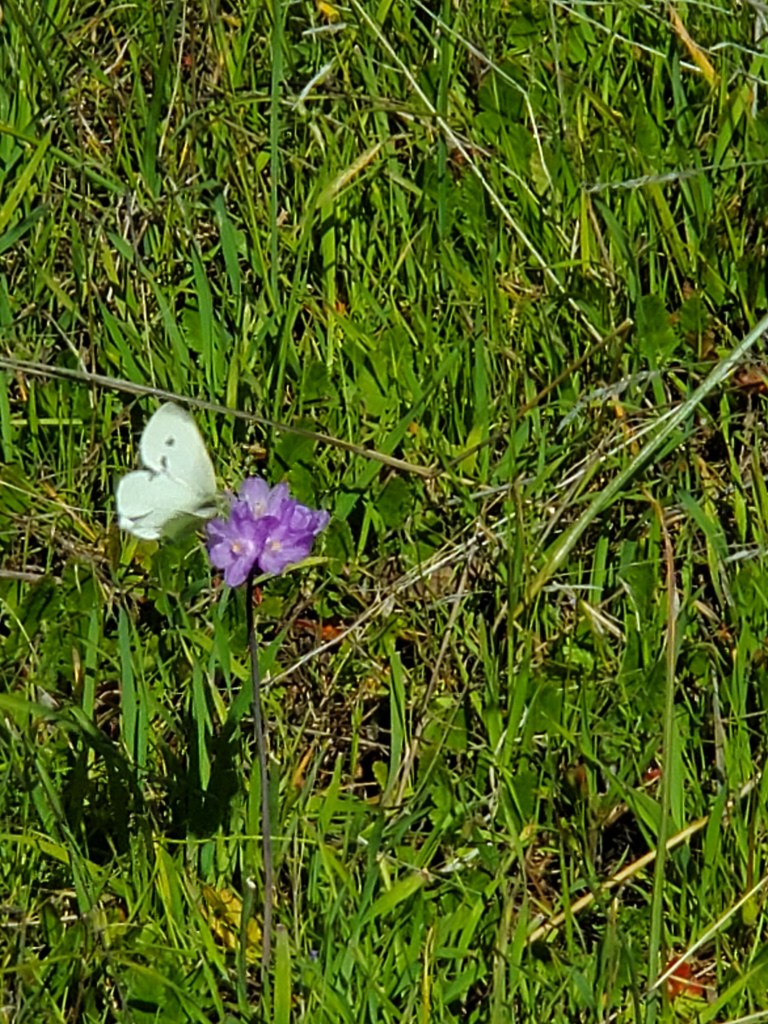
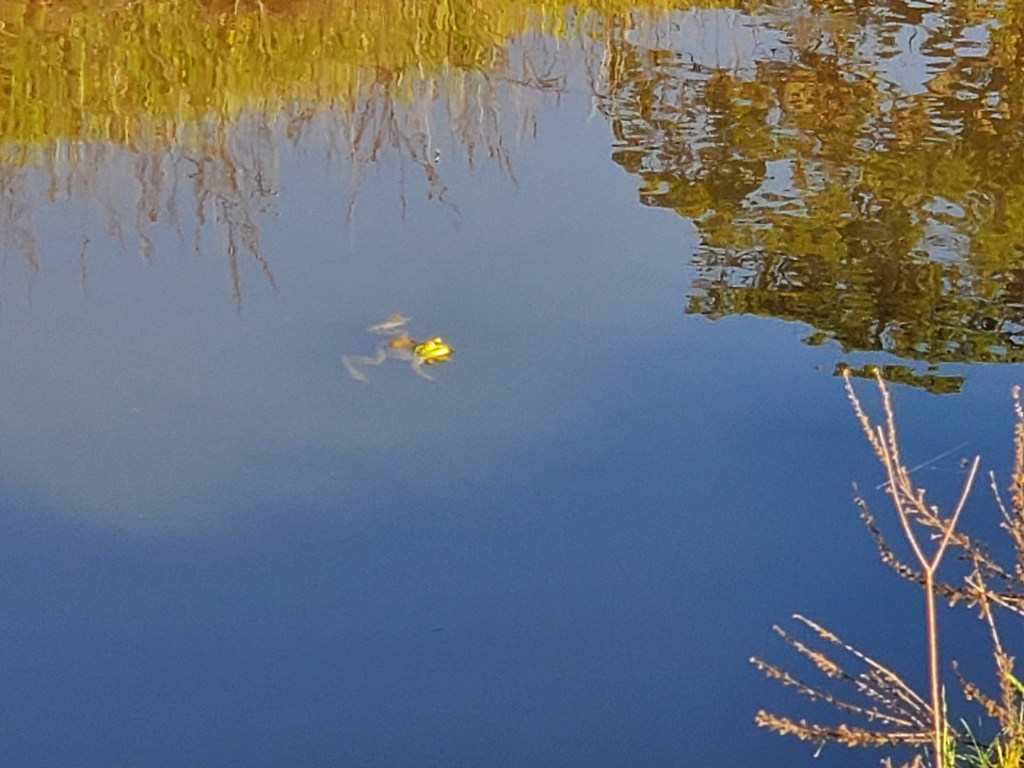
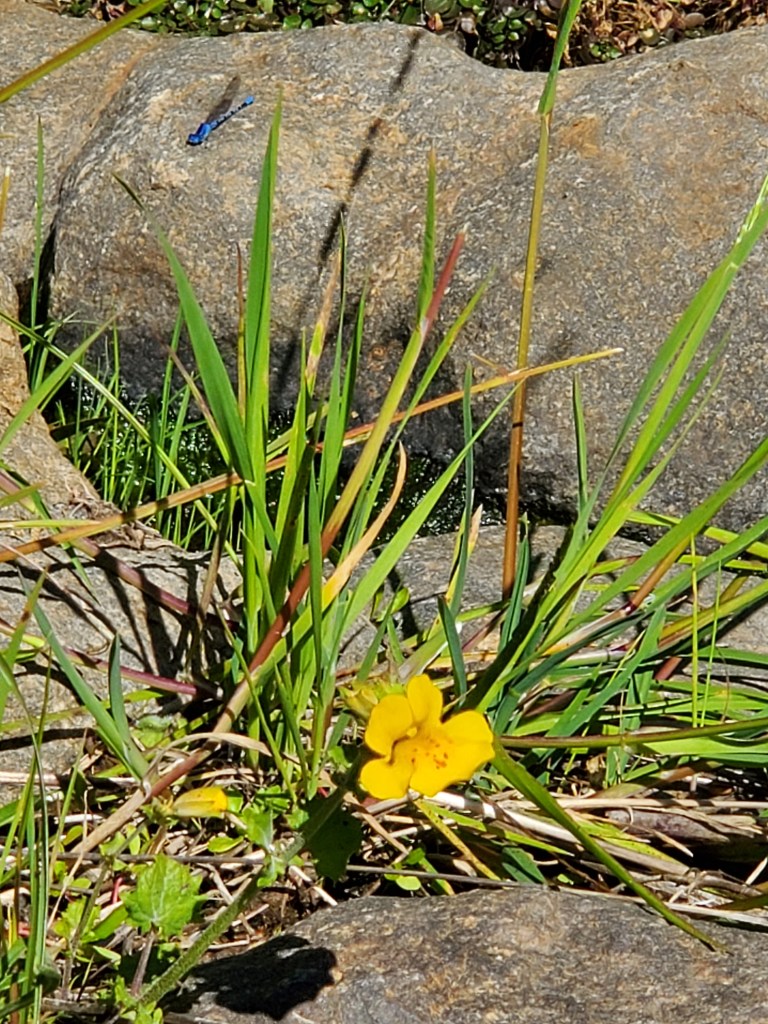
October was an incredible month for wildlife sightings. I saw: two mule deer doe, a group of turkeys, a large group of wild pig, tarantula, a few butterflies, a colorful moth, beetles, and the game cam caught more racoon, an opossum and a coyote. The toads are back croaking. I have seen several kestrel, sometimes two at a time. I hope this means they are going to make a home here. I see them each year, but this is the first time I’ve seen a pair.

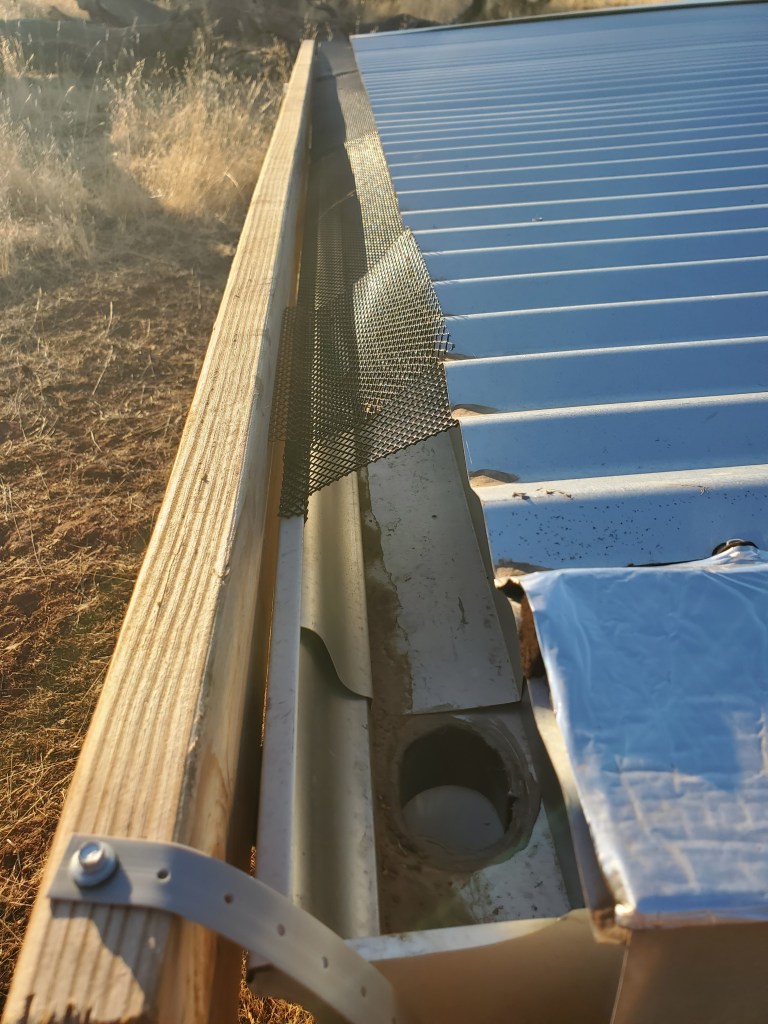
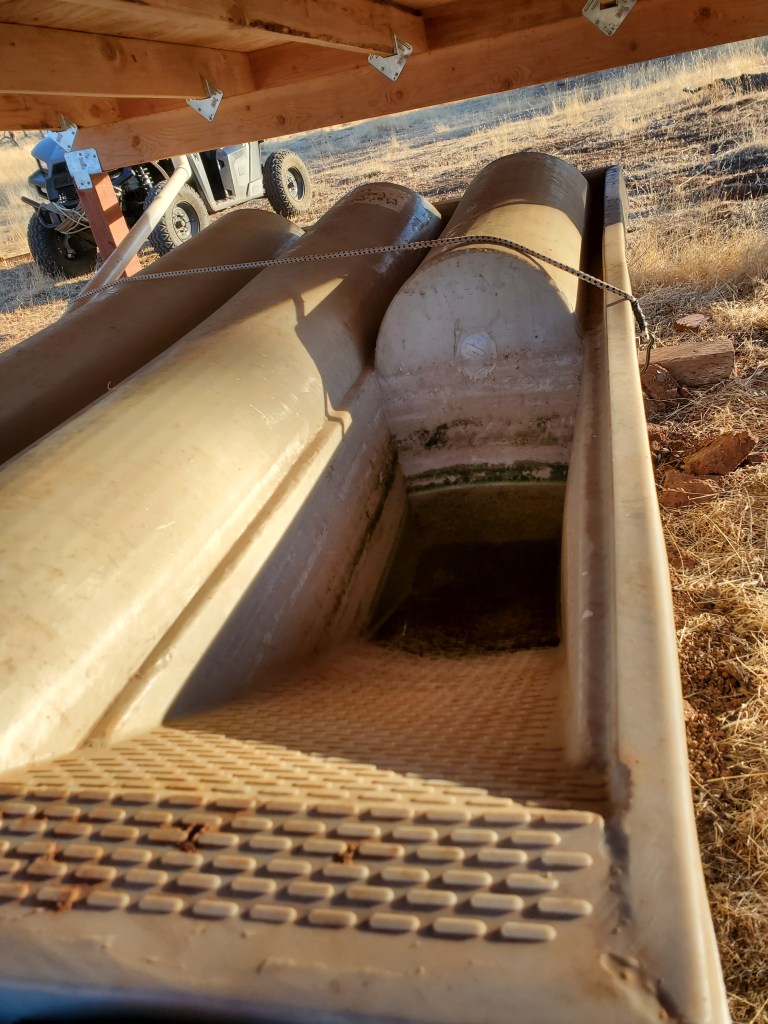
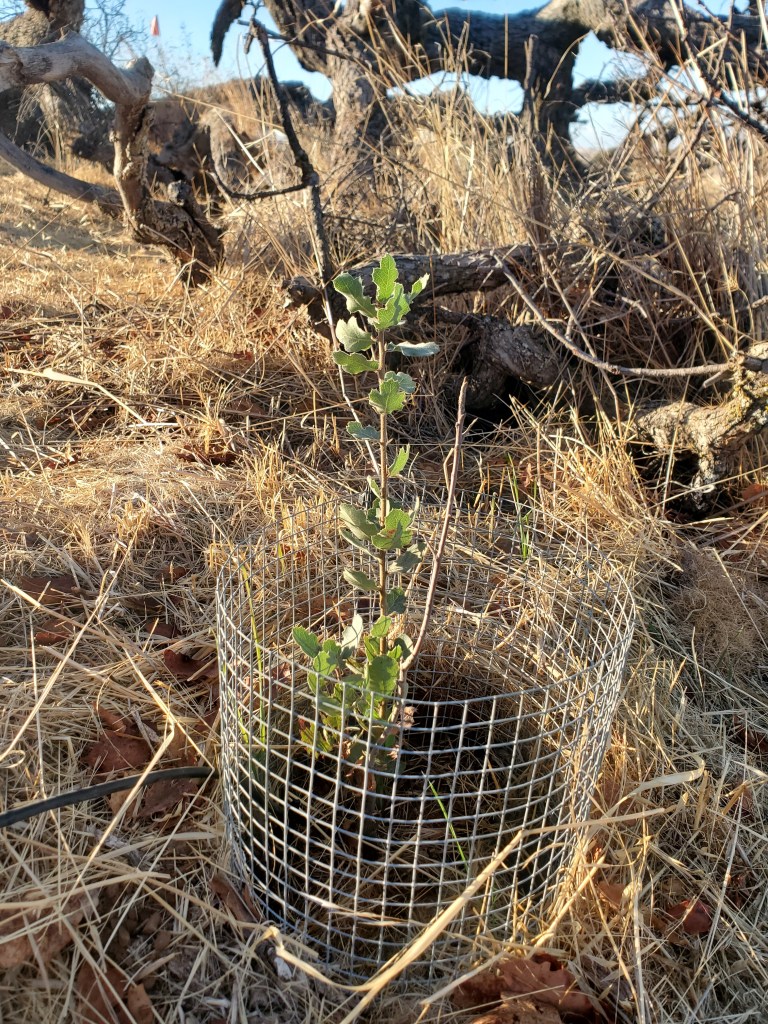
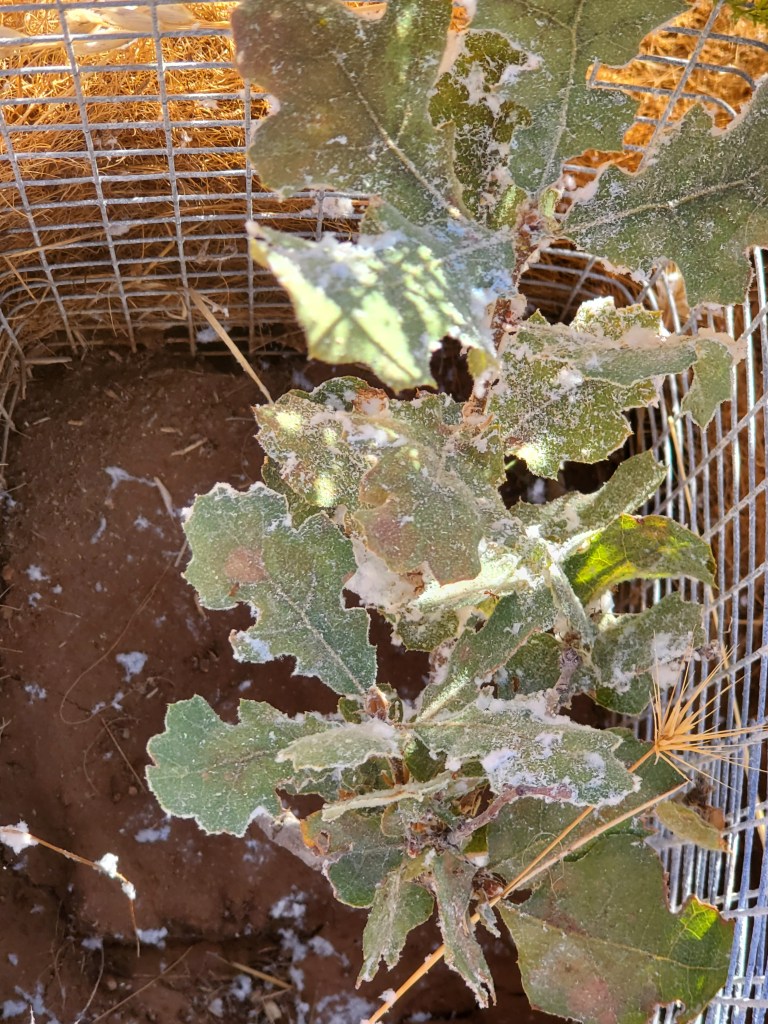
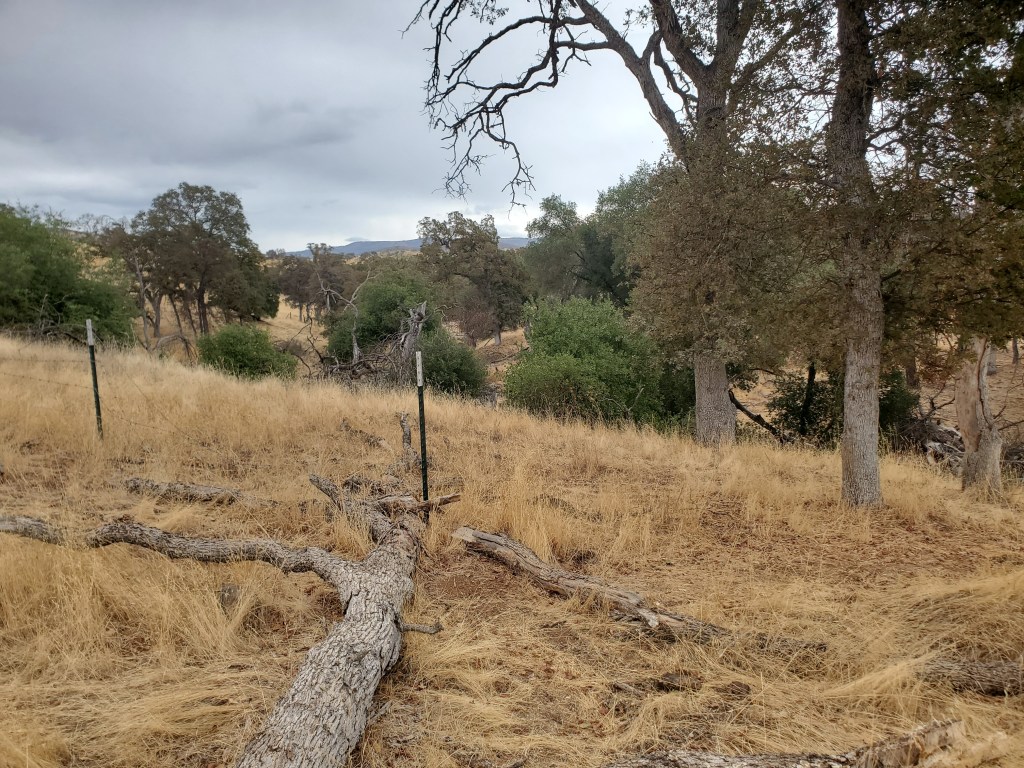
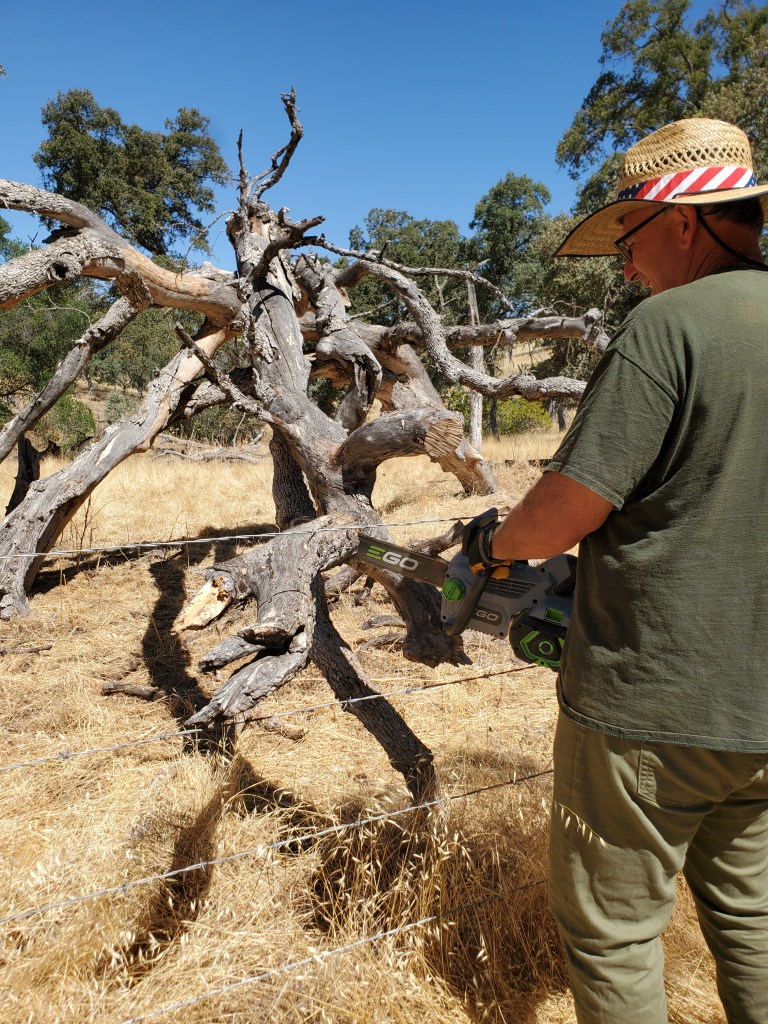
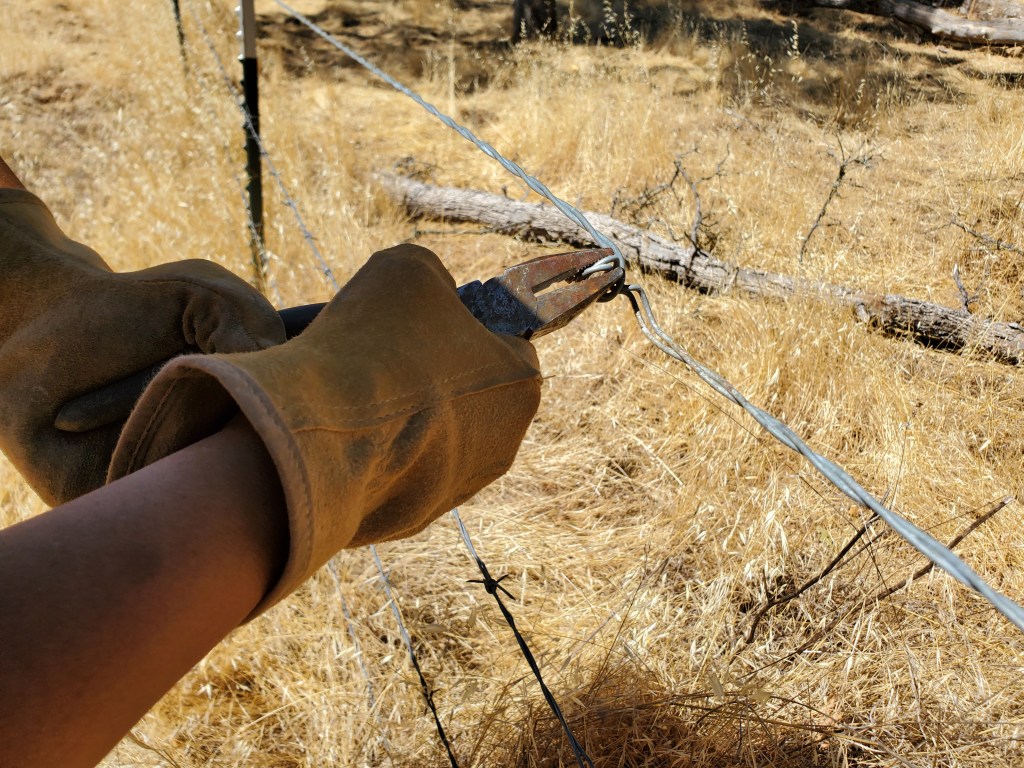
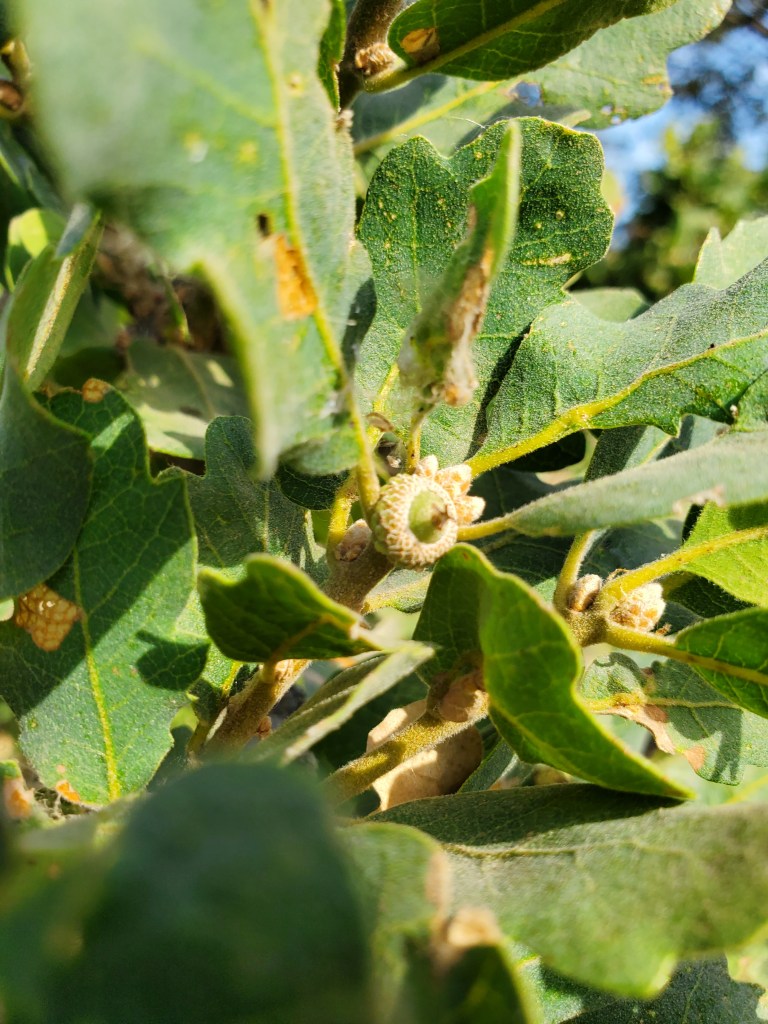
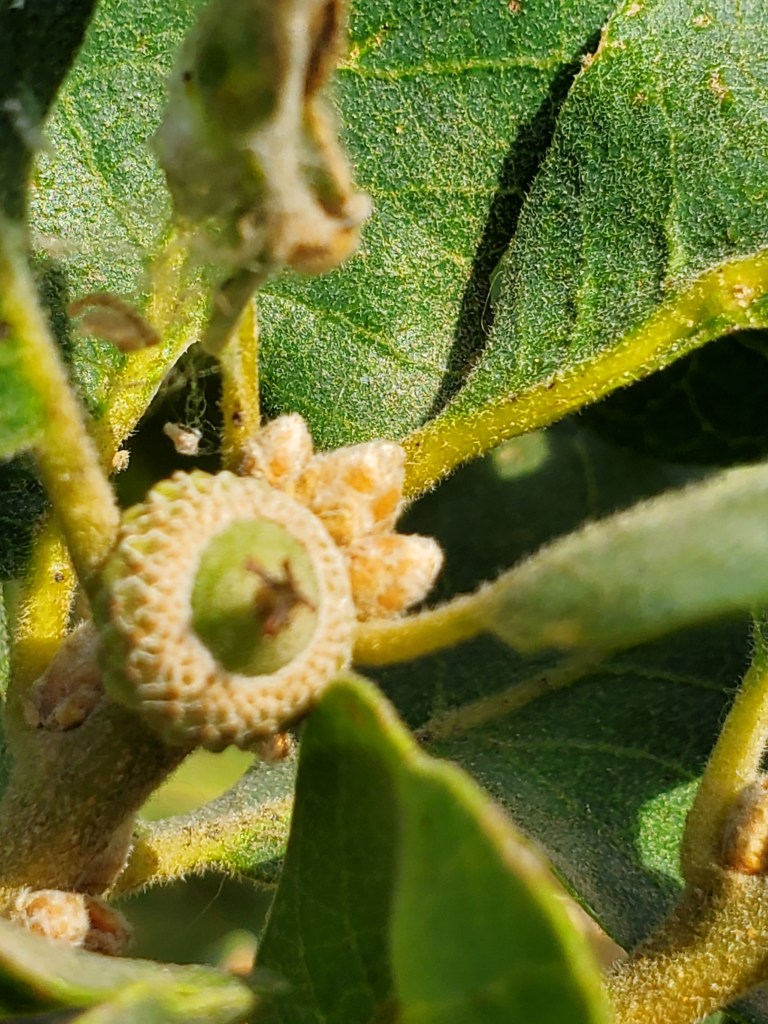
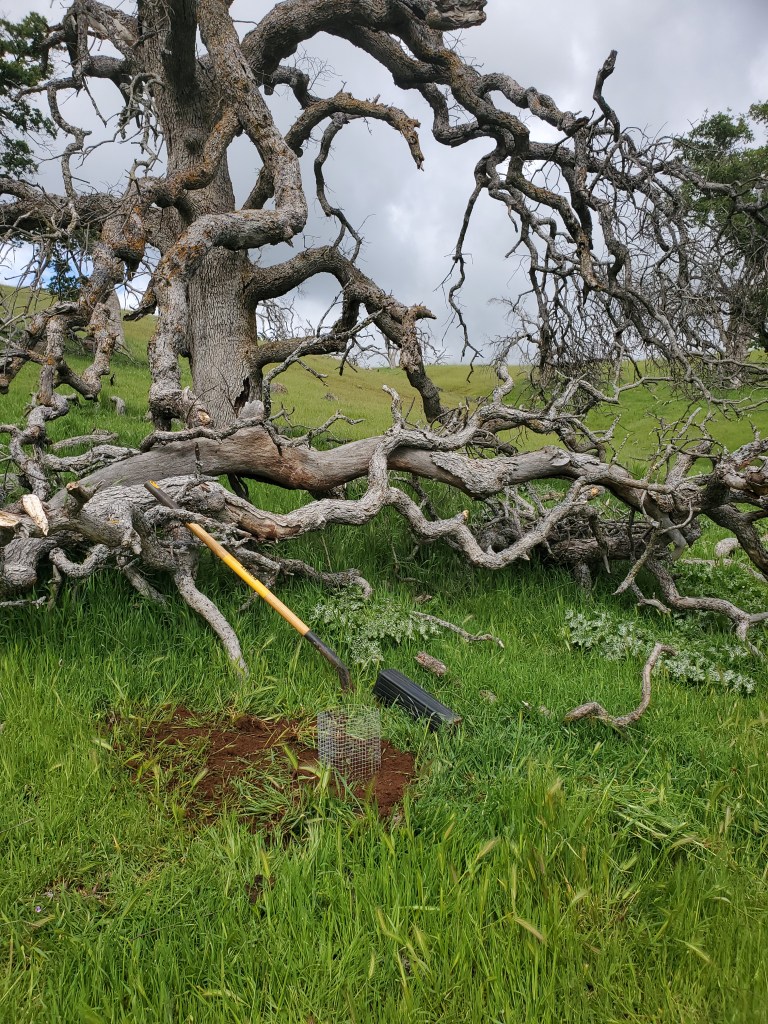
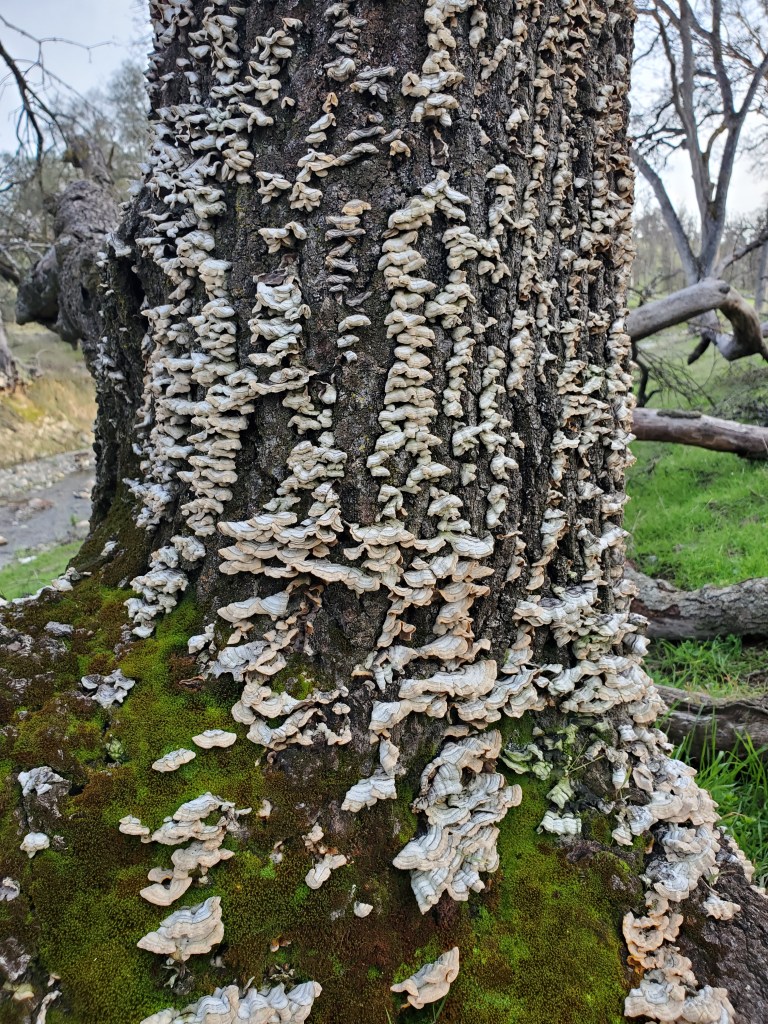
I checked fence and found more down at the Odom exclosure. The guzzlers needed some attention as well. I replaced the return back onto the unit at Guzzler 2. The screen and gutter were bent on Guzzler 1. I re-bent it back, but it will need to be replaced. Water is still able to be caught, but leaves could get into the water system. I took the screens and burlap off the oaks and freed them. They were all gorgeous and seemed to feel really great to have the open air. The one oak with the thick fungus on it is still alive, but has a mildew residue.
November Rain and Lots of Work

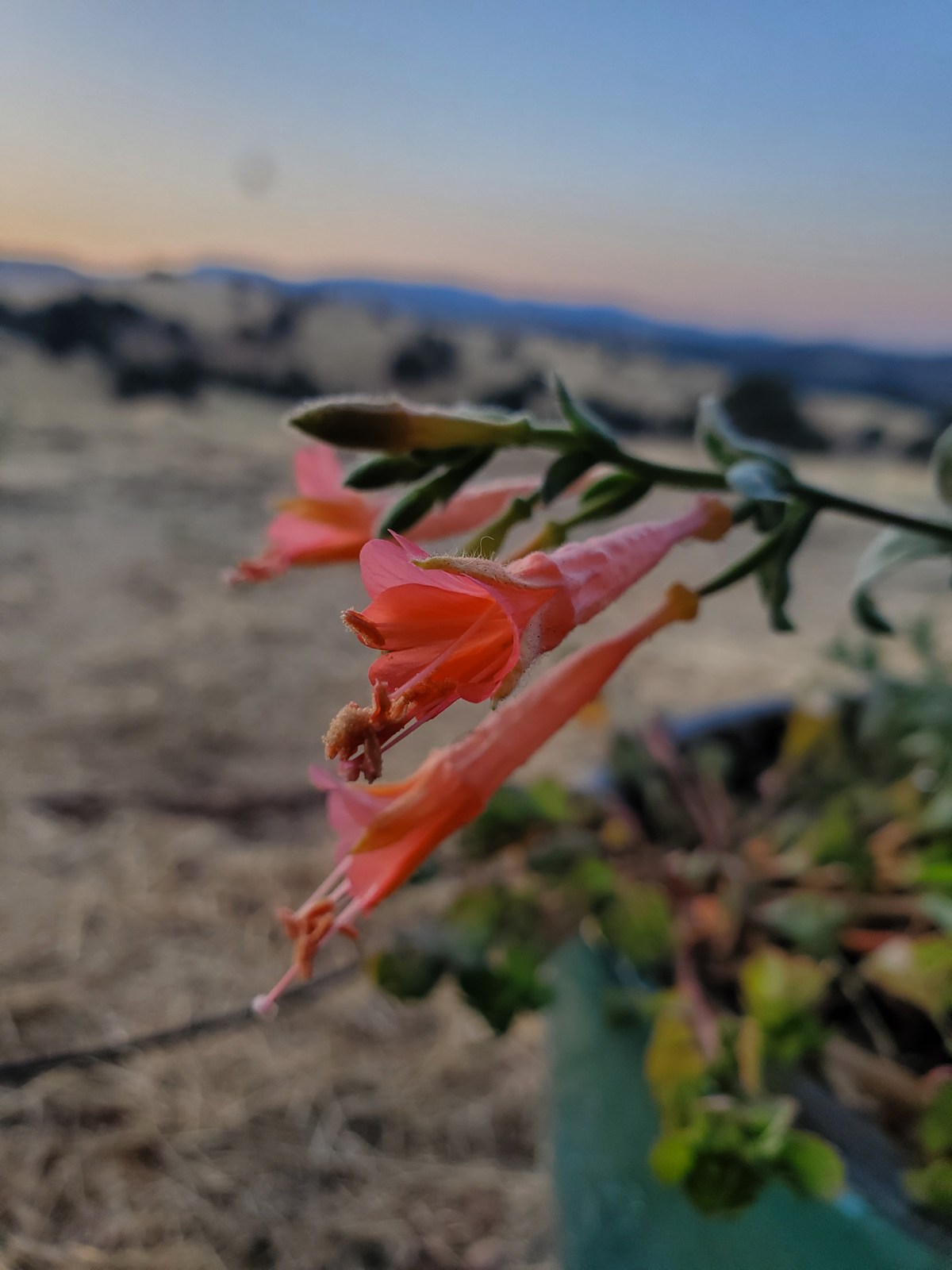
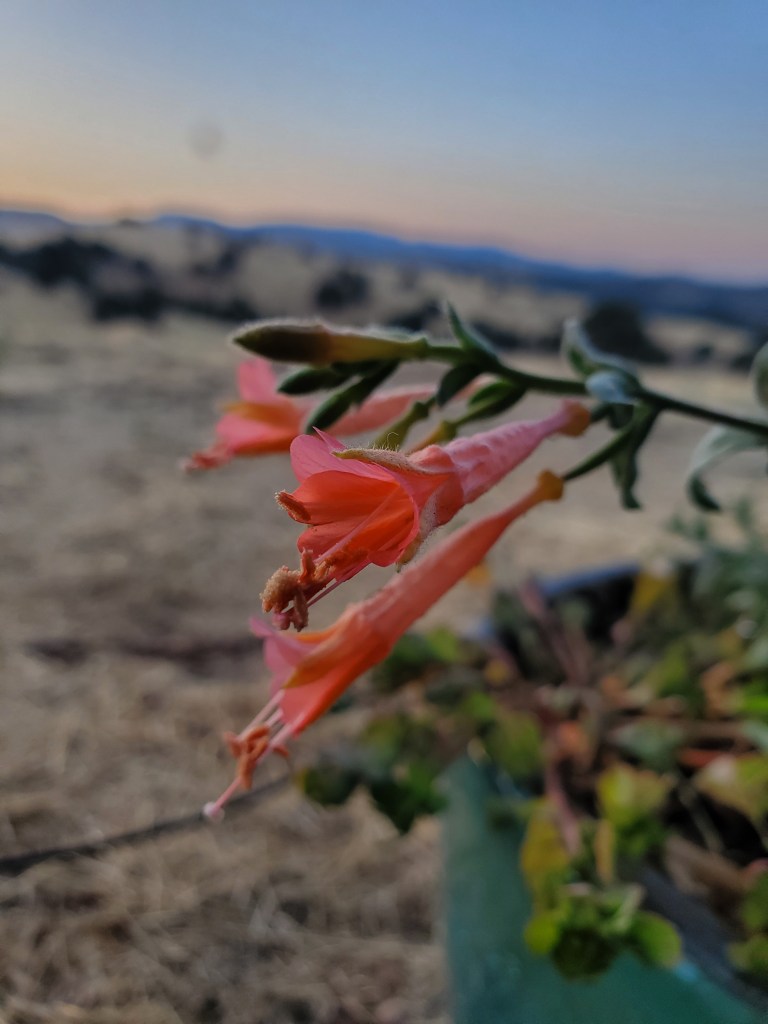
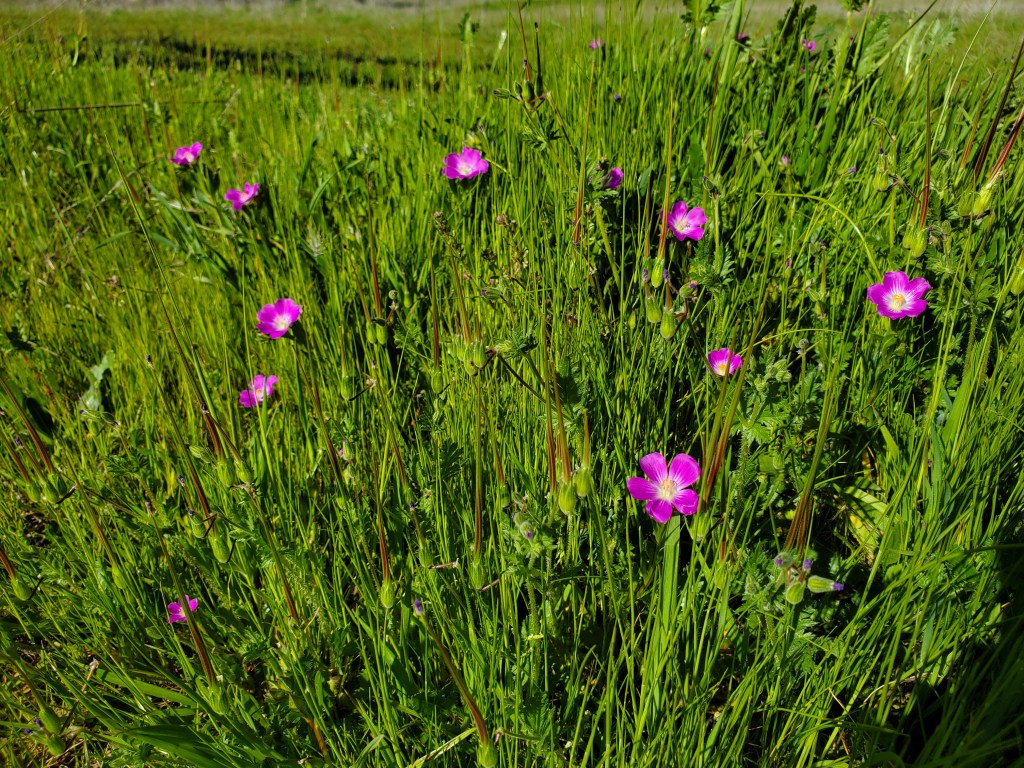
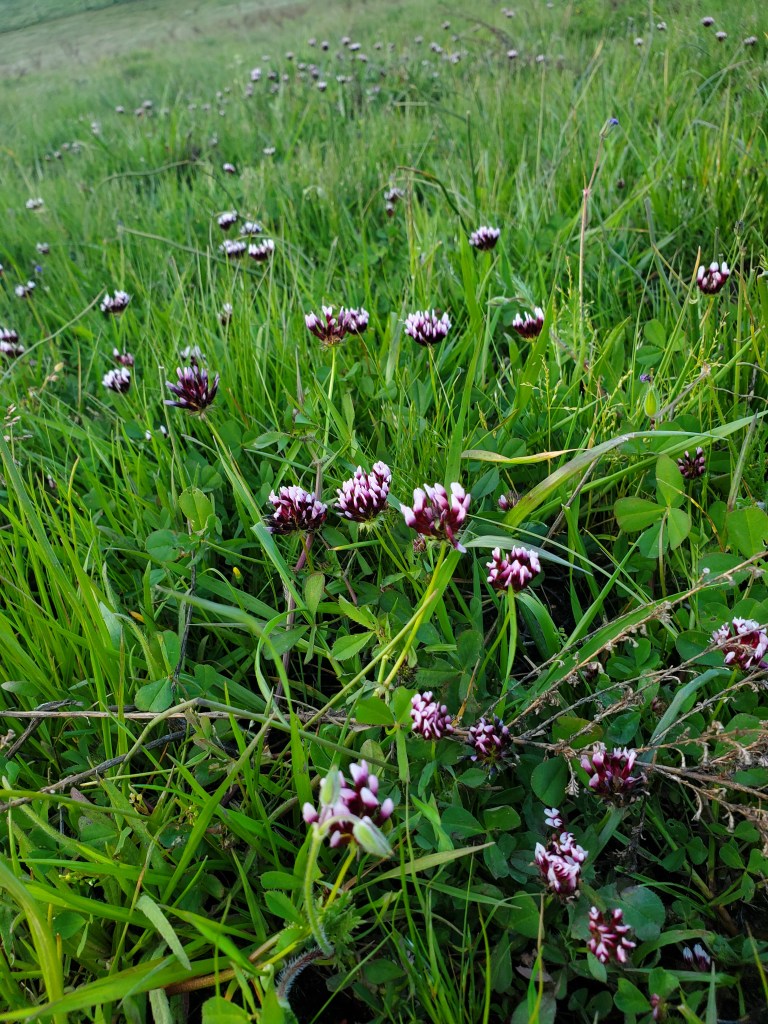
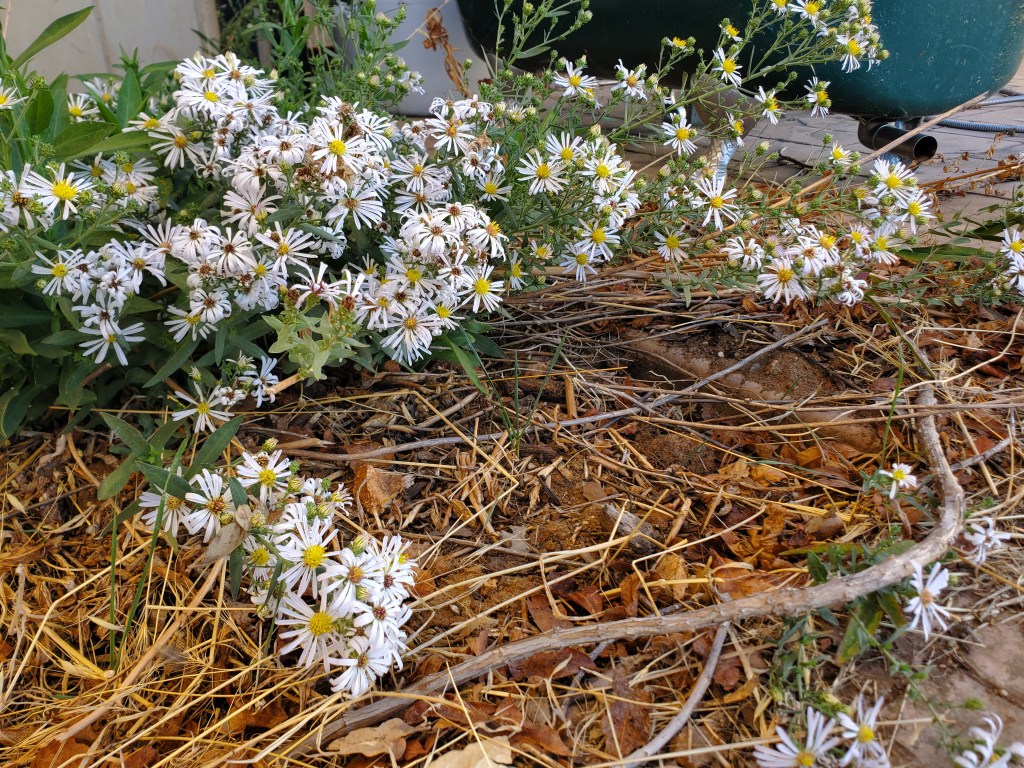
November has been a wet one. Thus far, I have measured 6.75 inches of rainfall this November. All together, with rain in October and some in September, I have measured 8.9 inches. The wetness along with several weeks of higher temperatures with sunshine has caused the grass to green up and grow like crazy. I am afraid I will need to mow soon to ensure native plants are not crowded out. We still have flowers blooming – yarrow, verbena, a few CA fuchsias and marigolds.

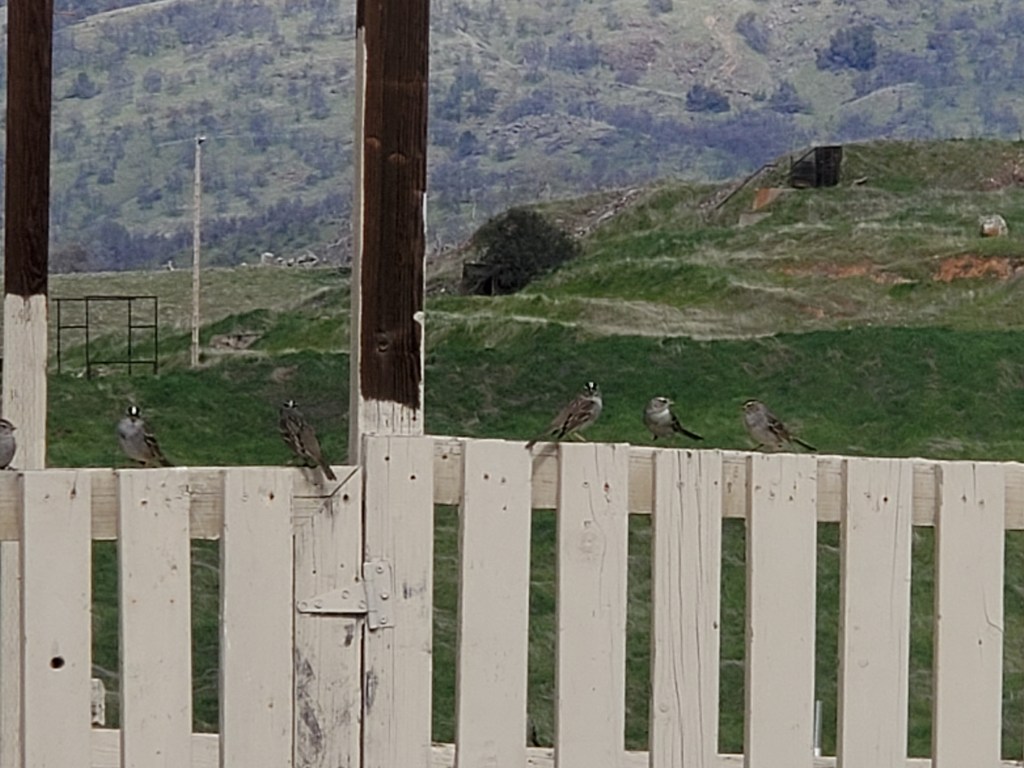
It has also been foggy recently. Typically, we are above the fog line. This layer of fog has helped keep the plants, and my garden, watered. It is beautiful and cold. As I was driving out of the driveway the other day, I disturbed a large group of birds sitting on the ground. They were blue birds. They alighted and perched on the fence across the street. They were so beautiful and in such a large group. I was taken aback.
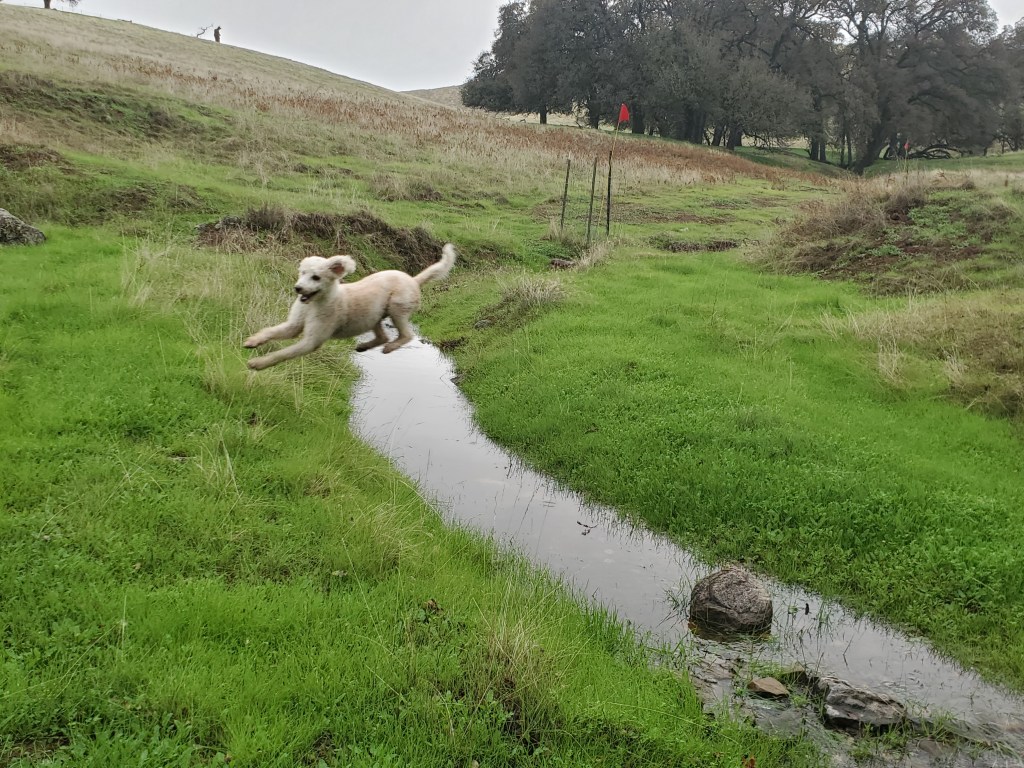
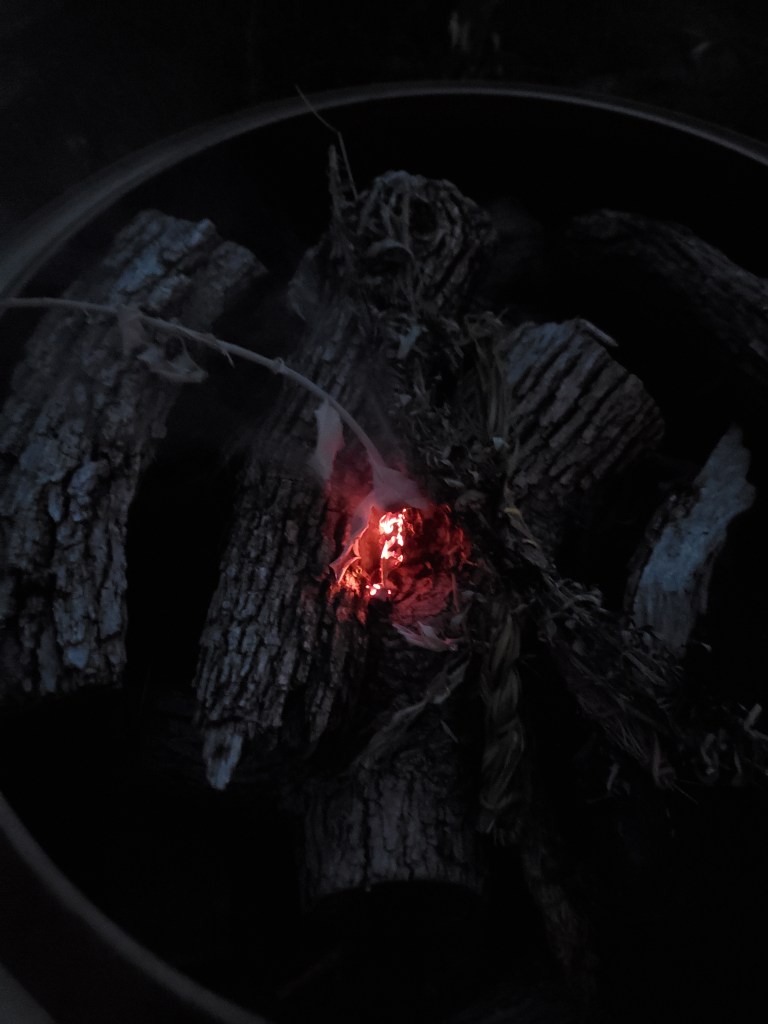
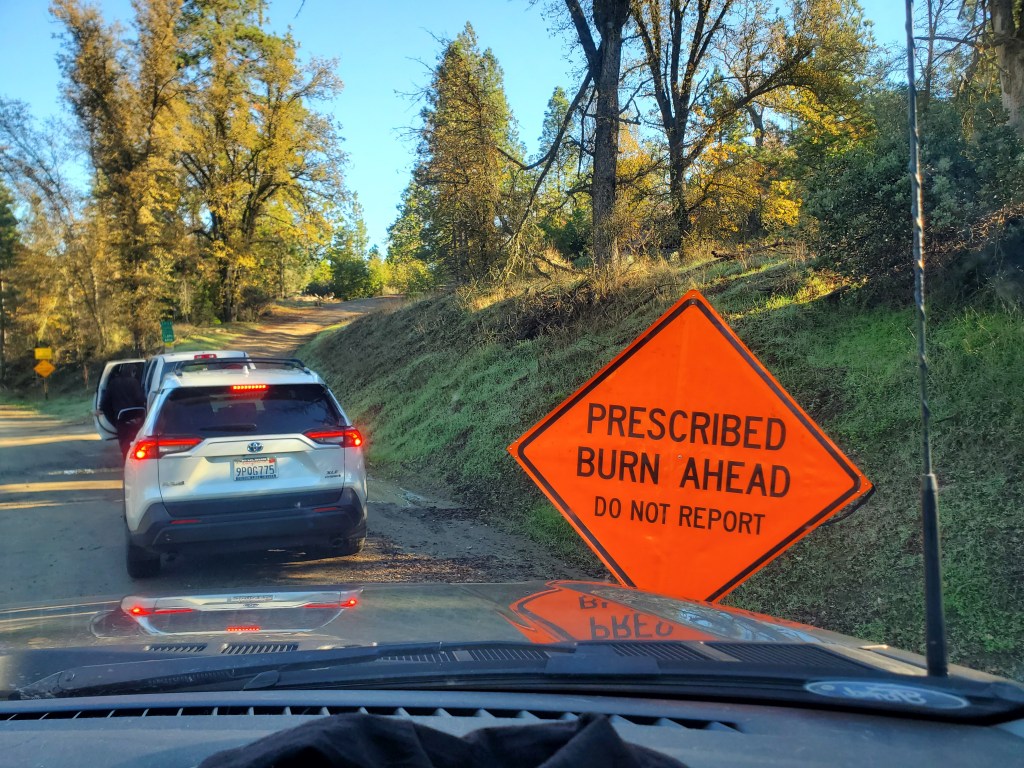
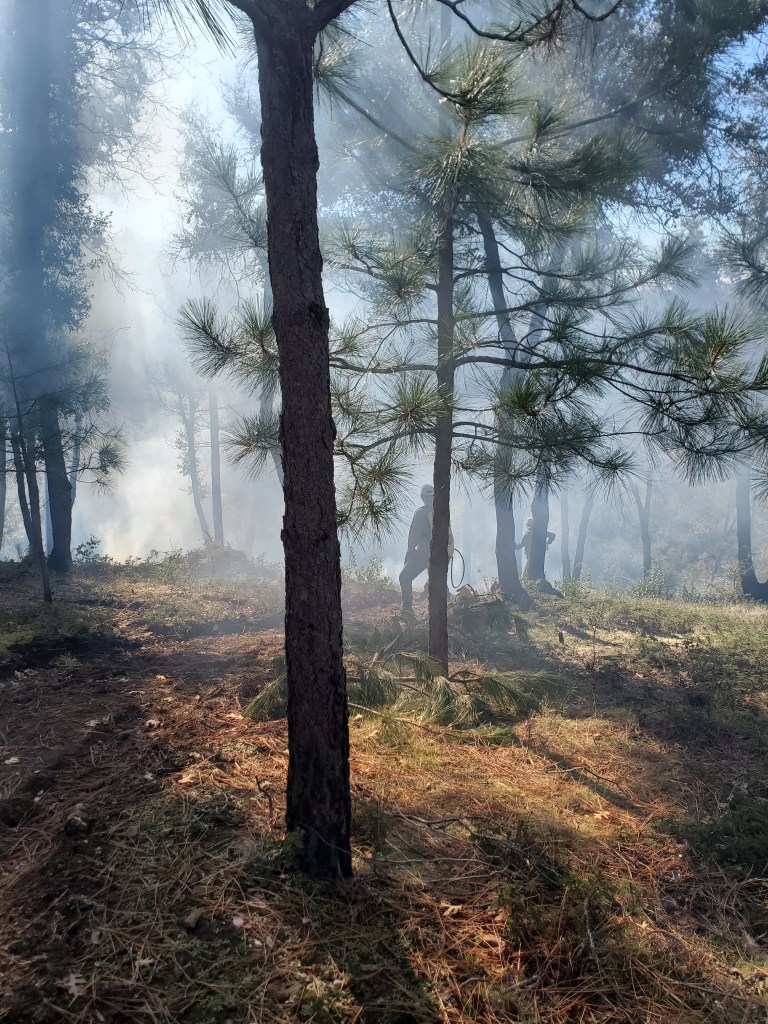
We are planning to do a burn with the local prescribed fire co-op. I am burning for the health of the soil and to help de-compete medusa head and other European grasses from the California Milkweed. We weed-eated fire breaks and had to attend another burn in order to be scheduled. I have been attending burns with the Southern Sierra Miwuk as well. There is something about cleaning up the ground, healing it that feels really good. I plan to start the fire traditionally and not use any gas torches. We will see how it goes – or even if I will be able to do it. The grass is so wet and green now.
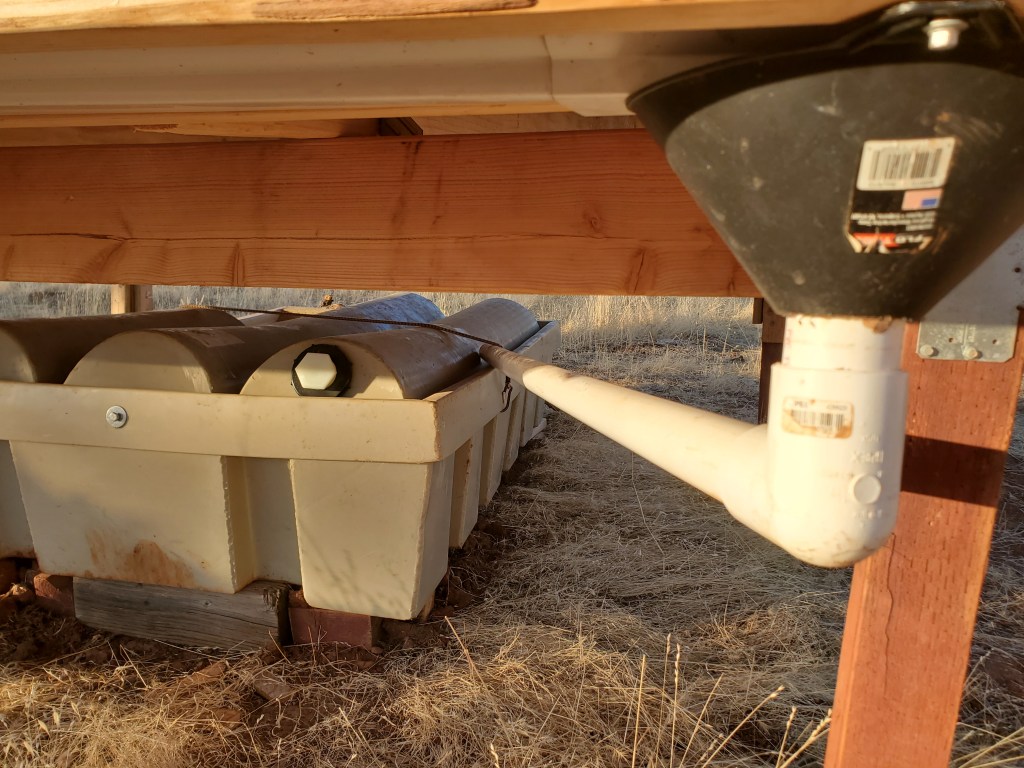
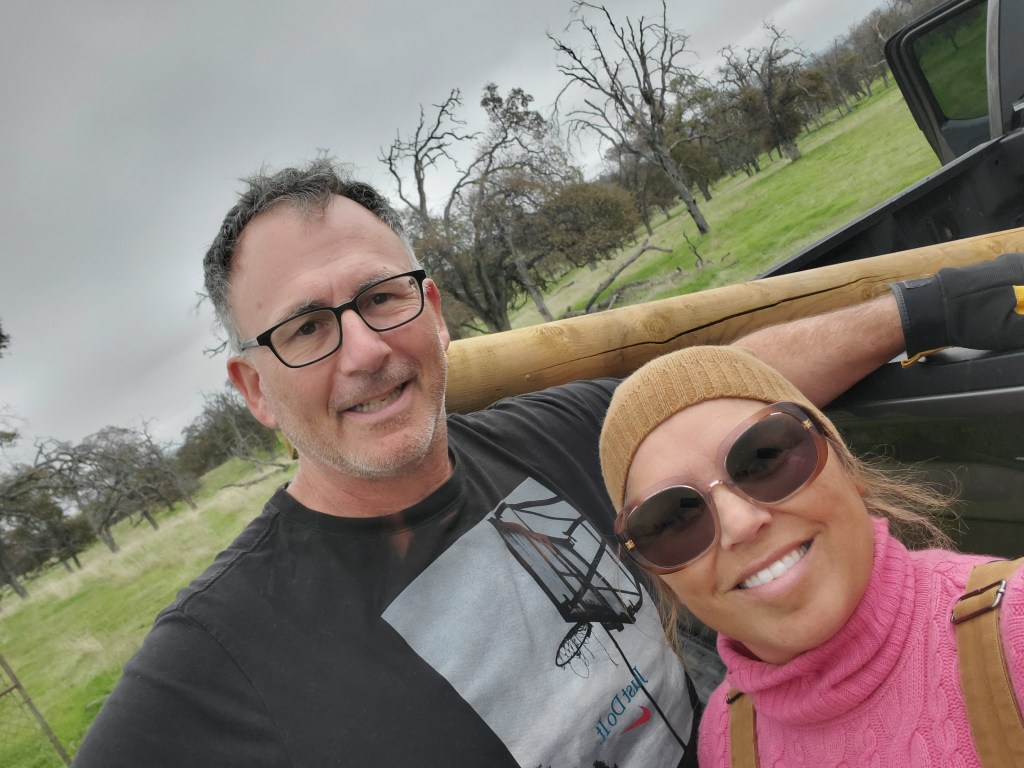
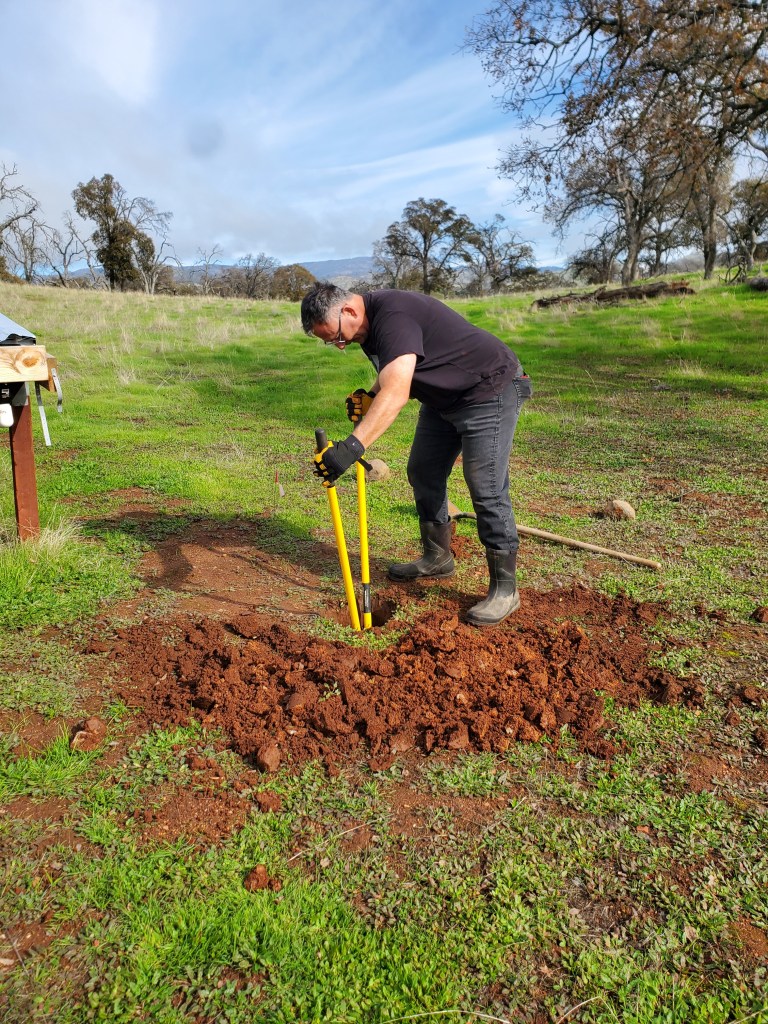
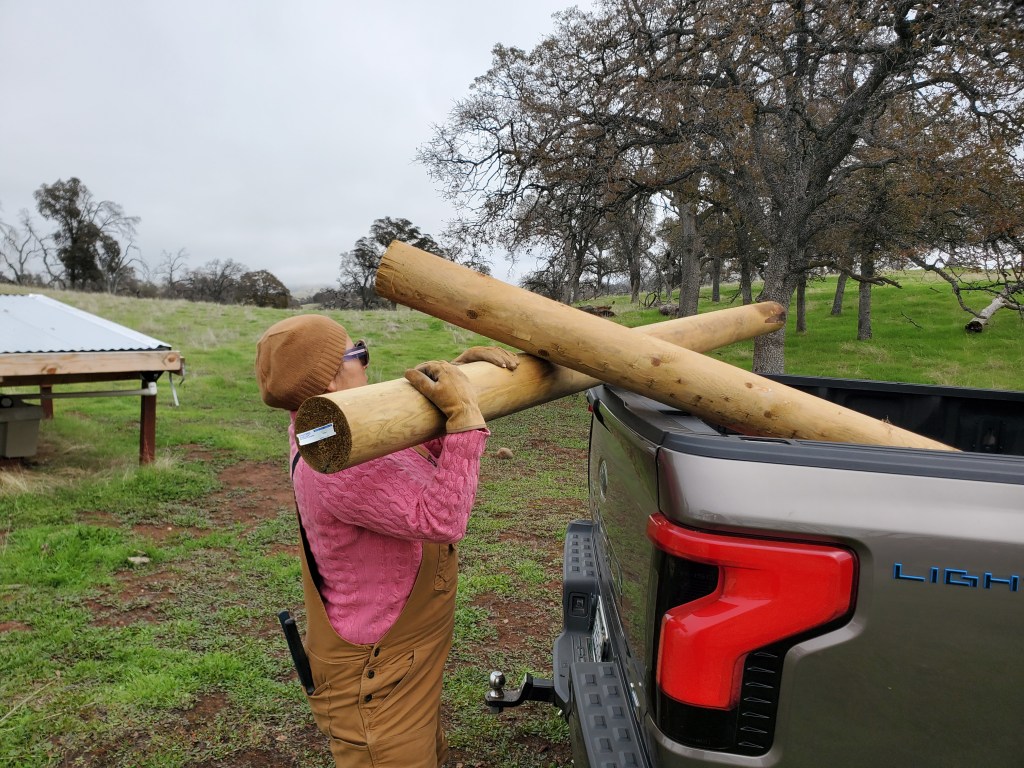
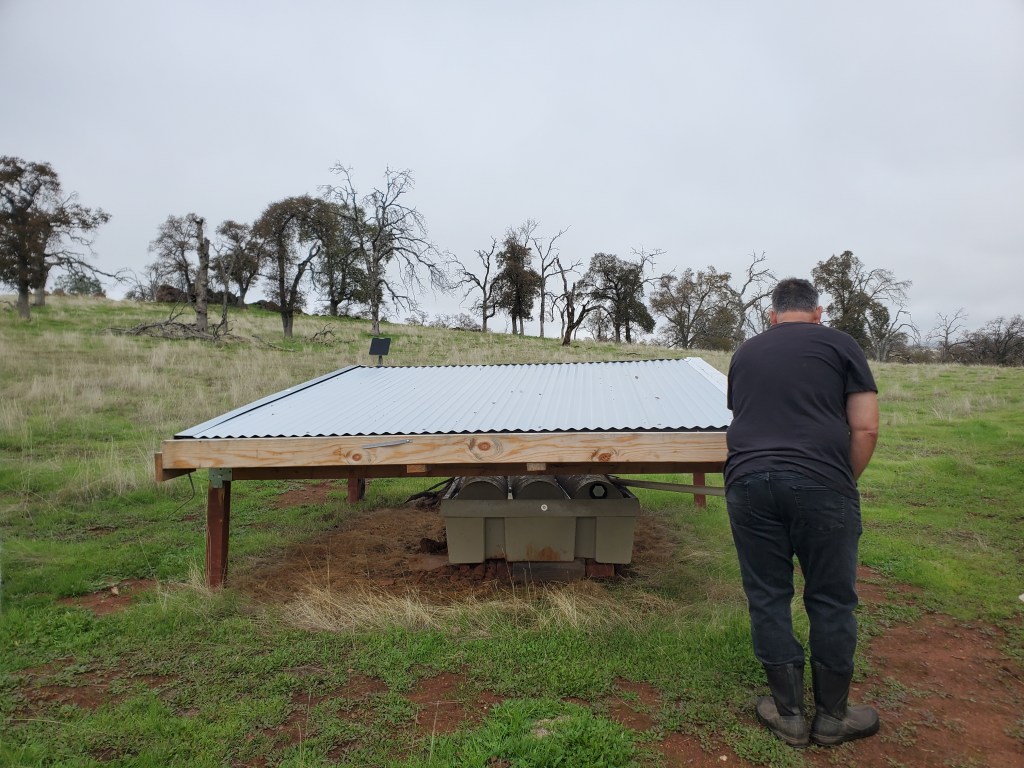
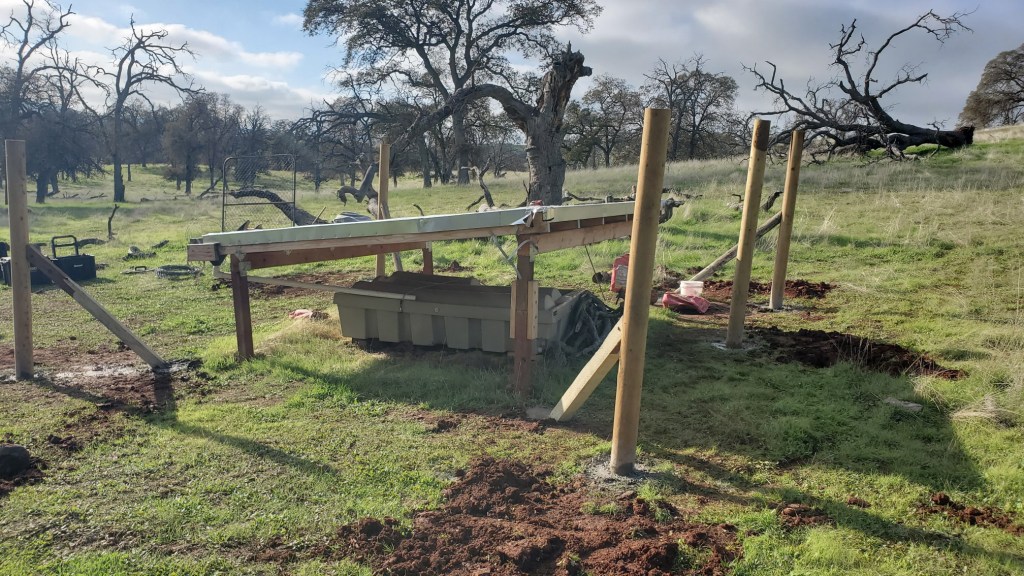
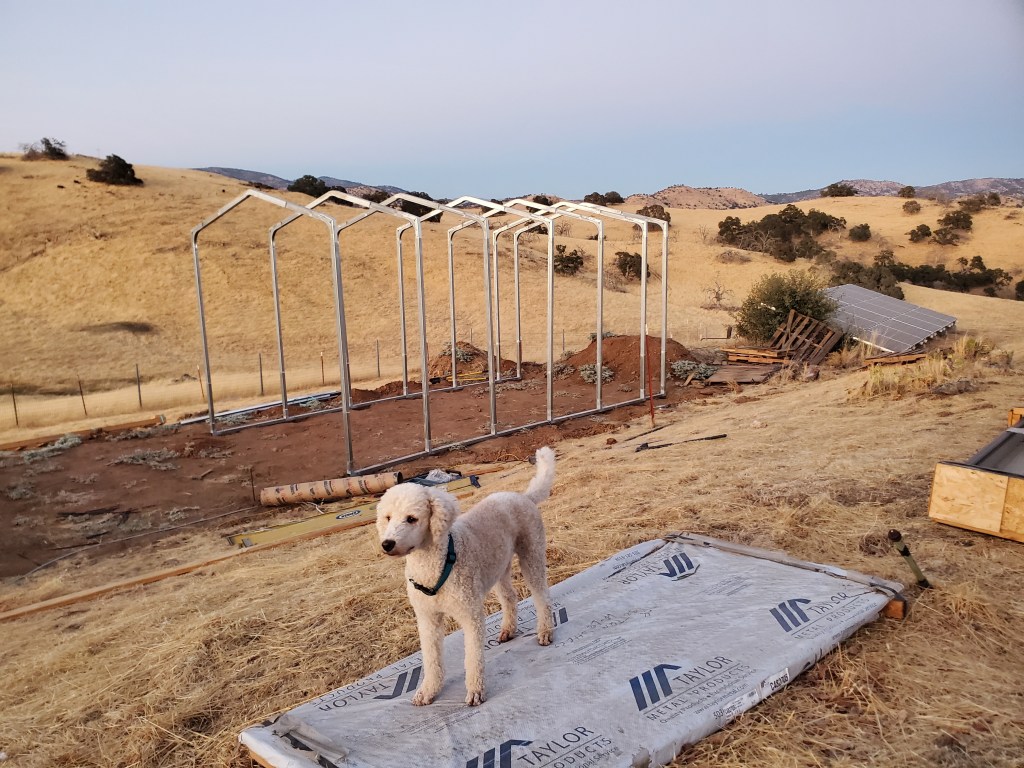
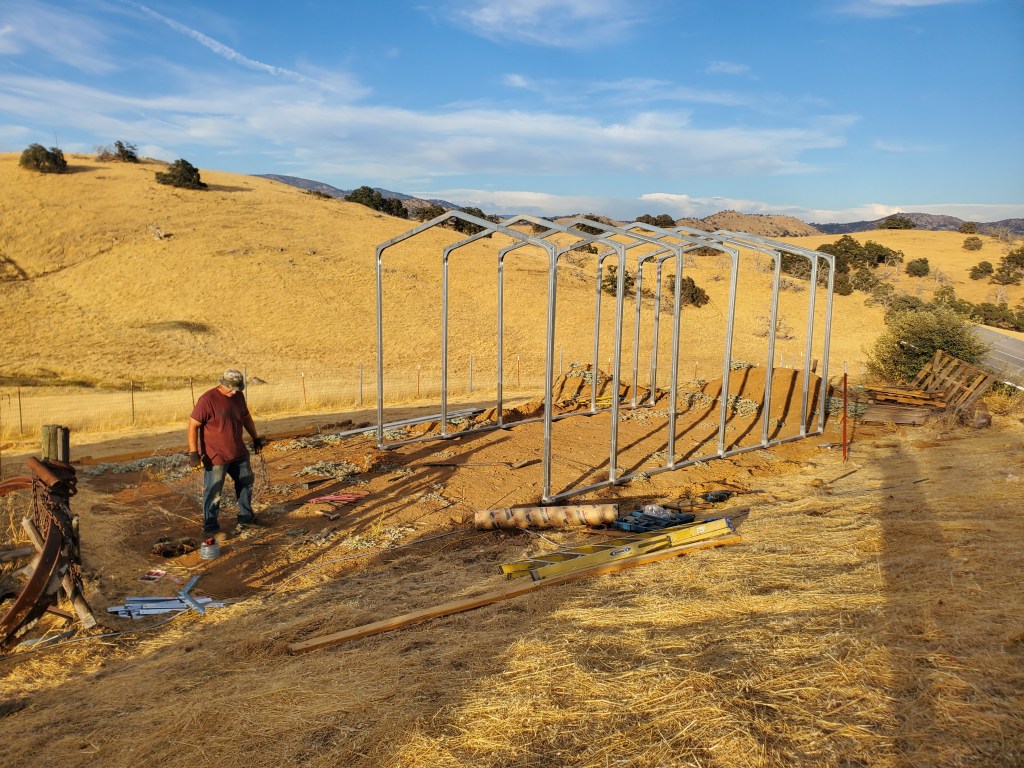
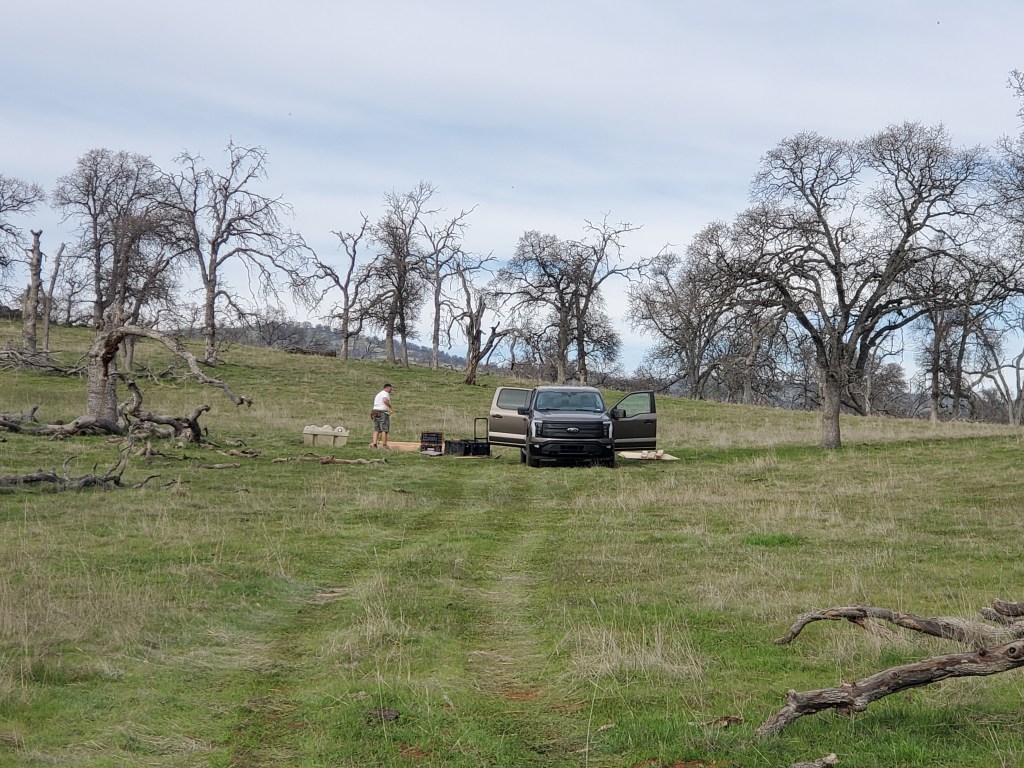
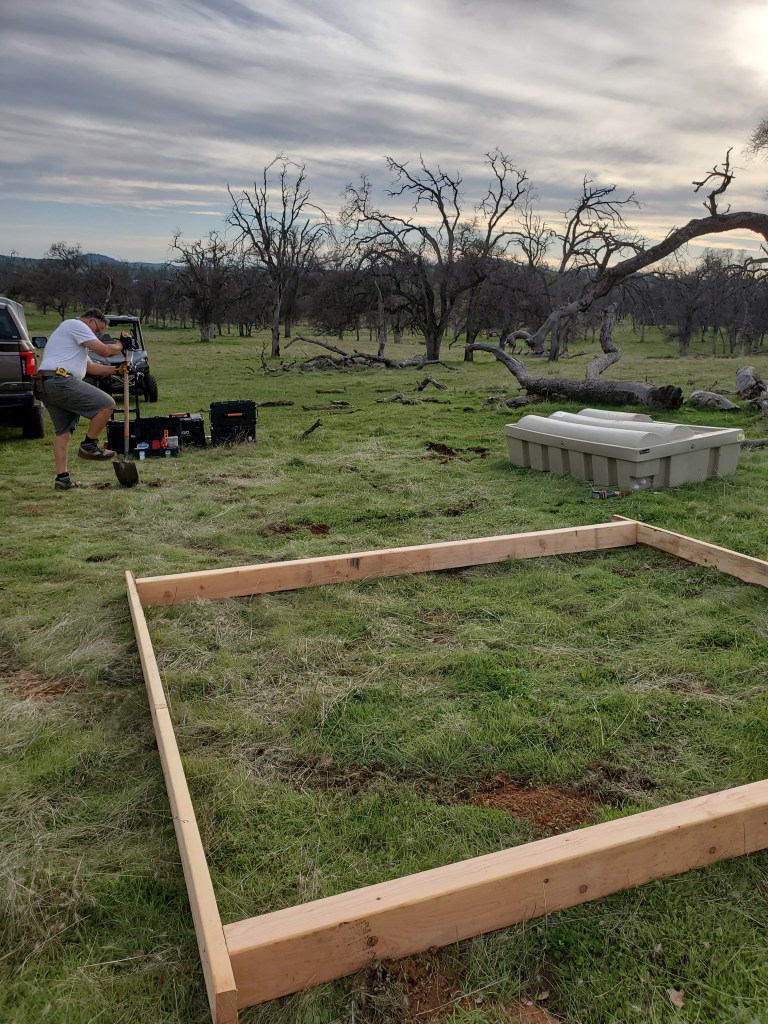
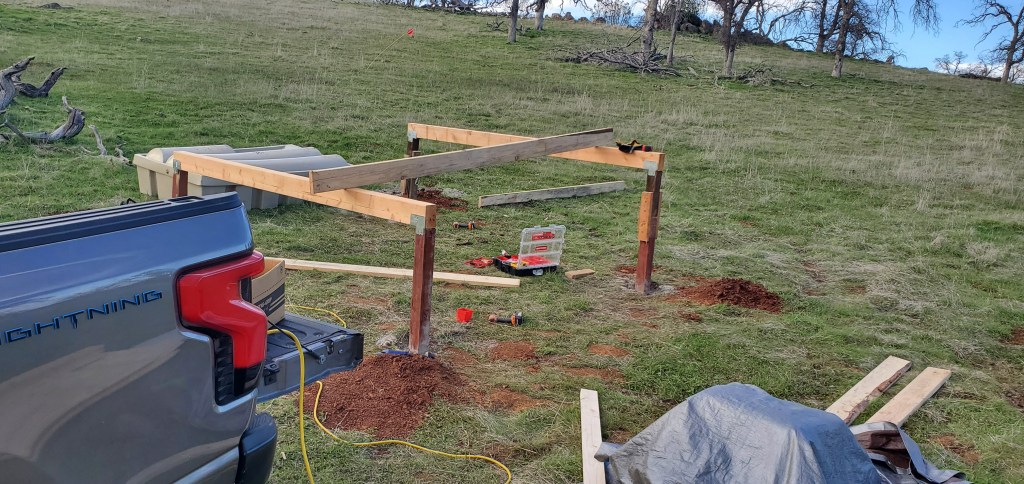
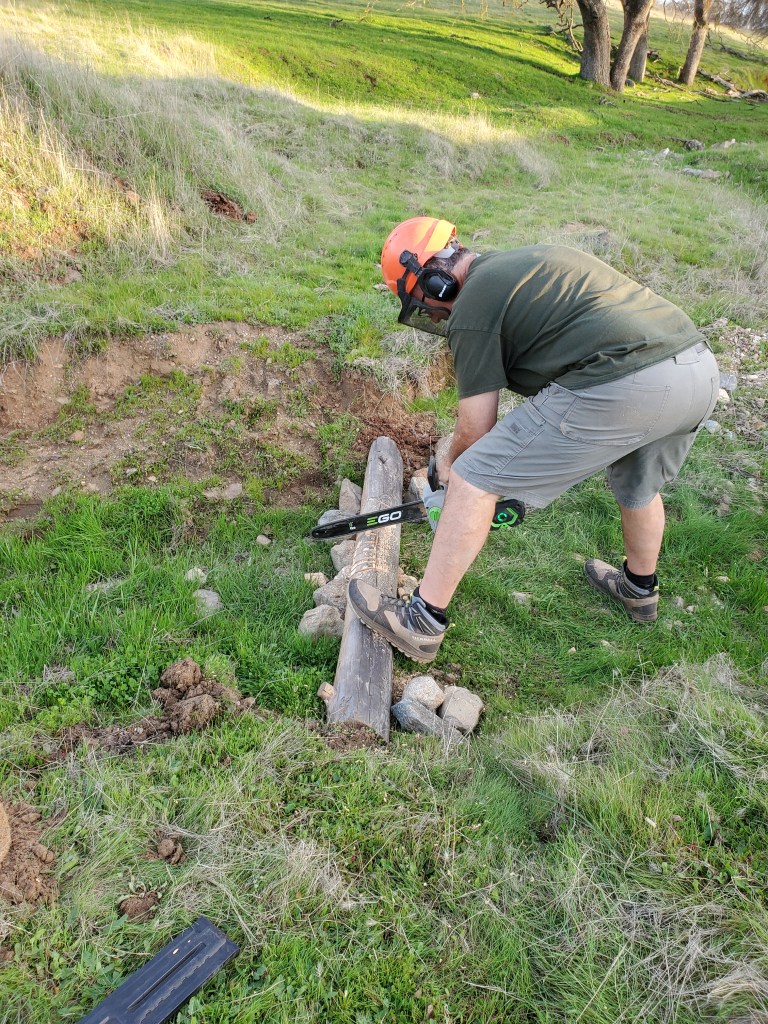
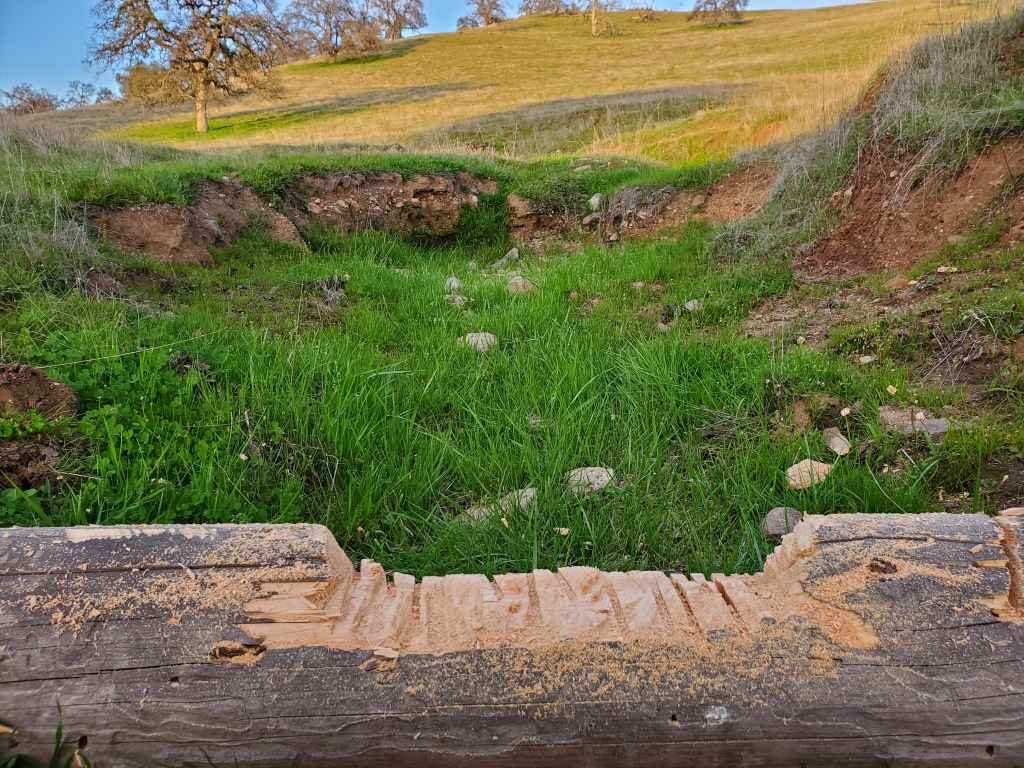
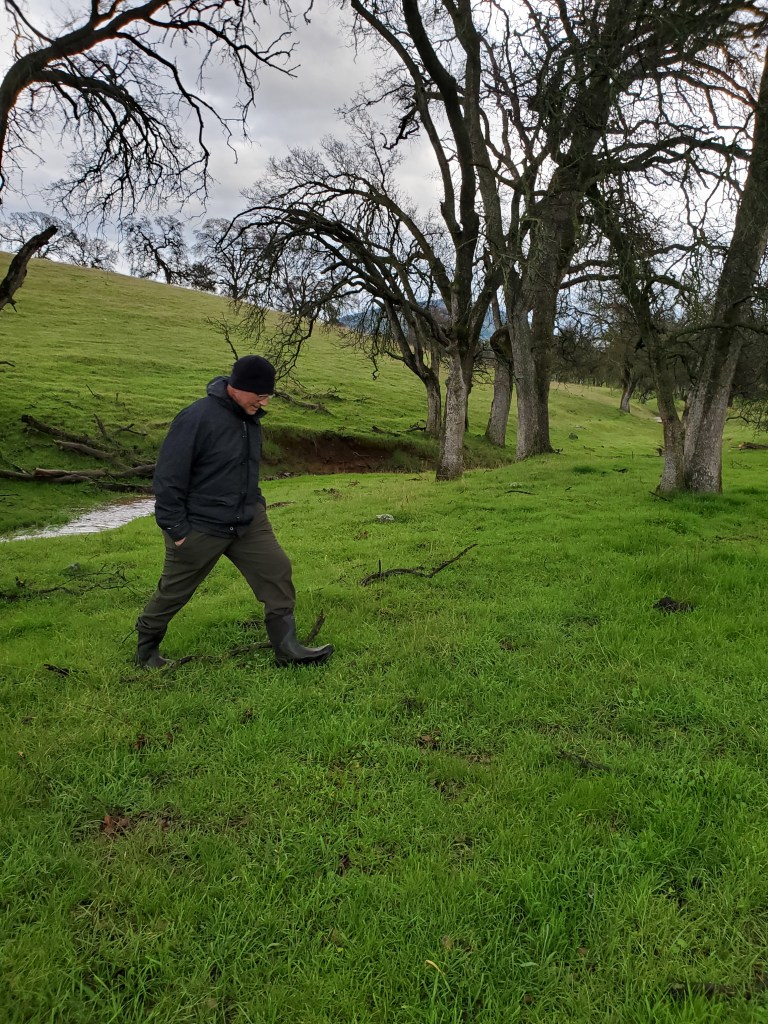
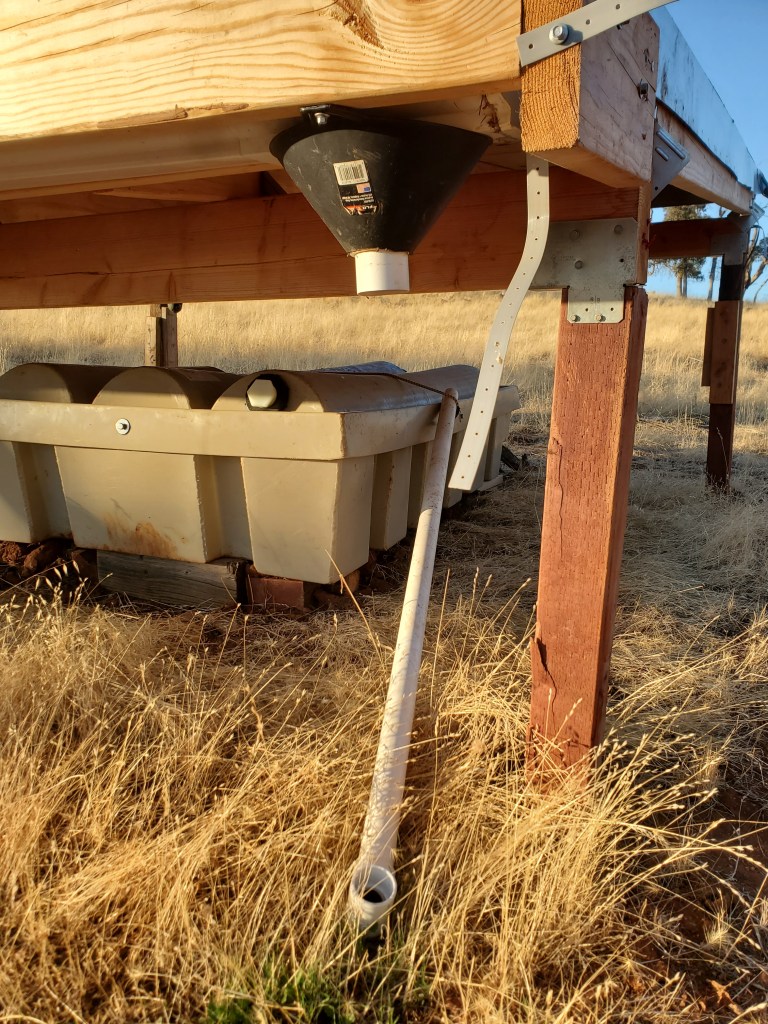
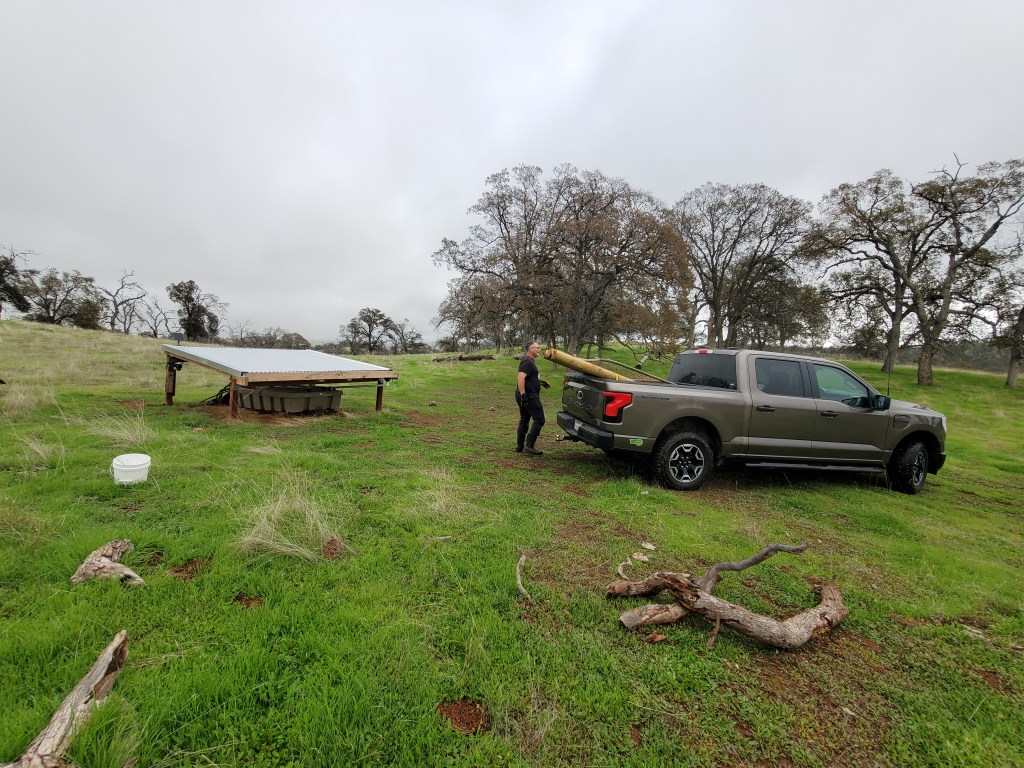
David and I have been building the protection fence around Guzzler 2 and prepping the ground and materials for the rainwater shelter over the tank that will feed the guzzler. We have gotten three bids to do the fence for us over the last few months because we have so many other projects. The first bid was outrageously expensive. The second contractor ended up in rehab (good for him!), and the third completely disappeared after sending a bid and communicating consistently. I started looking in the obits – grim I know – but I liked the kid. What is happening?

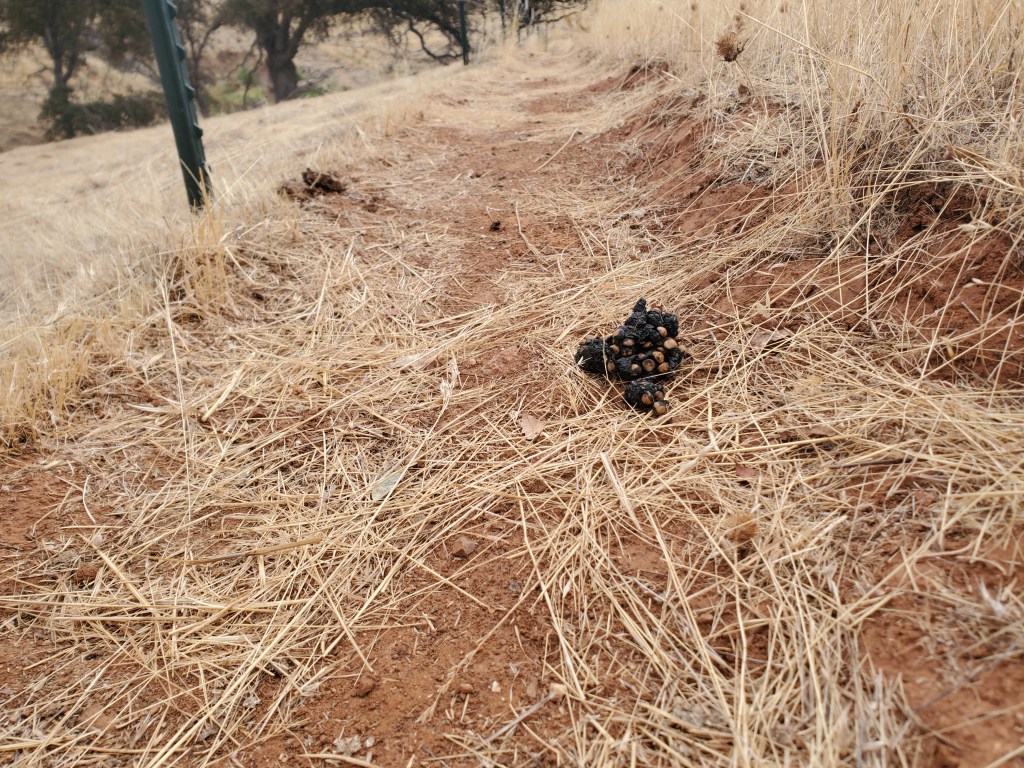
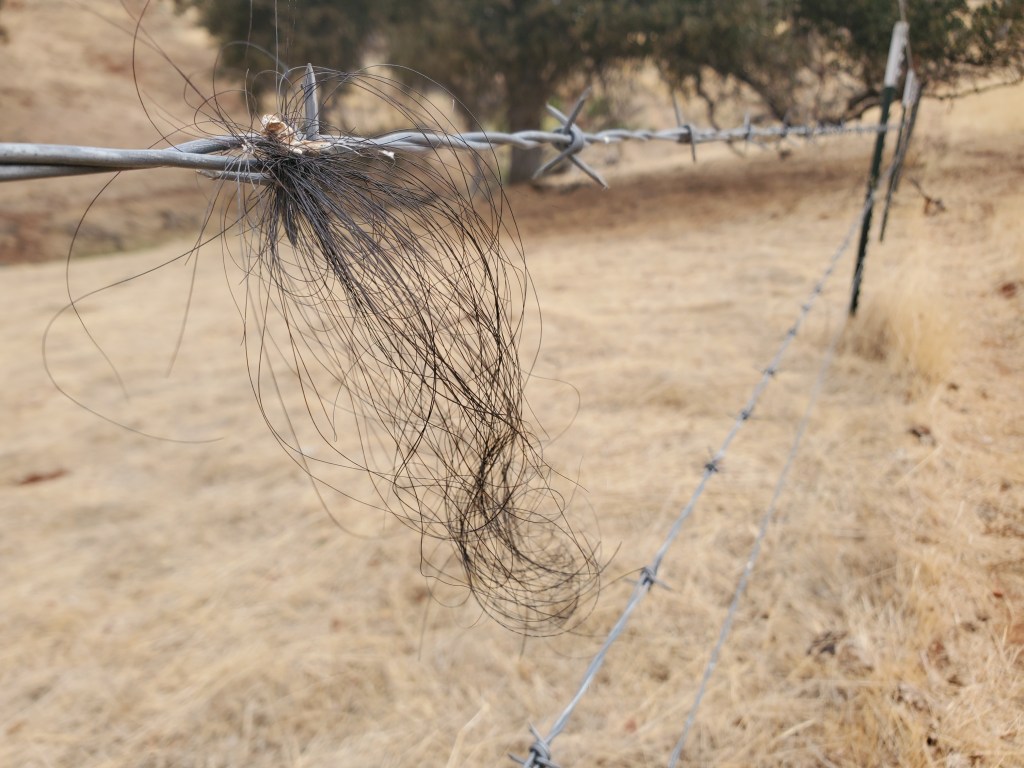
Time is running out, so David and I pivoted from other projects to focus on this one exclusively. Cows will be on the ranch in December. I had hoped to save David’s back and my neck by hiring out, but this must get done (and not for crazy money). If you are a regular reader, you may recall that I was hit by a car while biking in May. Unlike the movies where everything seems to end up perfect post an accident, in real life, everything is not ok. It remains difficult for me to work for long periods of time, my neck muscles ball up (which is very painful), my right thumb (which was broken) starts to throb and my leg, where it was tangled in the bike and still bruised, begins to sting. I share not to complain, but to ensure that the story is honest. Poor David is such a wonderful help. He digs and lifts, and lifts and digs. We have some spunk left in us for sure, but it ends up getting used faster than when we were younger.

Cows to Cocktails – a long story if you care to read it

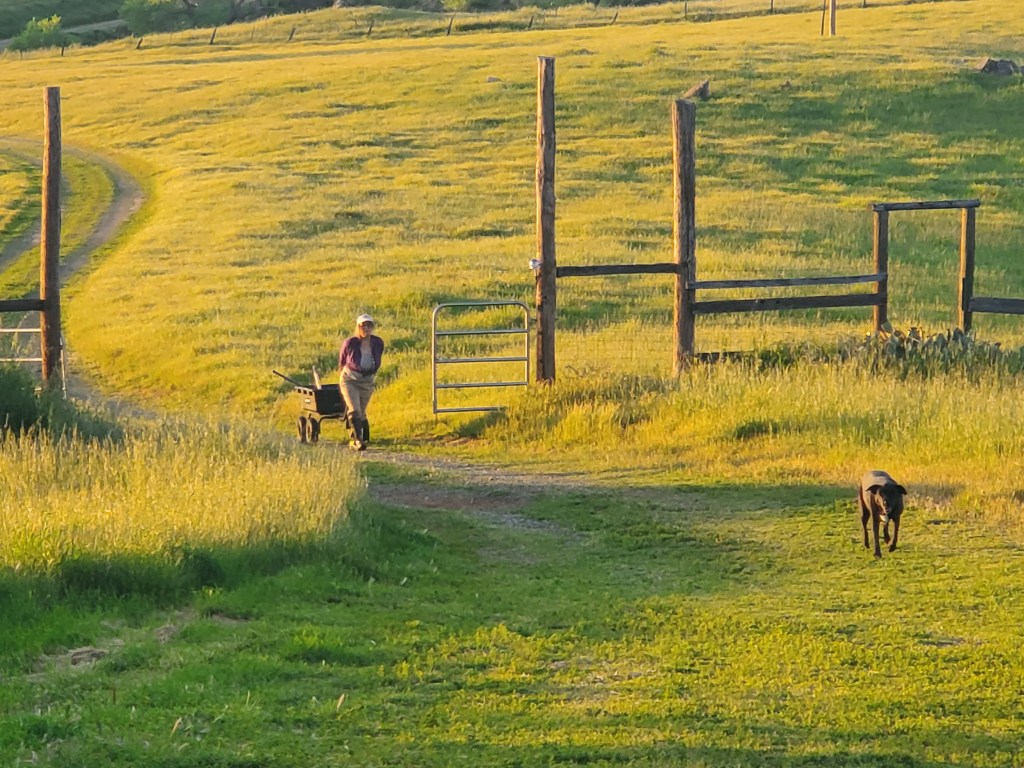
Life in the country is a joy. Where else can you spend two hours rounding up your neighbor’s loose cows, then jump in the shower, throw on a dress and enjoy a holiday season fundraiser event? Go from manure on your boots to sparkles on your shoes?

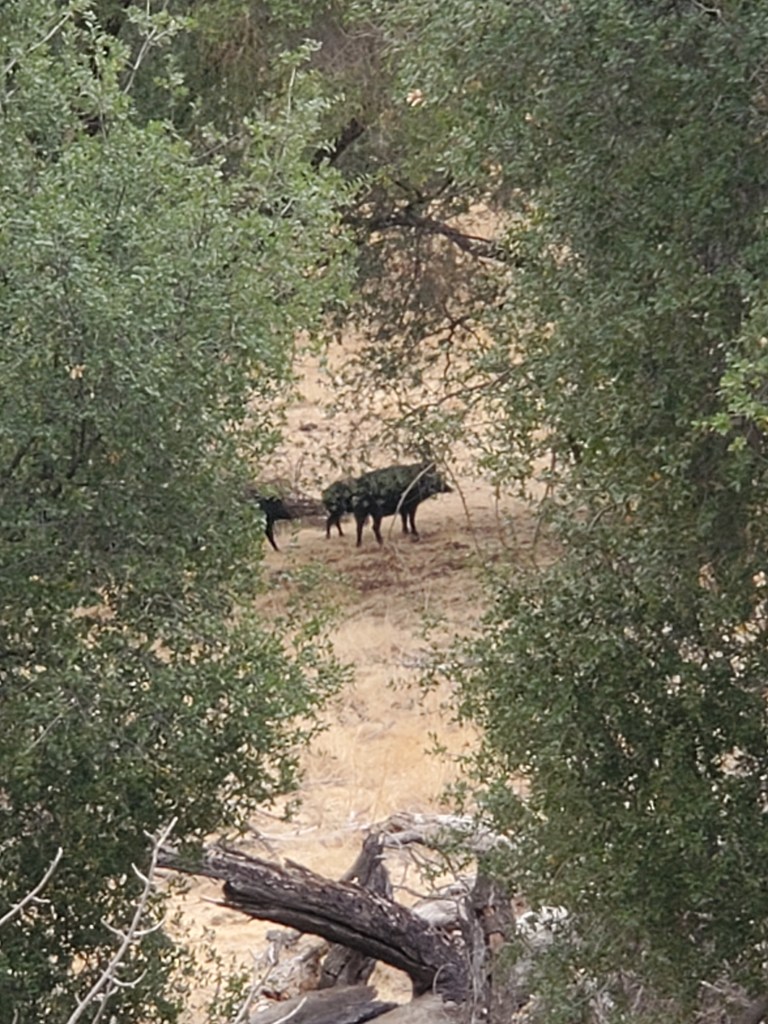
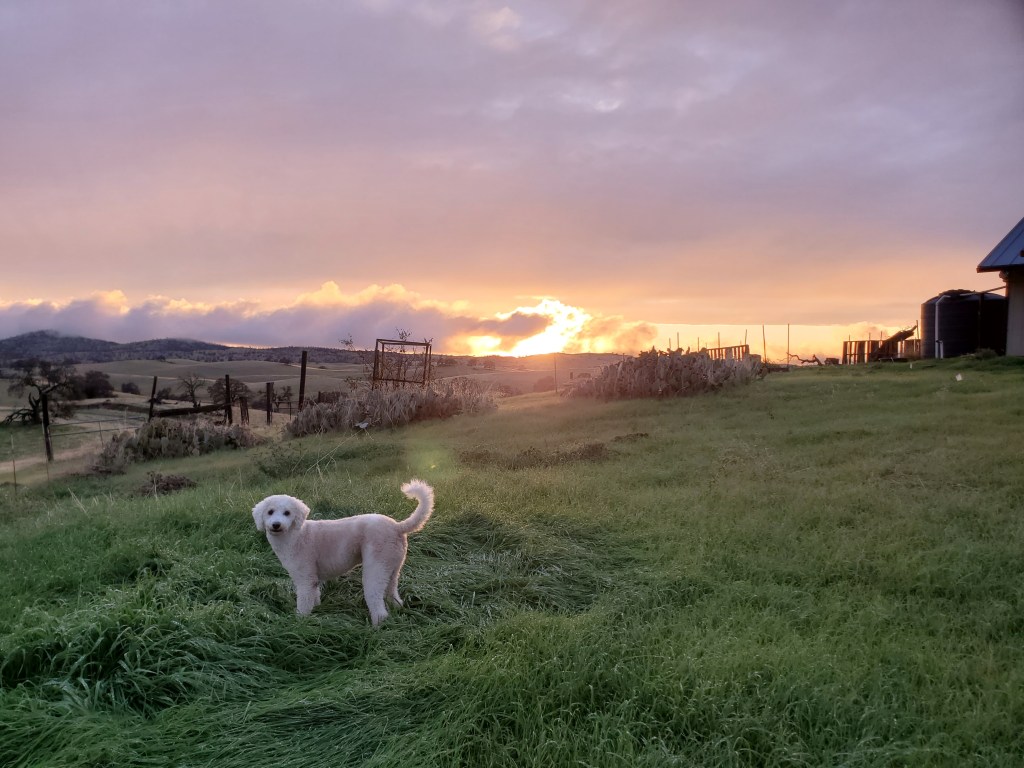
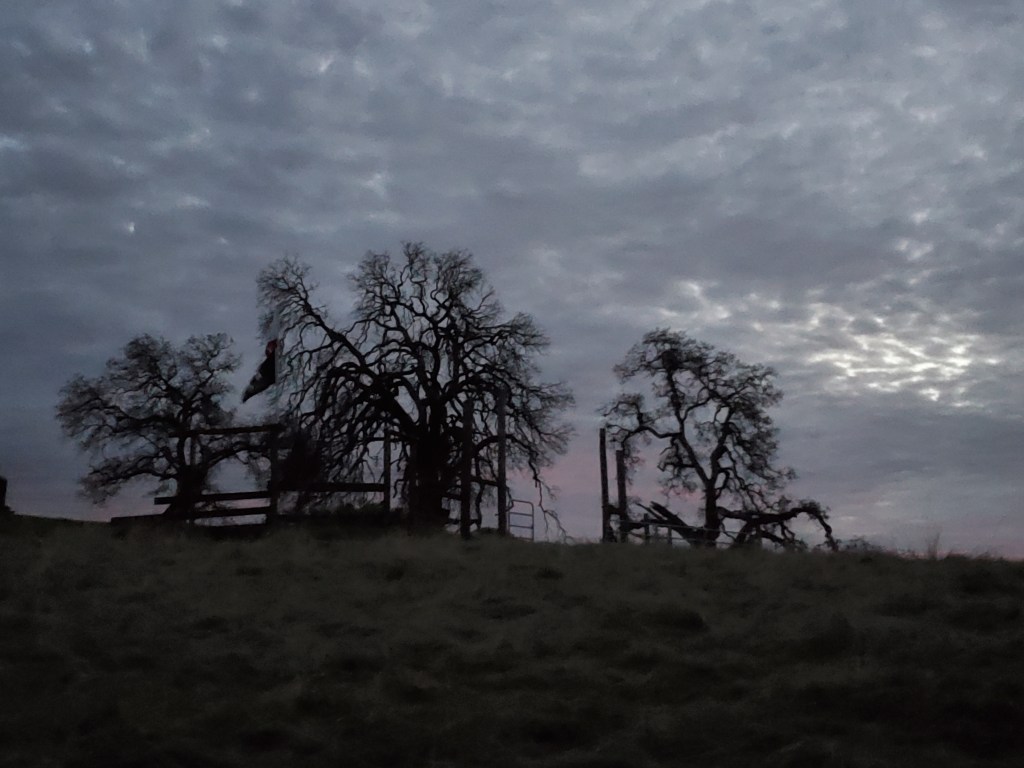
Last week, in the cold, early morning, around 6am, I went to let the dogs out to begin their day. The light was just beginning to illuminate the trees and hills. Frosted grass twinkled in the very dim light. I had a fundraiser to go to that evening, so had to think about my plan for the day. Nothing is close in rural California. If you have to do errands, even the closest commerce location is nearly a hour round trip – so you must plan your day well to get things done in time. As I went through my day’s list in my head, opening the door, letting the dogs out, in rote, I saw a dark blob in the near field. Then, there was another.

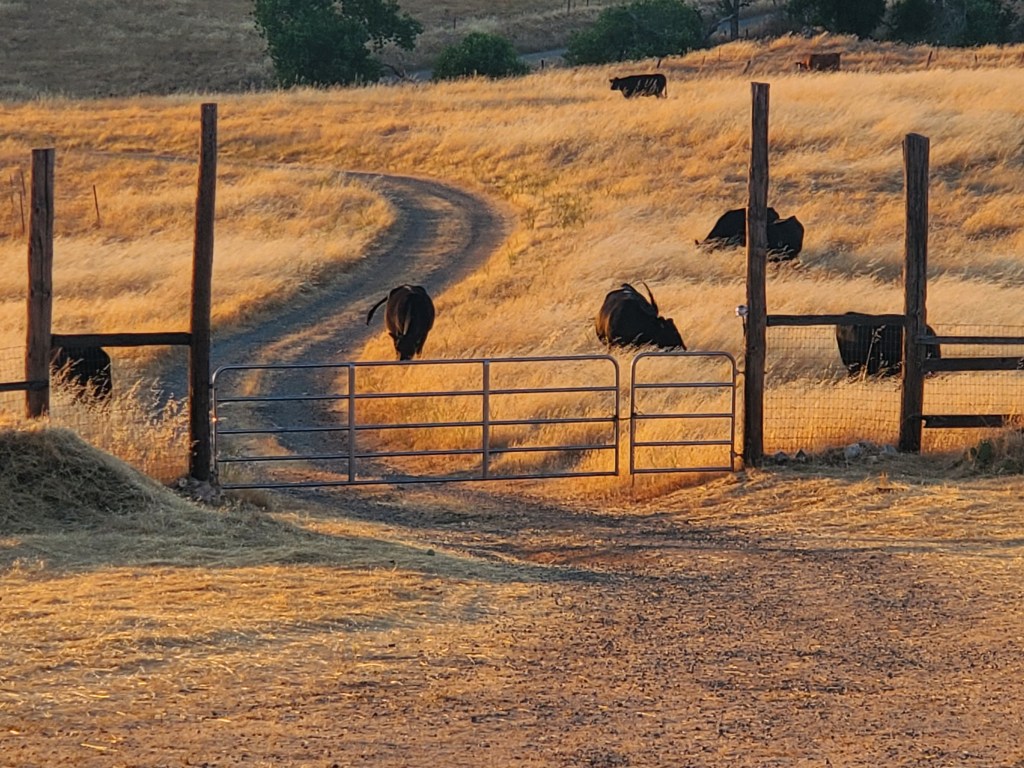
We have not had cows on the ranch since August. It was then my cattleman decided to retire out of the cattle business. He sold everything, and at a good time. Cattle prices are almost like gold on a hoof. As a result, we’ve kept the gates to the ranch and to the small enclosure around our home open for ease of coming and going.

I rubbed my eyes, looked again. As the light grew more, saw there were more in the field. I stepped out onto my concrete patio in my pajamas and sock covered feet, shivering a little at the shock of cold, and saw two more cows next to the trucks. Ok – I was fully awake now. What the heck was going on?

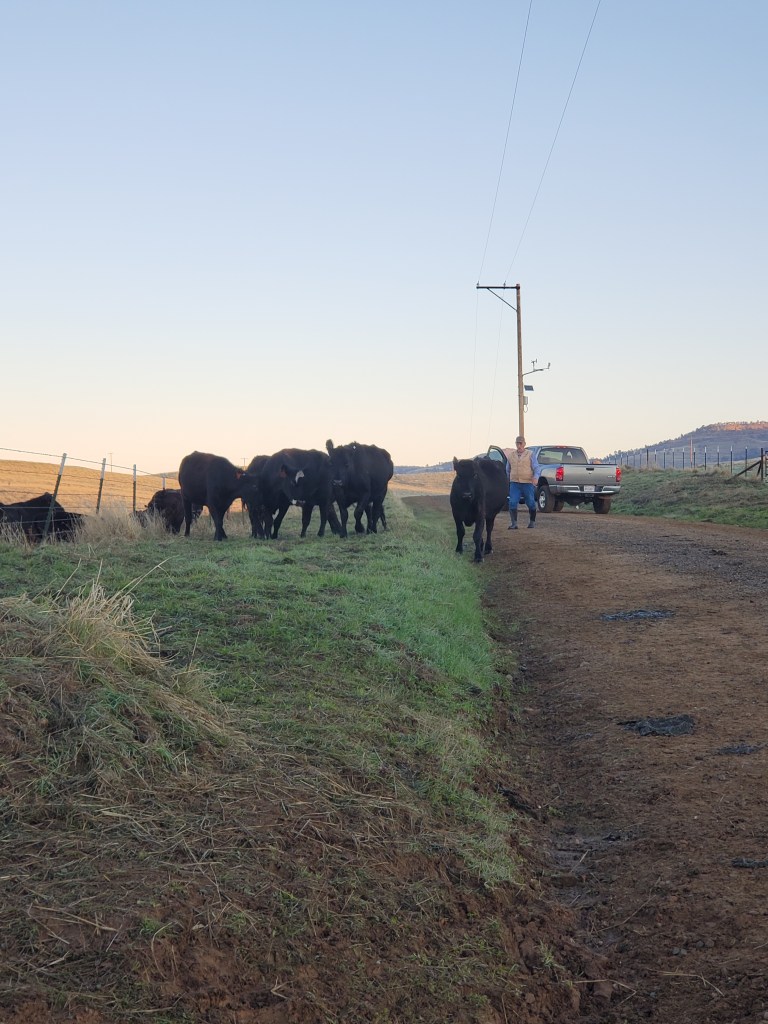
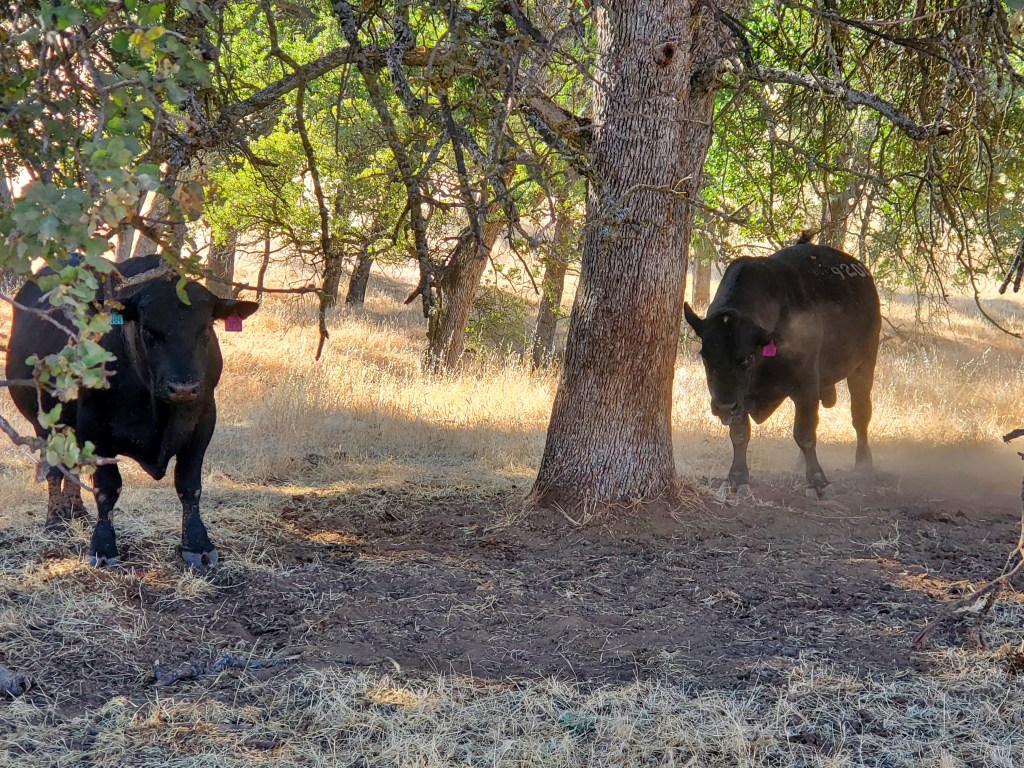
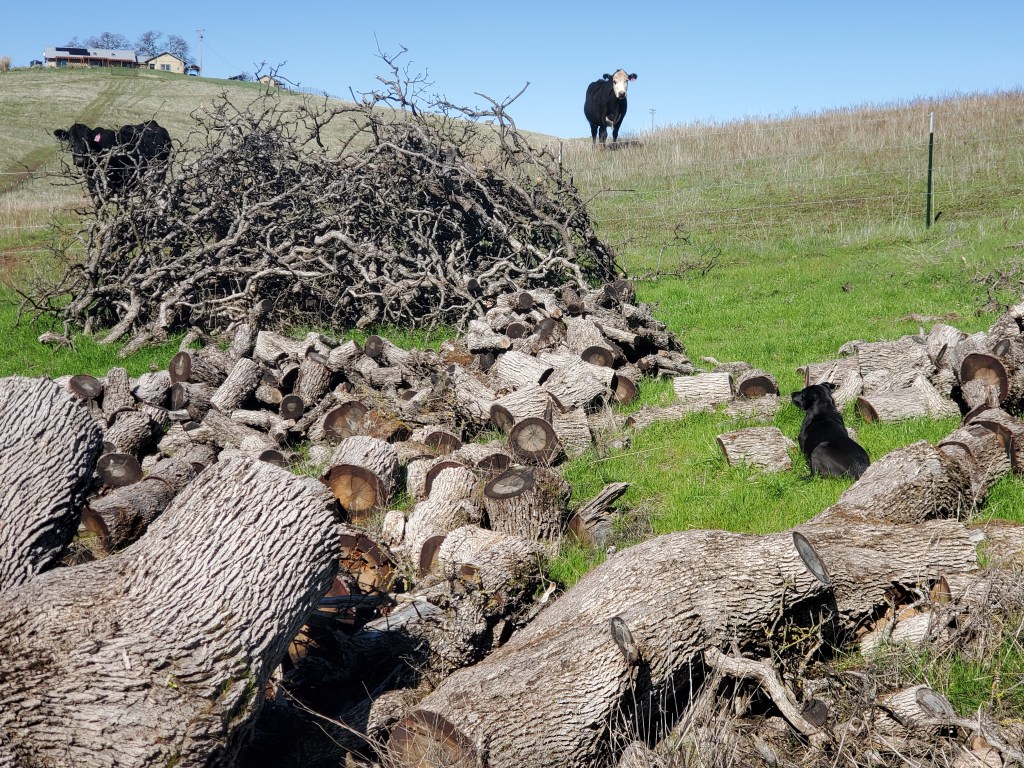
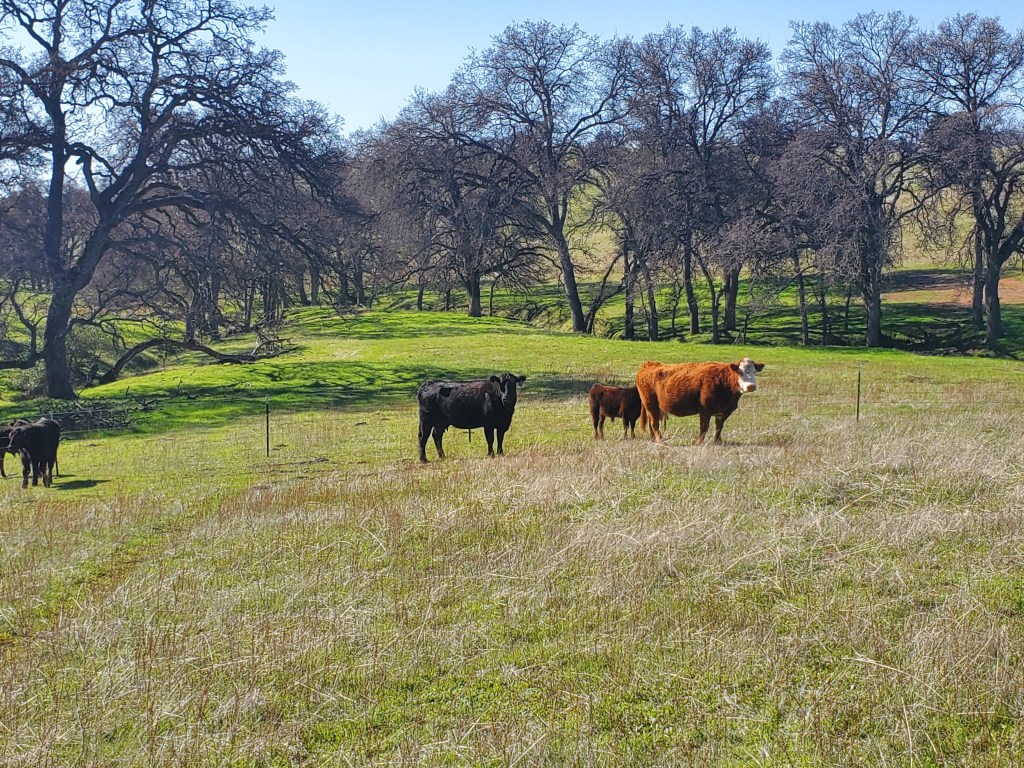
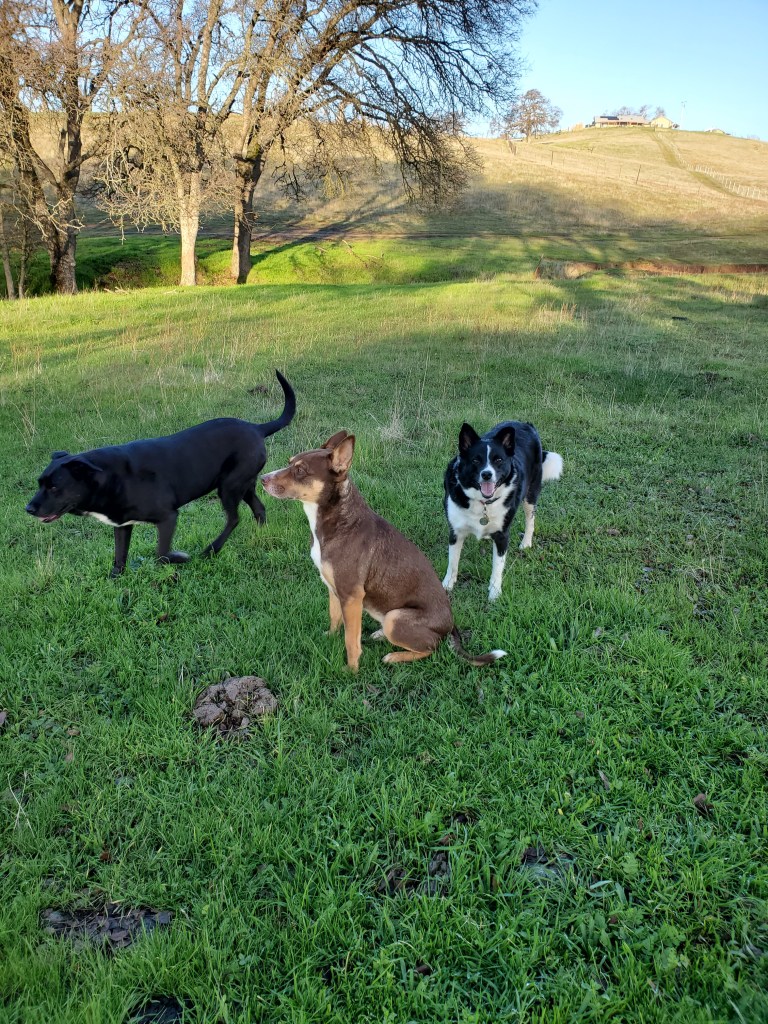
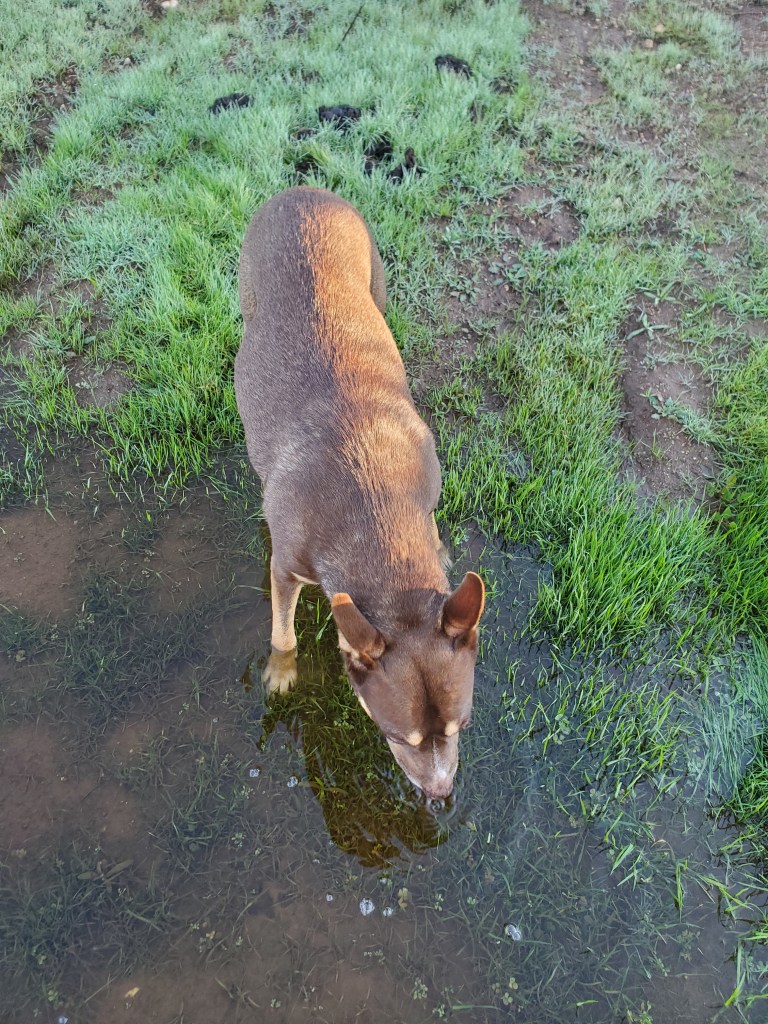
The dogs had done their business, and I hustled them in. They would be of no use to me. Millie, my nearly 12 year old kelpie, is arthritic and retired. The newer poodle, Pongito, is completely useless when it comes to cows. Better for him to be inside. I grabbed my hat, coat and jumped into my boots, in that order, and rushed outside. The neighbors had gathered the day before and left the cows overnight in a small, fenced in field. When I say small, it is about 20 acres with a small pond, on the corner of our rural intersection. There were over 100 of them. They had been mooing all night, protesting their enclosure away from wide open fields full of green grass.

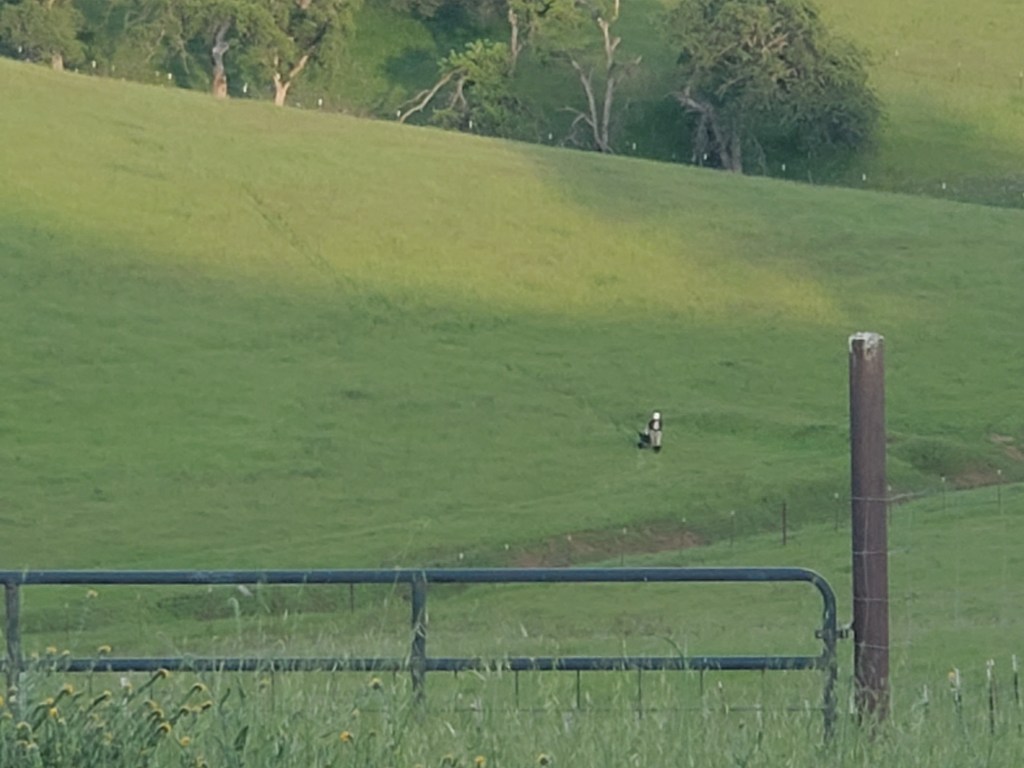
From my vantage, I can see the field clearly. My small home is on the top of a hill, and I have a fairly good view of the region. As I was well outside, moving the cows from my enclosure into the field, I could see the mass of cows had gotten loose and some had spilled into the road and into my neighbor’s ranch as well as my own. It is not how I wanted to spend my morning, but having loose cows on the road, especially so many with small calves, was a dangerous hazard for both cow, babe and motorists. Imagine driving 55 to 65 mph on a paved road, coming around a corner, and seeing a mamma and calf. Calves are not grown enough to have a sense of the road. As a unit, they move slower than just a single cow. I had to act fast.

First, I got the cows out from next to my house. I was on foot, so ran to the bottom of the driveway, 1/8th a mile from the house, and closed the gate. Ok, this group would be safe from the road and could be gathered and moved later. However, I did not want them to disburse across 360 acres of ranch, so I would need to close off the far north field. The small group of 3 cows and 5 calves were walking toward the cattle road and the open gate to the rest of the ranch. I quickly headed to the gate to shut it. Remember, these cows don’t know me. I cannot just out run them. They can spook, and worse, since it is a mamma and baby already in a tense, unfamiliar situation, mamma could get upset. It is a delicate situation. You have to more feel their energy, their direction, than see it. Too fast and you can push them right through the gate. They are faster than you after all. Too slow and they will beat you to the gate. Too close and they can get upset. Too far, and you have no pressure on them. It’s delicate.

I moved quickly, not fast. I kept a wide, but forward movement. That stopped them advancing and bought me more time to gain more ground. They watched me intently from their uphill vantage, finally turning away as I made it to the gate and swung it shut. One down. Next, I had to run back up the hill toward the house. The cows had turned the opposite direction and began walking toward the drainage, Swale Pond and Spring Creek where there was another open gate. I had to cut them off, which meant going to the top and over the hill.

As I got to the top of the hill, I saw that the pack had kept close to the fence line and was headed for the open gate. Luckily, they had crossed the drainage, swinging them wide, buying me more time. The green grass too was tempting -slowing them down as they would grab a mouthful and continue to move. Please remember, I am not the most fit person. I’m chubby, filled with too great a love of peanut butter. Moving my mass is not an insignificant task. I fast walk in a trudge more than alight. By now, although 49 degrees F, I am sweating in my pajamas, boots muddy and wet.

Seeing them still headed straight for the gate, I let out a yip so they could see me, and know I was there coming toward them. They stopped to look. I had the advantage now. I was higher than them, and “trudging” as quickly as possible down the hill. They about turned and headed north up another hill away from the gate. That was great. I got to there, closed it, turned around and headed back up hill to deal with the rest of the cows on the road.
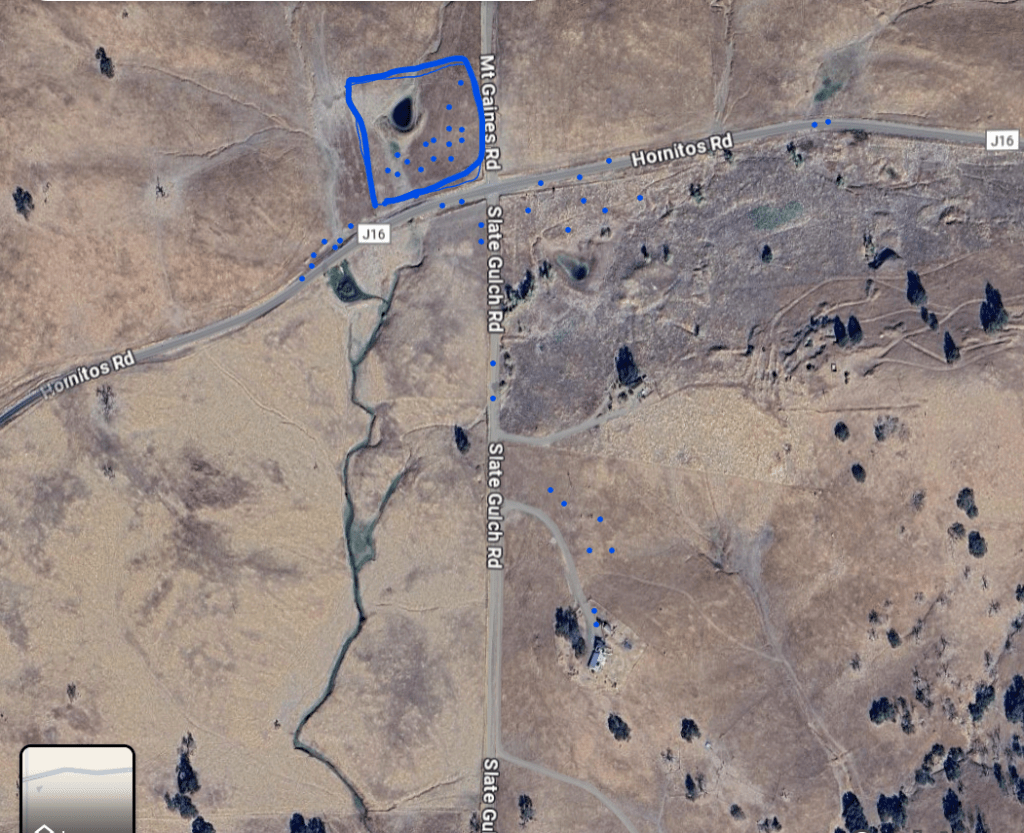
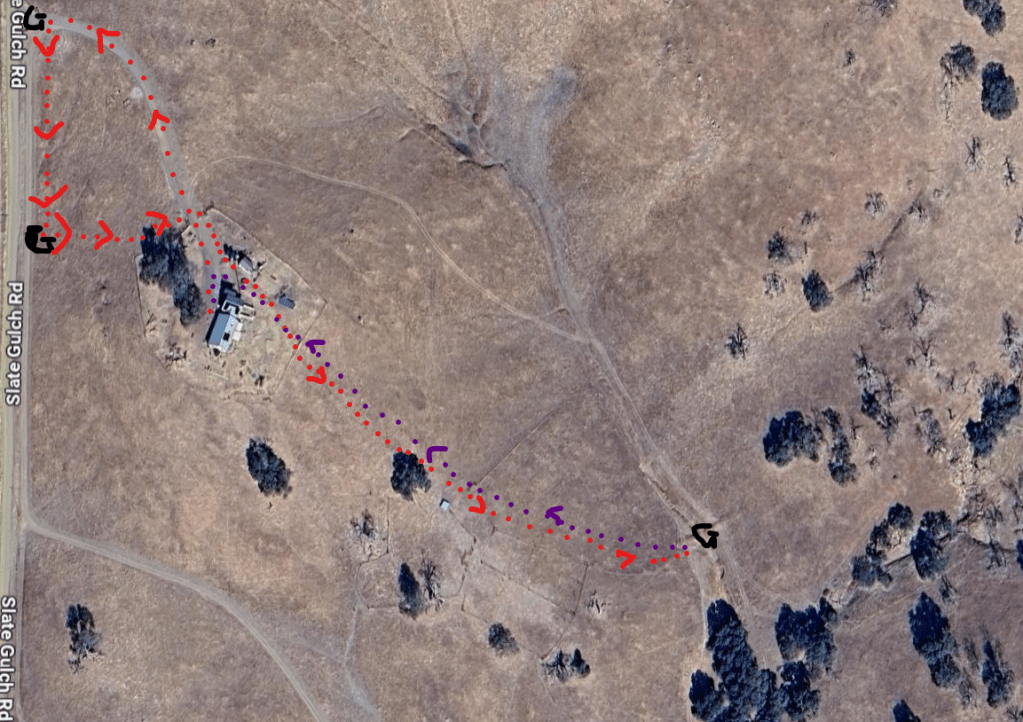
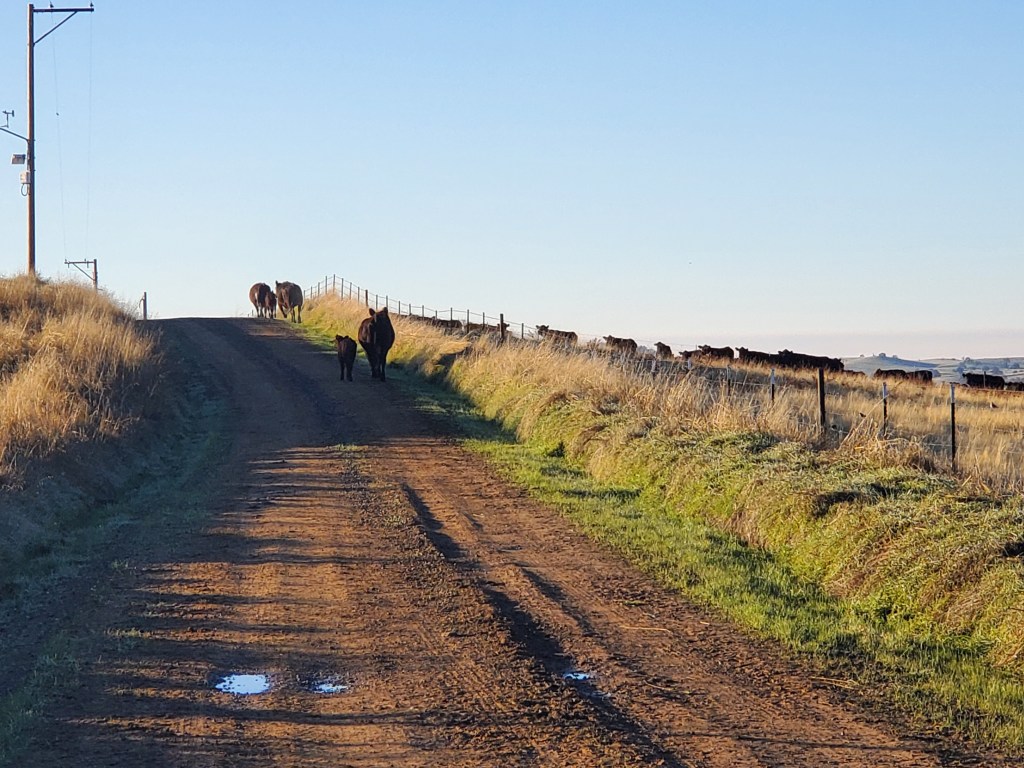
Once back at the top of the hill, I jumped into the polaris and headed toward the main road. I saw a bunch to the left on Hornitos Road, so turned left, and sped by them. I made a “u” turn and slowly walked them back to the dirt road of Mt Gaines. As I approached the intersection, I parked the polaris, jumped out and went out wide to convince them to turn up the dirt road rather than stay on Hornitos Road. As I was walking back towards them, an old friend Joel drove by. He saw the mess and pulled over to help. Joel is our retired Under Sheriff and husband of our retired (and excellent) county supervisor, Janet. They are also cattle people. He and his brother in law (BIL) Timmy were on their way to help another neighbor work their cattle that morning. Timmy was well behind him, so Joel called to let him know what was going on. Joel went up the dirt road and brought them back down where I had opened the gate to the smaller field where all the others were gathered. It is a trick to keep the cows in while the gate is open. Together we managed it, and got most off the road. Joel went on, and I waited for Timmy, who had called to let us know that there were more down the road.
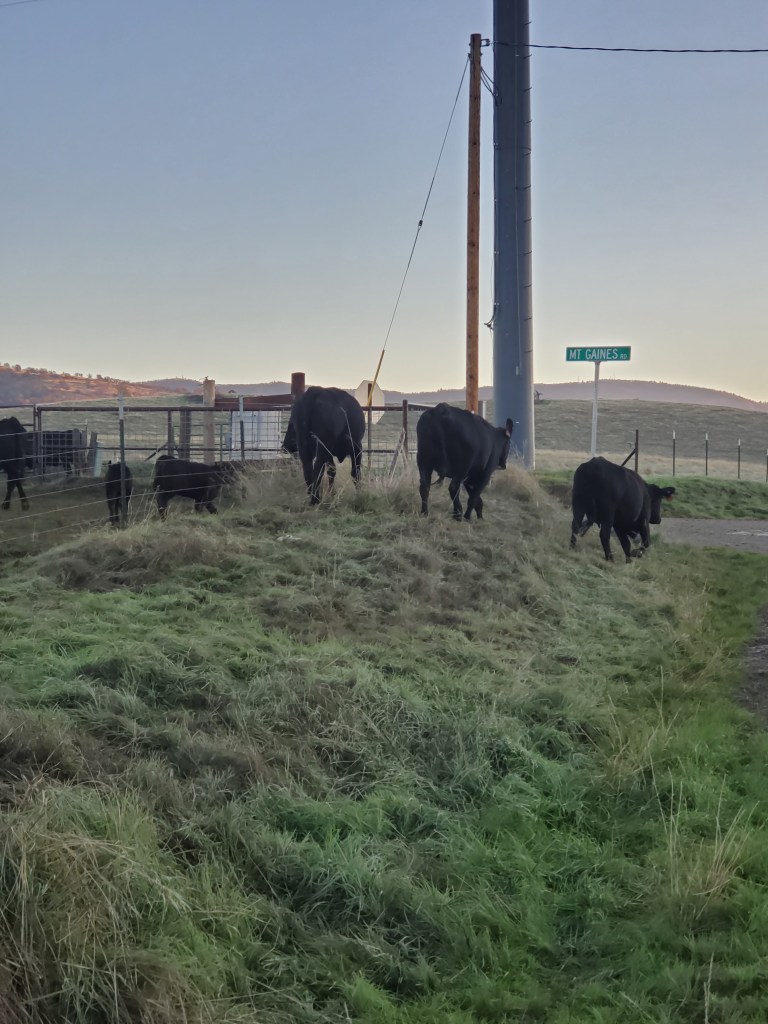
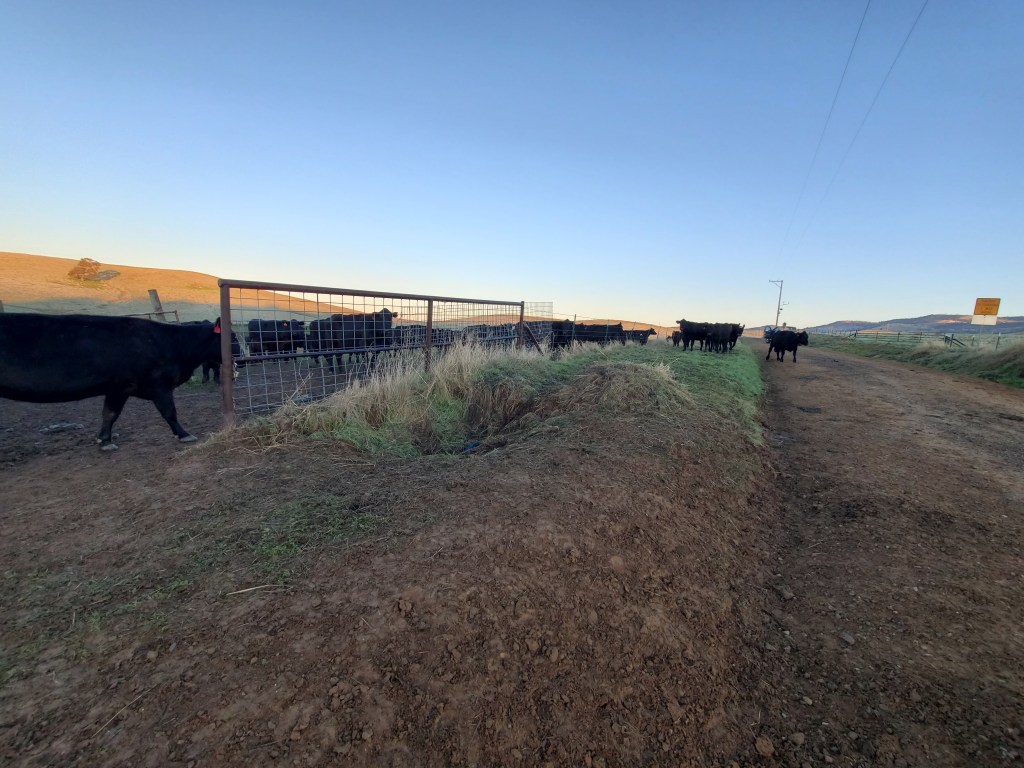
I finally saw Timmy cresting the hill, slowly driving the cow and calf he found toward the pasture. He got them onto the dirt road, pulled over, and after some discussion, decided he would gather the 5 or 6 that were on my neighbors ranch. She bought her place recently, and the prior owner really let it fall apart. As a result, the fences were wrecked, which enabled the cows to get onto it. Knowing that the cows would likely get back onto the road to go back to the gathering pasture where they likely left their calves, Timmy pulled his horse out of his trailer, and rode onto the ranch to gather the cows. I hid out of site and he was able to bring them out and onto the dirt road. They moved up the dirt road. Timmy said he would stay and open the gate if I could go up the road and move them back. I took the polaris up the road, and brought them back, pushed them into the open gate. Timmy shut it, and we were finally done.

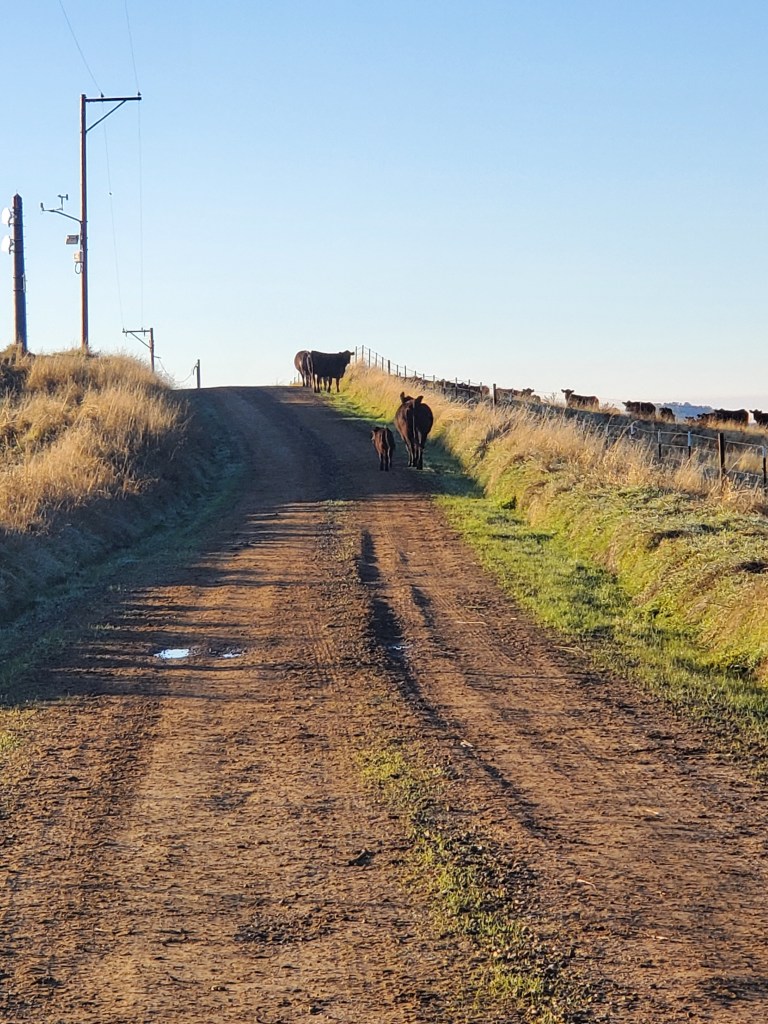
Later, the neighbors who owned the cattle came to assess the situation and gather the last of the cows off my piece and herd them onto theirs. Evidently, a gate was left open. They don’t know how. They said it had been locked. At least they were off the road, and everyone – cow, calf, human – was safe.

I went home, ate breakfast, did chores and then got ready for the event. Never a dull moment here!

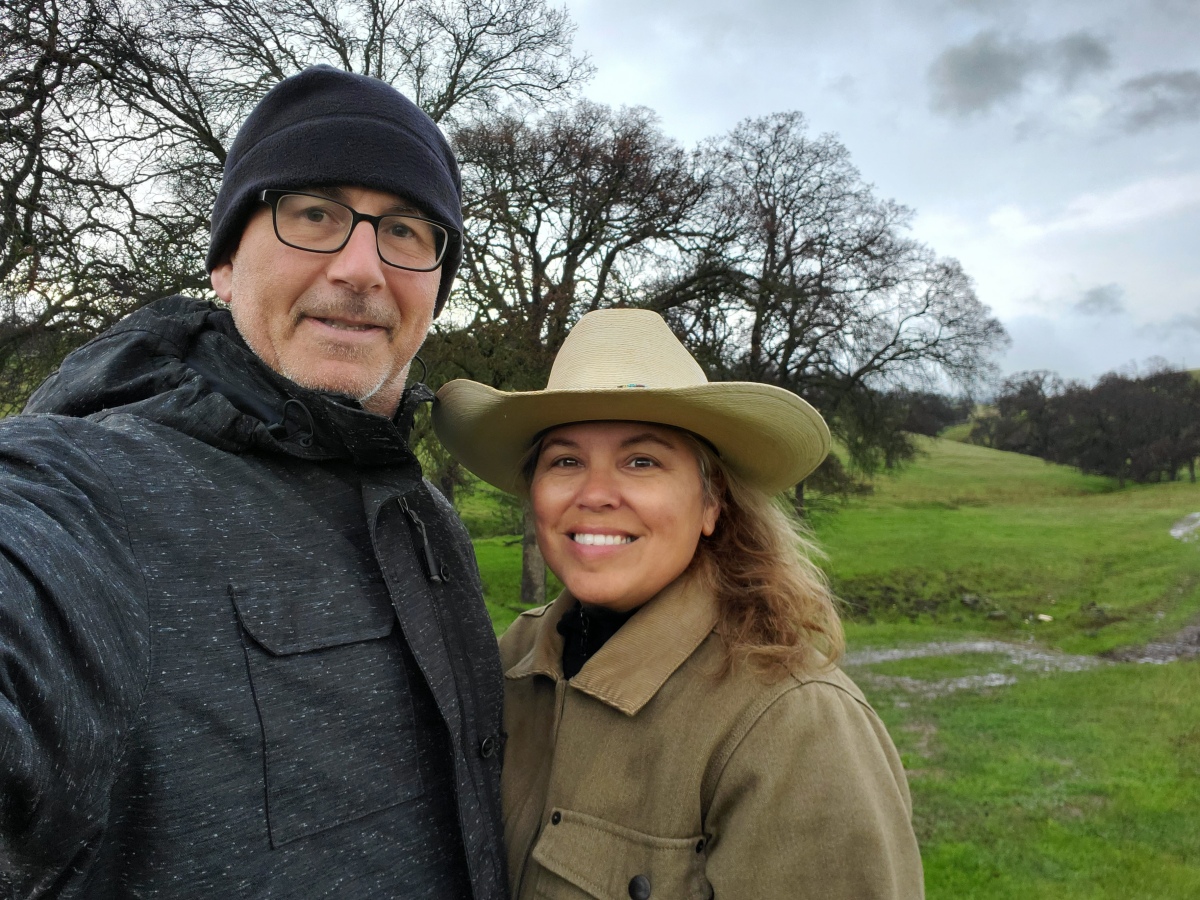
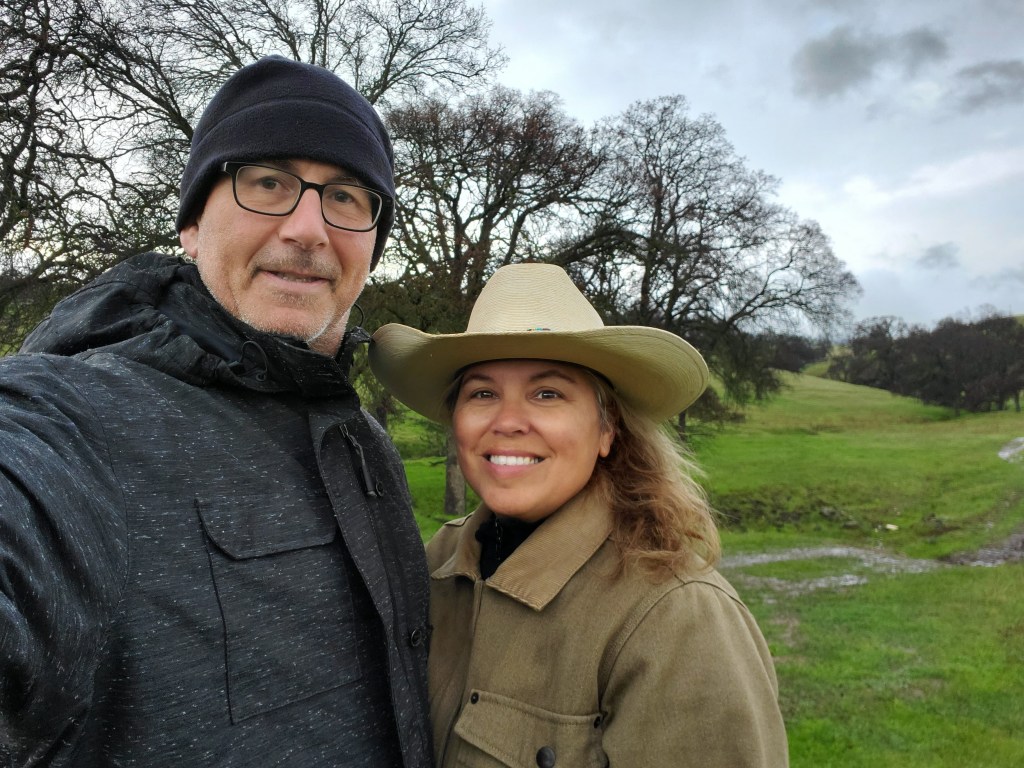
My love and I – a photo from the fundraising event. We clean up quick and decent!

The Beauty of this Planet

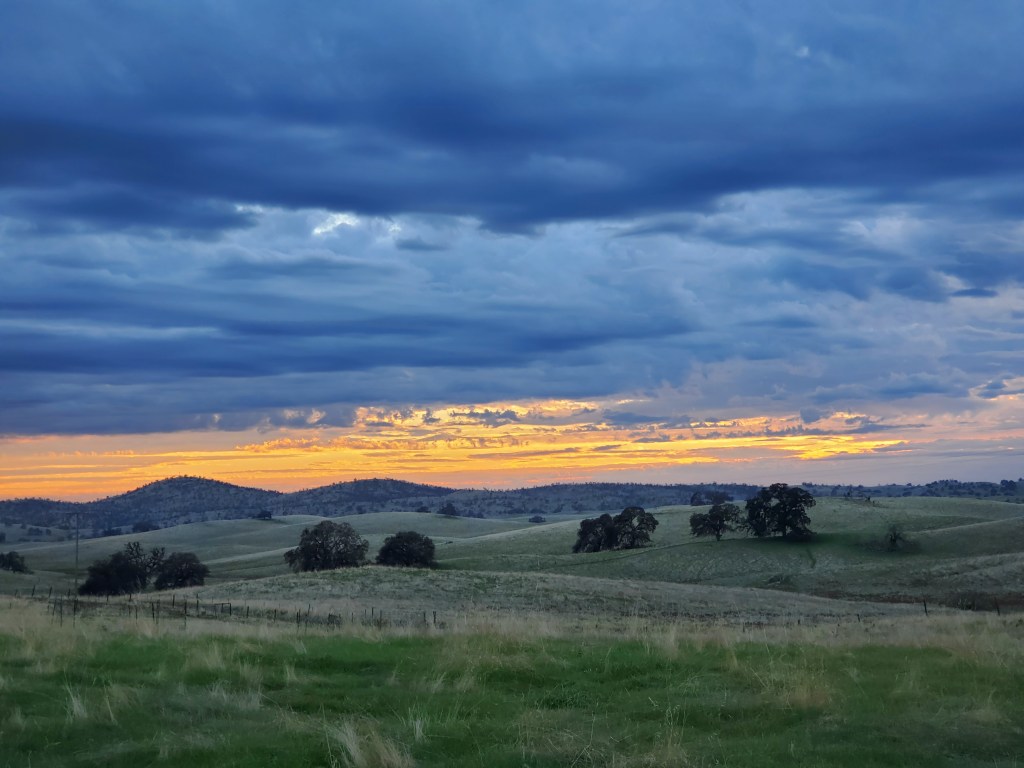
This incredible planet is so worth us doing better by her…
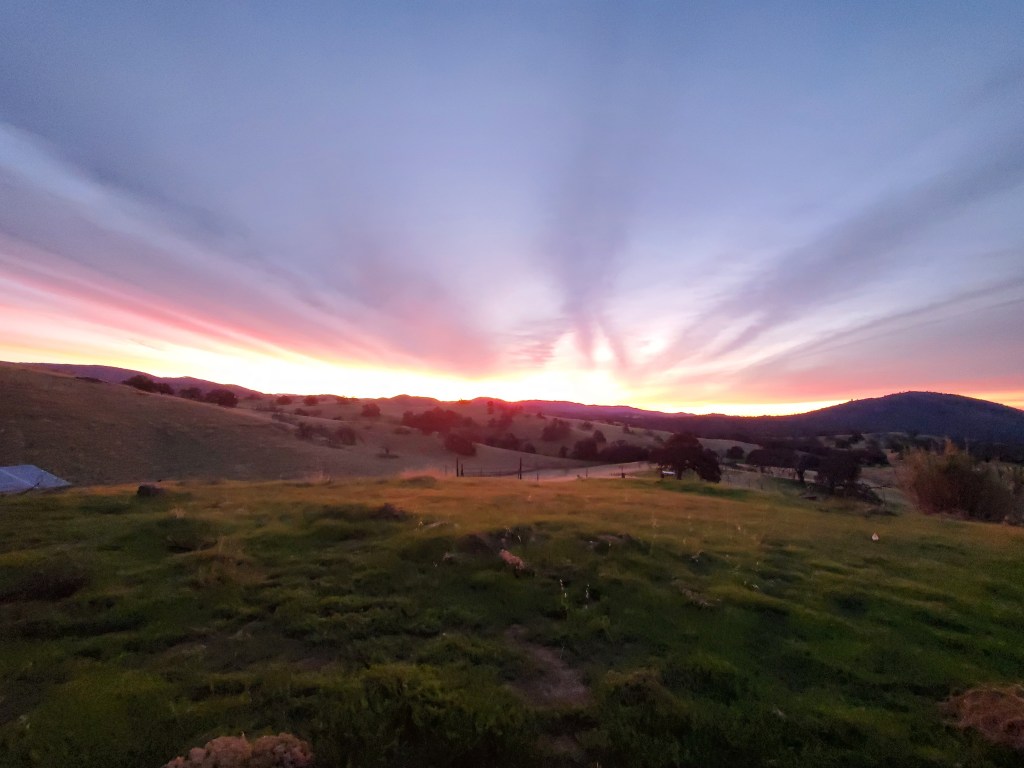
Flowers, Oaks and Rangeland Care

We have gotten lucky. The grasshoppers have not stripped everything. Their population exploded, especially near the riparian areas, then, all of the sudden, they abated. The hoppers had started eating their way up the hill. They hit some of my outlying plots hard, but then stayed away from the habitat closer to the hilltop. The oaks planted on the lower Spring Creek area and those down hill from the hilltop were not so fortunate. They were eaten, but quick action with screen boxes saved some. Several have come back and are leafing out again. I gave out a loud yip when I saw that. I had felt so dejected. I still lament the loss of the other trees. It is difficult to get a blue oak to grow under my specific conditions – heat, grasshoppers, gophers. Every year lost is one year less with young trees. I have to do better.

Since my last post, I have been focused on watering the oaks every five days. Having this cadence seems to be a recipe for success. It helps me not only keep them hydrated, but to trouble shoot any issues they may be having. The remarkably cool weather, for a July, has been helping give these trees a chance. I love them so much, and want them to thrive.

With the hoppers having abated, David and I have been slowly releasing the plants we covered in screen boxes. They have done very well. We are keeping the oaks in screen boxes just in case. I will plan to lift those in September. Thank you again to David and Sam for making those so quickly!

Blooms

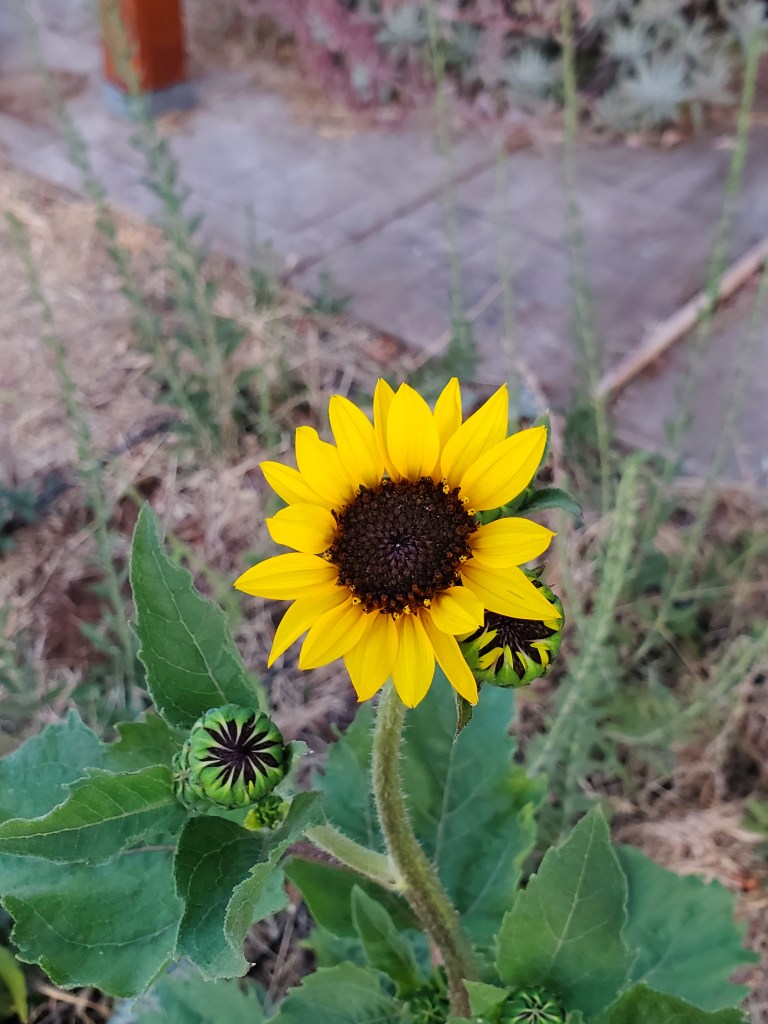
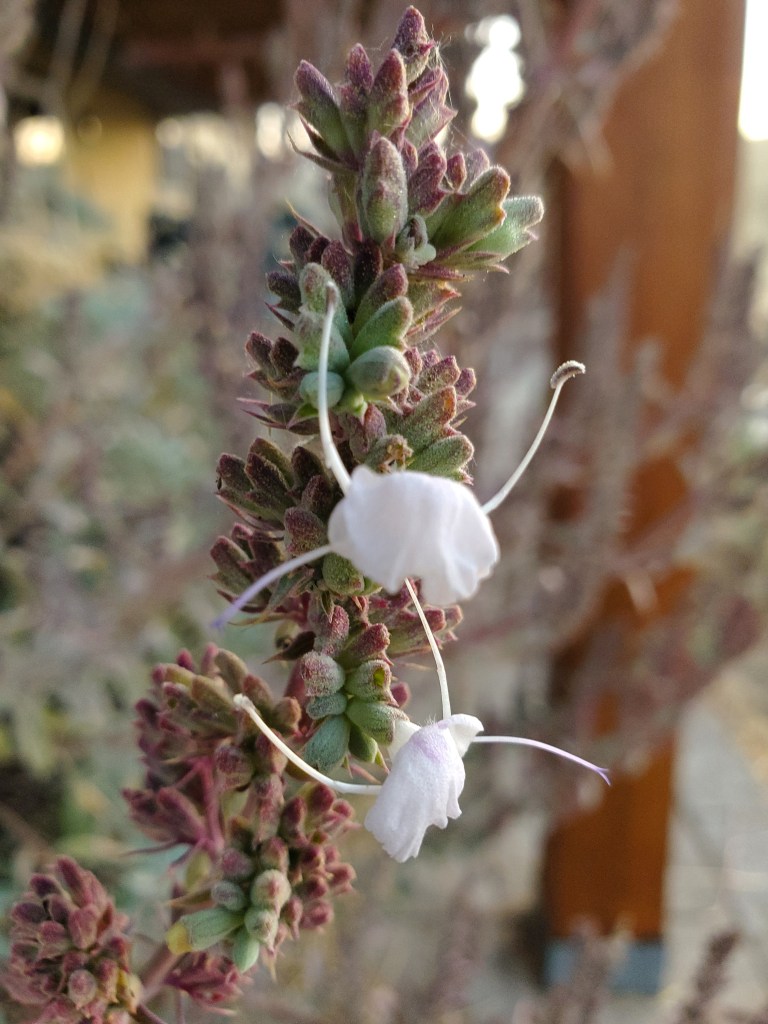
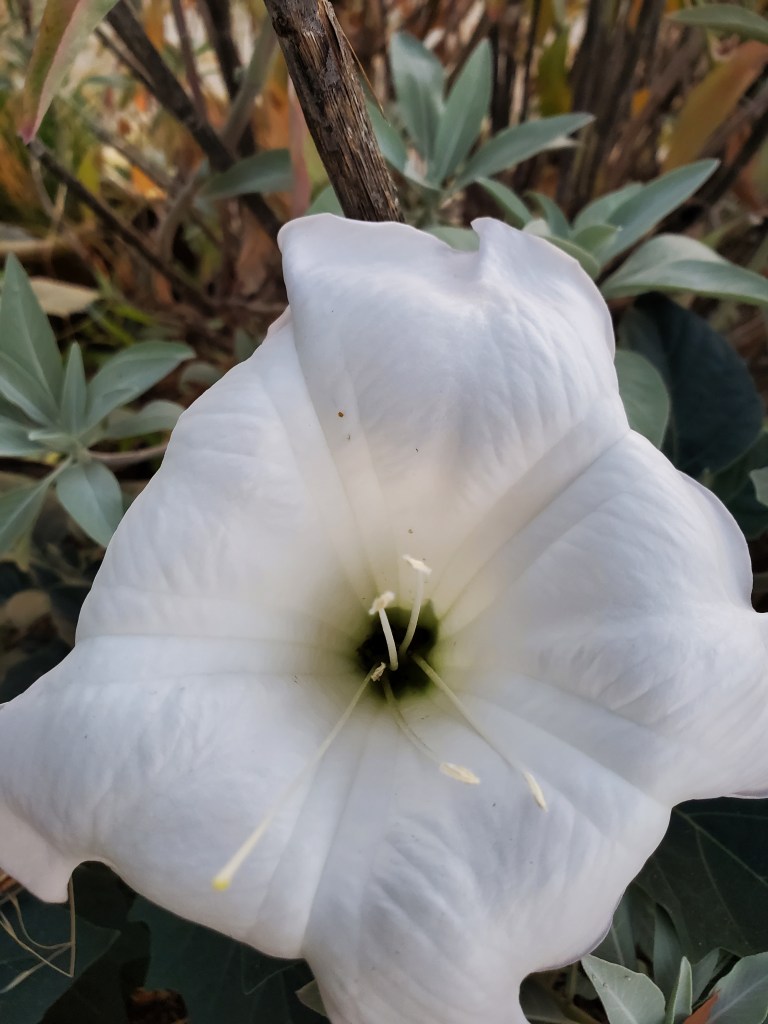
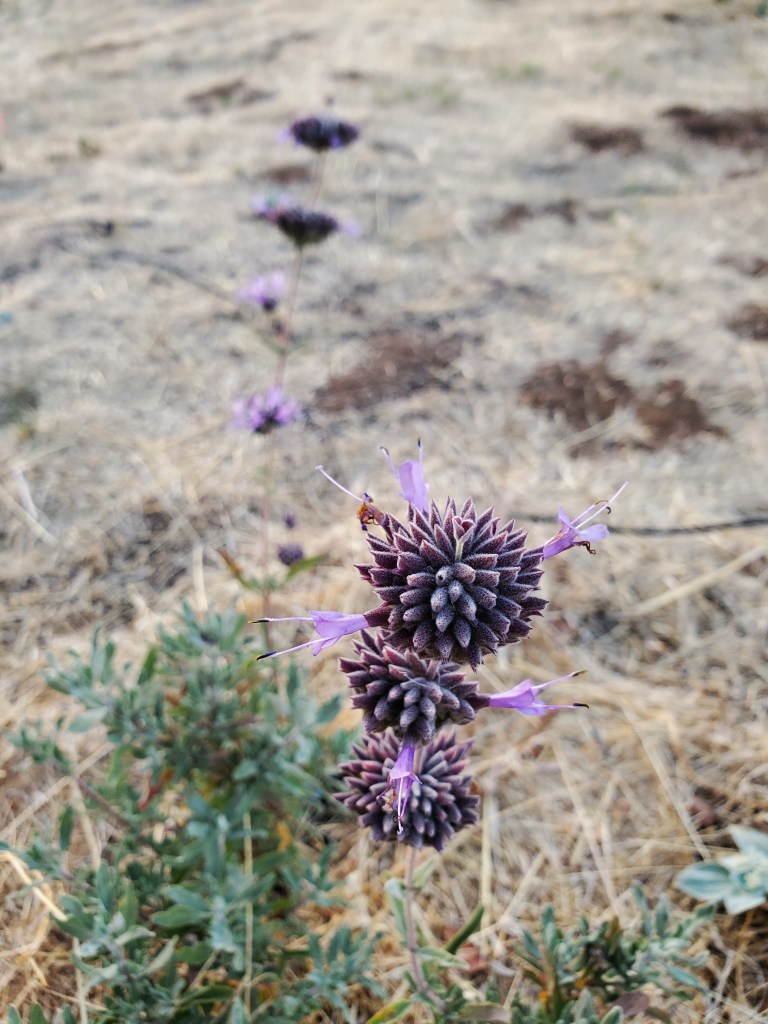
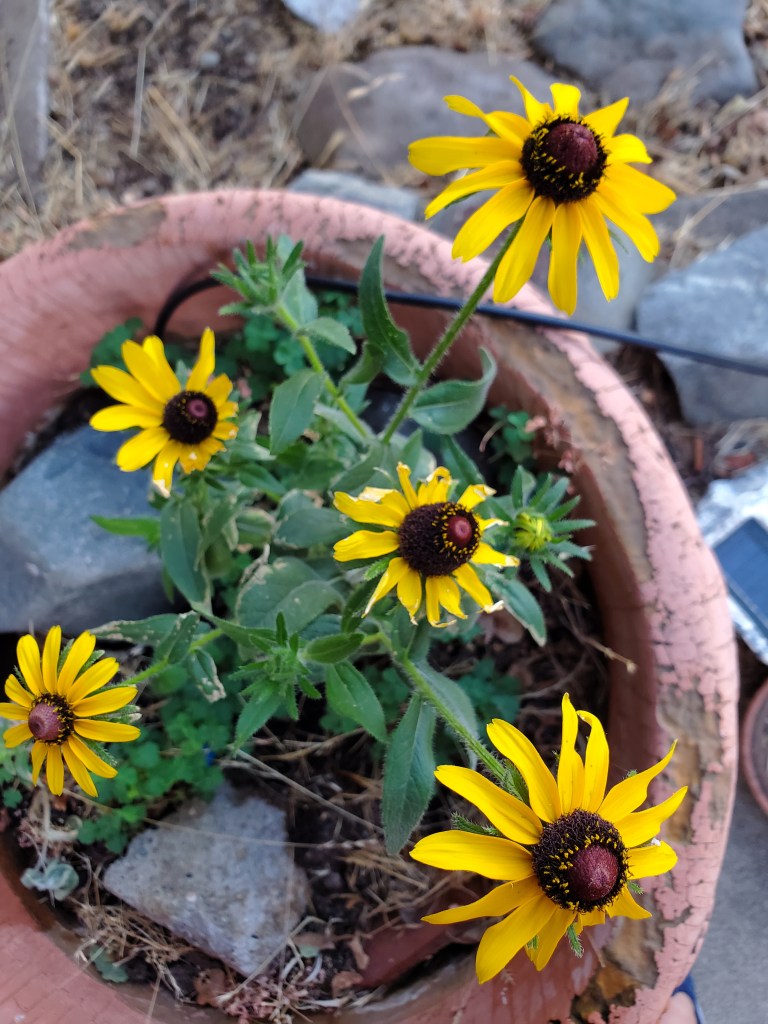
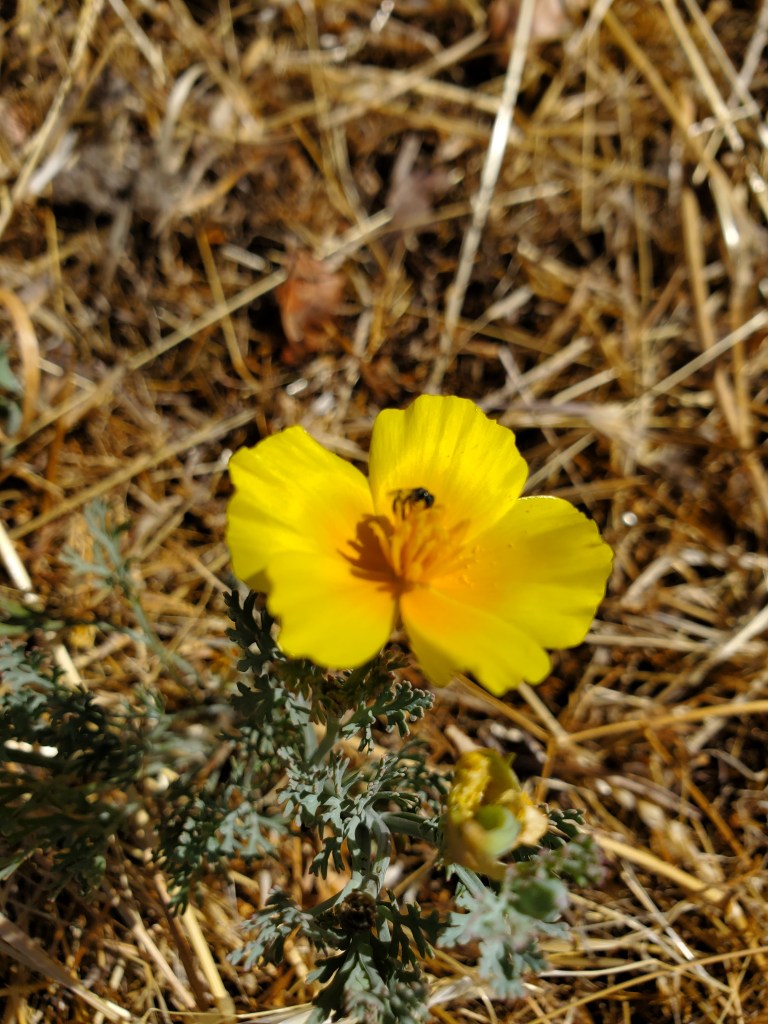
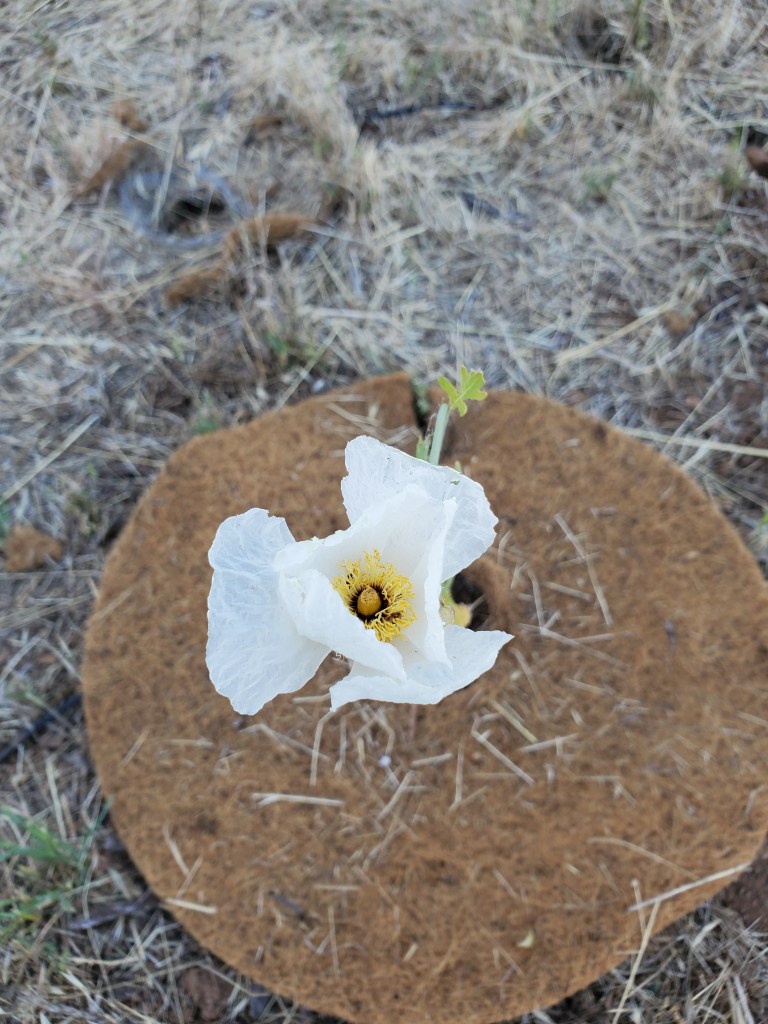
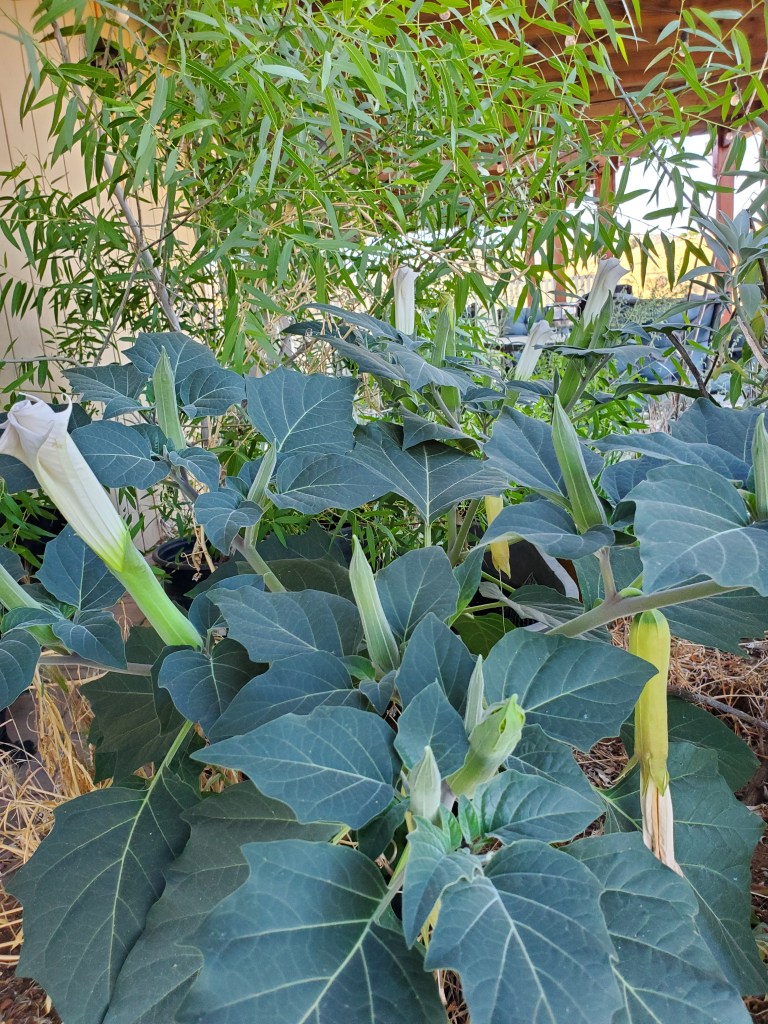
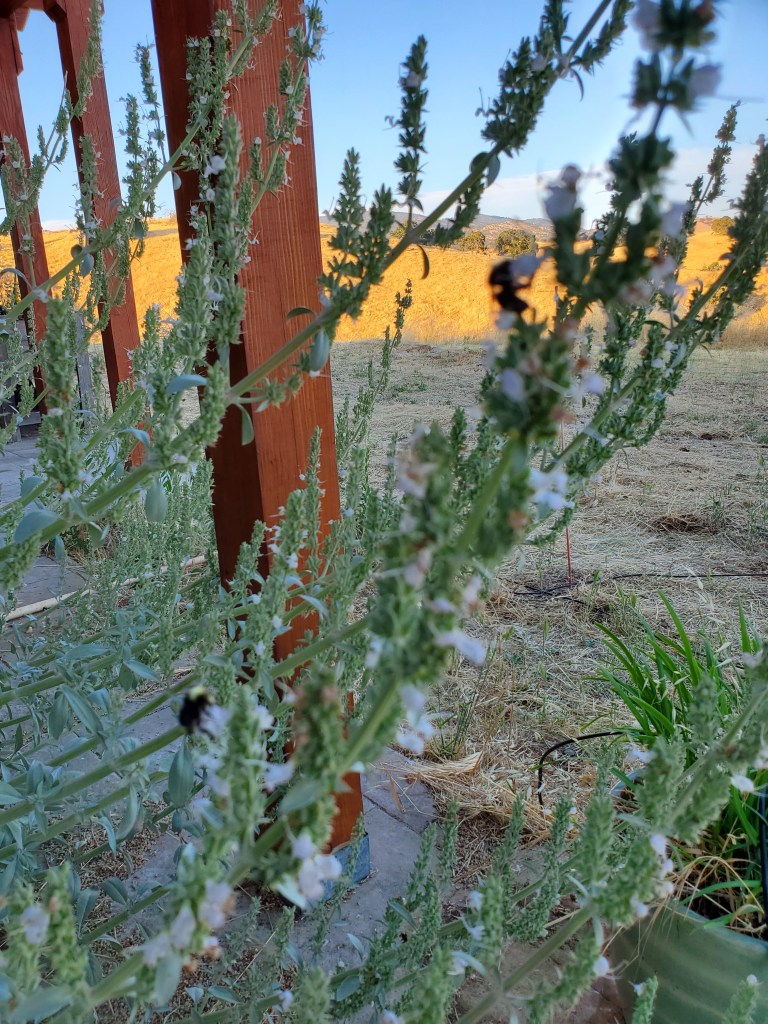
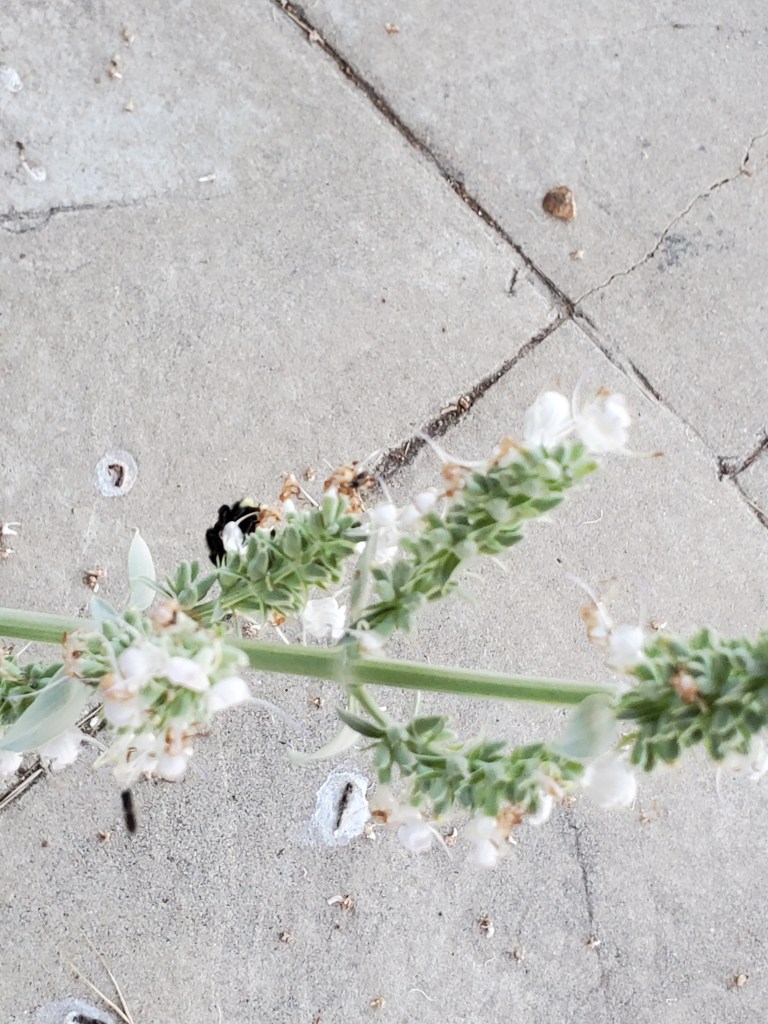
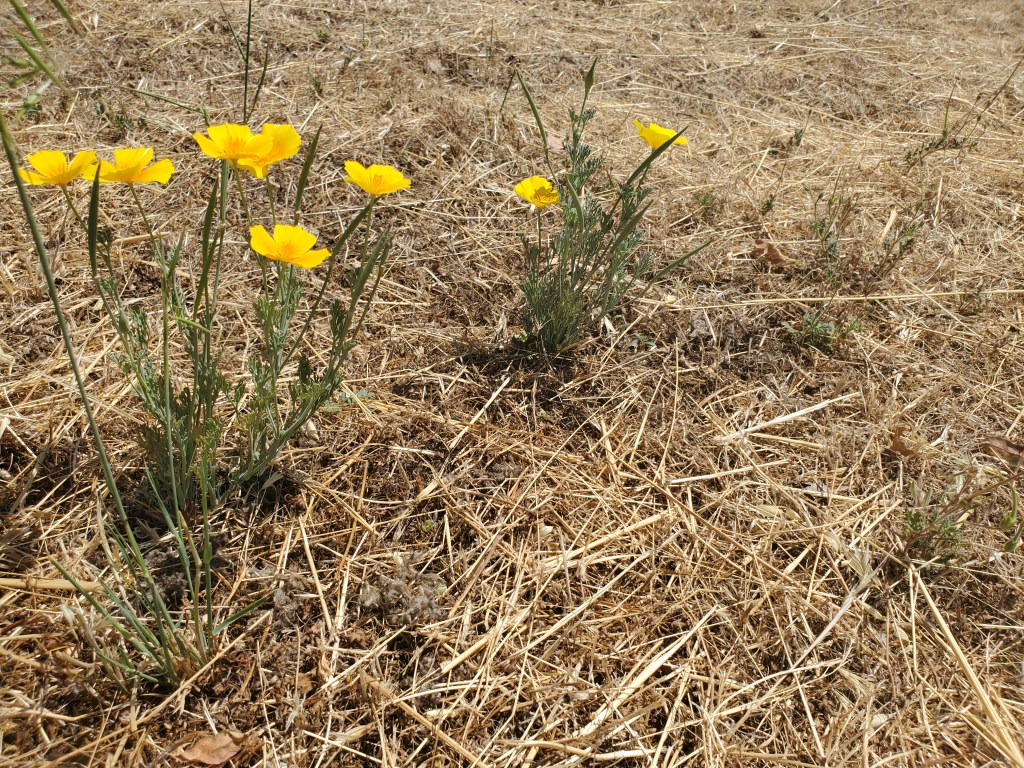
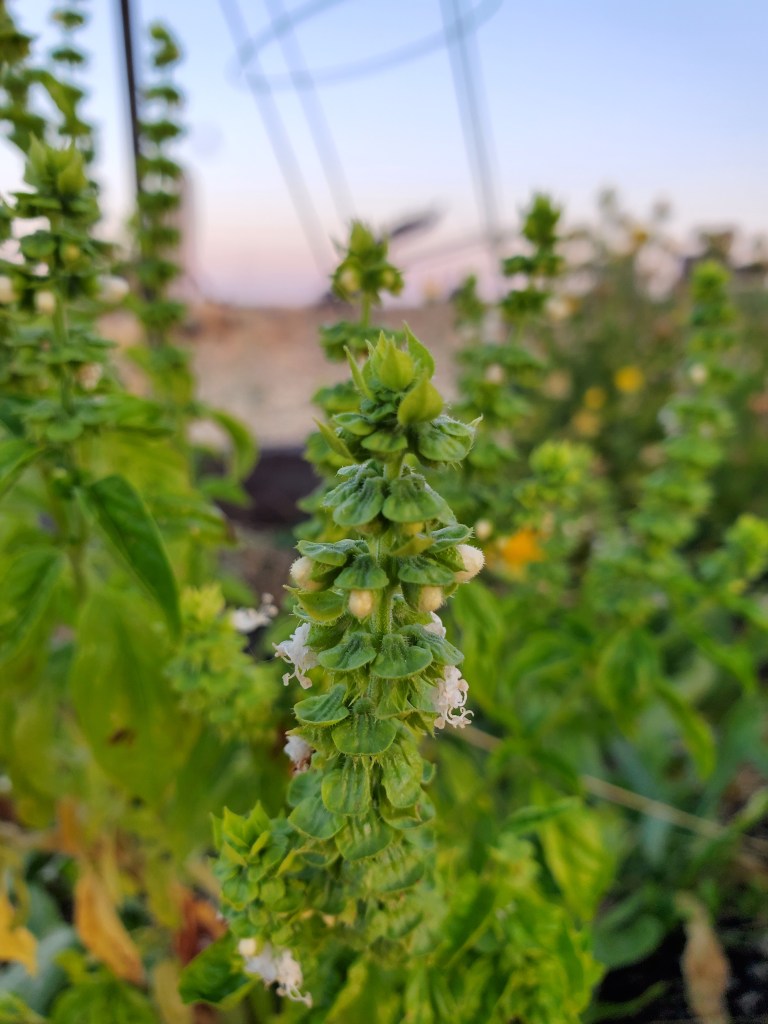
Blooming on July 13 when I began this post and mostly still blooming now are pacific asters, datura, sunflowers, matilla poppy, California poppy, narrowleaf milkweed, California fuchsia rabbit brush, black-eyed susan, marigold, sulfur buckeye, and worm wood. There were a couple small blooms on the white sage, basil and other garden items.

Ranch Maintenance

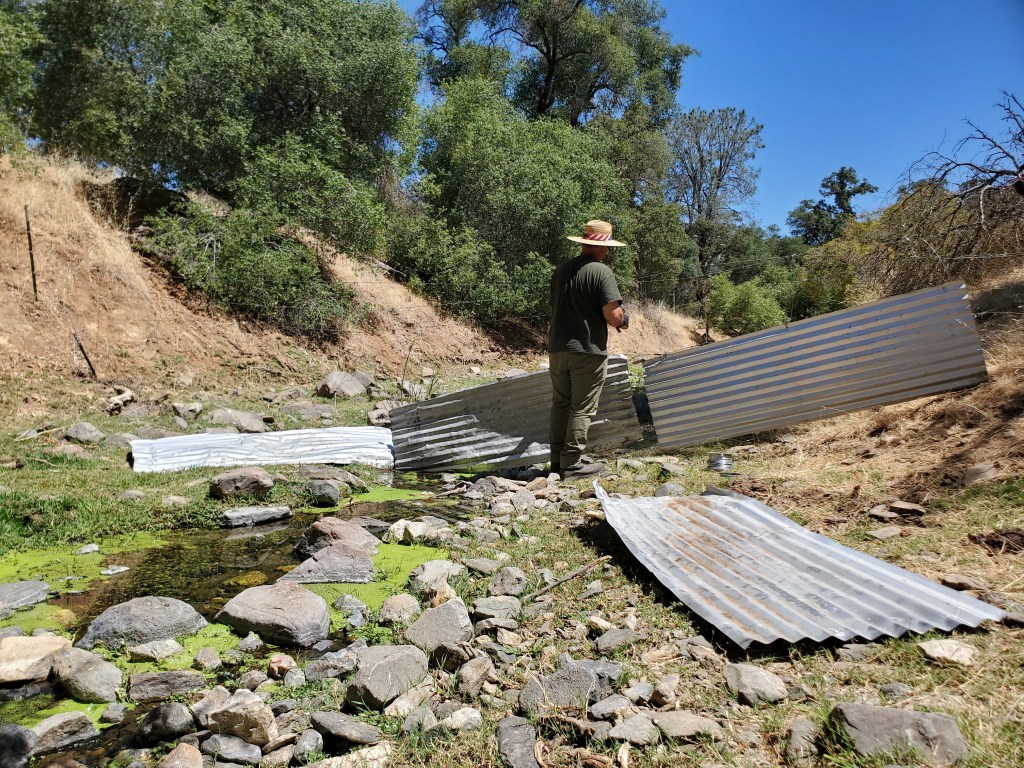
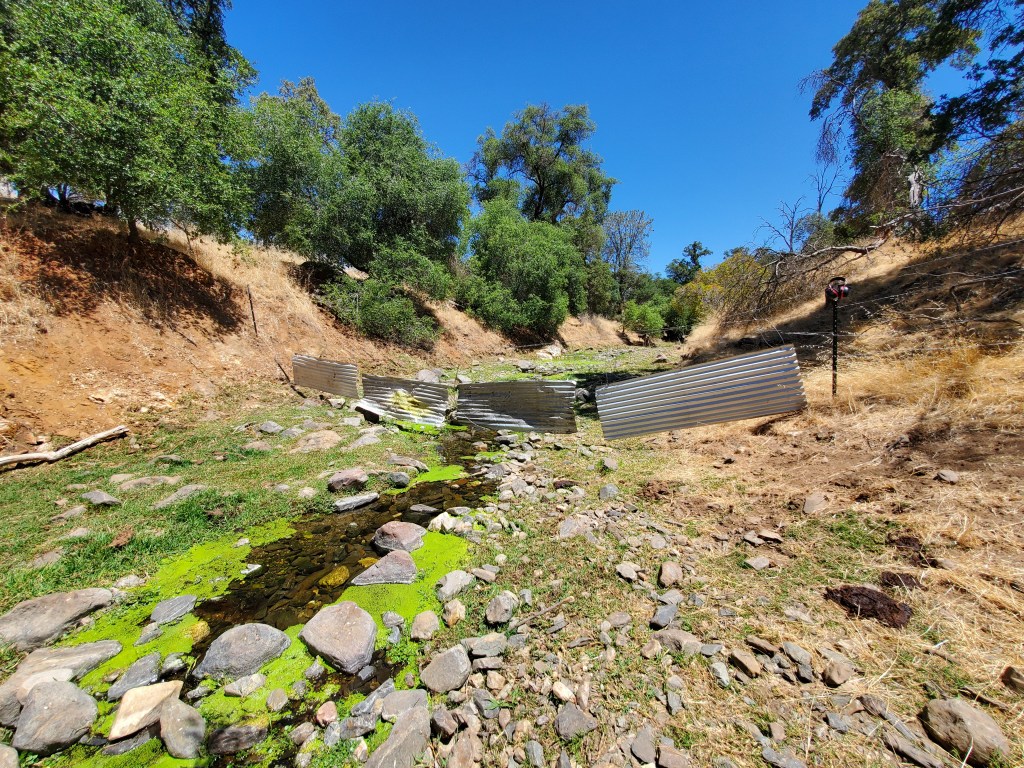
One of the things I love about living on a ranch is that there is always something to do. David and I finally got to the fallen trees and water gaps on Odom Creek. After one of the last major storms this past winter, high winds blew down several branches and dead trees. Two fell on the Odom Creek riparian exclusion fence, making the fence slack. High waters from a rain event took the tin blocking cattle access through the water gaps (areas where the creek flows through between two stream banks under a fence crossing the creek) and deposited them downstream. I retrieved them soon after the storm but did not replace them until several months later due to other issues requiring my attention.

With the tin down, it opened a small pathway for cattle to get into the exclusion. Grass and creek plants that typically grow inside the exclusion area were nowhere to be found. Adding to this was the large number of grasshoppers near the riparian areas this year. Thistle, which the cattle normally leave alone due to their spiky, tough exterior, were stripped to skeletons. Both contributed to no vinegar weed (another favorite), less watercress, no milkweed and no thistle nectar.

Wildlife

Although I’ve not see as much wildlife as I have in the past, there have still been some beautiful encounters. Running across the road in the near area, and sadly no photos, I have seen coyote, a bobcat and bunnies. Below are other friends.

Seed Collection

As plants begin to die back and set their seeds, I have been out collecting. I never collect more than 10% of what is available. I share with the birds as well as leaving plenty to grow the next generation.

Rainwater Catchment Building Continues

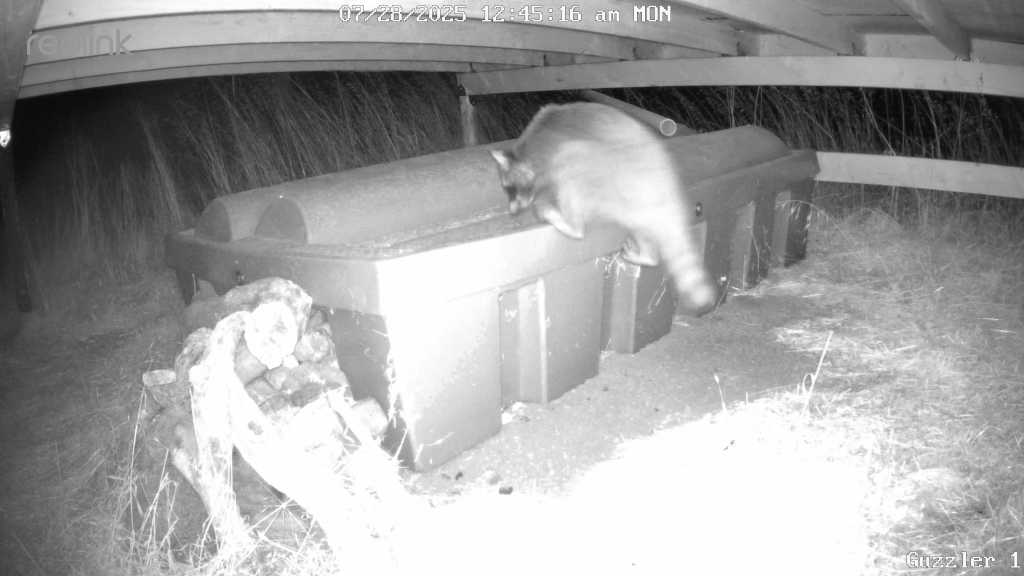
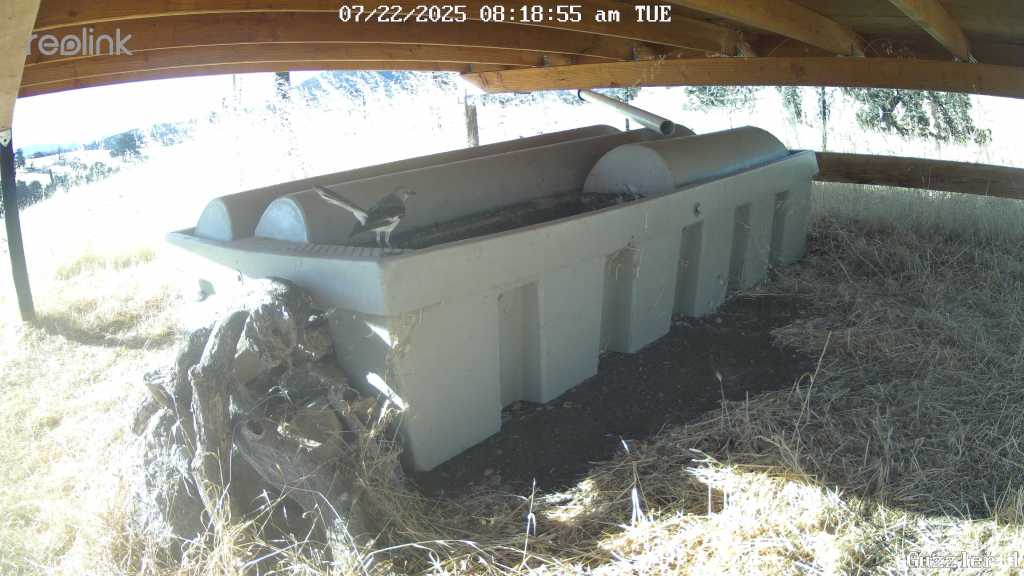
One of our ongoing projects has been to create a fresh, ongoing supply of water to the wildlife guzzlers. Recall, we built a small overhang over the guzzlers to catch more rainwater than if they were left out on their own with their beveled tops. The overhang also acts as shade to decrease evaporation from the unit. Some years, the water captured lasts the entire year. During droughts, the water has run out by late August. To prevent running out, but to also inflow more fresh water, we are building a larger rainwater catchment up hill to gravity feed into the guzzler. The tank is 1500 gallons and will be under a metal building to protect it from sun exposure and heat gain. David has been working on it and will likely be done a week from this post. I am very excited to keep water flowing throughout the hot months. The guzzler has become a very busy place with ground and song birds, raccoons and one feisty feral cat. Thank you to the Natural Resources Conservation Service (NRCS) EQUIP program, US Fish and Wildlife Partners Program and Point Blue Roots Program for believing in this work and supporting it.

Fire Danger Ever Present

Living in the new norm of ever present fire danger feels unsettling. When I was a child growing up in the Sierras, fires were part of life, but rarely major conflagrations. There was more water then and less people. I never worried, and I don’t recall my parents worrying the way I do now.

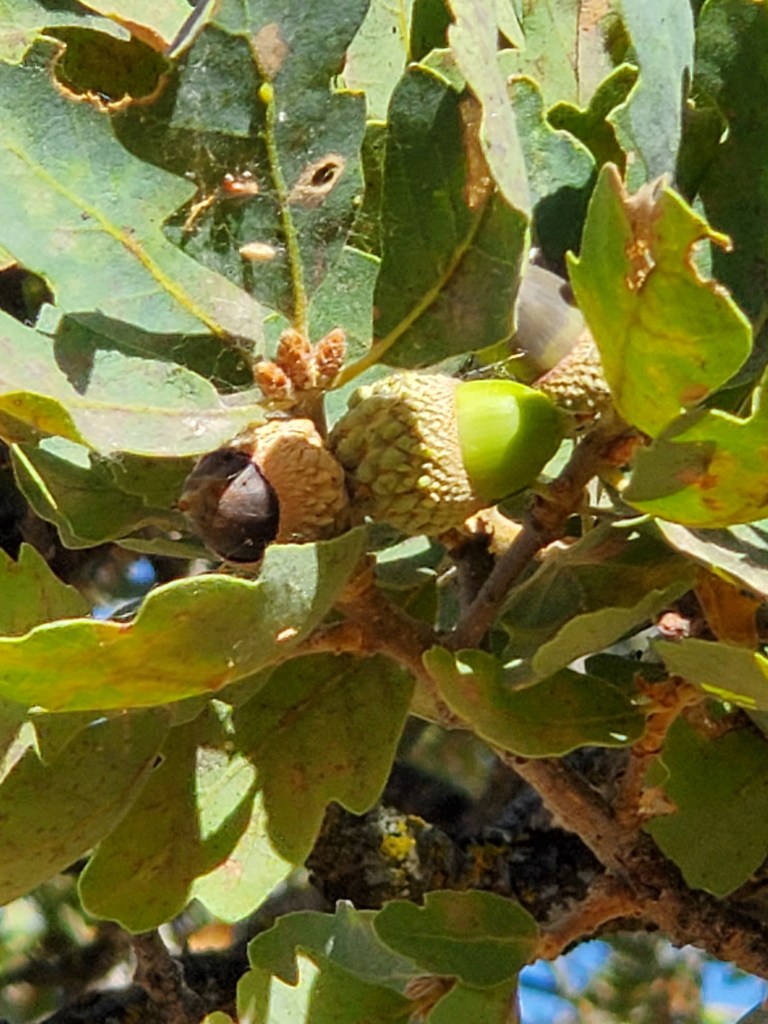
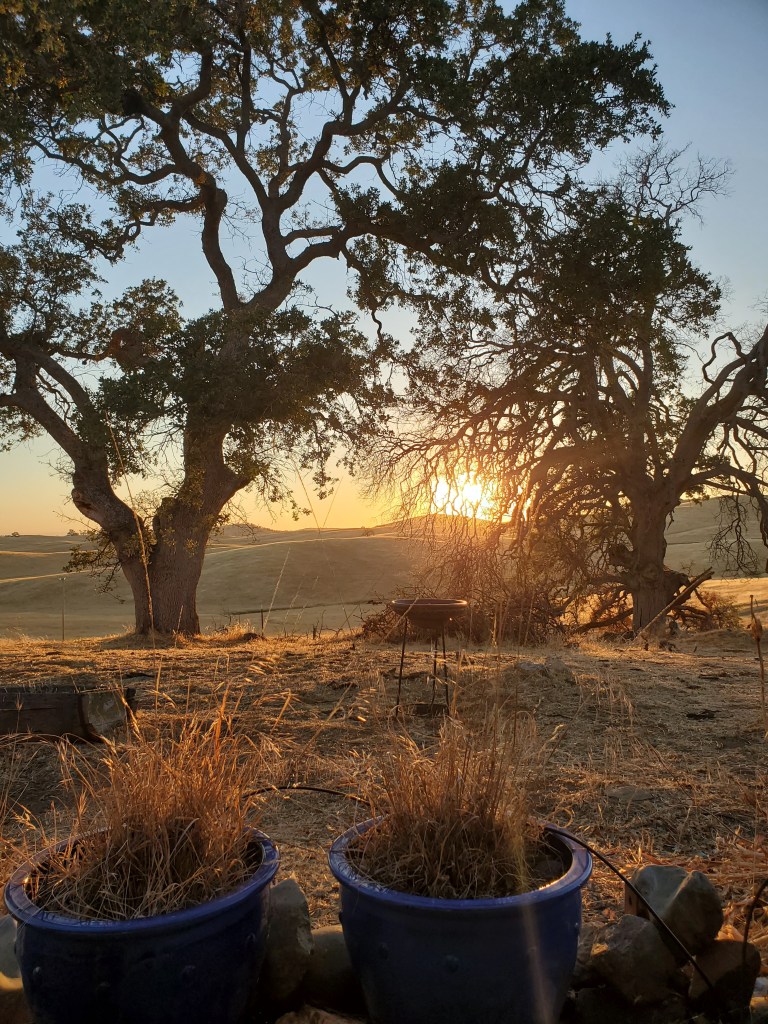
This year and last, we had a nice, steady stream of rain events that kept the soil moist longer into the summer. This year, in fact, David and I both noticed that all the oaks look healthy and happy. Their leaves have stayed on and are a vibrant green. Fresh, well-formed acorns are setting now. July has been much cooler, and that has helped the mature trees too.

Even with these positive signs, I still cross my fingers that a major fire will not rip through the land. Through my work in natural resources, I can see the massive investments by the state in fuels reduction and stewardship. Communities are working hard, year-round to be better care-takers of the land. The problems of over 100 years of fire suppression, population growth in wildland areas, more efficient ag tech to suck water from the land and climate change shifting temps into record levels are all massive issues to overcome. The pace and scale needs to be even greater – and as importantly, if we do not tackle the root causes, we will be constantly fighting an uphill battle. Stewardship, care for the land, being in good relation is not work; it is life. It is an ongoing relationship where a thoughtful existence results in abundance and health in an environment where we can all live – nature relatives, humans – and thrive.

Another Race Against Time

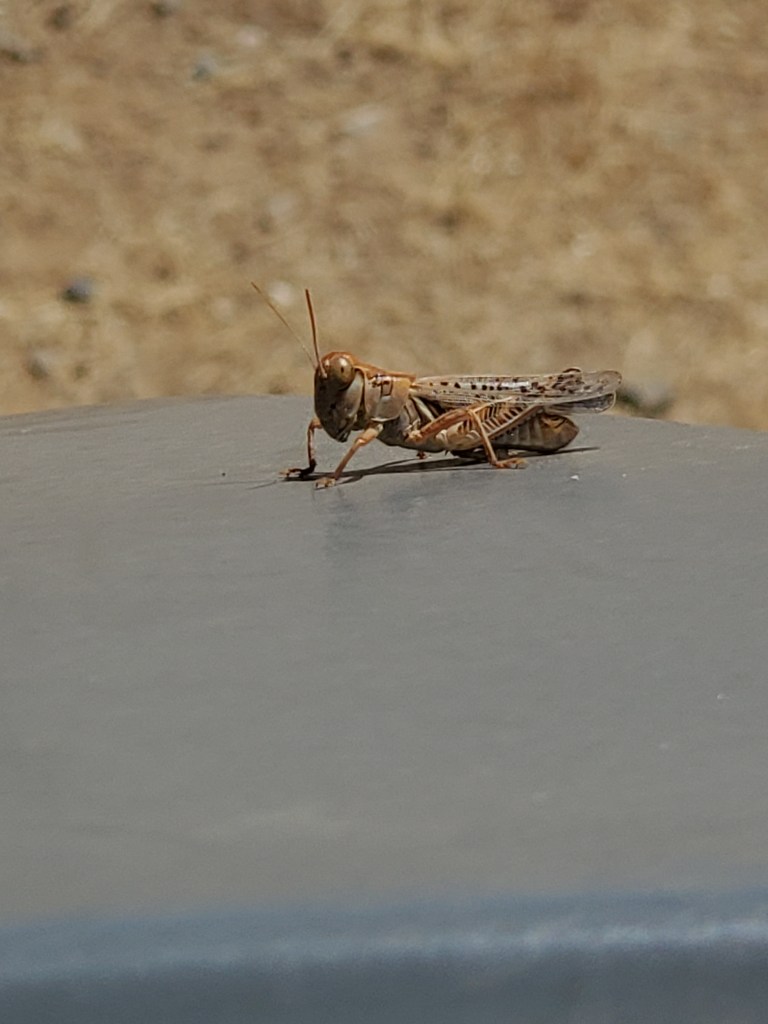
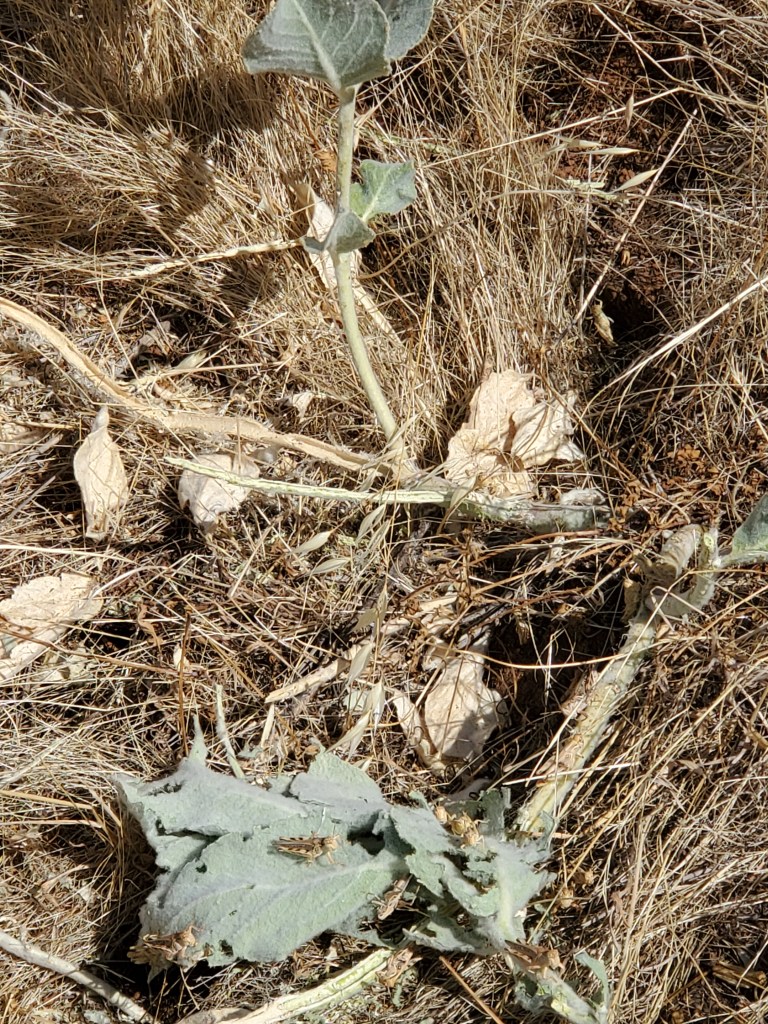
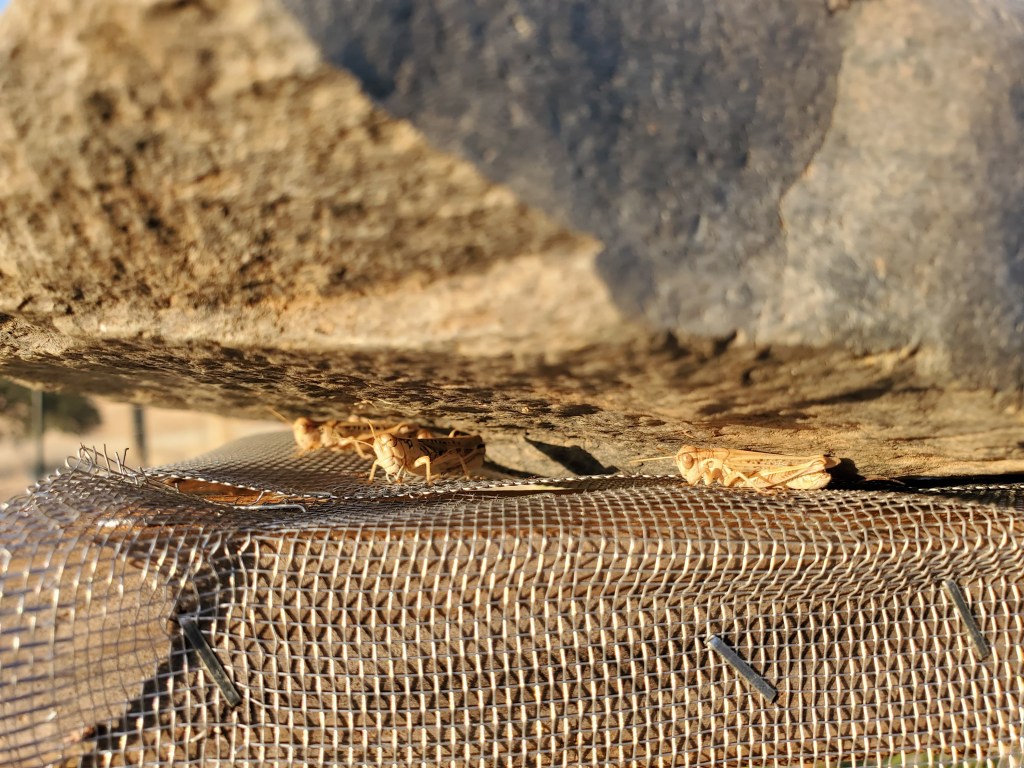
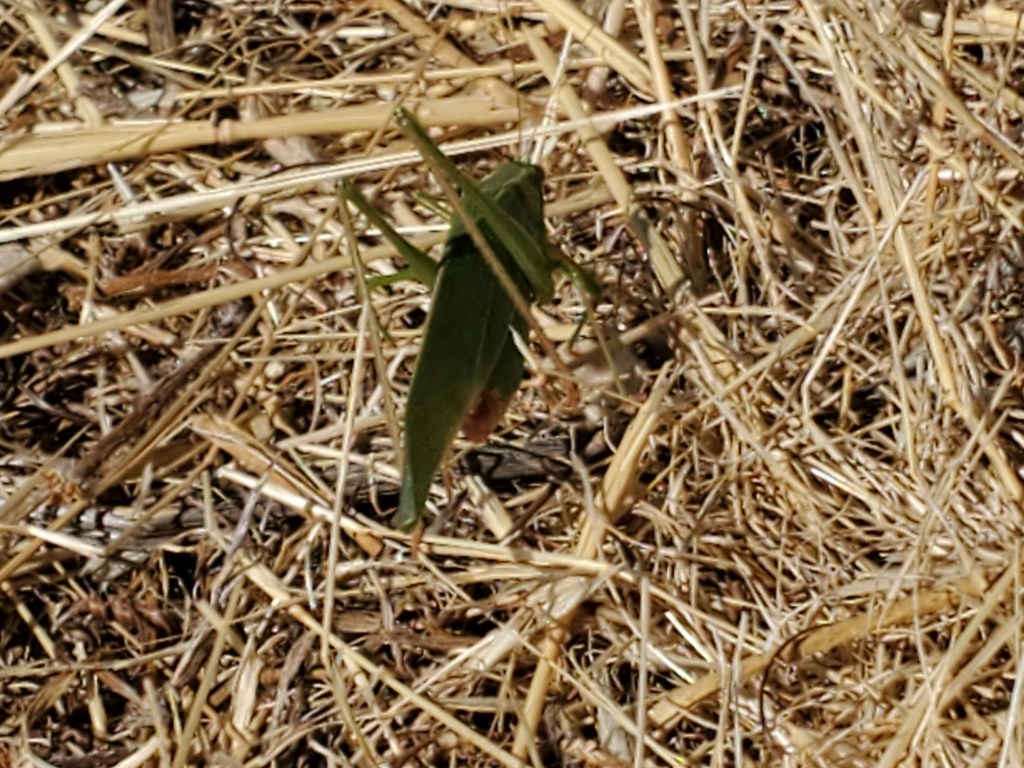
Oh yes, by the title and the time of year, I am sure you understood that the grasshoppers are back. They are eating their way up the hill. I had hoped they would not be back, that the typical cadence of boom and bust for the hoppers would return. We are due for a few years without plague levels. Alas, once again, the imbalance of what we are doing to this planet has manifest itself on Taawim Bwiapo. Essentially, almost nothing gets to live but the grasshoppers.

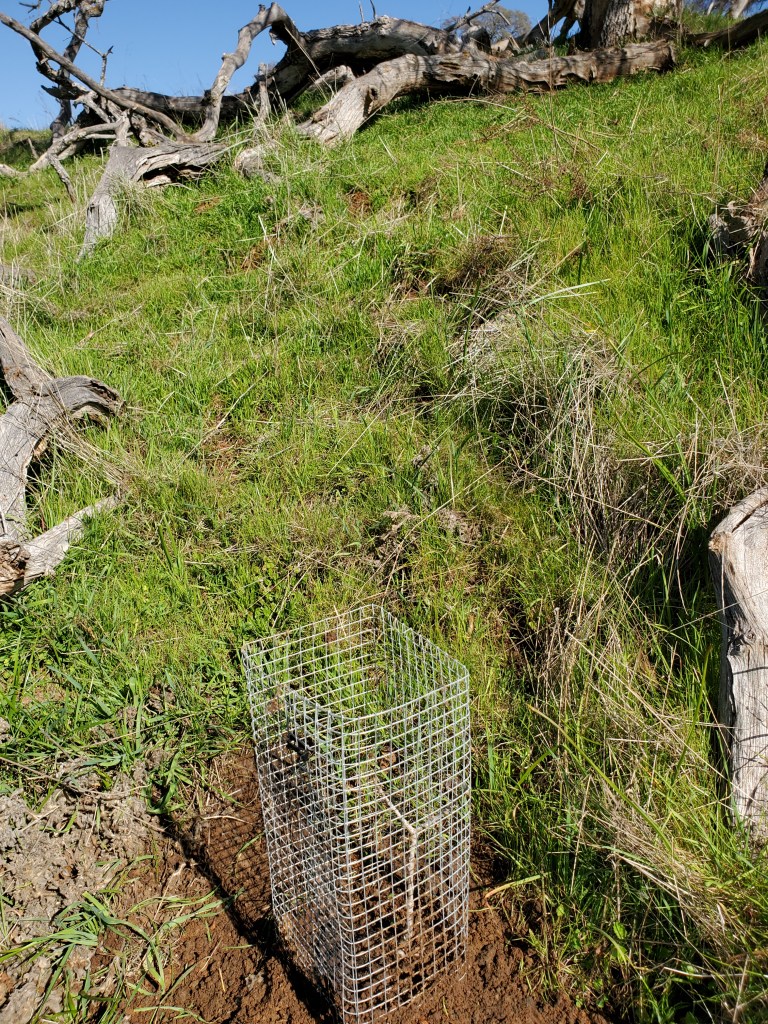
Except…this year, I am more ready – busted thumb and limpy leg and all. As soon as I saw some bites in the oak seedlings by the creek. I had David purchase aluminum screen. He began to make little screen houses to go over the gopher cages in which the oak seedlings were planted as well as other screen boxes for my pollinator plants. The poor guy. He is doing so much. I am getting better, little by little, but still cannot perform most of the ranch work I need to get done. David also has his paid work to do, which has been extremely busy of late. To enable us to get what we need done in the timeframe it needs to be done, I decided to hire someone to help us on the ranch, and to give poor David a break.

I put out the word I was looking for someone, and a friend, Jeanne Ann, said she had a grandson who was looking for work. His name is Sam. He jumped in and did weedeating freeing David to help with the oaks. We began placing his boxes and found that the two oaks at the downstream section of Spring Creek were already eaten. I lost my breath. I was horrified. When I looked closer, I saw that the bark had not yet been eaten off, like last year. Maybe there was still a chance. We covered and watered them anyway in case they were able to survive.

Then, a major issue happened at David’s work, and he was on a service incident for the entire day. Work stopped on my oak and plant cages. With my injuries, I was not able to do anything. I asked Sam if he knew how to build and use carpentry equipment. Turns out, he has done building before -so he had knowledge. He jumped in and innovated on David’s design and began pumping out screen boxes. Thank you Sam!!

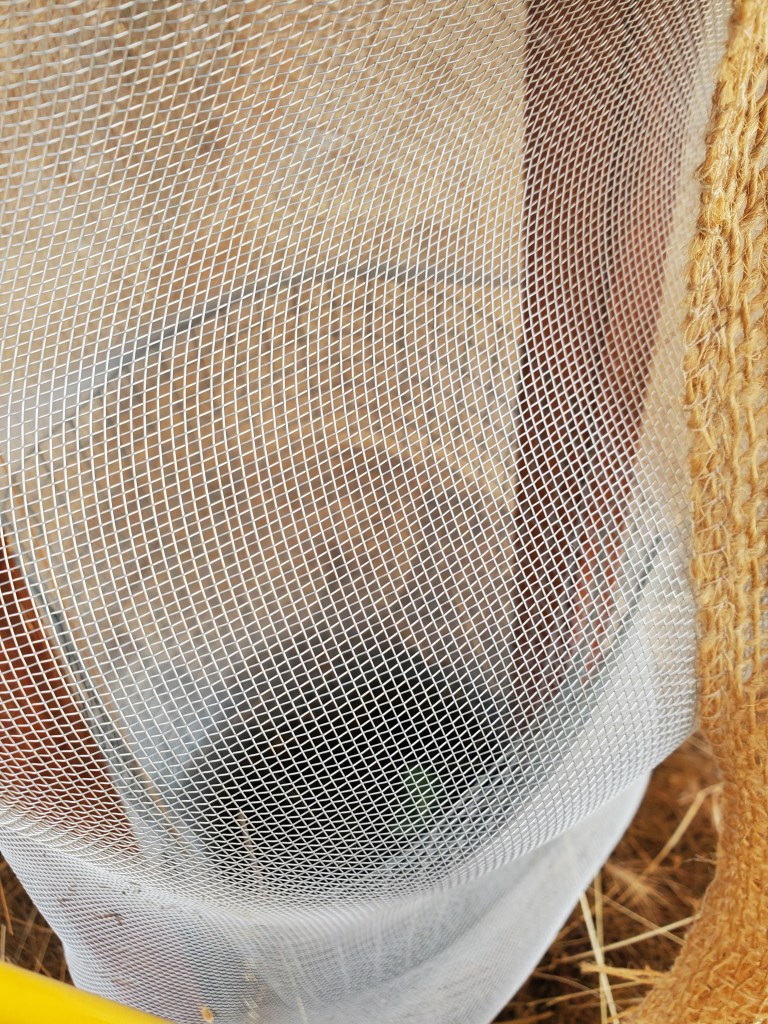
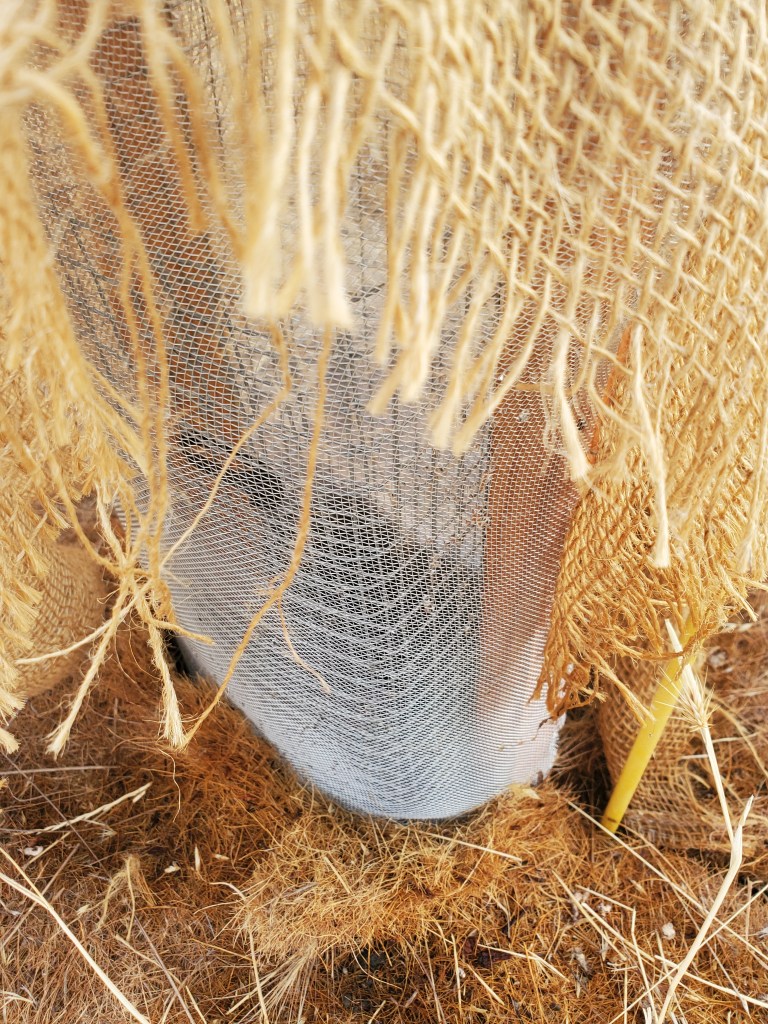
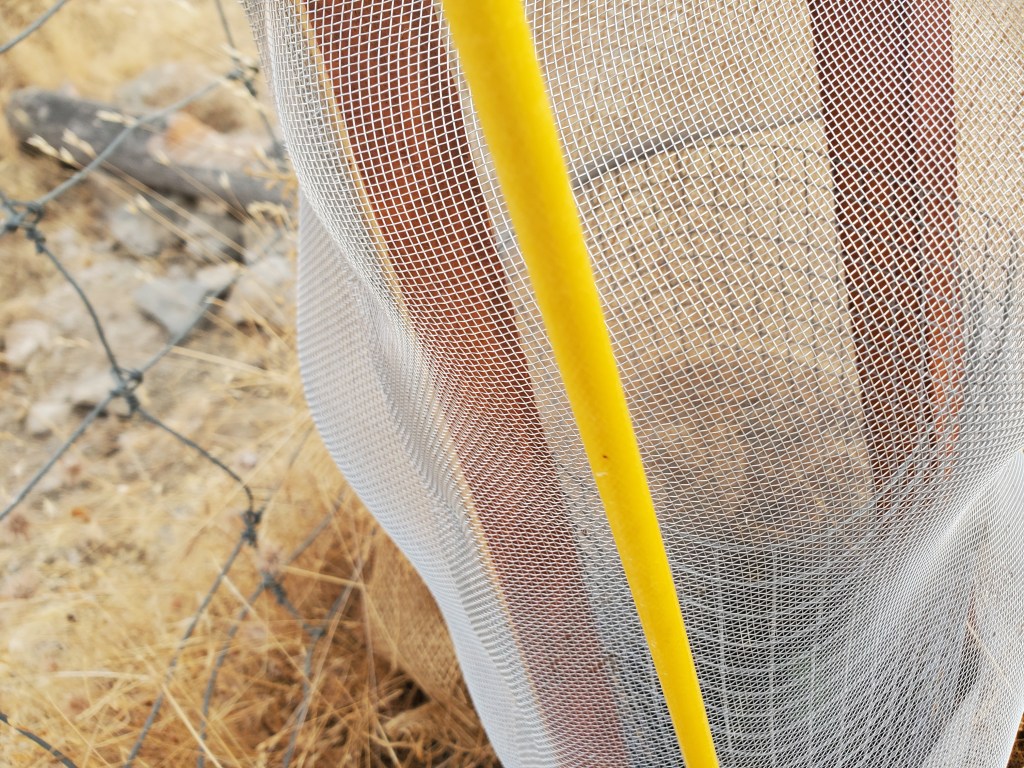
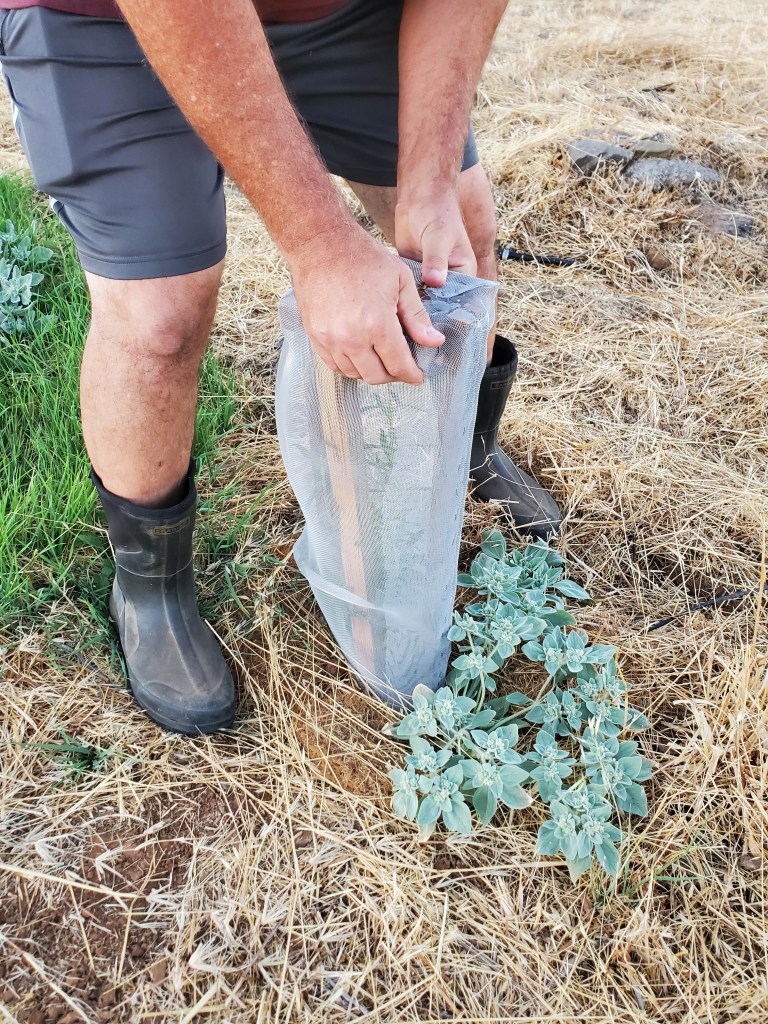
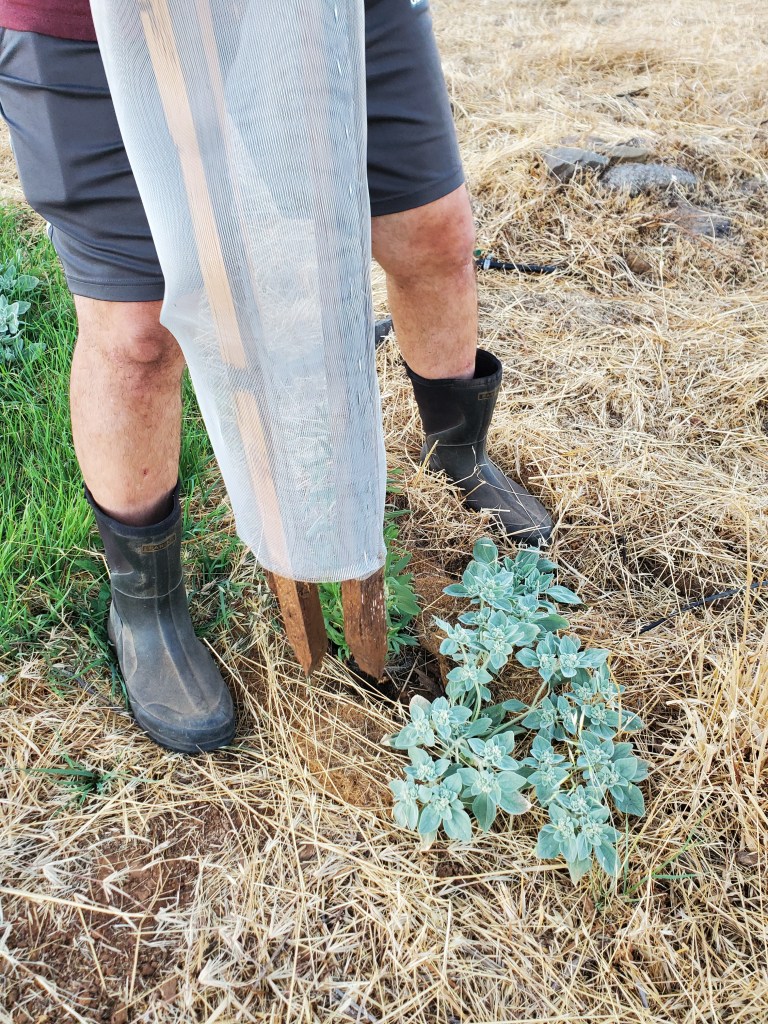
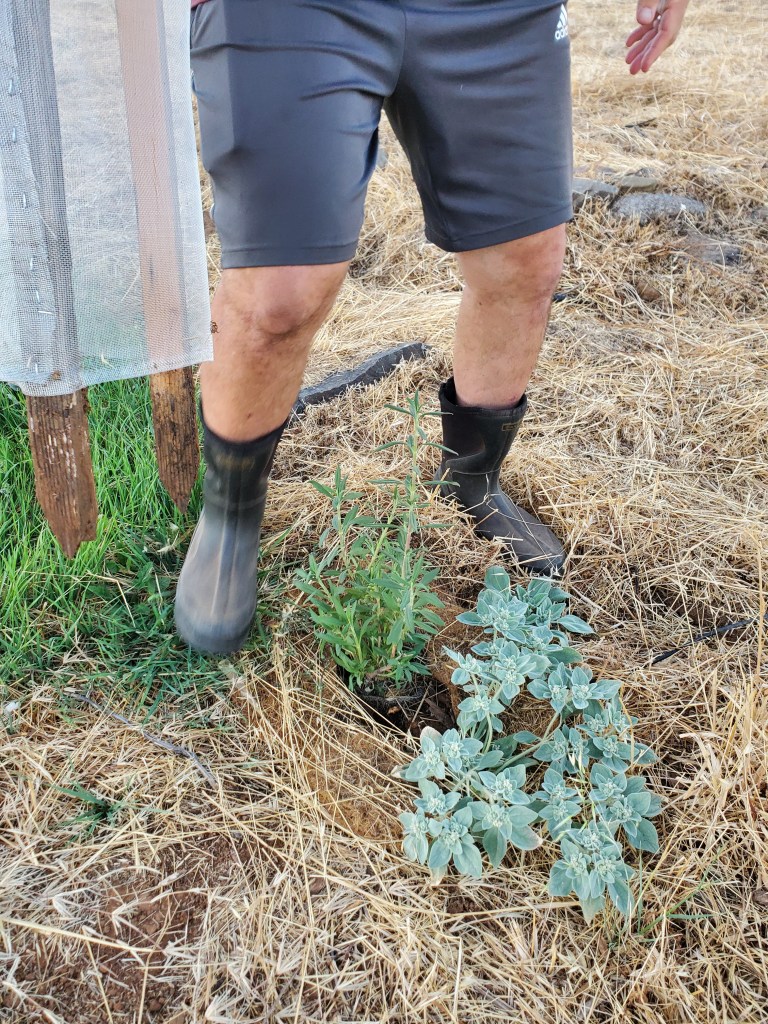
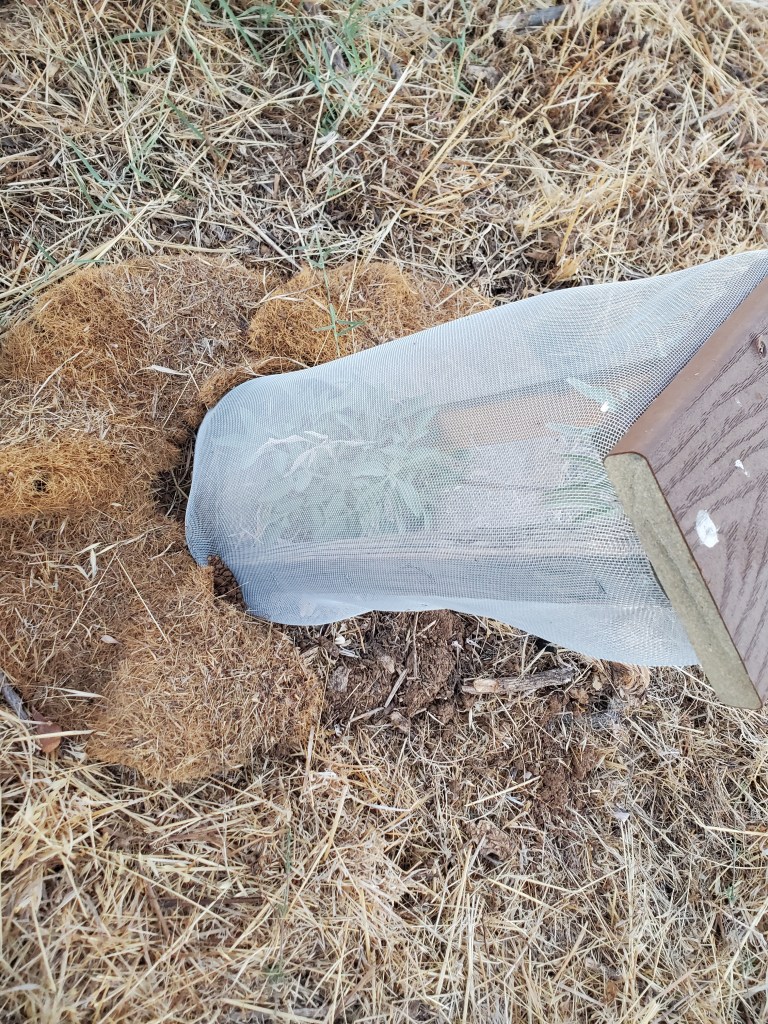
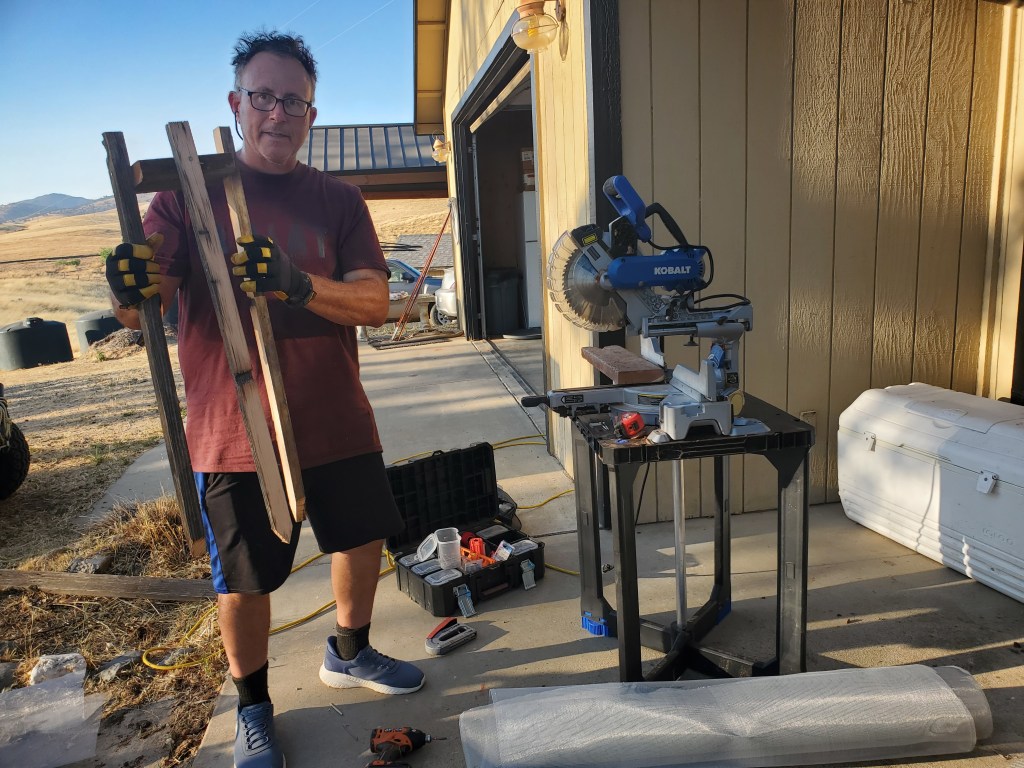
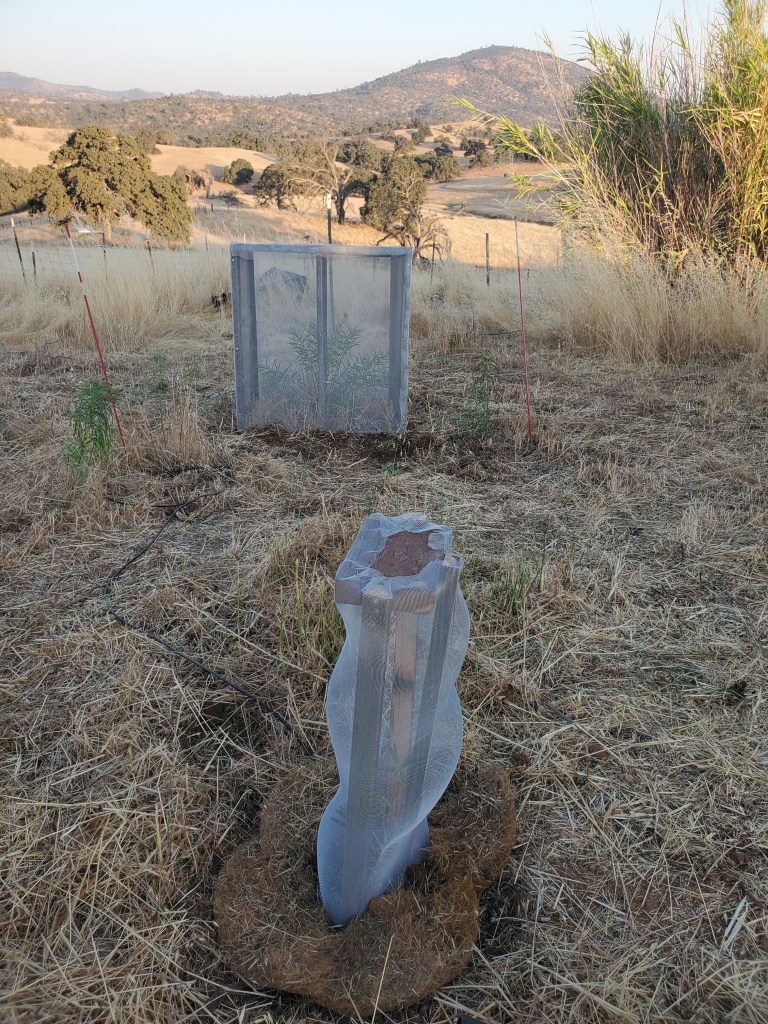
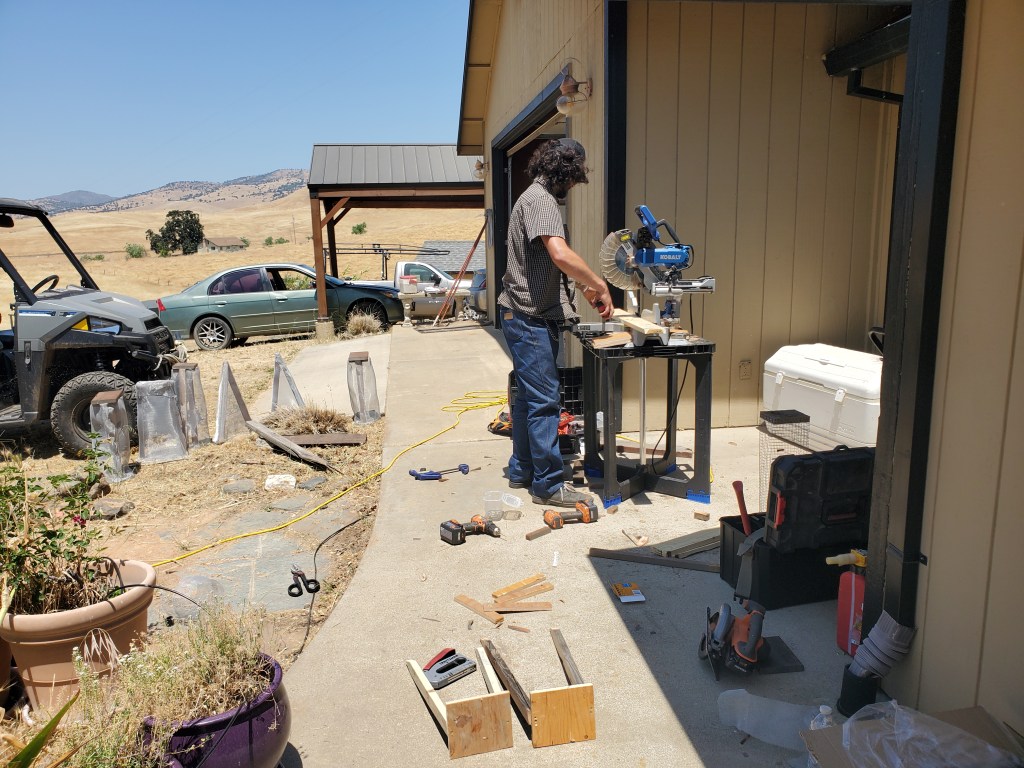
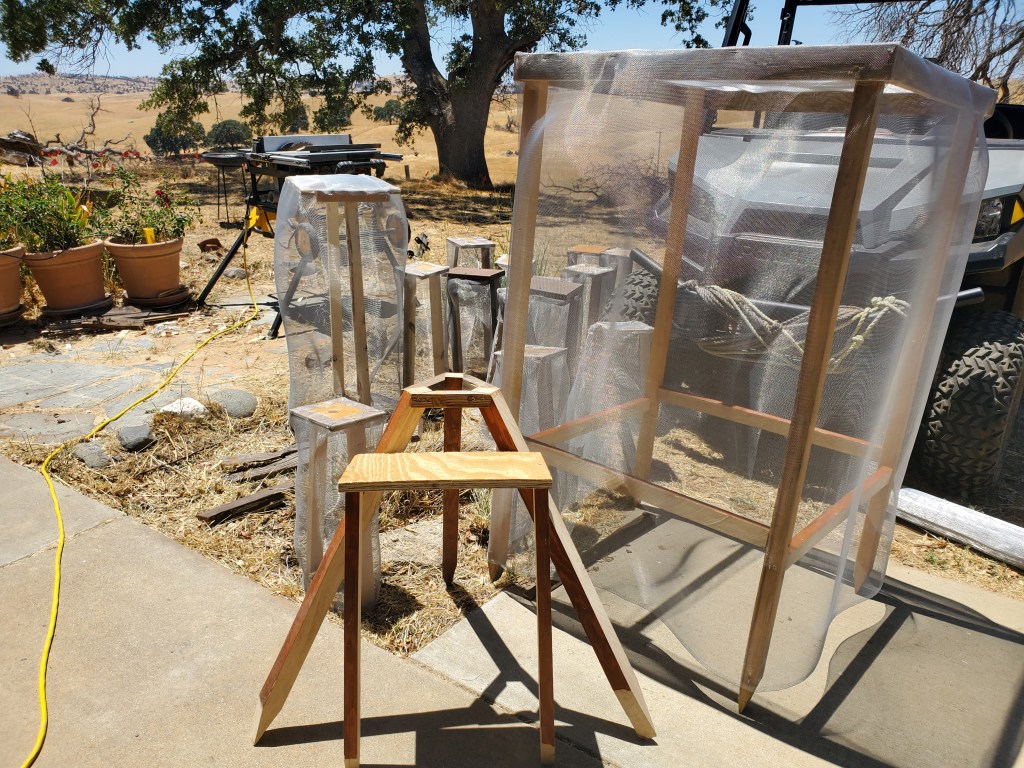
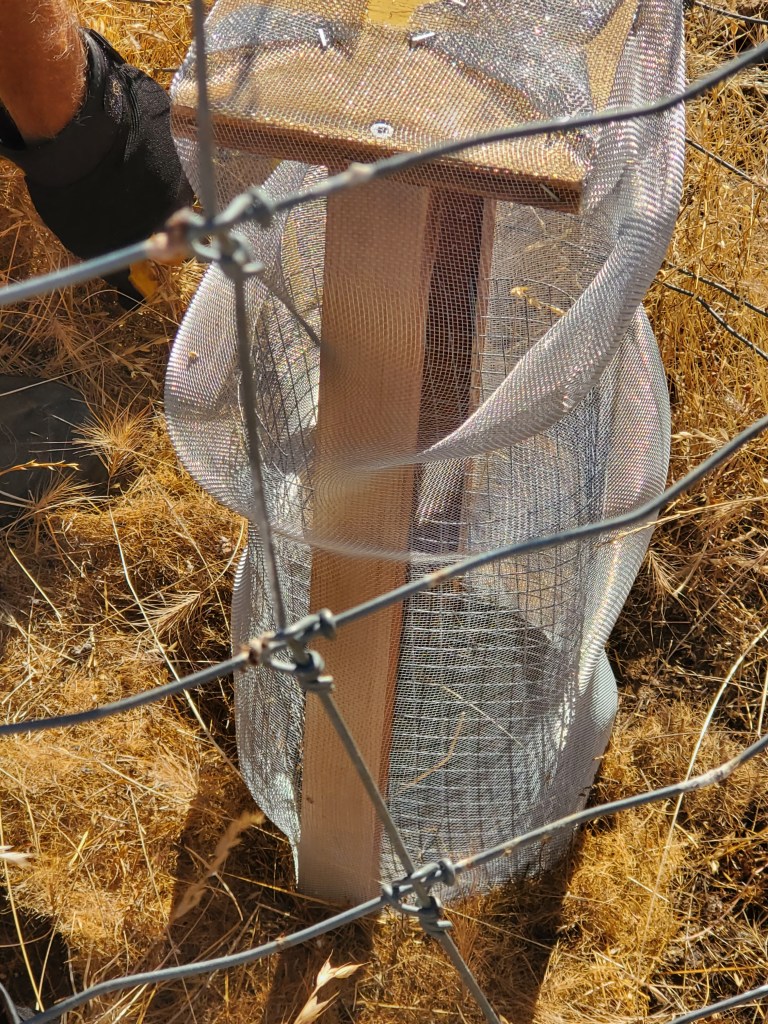
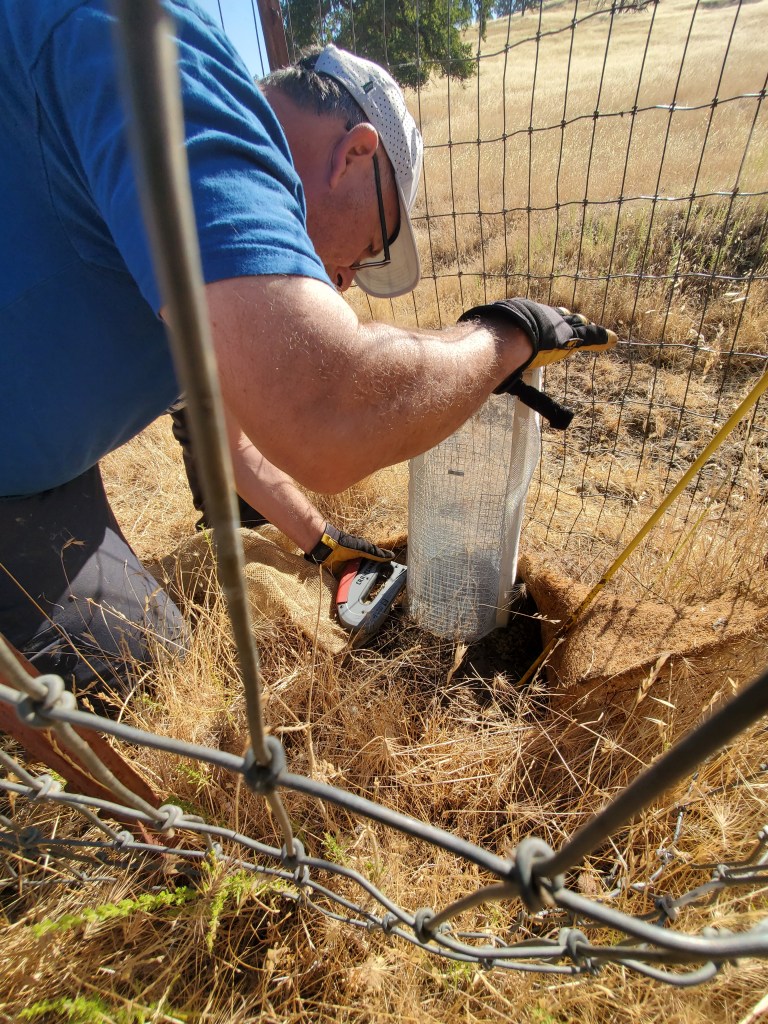
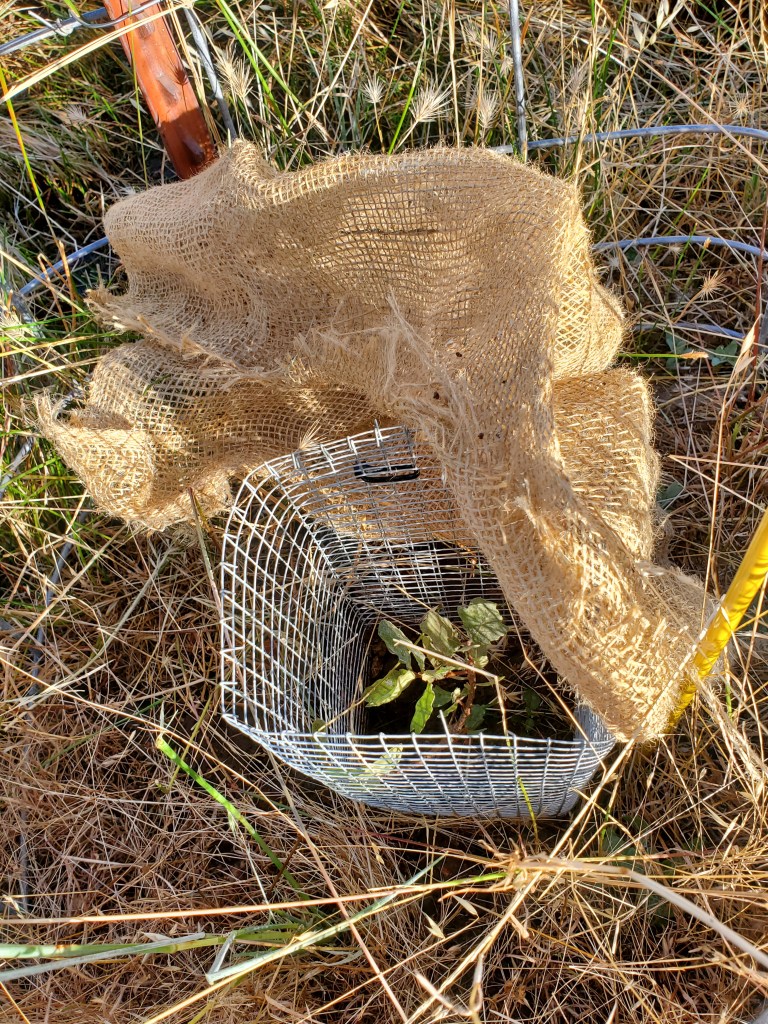
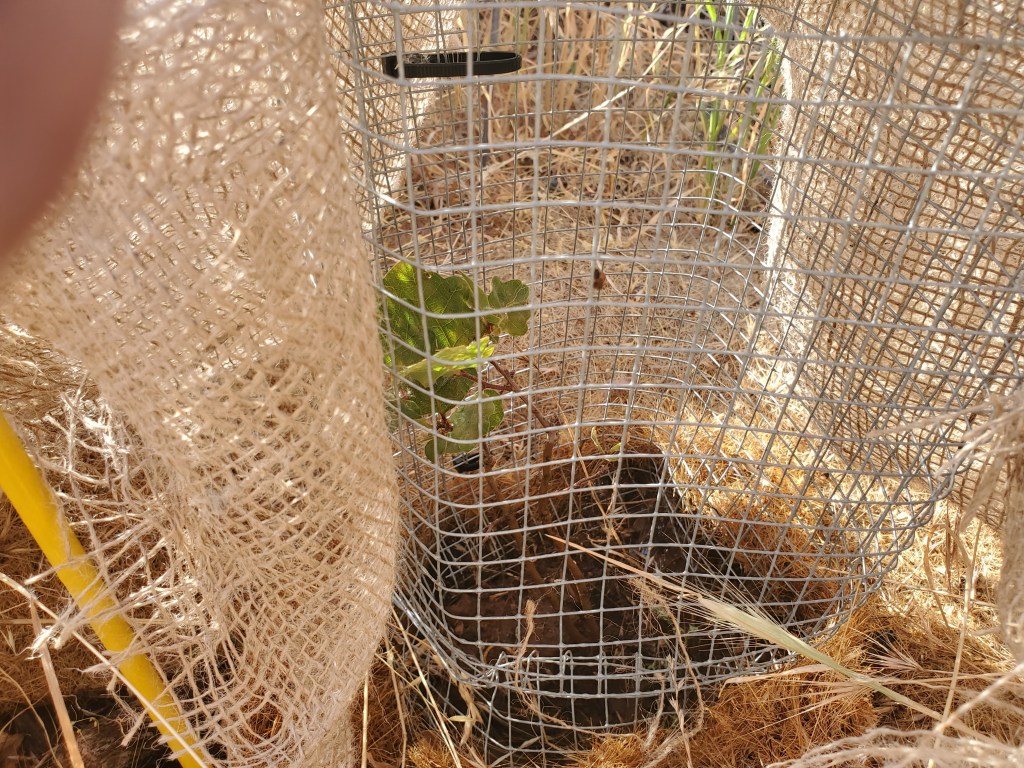
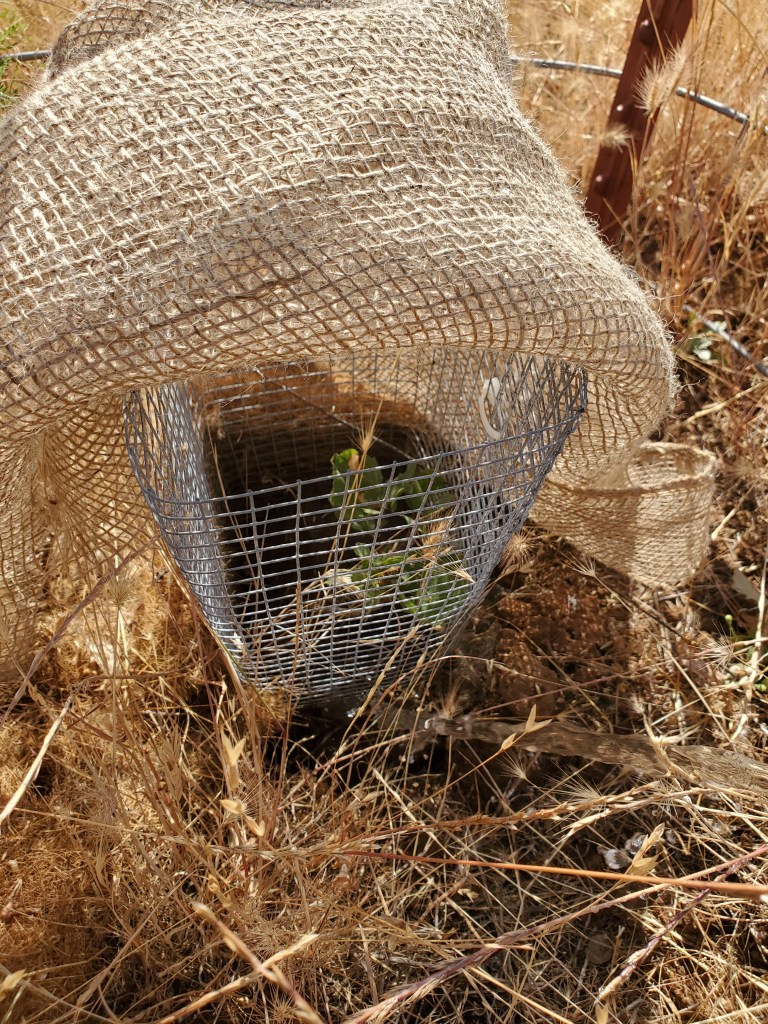
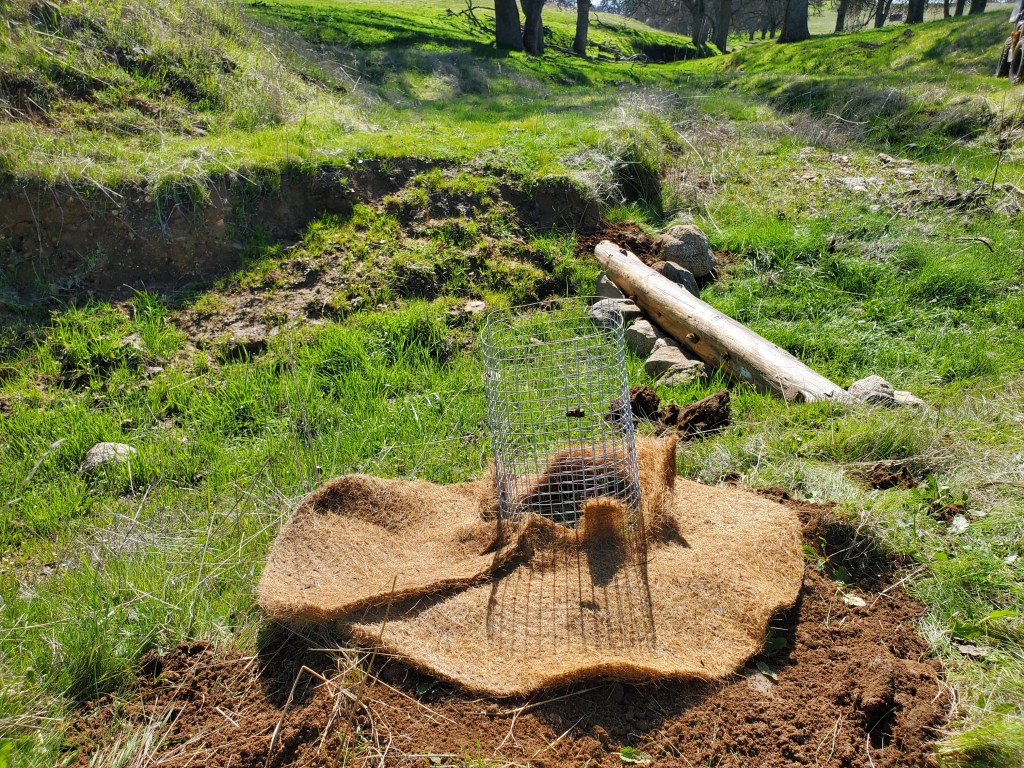
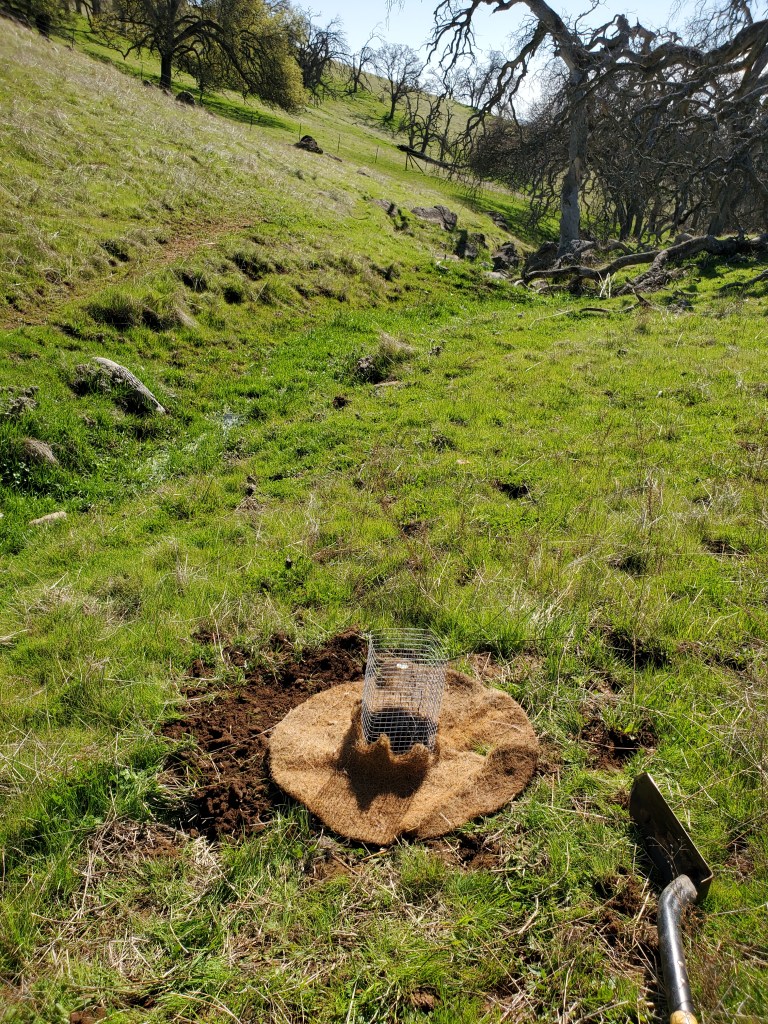
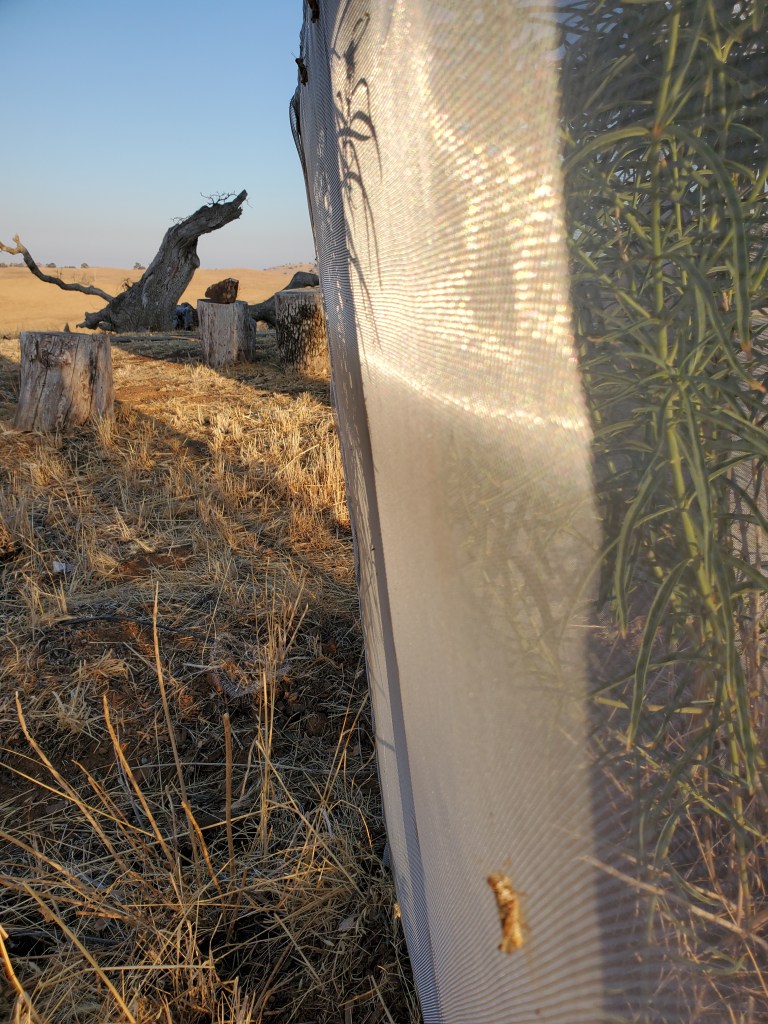
They are designed to have a wooden top to give it weight and an attachment point. There are two stakes (cut on the table saw from scrap wood) attached to the wooden top. They are nailed in at an angle to help with going over the cage shaft. Screen is measured to just fit around the gopher cage shaft. The screen is wrapped around the wooden structure and stapled.

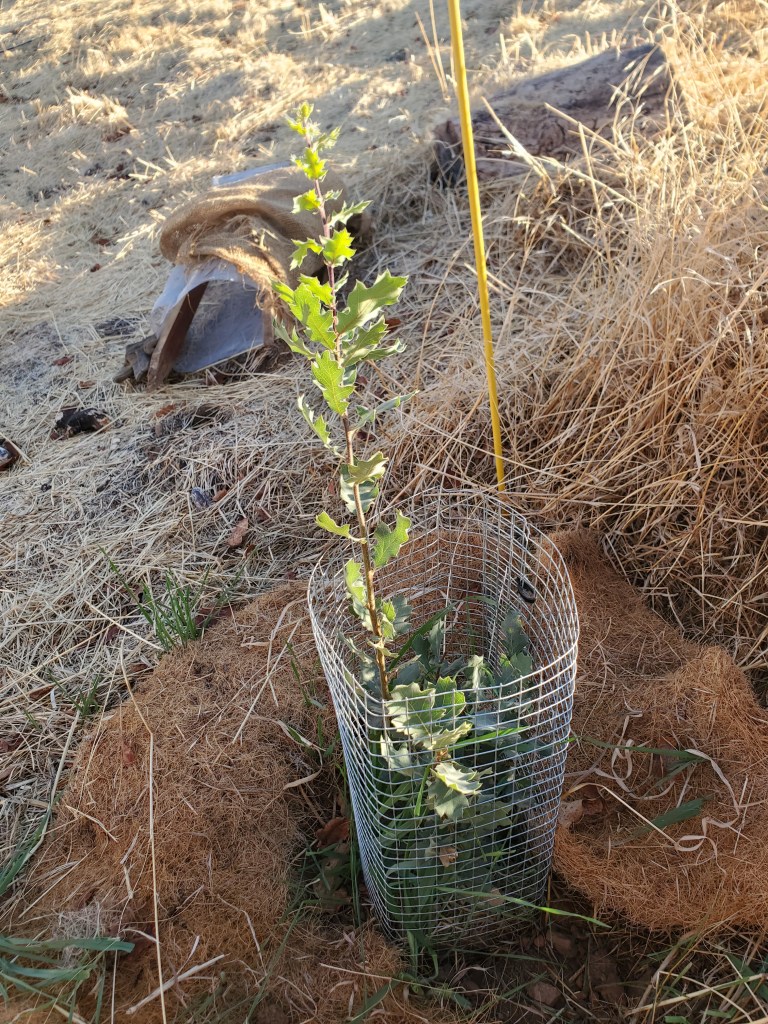
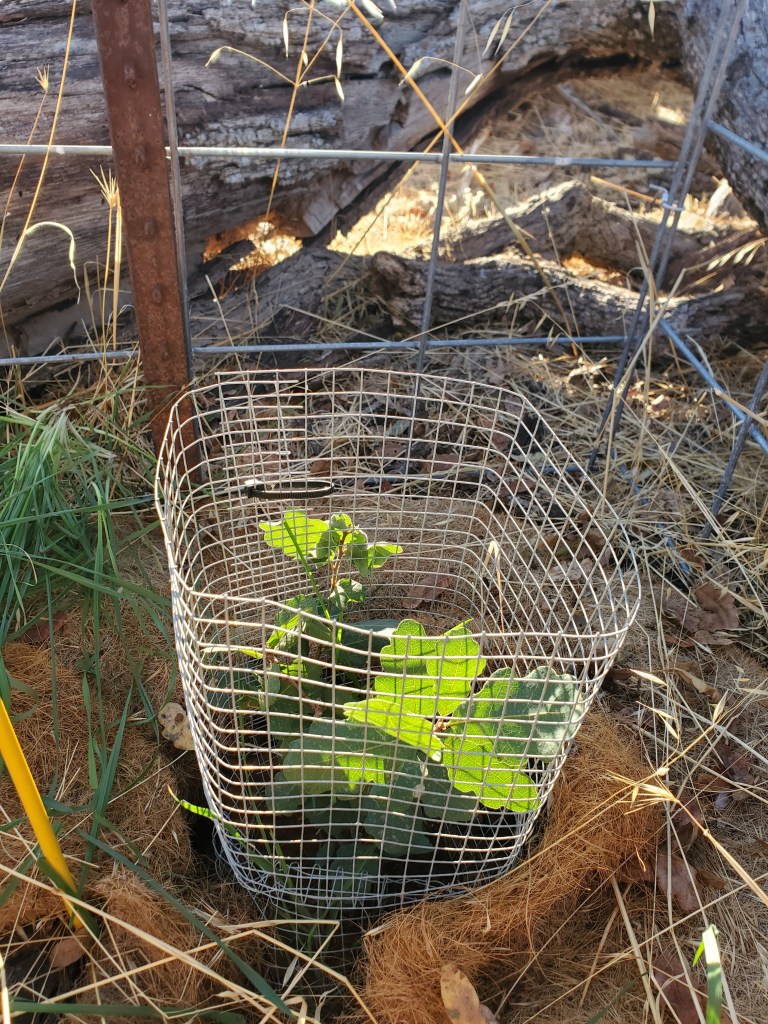
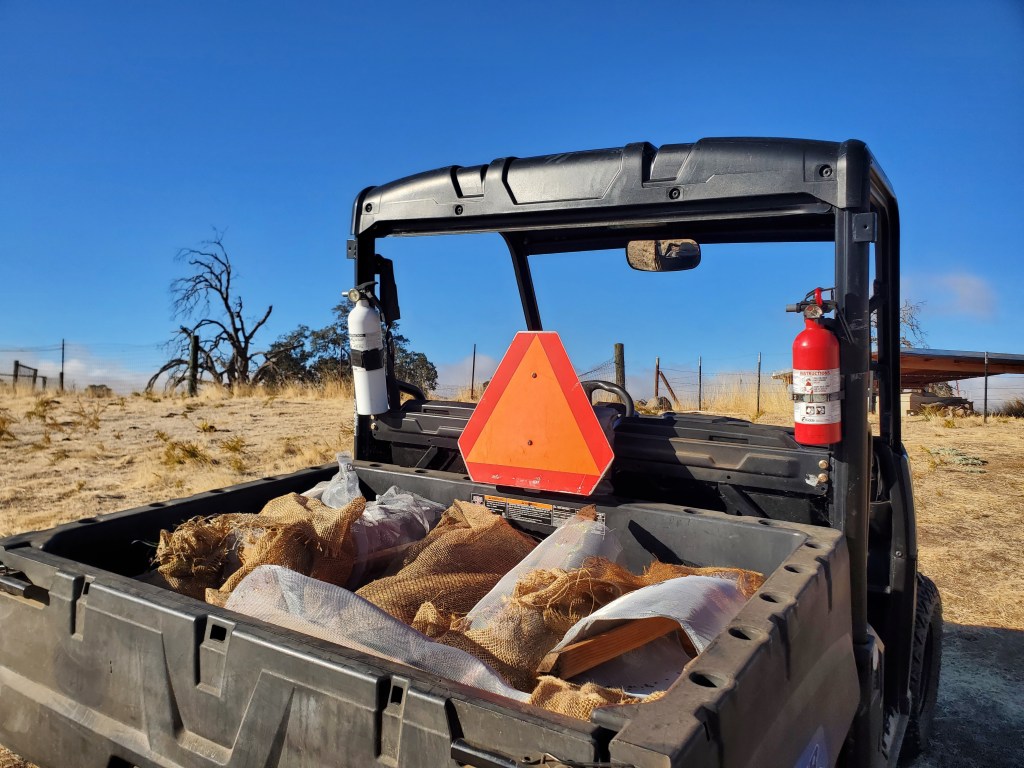
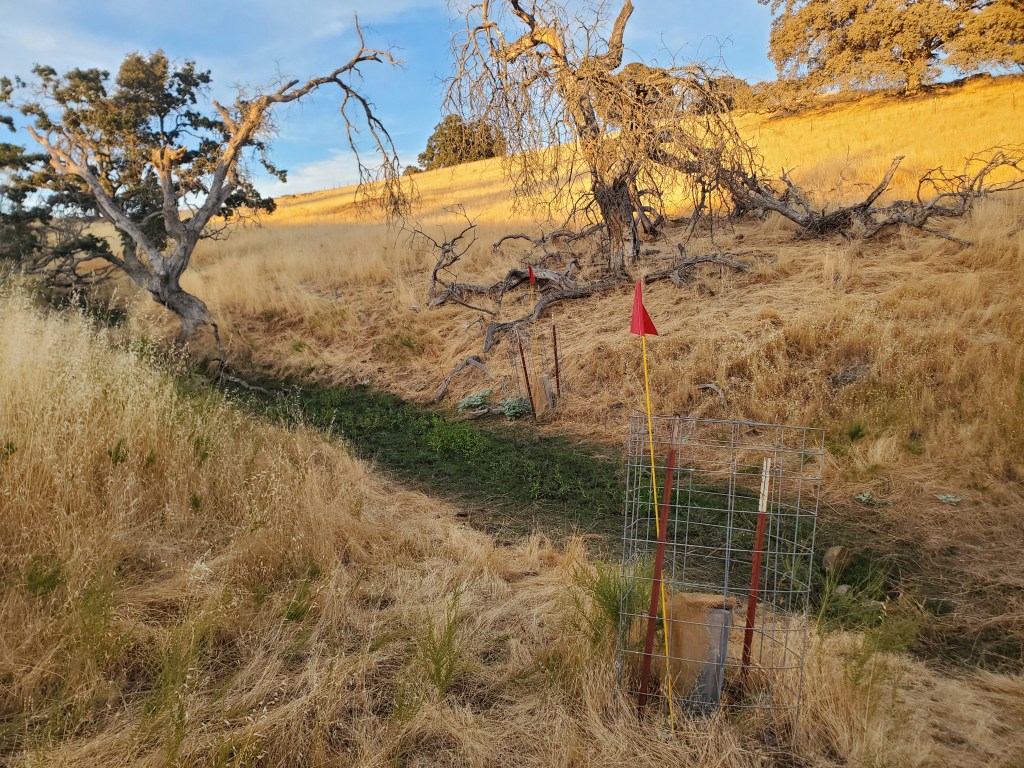
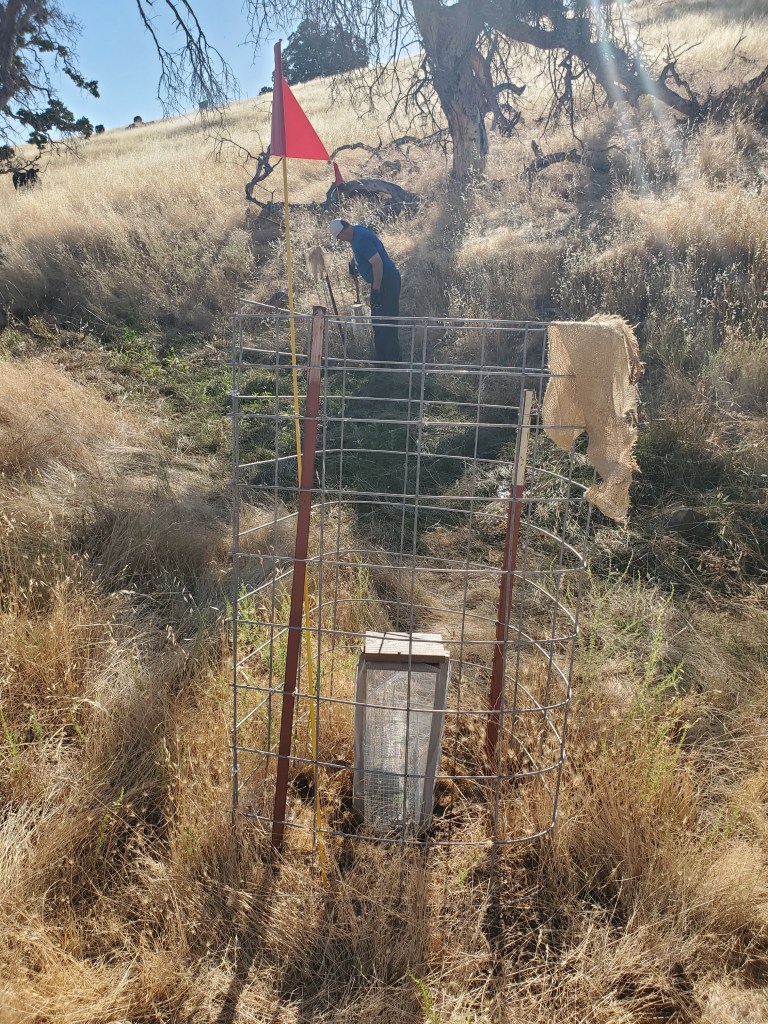
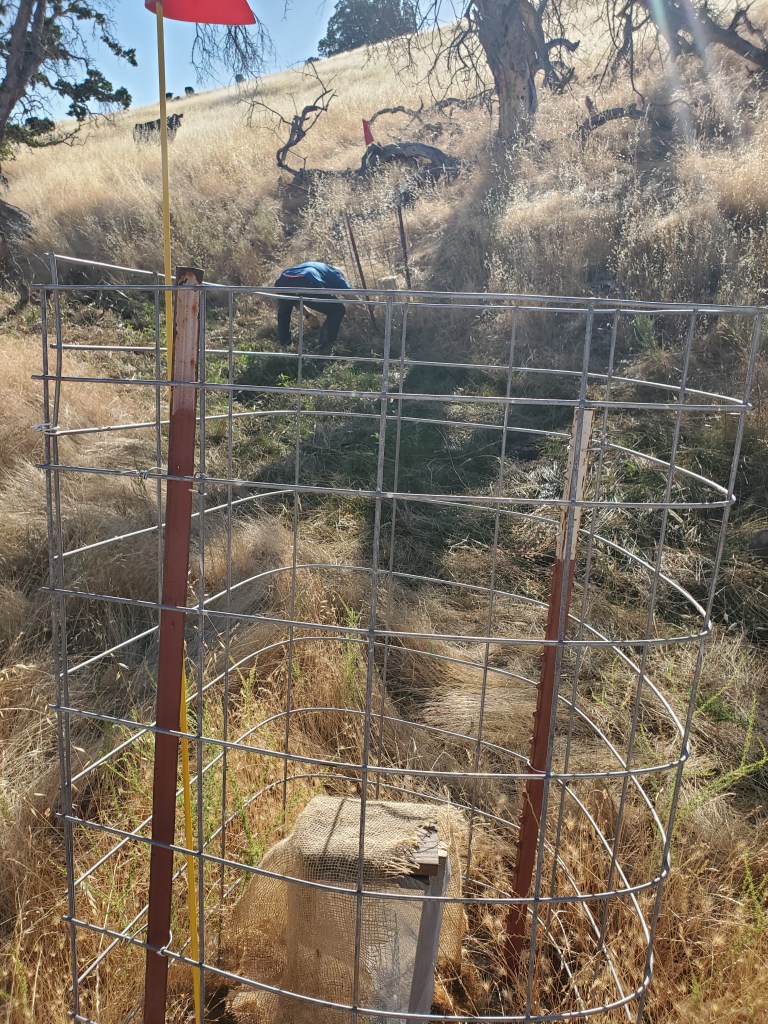
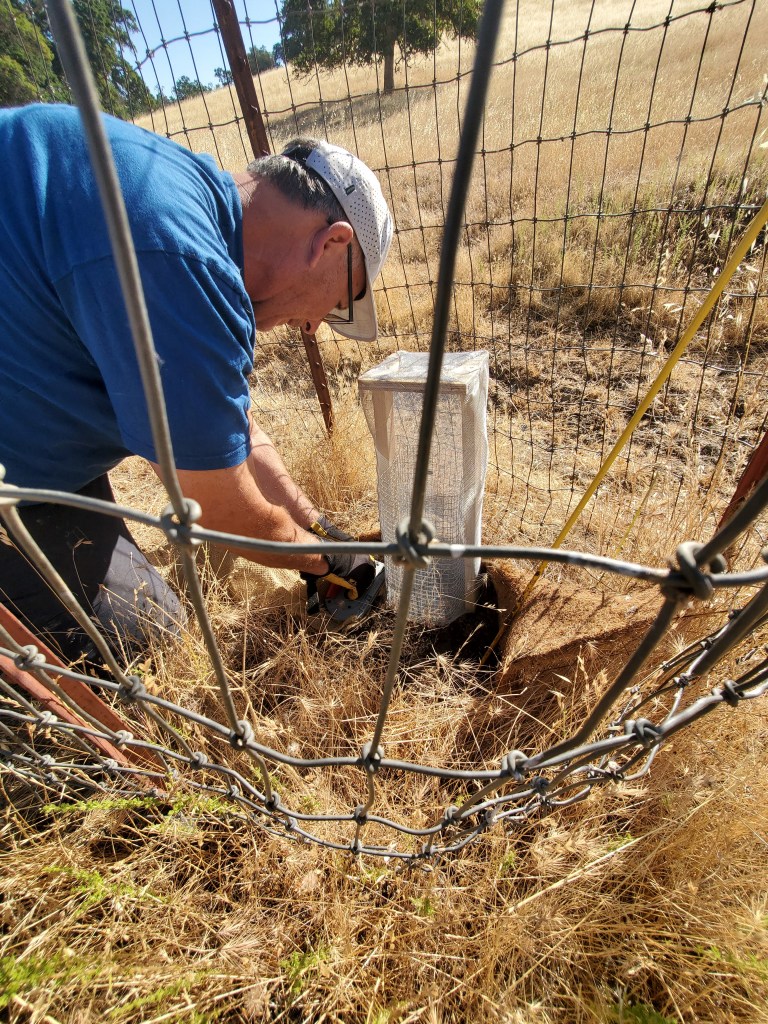
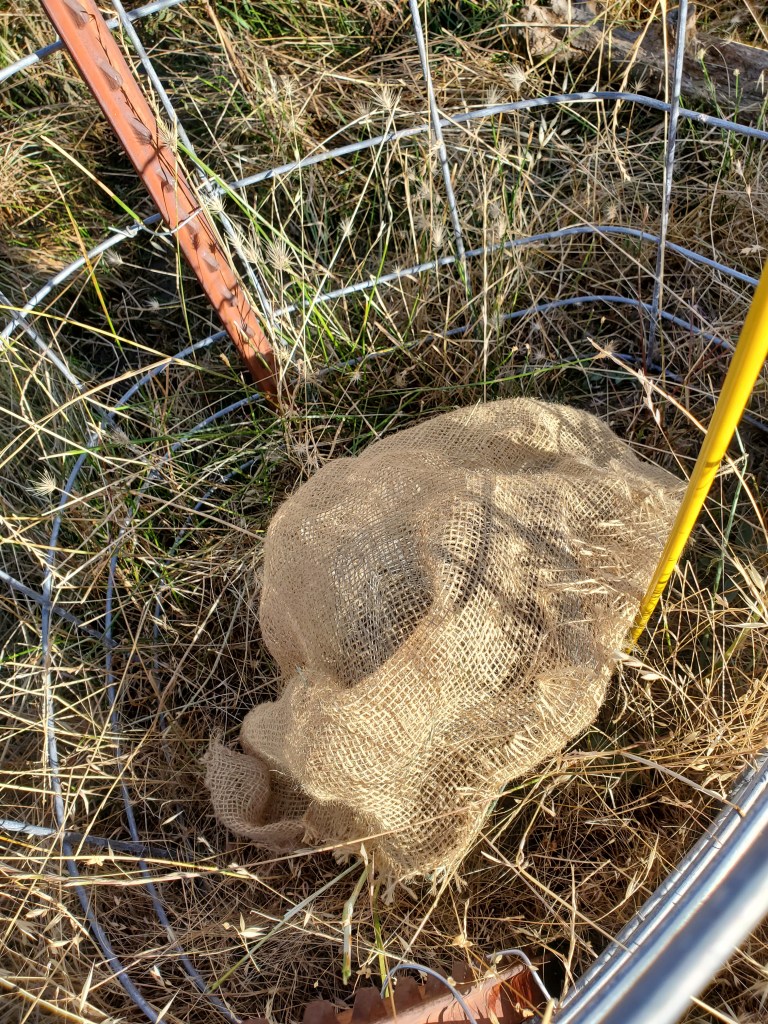
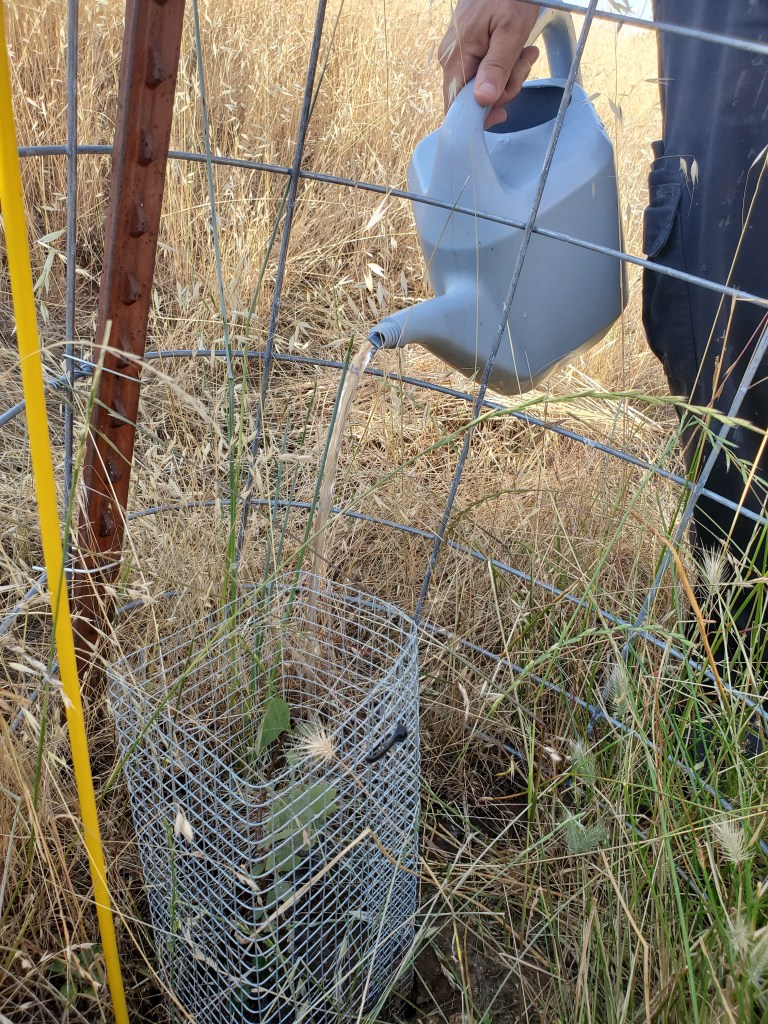
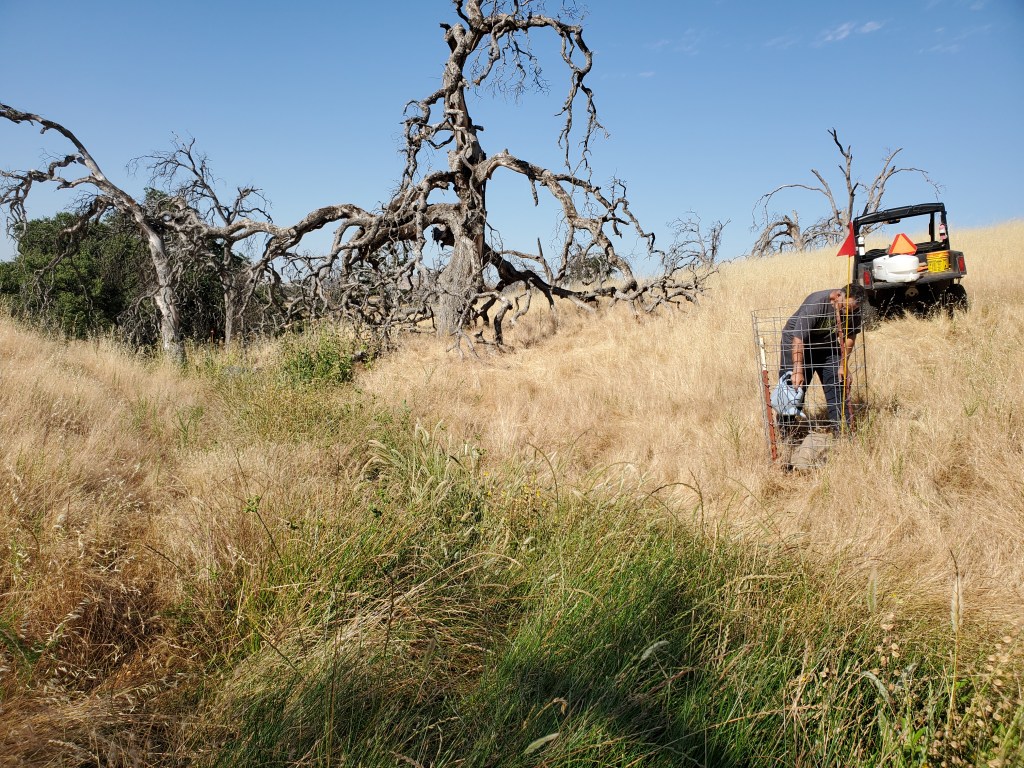
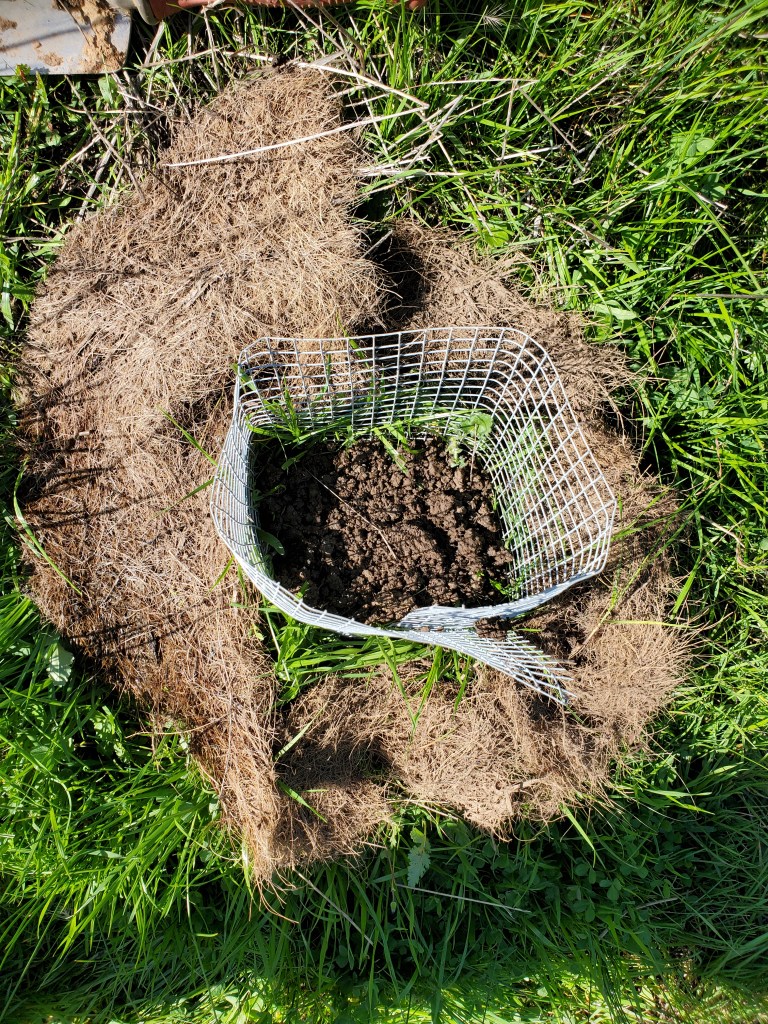
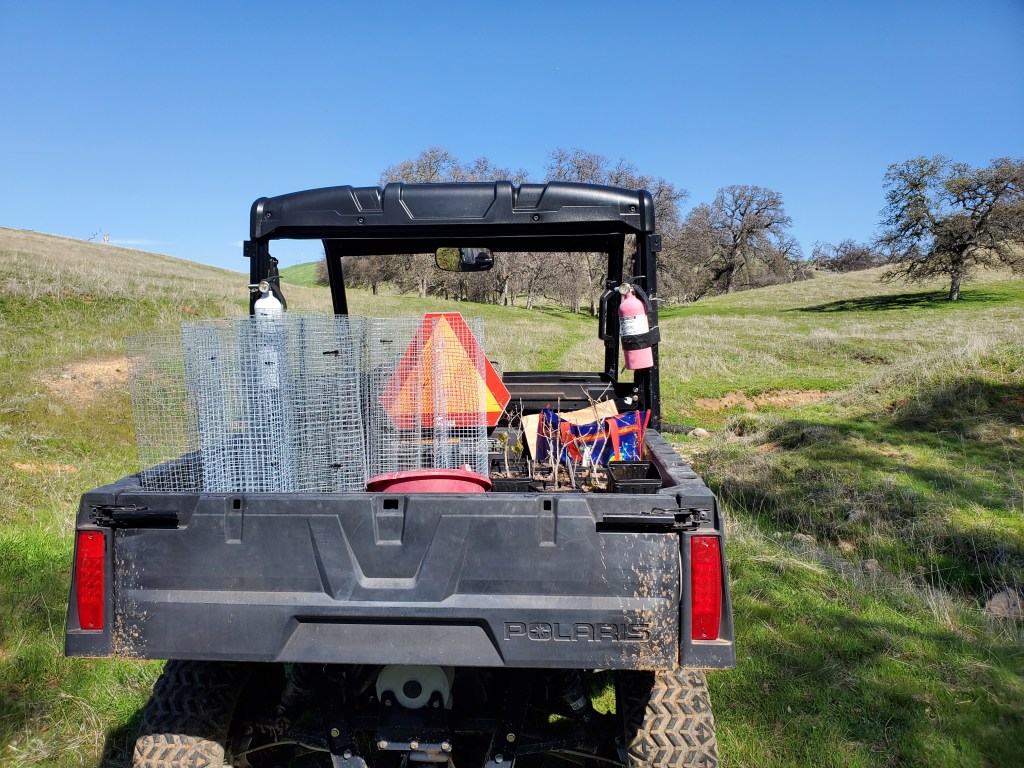
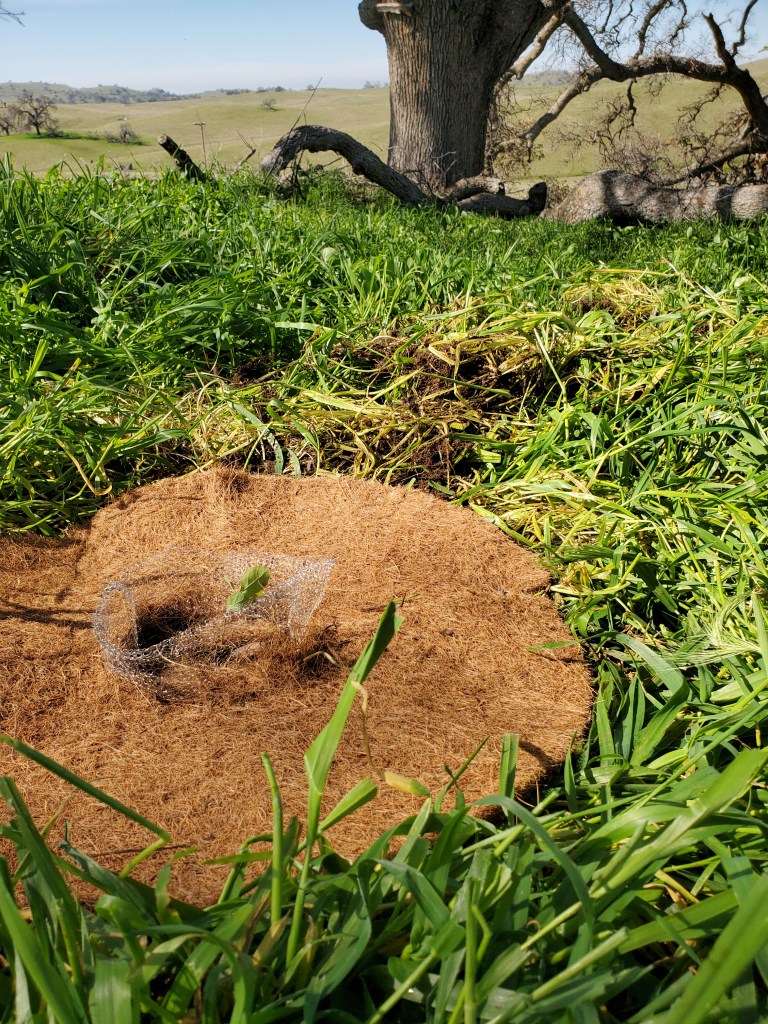
To do this takes time. The trees by the house got their boxes first. Then more needed to be built. Sam worked on the boxes while David and I placed what had been built. David could only work with me in short bursts because of his work schedule. It is laborious and very hand-oriented. You need to load water for the trees, load the boxes, the hammer, buckets and other tools to open cages or fix things. Then, you need to drive the polaris to the locations — no power steering. Next, you unload what you need, pull the huge, heavy tub with water toward the tailgate, unscrew the cap, hold onto the cap despite the pressure of the water in the large container, hold the watering can with the other hand or place on the ground, close the cap just right to prevent leakage (since you must have enough water for all the trees on your route.), haul the water, remove the shade burlap from the gopher cage, and water the tree. You need to pull up the coir pad so the screen box stakes can hit the dirt. Then, you go back to the cart, grab the screen box, lift it over the side of the cage. You need to alternate your hands through the openings in the cage, grabbing the screen box with one hand while placing your next hand through the next level of holes to grab the box, gently lowering it down over the oak in its gopher cage. This takes time. It is a gentle operation because you don’t want to risk dropping the screen box in the cage out of reach or breaking a branch on the seedling. Next, you carefully fit the screen over the gopher cage. They are designed to just fit. You don’t want to be too strong with it or the screen may pull off the staples or wood crack. You pull it over the gopher cage like a condom, then take your hammer and pound the wood stakes into the moist ground with the hammer. You then squish dirt up against the screen so there is no entry point for the hoppers. You place the coir pad back around the blended unit, grab the discarded hammer, walk back to the polaris and do it all again. Ideally, you don’t want to have to open the cage. That takes much more time – so you have to be careful.

With my thumb still busted, wrist, knuckles and ankles still sprained, my job has been copilot, holding the water bucket with my good hand, carefully walking over to the tree, watering and removing the burlap and coir pad. David was doing everything else. As we went to each tree, I held my breath as I lifted the burlap shade cover, hoping I would see the healthy seedlings I had watered just 6 days prior. The two upstream on the Spring Creek…they looked great. I breathed out. The one by the lower pastures planted into the old dead oak, I lifted the cover, mostly eaten. There was one green leaf left. I’ll take it. Watered and screened. The discovery was unsettling. I became nervous for the others.

Then, David received a message that there was another major issue at work. He had to help save the day for a different type of situation. Secretly, I deflated. We needed to complete the work or there might not be any other trees to screen. I felt nearly useless and very dependent upon David. Shoulders slumped, I helped pack up the polaris and got into the passenger’s seat. We had been out since 6:30am working. It was almost 9am. David had given me plenty.

As we drove toward the house, I resolved that I would do as much as I could with one hand. There could be no more delays. We already lost the two oaks down stream. I had to do something. We got home; David jumped out and quickly went inside. I went over to the pile of screen boxes, loaded up for the remainder of the oaks, got behind the driver’s seat for the first time in 5 weeks and carefully backed up and went back out.

The first tree was the oak by the guzzler. Hopefully, I lifted the burlap. She was gone. I went to my knees, gripping the cage, lay my head on the fencing and let out a scream and started to cry. Another one so healthy just days ago –gone. I pulled it together, and with renewed determination, I set about doing what David did, slowly and steadily. I was able to use my right arm, instead of the hand, as a bolster to hold things against my body and my left hand to do everything else. It was not ideal, but it was the only tool I had.

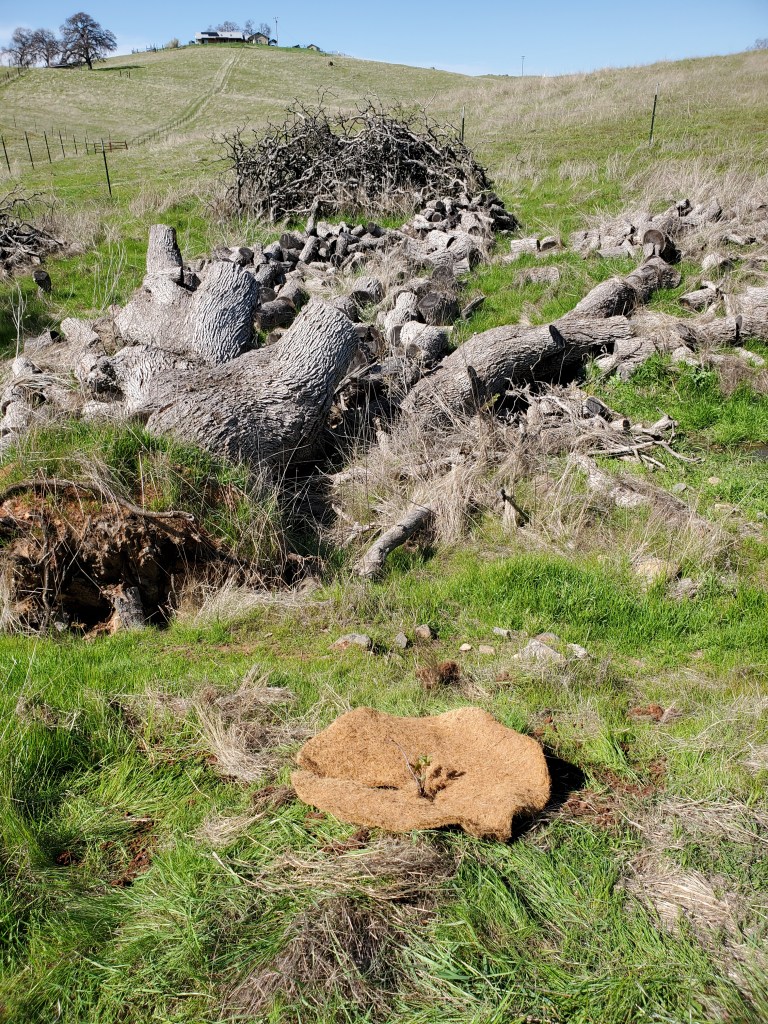
Like the other eaten oaks, the bark was still intact. I watered her, screened her, shaded her, and then moved on. The oak near the perimeter fence on the southeast was gone too. Instead of getting mad, I did the same thing… water, screen, cover. I went to the next tree. She was gone. My stomach started twisting. Hatred for myself for not being on it sooner crept in. Remember, every tree that does not survive, I must wait another year before I can try again. It is another year wasted. Water, screen, cover. I drove to the tree due west of our old, dying grove, lifted the burlap and — she was super healthy, full of leaves! The hoppers had not found her yet. I watered, screened and covered. Of the nineteen seedlings, six were stripped and ten had survived. The other three failed to thrive. They were lost around the time of the May heat wave.
Two Weeks Prior

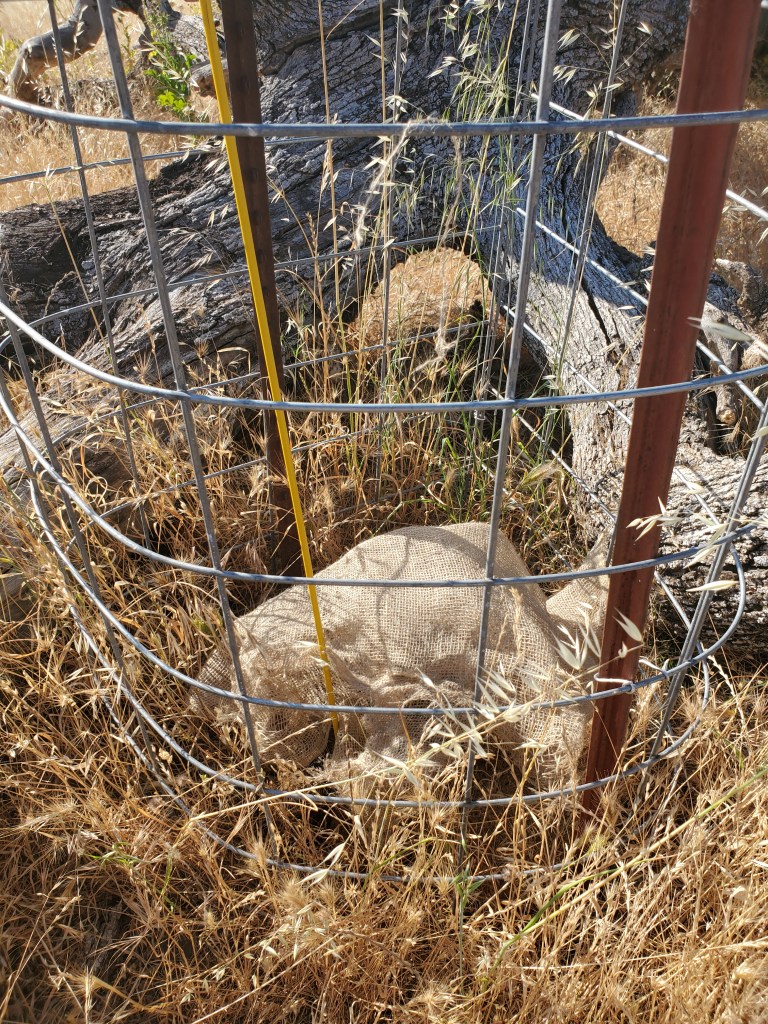
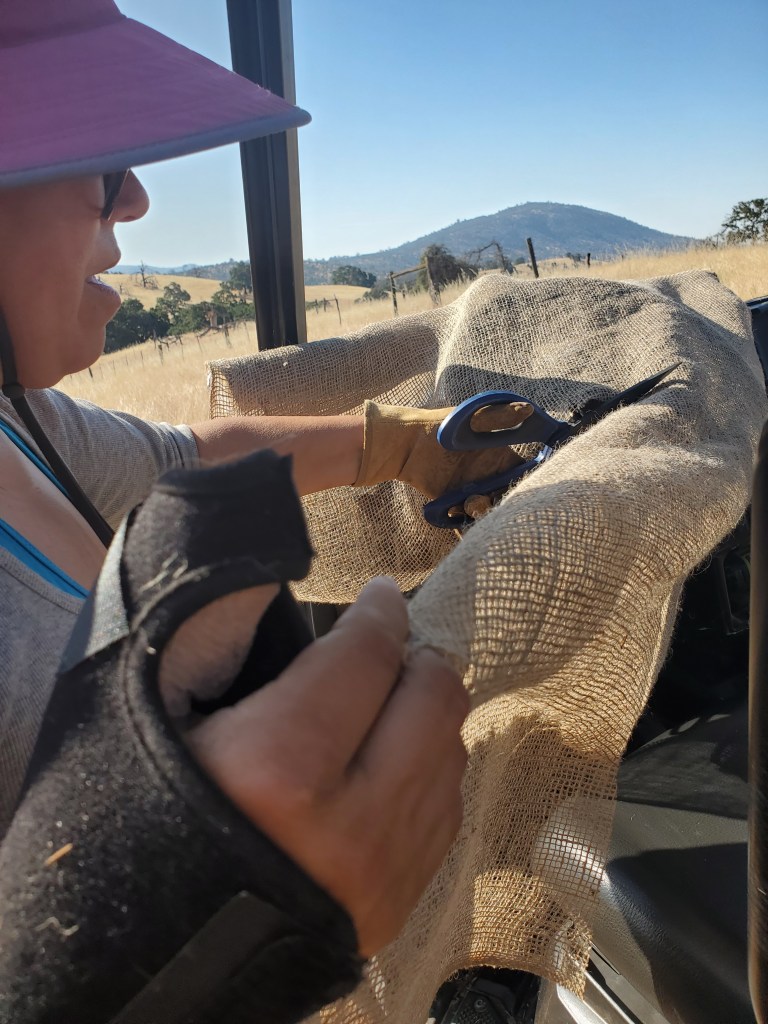
Just like in the movies, I will now take you to a flashback two weeks before the hoppers ramped up. David and I have been maintaining a strict watering schedule of every 5 days for the oaks. In anticipation of the mini heatwave, we also cut sections of burlap to lay over the gopher cages to shade the oaks. Sadly, two oaks appear to not have made it through the heat, the one in the exclosure and one of the driveway oaks. We continue to water them just in case the roots are still alive.

Milkweeds Gone

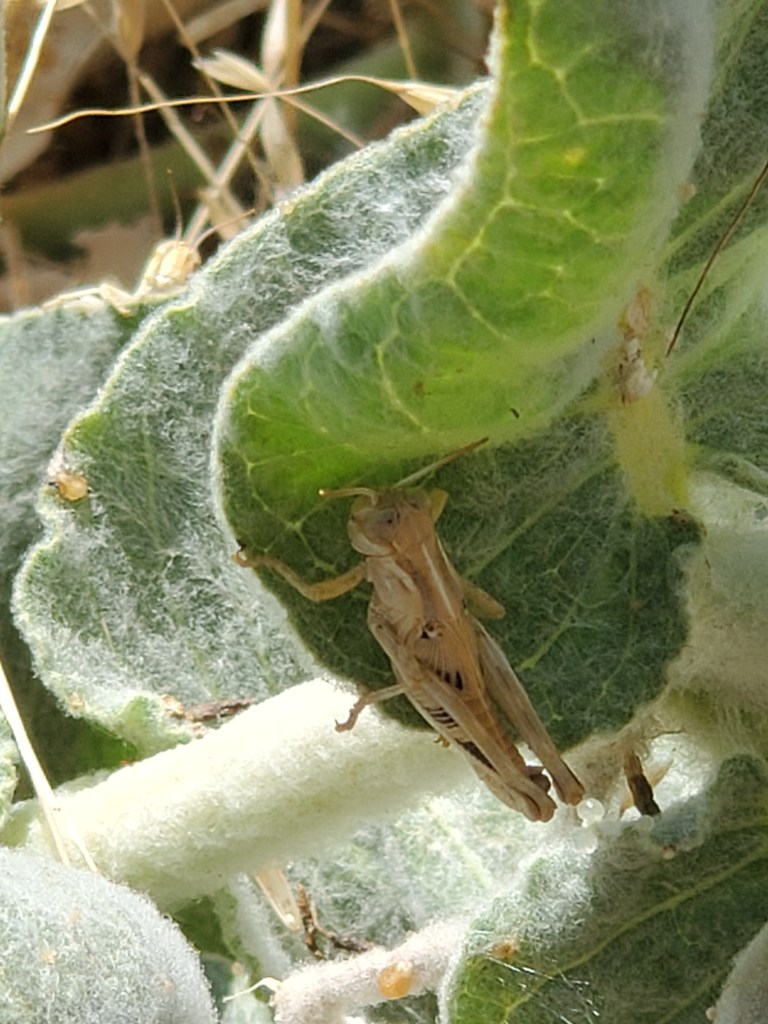
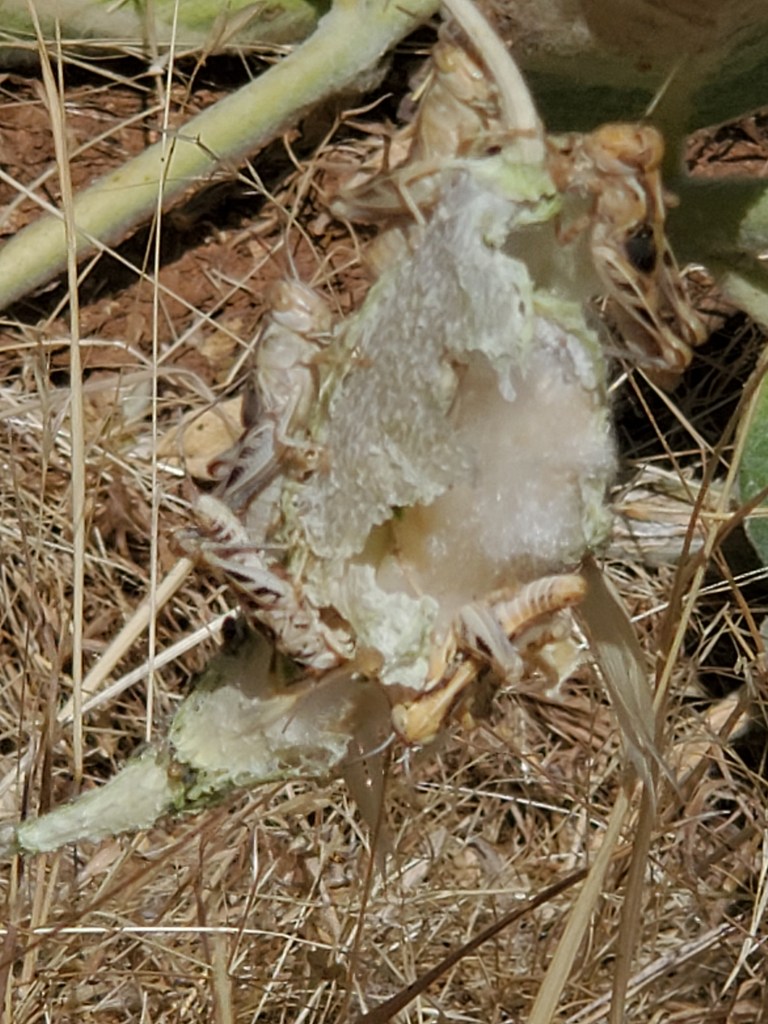
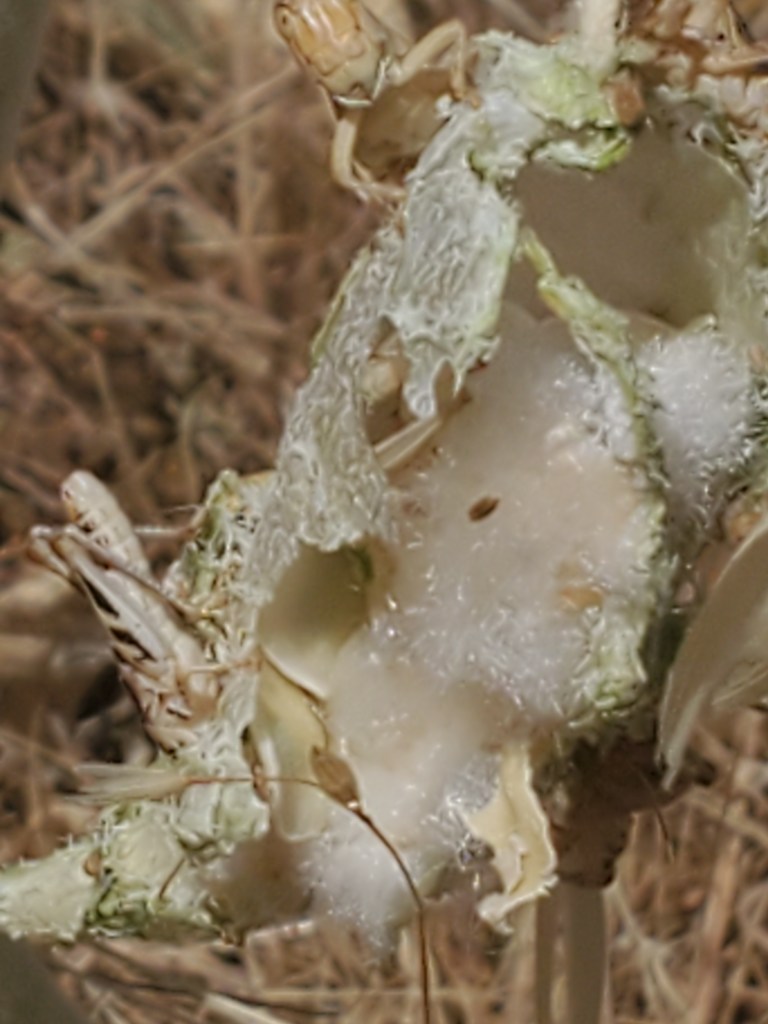
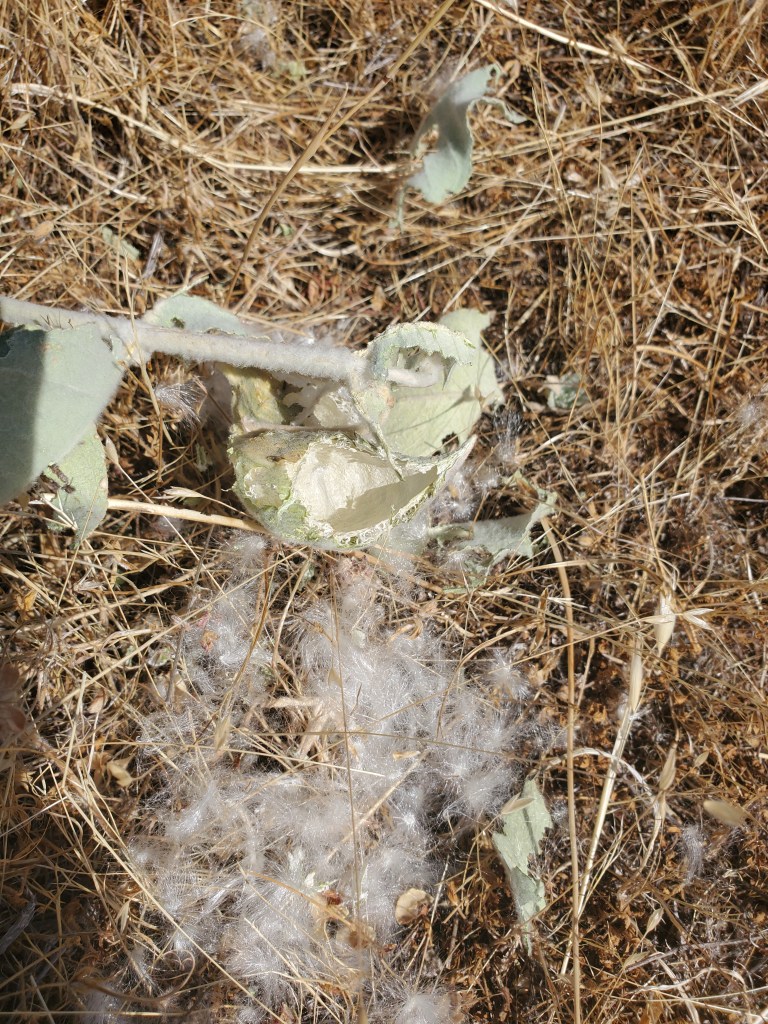
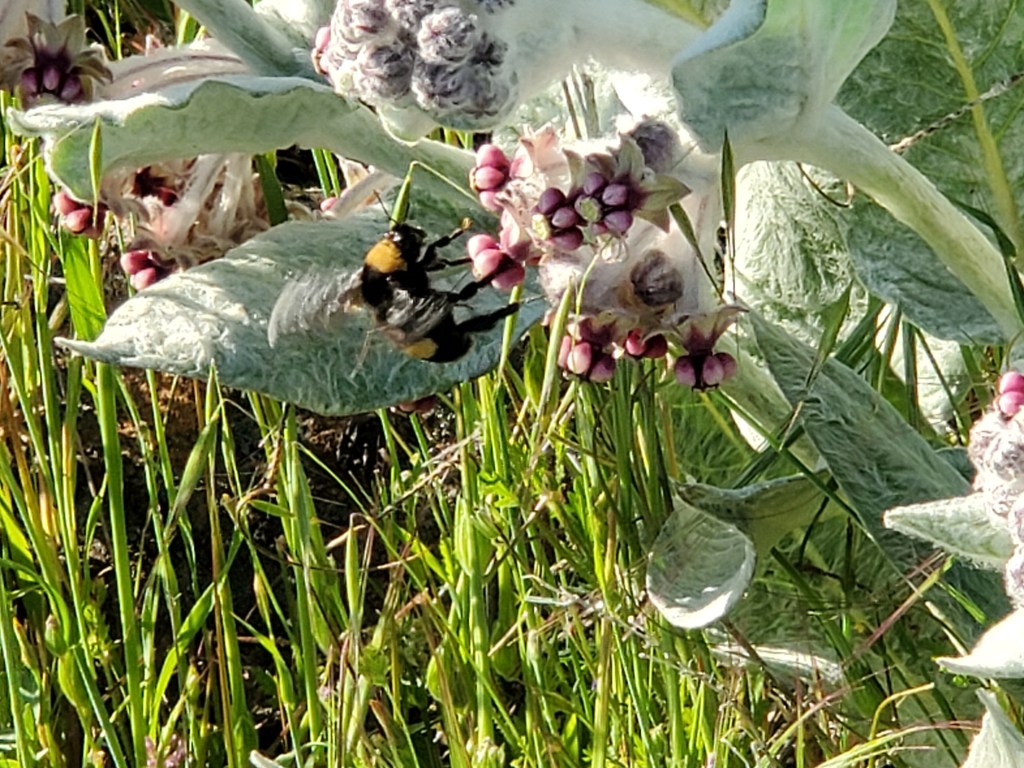
Similar to the oaks, the grasshoppers are all over the California milkweed. The only difference from last year is that the hoppers came later giving the milkweed more time to set seedpods. With the accident, I have not been able to monitor the sites. Last Sunday, I felt strong enough to walk up the hill, slowly and carefully. I found every milkweed at one stage or another of being eaten. On the more intact ones, there was still no sign of monarch activity. I am officially designating this spring a no monarch spring. Add that to the no monarch fall. It is beginning to feel very depressing.

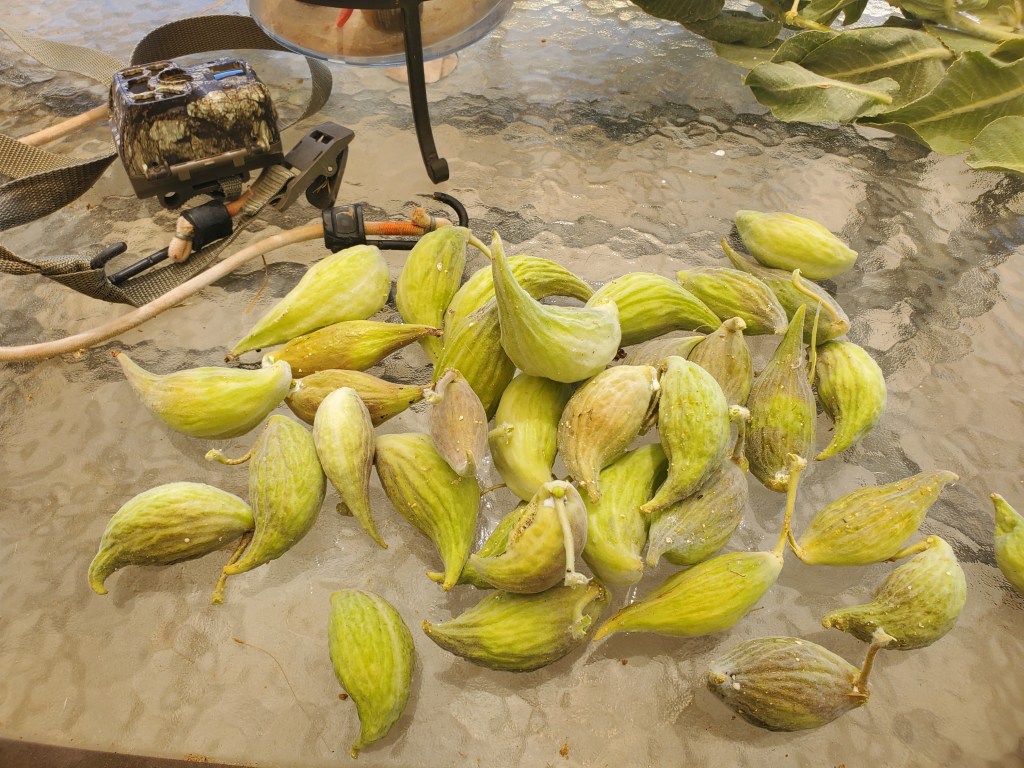
The plants on the south-facing slope were mostly eaten. There was evidence of seedpod destruction. Although not prepared with clippers and a bag, I began to harvest the pods. If I waited much longer, they would all be gone. Because I was pulling them off the stem early, the white “milk” ran onto my hand making my fingers and palm sticky. I continued, but could only find six seed pods remaining at the site. I moved to the north-facing site. More plants were intact, but were rapidly being eaten. There was a bumper crop of seed pods, including four massive ones. Normally, I would never harvest more than 10% of the pods and allow them to drop and open naturally. In this case, with sure death ahead of them, I went about my business of disconnecting the children from the umbilical cord, they, still holding tight for the nourishment it brings, and me, covered in mom’s milk grabbing her treasure for the possibility of life down the road.

With no bag, I placed them in my pockets, held a bunch in my arm and finally, made a pouch with my tee shirt. Several branches, with seedpods still attached, had been dismembered from the plant by the hoppers. I used those as a base for piling on the loose pods. It worked. I was able to slowly navigate back across the hills, pregnant with A. Californica seed, to the patio without dropping a pod. After the danger has passed, I will release these seeds back into the areas from which I harvested them – probably September.

With the milkweeds done for the year, the cows still remaining on the ranch and the grasses nearly 4′ tall, I opened the gates to the far north field. The cattle have made their way into the field munching on the buffet of tall grass and thick green grass and flowers in the riparian areas that have been, as yet, untouched by cattle. Within the first day, those green patches were eaten down to dirt. My feelings are mixed. While I want to preserve the flowers I have left in the riparian areas, I also would like the tall grass to be grazed off a bit. Fire danger is always top of mind. All needs must be balanced, habitat for birds, pollinators while not trying to overstock too much on grass.

Wildlife

Even as the temperatures heat up, there are blooms, and I still see glimpses and/or evidence of wildlife. The guzzler has continued to be a center point for racoon and bird activity.

Wanderings

What horrors we are seeing. There are so many tragedies happening; I can feel the energy of the earth listing. There is only one healthy way to be, and that is in balance. You don’t take more than you need. You don’t give more than you can. My dear friend had a very ill wife. He cared for her for over 20 years. He was unbelievable, one of the finest caregivers I have ever seen. Lifting, bathing, feeding, driving, monitoring – he was her spirit moving her through life, so that she could live well and with dignity. She passed last month. My friend, with nothing left for himself, died three and a half days later. He gave more than he could.

With so much loss and sadness, it has been difficult to focus on writing. The unrest, murders, bombs and abuses of power, have caused me and so many others emotional distress. This is not living in a good way. I see it on the ranch, the imbalances. It is unhealthy, and things are mixed up here. There are only two entities that can move us back into balance – us, or Maala Bwia (Mother Nature). Given all the human greed and climate horror of the last century to today, I don’t have much hope that it will be us that leads the shift back. But, if it is itom Maala/our Mother, it will not end well for many of us. So let’s get more of us working toward finding our equilibrium.

Amid the depravity and cruelty, there is always light. This is something so lovely it will fill your heart – true heroes from the Resource Conservation District of Santa Monica Mountains racing to save gobbie fish and trout from sure death after the catastrophic Palisades Fire in Southern California. This is the type of character that will shift us – respect, dedication and reciprocity to all life no matter its popularity, size or their ability to be commercialized for humans.

Here is the article in the LA Times.

Here is a brief YouTube film the organization made.

Here is a link to a larger documentary about humans fulfilling their obligations to the Huya Ania (Wilderness/Natural World). It is just a trailer, but please, try to organize a viewing at your location if you have the capacity.

Goodness exists all around us. Grab hold of it instead of the negative. Cling. Never let go. Eventually, its light wraps you, moves through you, becomes who you are. Let’s all bring more light.

Frog Songs|Blue Oaks Planted|Guzzler Install

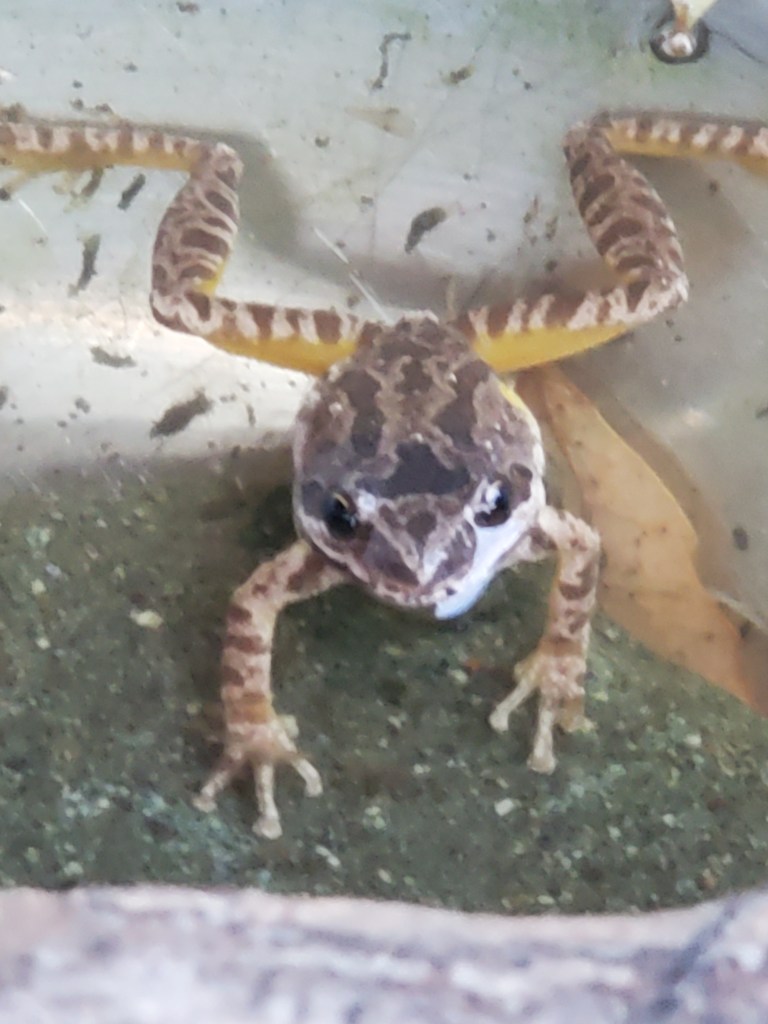
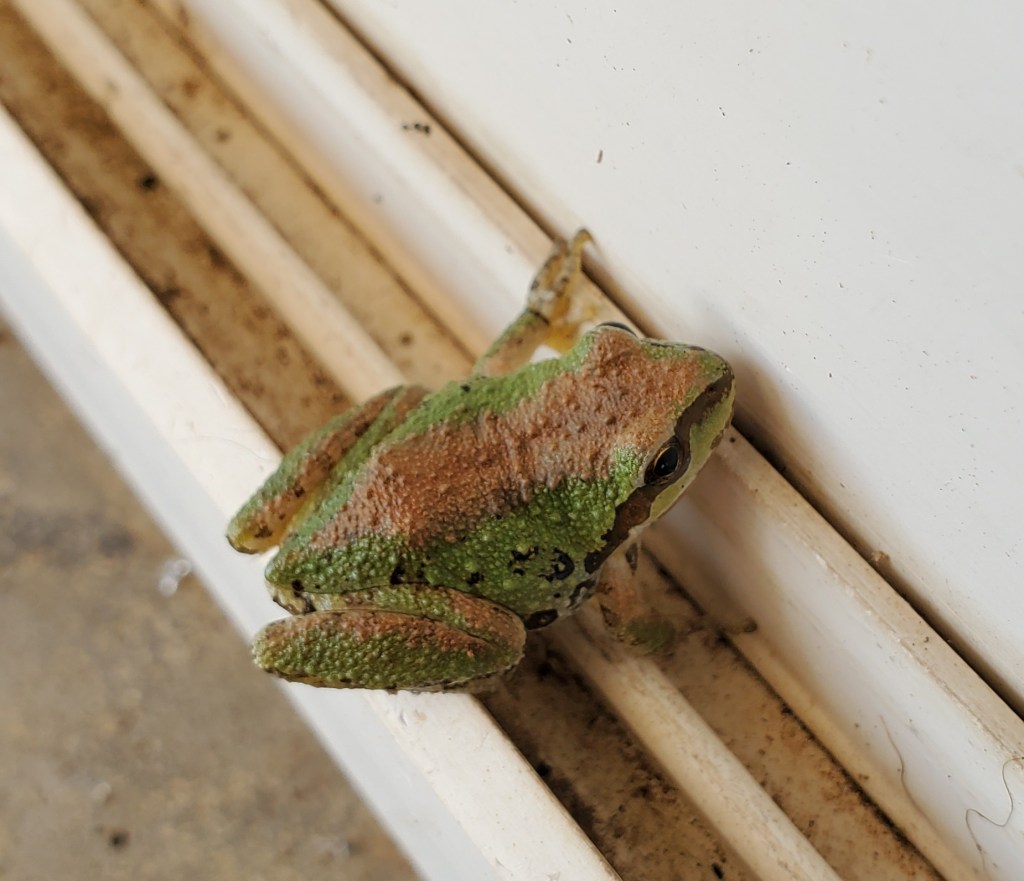
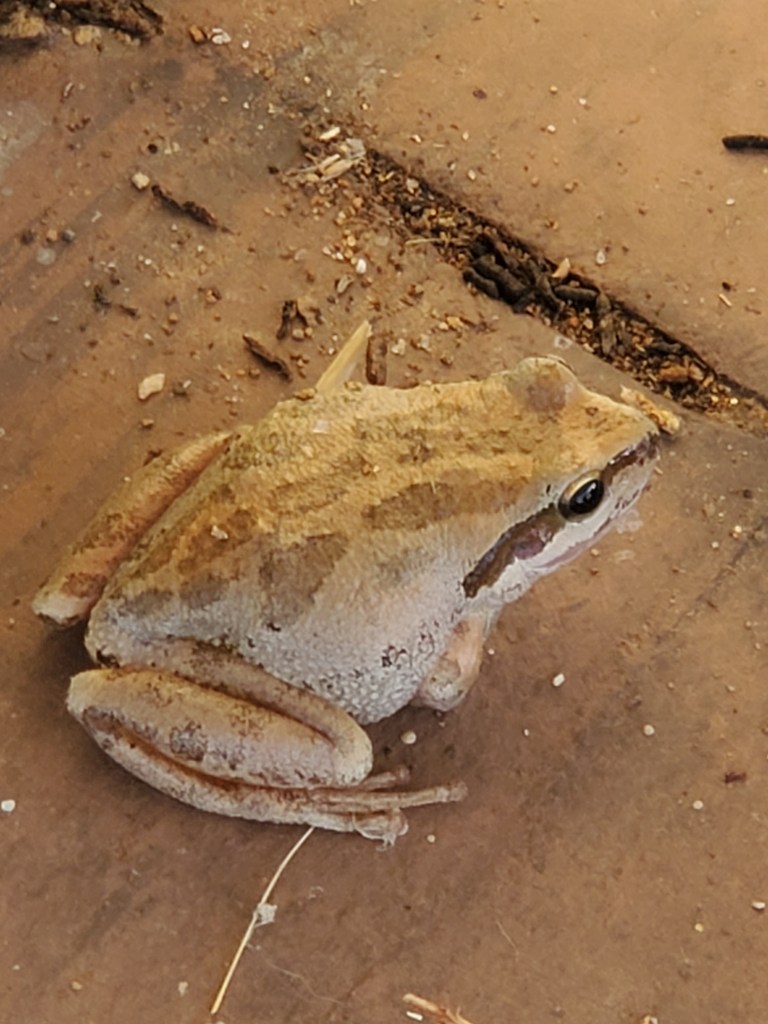
Sierra Tree Frog thinking about climbing the sliding door

Every day, I am treated to a symphony orchestra of such precise, crisp quality that I am moved emotionally. Each diverse player is always in-tune, and the music is in stereo. No, I’ve not traveled to San Francisco or Los Angeles. I step out on my front porch to a noisy, bustling world — first the rushing creeks after the rain, then chorus frogs with their undulations in 360 degree splendor. The coyotes cannot be left out. They join from far distances and close, their songs carrying across arroyos and hills. A mourning dove enters the symphonic experience just at the right time, then a muted tink of the rustle as a light breeze moves through the oak branches, playing the leaves like keys of a piano. Like a horn, a screech owl hoots, or a barn owl screeches. California toads croak, then trill. Finally, my own heart plays a role keeping time, threading through this musical soup, a genius blend, warming and nourishing, rich and whole.

Guzzler Project

Construction of Guzzler Two, which is located on the east section of the ranch, has begun. David made a mistake early on in the dimensions. Although he fixed it, we lost half a day putting us behind timeline and up against the recent rain storm. He got the posts sunk and cemented and the headers on, but was not able to get the rest of the joists, roof and gutter on. It was disappointing, since we have a week of rain. However, I have to give us both a break. Life has been challenging. There was no time to start earlier. We have so many projects, medical appointments for dad, work and catch up for work from the last several months as well as other volunteer responsibilities. I remind myself that we just can’t do it all.

I am grateful for the time we can dedicate. At least the guzzler is up, and has a beveled lid that is designed for rainwater catchment. There is a ramp built in, so we will get some water in and have a working unit for animals.

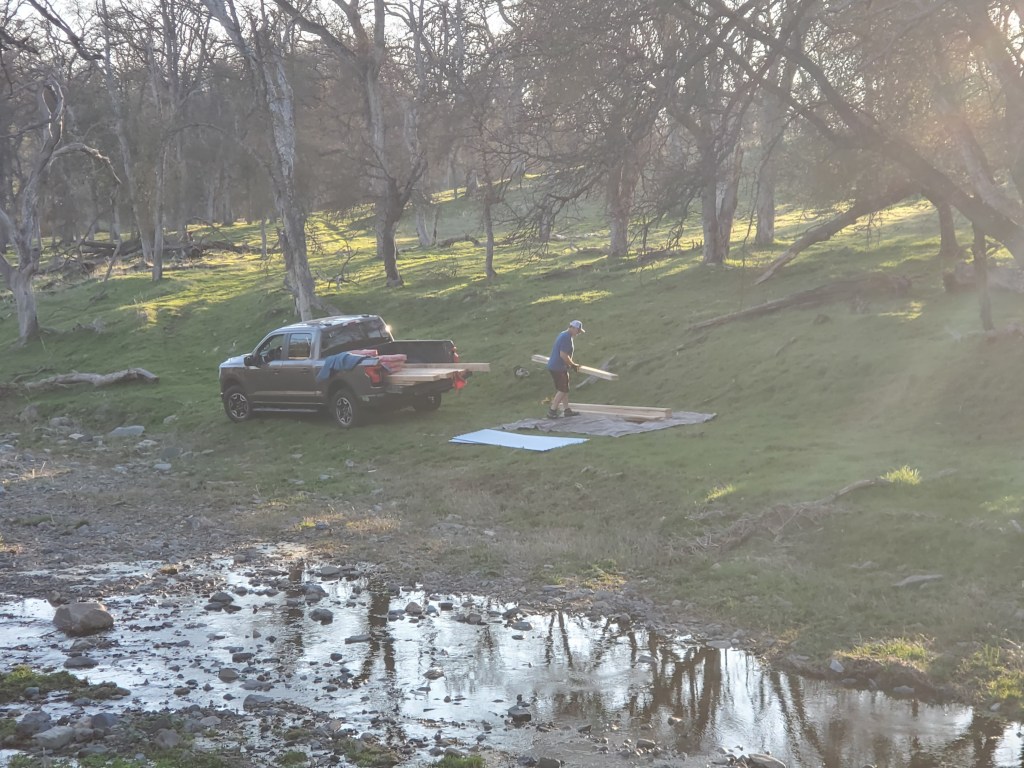
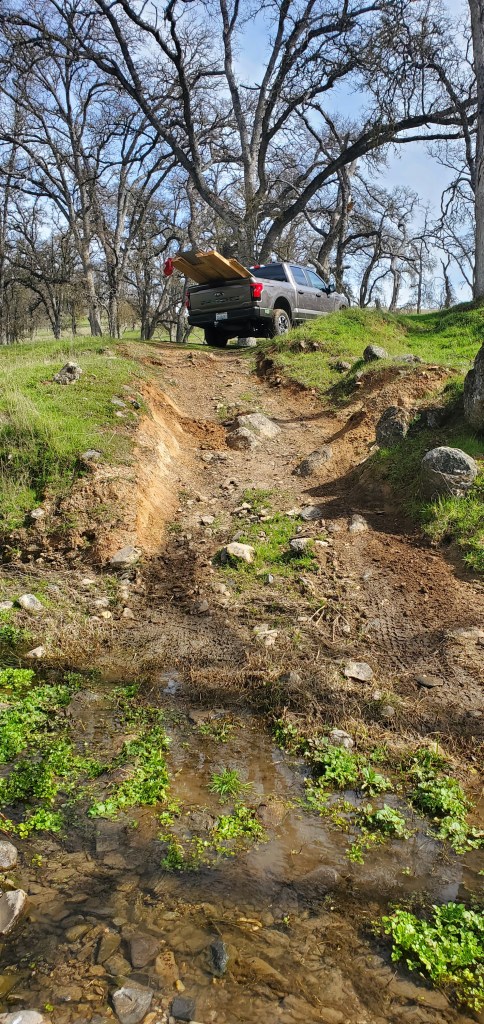
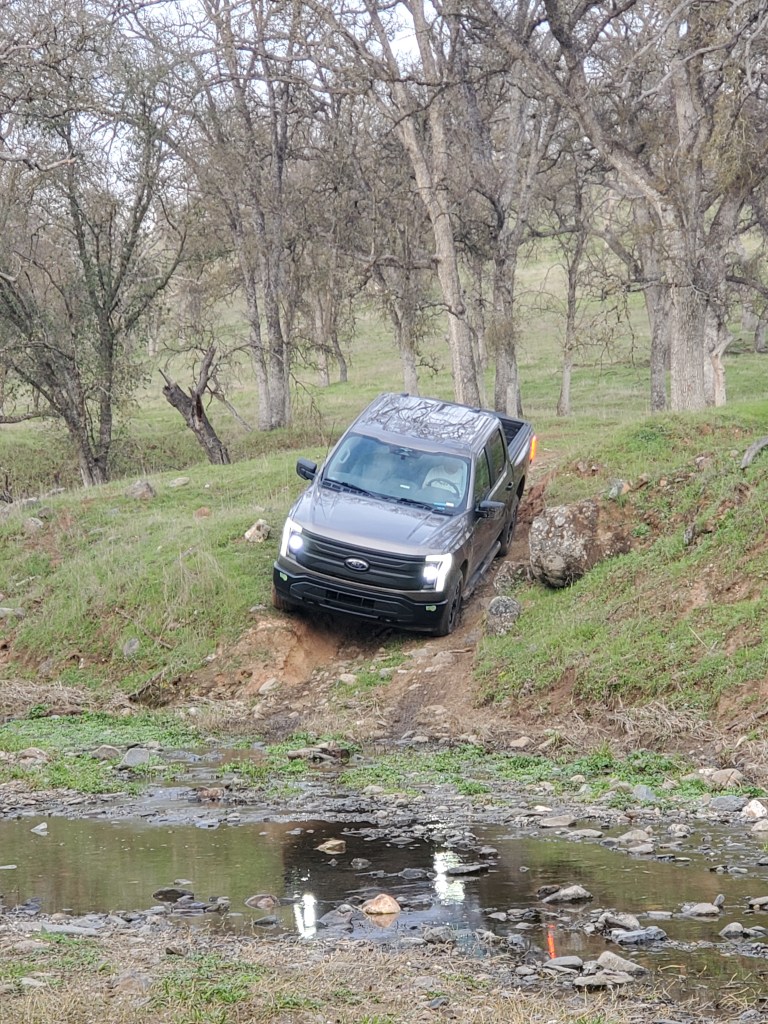
In 2015, the big flood year, the road to the area east of Odom Creek on the ranch was washed out. I would access via foot or ATV. We initially began to stage the materials on the west side of Odom Creek, but David had a feeling he could make it in the truck. I thought this should be a big “no”. Besides the fact that this is a newer truck David uses to commute with, I try to limit motorized vehicles on the ranch simply because their impact on the soil. Everything we have is electric, so I am not concerned about emissions or oil leaks. The weight and act of rolling across the ground over and over has consequences. This is why I stay in my tracks as much as possible when servicing plantings.

Well, when I left to plant oaks, David measured the area, measured the truck, measured the area, measured the truck and decided to go for it. He texted me some photos, and I was shocked. The truck made it. I thought that perhaps making one trip with the truck instead of five with the ATV might be better. I walked the route first trying to make sure there were no frogs or other wildlife, then I allowed myself and/or David to roll through the water and on the bank again. I am trying to do what I can to mitigate damage and hoping the guzzler will make up for any damage we may be causing rolling our vehicles back and forth.

Blue Oaks Continue to be Planted

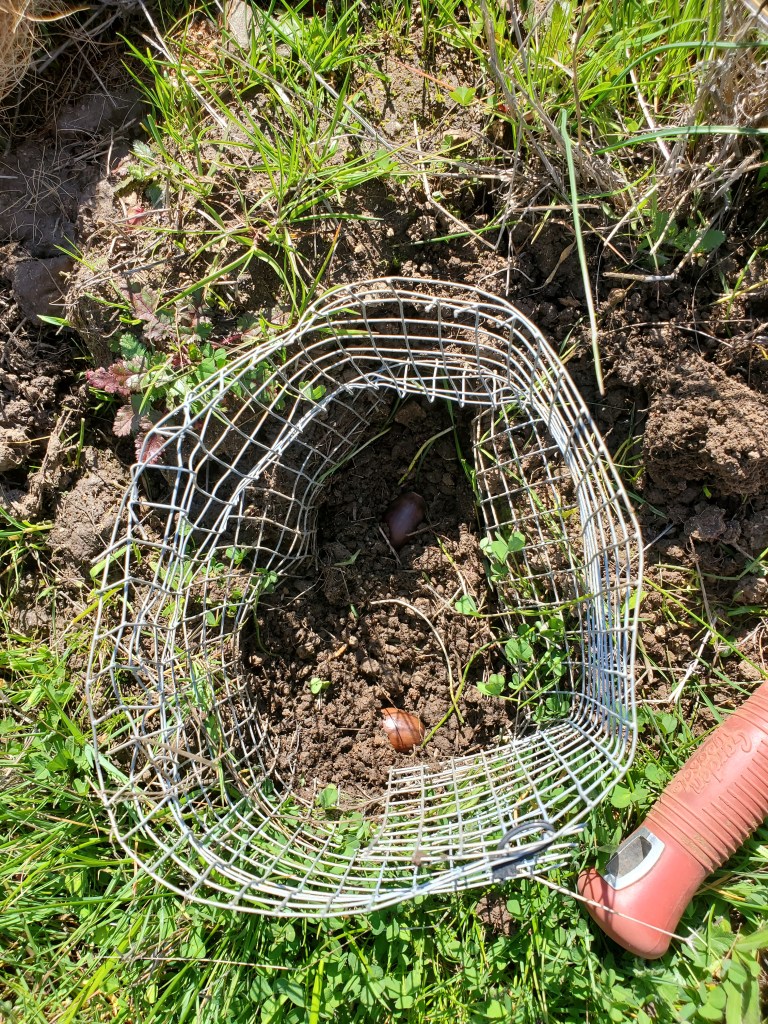
I have accelerated my work getting seedlings and acorns in the ground. With the challenges of life, I’ve not had enough time to spend. Fortunately, the ground was still soft from prior rains. It was easier to work with. Most seedlings required gopher protection. This means digging 18″ +/- holes in which to place specially designed cages with soft wooden bottoms that are long enough to allow the lengthy oak taproot to grow. The wood bottoms have holes for drainage and root movement. Conceptually, the soft wood bottom will rot in a year or two, opening up more space for the roots to thicken and become resilient.

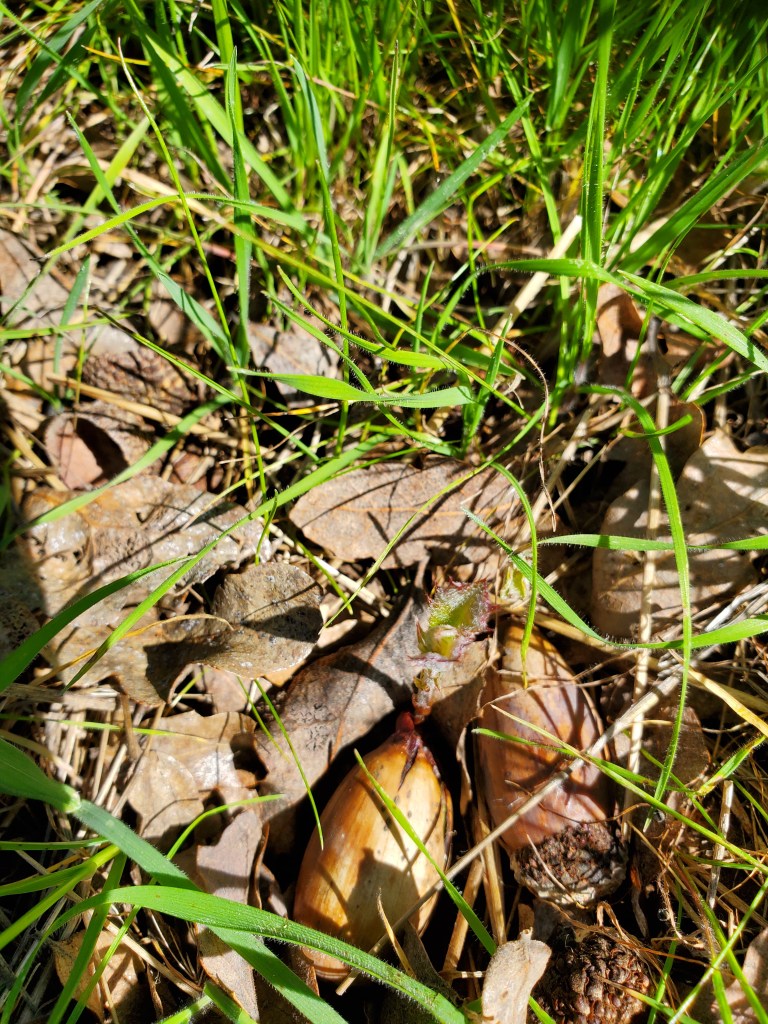
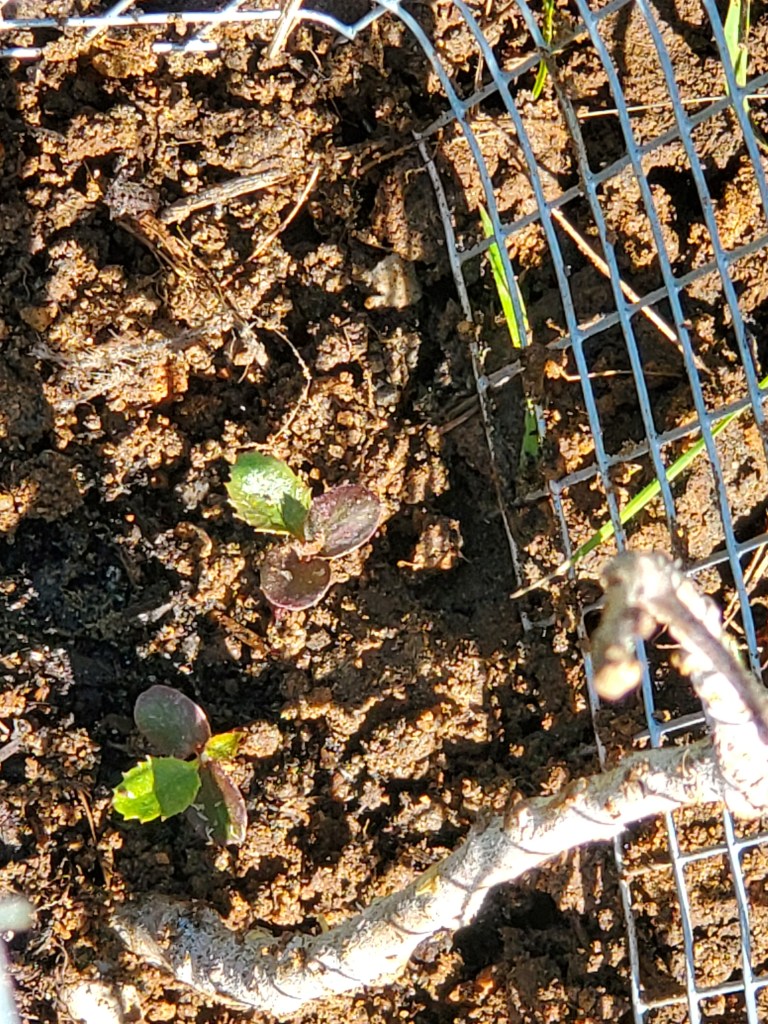
In all, I planted close to 60 acorn along the creek and in five cages left over from last year. For the seedlings, I planted three along the Spring Creek, three in the new grove near the driveway, and four near the house. I will be planting five more down slope from the house in an effort to repopulate two areas with oak die-offs. Those will take a little more time since I will be creating a trench above and below each seedling to capture more rainwater. This will help increase soil moisture near where the roots can access it. I still have a pile of local oak bark to fill the trenches and absorb more water. The next step for all of the oaks outside the exclusion zone will be to build a fence.

New Log Drop

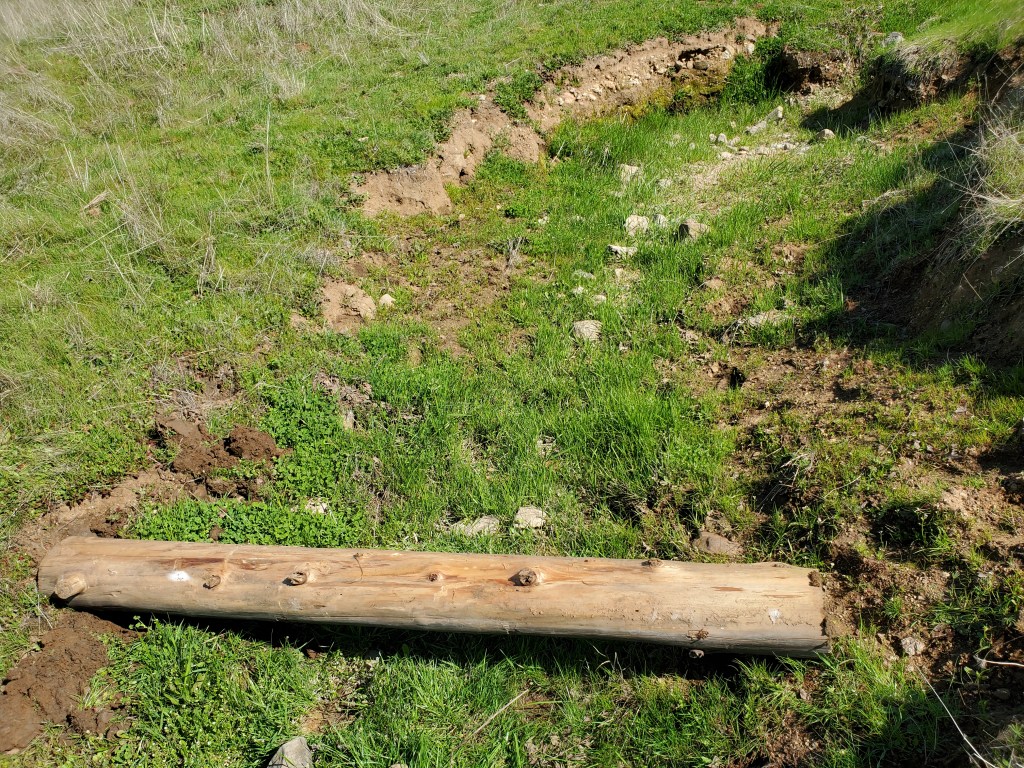
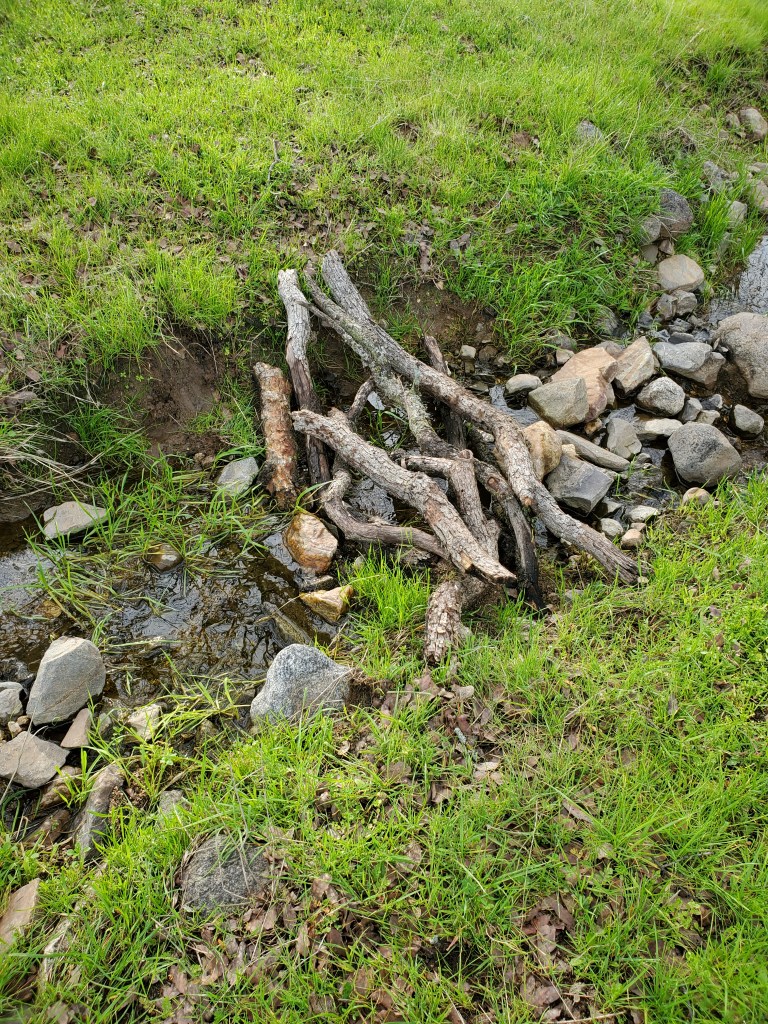
I created a very informal log drop further down stream on the Spring Creek. Again, the goal is to slow the rushing water from increasingly aggressive storms to try to retain the soil moisture and give the land more of a chance to recharge ground water. I also placed an oak behind the log drop to, hopefully, provide more moisture for the oak to thrive longer in dry conditions. The soil has a lot of clay, which retains moisture. There are groves up and down stream from the oak planting area, so I think the soil can work for these oaks.

Wildflowers are Up

The wildflowers are in full display, with more blooming each day. There are so many colors – blue, purple, orange, white, and of diverse variety. I also saw my first butterflies on March 1 (possibly buckeyes. They were brown) and heard a large bee. Spring is happening whether I am ready or not…I’m not. The air is smelling like nectar. In another few days it will be heavy with the perfume of a million flowers.

Odds and Ends

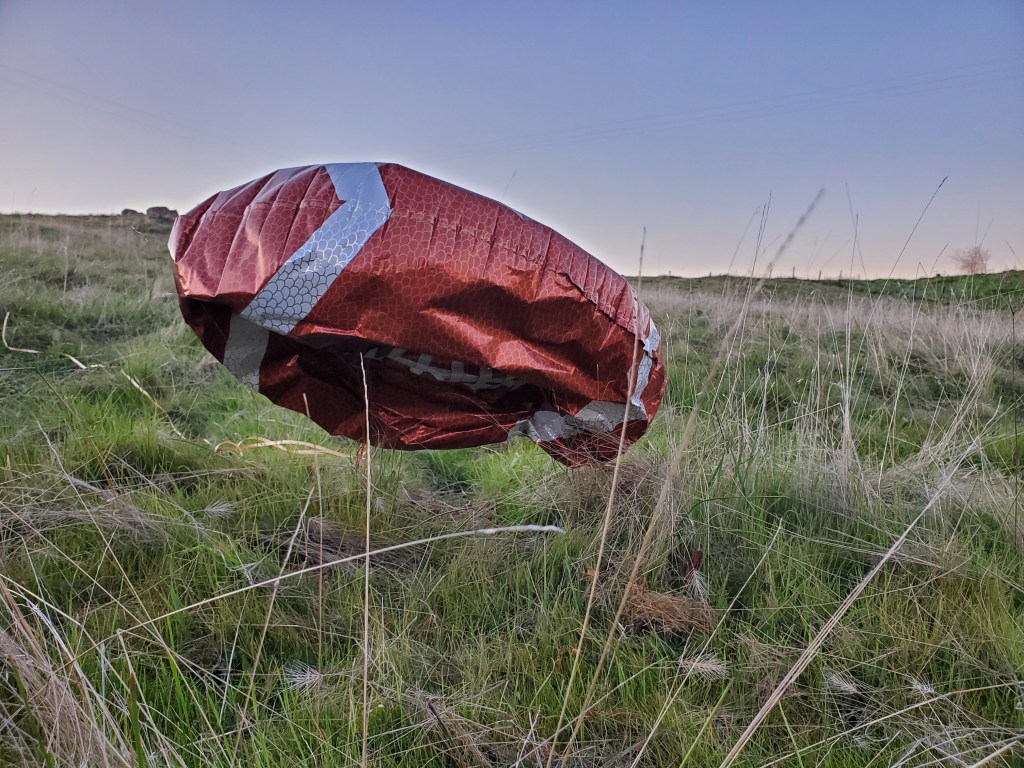
The joy of living here and caring for the land is immense. There is always so much to see and experience, even 22 years later. I pick up garbage that floats through the creek, blows down the hill or floats in the air. It seems we are always finding mylar balloons. Please don’t purchase them. They are trash and end up at my place. They can kill calves who do not know what they are and eat them.

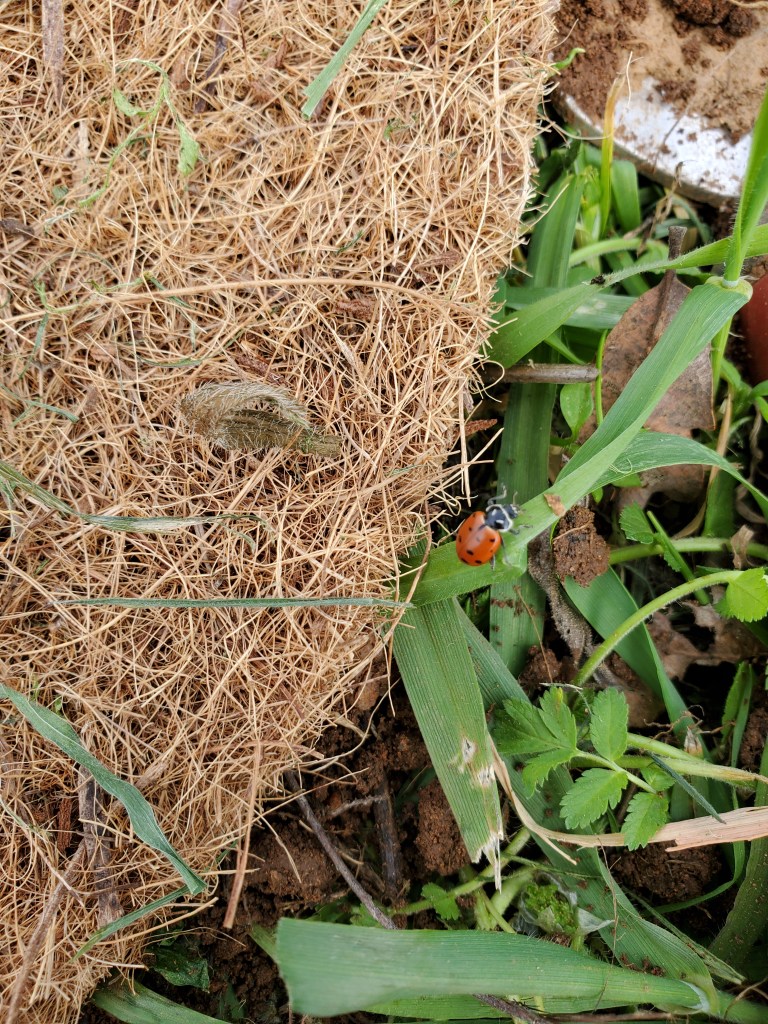
While planting oaks, I heard a whoosh near my head. Two redtail hawks in their mating ritual, dove and sped back up high near where I was working. It was incredible to see and hear them so close. Getting an early start to the day allows us to see so much wildlife. We saw a huge group of turkeys. They are large and interesting, though they are not native. They eat the eggs of quail, harming their populations. I wish a bobcat would control their population more. People think they are cute and feed them just a few miles down the road, but they are very destructive. I would rather see quail than turkey any day. The lady beetles are out. They are really beautiful. I used to see them incubate in tree bark as a child. We had so much abundance then. The other evening at dusk, as David and I were finishing our work, we saw a great blue heron flying to the east. I hope it stopped at the neighbor’s pond and decided to stay a while. We used to have a mating pair that would return each year. They had their nest in a tall bull pine on the neighbor’s property. It fell one winter. When the couple returned the next year, they did not stay. The male would come back year after year with no mate. What a loss.

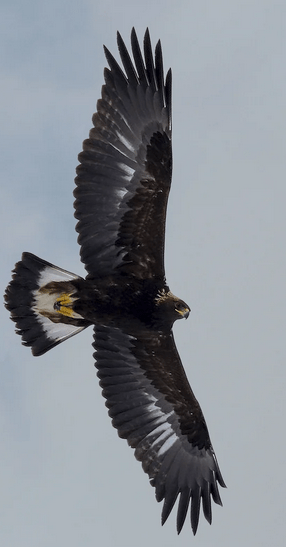
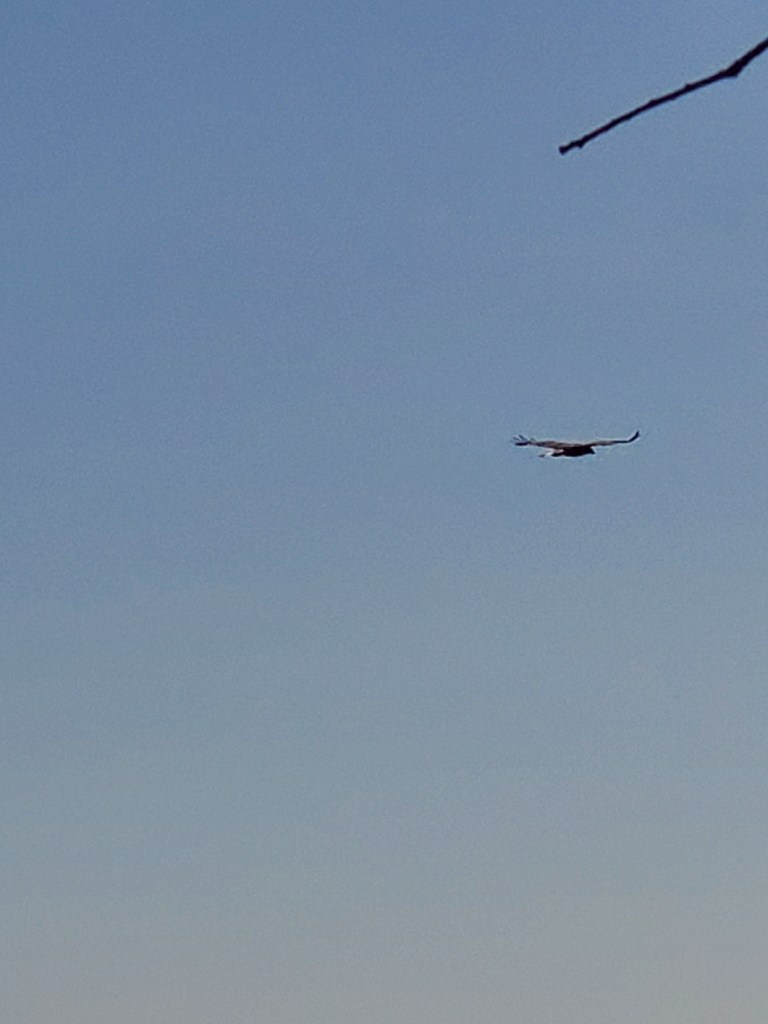
Probably the most exciting thing I have seen in a long time was a golden eagle. It honored me with its presence on February 27. I was looking out the living room windows, which look to the east. I saw a massive bird fly down the hill. It circled the tree near guzzler 1 then flew back over the house. I dropped what I was doing and flew outside. It was about over the house then, so I rushed around the side of the house to get another glimpse. It was massive with long, dark fingered wings and gorgeous white patches underneath. It flew north west, presumably to the Merced River, which is close by.

I screamed. David thought I was crazy. I couldn’t stop telling him about it. My goodness, it was gorgeous. David finally protested after the third retelling, and I said, “Now you know what it feels like when you tell me constant ‘bug in the compiler’ stories about your tech issues.” “Touché.” he said.

We are doing something right when an eagle comes to visit. We work hard to be good stewards and good ancestors. Thank you eagle for letting us know.

This is what it looked like, but it all happened too fast to get a picture.
Photo credit: RaptorResources.org

Hot, Dry and a New Normal We Must Not Accept

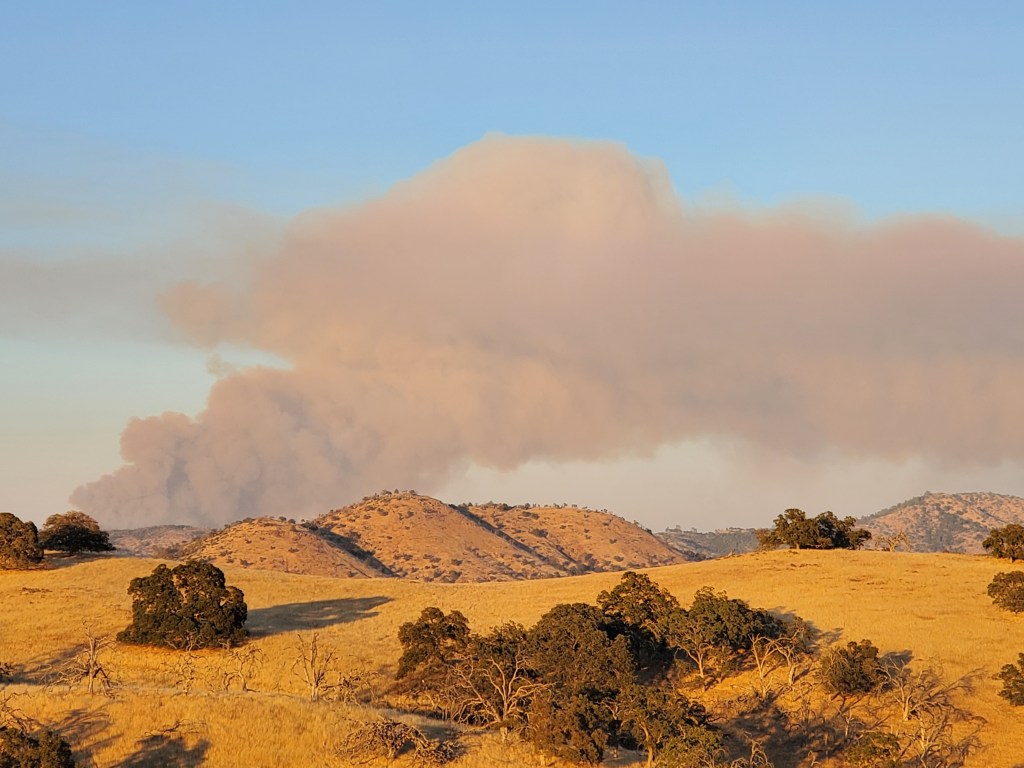
French Fire plume growing fast

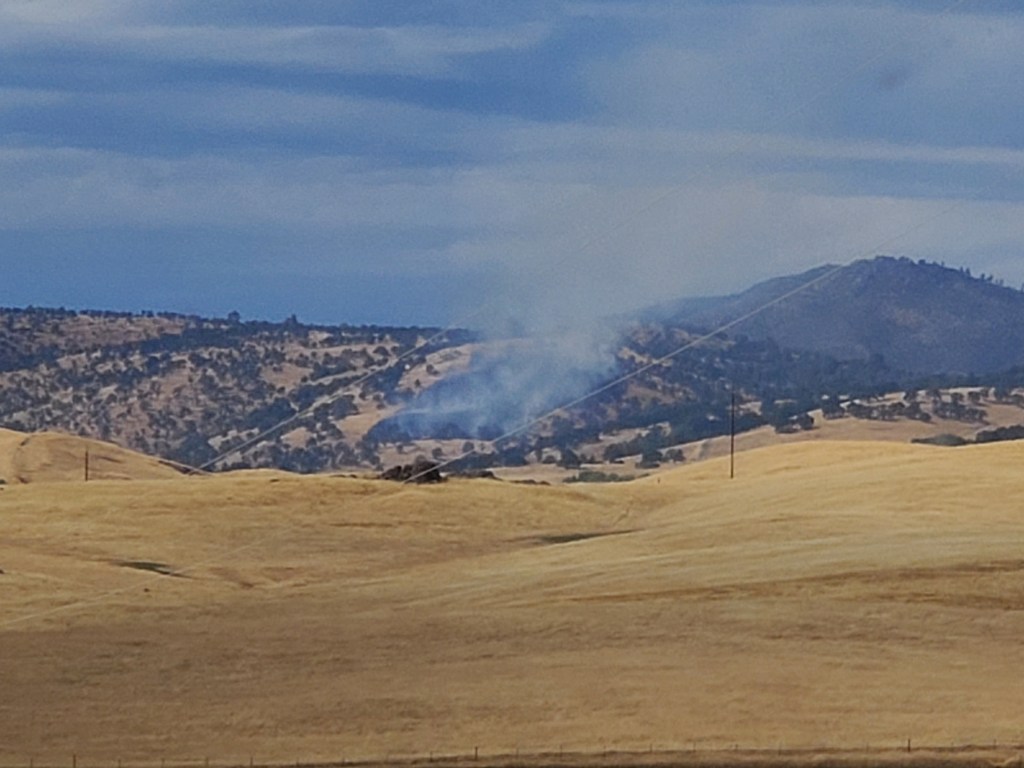
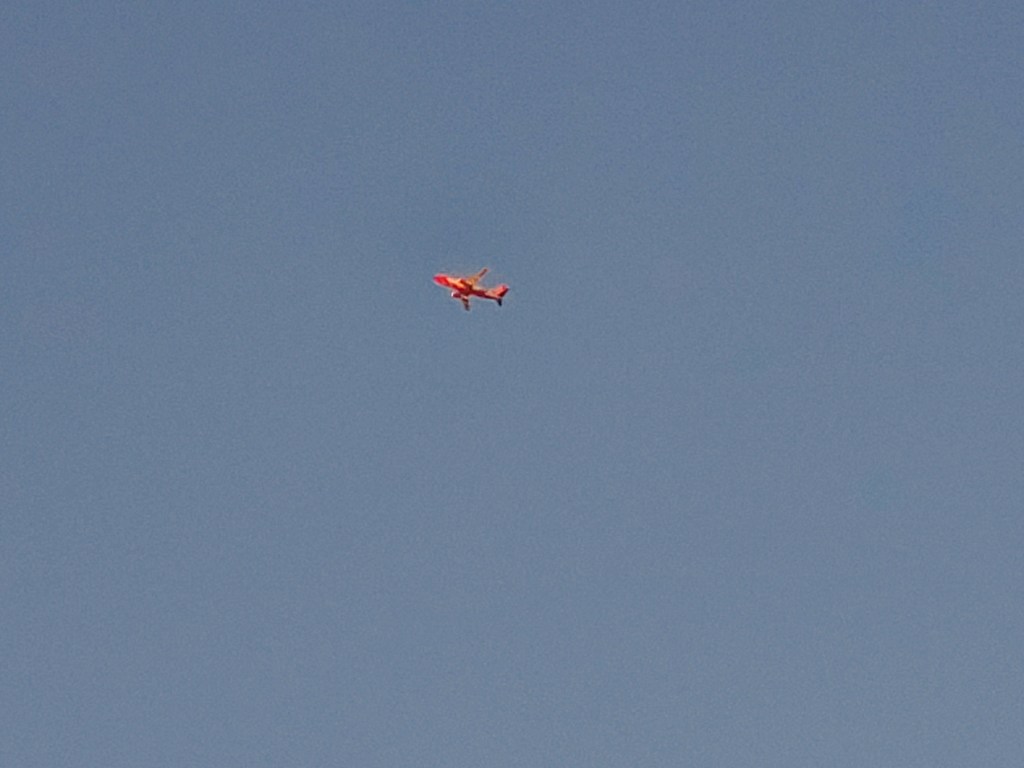
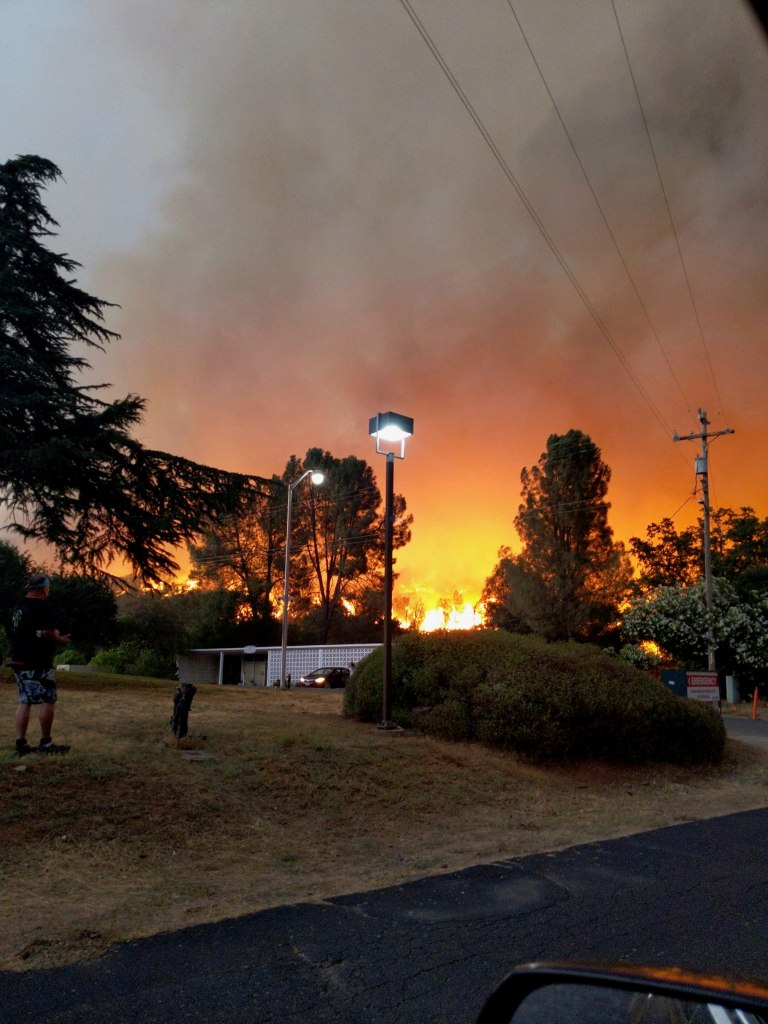
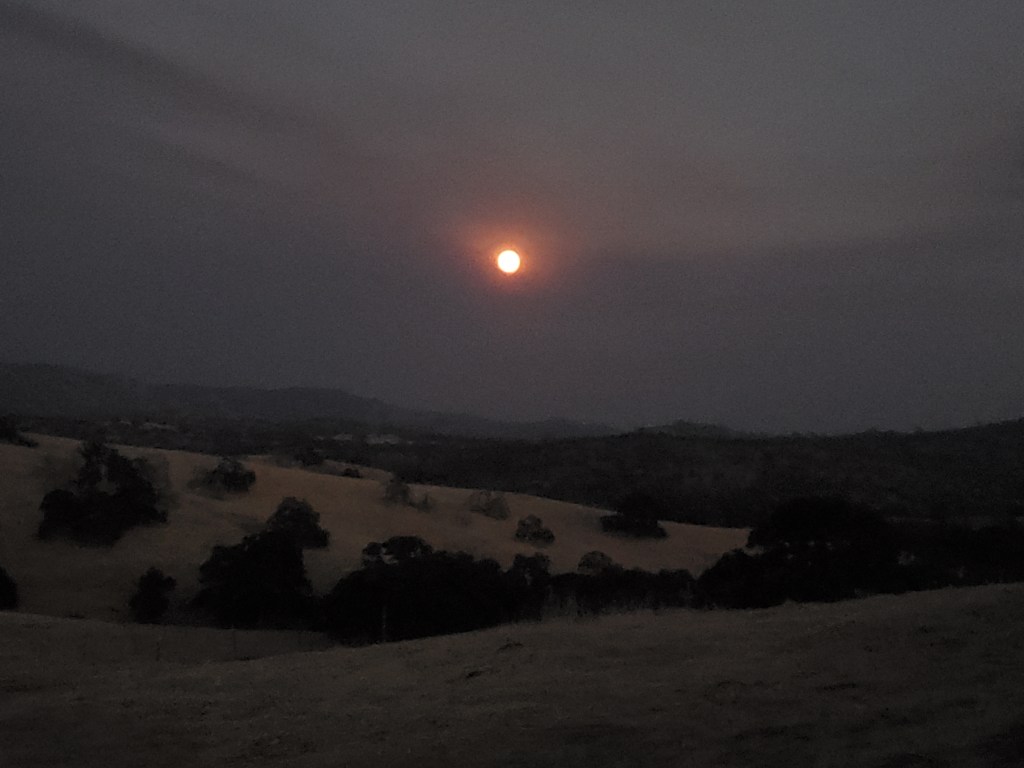
It is going to be a bad fire year. We have already had three fires near the house and the French Fire burning right up to the edge of town. I have more air traffic than normal – big planes and helicopters – flying to one fire or another. There are so many all around the region and state. It has been stressful to say the least – and hot. Even if you are in air conditioning, the heat weighs on you. What I have found is that when there are many contiguous days of temperatures over 100 degrees F, the heat just stays. Nothing has a chance to cool down. This includes the human body. There is only so much it can take before you begin to see changes, and that tolerance level is different for everyone. For me, it gets to be too much after a couple weeks, again, even when I am in air conditioning.

I notice it in people all around me as well. Some guy took the time to yell at my mother-in-law and I, for example, for standing too near a crosswalk. It seems we inconvenienced him by 5 seconds in that he had to decide if he should stop to let us cross or not. The heat is getting to people, and they are acting crazy.

The heat is bad enough, but when you look out your window and see sticks where lush plants and happy flowers used to be, it is can be depressing. The grasshoppers have receded from their population of billions, but they are still here in the 1000s. I won’t be able to release my lone milkweed survivor until there are nearly none. Yesterday, I counted 9 on the cage, but there are thousands still in the grass all around. I feel badly for her gorgeous, nectar-rich flowers that have bloomed with no butterfly, bee, fly or moth to use it. Even if pollinators were near, the flowers are behind screen, only able to bloom because they were imprisoned. What a great day it will be when I release her stems, leaves and petals.

I am seeding more plants now, a little too late in the season for some, in the hope that I will have some more life out there, even if I have to plant it myself. My goodness — seeds are a miracle in this life. I am so grateful for their puny-sized, packaged progeny, patient and planning their emergence. Seeds, I love you.

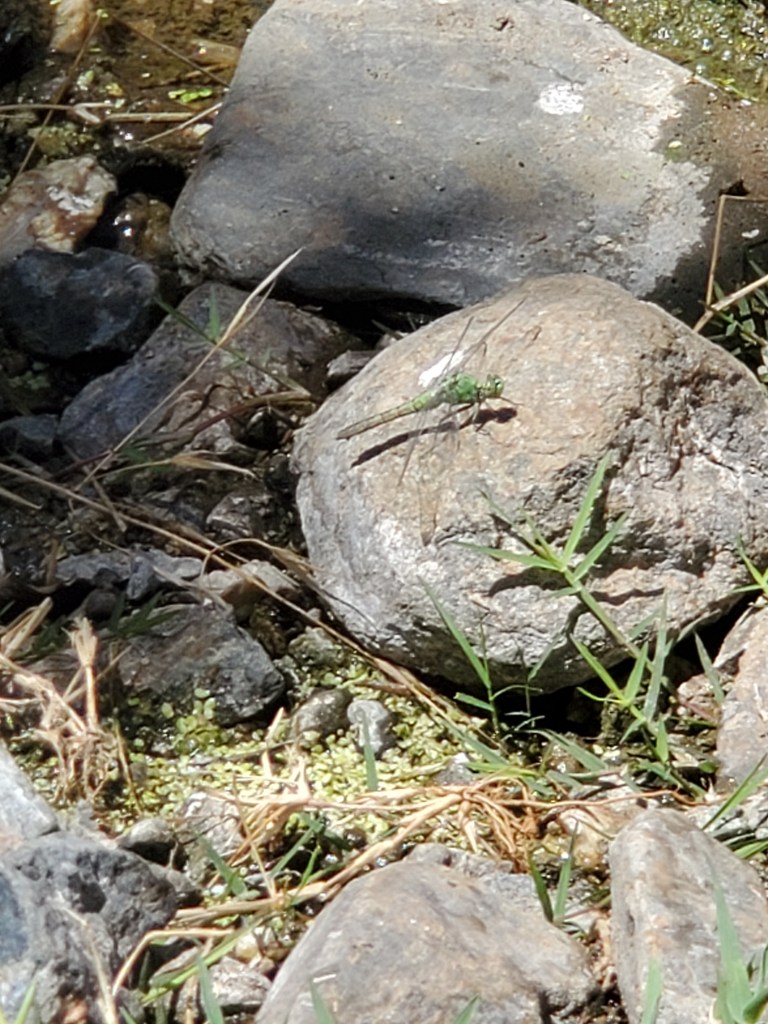
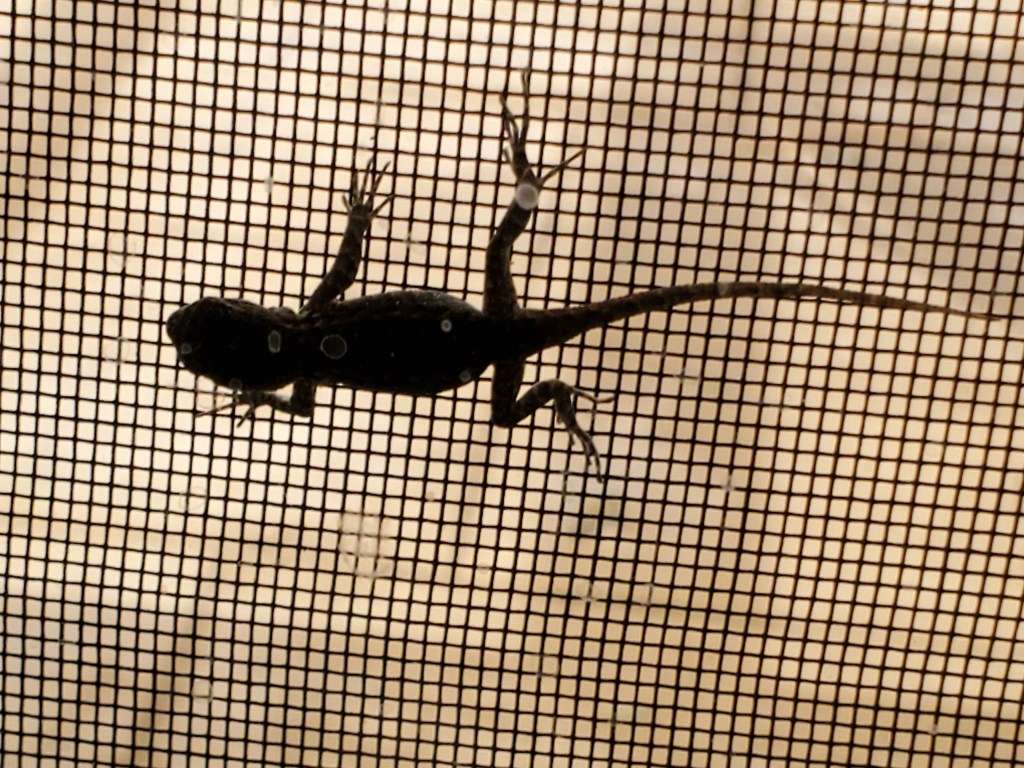
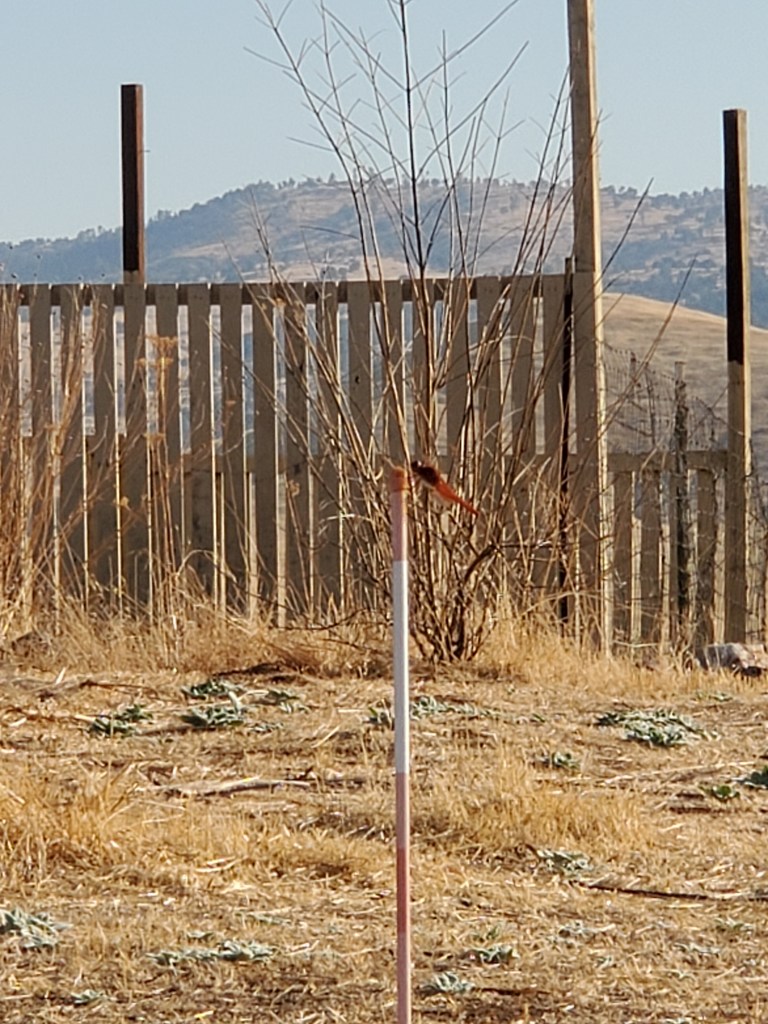
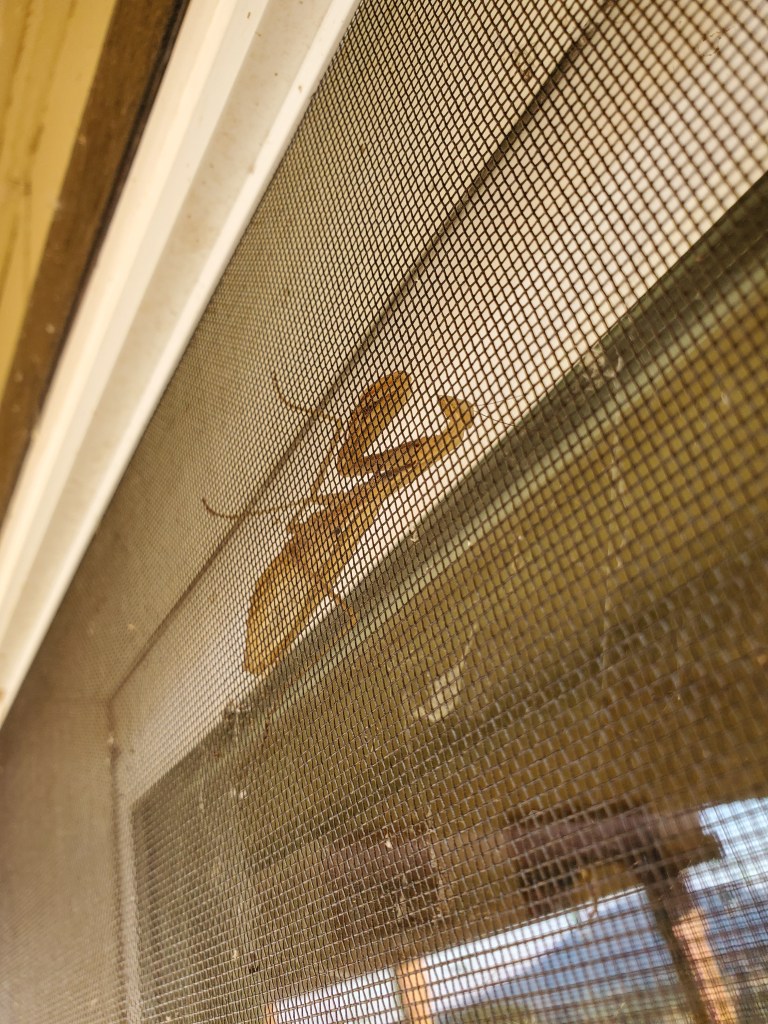
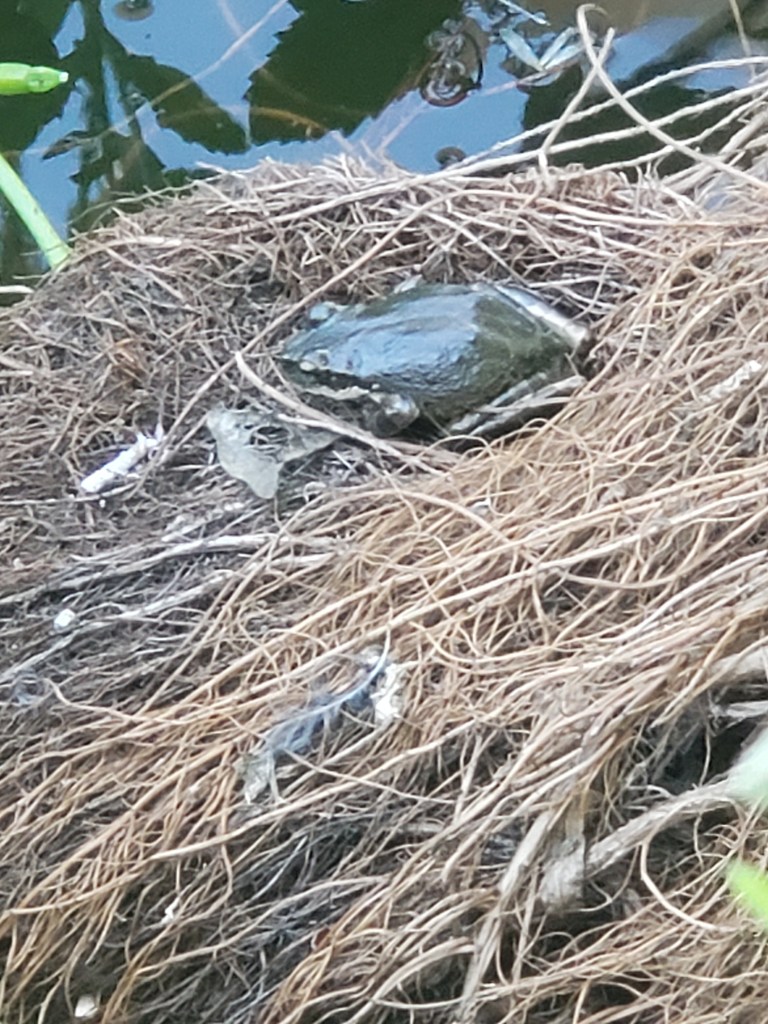
As I lament, I must also recognize the resilience of the life that is left. Acorns are emerging. The songbirds continue to stay. Large raptors and vultures soar. Lizards dart from one location to the next, while the California Toads move at night, leaving their poop behind. Small frogs have begun to show themselves, emerging from the tendrils of willow roots and debris in potted plants. Dragonflies have been more visible at the house, and not just in the creek where there is still running water. A beautiful green snake took up residence near the toad pond (presumably because dinner is very near and fat). Even a cool hopping insect that looks like a leaf was hanging around on the Polaris. Life is all around and abundant – and some that were eaten will return.

Water Still Running

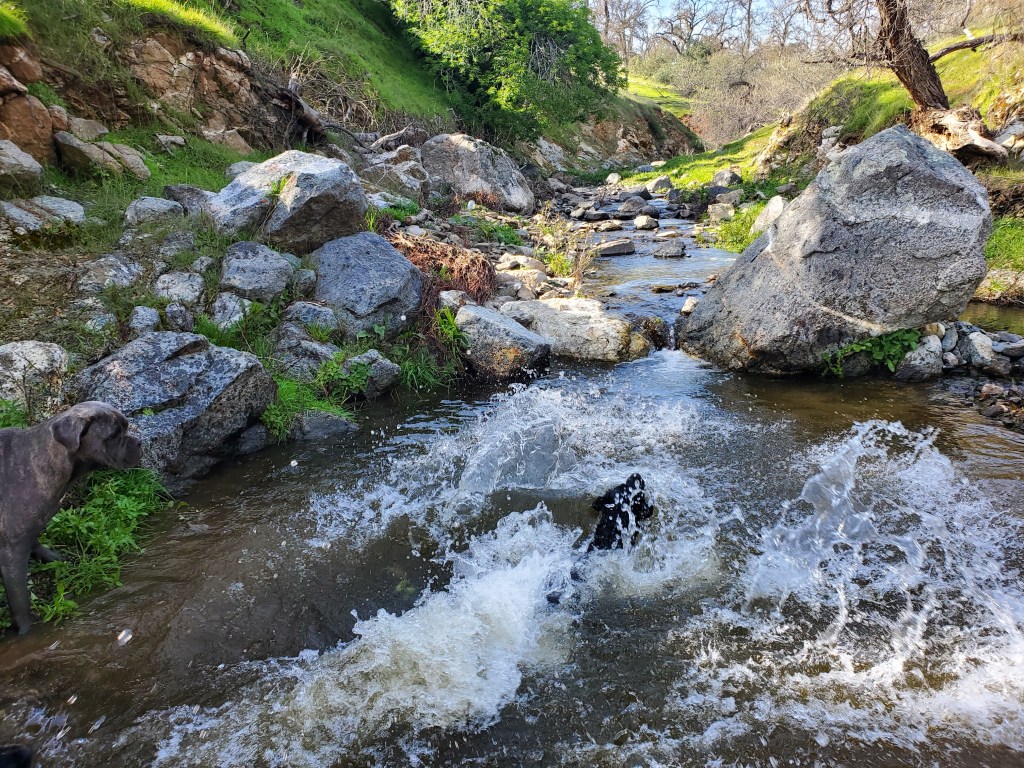
The creeks are still running. They are providing much needed water access and sustenance for the plant life adjacent to the creeks.

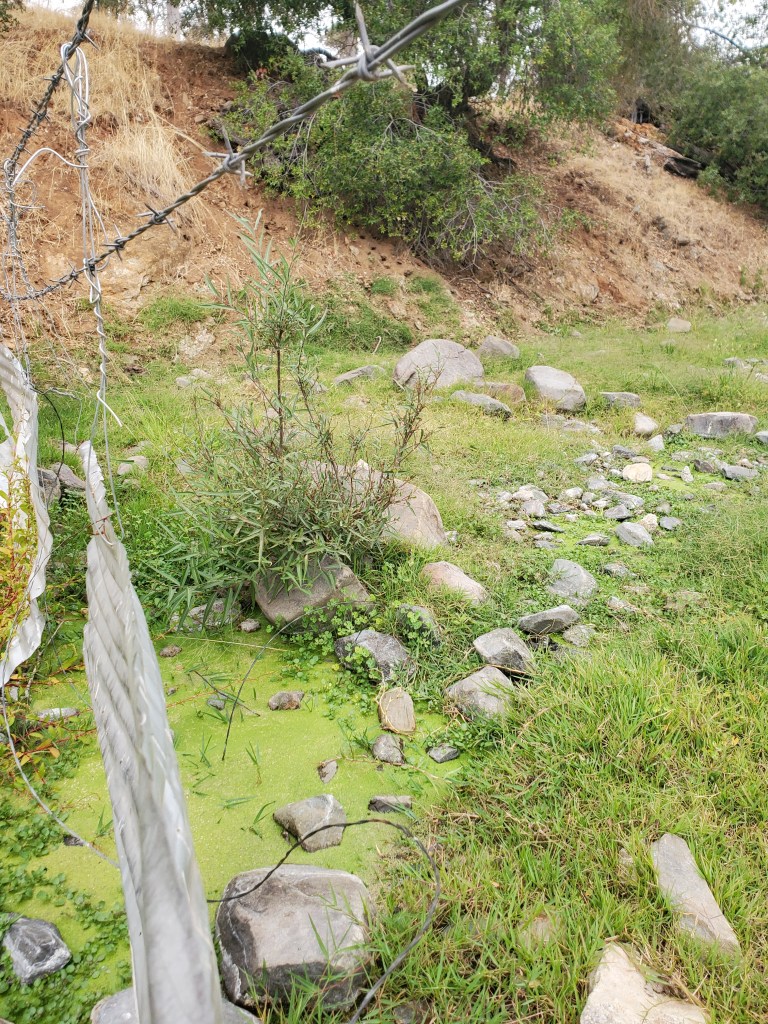
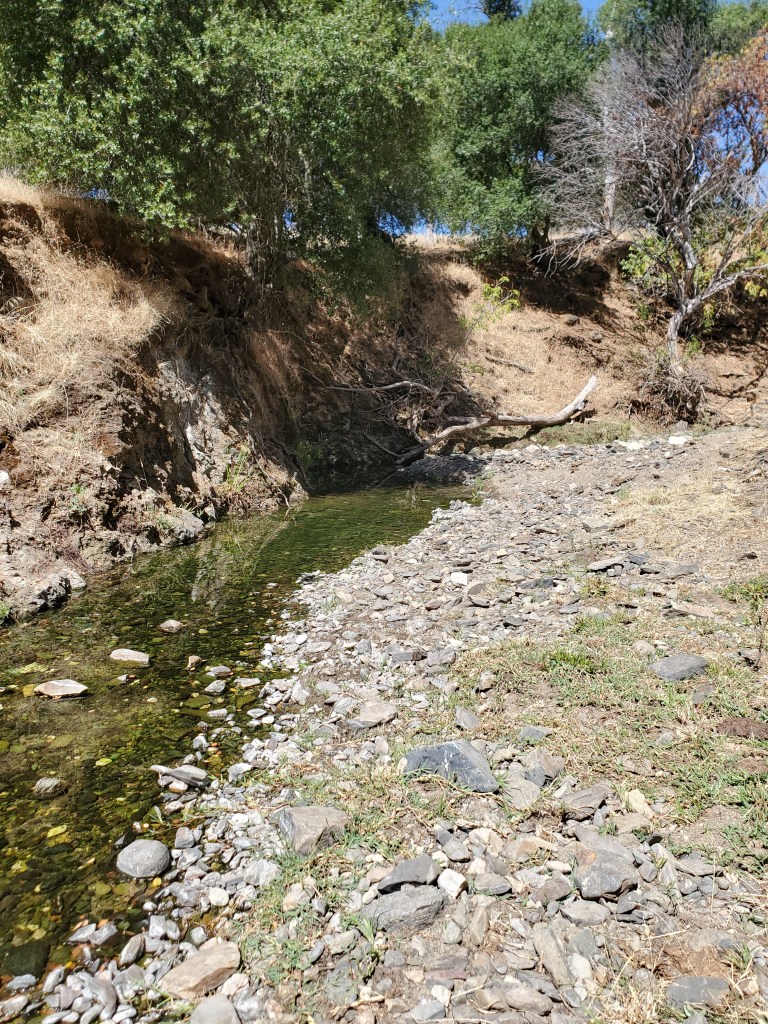
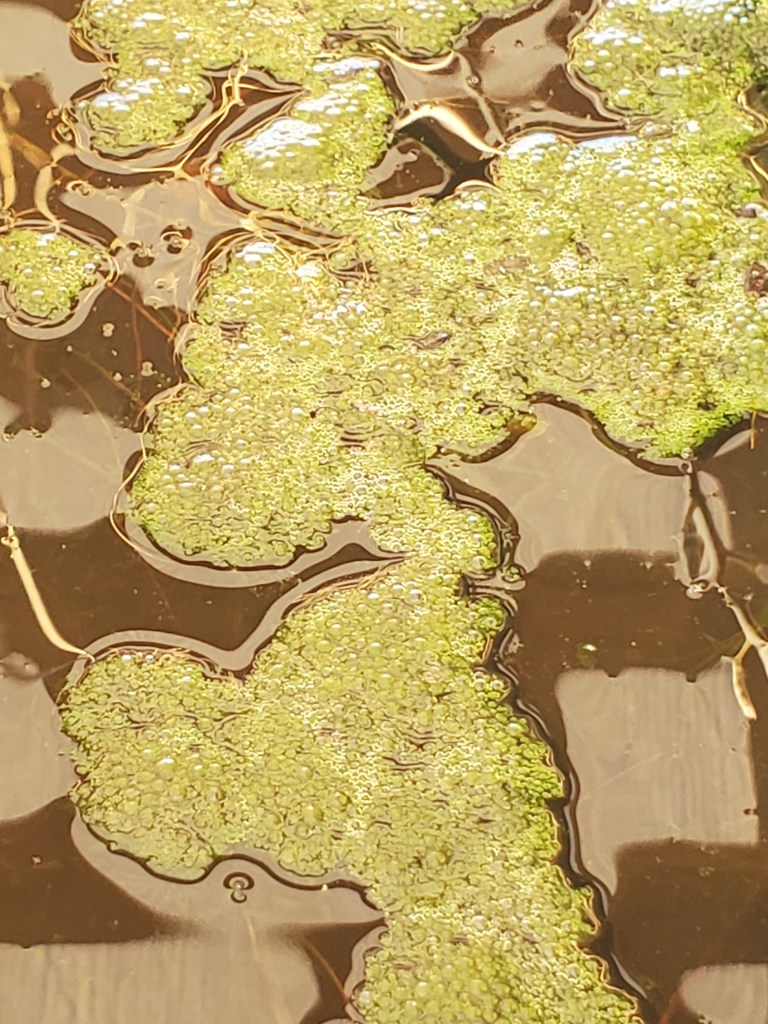
Unfortunately, the amount of nutrients in the water from cattle dung and the heat are causing algae to bloom. Algae is an interesting life form. It can be toxic. Its decomposition can suffocate life in the water, but it also provides a significant portion of oxygen on the planet, much like forests.

I don’t know if the green algae on the creek is harmful, but I don’t mess with it – – except to throw rocks into the spring and puddles to break up its thickness, and open some holes to the water underneath. This is in part some of the reason I fence out cattle, to decrease the amount of excess nutrients going into the water. I cannot help upstream, but I can decrease the overall amount as it moves through my ranch at least.

Riparian Oak Seedlings Still Alive

I am overjoyed to report that the oak seedlings in the riparian areas still have leaves. I did see some damage to the leaves, but that is all. The grasshoppers did not fully destroy them as they did the very young plants I planted.

I learned recently that what looks to be like a young oak can actually be decades old. This was mind blowing. Given this, perhaps the small oaks in the riparian area have developed a more mature protective element to their leaves and bark that prevented more predation. I know that what I call seedlings are actually many years old since I’ve been protecting them for over a decade with downed branches when the area was open to grazing. Their smallness is a product of grazing and drought. It has been a huge relief to see them grow last year and this year in response to more water and protection.

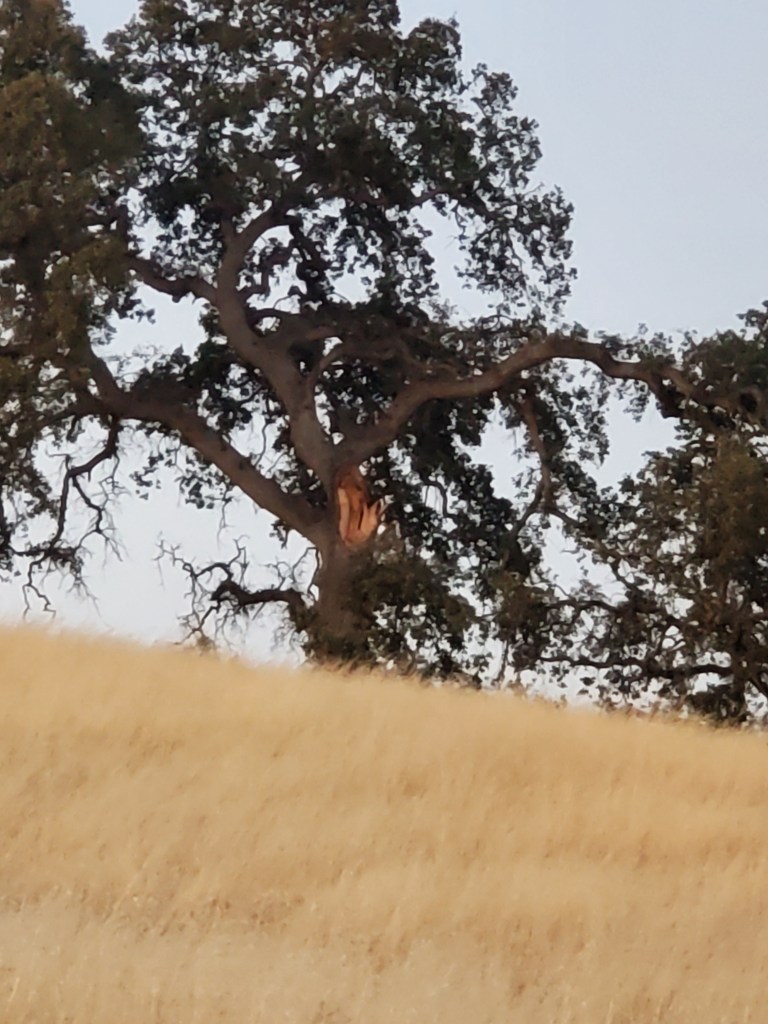
This success is all the more important as I continue to see decline among the adults on the hillsides. On my walk yesterday, I heard a horrible loud crack. I looked in the direction of the noise and saw movement in one of the grand oaks on the south hillside slope from the house. Then, I saw an entire branch fall. It continued to crack then crash down.

I was horrified, sad, angry- oh, how I grieve for these crucial lives. I keep thinking, “What can I do better?” I don’t use much water at the house. I put water back into the ground. I am slowing water. I guess I need to do more dirt work and create little moats below and above groves of trees, outside their drip lines, to capture water as it runs down hill during rain events. The work cannot begin until the soil is moist again. The metal edges of tractor buckets can cause a spark, and this whole place is filled with dried out, tall, European Grasses. Another year going by; the clock ticking on what can be done and if it will be too late to help. And, the cost – it will be all on me to cover with no program to help.

Breathe. Deep in. Full out. Repeat…Repeat. Reminder: you can only do what you can do. Much is out of your control and so much larger than you. You are not absolved of responsibility, but the full responsibility is not yours and yours alone. Stay healthy. Keep your joy and continue working at a pace you can sustain.

Extreme Heat is Not an Acceptable Norm

I know the extreme heat is a key factor in the death, piece by piece, of my oak relatives. It causes the death of thousands of people per year in the United States, and that is increasing. We cannot accept this as normal. If we love this incredible land, ocean, waterways and sky, if we love our children, then we must be intentional in our actions. I know this issue, like the oaks falling apart, is larger than one person. If we each contribute something, then things can get better. We have seen this happen already with the butterflies. Acting together, many planting milkweed and more nectar plants, have helped bring the monarchs back from the brink of extinction on the west. Although we have more to do to stabilize the population, we are on the right track.

Every choice we make as individuals makes an impact. You don’t have to deprive yourself at every turn; what I am suggesting is that we have to understand that our individual choices have consequences. In knowing this, we can make informed choices, not let guilt-aversion act as a barrier to good action and understand that we are each important change-makers in how the future is shaped. This is big; I know. Please don’t loose your sense of hope. It is some of the most powerful medicine we have. Aho.

100th Post

Wacky AI generated image

It’s early Sunday morning. The sun is not up. I’ve been up doing chores, feeding animals, opening windows to allow the cool air, laden with scent, into the house. It is barely light, getting lighter. The birds start to sing. First one chirp, which leads to two then it all begins. I step into my boots, dogs at my heels and head out – pulled, then lightly pushed by the cool air now gently swirling in the house.

The ground is soaked from the dew. My boots collect the moisture along with leaves and purple pedals from the thousands of small flowers, close to the earth, lining my path. I check the milkweeds. They are stretched into the air bolstered by days of sun as they break through the invasive grasses that block the light. I examine the space to see if more are there. They are, and I breath, grateful for the resilience of these plants.

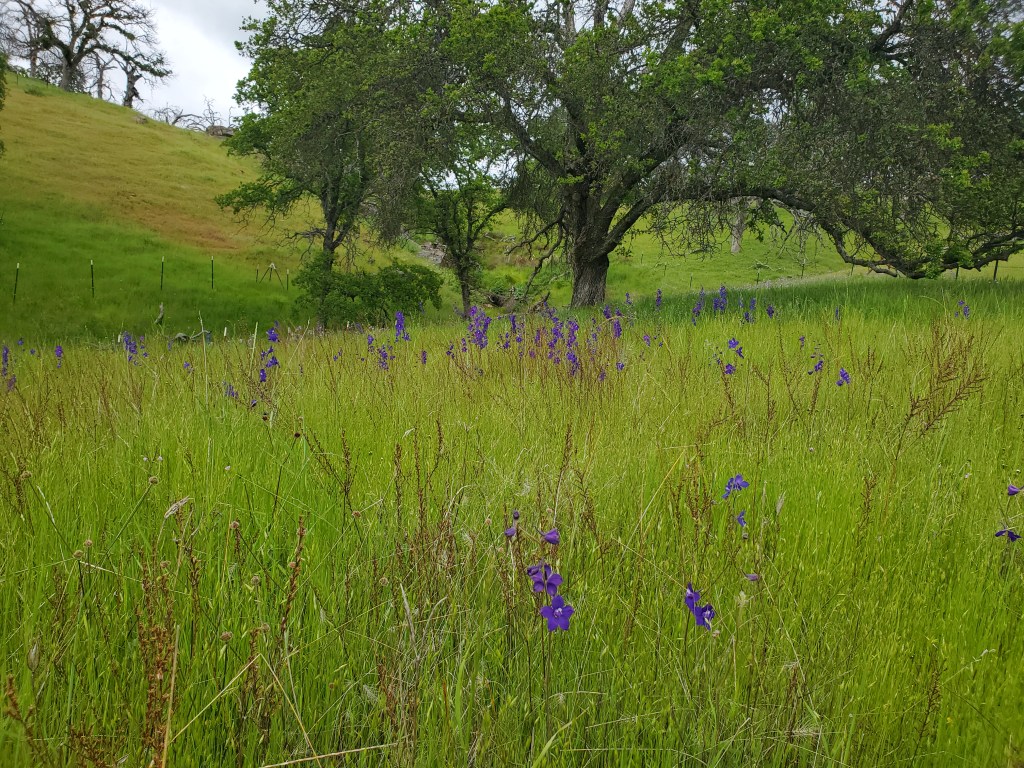
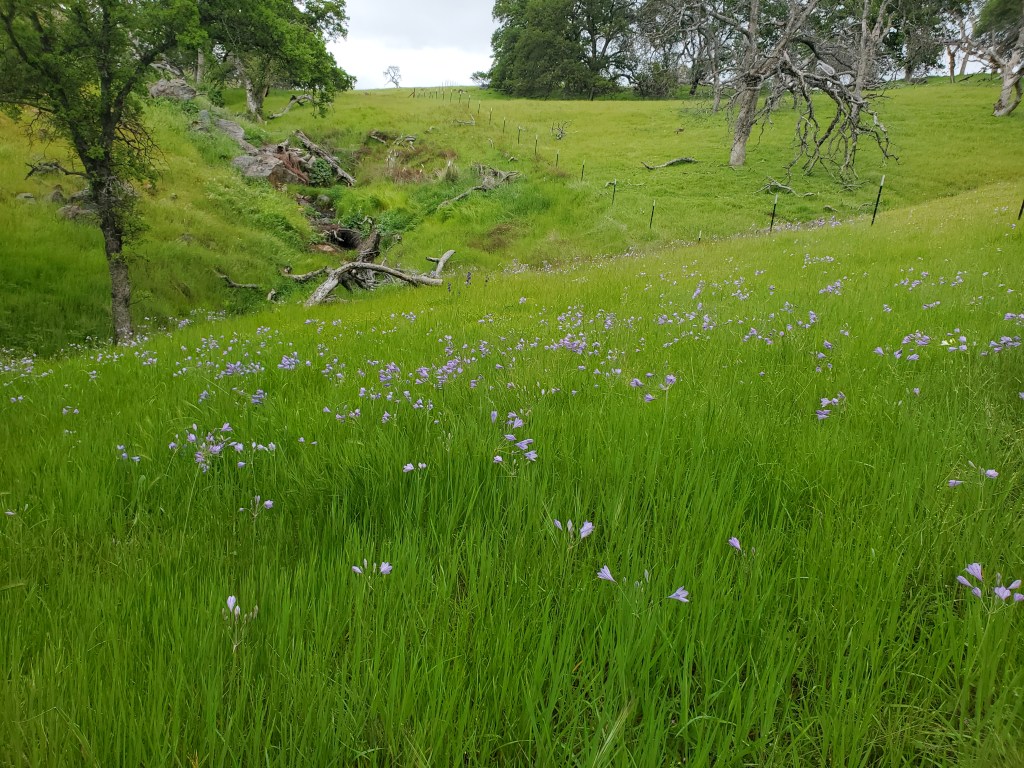
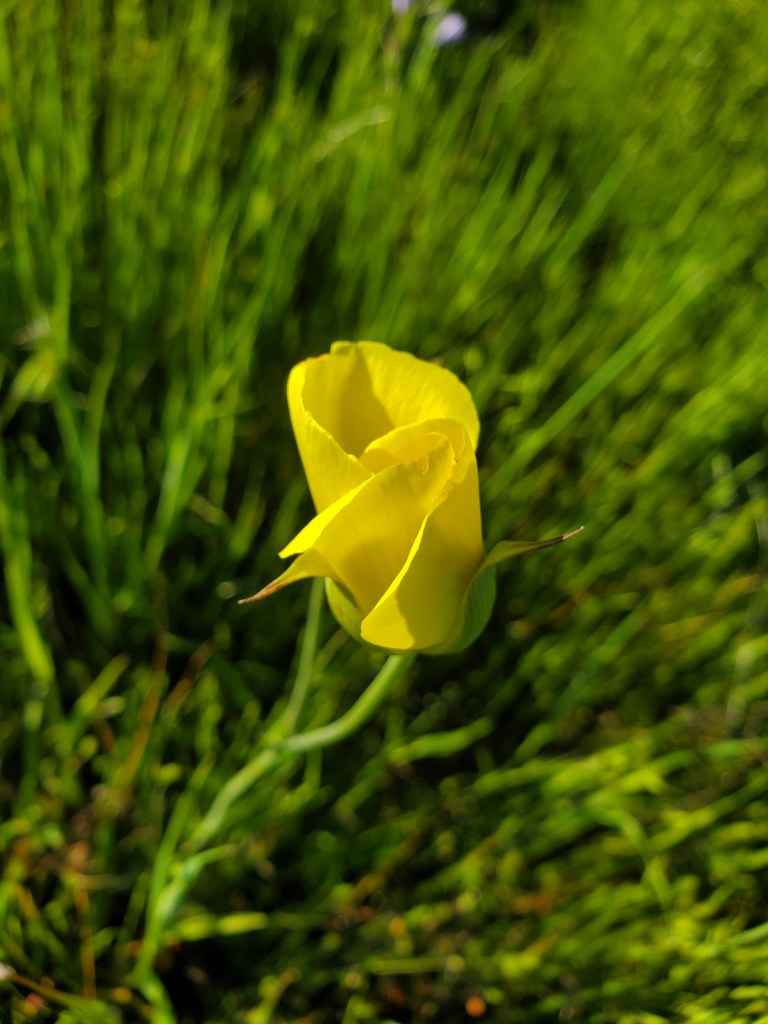
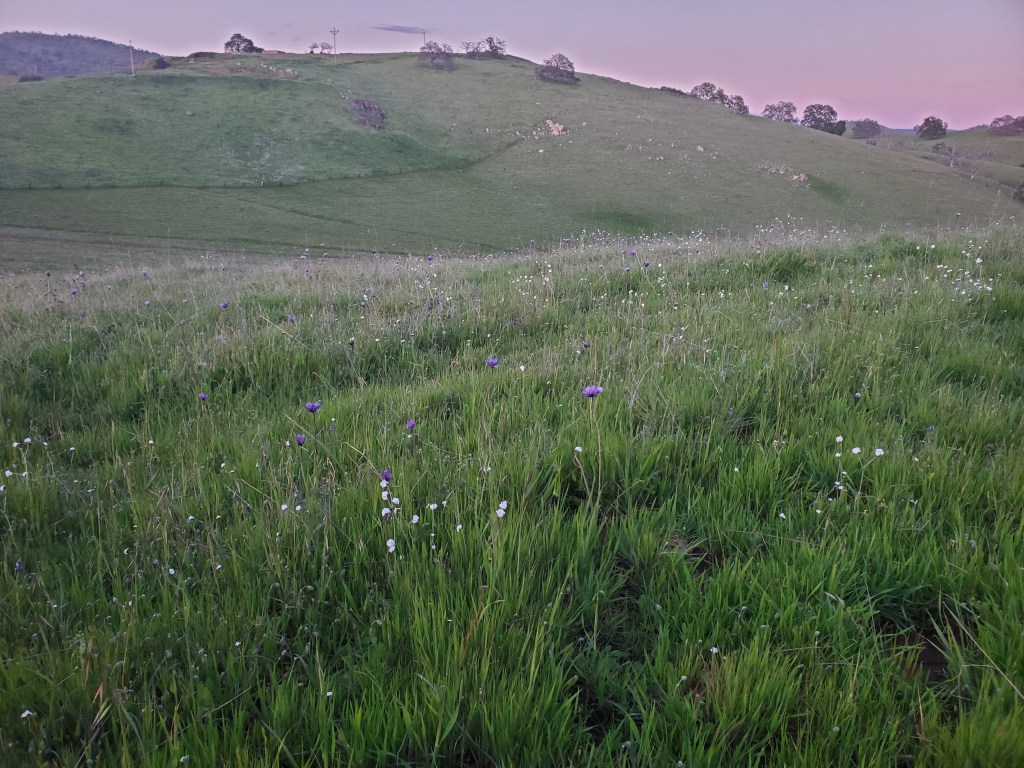
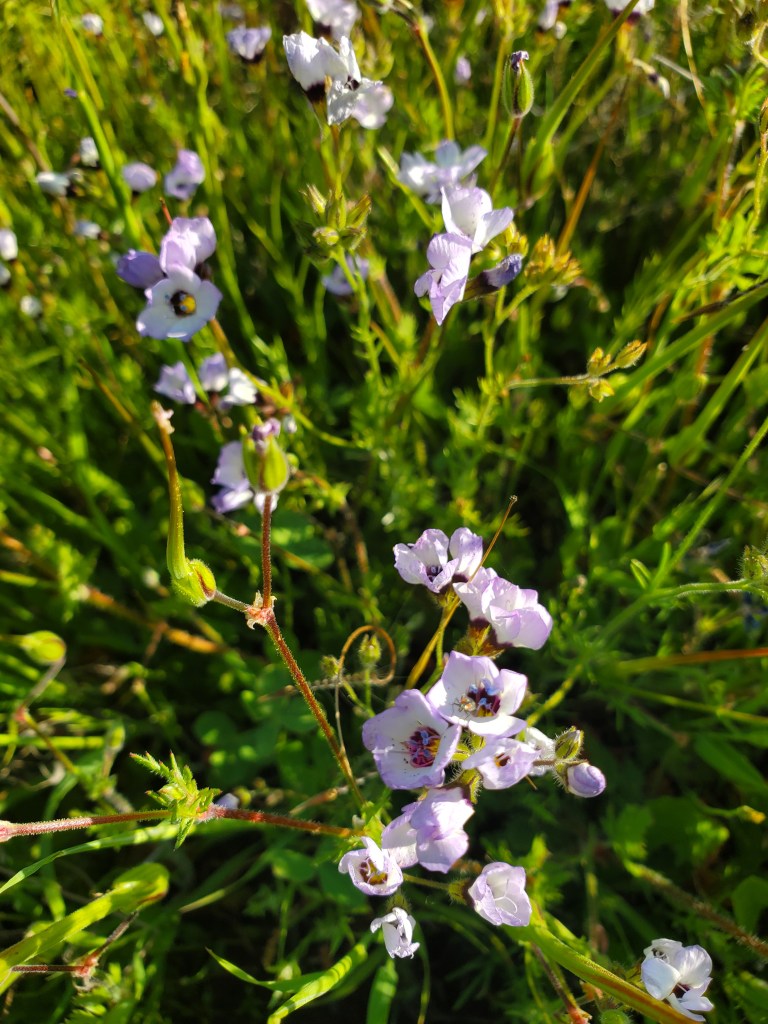
Heading down the hill with the symphony of birdsong the nectar of those thousands of flowers hits me. The grass nut flowers, tall with trumpeted light purple petals in a starburst formation cover the hillside. Among them are hints of dark purple, tall and narrow larkspur. Yellow Mariposa lilies are beginning to dot the hillside – more than I’ve ever seen here. The popcorn flower has nearly abated making room for more purples, filaree and small lupine – the large ones almost ready to burst.

As I get closer to the drainage, the temperature turns cooler, a function of the cold water that soaks the earth and continues to trickle. Walking along the drainage there is more larkspur, orange fiddle neck and now some new yellow seep monkey flower. The birdsong is penetrated by the flap of wings. A single bird flies overhead. Even though it is small, it is quiet enough to hear the displacement of the air with each flap. This is why the morning is magic.

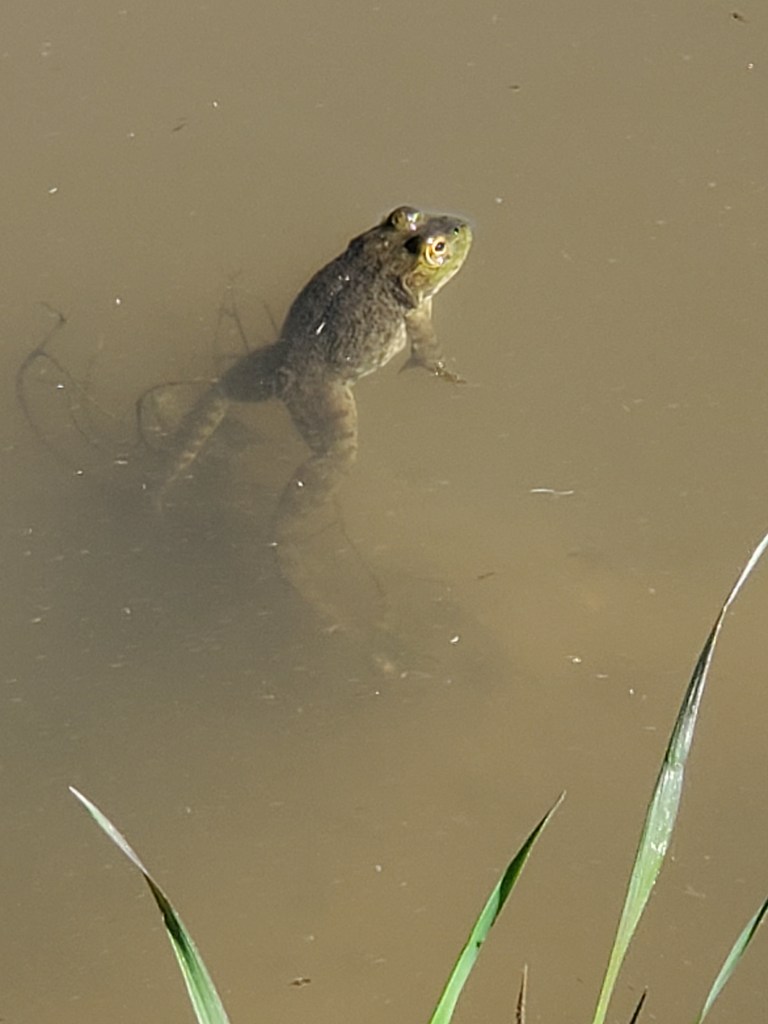
I cross the swale pond and walk into the grove. The bullfrogs floating on the water surface dive beneath the murk, and those on the banks give a chirp as they jump into the water. The nectar scent is replaced by the sweet smell of wet bark and earthen musk. With every step, I stir up more smells of wet soil. The oaks are green, and full of leaves, which I hope portends of a mass of yummy acorn in the Fall. They look happy as I examine the check dams. The soil is still moist in the drainage fork. Good. The water is still running in the spring creek with some nice deep holes. Good. I note invasive thistle growing in my mini wetland and make a mental note to bring the weed eater down there later. With my mother-in-law, I planted milkweed seed. I am hoping to make this new sedimented area more diverse, not just a thicket of Italian thistle. Thistle is nectar rich, and the pollinators love it. There thousands of stalks allover the ranch. Taking out this little section will not impact nectar availability. I hope to get a glimpse of the quail I saw the other day, but I don’t. It is too early for some.

I exit the grove to check the open section of the spring creek. My boots are wet up to mid calf. Despite the work of the cows, the grass has grown taller with last week’s rain. The first section of creek is still running, filled with grass and small, open stands of water. More seep monkey flowers emerge. About halfway down the open section of creek the water stops. I hear the last drips into a small pool just downstream of my old, small, rock check dam. The flow is underground now. It leaves a creek bed of moist soil the rest of the way to my property line.

As I veer back to the trail, turning west now on the open grassland, the sun is up over the east mountains and hits my back. The warmth is a familiar hand across my back comforting me as I walk. I notice the humidity now, so thick. The full force of nectar is back, clinging to the water molecules in the air, which fill my lungs. I think of all those molecules that comprise this Spring cocktail of life and know that my body will know what to do with all the constituent elements as my lungs expand and contract. I breath even deeper now, filling myself with this ancient food.

There are still no raptors, ravens or vultures in the sky. This time is for the songbirds to flit and sing with less concern of being a meal or their eggs being a raven’s meal. I link up with the cattle road and make a turn north, fully surrounded by the large expanse of grassland. I hear the unmistakable song of the meadowlark, deeee, de de de deee, then as the sky brightens, coyotes begin to sing. As I get closer to the driveway, there is the distant rumble of cars on the road, which is a quarter mile away. The sun has woken humans up too. I continue the last leg of my walk, Millie by my side and Beatrix taking the short-cut through the grassy hill. I feel grounded and filled. This walk is a ceremony of connection, an acknowledgement that we are all together, living for one another.

Monarchs Are Back with Babies!

There is no more gratifying symbol of the success of the work here than the habitat being used. This is especially true when monarch caterpillars are present. On Monday, 4/22, I walked the steep hillsides to check on the California Milkweed plots. Fortunately, I had friend and biologist extraordinaire Deedee Soto at the ranch visiting. It was warm that day, even at the end of the day, so we sweated as we made our way up. The first plot, all the plants looked healthy, but there was no evidence of monarch use. We made our way down hill, crossed the drainage, still spongy with water, and then started our ascent. Again, this is a steep slope. Deedee and I walked slowly, taking breaks. Mille and Beatrix were with us, but about halfway up, I turned to say something and did not see Beatrix. Where was she? Evidently, she gave up, went back down to the spongy drainage and laid in the coolness of the grass and soil spectating our ascent. I rolled my eyes, slightly jealous, and the rest of us continued upward.

At the plot, our efforts were rewarded. Six of the 13 plants had caterpillars. I screamed with joy to Deedee. It just came out. Fortunately, she understands and doesn’t think me strange to be so excited about this tiny yellow, black and white creature. Because of Deedee’s high skill, and youthful eyes, we counted 28 caterpillars of varying ages, from the first instar to the third. Caterpillars go through five caterpillar stages, with #5 being the largest, before they transform to chrysalises. Twenty-eight is a great start! There could be more though. Caterpillars are very crafty, having the super power to hide in plain site. Two other plants had evidence of monarch use, but we could not find any caterpillars. I whoo hooed from the hilltop. The monarch mamas had found this patch of California Milkweed a hospitable home once again, trusting this place with their future.

All Oaks Planted

If you are a regular reader of this blog, you may remember that my neighbors, Ric and Kim, are extremely generous, allowing me to use their electric Polaris for my habitat restoration work. Those vehicles are extremely expensive, and we are so grateful for this kindness. It makes life much easier. I was reminded of this last week when Ric had his vehicle back with him for some work, and I was still engaged in blue oak planting. Undeterred, I regressed to using my cart and hand dragging around my tools and plants to continue planting. I got three more blue oaks planted, but goodness, I was sweating.

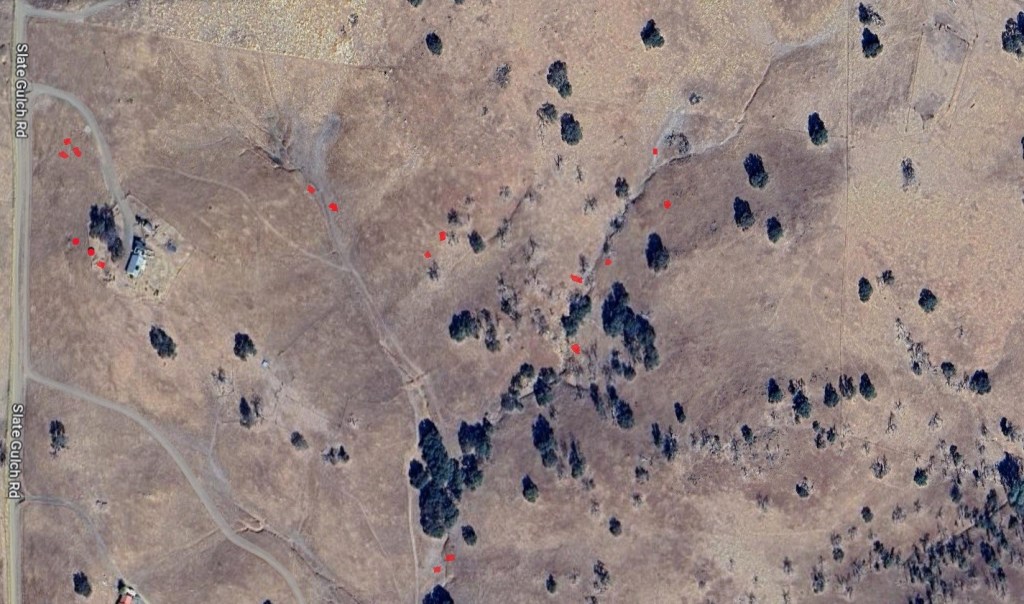
The good news is that two of the earlier oaks are thriving, and the seedlings I’ve been protecting in the Spring Creek area for 15 years are finally appreciably growing.

Red dots are planted seedlings

Wildflowers and Wildlife

Fire Keeping

Nellie, the previous Pollinator Program Coordinator for the Southern Sierra Miwuk Nation, attended a traditional cultural gathering the other weekend and educated participants on pollinator plants. She gave the group a packet of milkweed seeds with tobacco and sage as part of the mix. Nellie said that when we planted the seeds we would be making an offering at the same time. I nearly cried I was so proud. I agree. Planting is a sacred act; it is bringing us closer to fulfilling our responsibilities as stewards of where we live and connecting us to place in a way that is intimate. She is keeping the fire of knowledge of traditional practices, values and connection and sharing those with others who are continuing on their road back to a reciprocal relationship with all our relations.

Five Years and Three Months

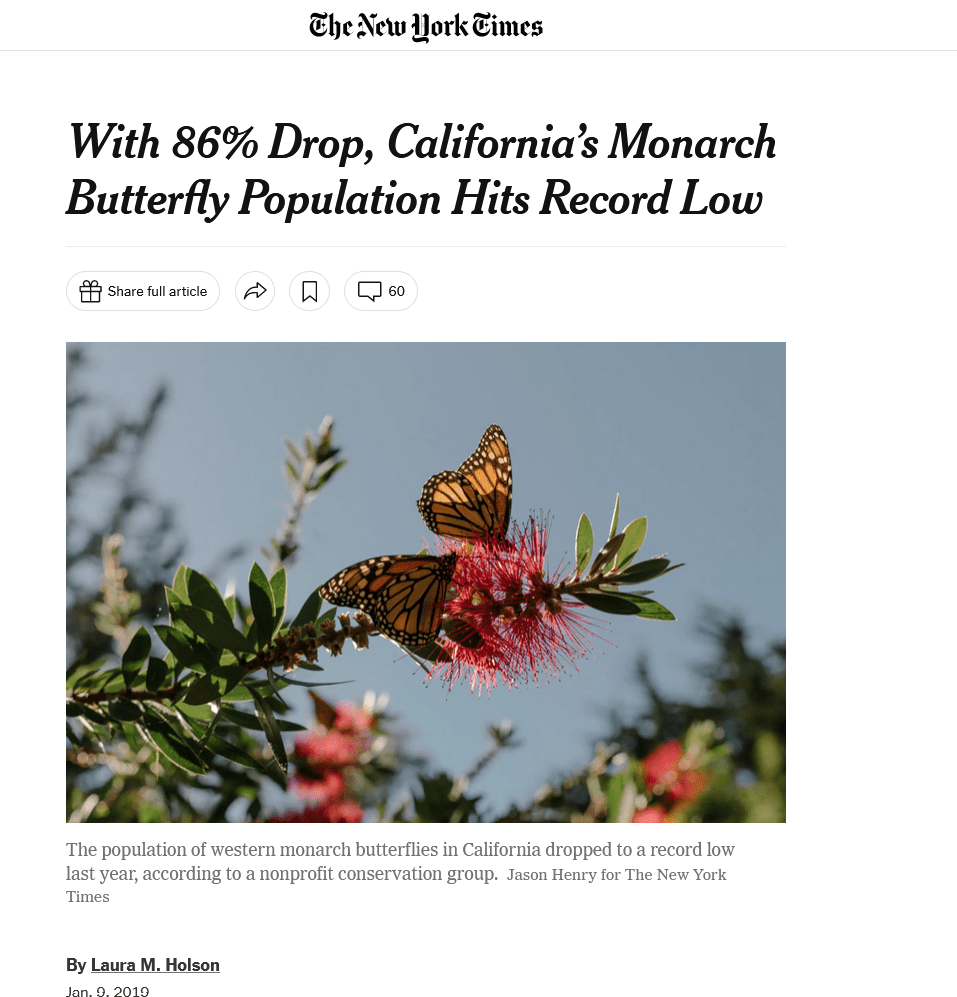
It has been five years and three months since I read the New York Times article about the plummeted numbers of monarch butterflies. It made me sad and angry that monarchs could very well be lost in my lifetime. I did not want to imagine a west without this beautiful and important native animal. I still remember that day in January when I read that article. I thought, “Ok, I am not willing to let that happen without a fight. What can I do about this?” So, I got to work learning as much as I could about monarchs, their migration, lifecycle, what they needed to survive. I learned who the key organizations were leading the charge and that there, gratefully, was a significant focus on this issue. I knew I had seen monarchs before, but it made me consider how long it had been since I’d seen any at the ranch, or even in town. I went back through photos. It had not been for ten years – not since before the 5-year drought.

The first people I reached out to were the Southern Sierra Miwuk tribal elders. I asked them about the monarchs and the western slope of Mariposa County and what they knew of the populations, plants and timing. I then reached out to some older ranchers to gauge how often they had seen monarchs and what they remembered from their grandparent’s stories. It was clear. The elders shared about times of abundance, with fields of butterflies, including monarchs, all over the milkweeds that particularly grew in the riparian and marshy areas. There were more flowers then and more milkweed to support hungry caterpillars and butterflies. The ranchers told me of less abundance – of having seen them as children, but not as many now. With this information, I knew this area had supported flocks of butterflies, and that it could possibly be that way again – at least Taawe Bwia, my ranch, could be an oasis.

To get plants, I reached out to Mariposa Native Plants (Ron Allen and Bev Andalora). I knew them in the community, and Ron had already been gaining a reputation as a “milkweed whisperer”. From the information I gained online, to Ron and Bev’s knowledge, we created milkweed plots. I started with two diversified plots, and both were ravaged by gophers. I started over, placing the plants in mesh baskets instead of chicken wire cages. That worked, but it was expensive. While I was committed to the project, I could never have scaled it as big as I have without the Mariposa County Resource Conservation District (Melinda Barrett). She was a wealth of knowledge, and I changed the composition and structure of the milkweed plots to “pollinator islands” based on her guidance. She was able to help because there was significant funding from the Wildlife Conservation Board, and the California Association of Resource Conservation Districts, as the intermediary administrator.

I was fortunate to have the thought partnership of Xerces Society partner biologist Deedee Soto, who shares my passion and commitment to conservation work. Truly, without her expertise, I would not have as much success. She is a genius with plants – propagation and ID. At this time, Xerces also began their very useful habitat kits (Thank you to Jessa Kay-Cruz and Angela Laws!). Not only did it provide all the plants needed for a successful pollinator island, it taught people about the plants, bloom timing and diversification. I still have the very first plant list with bloom times. It was such a great resource, and what a great idea.

I received tremendous support from the National Resource Conservation Service (NRCS) John Grimes, Jesse Baum, Prospero, and so many others in the NRCS ecosystem. Farm Advisor Fadzayi Mishari provided input on conservation issues early on in my land stewardship and organized important educational opportunities for the ag community where I was able to learn a great deal.

Point Blue Conservation partner biologist Elena Kromer wrote my first conservation plan. While it took a very long time to get done, she listened carefully to what my concerns were and designed a plan that addressed many of them. This process connected me further into Point Blue, where I was able to join their carbon sequestration and wildlife resources study project and access their Roots grant program (Cati Mong). Also of essential help were the classes and resources from Monarch Joint Venture. They offered the first online class I took that brought me from knowing almost “0” to knowing much more. I was able to take that knowledge and advance it through the Pollinator Partnership Pollinator Stewardship Certification program, where I earned my certification in Summer 2023. Most recently, I was also able to qualify for the California Department of Fish and Wildlife Partners Program with many thanks to biologist Rosie Gonzalez and her colleagues for smoothly navigating me through the process.

Last, but not least, I want to acknowledge my dear family, friends and readers of this blog. My dad, Alan, and dear friend Daniel donated funds early on that helped me purchase more plants and supplies. My mother-in-law Sheila sends me fun butterfly-themed gifts. My brother Vance, and sister Sarah, who actually read this blog early on, encouraged me. My neighbors Ric and Kim who let me borrow their Polaris, and early on Ric helped considerably with fencing labor. My nephew Ashtin and niece Desiree have helped with the branch fence early on. My other mother-in-law, Liz, has helped me work the ranch each visit, planting seeds, digging channels and holes. Dear friends Melanie, Molly and Jen have worked side by side with me to build rock and log check dams. Friends in the community and on social media, readers of this blog who have sent words of encouragement, recommendations, shared knowledge, ignored my typos, and encouraged my writing, you all kept me going especially when I had set-backs. Finally, my beloved spouse, David, who without him nothing is possible. From his emotional support to physical labor, and financial partnership, he has been there for me and this dream of changing the course of monarch survival, to create a place where they can be assured of food and shelter along their epic journey. Chiokoe uttesiavu. Si se enchinakiavu. Thank you. I appreciate you all.

Goal accomplished!

Free T-Shirts?

To commemorate my 100th post, I am having a PolliNative t-shirt giveaway. If you like what we are doing here and want to represent via a beautiful organic cotton shirt with a heartfelt message, here is how:

  1. Make a comment on this blog with no more than three sentences sharing about what you are doing to help our pollinators thrive.
  2. Everyone who submits a comment will be entered into a random drawing for a tee-shirt. They are expensive, so I can only give a handful away.
  3. Comments must be in no later than May 24th.

Thank you, reader, for everything you do to make our planet a healthy place for our children and for all our relations. Si enchi nakiavu (I appreciate you all).

Rain and Gophers Impact Milkweed. Wildflowers. Education. Bumbles. 99th Post -WHAT?!

Popcorn flower in foreground with a kaleidoscope of color beyond

The smell of nectar – that is how I started my previous blog post. It is 10 times as intense now. As I walk, I breath deep, then deeper. I want my all the tissues in my body to remember the scent and oily feel of this sensory gift the plants are giving. They get something too of course – pollination, genetic distribution, a chance to live again next year through their progeny. A life well-lived, whether insect, flower, or mammal, is a life of reciprocity.

Almost daily I make my way up the steep hills to check on the California Milkweed. It has been raining, and I want to see how everything is impacted. I am not entirely sure why, maybe curiosity, for there is very little I can do to help them. Their lives are in nature’s interconnected tendrils, a thatch of inter-dependencies, of which I am just one piece – with agency – but not as effective as I would like.

Breathing deep (and labored from the grade), I finally get to my destination, the large community of plants. There are four things that become immediately clear: 1. something has been here before me. The dogs are sniffing tightly around the milkweed. I get nervous. 2. The leaves look a bit rough from moisture, the delicate, velvet-like fuzz drooped just a little, a dusting of white mildew on the body. 3. Flowers are already beginning to bud. It seems early, but what I have learned over the years is that the CA Milkweeds are truth-tellers, future-readers. I imagine them with their crystal balls beckoning me to sit nearby and listen to a reading of the future. The future they are predicting is a spring done early and longer summer. After all, we only had five days of real winter here – only 5 days the ground frosted over. 4. After my typical count, I finally see it. Plants are missing. I move around the space counting again. There were 10 of 17 at site one. Seven of 11 at site two. One of 1 at site three, and 1 of 2 at site four. There were 10 plants here the other day. I am missing two, no three plants, and I see that there is a new one that has emerged – so technically, there should now be 11. The cows were up there just a week before, but there is no sign of browsing, no trail of pulled stems and leaves remaining from an ill-conceived tasting of a bitter, toxic treat. It doesn’t make sense anyway. With all the thick, delicious, moisture-rich grass, there is no compulsion to try something that smells of bitterness. Among the missing is one of the largest, oldest plants. I get on my hands and knees to look closer. I see a hole. The gophers got them. What kind of gophers are these? They like the thick, bitter milk of the milkweed, the dense poison of the root? Before my heart sinks, I see one small leave still there. It’s adjacent leaf is bit off at the stem, but nonetheless one leaf and stem has survived.

From vibrant to almost gone

One thing I have learned is that these plants are resilient and fast growers when the conditions are right. There are two large mature plants that can be egg-laying sites for monarchs. Remember, monarchs are choosy. They like to lay eggs on plants that are more mature, so there is sufficient food for their brood. There are others still emerged and growing. The rain and cool temps have slowed them, but it has also slowed the migration of the monarchs. It has given special time for the crotch bumble bee to make a meal of the emerging flowers before more hungry competition arrives. Then, the other plants, impacted but not dead will bloom and sprout, replacing the leaves and stems of the earlier sprouted mature plants after they are eaten by ravenous caterpillars. There is a wonderful balance to everything, and I have, we all have, our roles.

Education

Giving and receiving is how balance is created. You learn. You try. You teach what you learn from trying. I have shared how remarkable Shana, the Southern Sierra Miwuk Nation Pollinator Program Coordinator, is. She has a natural affinity and relationship with plants. The tribe has been doing a great job of offering cultural education classes for tribal members and other Indigenous residents. A couple weeks ago, Shana was a presenter on plant propagation at an Indigenous botany class. She presented with Jeanette Acosta who discussed the uses of pine. It was an outstanding program. Shana and Jeanette did a great job, and I learned so much. It is wonderful to see her learning and teaching.

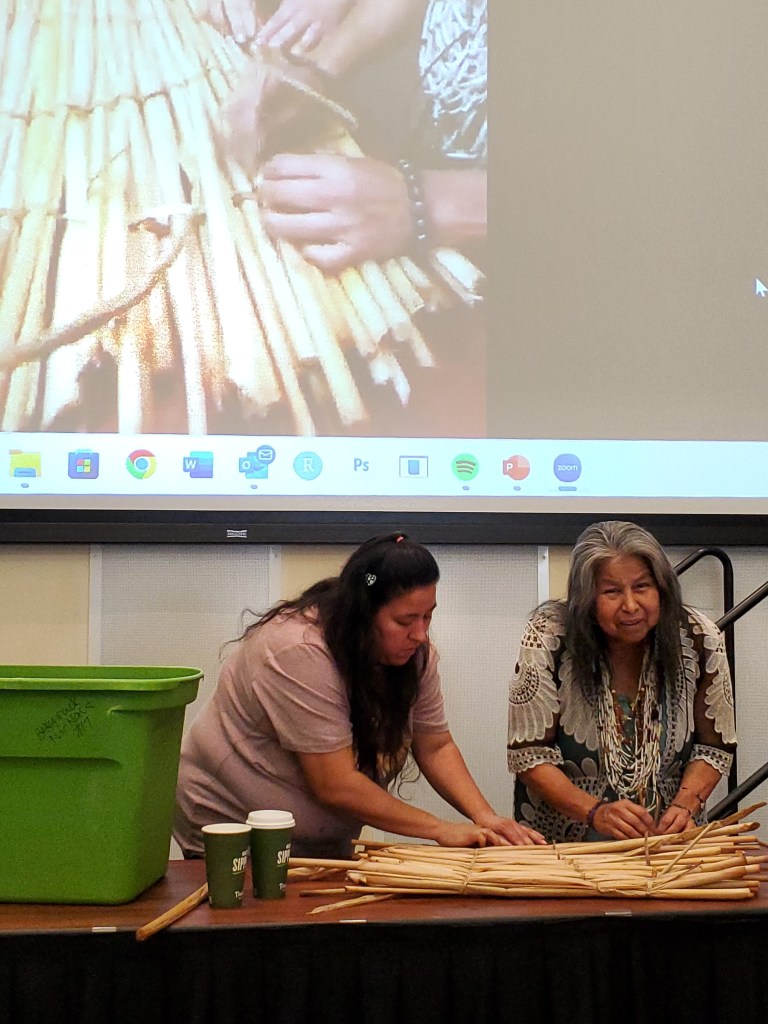
A group of us also attended a workshop at UC Davis on traditional tule stewardship and its relation with limiting bug-borne diseases. It was fascinating. The presenters were Diana Almendariz, Maidu-Wintun natural and cultural history expert, and Geoffrey M. Attardo PhD, professor at UC Davis. It was one of the best presentations I have ever been to – a Sunday well-spent!

Diana with daughter Christina demonstrating weaving a tule mat. They were incredible!

This month, Shana and I will be attending a tribal pollinator co-management workshop in Santa Fe where we will learn and share. It was a tremendous honor to be invited to contribute and connect. I am looking forward to learning and building a larger network of stewards across the land. I have an additional trip to Santa Fe for a restoration workshop. We will be learning from Santa Rosa Pueblo people and others about their stewardship work and learning through helping.

Frogs, Toads, Birds, Bumbles and Butterflies

There is so much wildlife. The small brownish-white butterflies are all over the wildflowers. I saw the first painted lady, a pair actually, yesterday. There are more large bumble bees around than I have seen in over a decade. They are flying from flower to flower and then directly at me, sending me the message that I need to leave their food zone. I try to get a photo before I heed their wishes, but they are moving too fast. I leave and go back to my office to work. The songs of hundreds of birds blend beautifully each day outside my office window. Adding to their chorus are the chirps of frogs, toads and grasshoppers. The music is joyful. Chiokoe uttesiavu weweriam (Thank you relatives)!

Wildflowers Abound

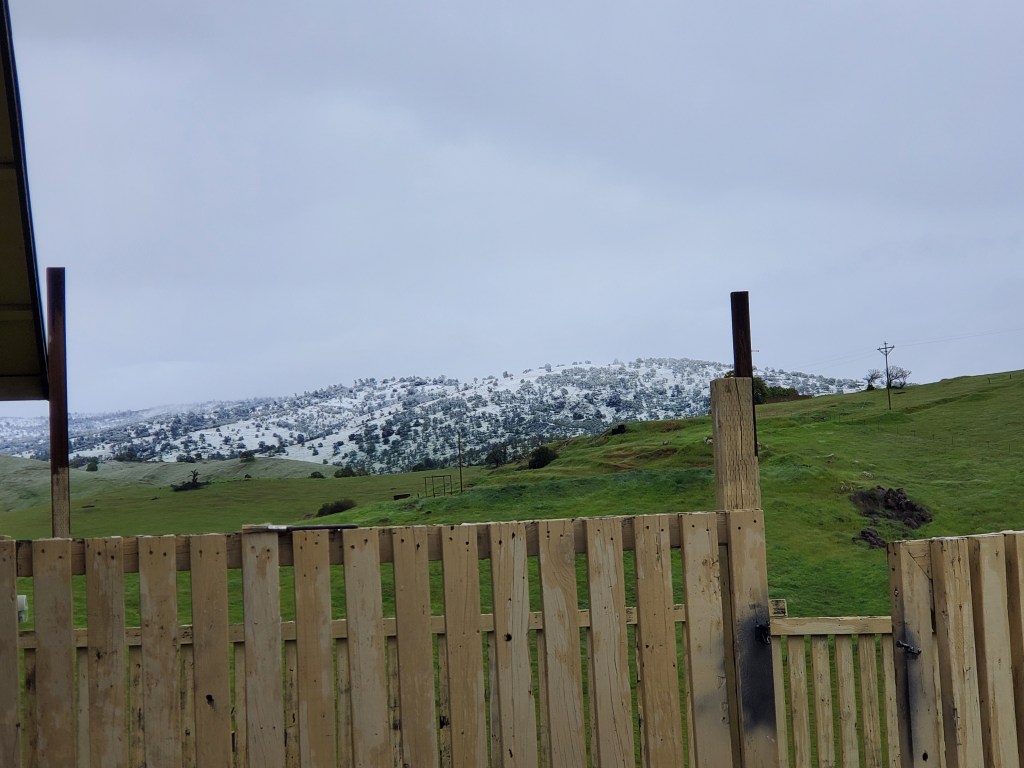
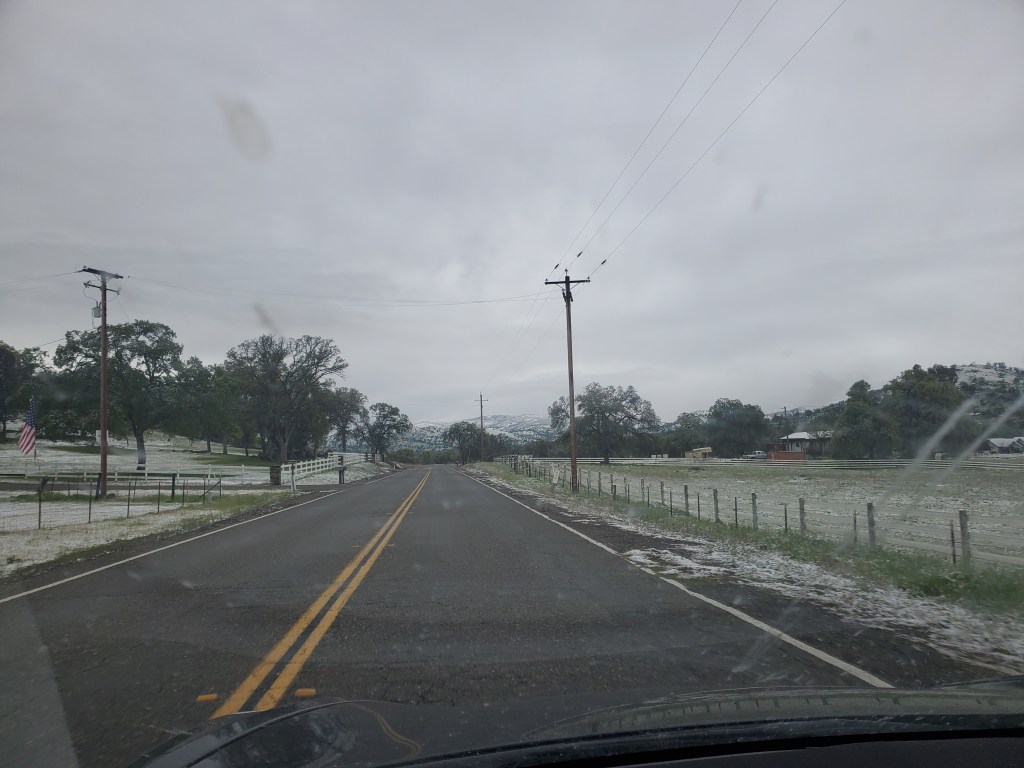
These flowers are a lifeline for so many creatures. They are only possible because of water. So far, we have had just over 16″ of rain, spread well over the rain year, not in a few big gushers. This is just above average precipitation for Hornitos, and follows an abundant rain year. It has been pleasant to see this “normal” distribution of moisture, growth and blooming. I was concerned the milkweed and other flowers might be damaged by last weeks cold storm. They weren’t. We did not get snow, but the snow was close to our elevation making for beautiful views. I would have loved a snow storm like last year in January or February. Snow helps slow things down and distribute water slowly.

More Oaks Planted

My mother-in-laws were visiting again, which provided a wonderful opportunity for another set of hands to plant the oak trees. We planted four together along the drainages. Although I use the existing pattern of oak trees as a guide for where to plant, I am concerned that the soil in one of the drainages is a little too clay-like. One of the biologists once told me that trees can change an entire system if they take root by bringing up moisture, shading soil with their canopy and bringing more types of life to an area. Everything I do is an experiment based on logic and observation. The plants and land know where they can survive, where they should be. My role is to help them survive by watering during their initial first two years of life in a changing climate. If they make it through, my role then becomes one of monitoring and maintenance.

While oak planting, I also brought dried elderberry seed to plant. Last year, I gathered elderberry from an old grove near the Tuolumne River to help the Southern Sierra Miwuk have enough stock for an elderberry syrup making class and for elders. I saved a little for me and dried some seed for planting this year. We will see if there is enough moisture to make this plant happy. I planted them near the small spring.

My 99th Post!

Whew – 99. I am on the edge of triple digits. The next post will be a celebration and reflection. I continue to be astonished by this journey, the wonderful plants, animals, insects, amphibians and humans that I meet. It has been a huge amount of work, but I am grateful everyday for this opportunity to steward – even if my back, shoulders, feet, legs and arms are sore. It is worth every ice pack!

My Fourth PolliNative Monarch Season Begins With Emergence of Ca. Milkweed

Take a deep breath. Release. The air is now thick with nectar. The sweet smell is hanging on the moisture molecules of humidified air. With it, comes the scent of grass, freshly grown, and a hint of oak bark still moist from the rains. I hope you can imagine this smell of spring. It invigorates me and lets so many other nature relatives know the time to emerge is near.

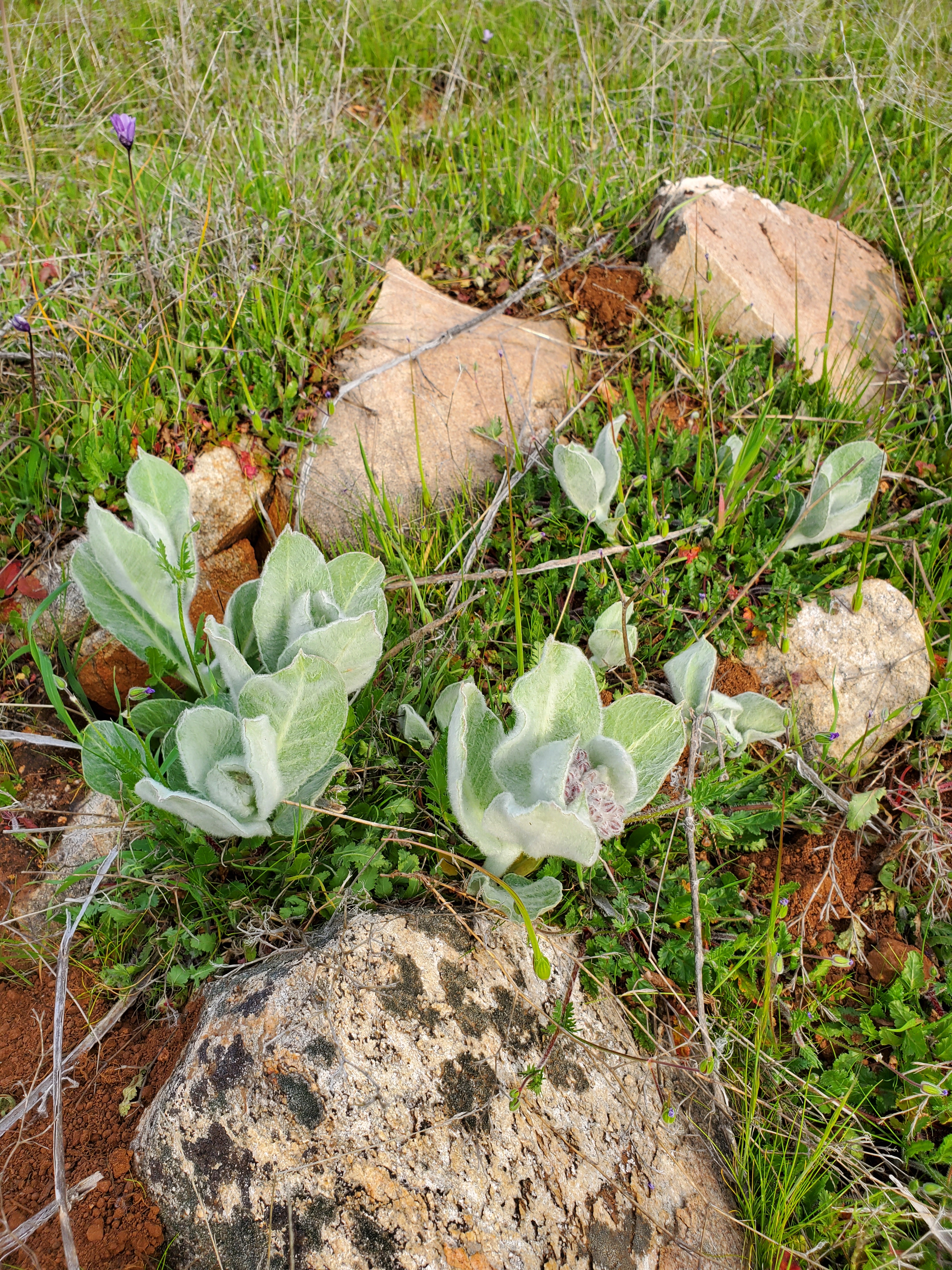
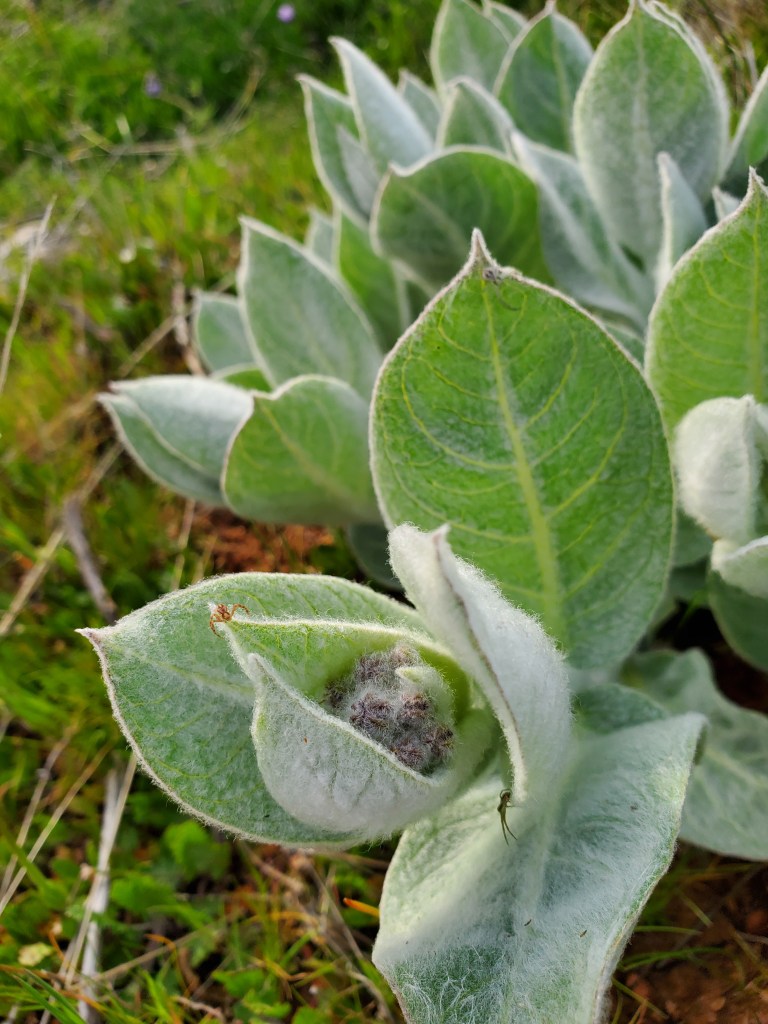
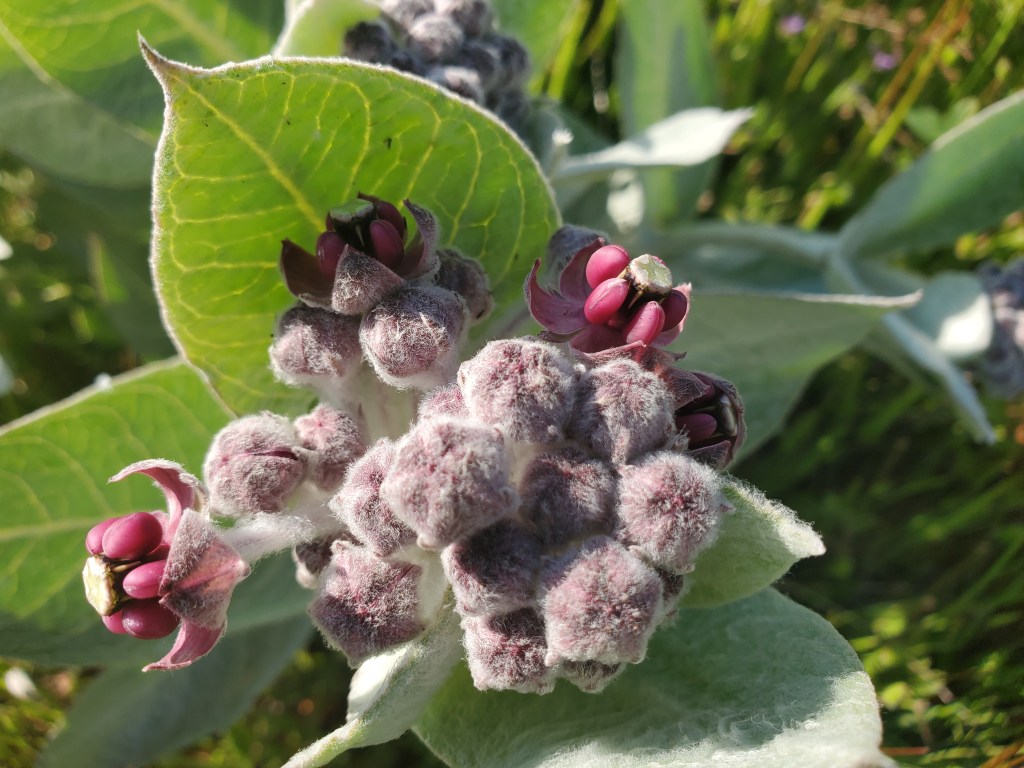
Drinking with my nose, walking up the 60% grade hill to the California Milkweed plots, I begin to look down wondering if my favorite plant has made its way up from underground life. It took a little searching, but I found them early last week, the soft, velvety leaves of A. Californica. I expected to perhaps find emergence on the three most mature plants, but I found a fourth as well. In finding the fourth surprise plant this early, I am feeling like things are continuing to heal, expand, and thrive.

The cattle are toward the end of their rotation on the south side of the ranch. They will be on the north side soon for 2 weeks. If I see signs of monarch usage, I will shut the new gates to the far north field. What a relief! I won’t need to stress about protecting the plants this year. Thank you to John Grimes and the National Resource Conservation Service (NRCS)!

Monitoring Rock and Log Check Dams

We have significant sediment build up behind even the smallest of check dams. Plants are beginning to take root creating a new habitat – from running water to a marshy water filter of plants and sediment that did not exist before. I get to play in the water too, so it is not all work. I added another small rock check dam even further down the drainage to continue the slowing process and make a wide spot that may be supportive of an arroyo willow. I am still considering whether I will plant one there. The water needs of the willows are considerable, even the ones adapted to this drier climate.

Planting More Oaks and Seeding

I am continuing to plant oaks, albeit slowly. The seedlings have green sprouts, so I am going to try to hurry and get them into the ground. Of course, the day I went to plant a couple, the cows were loafing with their babies nearby. I try not to disturb them too much. They look so comfortable and peaceful when they are lying on the ground, taking in the sun or languidly chewing cud. The babies can spook easy, and that can get the entire group alerted. More than the economics of running fat off them, I simply want to respect their peace if I can. As such, it makes more sense to park the vehicle and walk my tools and plants the remaining distance.

The first seedling, I plant in the exclosure near the area where the healthy oak fell over last year. That will be a good place with ample water. I place the tree very straight slightly higher up the hill from the up-turned rootball. For the second seedling, I choose a place near the grinding rock among the skeletons of old trees but near enough to living trees. It is another area near the water with shade and light. I say a prayer for each, welcoming them home and a wish for their wellness.

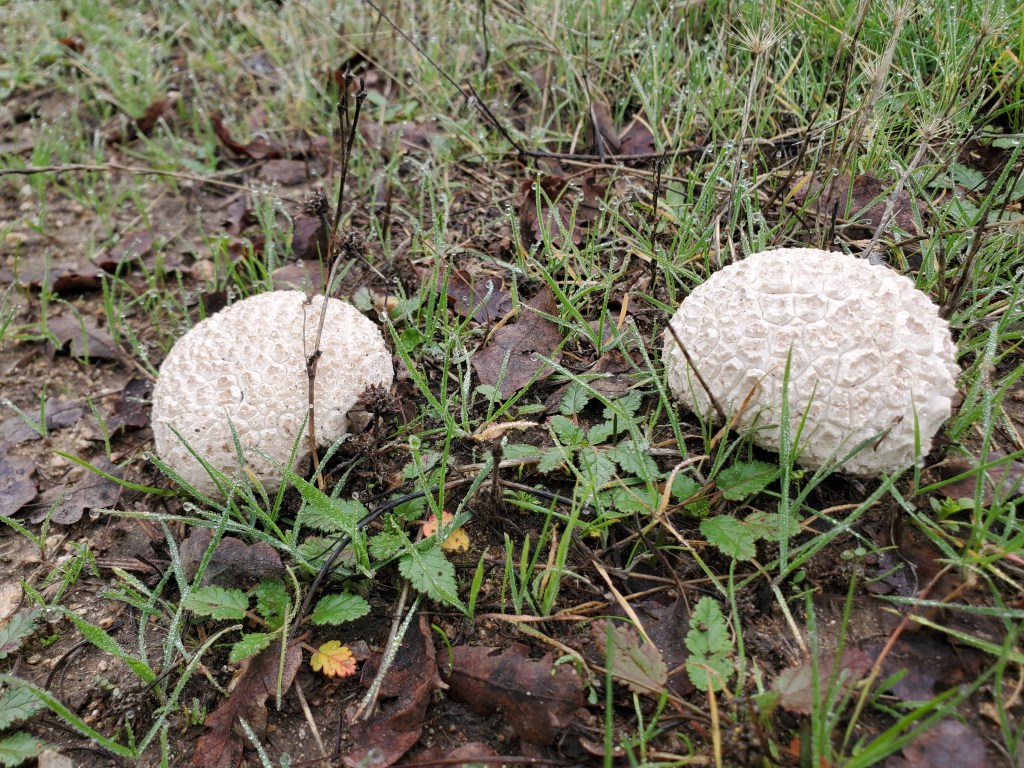
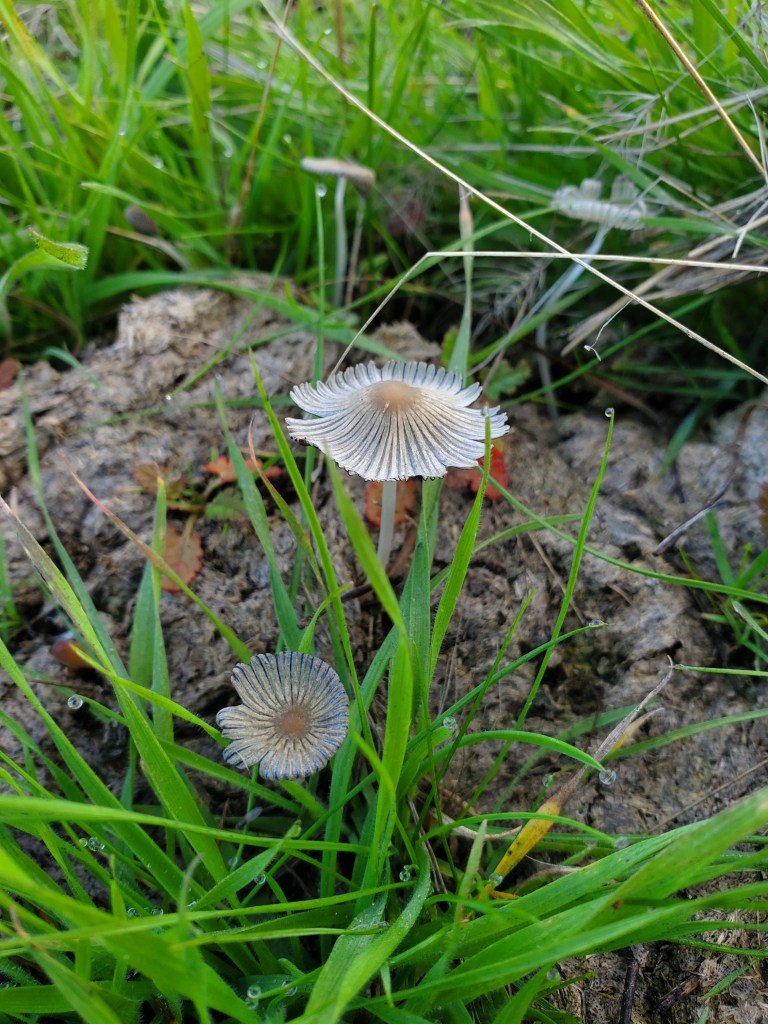
Mushrooms and Wildflowers

Bees

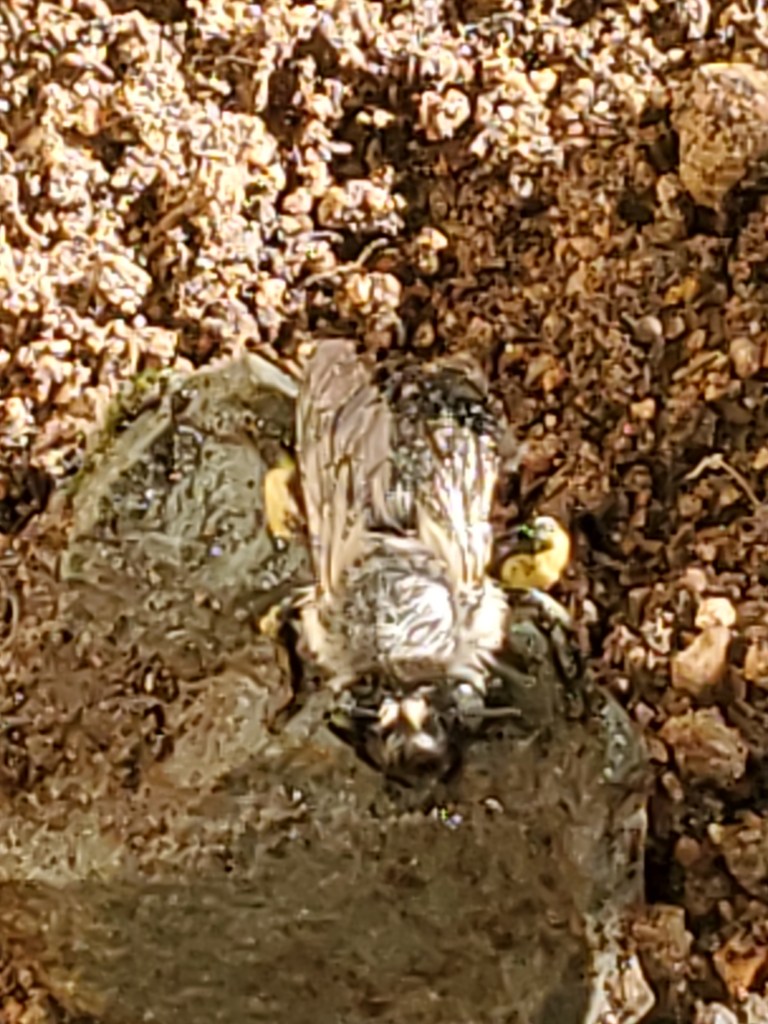
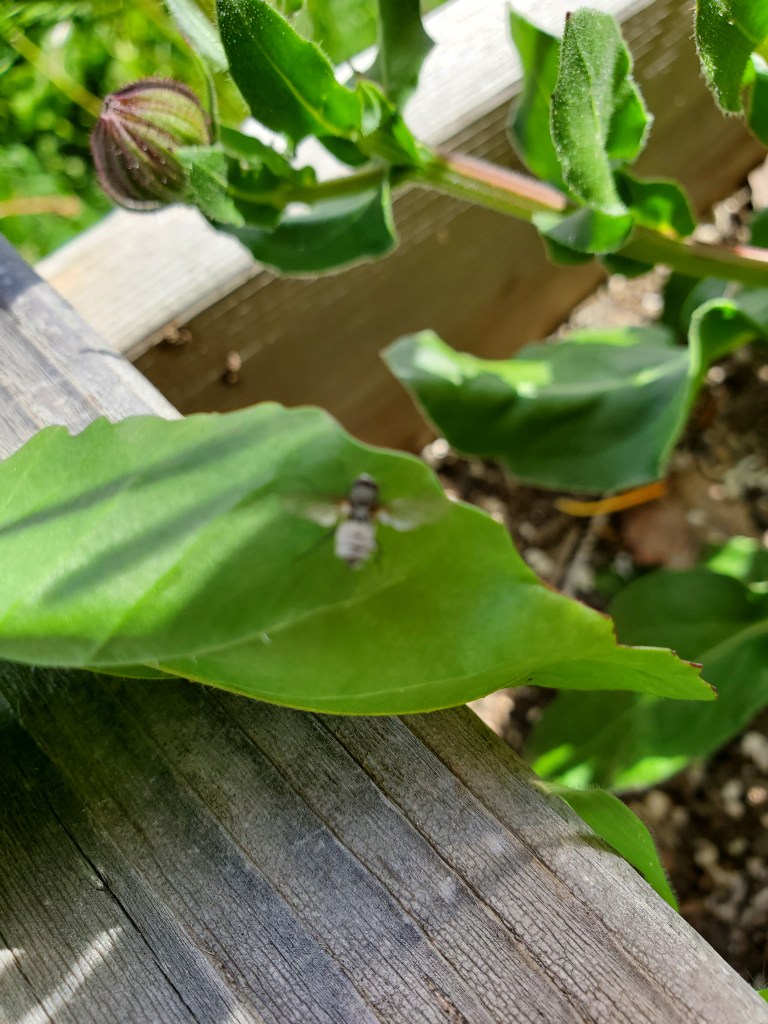
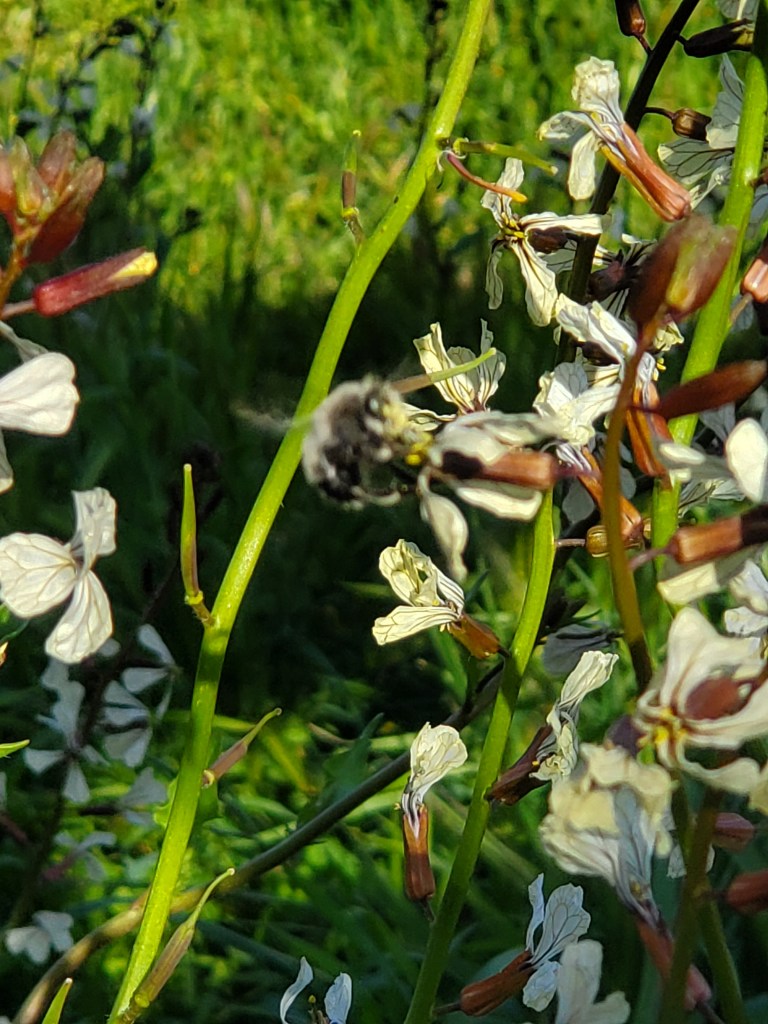
When the sun comes out, we are seeing some significant bee action. Honeybees, a cute silver native bee taking a nap, and fuzzy silver bumble bees have presented themselves. There were some viceroy butterflies just the other day. They are large and orange, so very exciting to see. They move too fast and don’t stay long. It is rare that I get a good look at them let alone a photo.

A very special guest made an appearance twice – a rough legged hawk. They live in the arctic north and fly south for the winter. Mariposa County is near the absolute south portion of their range. According to bird resources and my Stokes bird book, it is rare to see them this far south. I am thanking all the water for staying here and making a compelling habitat for some remarkable raptors this year, including a bald eagle the other day.

Stewardship is Not all Outdoor Work

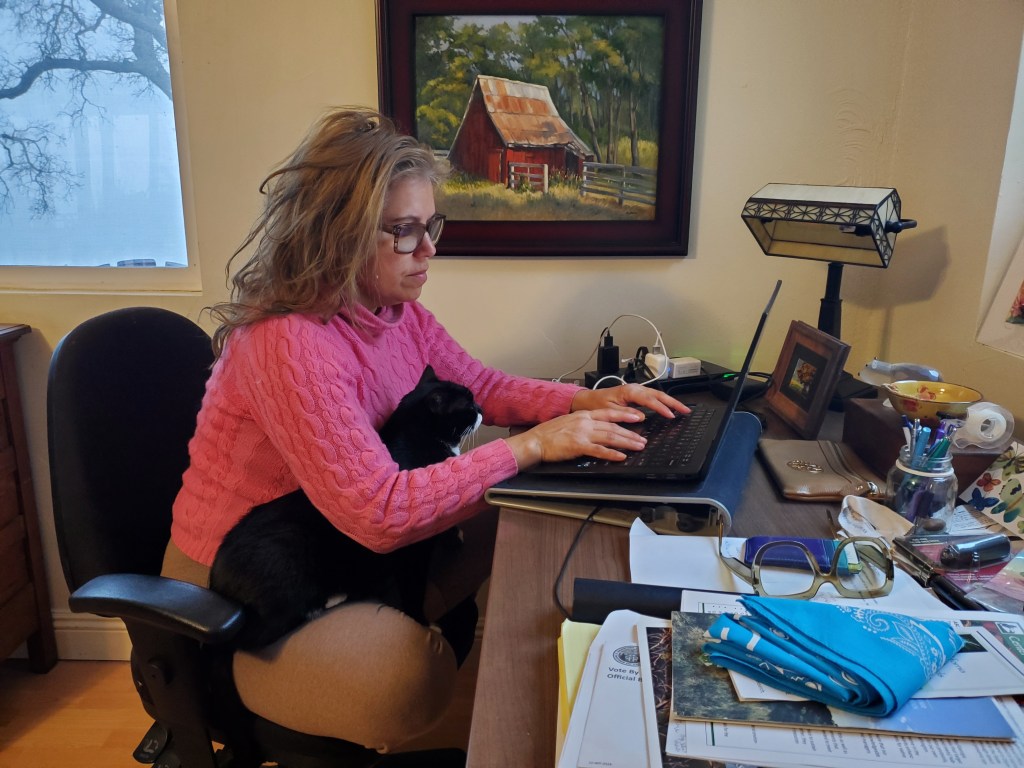
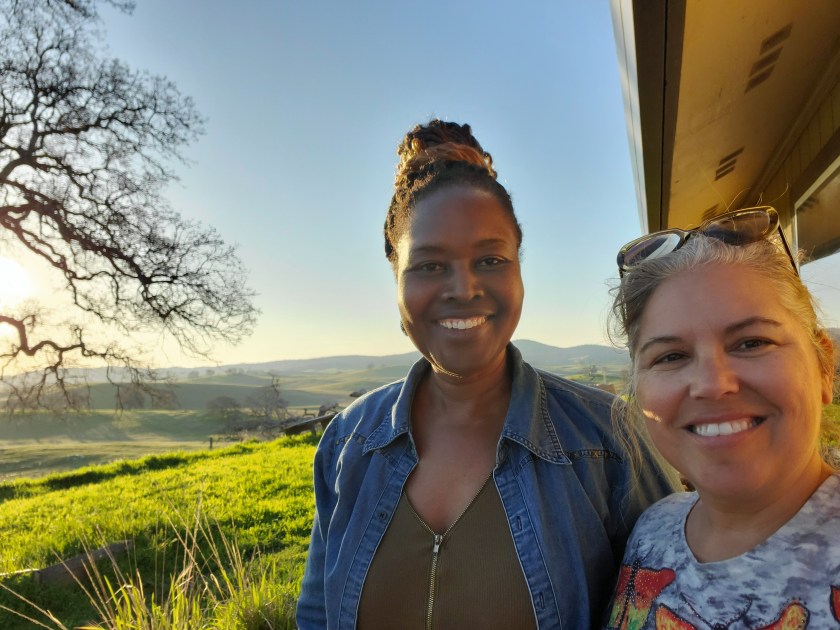
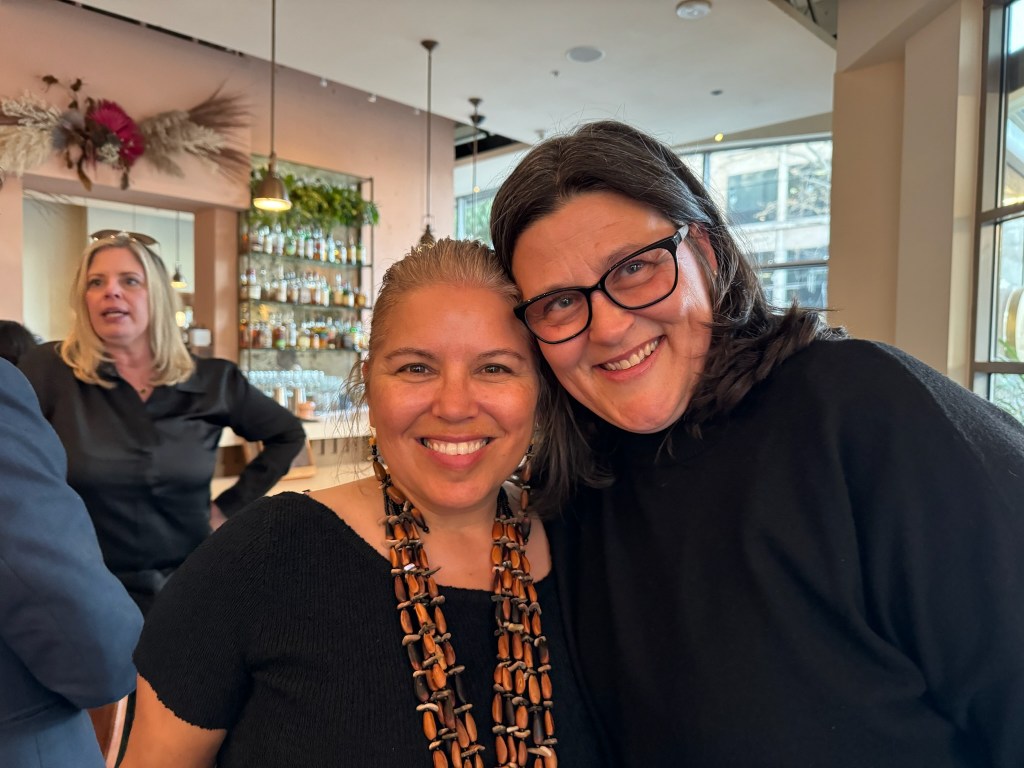
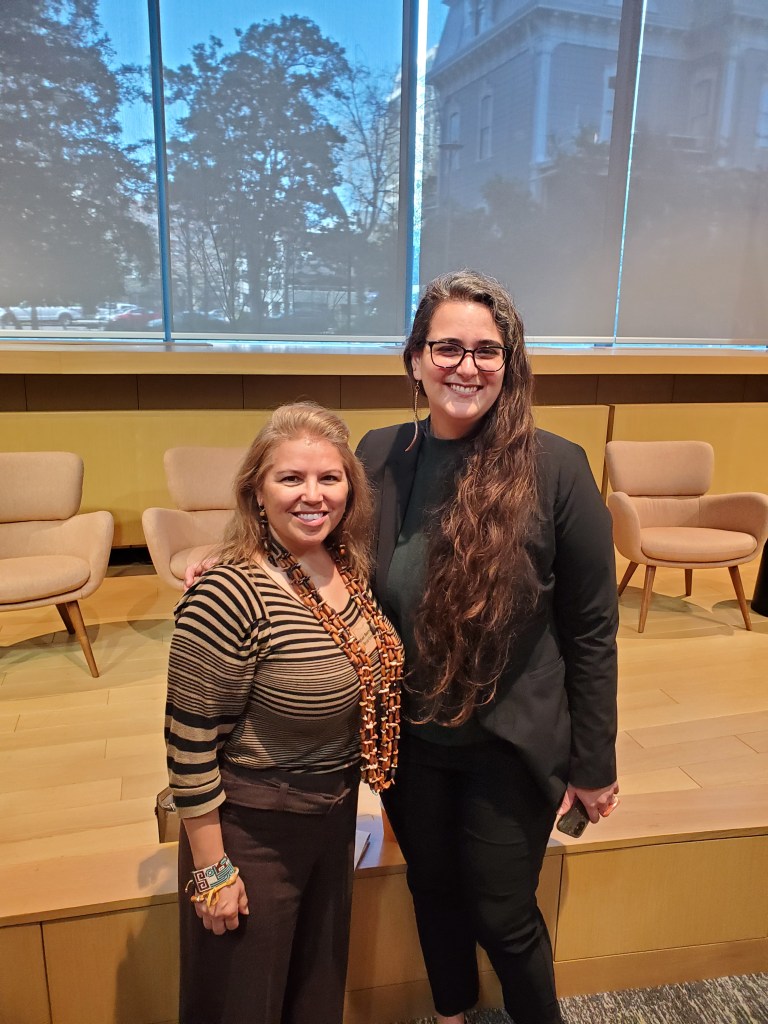
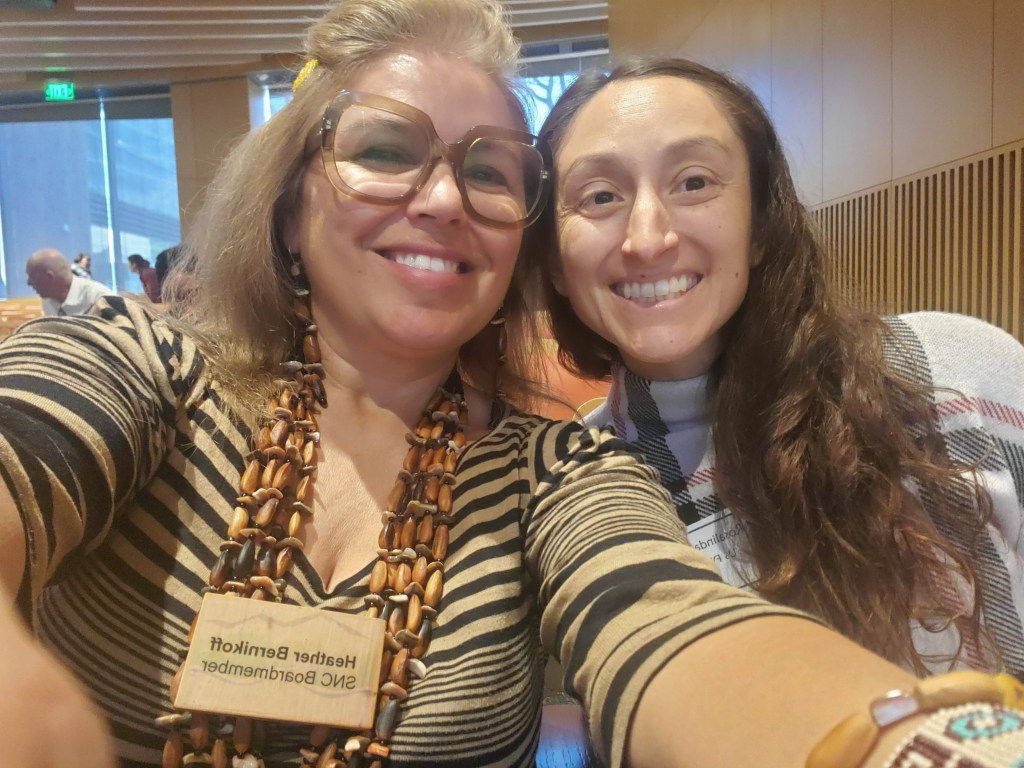
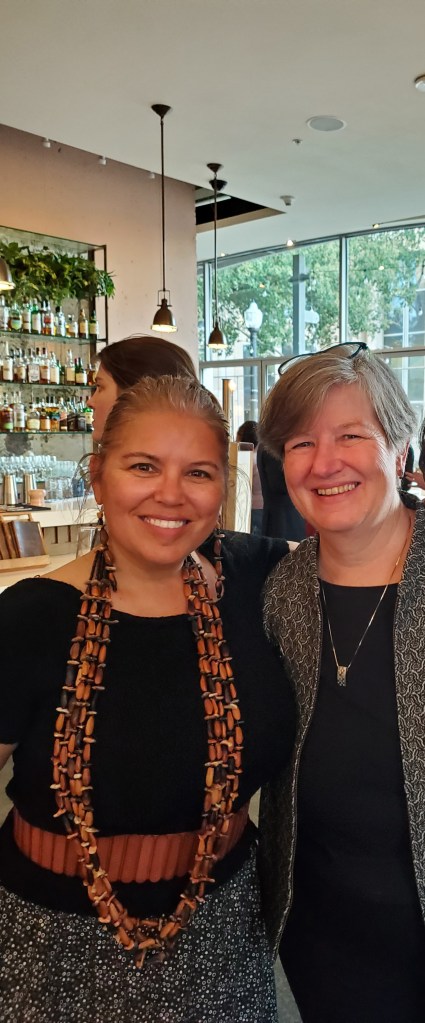
As much as I would like to say that stewardship work is 90% outdoors, it isn’t. I spend probably 70% of my time researching products, information, other programs, funding opportunities, reading articles, writing reports, writing grants, making connections, responding to questions (on email, blog, Facebook, Instagram, on Pollinator Partnership and Women for the Land dedicated communities), planning projects, performing data entry, sifting through photos, following up on conversations, supporting networks, ordering supplies, attending meetings/conferences, traveling to meetings/conferences and writing this blog. For this section, I will show some pictures of me out and about, which I am super uncomfortable with. I am not a selfie person (no judgement on others, just not me), but they are important to the story of this work. I’ve had to get used to it. Please bear with me.

In just the past three weeks, I attended the California Rangeland Conservation Coalition Summit, Community Alliance with Family Farmers Tech Expo in Madera, Xerces Pollinator Program, Native American Fish & Wildlife Society Pollinator Working Group, met with the Farm Advisor, met with NRCS, and attended my last Sierra Nevada Conservancy Board meeting as a board member. There is so much great information to know, people to see and connect with, and input (you hope is helpful) to provide. There is much more to be involved in that is worth my time; I just don’t have the time at this point. I am feeling pretty maxed out.

At the rangeland summit, I finally meet in person two extraordinary women – Nancy and Susie Calhoun. With their other sister, they conserved their large family ranch in Livermore and continue to protect it and make habitat for all the life that exists there. HEROES!!
I saw Fadzayi Mashiri, our Farm Advisor, at the Summit as well. We made a plan for her to visit the ranch. It had been a long time since she was last here. She provided some great recommendations to improve on what I was doing and was one of the people early, early on who helped me think through improvements to this land. HERO!!

SNC Wrap-Up: Bittersweet

My final meeting as a board member of the Sierra Nevada Conservancy (SNC) was last week. California Governor Gavin Newsom appointed me to this role in 2021. I have enjoyed being on the board, working with good people both on staff and as board colleagues. I appreciated the opportunity to learn about forest stewardship and rural community resilience. I learned about the State budget process, which is wildly complex. As the first culturally Indigenous person to sit on that board, I also appreciated the opportunity to ask questions about representation of Tribal governments and Indigenous led organizations, about how inclusive and equitable funds are being distributed, about why some projects call for herbicides, and trail safety and careful placement with regard to Indigenous needs. Safe, inclusive, carefully planned projects make the outdoor experience for all life better.

My last day was bittersweet –sweet in that I am leaving to deeply focus on natural resources, climate and tribes, bitter in that I absolutely love working with the entire staff of the SNC. The staff are so accomplished, professional, competent and devoted to their mission to restore and enhance the extraordinary natural resources and communities of California’s Sierra-Cascade region, while protecting them from wildfire and a changing climate. It has been such a privilege to serve the public, rural communities (which I love), the Newsom Administration and be a voice for my nature relatives. I will miss this work and all of the people.

Wanderings

Even though I am busy every day, I never lose sight of how grateful I am for the opportunities that have come my way to serve, help, make a living, and be a land steward. To know you make a difference is a gift, and it is a gift everyone can access. Whether you plant milkweed where there is none, sit on an advisory committee or board in your community, organize with others to make good, helpful change, you make a difference. Step into life, take opportunities with good intent, be a hero for a butterfly, bumble bee, forest or community. You got this!