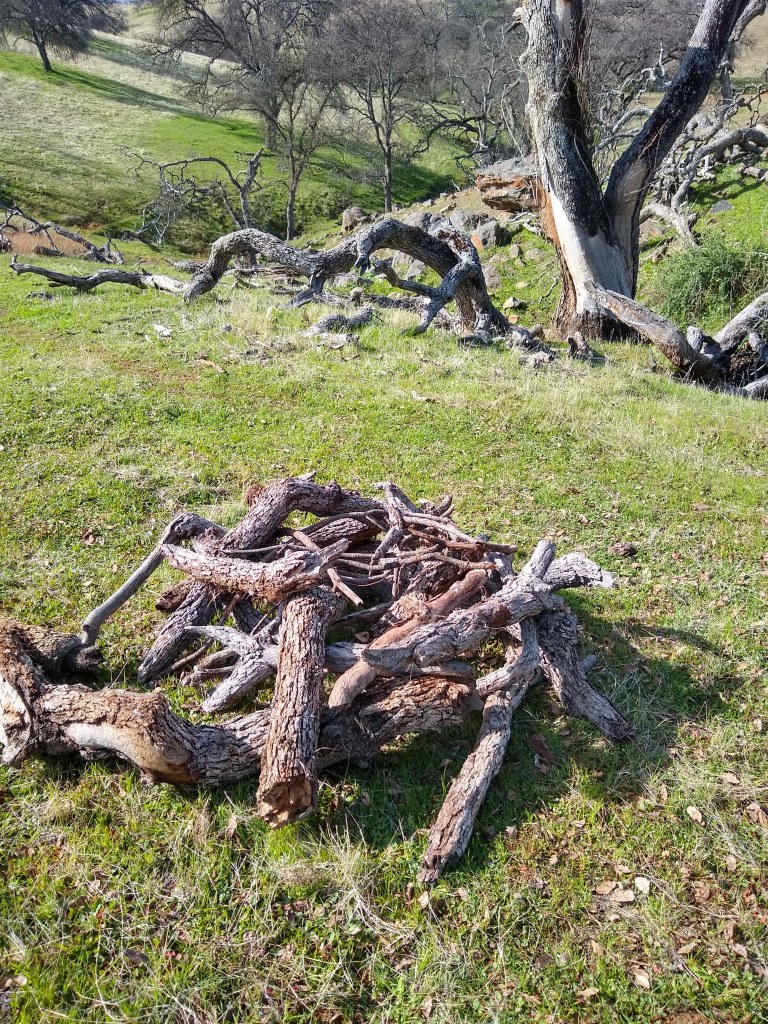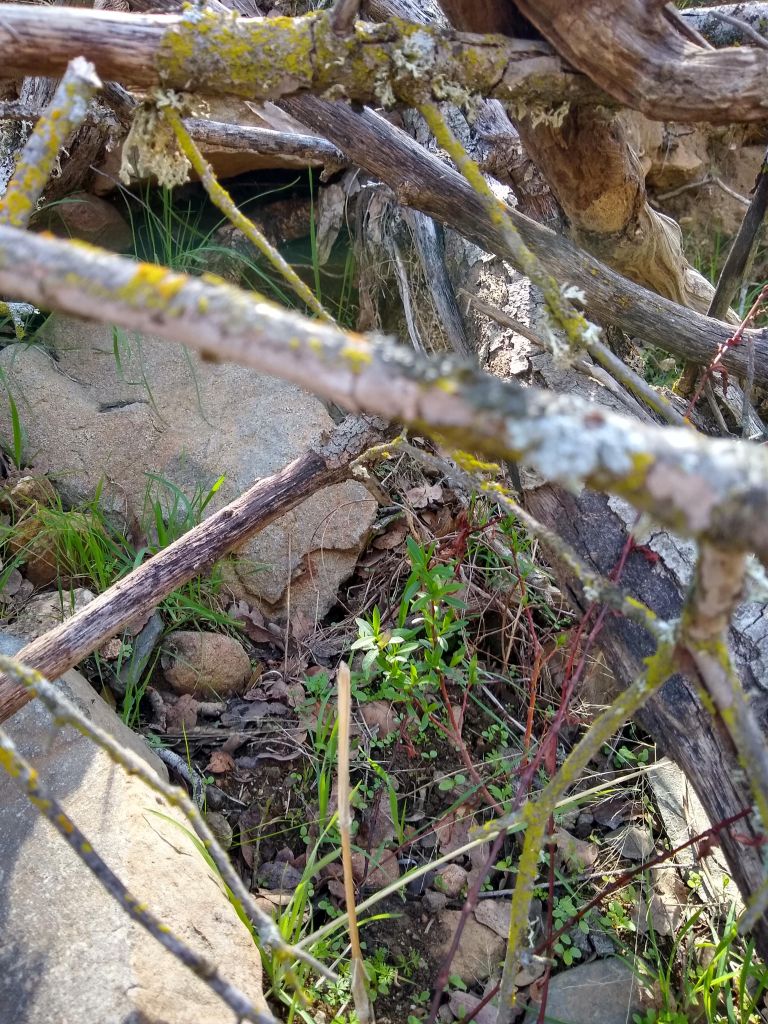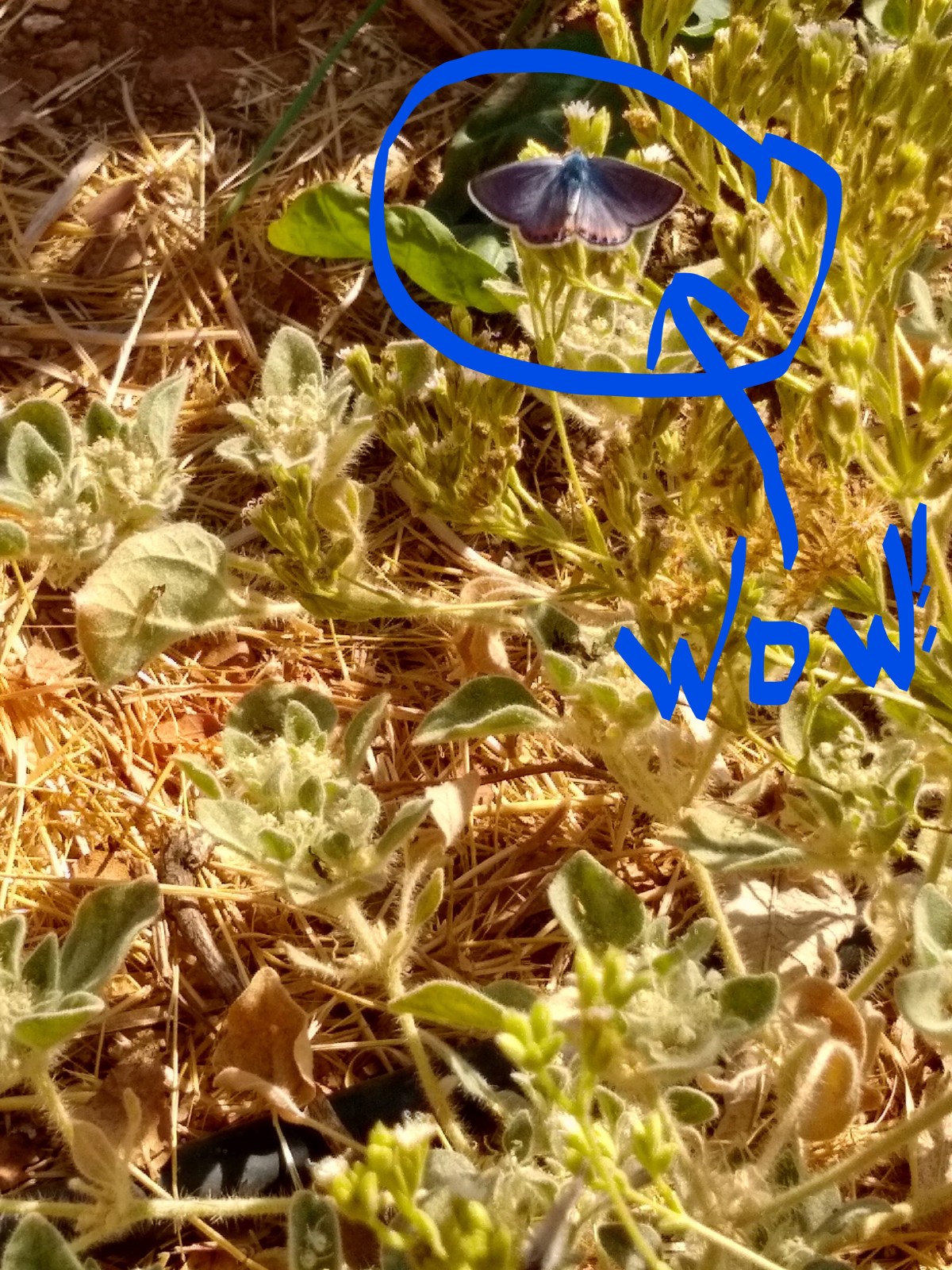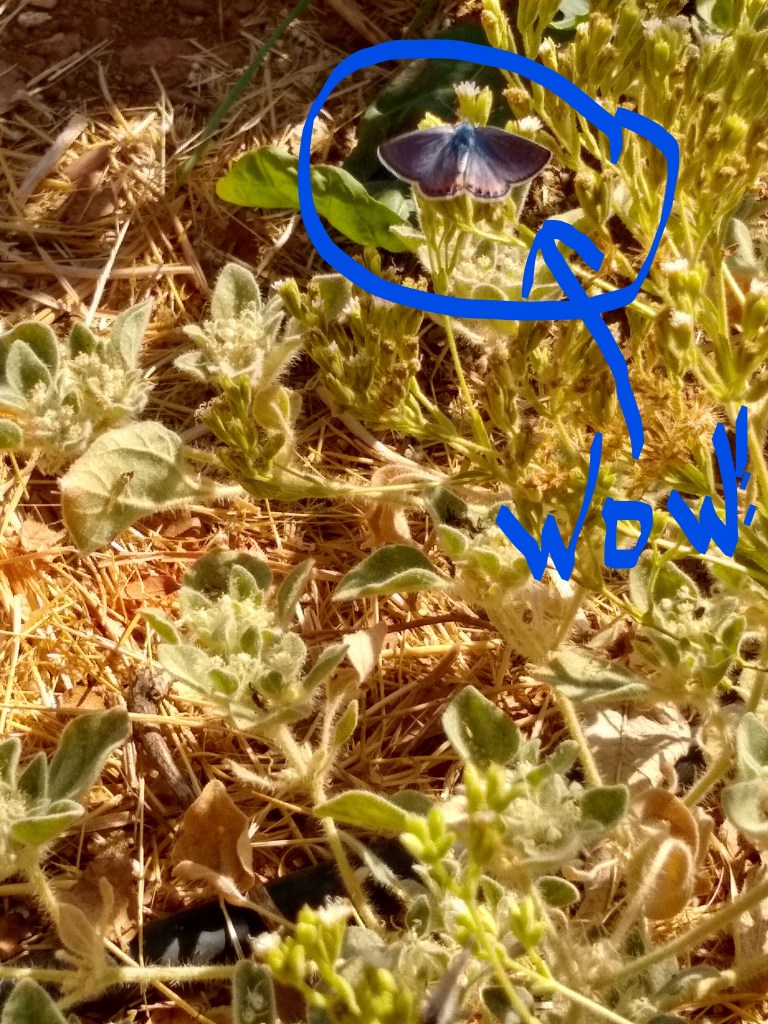
Another Race Against Time

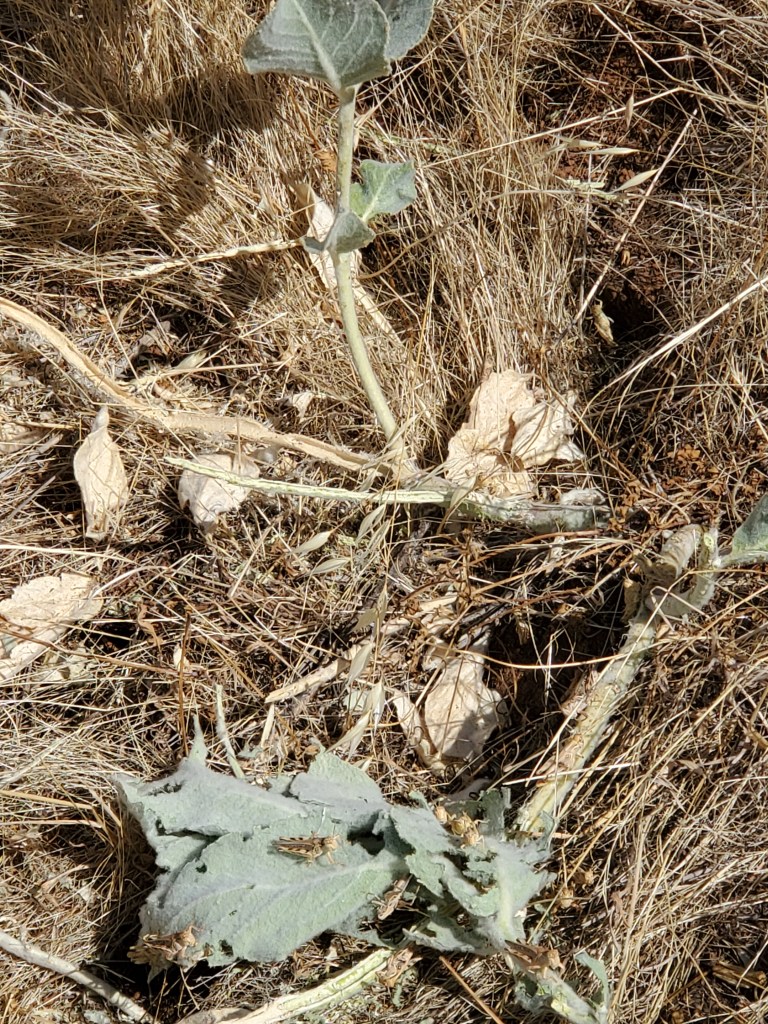
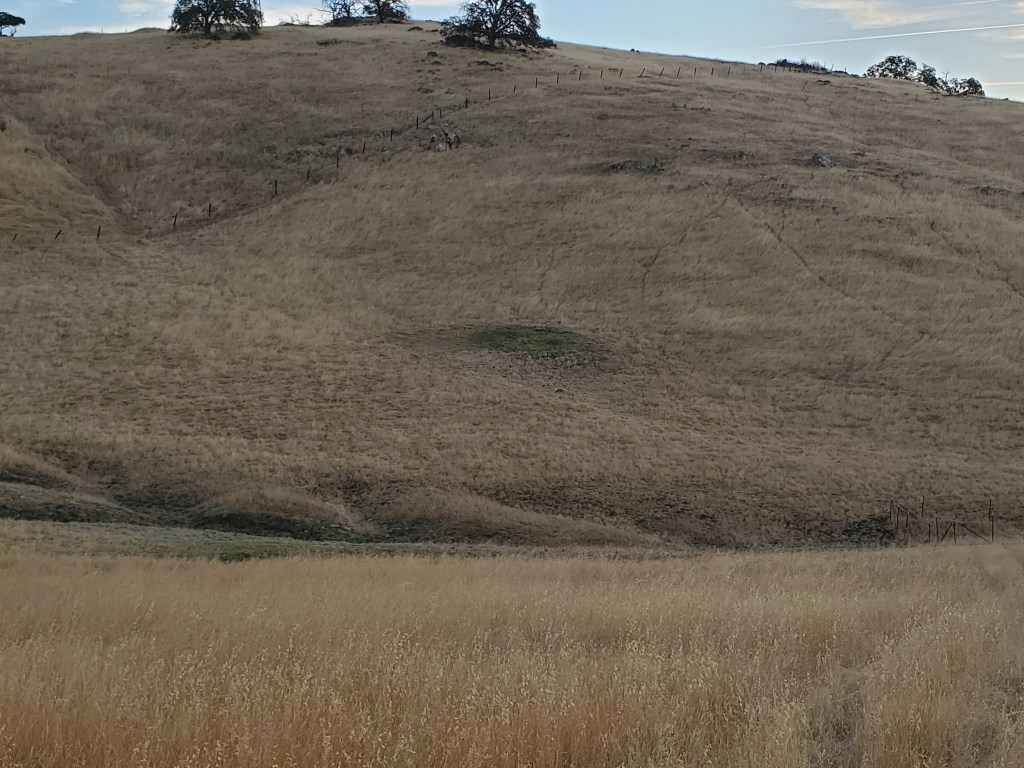
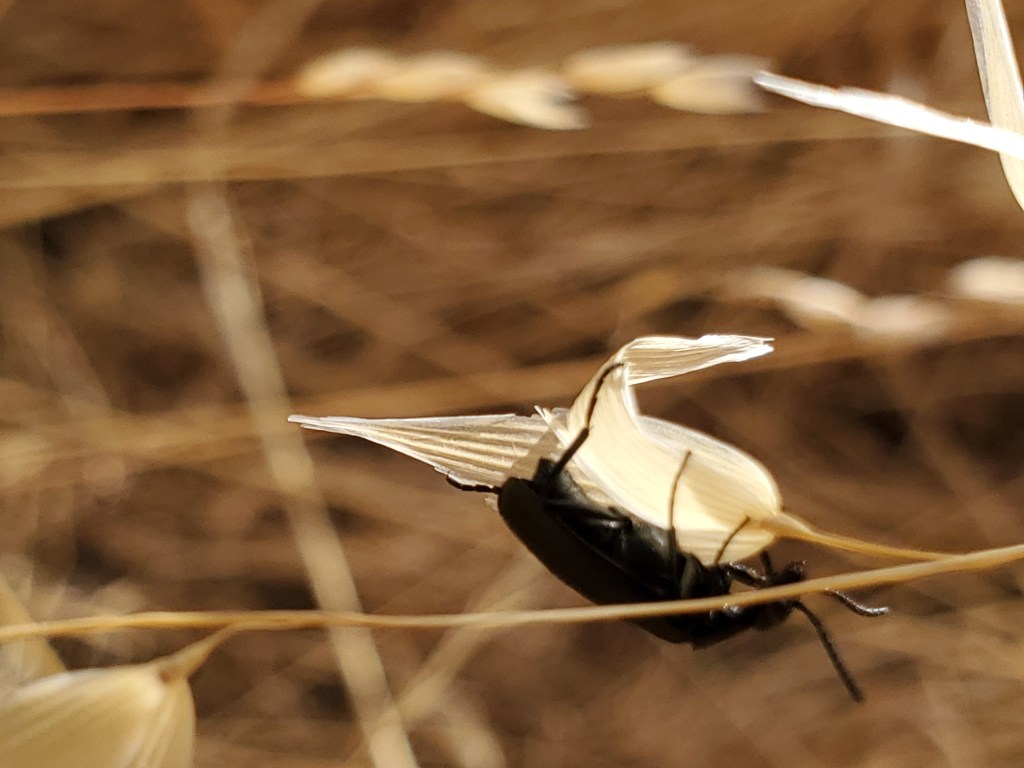
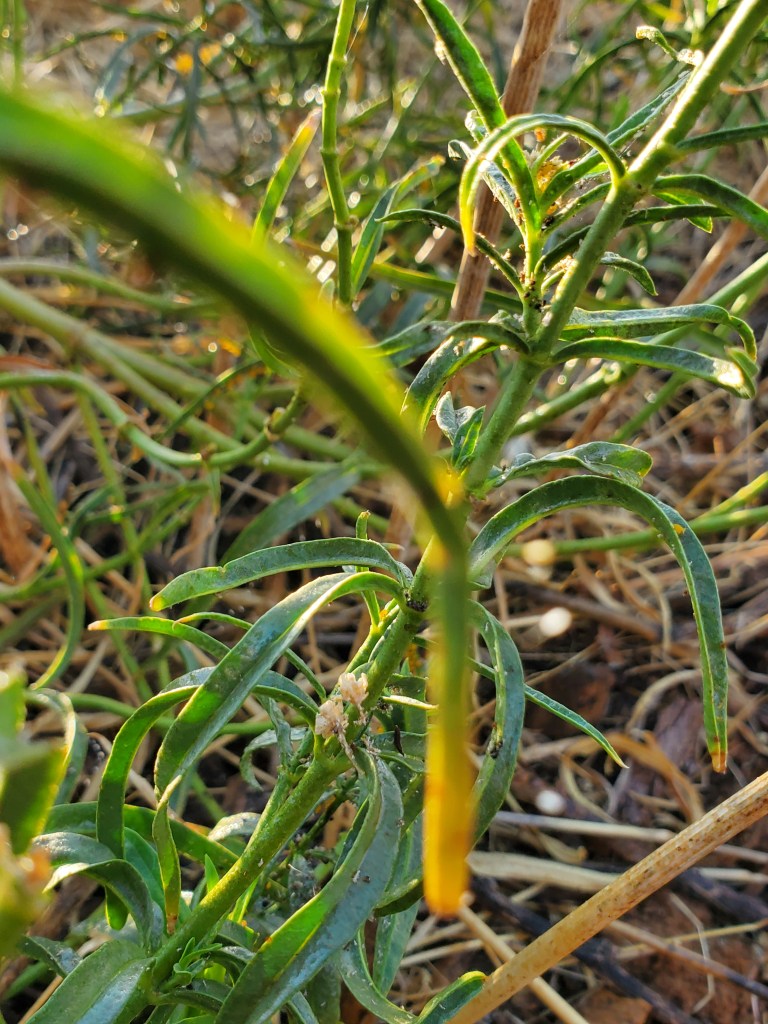
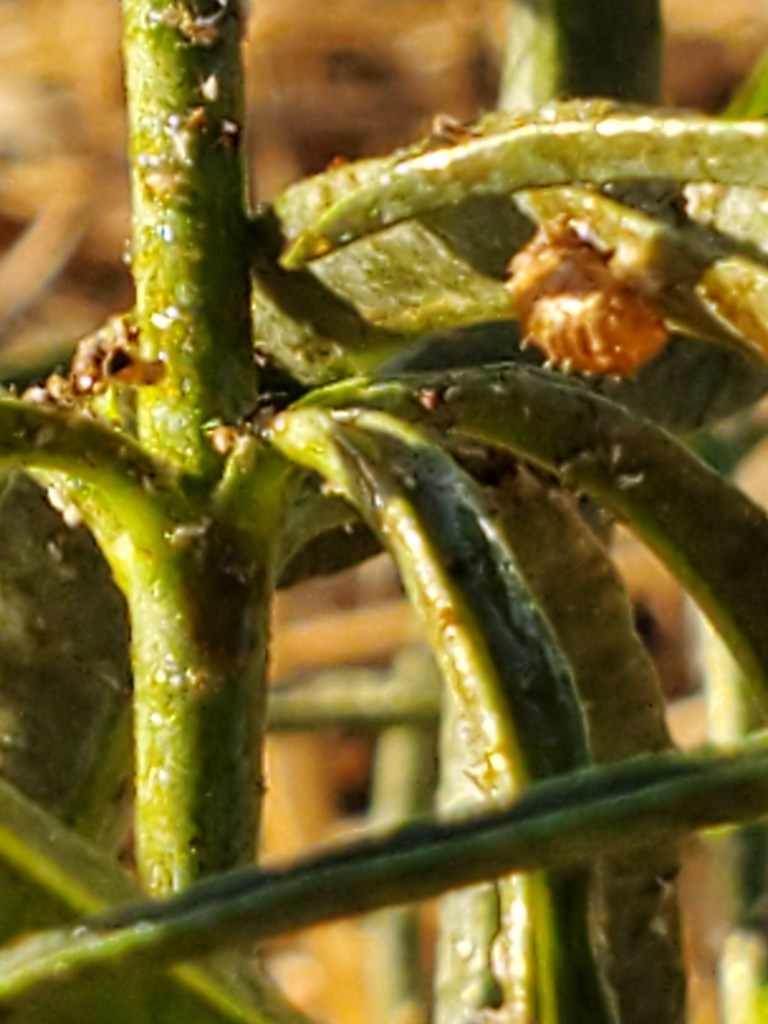
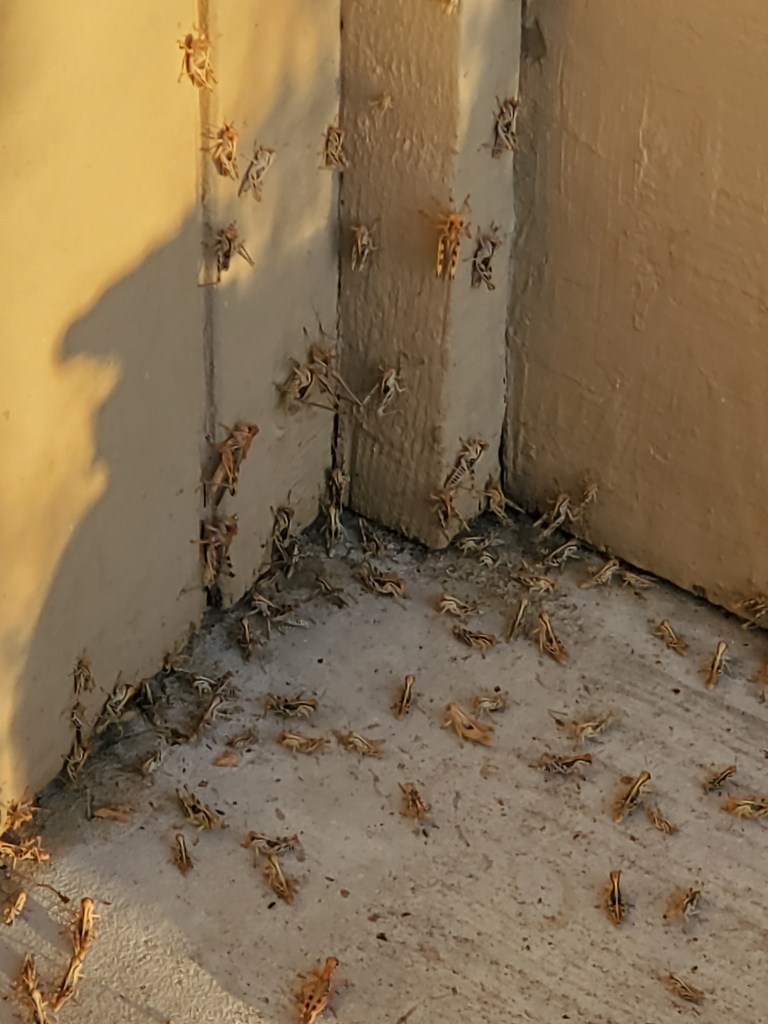
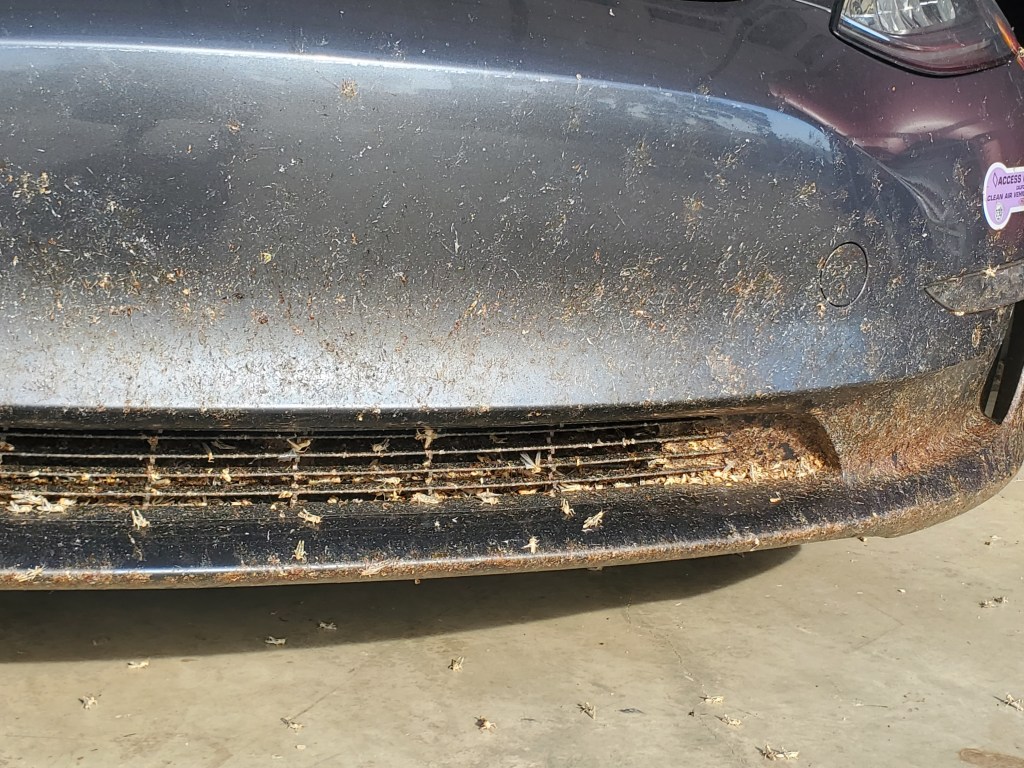
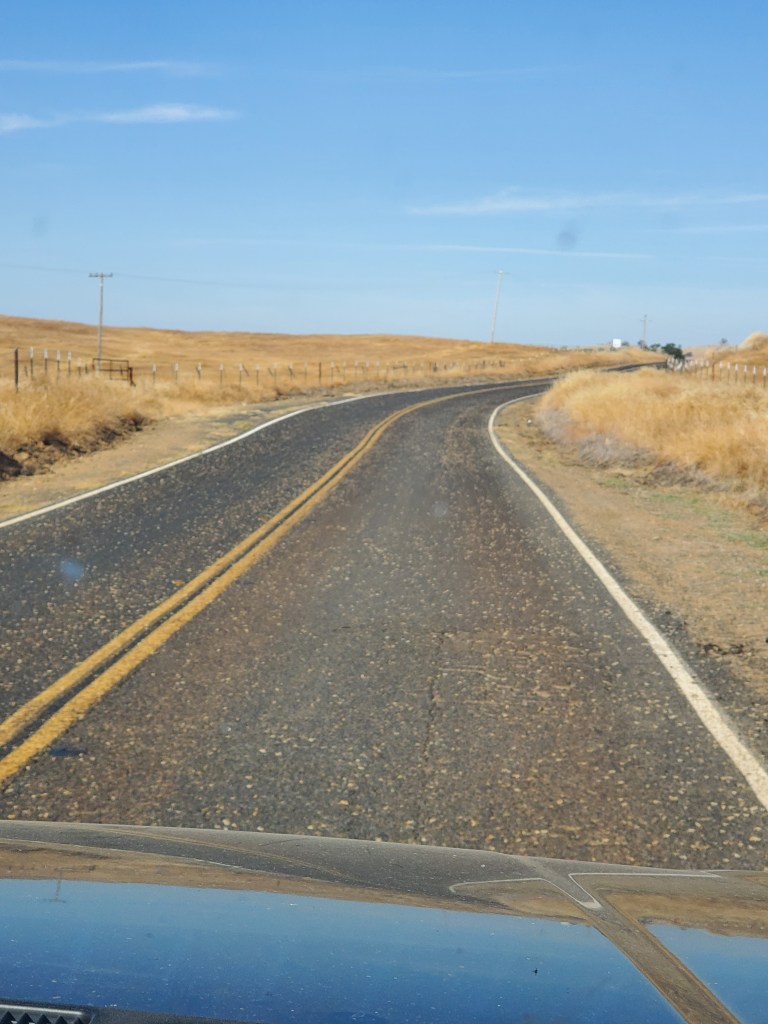
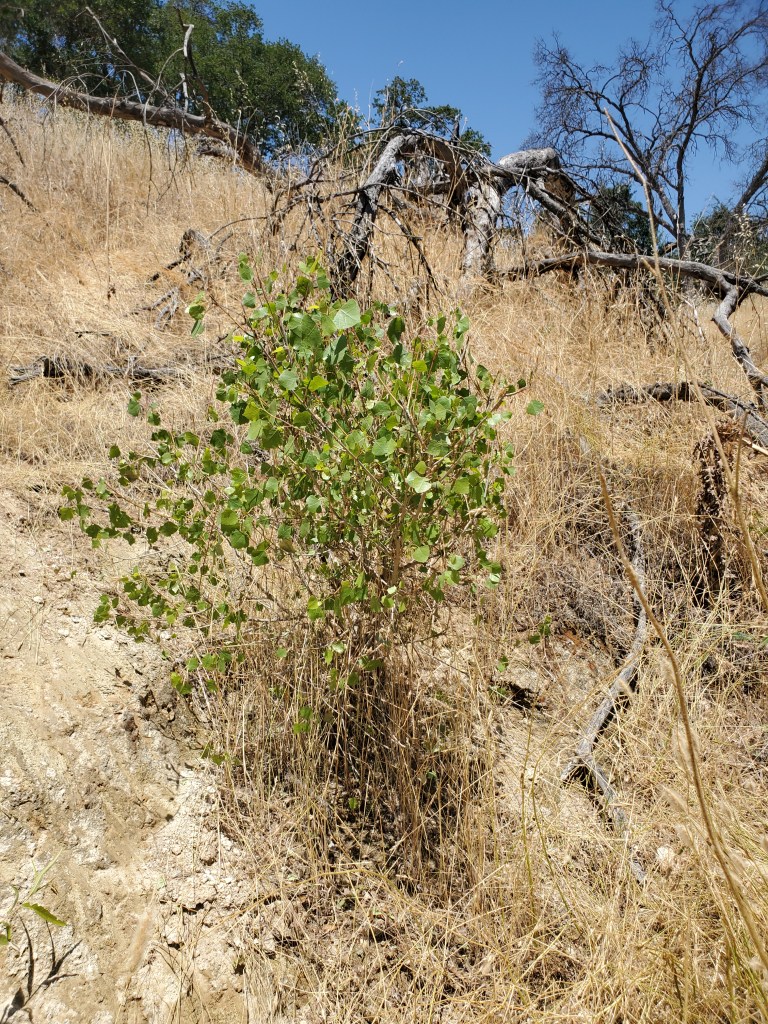
Oh yes, by the title and the time of year, I am sure you understood that the grasshoppers are back. They are eating their way up the hill. I had hoped they would not be back, that the typical cadence of boom and bust for the hoppers would return. We are due for a few years without plague levels. Alas, once again, the imbalance of what we are doing to this planet has manifest itself on Taawim Bwiapo. Essentially, almost nothing gets to live but the grasshoppers.

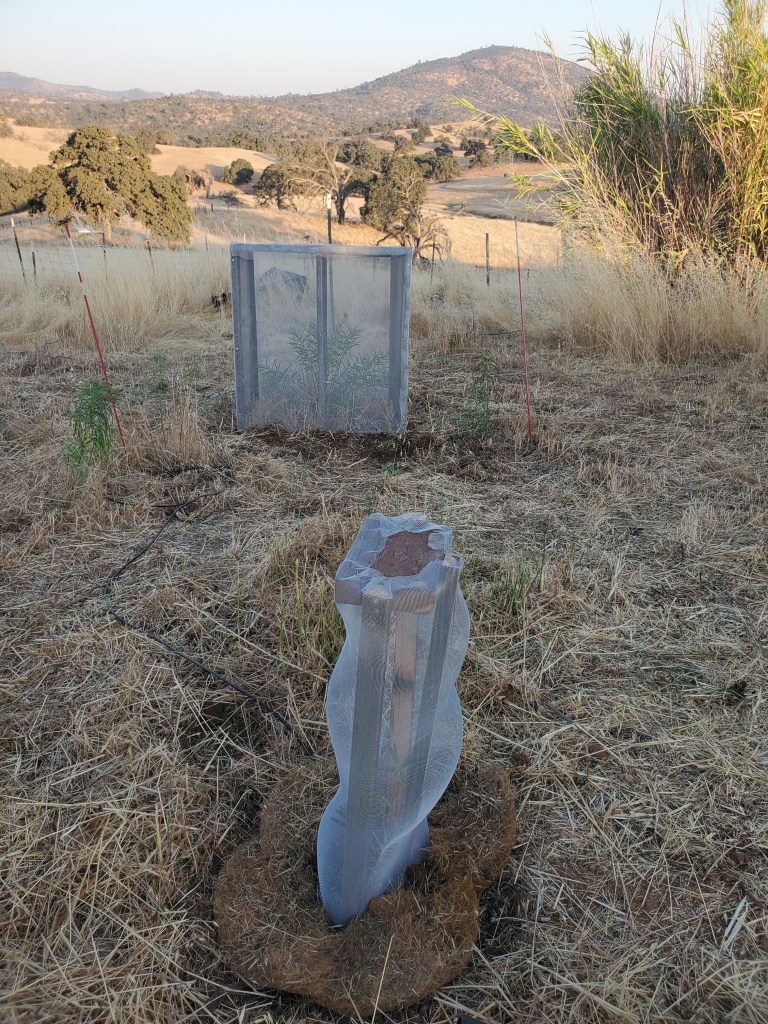
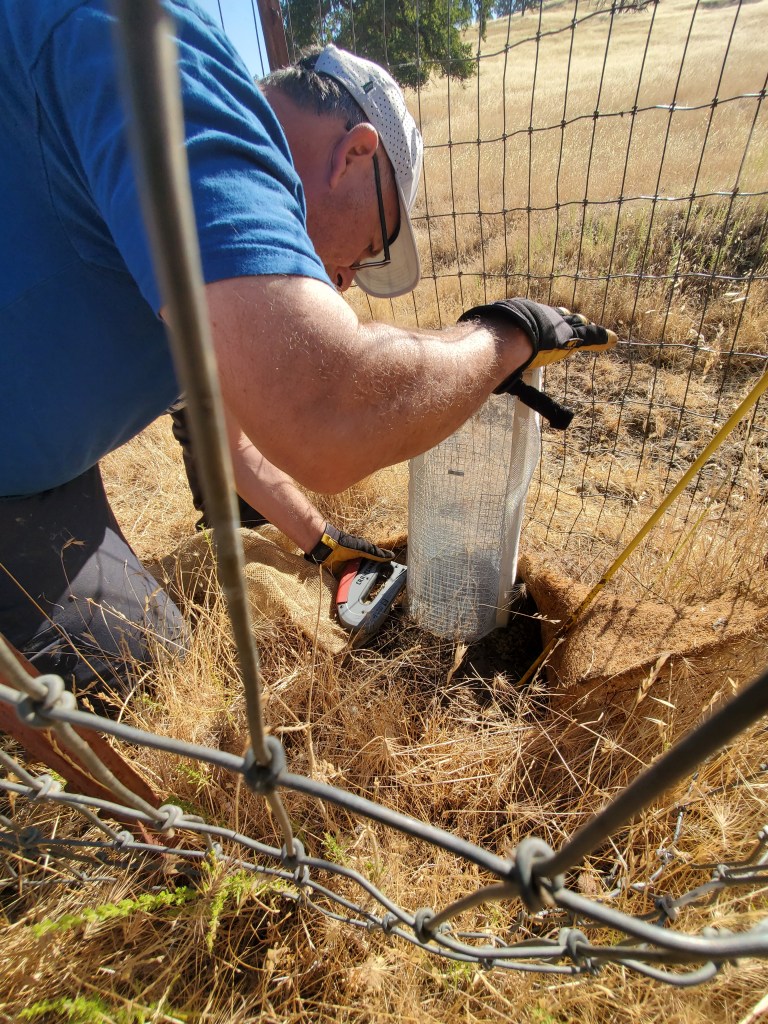
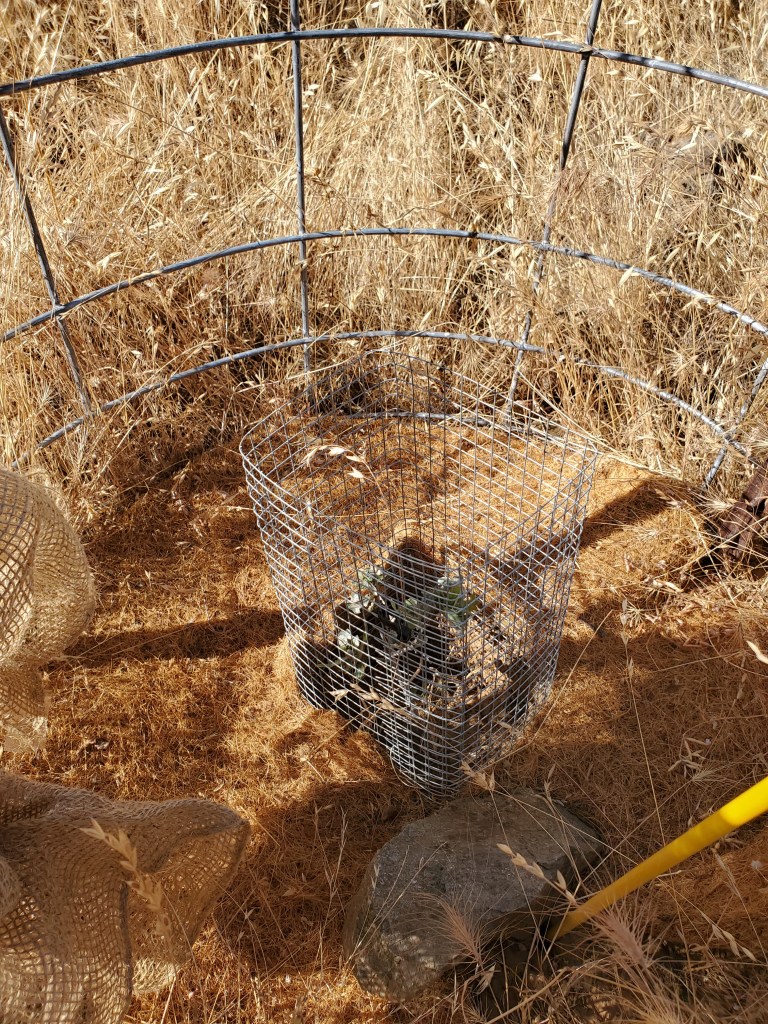
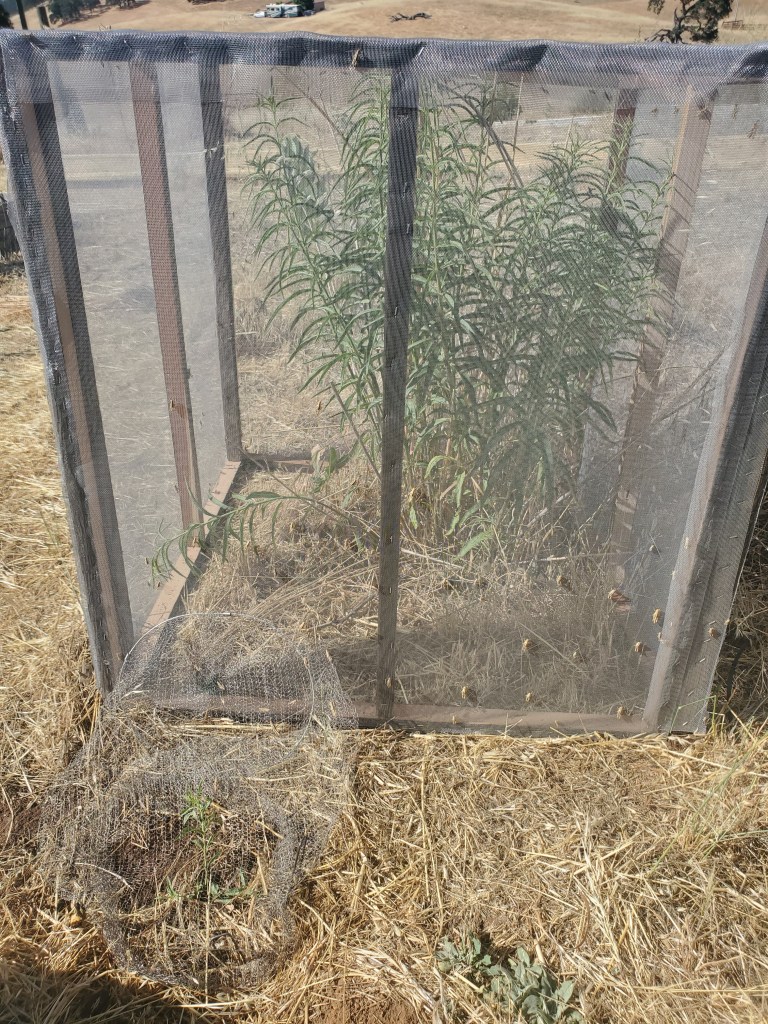
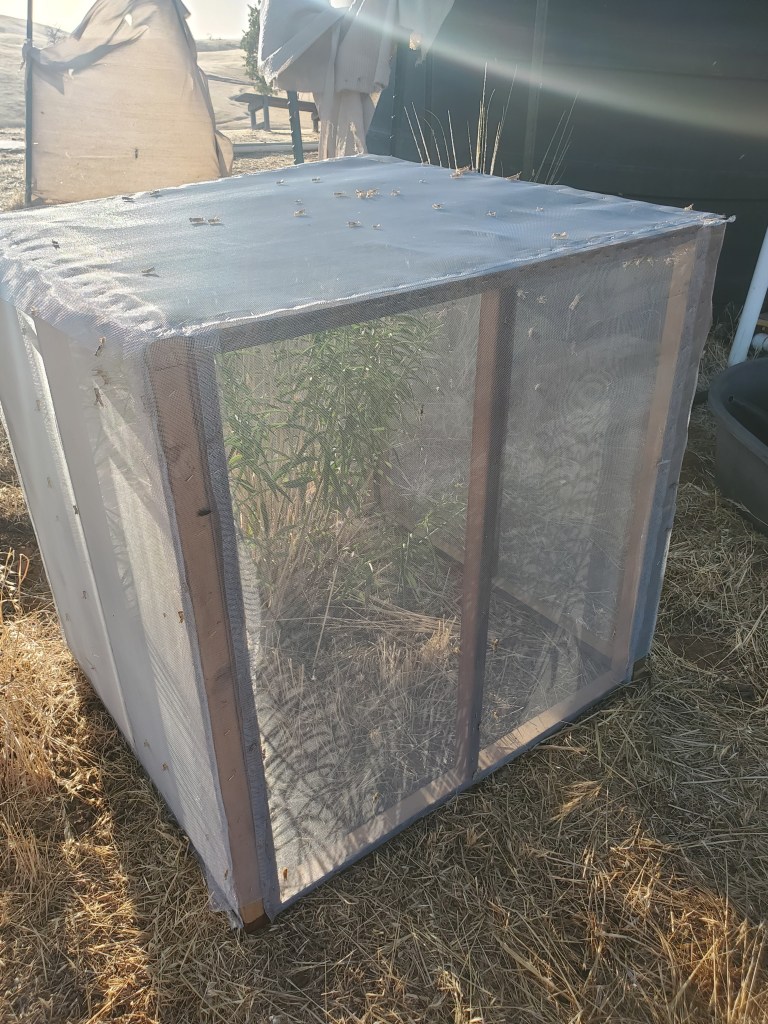
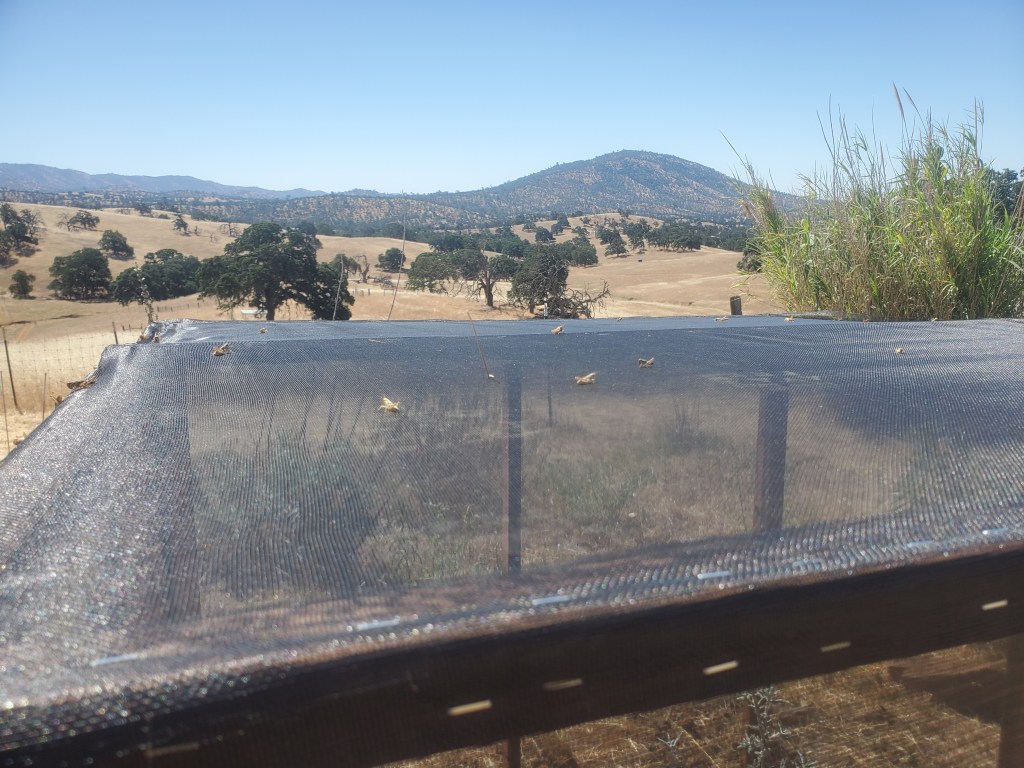
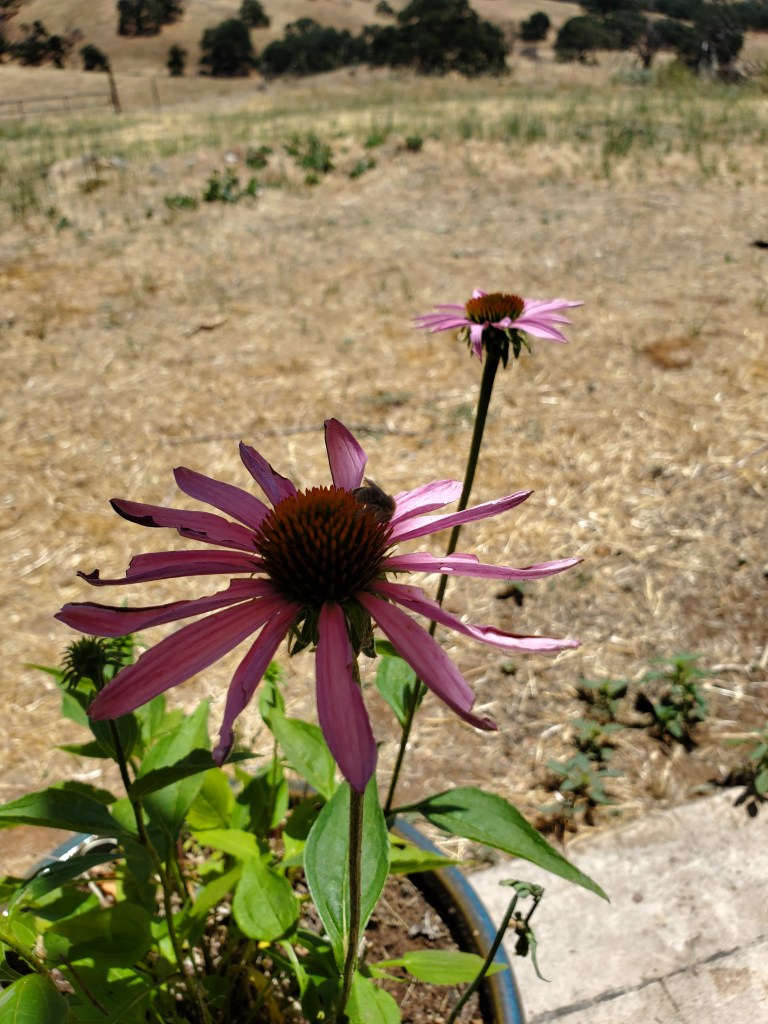
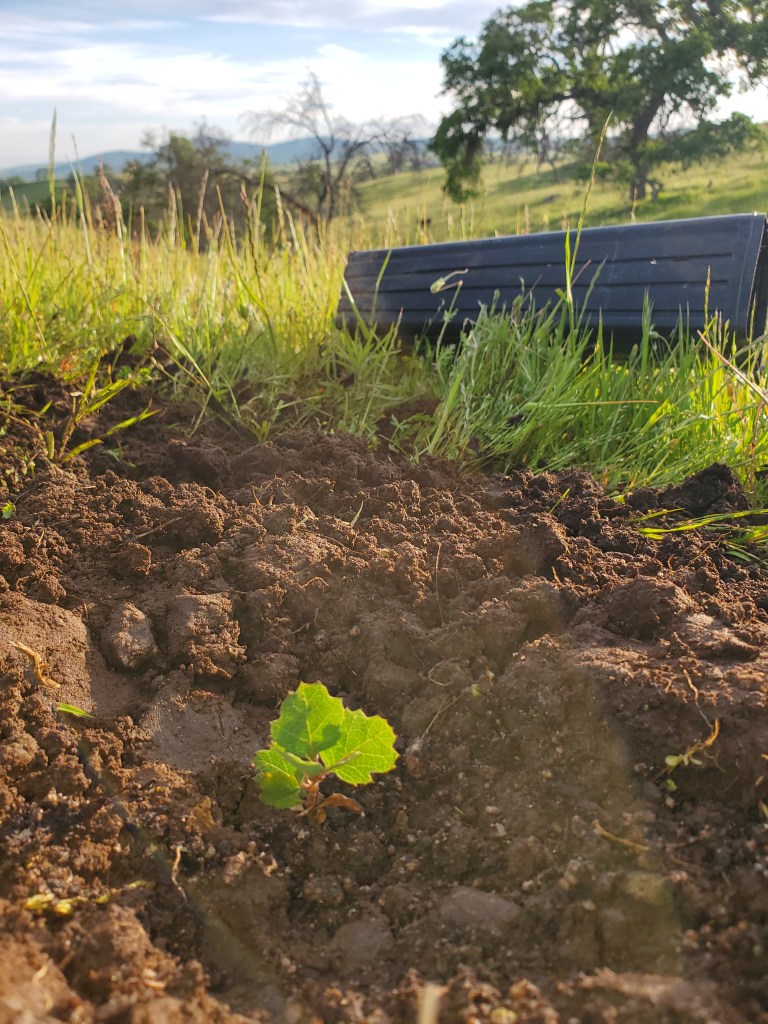
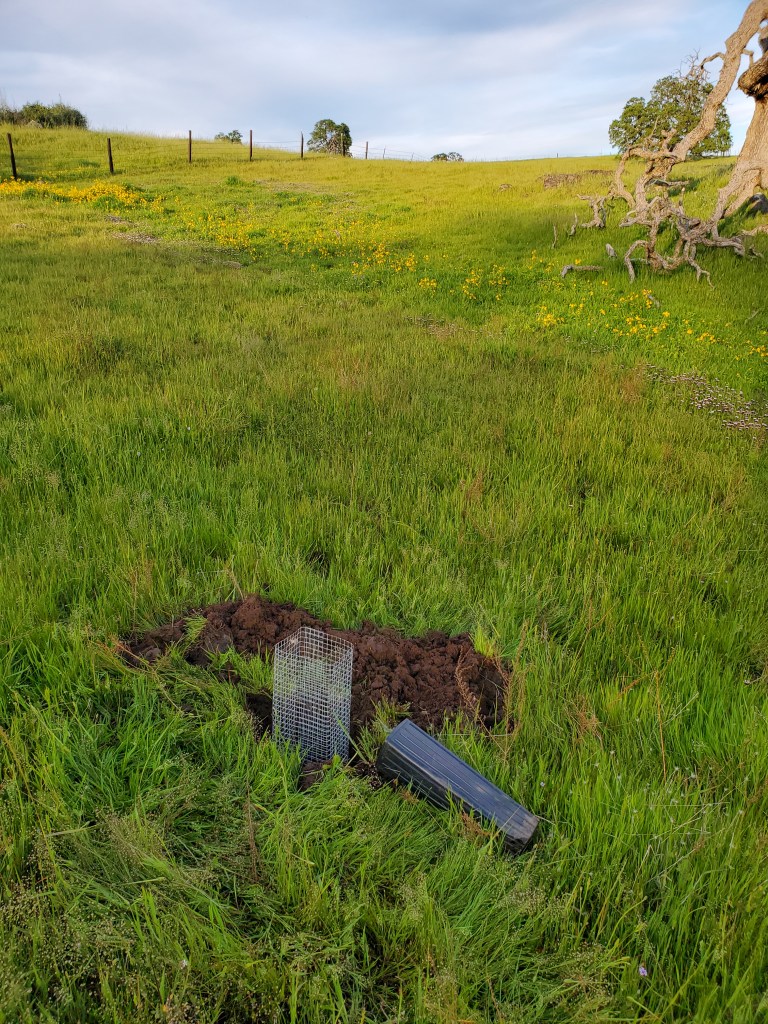
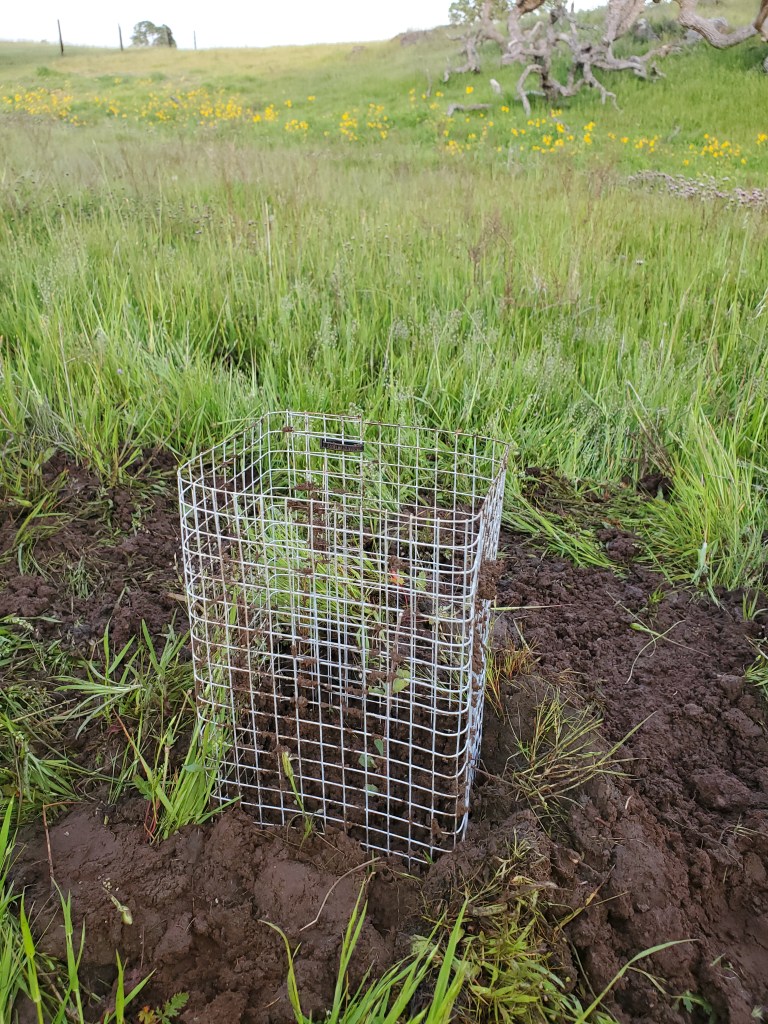
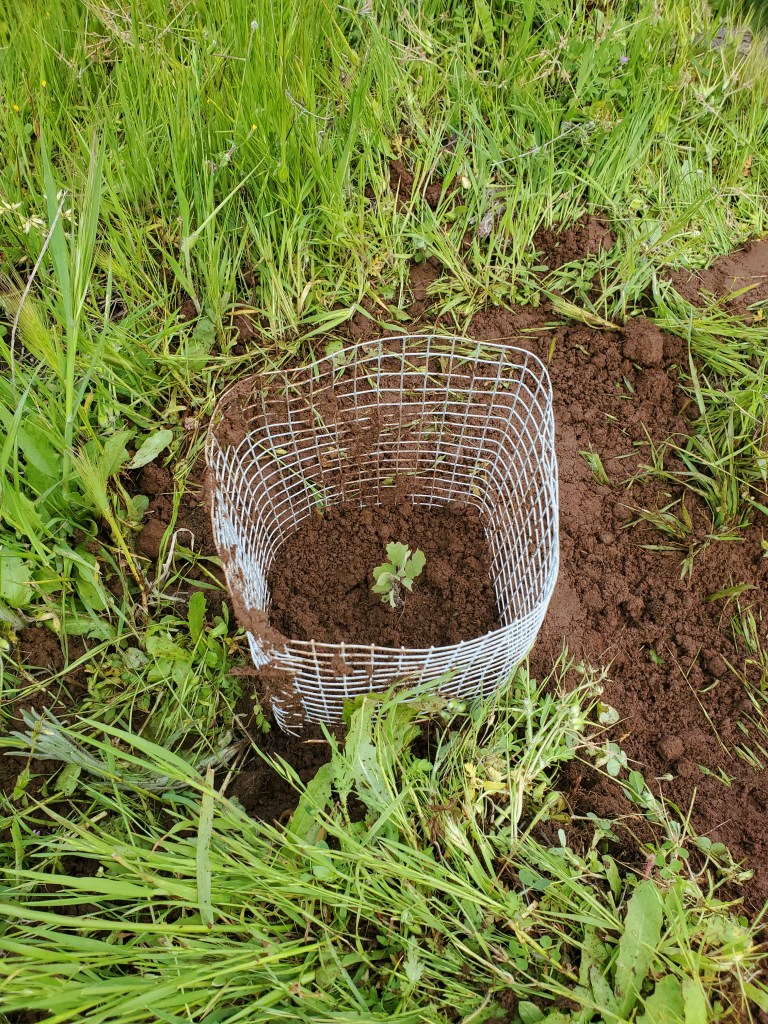
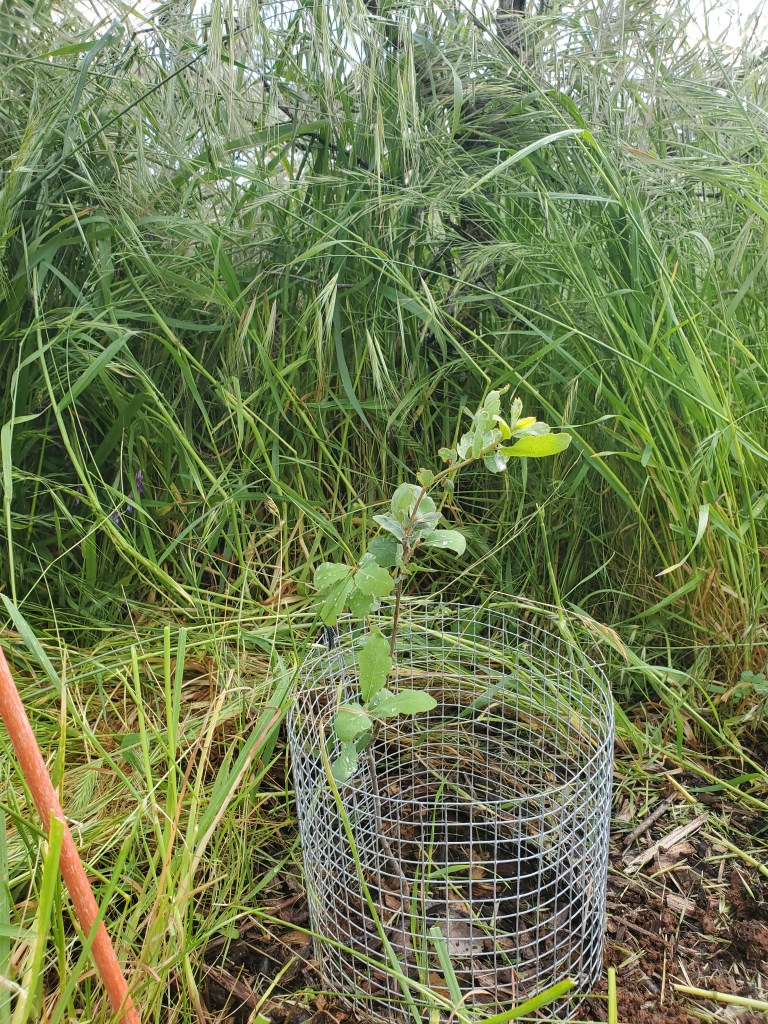
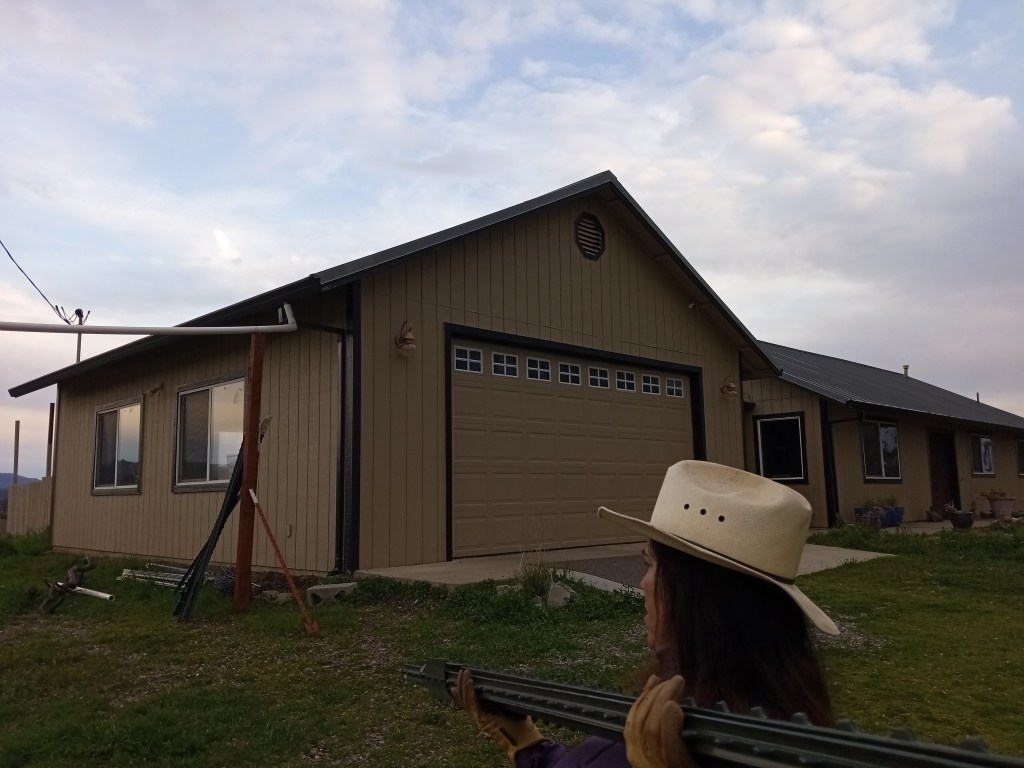
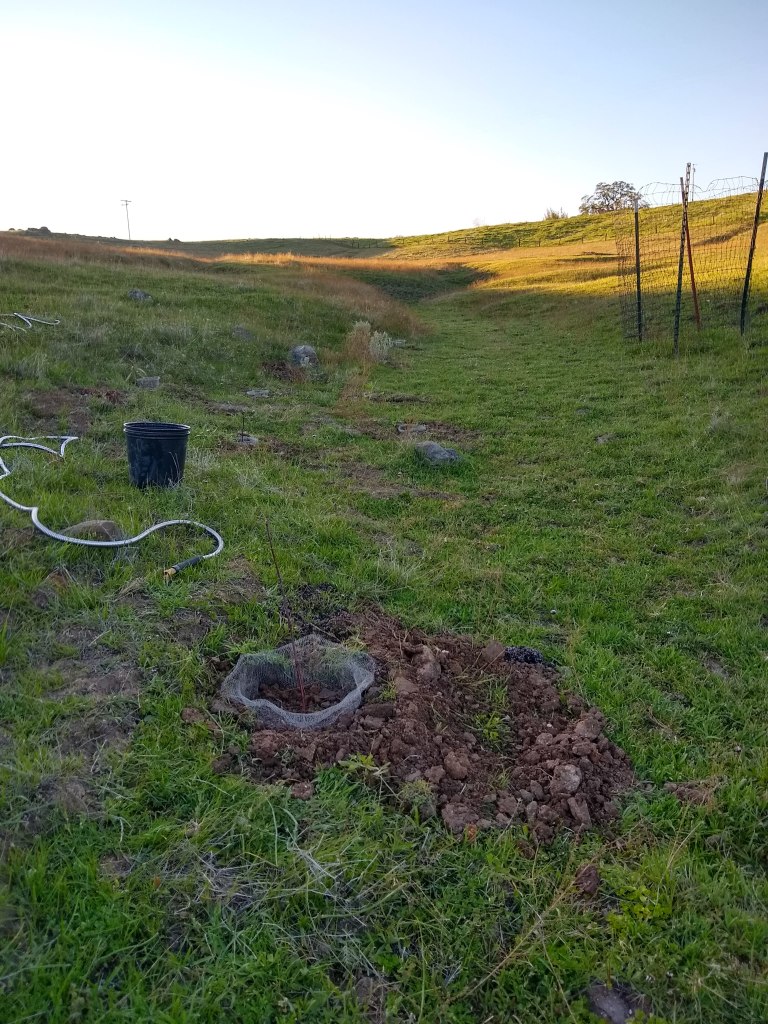
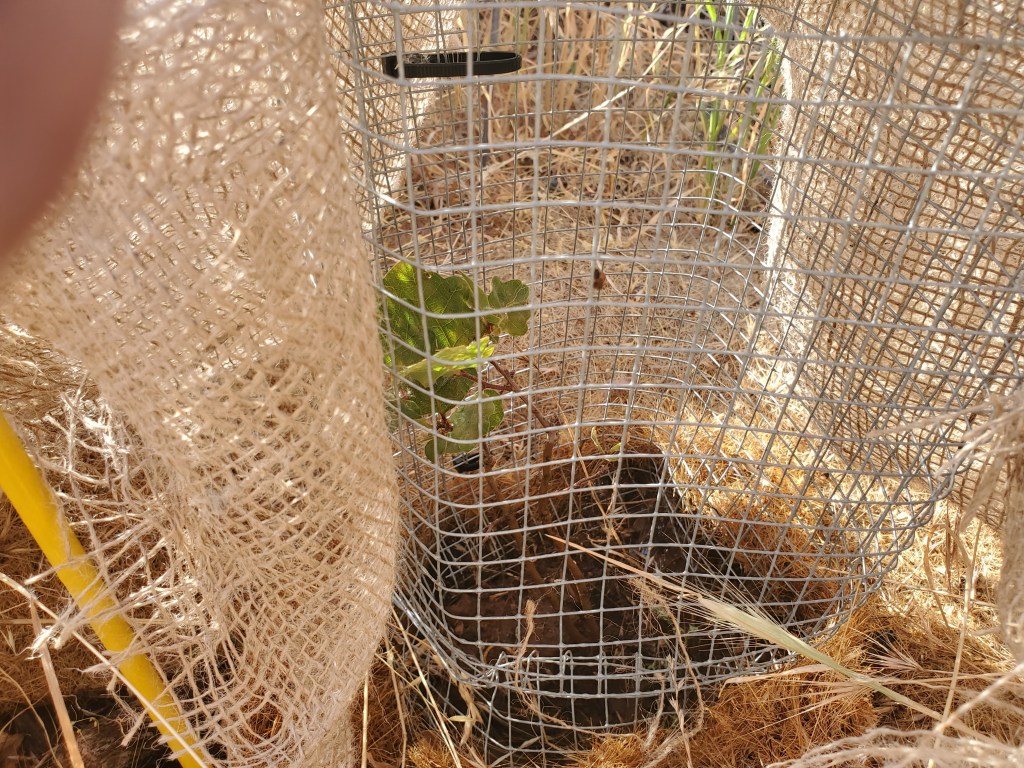
Except…this year, I am more ready – busted thumb and limpy leg and all. As soon as I saw some bites in the oak seedlings by the creek. I had David purchase aluminum screen. He began to make little screen houses to go over the gopher cages in which the oak seedlings were planted as well as other screen boxes for my pollinator plants. The poor guy. He is doing so much. I am getting better, little by little, but still cannot perform most of the ranch work I need to get done. David also has his paid work to do, which has been extremely busy of late. To enable us to get what we need done in the timeframe it needs to be done, I decided to hire someone to help us on the ranch, and to give poor David a break.
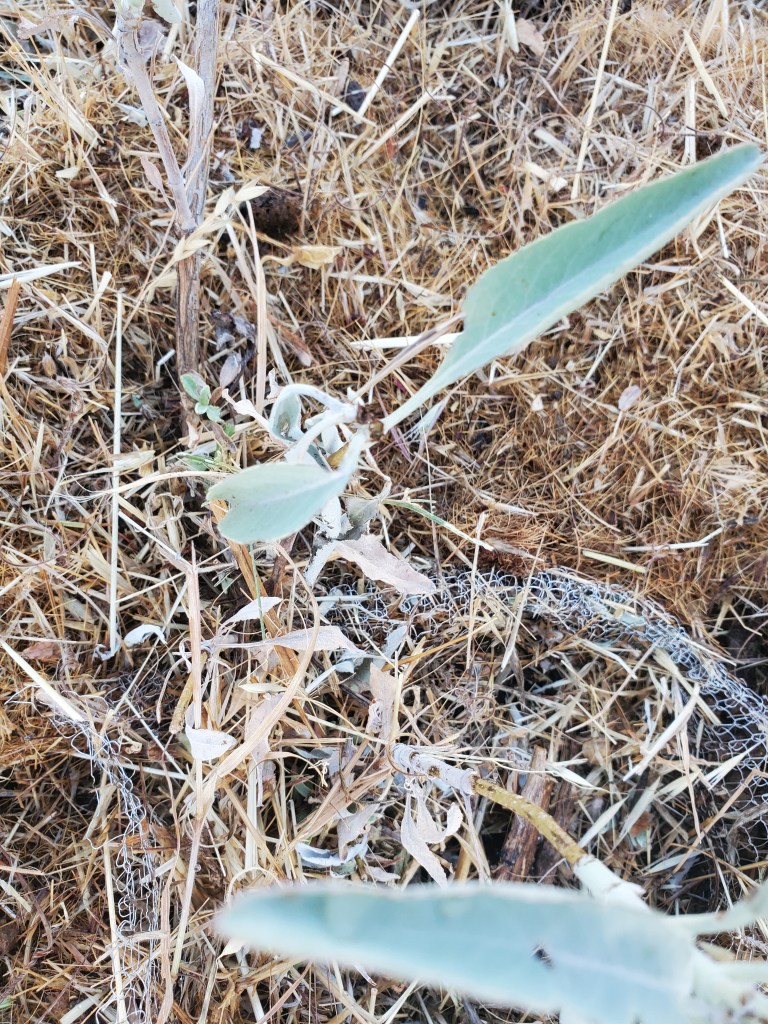
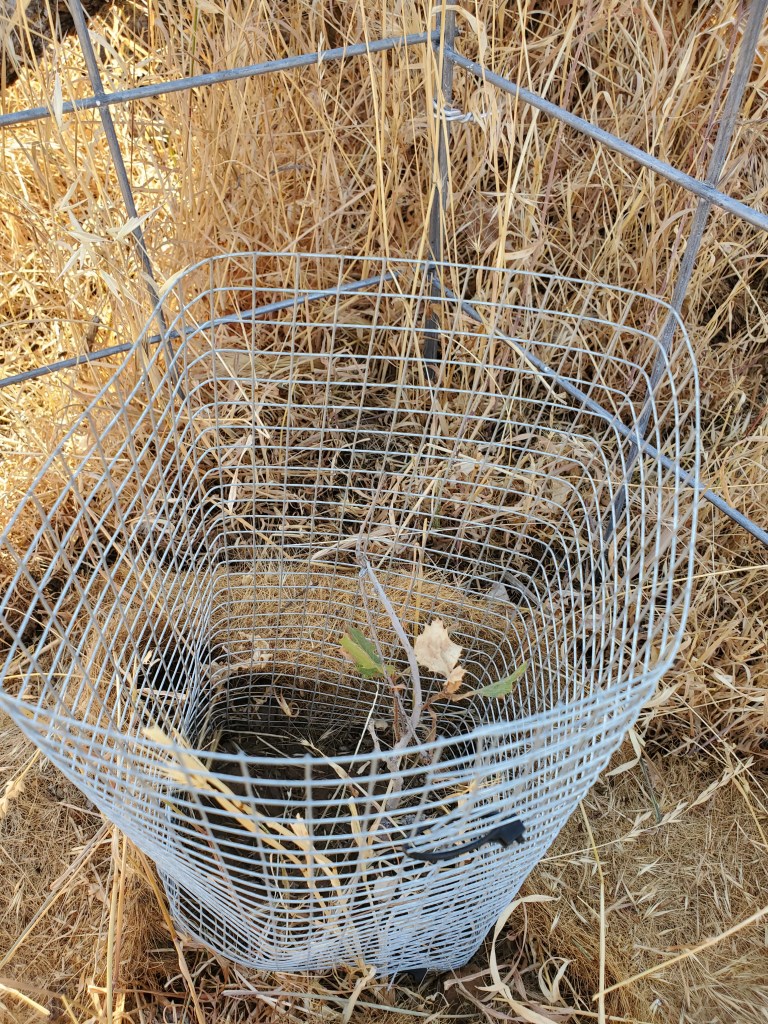
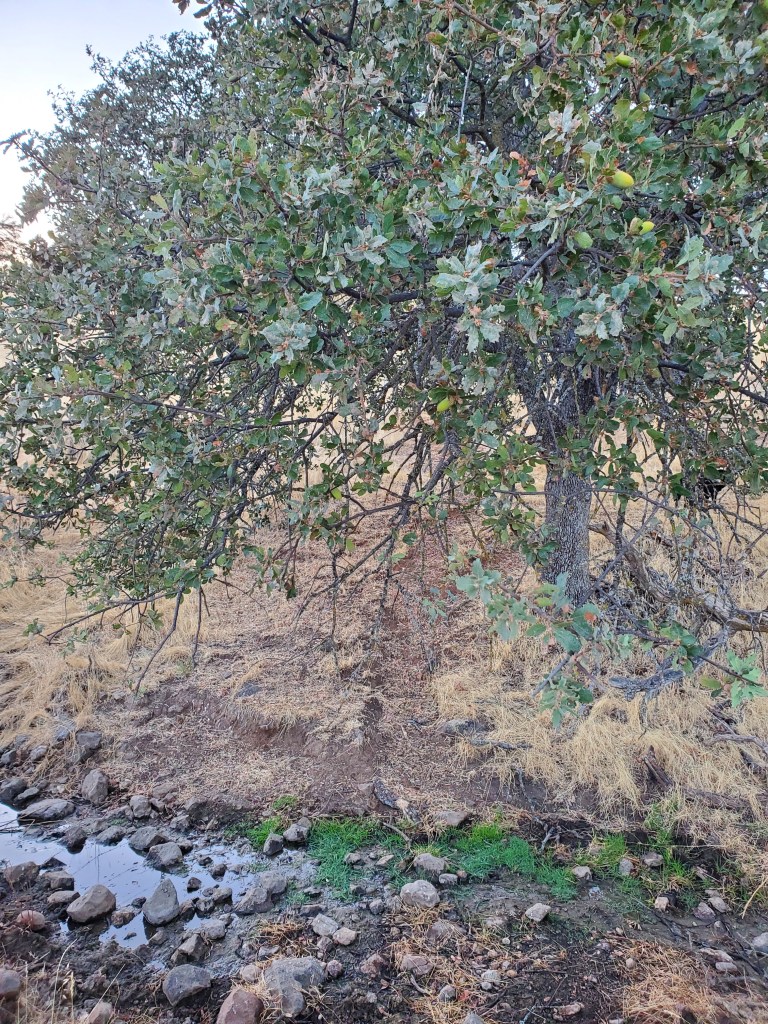
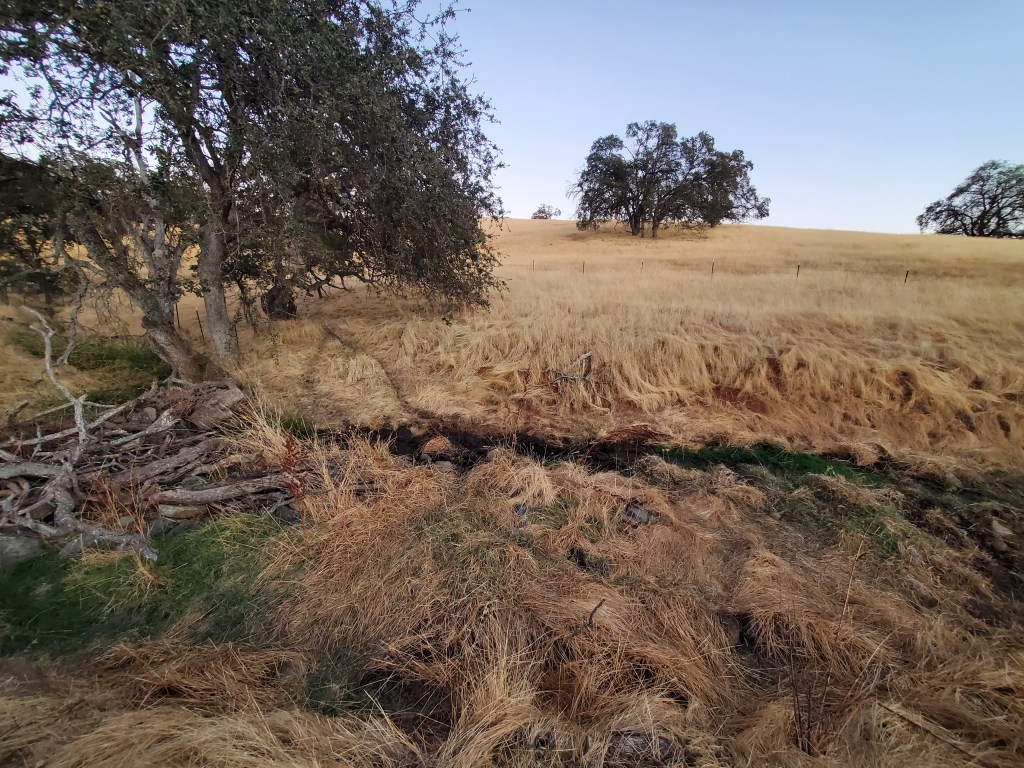
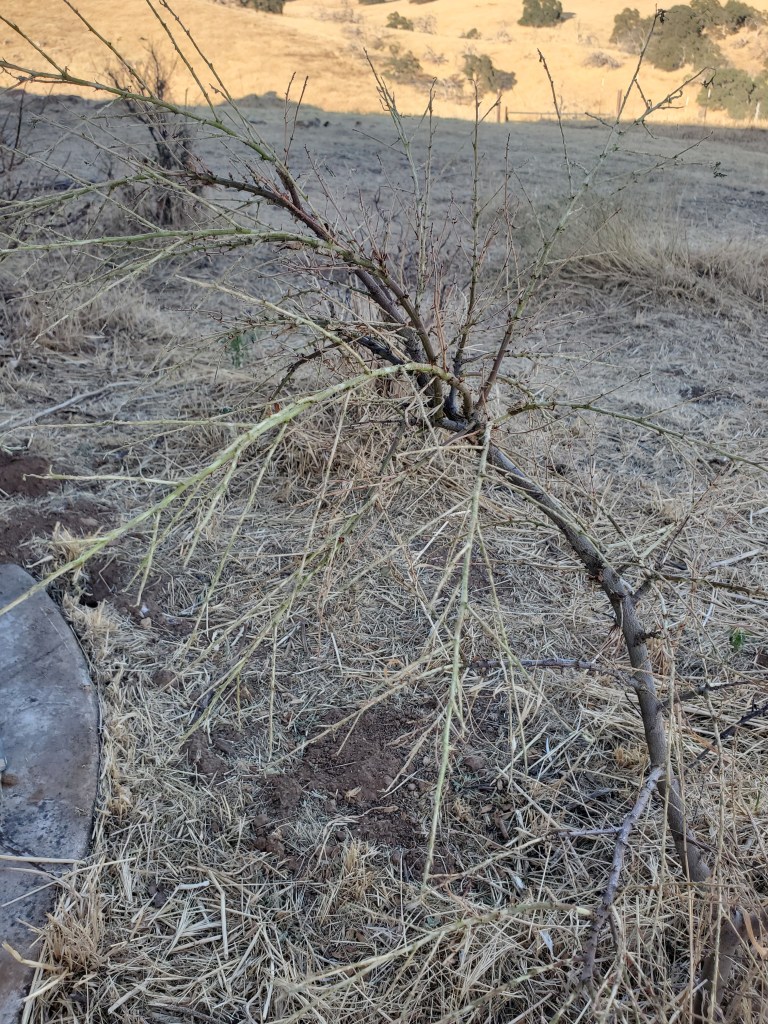
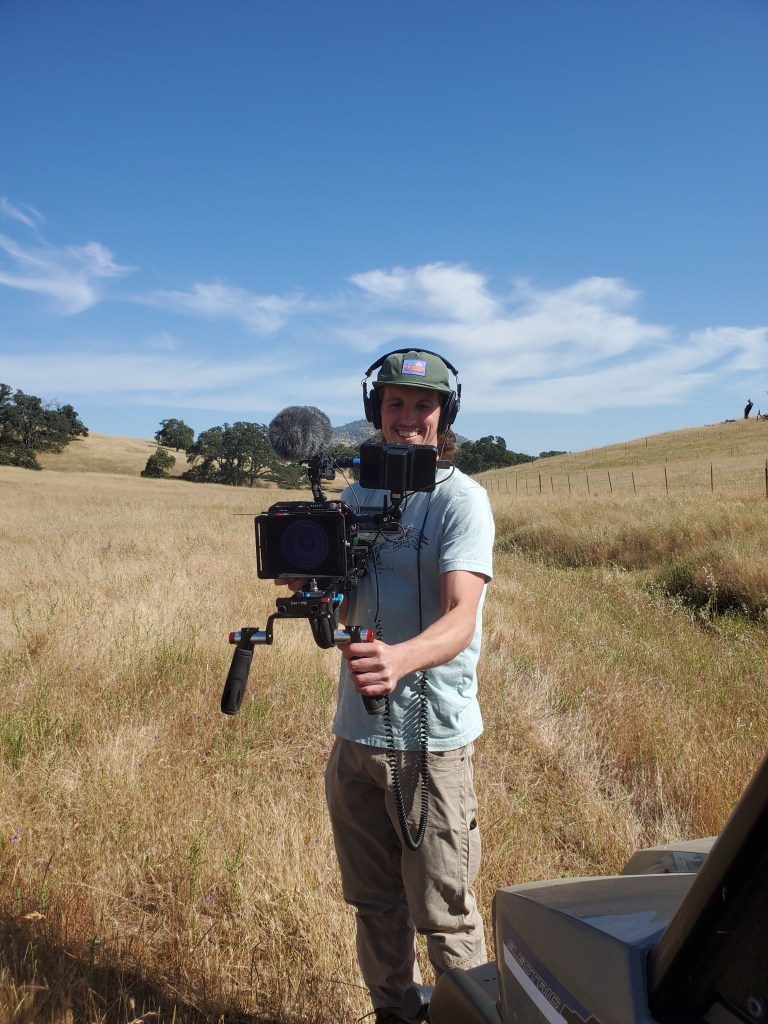
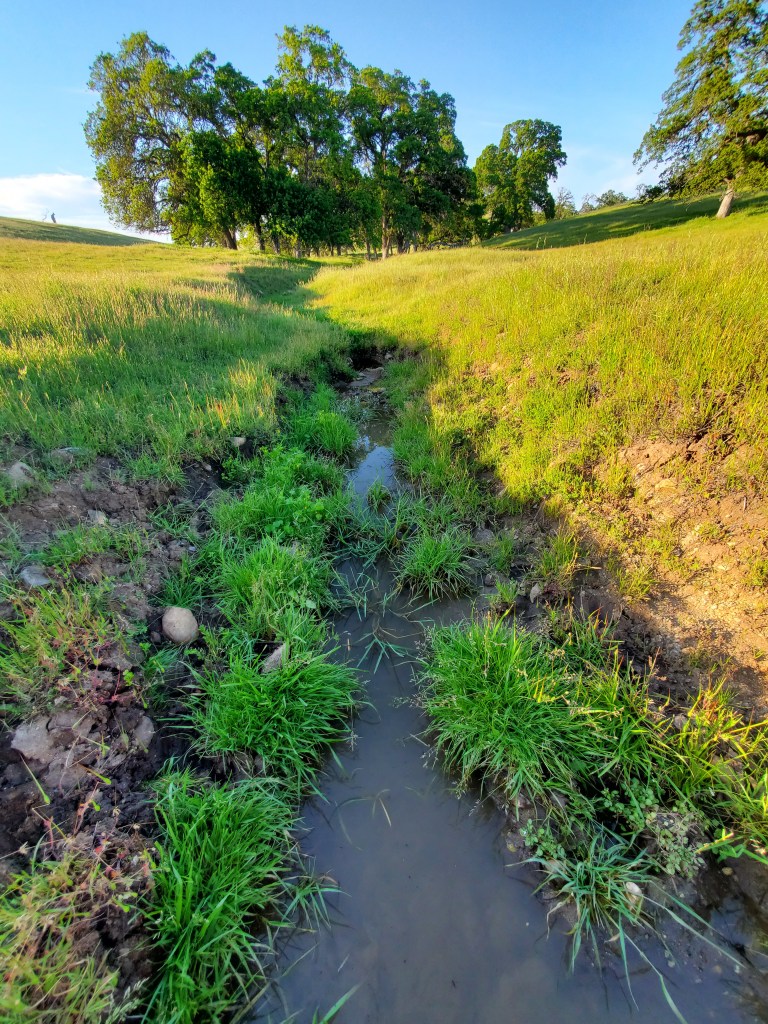
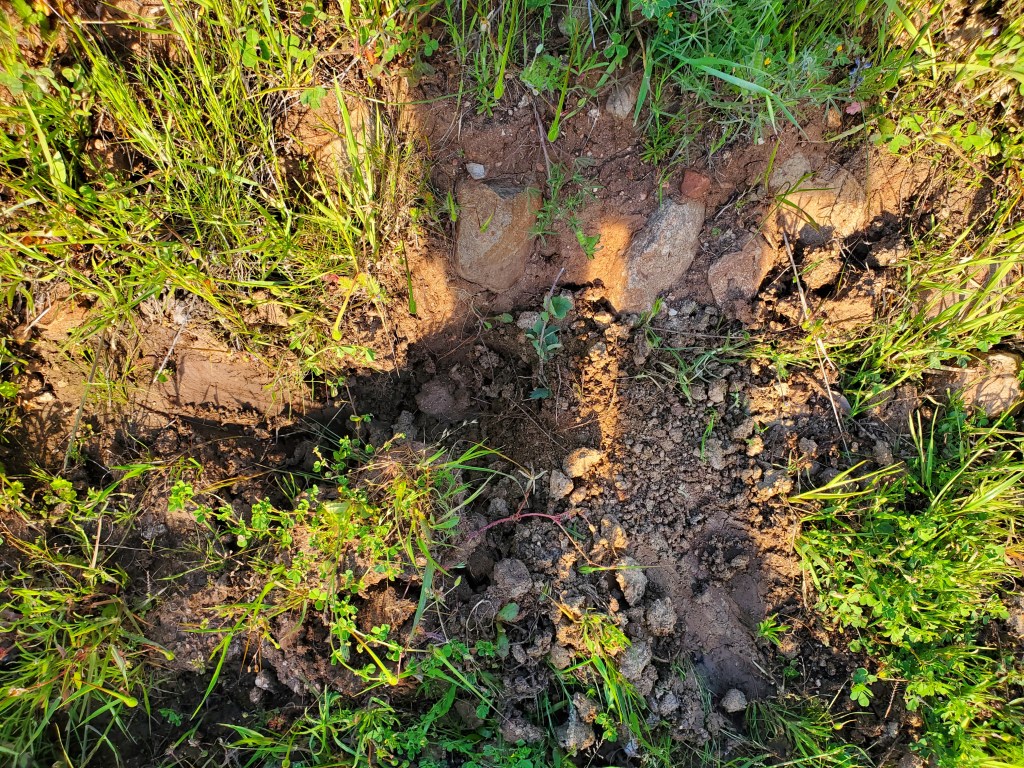
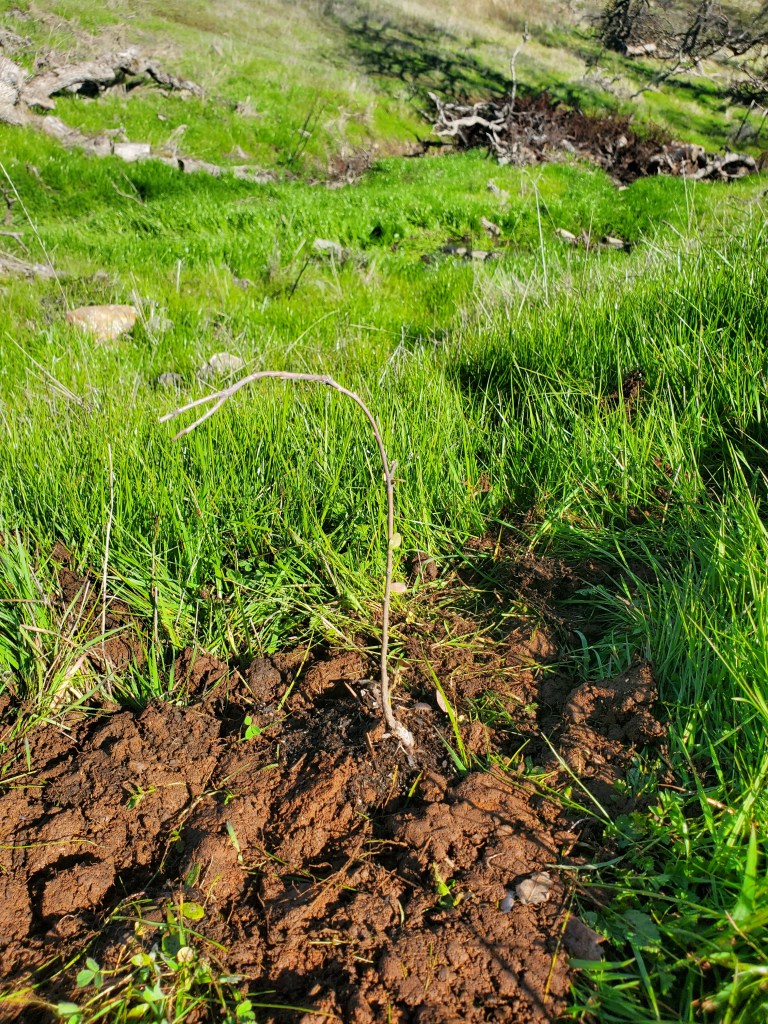
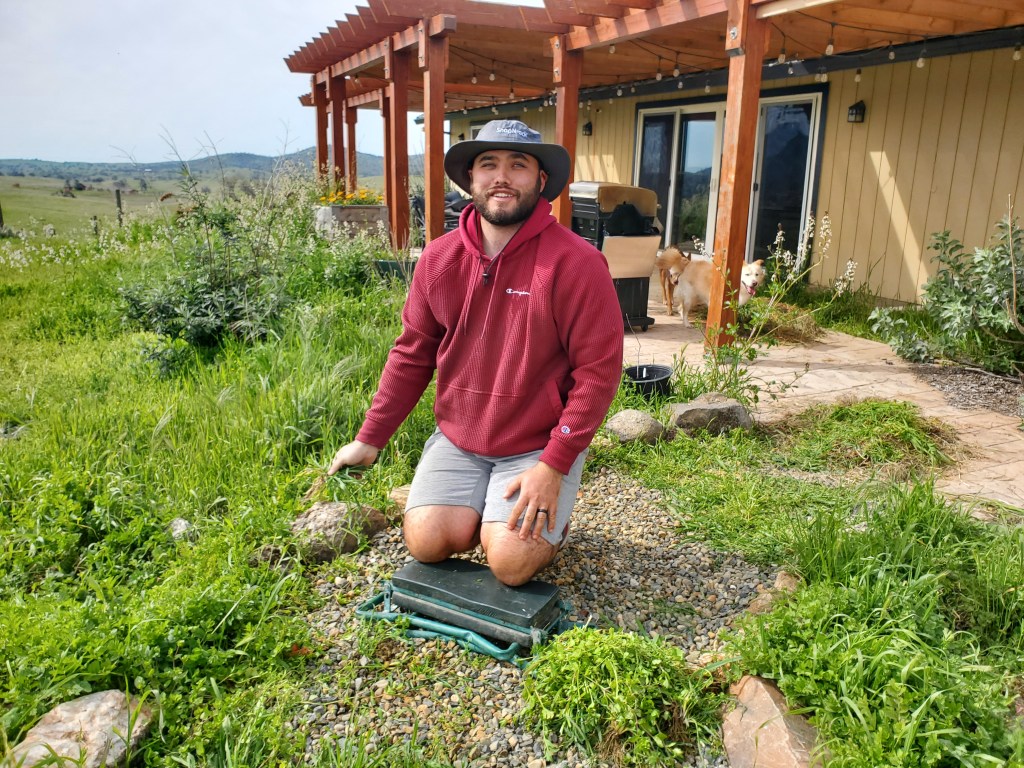
I put out the word I was looking for someone, and a friend, Jeanne Ann, said she had a grandson who was looking for work. His name is Sam. He jumped in and did weedeating freeing David to help with the oaks. We began placing his boxes and found that the two oaks at the downstream section of Spring Creek were already eaten. I lost my breath. I was horrified. When I looked closer, I saw that the bark had not yet been eaten off, like last year. Maybe there was still a chance. We covered and watered them anyway in case they were able to survive.

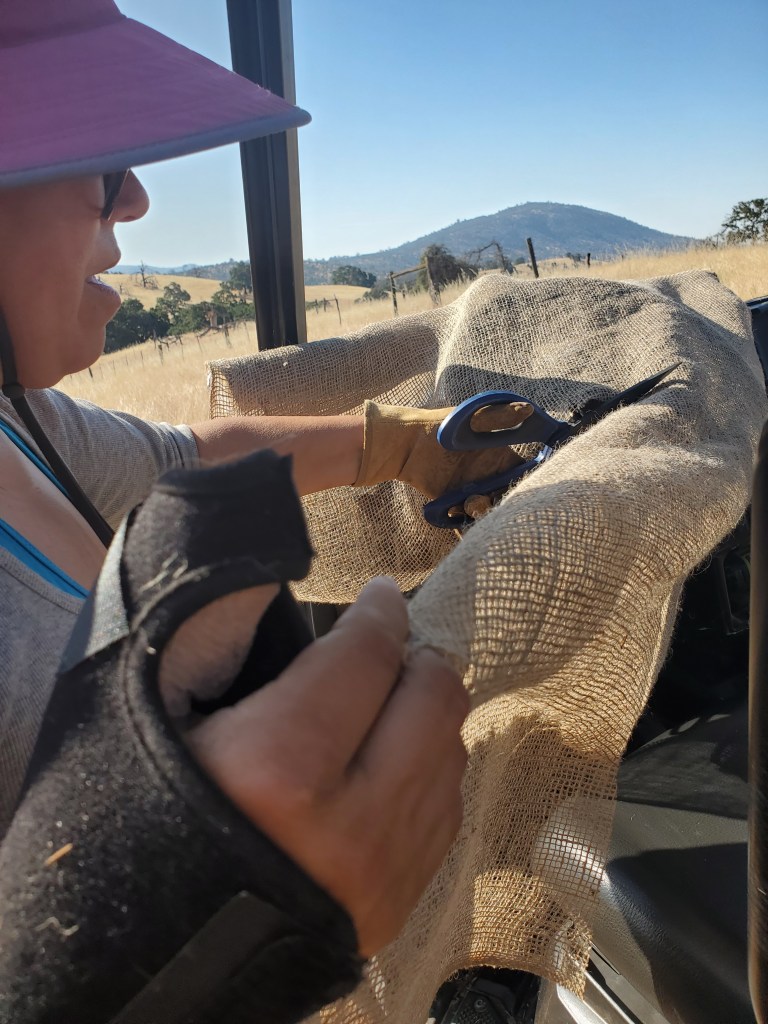
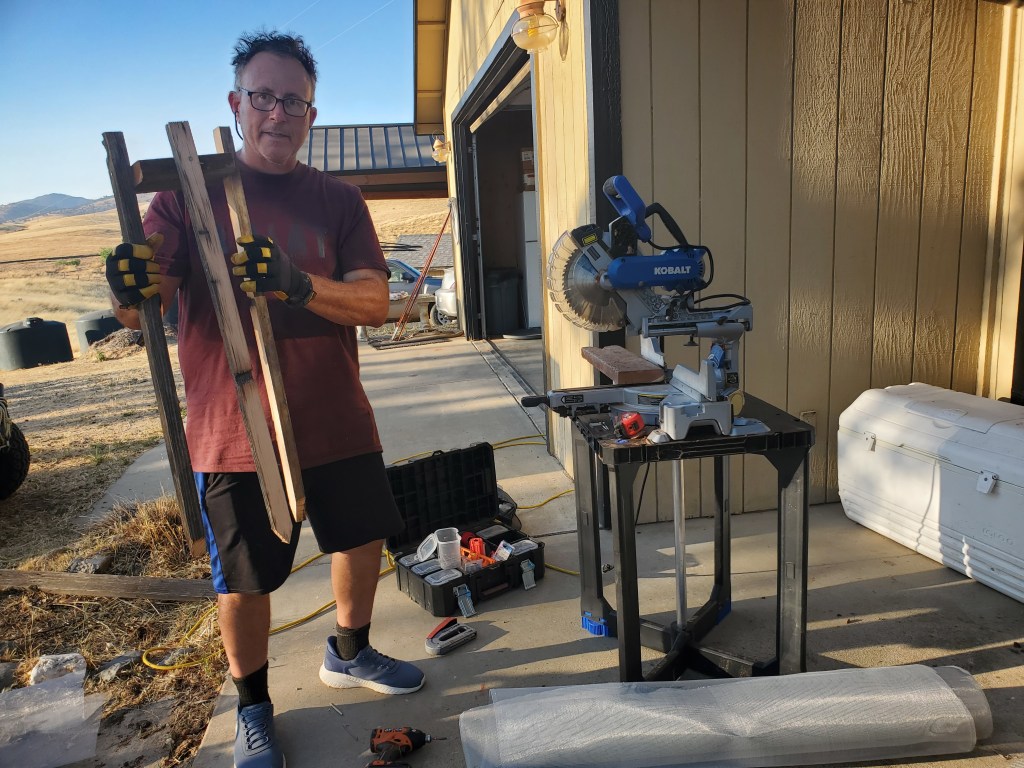
Then, a major issue happened at David’s work, and he was on a service incident for the entire day. Work stopped on my oak and plant cages. With my injuries, I was not able to do anything. I asked Sam if he knew how to build and use carpentry equipment. Turns out, he has done building before -so he had knowledge. He jumped in and innovated on David’s design and began pumping out screen boxes. Thank you Sam!!
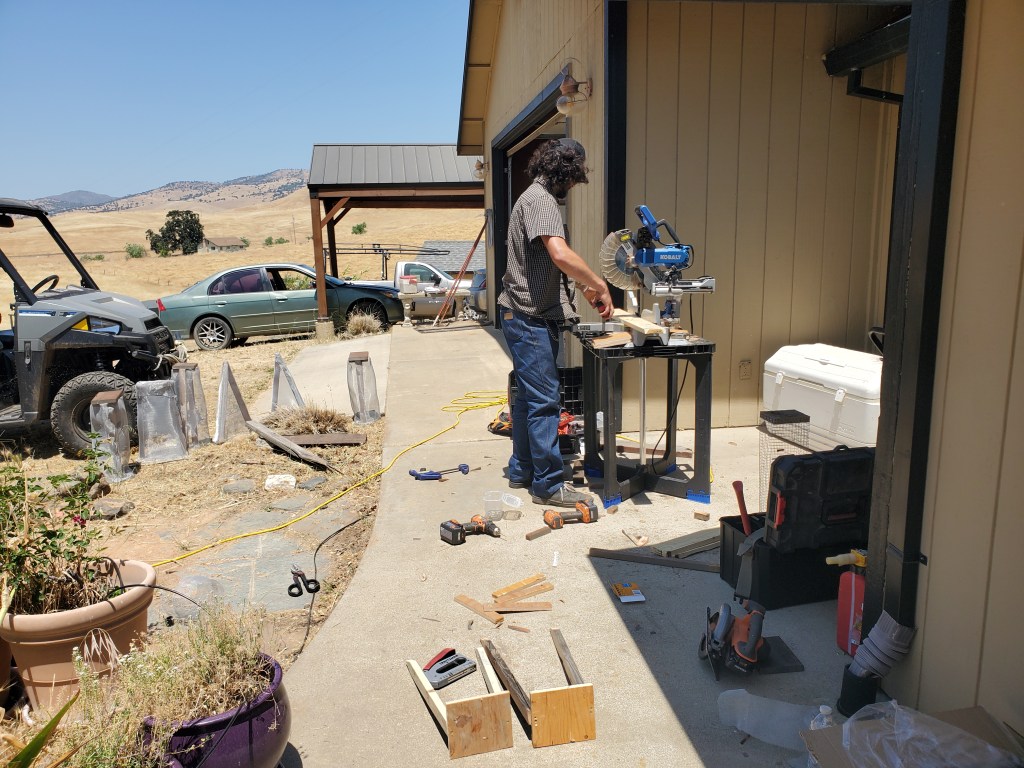
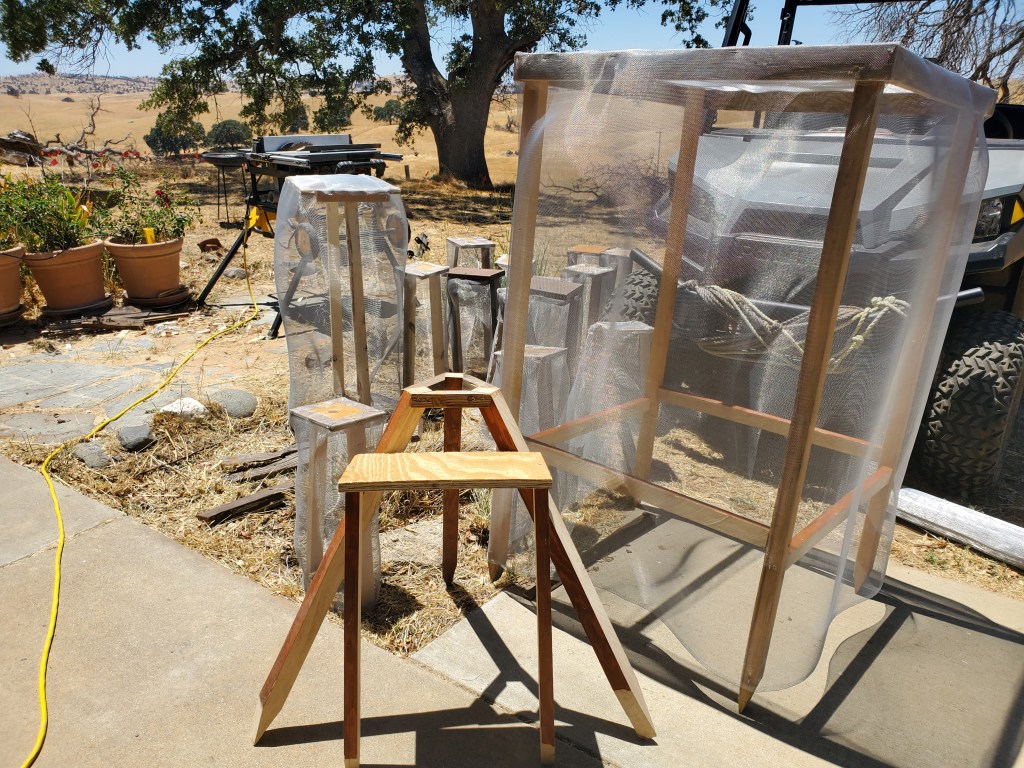
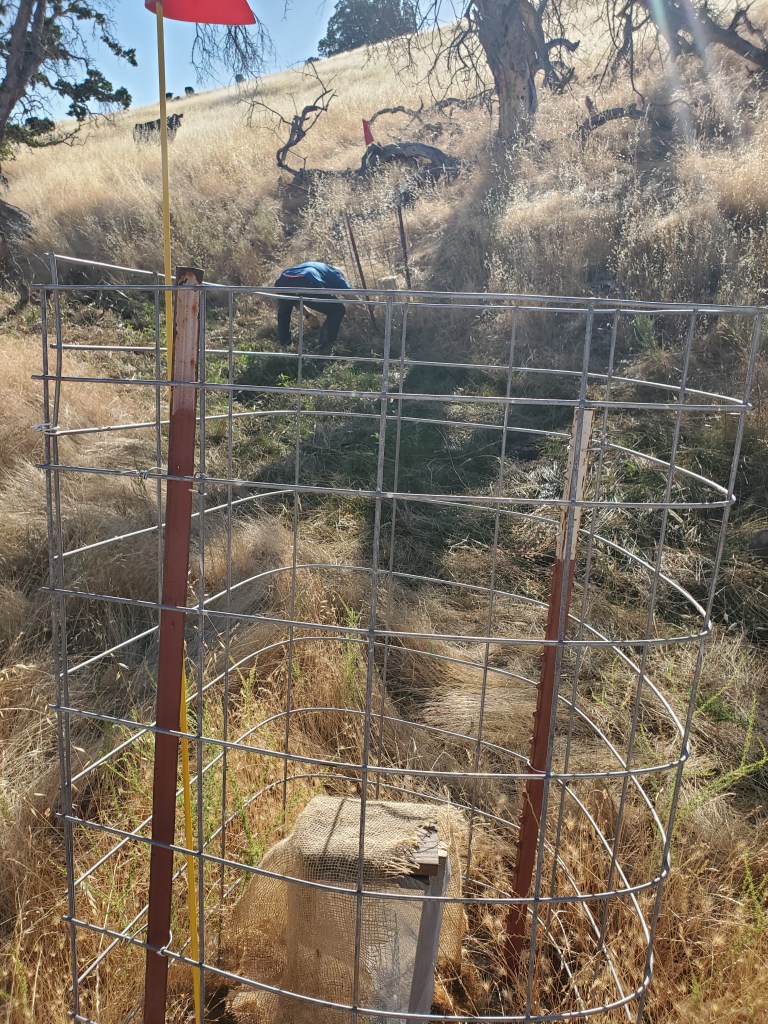
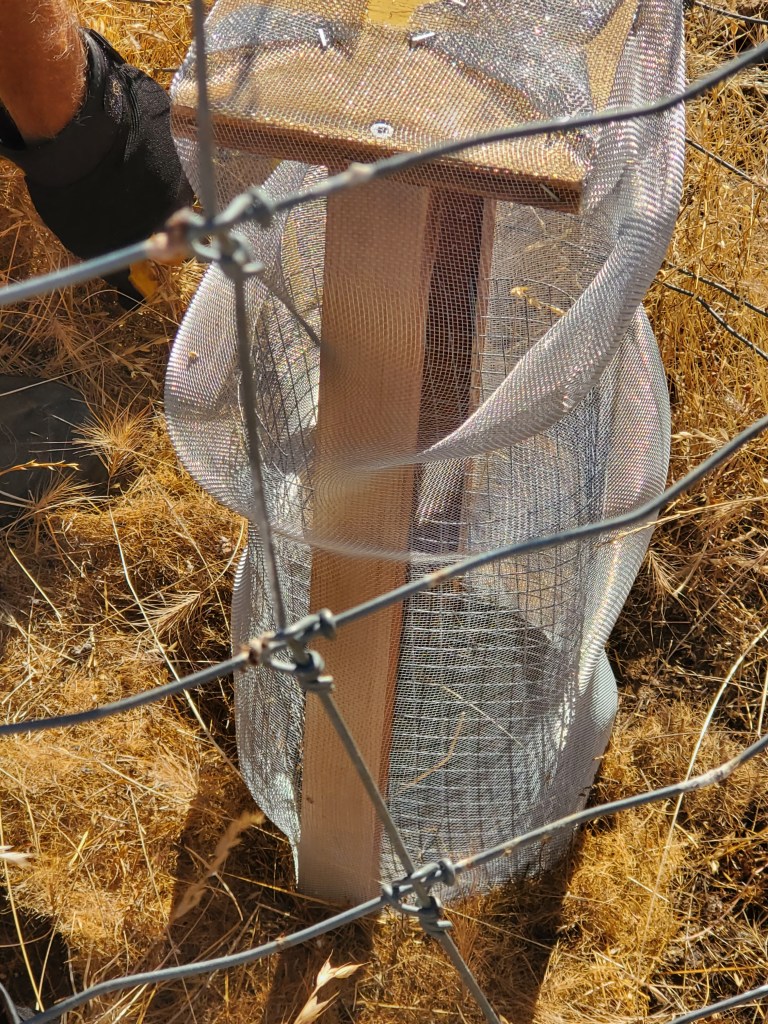
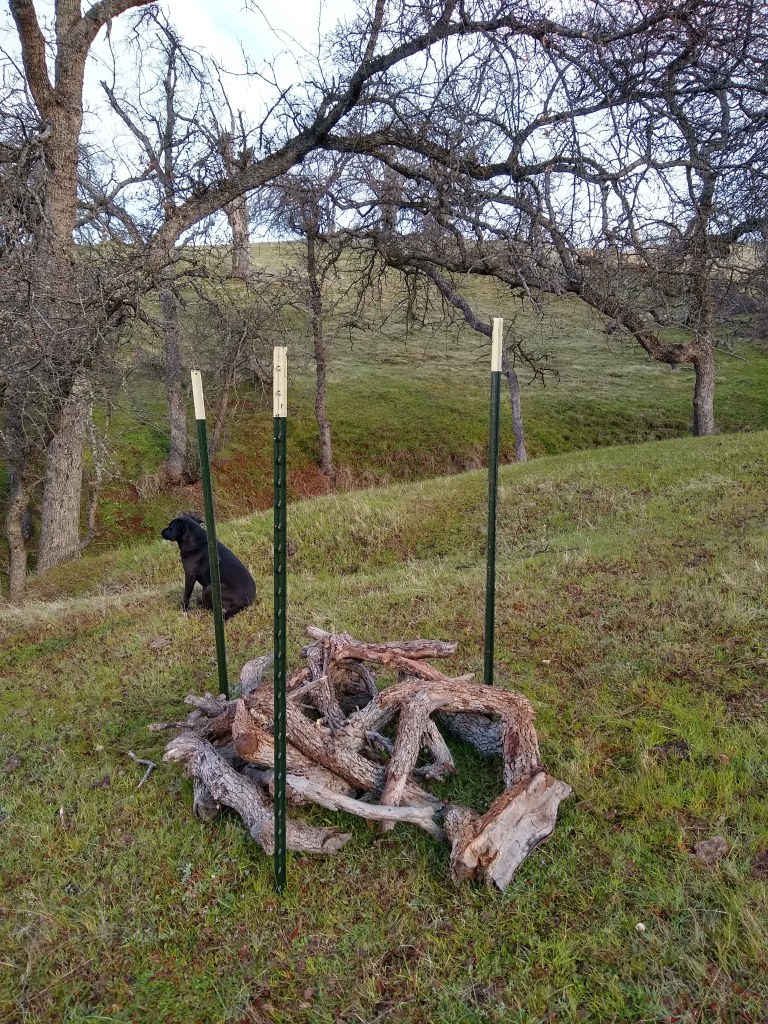
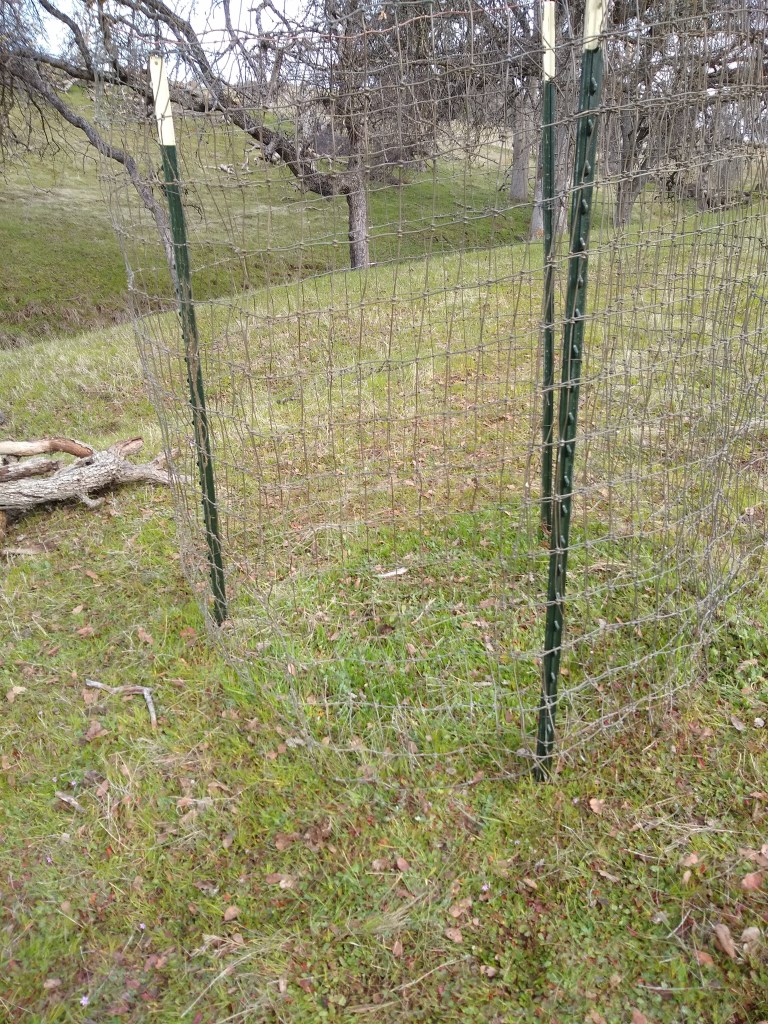
They are designed to have a wooden top to give it weight and an attachment point. There are two stakes (cut on the table saw from scrap wood) attached to the wooden top. They are nailed in at an angle to help with going over the cage shaft. Screen is measured to just fit around the gopher cage shaft. The screen is wrapped around the wooden structure and stapled.

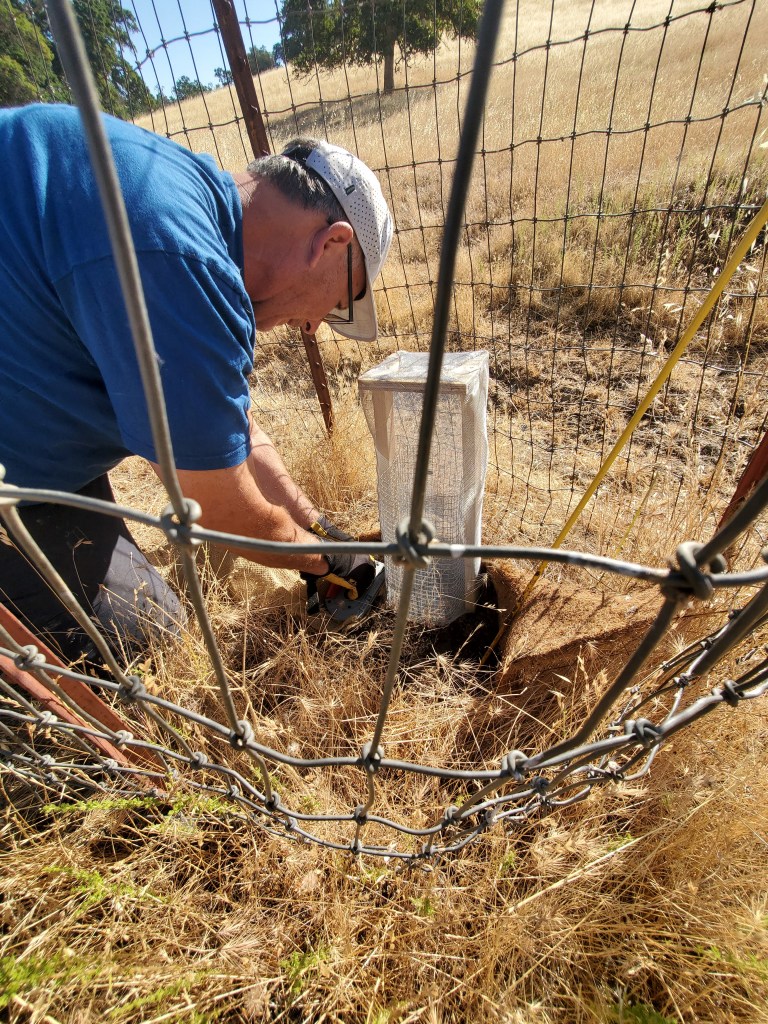
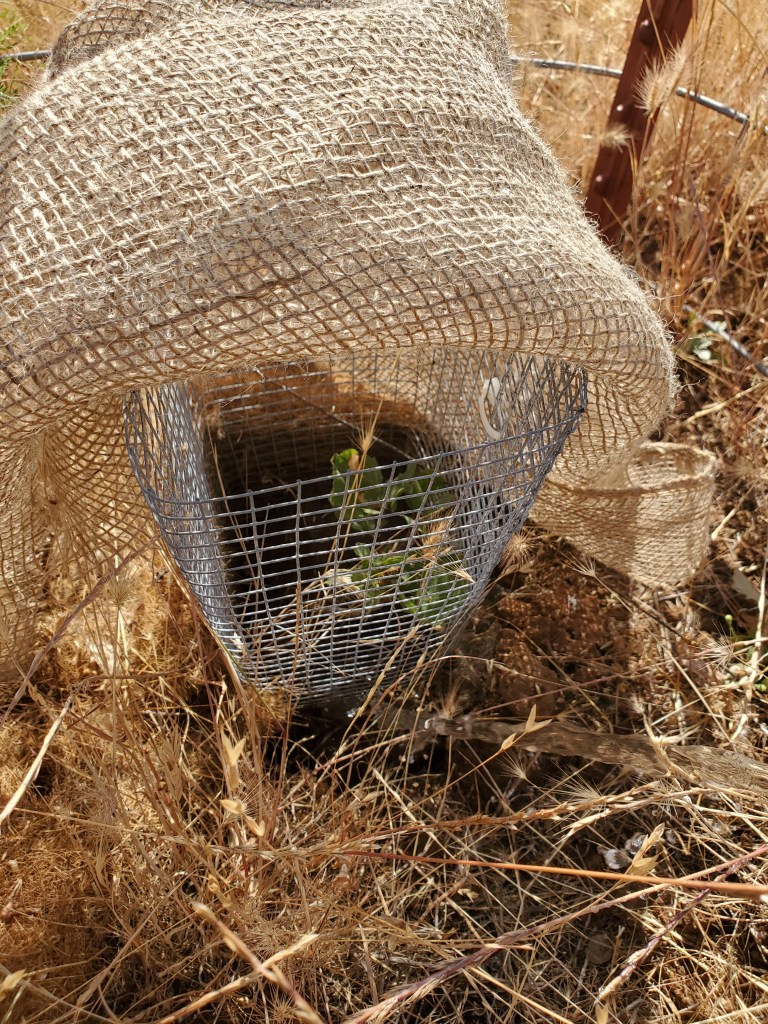
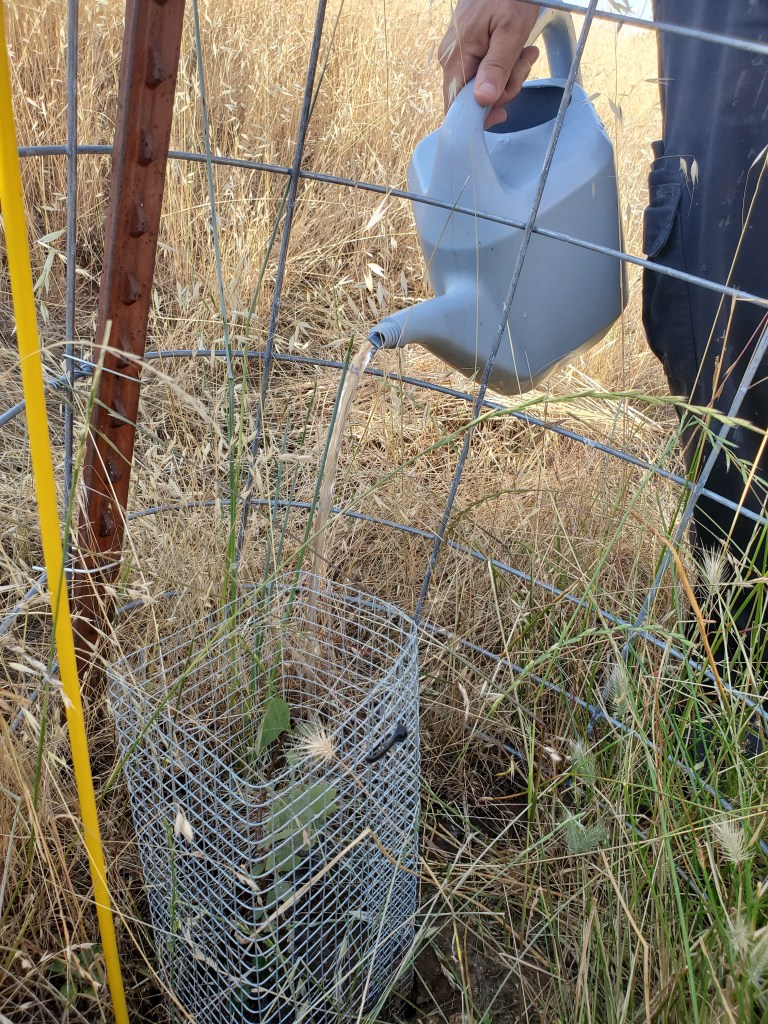
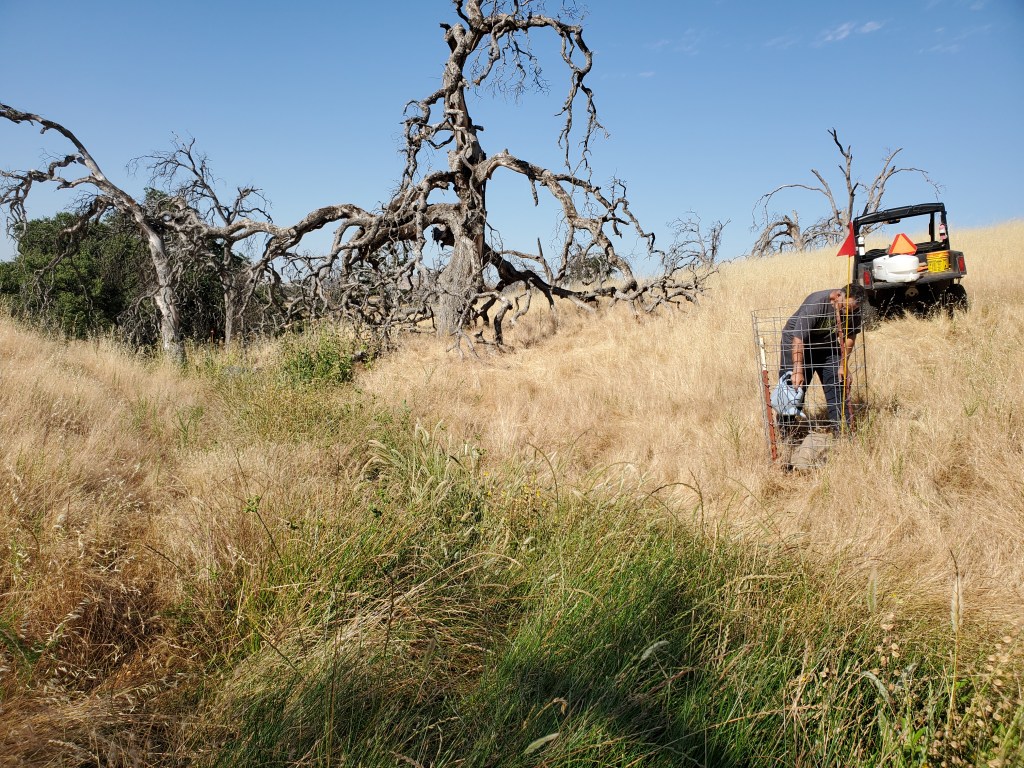
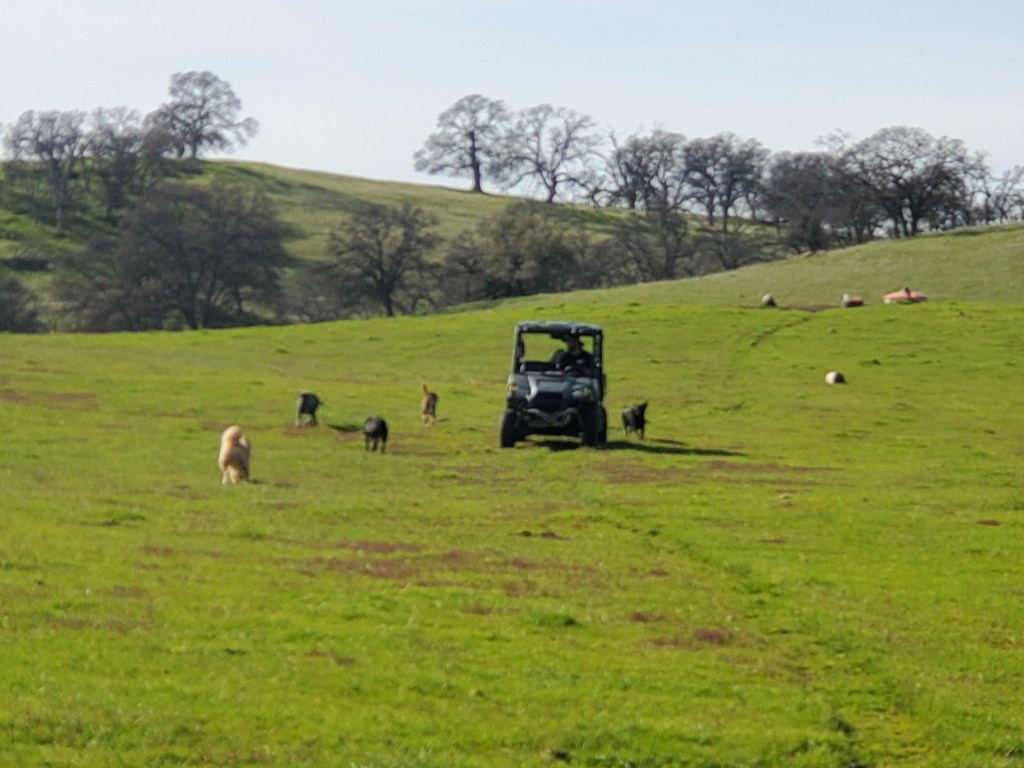
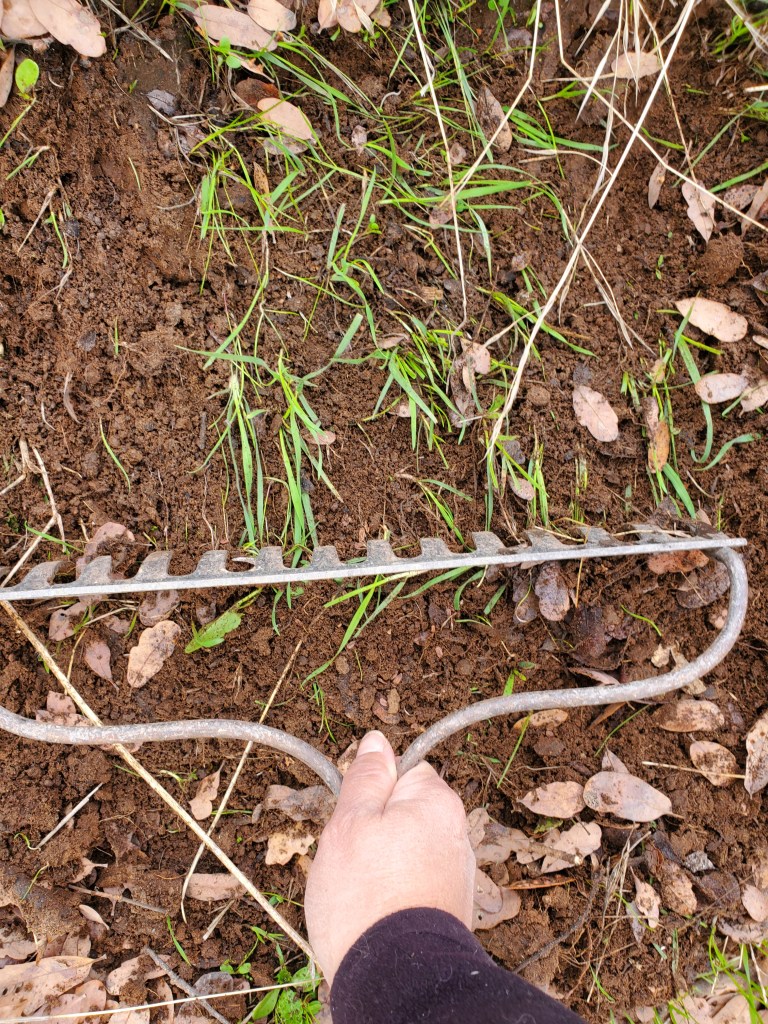
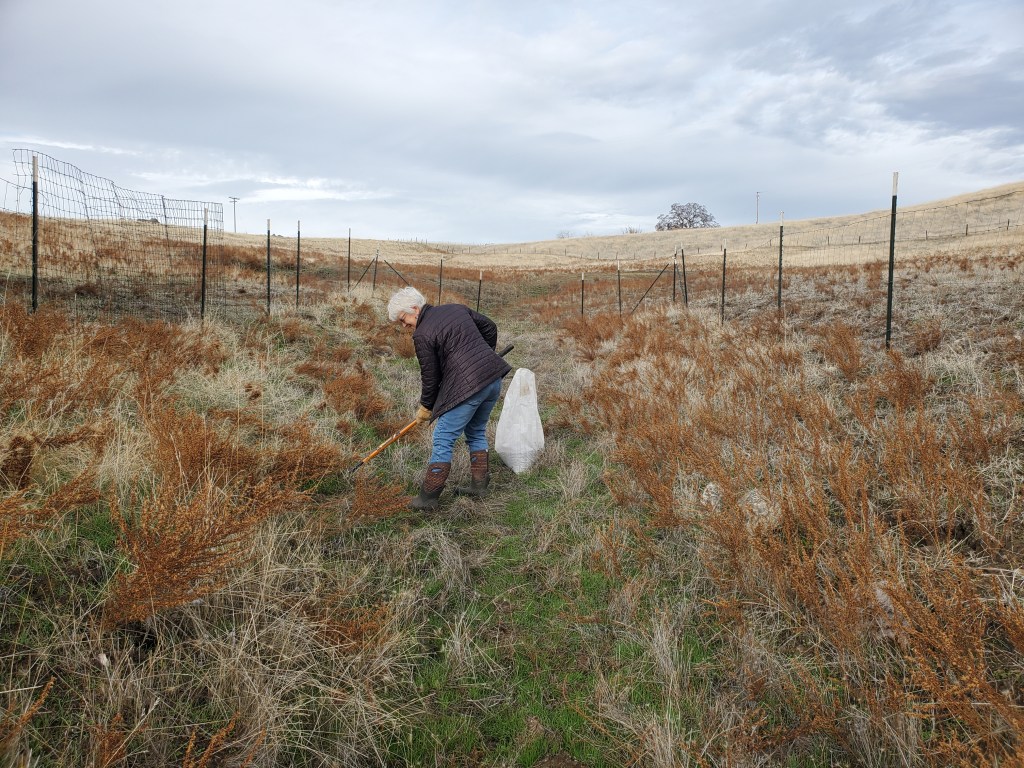
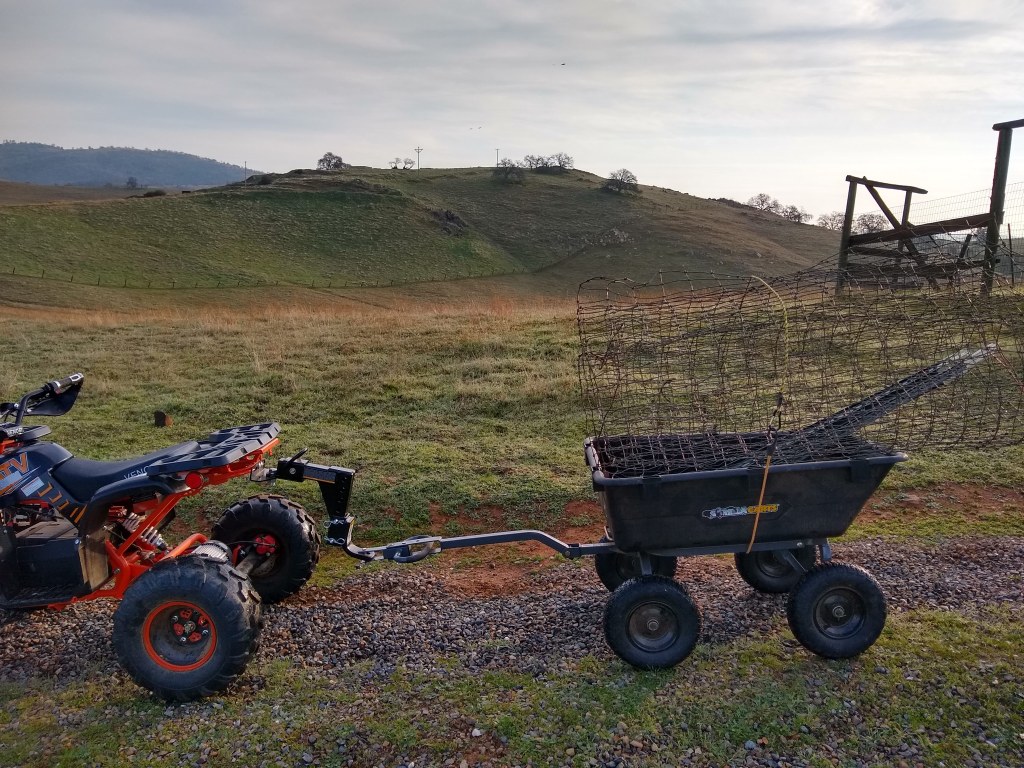
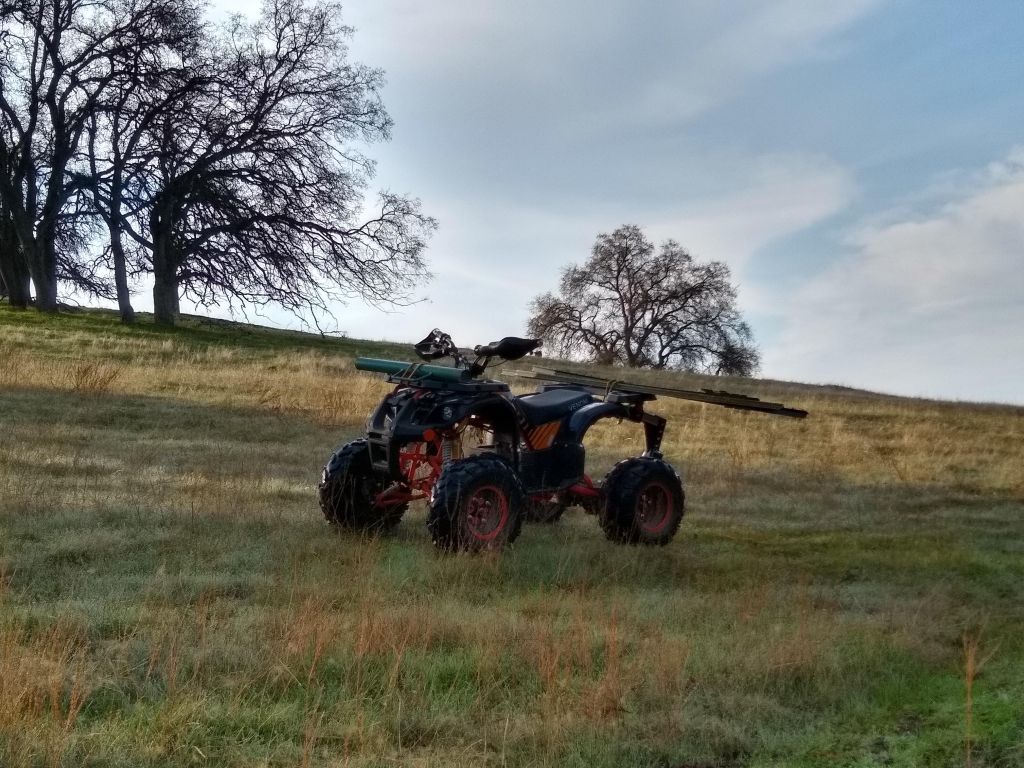
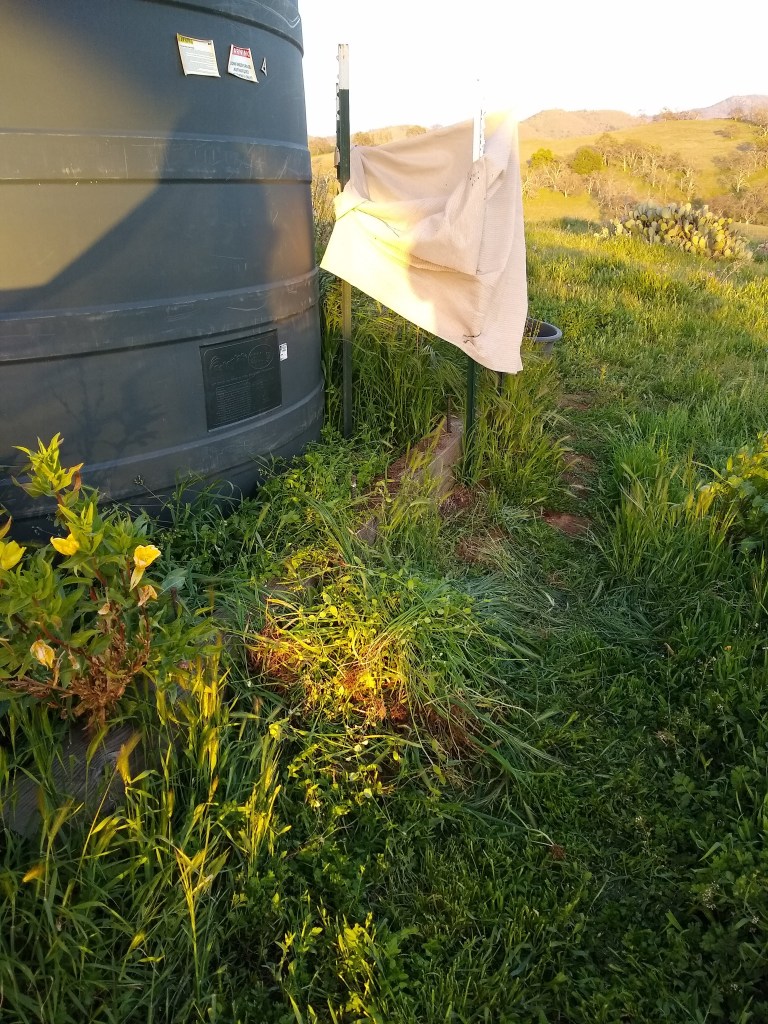
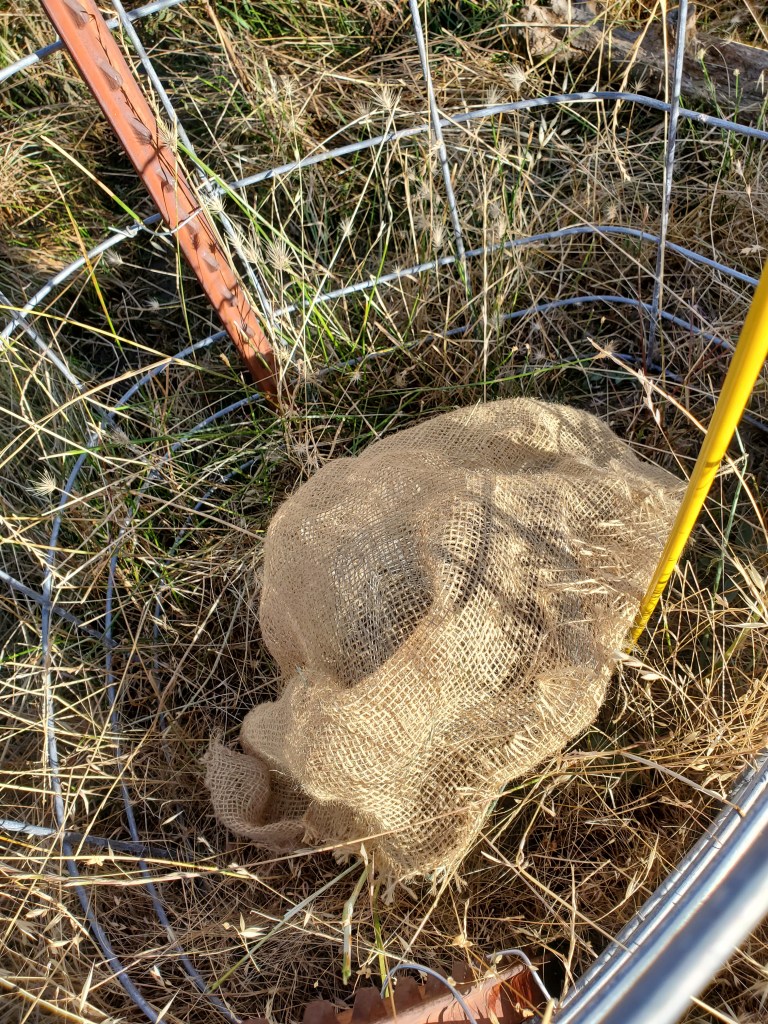
To do this takes time. The trees by the house got their boxes first. Then more needed to be built. Sam worked on the boxes while David and I placed what had been built. David could only work with me in short bursts because of his work schedule. It is laborious and very hand-oriented. You need to load water for the trees, load the boxes, the hammer, buckets and other tools to open cages or fix things. Then, you need to drive the polaris to the locations — no power steering. Next, you unload what you need, pull the huge, heavy tub with water toward the tailgate, unscrew the cap, hold onto the cap despite the pressure of the water in the large container, hold the watering can with the other hand or place on the ground, close the cap just right to prevent leakage (since you must have enough water for all the trees on your route.), haul the water, remove the shade burlap from the gopher cage, and water the tree. You need to pull up the coir pad so the screen box stakes can hit the dirt. Then, you go back to the cart, grab the screen box, lift it over the side of the cage. You need to alternate your hands through the openings in the cage, grabbing the screen box with one hand while placing your next hand through the next level of holes to grab the box, gently lowering it down over the oak in its gopher cage. This takes time. It is a gentle operation because you don’t want to risk dropping the screen box in the cage out of reach or breaking a branch on the seedling. Next, you carefully fit the screen over the gopher cage. They are designed to just fit. You don’t want to be too strong with it or the screen may pull off the staples or wood crack. You pull it over the gopher cage like a condom, then take your hammer and pound the wood stakes into the moist ground with the hammer. You then squish dirt up against the screen so there is no entry point for the hoppers. You place the coir pad back around the blended unit, grab the discarded hammer, walk back to the polaris and do it all again. Ideally, you don’t want to have to open the cage. That takes much more time – so you have to be careful.

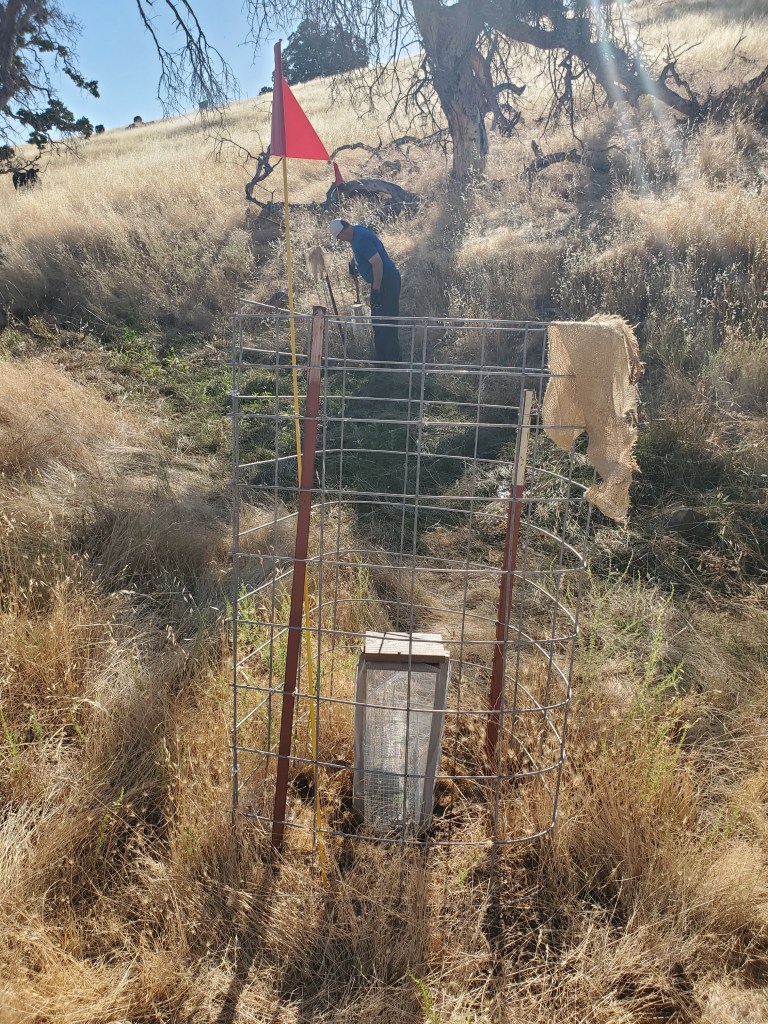
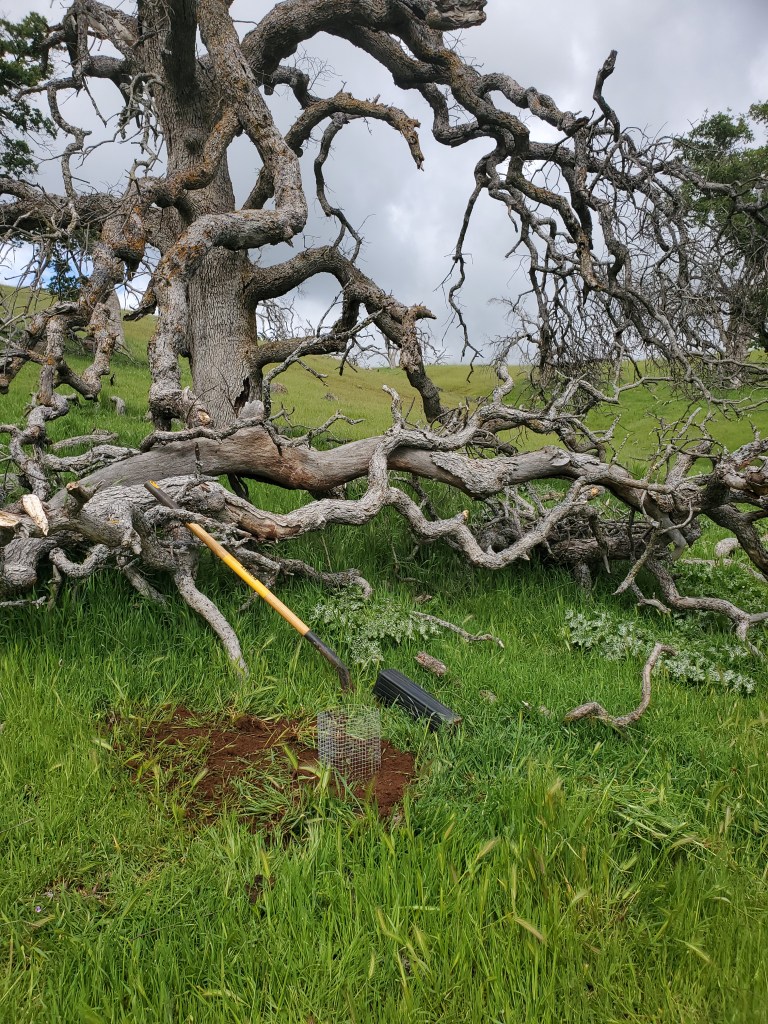
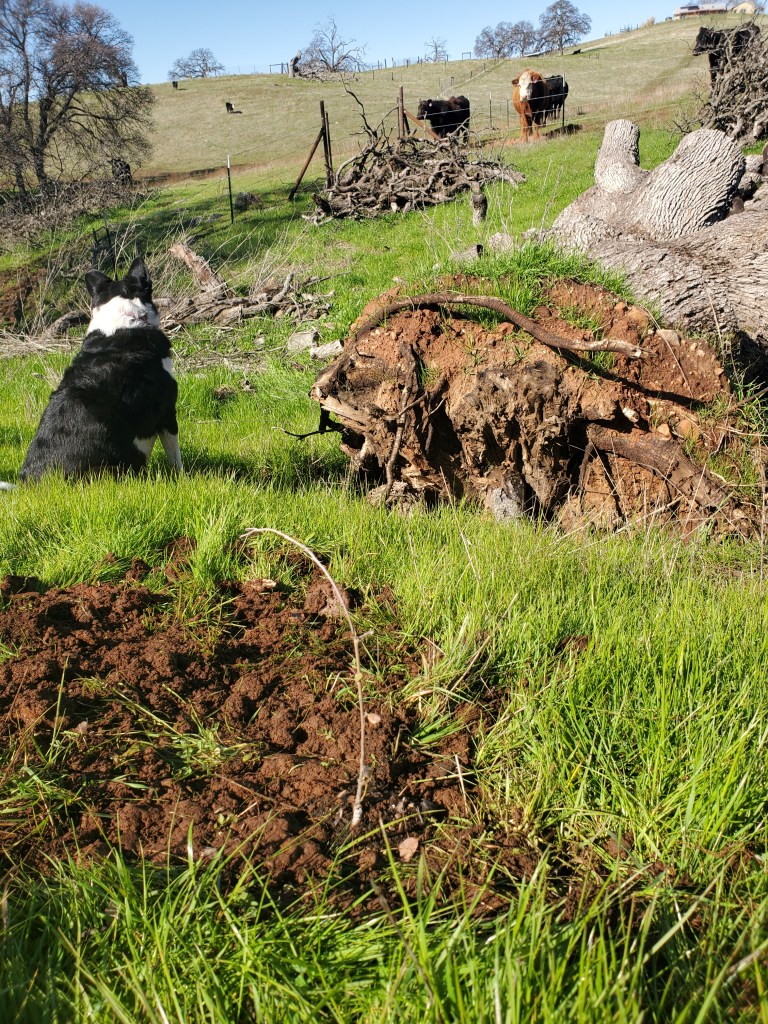
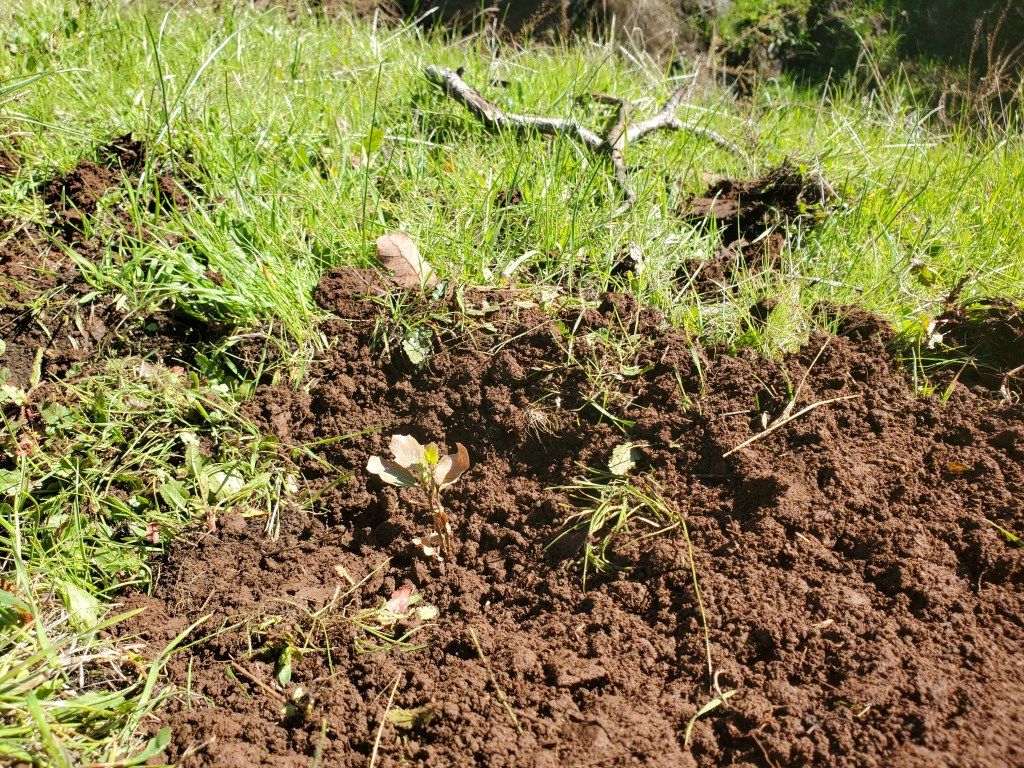
With my thumb still busted, wrist, knuckles and ankles still sprained, my job has been copilot, holding the water bucket with my good hand, carefully walking over to the tree, watering and removing the burlap and coir pad. David was doing everything else. As we went to each tree, I held my breath as I lifted the burlap shade cover, hoping I would see the healthy seedlings I had watered just 6 days prior. The two upstream on the Spring Creek…they looked great. I breathed out. The one by the lower pastures planted into the old dead oak, I lifted the cover, mostly eaten. There was one green leaf left. I’ll take it. Watered and screened. The discovery was unsettling. I became nervous for the others.
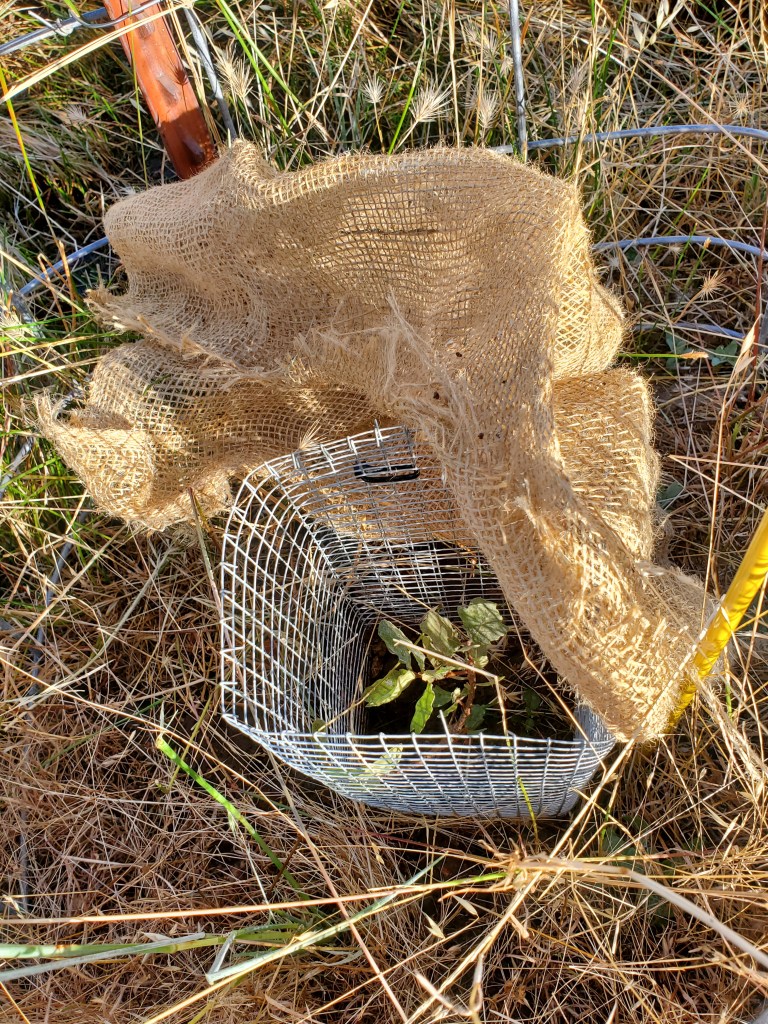
Then, David received a message that there was another major issue at work. He had to help save the day for a different type of situation. Secretly, I deflated. We needed to complete the work or there might not be any other trees to screen. I felt nearly useless and very dependent upon David. Shoulders slumped, I helped pack up the polaris and got into the passenger’s seat. We had been out since 6:30am working. It was almost 9am. David had given me plenty.

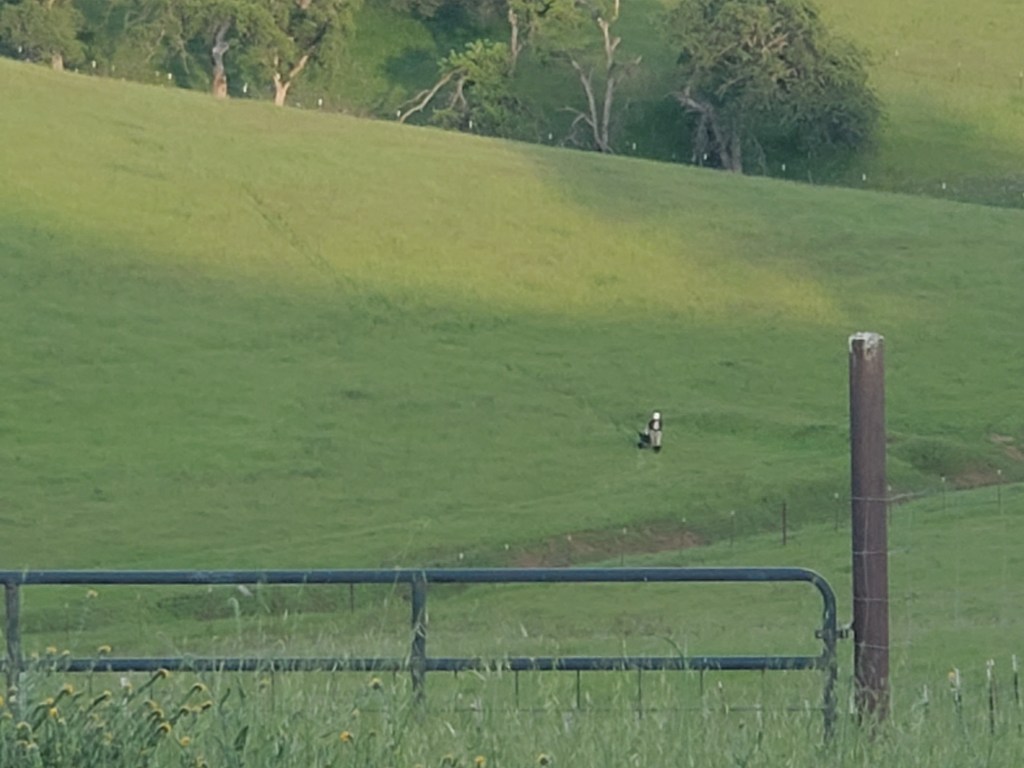
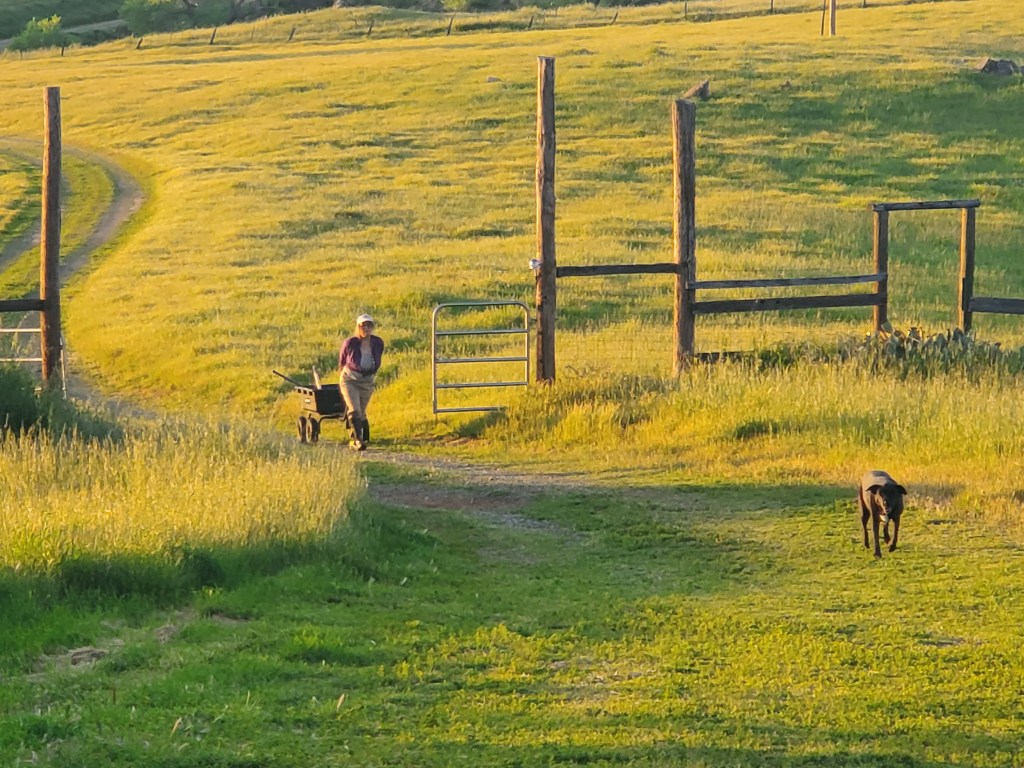
As we drove toward the house, I resolved that I would do as much as I could with one hand. There could be no more delays. We already lost the two oaks down stream. I had to do something. We got home; David jumped out and quickly went inside. I went over to the pile of screen boxes, loaded up for the remainder of the oaks, got behind the driver’s seat for the first time in 5 weeks and carefully backed up and went back out.

The first tree was the oak by the guzzler. Hopefully, I lifted the burlap. She was gone. I went to my knees, gripping the cage, lay my head on the fencing and let out a scream and started to cry. Another one so healthy just days ago –gone. I pulled it together, and with renewed determination, I set about doing what David did, slowly and steadily. I was able to use my right arm, instead of the hand, as a bolster to hold things against my body and my left hand to do everything else. It was not ideal, but it was the only tool I had.
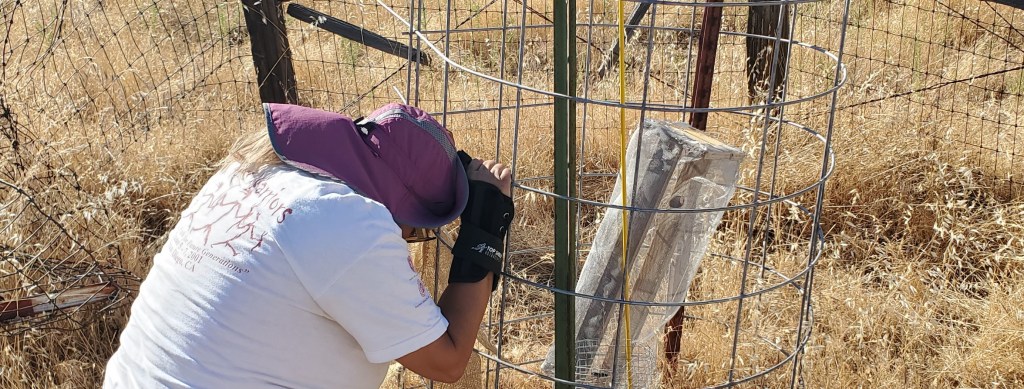
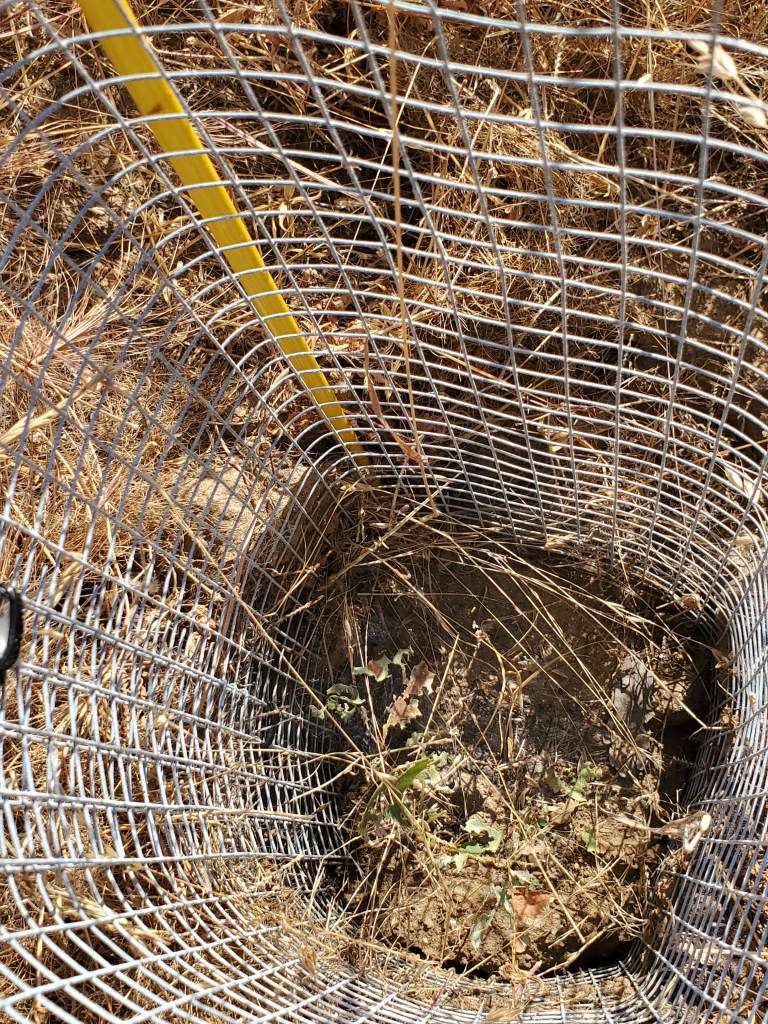
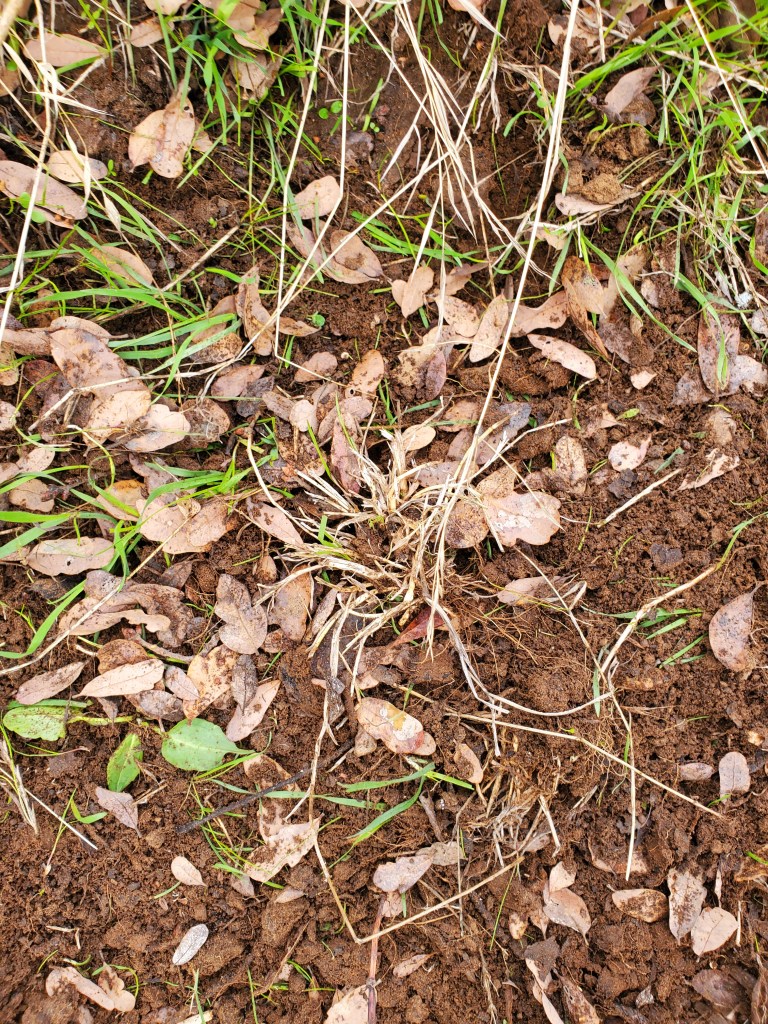
Like the other eaten oaks, the bark was still intact. I watered her, screened her, shaded her, and then moved on. The oak near the perimeter fence on the southeast was gone too. Instead of getting mad, I did the same thing… water, screen, cover. I went to the next tree. She was gone. My stomach started twisting. Hatred for myself for not being on it sooner crept in. Remember, every tree that does not survive, I must wait another year before I can try again. It is another year wasted. Water, screen, cover. I drove to the tree due west of our old, dying grove, lifted the burlap and — she was super healthy, full of leaves! The hoppers had not found her yet. I watered, screened and covered. Of the nineteen seedlings, six were stripped and ten had survived. The other three failed to thrive. They were lost around the time of the May heat wave.

Two Weeks Prior

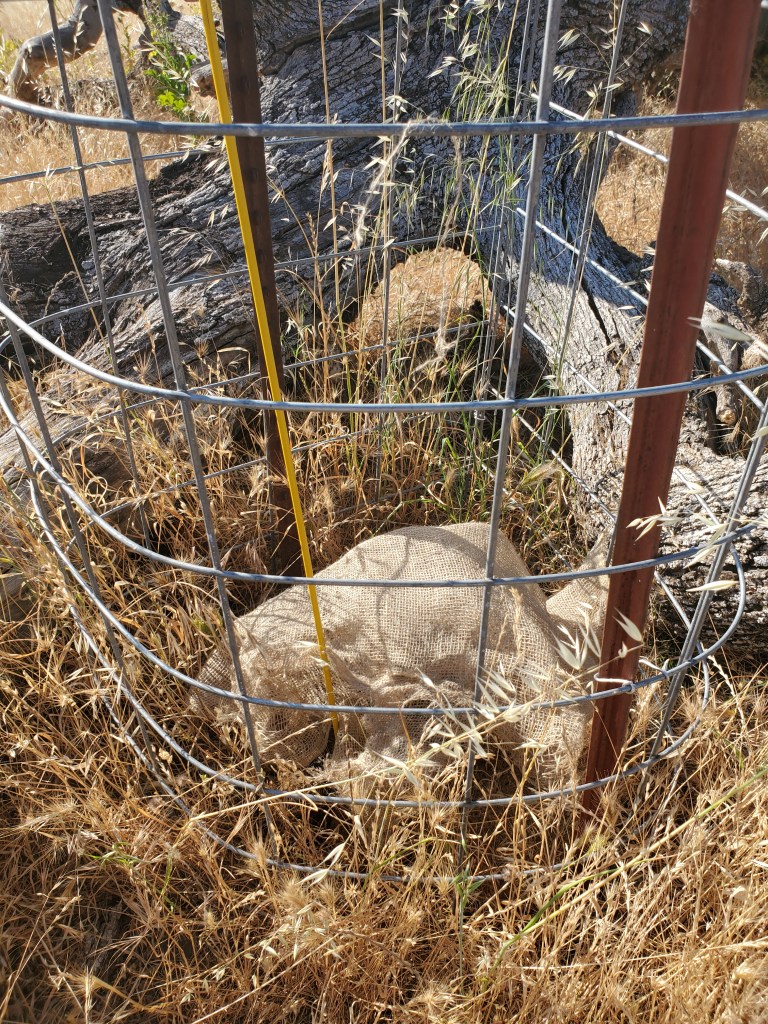
Just like in the movies, I will now take you to a flashback two weeks before the hoppers ramped up. David and I have been maintaining a strict watering schedule of every 5 days for the oaks. In anticipation of the mini heatwave, we also cut sections of burlap to lay over the gopher cages to shade the oaks. Sadly, two oaks appear to not have made it through the heat, the one in the exclosure and one of the driveway oaks. We continue to water them just in case the roots are still alive.
Milkweeds Gone

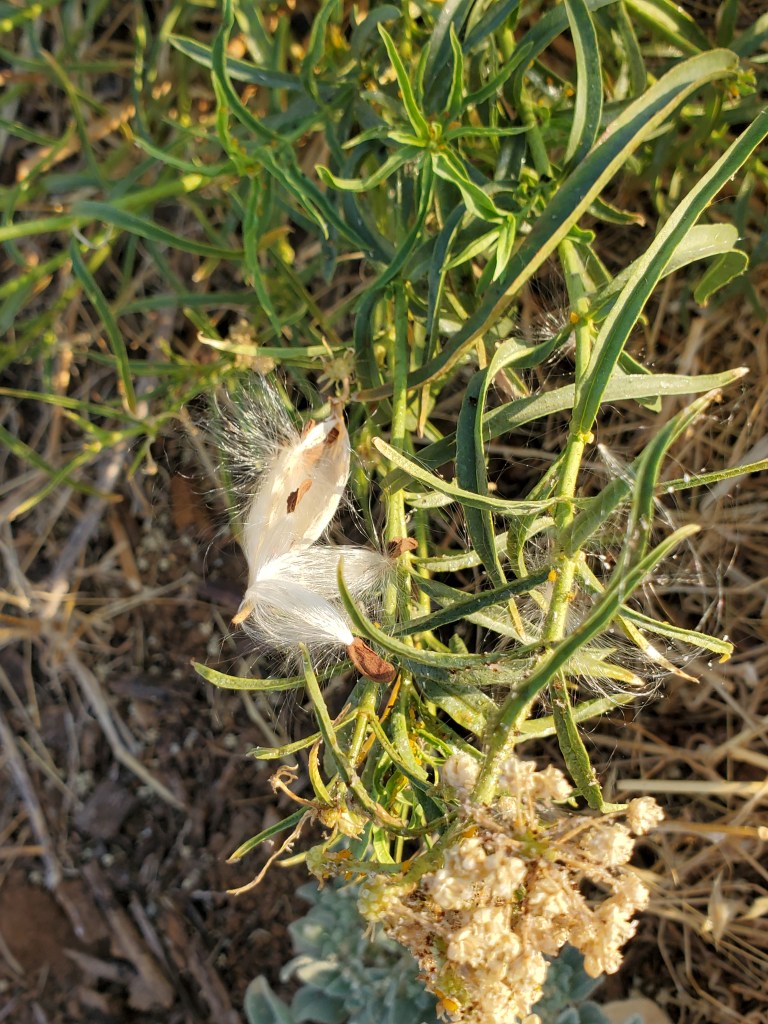
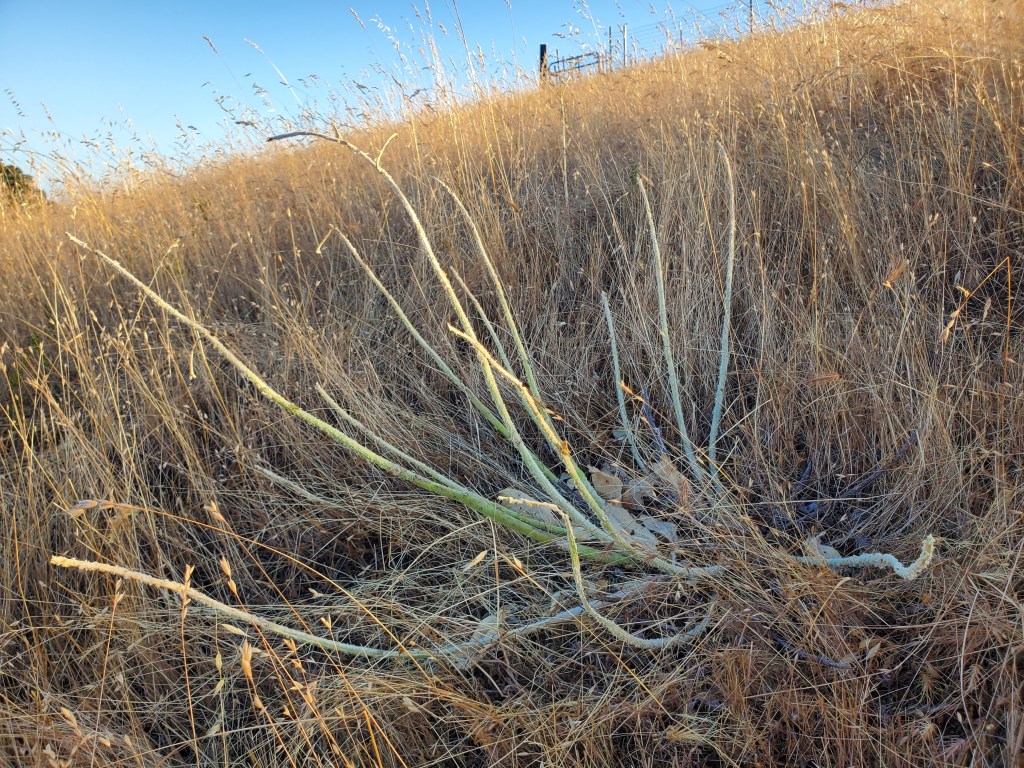
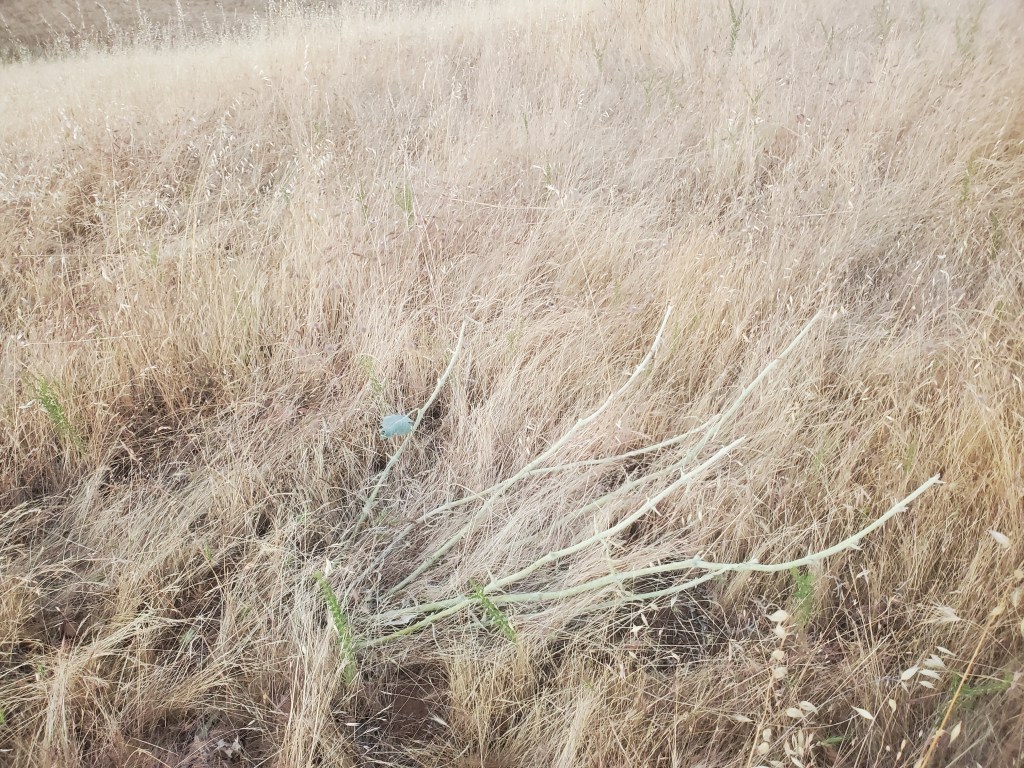
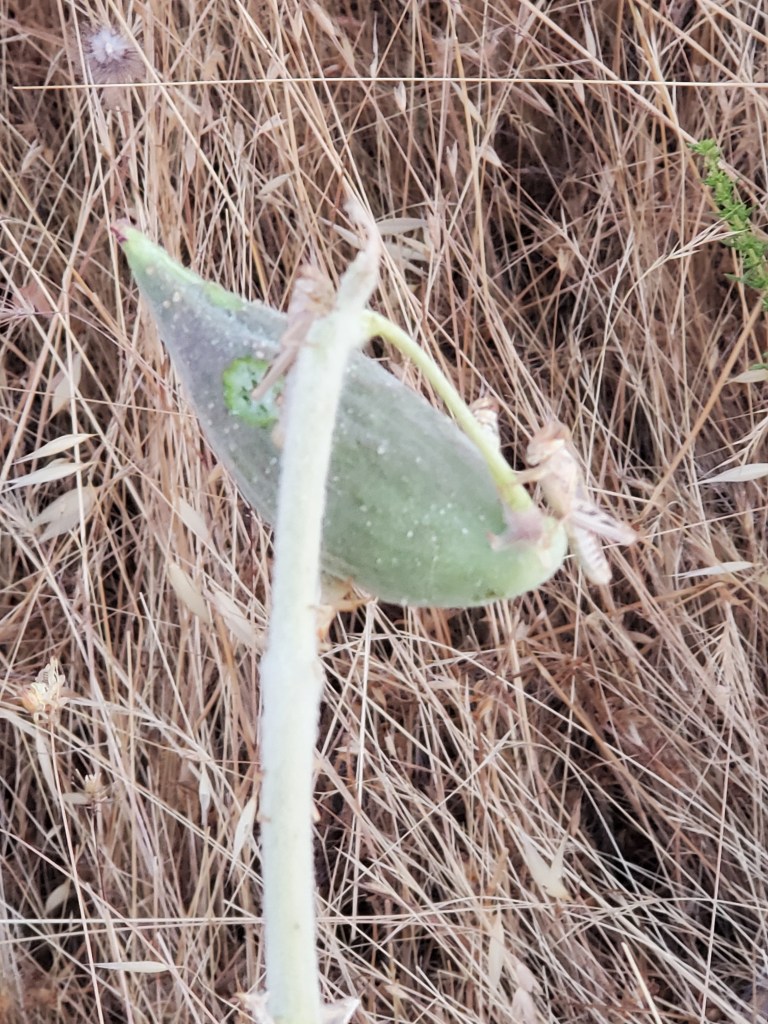
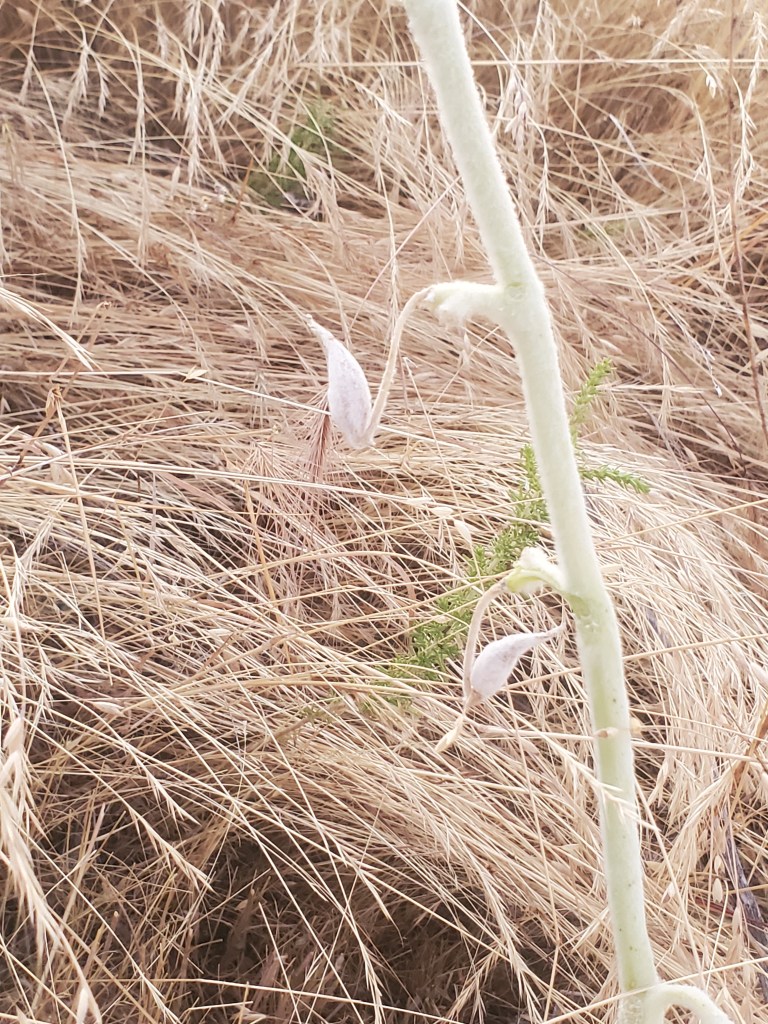
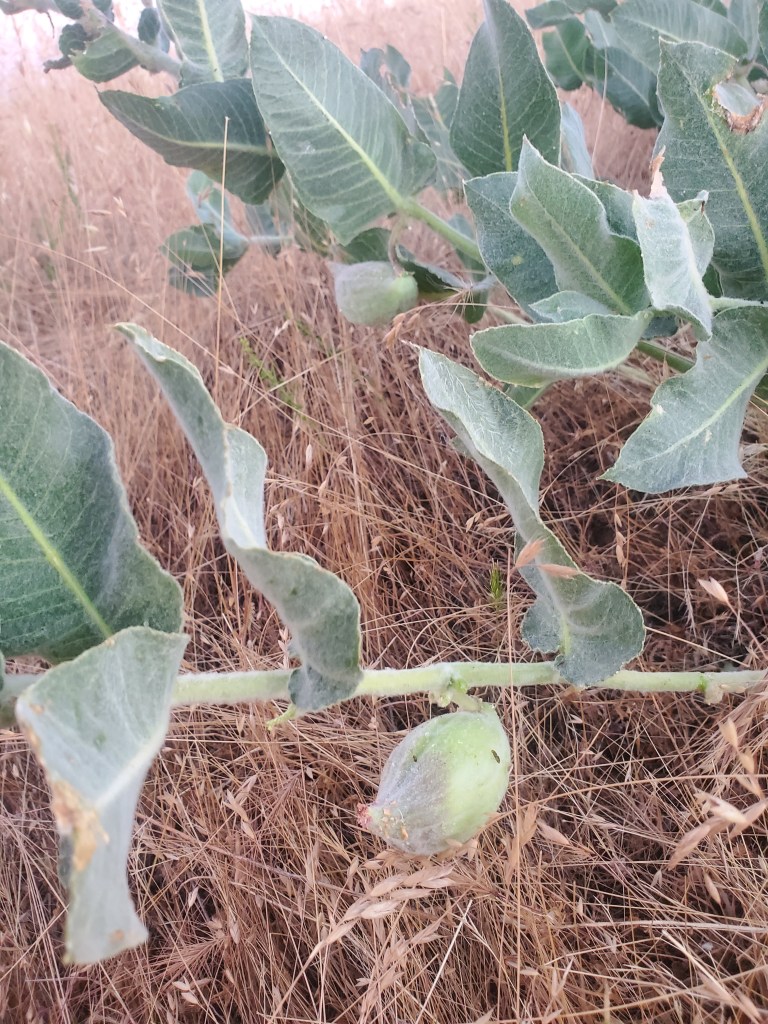
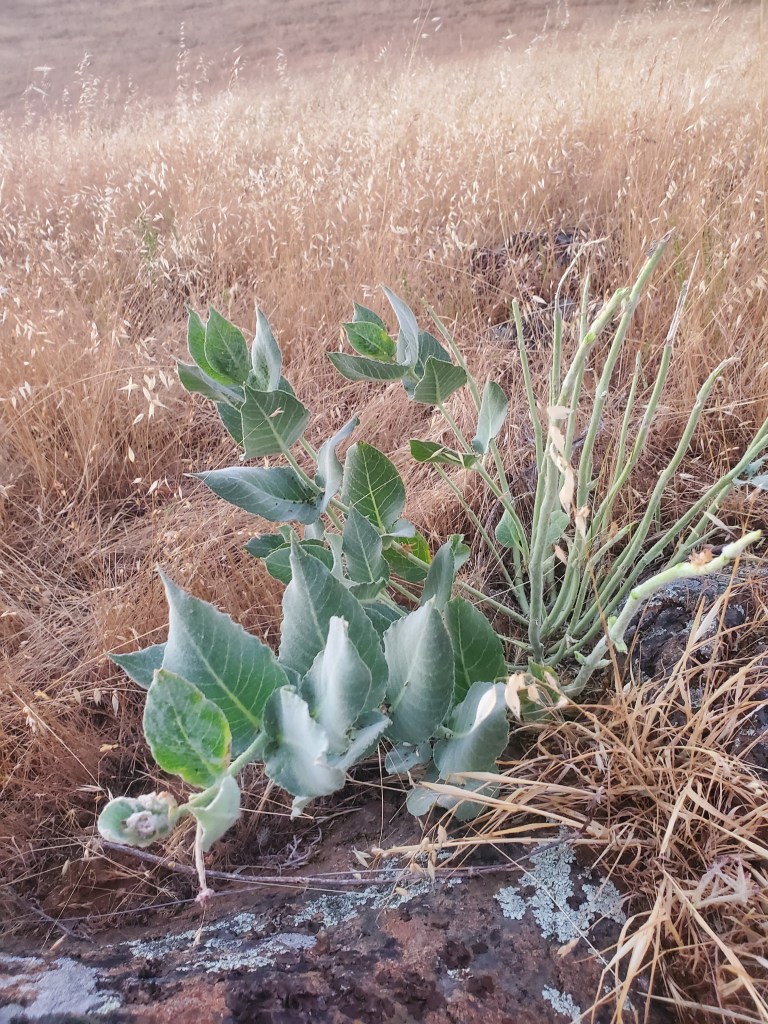
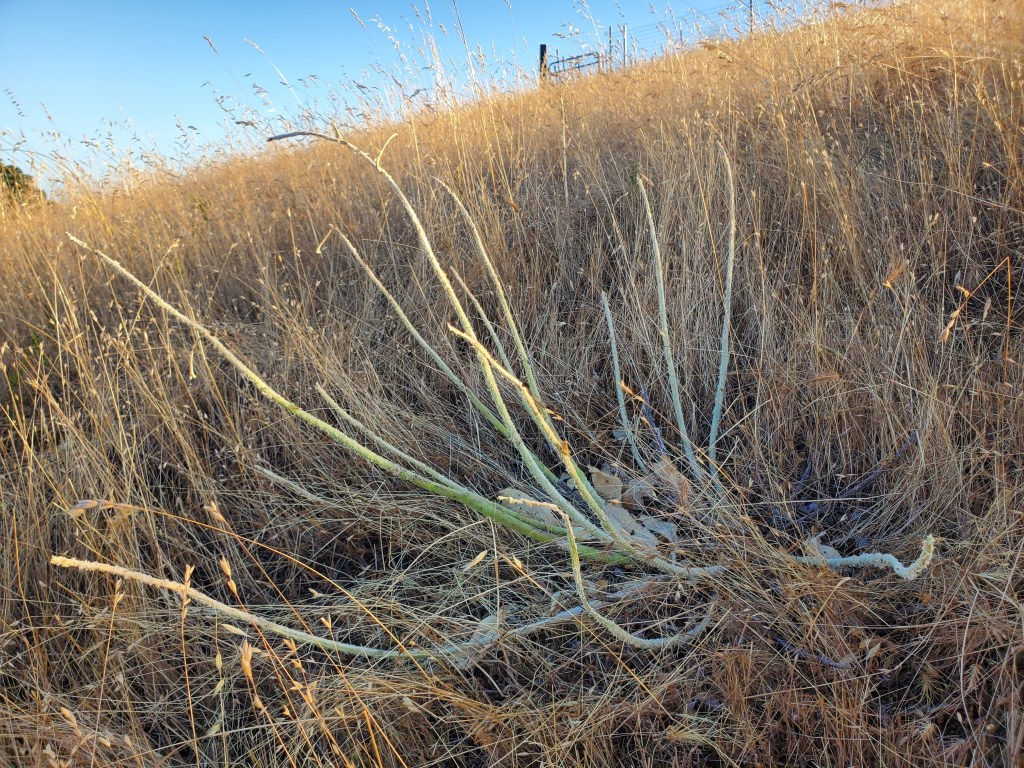
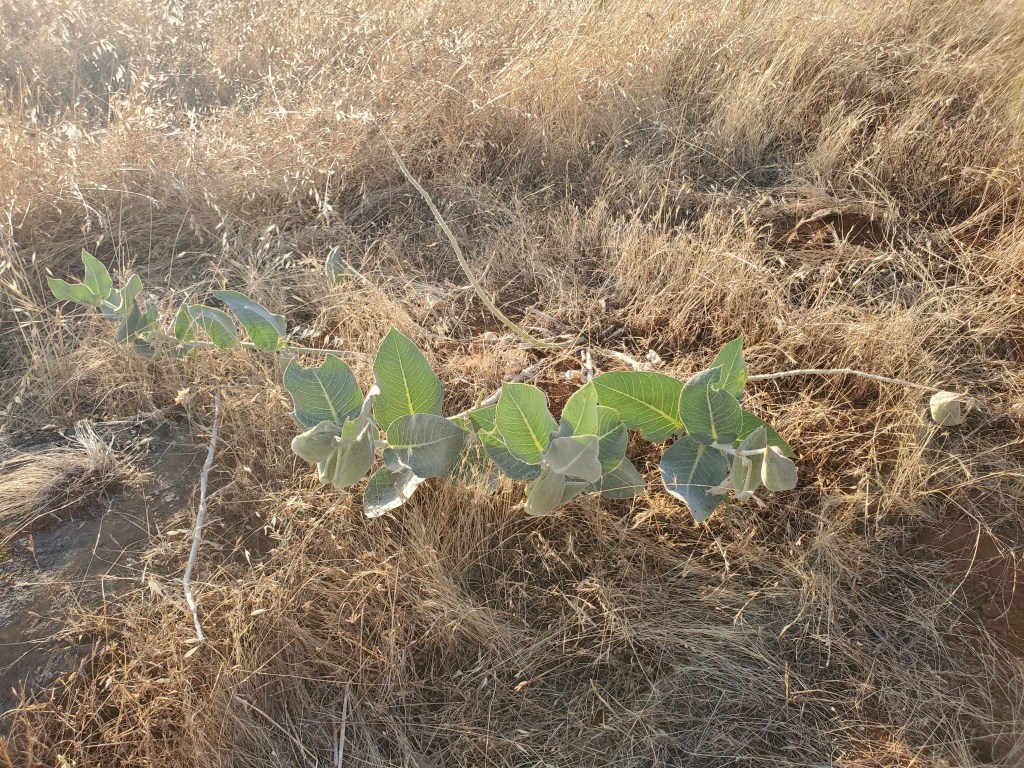
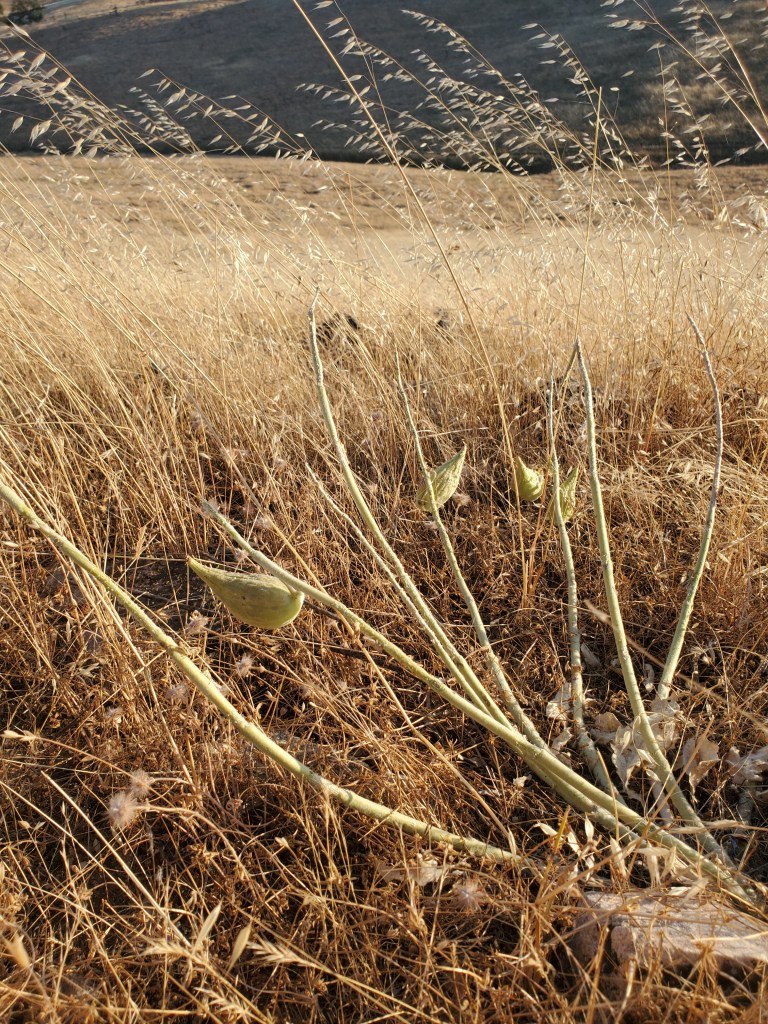
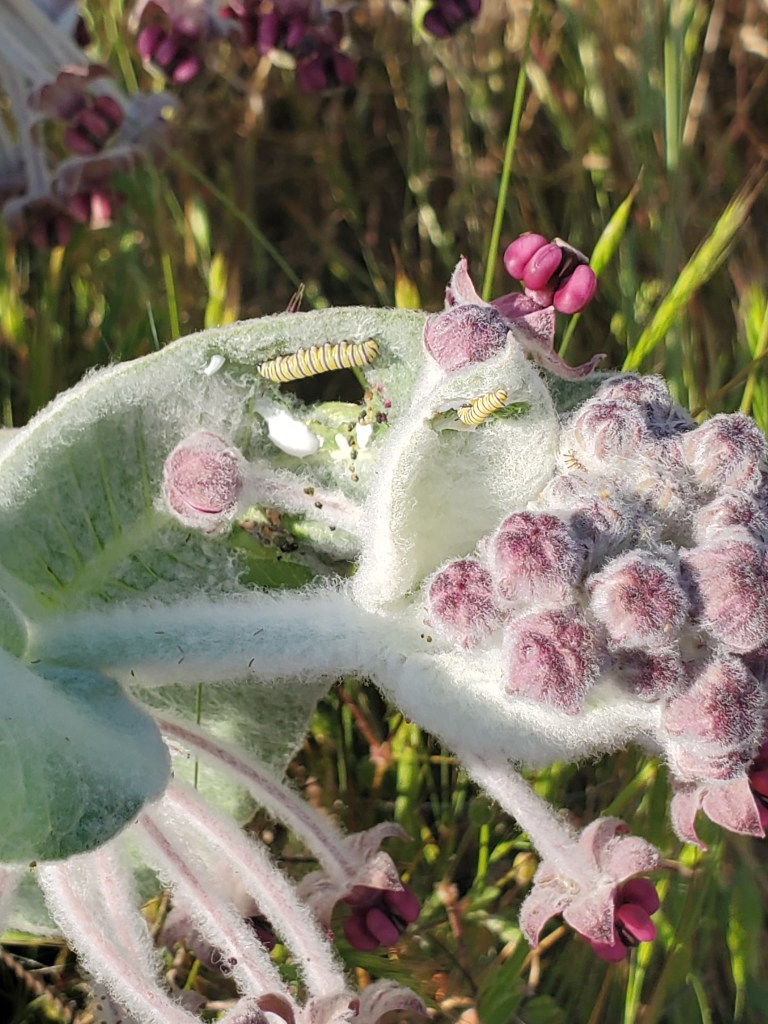
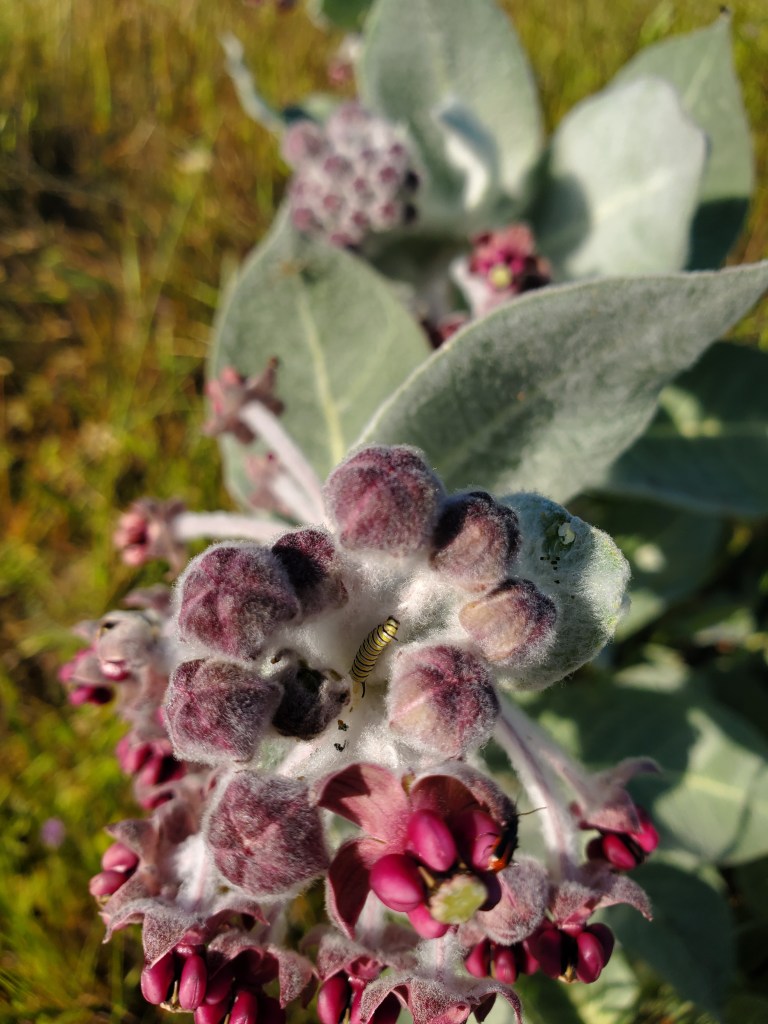
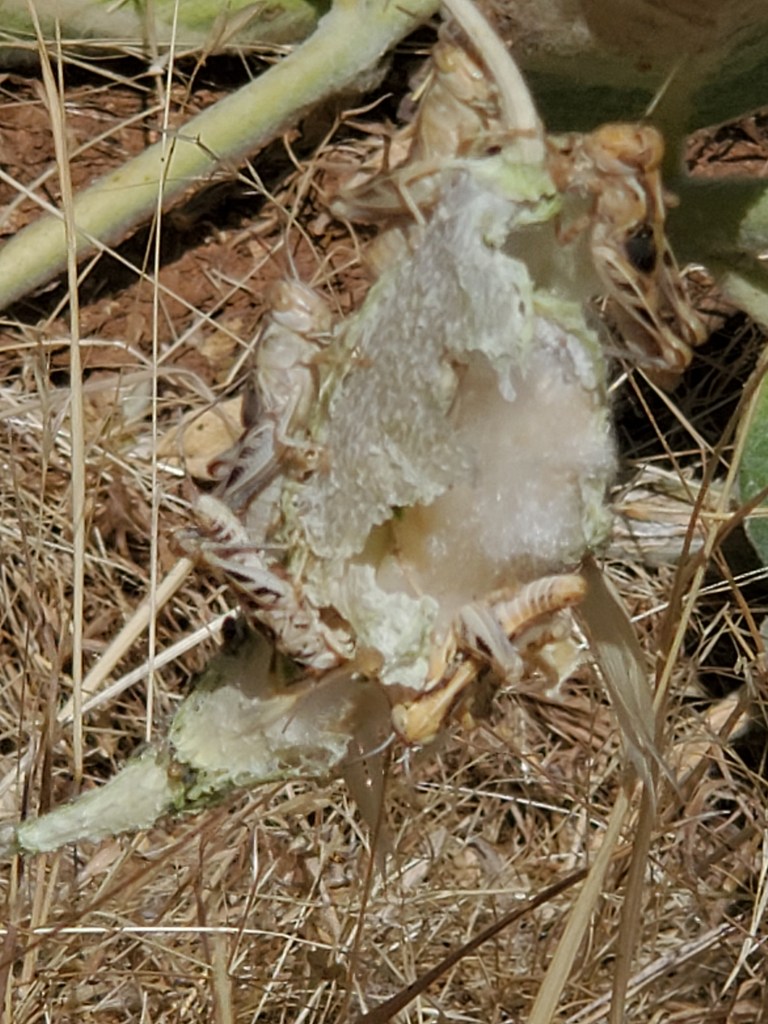
Similar to the oaks, the grasshoppers are all over the California milkweed. The only difference from last year is that the hoppers came later giving the milkweed more time to set seedpods. With the accident, I have not been able to monitor the sites. Last Sunday, I felt strong enough to walk up the hill, slowly and carefully. I found every milkweed at one stage or another of being eaten. On the more intact ones, there was still no sign of monarch activity. I am officially designating this spring a no monarch spring. Add that to the no monarch fall. It is beginning to feel very depressing.
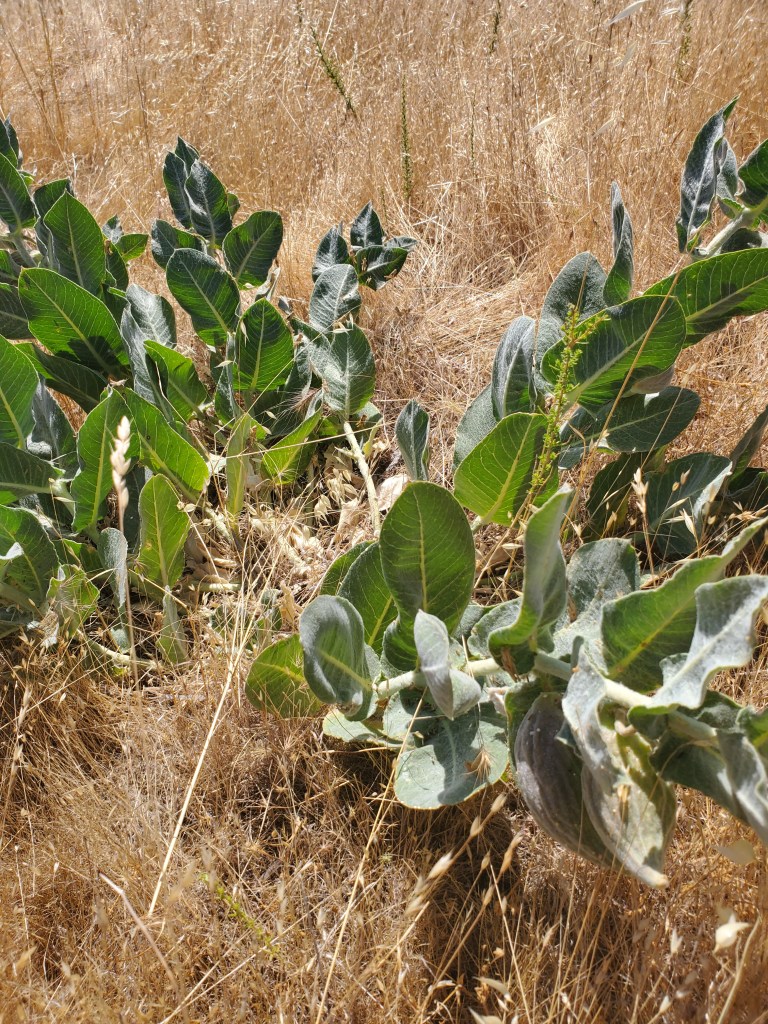
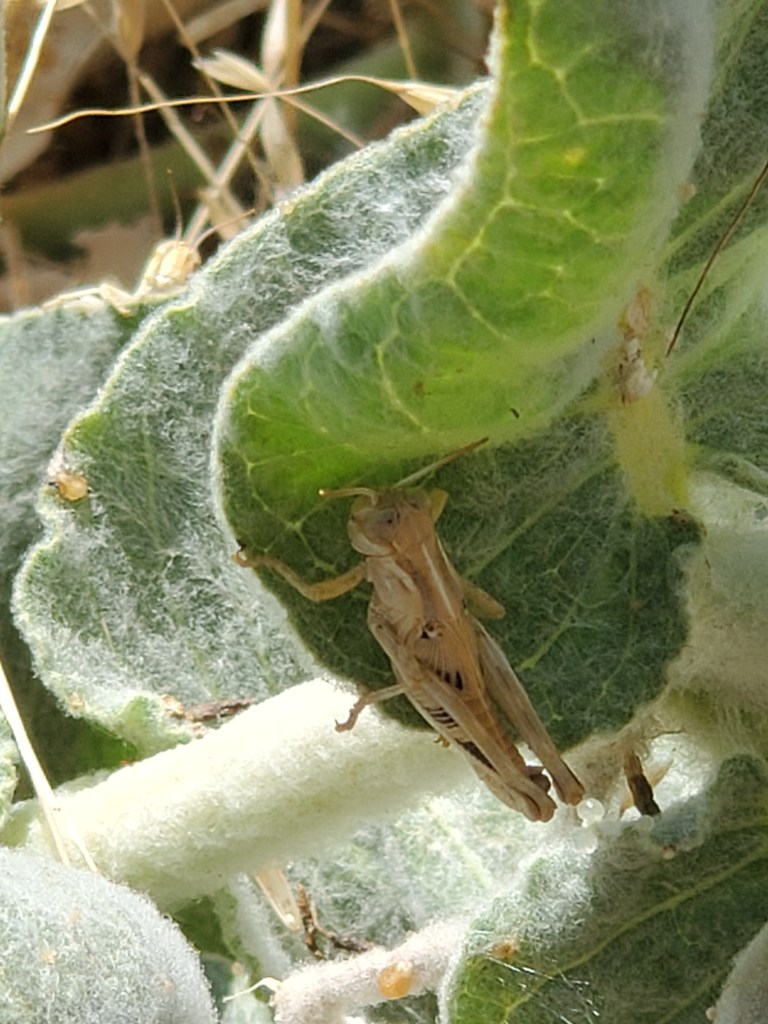
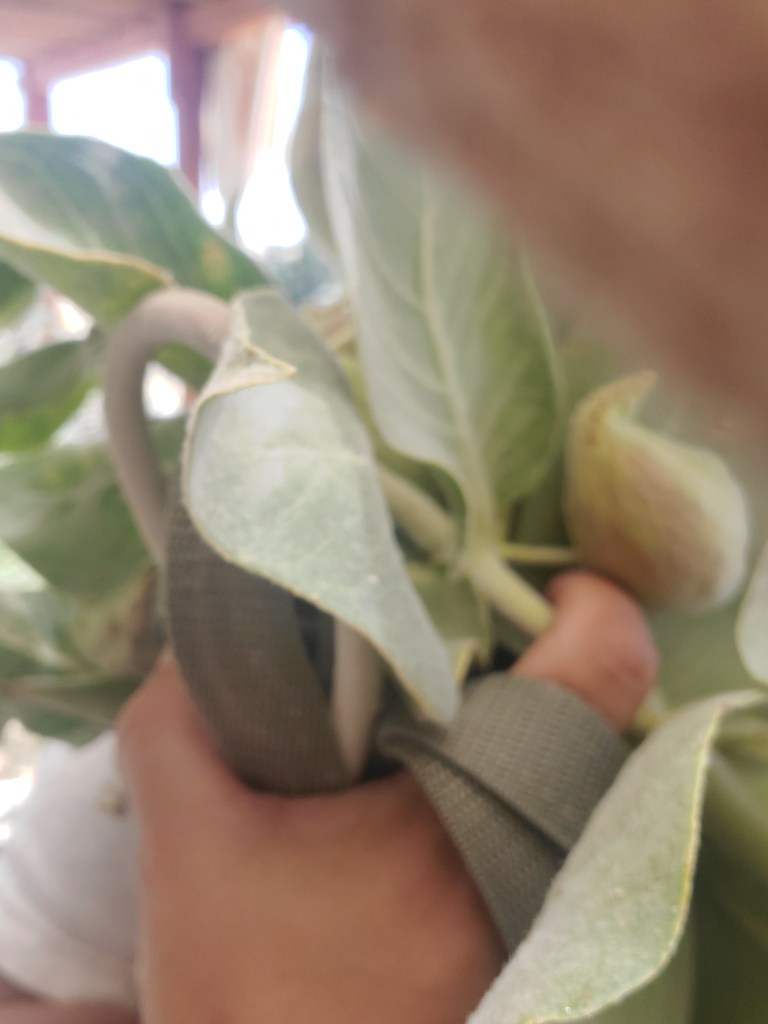
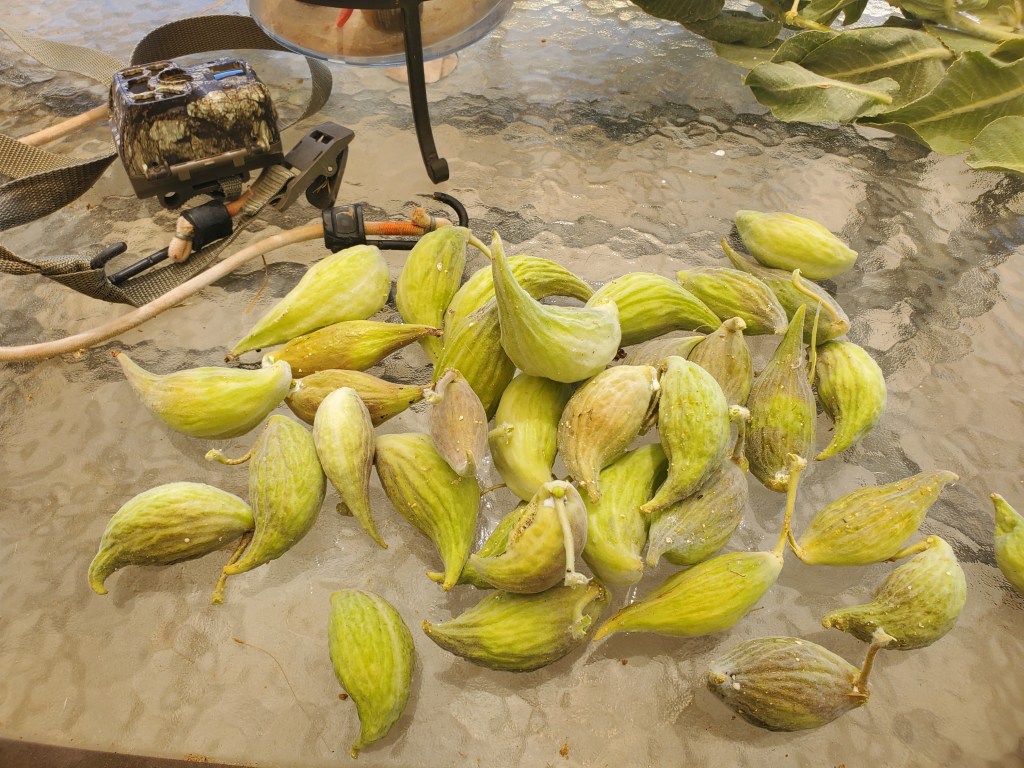
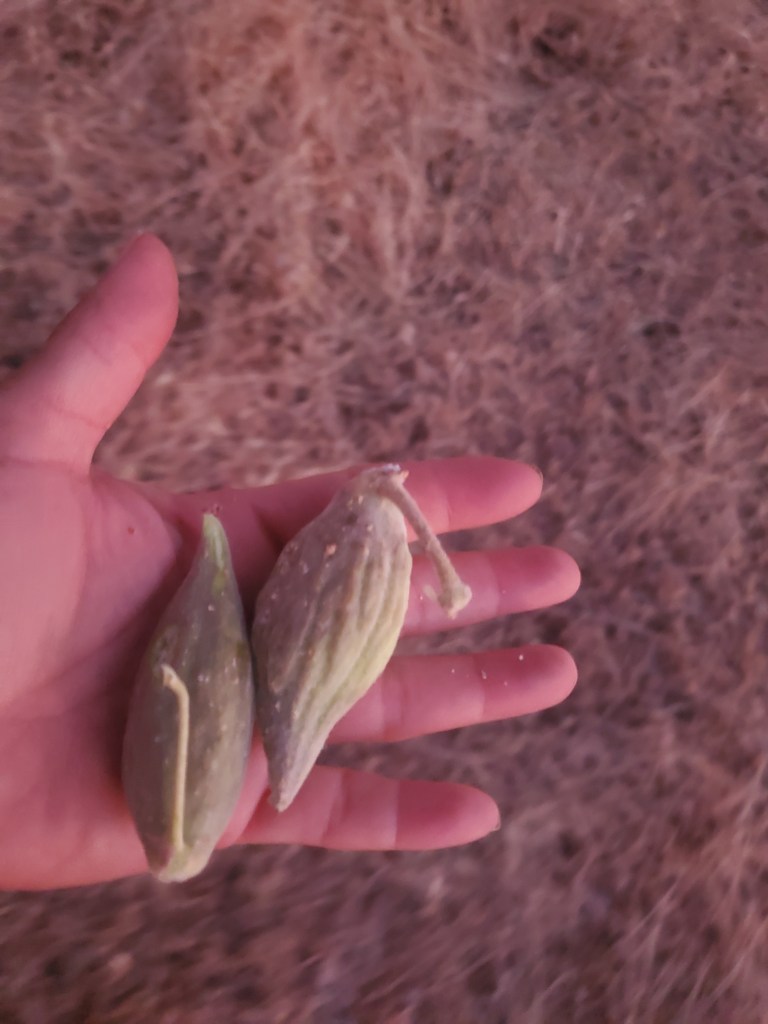
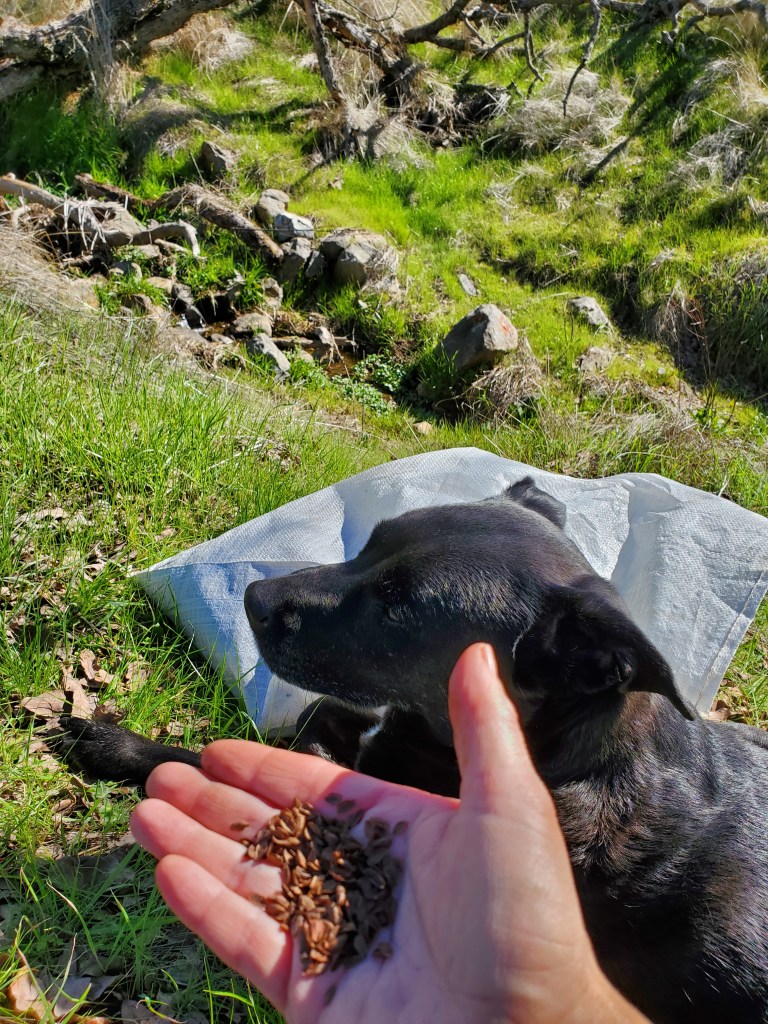
The plants on the south-facing slope were mostly eaten. There was evidence of seedpod destruction. Although not prepared with clippers and a bag, I began to harvest the pods. If I waited much longer, they would all be gone. Because I was pulling them off the stem early, the white “milk” ran onto my hand making my fingers and palm sticky. I continued, but could only find six seed pods remaining at the site. I moved to the north-facing site. More plants were intact, but were rapidly being eaten. There was a bumper crop of seed pods, including four massive ones. Normally, I would never harvest more than 10% of the pods and allow them to drop and open naturally. In this case, with sure death ahead of them, I went about my business of disconnecting the children from the umbilical cord, they, still holding tight for the nourishment it brings, and me, covered in mom’s milk grabbing her treasure for the possibility of life down the road.

With no bag, I placed them in my pockets, held a bunch in my arm and finally, made a pouch with my tee shirt. Several branches, with seedpods still attached, had been dismembered from the plant by the hoppers. I used those as a base for piling on the loose pods. It worked. I was able to slowly navigate back across the hills, pregnant with A. Californica seed, to the patio without dropping a pod. After the danger has passed, I will release these seeds back into the areas from which I harvested them – probably September.
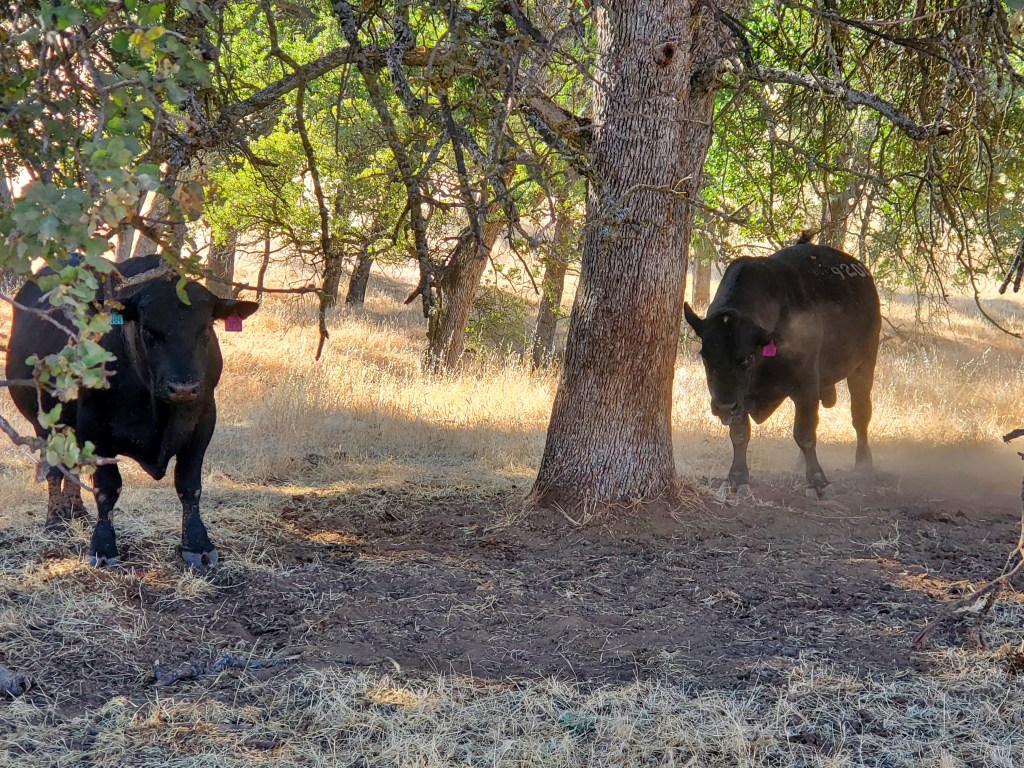
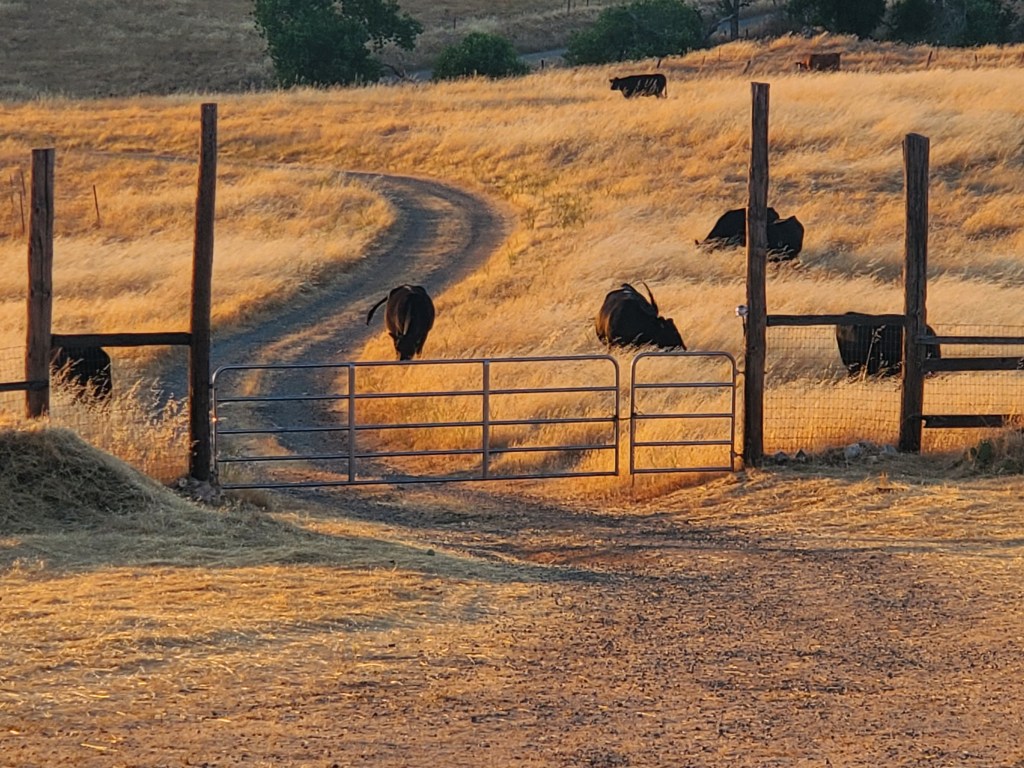
With the milkweeds done for the year, the cows still remaining on the ranch and the grasses nearly 4′ tall, I opened the gates to the far north field. The cattle have made their way into the field munching on the buffet of tall grass and thick green grass and flowers in the riparian areas that have been, as yet, untouched by cattle. Within the first day, those green patches were eaten down to dirt. My feelings are mixed. While I want to preserve the flowers I have left in the riparian areas, I also would like the tall grass to be grazed off a bit. Fire danger is always top of mind. All needs must be balanced, habitat for birds, pollinators while not trying to overstock too much on grass.
Wildlife

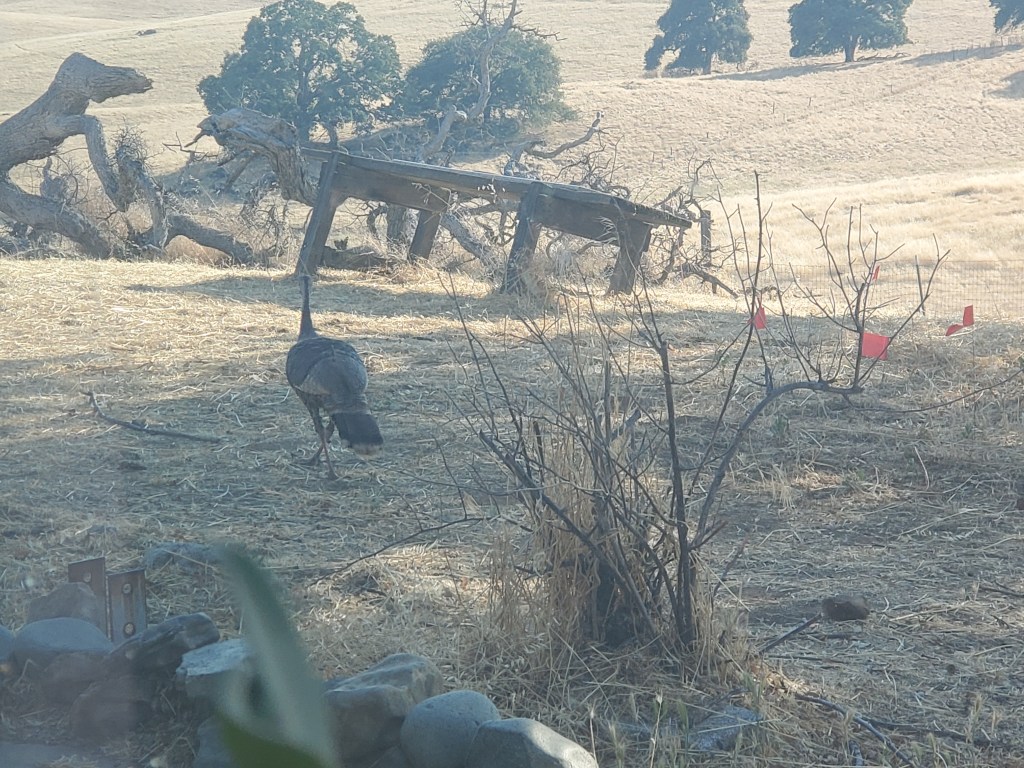
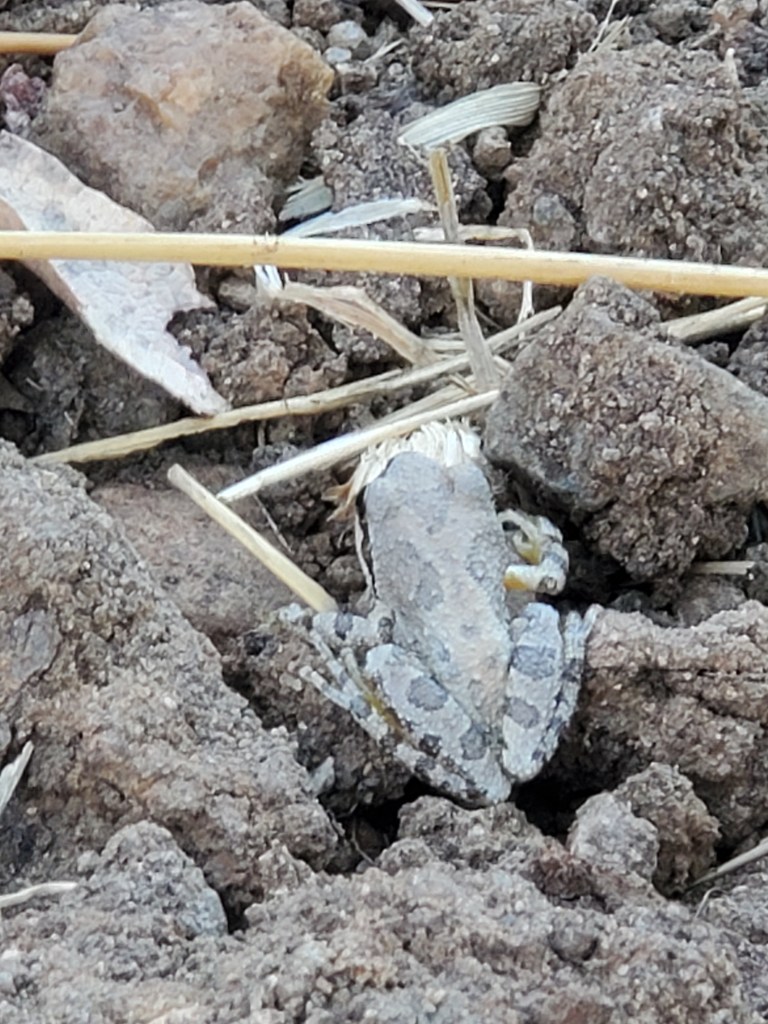
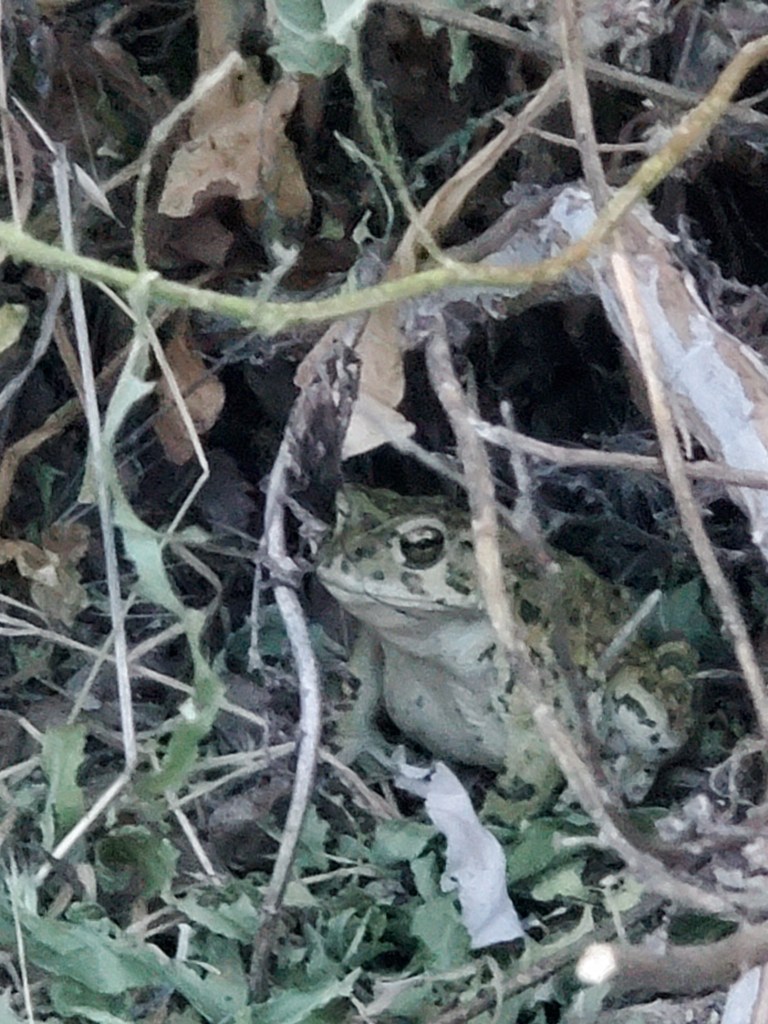
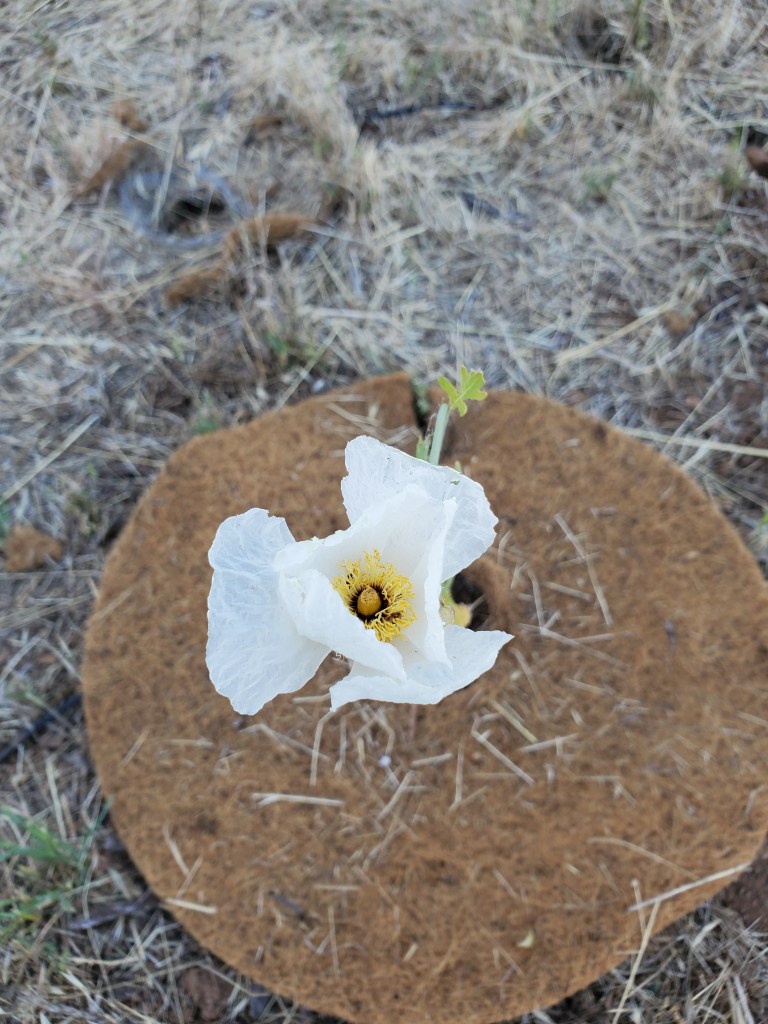
Even as the temperatures heat up, there are blooms, and I still see glimpses and/or evidence of wildlife. The guzzler has continued to be a center point for racoon and bird activity.
Wanderings

What horrors we are seeing. There are so many tragedies happening; I can feel the energy of the earth listing. There is only one healthy way to be, and that is in balance. You don’t take more than you need. You don’t give more than you can. My dear friend had a very ill wife. He cared for her for over 20 years. He was unbelievable, one of the finest caregivers I have ever seen. Lifting, bathing, feeding, driving, monitoring – he was her spirit moving her through life, so that she could live well and with dignity. She passed last month. My friend, with nothing left for himself, died three and a half days later. He gave more than he could.

With so much loss and sadness, it has been difficult to focus on writing. The unrest, murders, bombs and abuses of power, have caused me and so many others emotional distress. This is not living in a good way. I see it on the ranch, the imbalances. It is unhealthy, and things are mixed up here. There are only two entities that can move us back into balance – us, or Maala Bwia (Mother Nature). Given all the human greed and climate horror of the last century to today, I don’t have much hope that it will be us that leads the shift back. But, if it is itom Maala/our Mother, it will not end well for many of us. So let’s get more of us working toward finding our equilibrium.

Amid the depravity and cruelty, there is always light. This is something so lovely it will fill your heart – true heroes from the Resource Conservation District of Santa Monica Mountains racing to save gobbie fish and trout from sure death after the catastrophic Palisades Fire in Southern California. This is the type of character that will shift us – respect, dedication and reciprocity to all life no matter its popularity, size or their ability to be commercialized for humans.

Here is the article in the LA Times.

Here is a brief YouTube film the organization made.

Here is a link to a larger documentary about humans fulfilling their obligations to the Huya Ania (Wilderness/Natural World). It is just a trailer, but please, try to organize a viewing at your location if you have the capacity.

Goodness exists all around us. Grab hold of it instead of the negative. Cling. Never let go. Eventually, its light wraps you, moves through you, becomes who you are. Let’s all bring more light.
Endless Summer

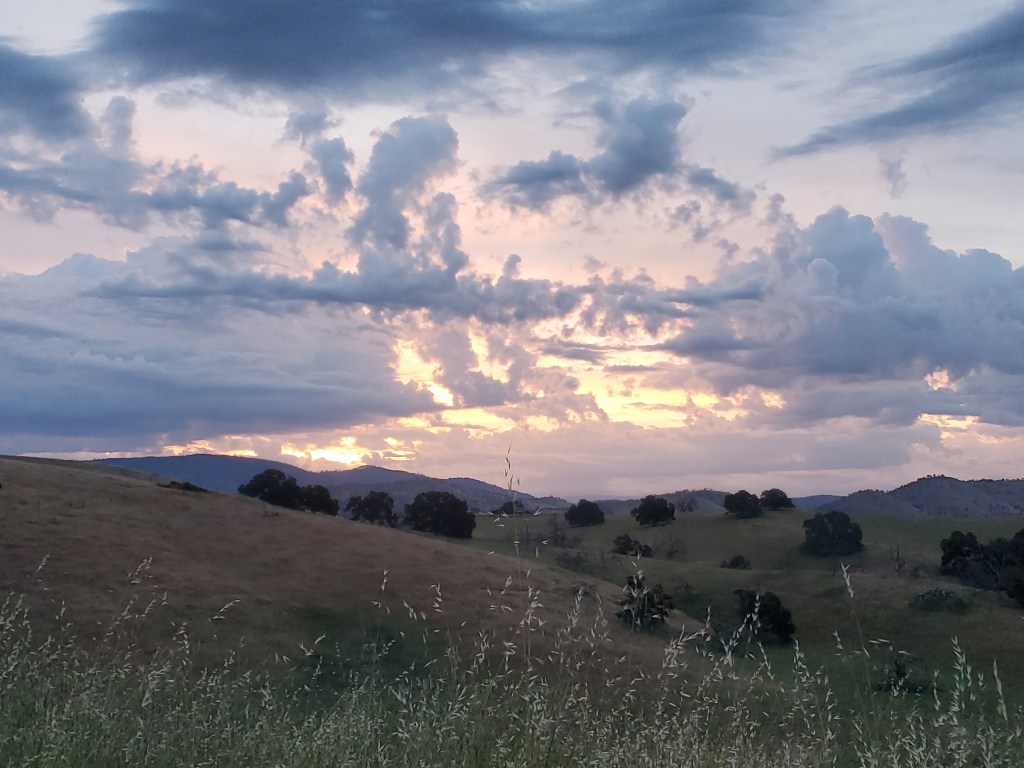
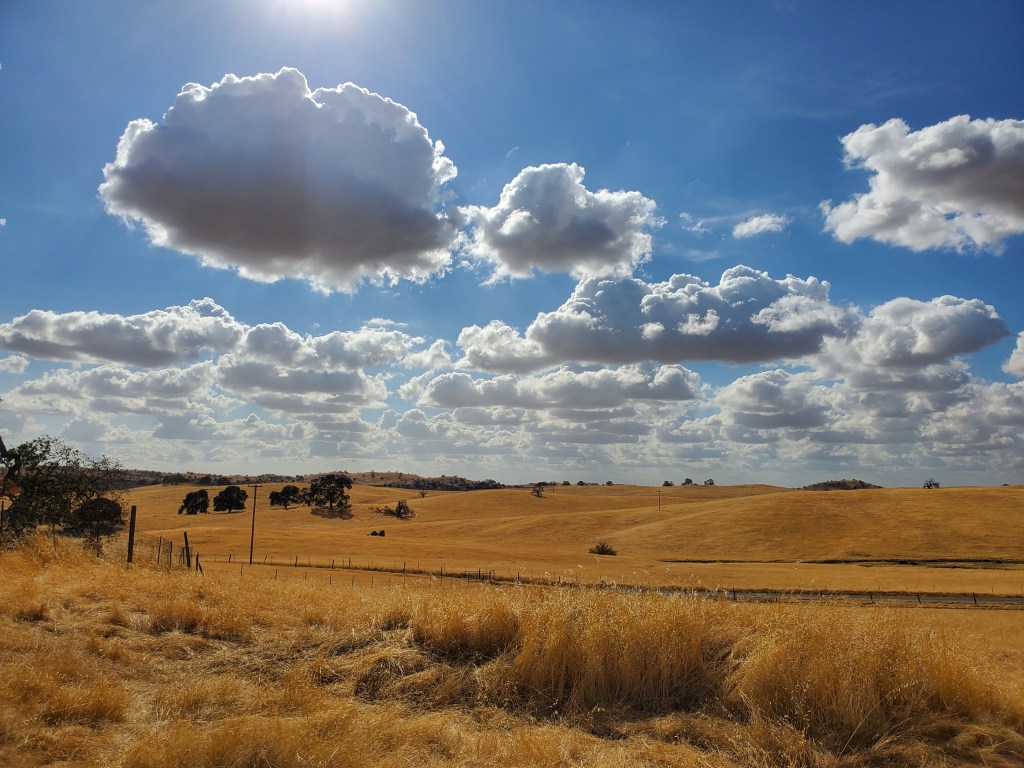
A rare day in September when the clouds came and temperatures went down, but otherwise, hot and dry

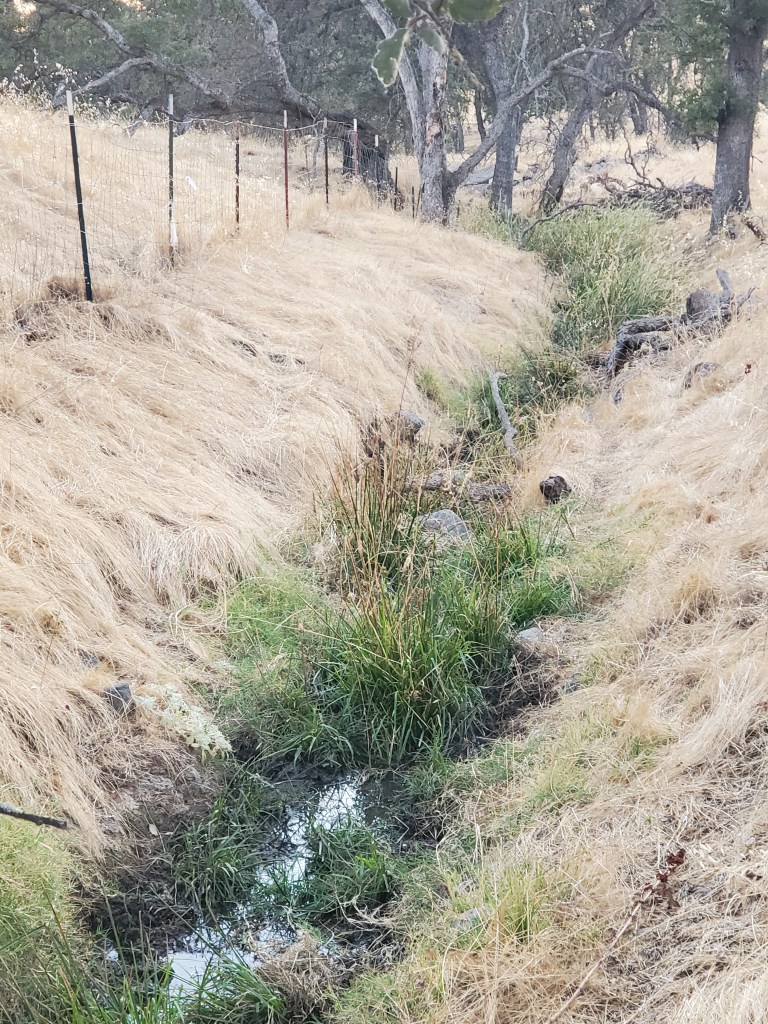
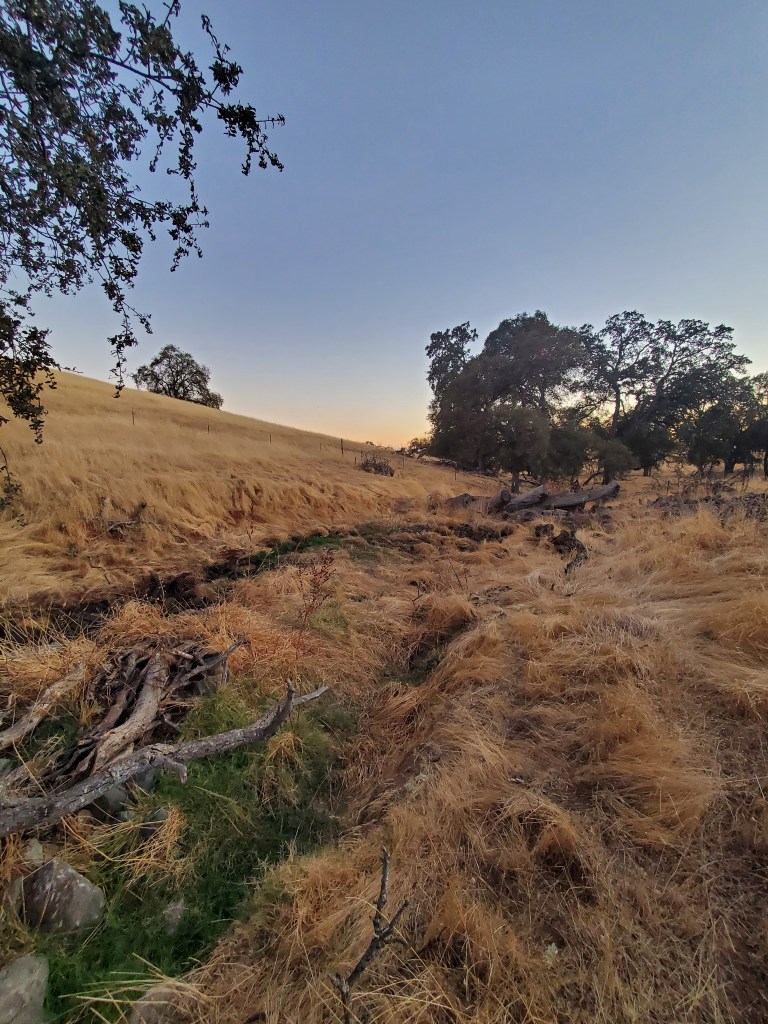
It is October 24th, and we are still seeing 80 F + days. My body is tired of being warm. Surprisingly, there is still water in the seep and in the spring creek, but their reach is far less than just four weeks ago.

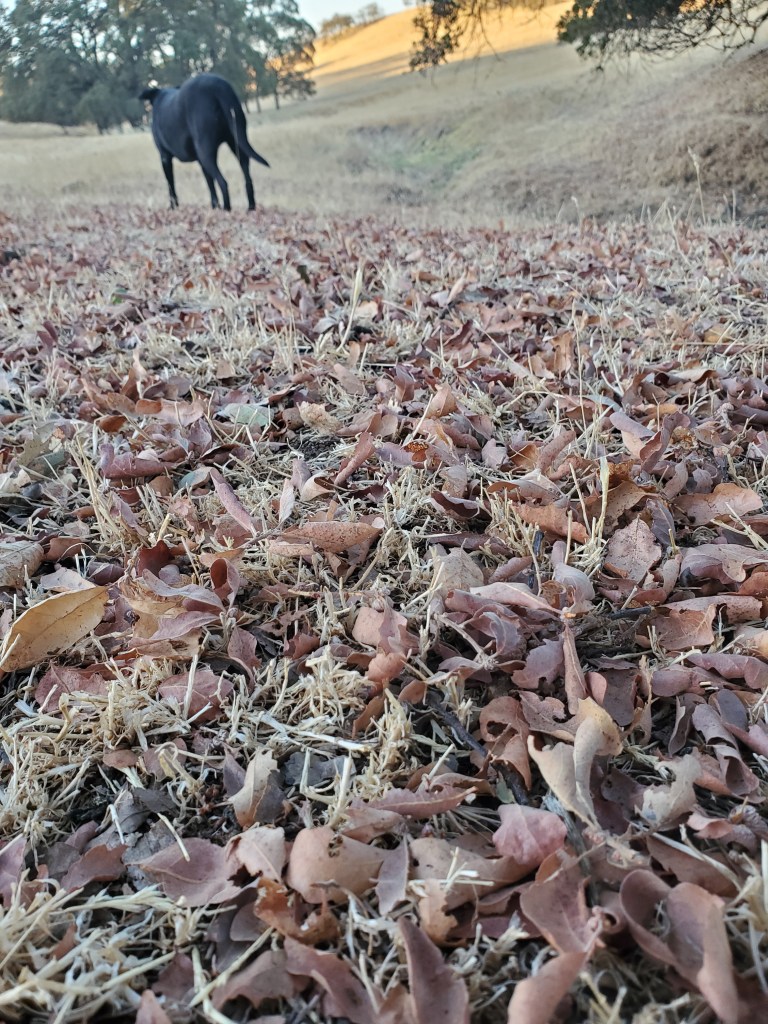
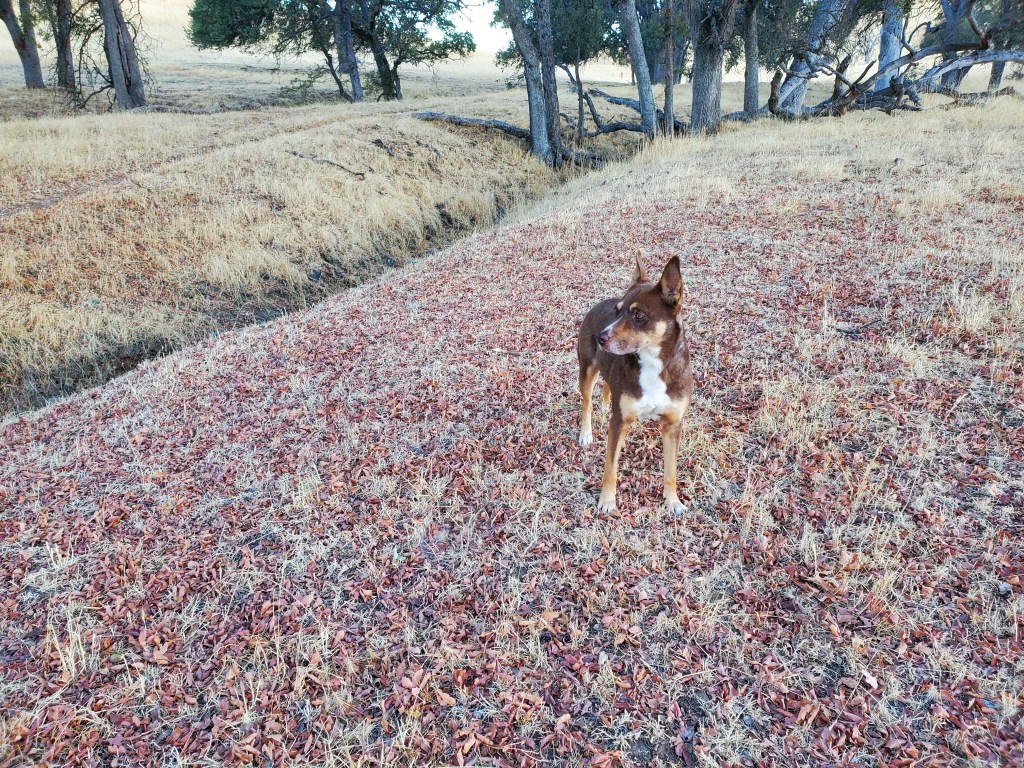
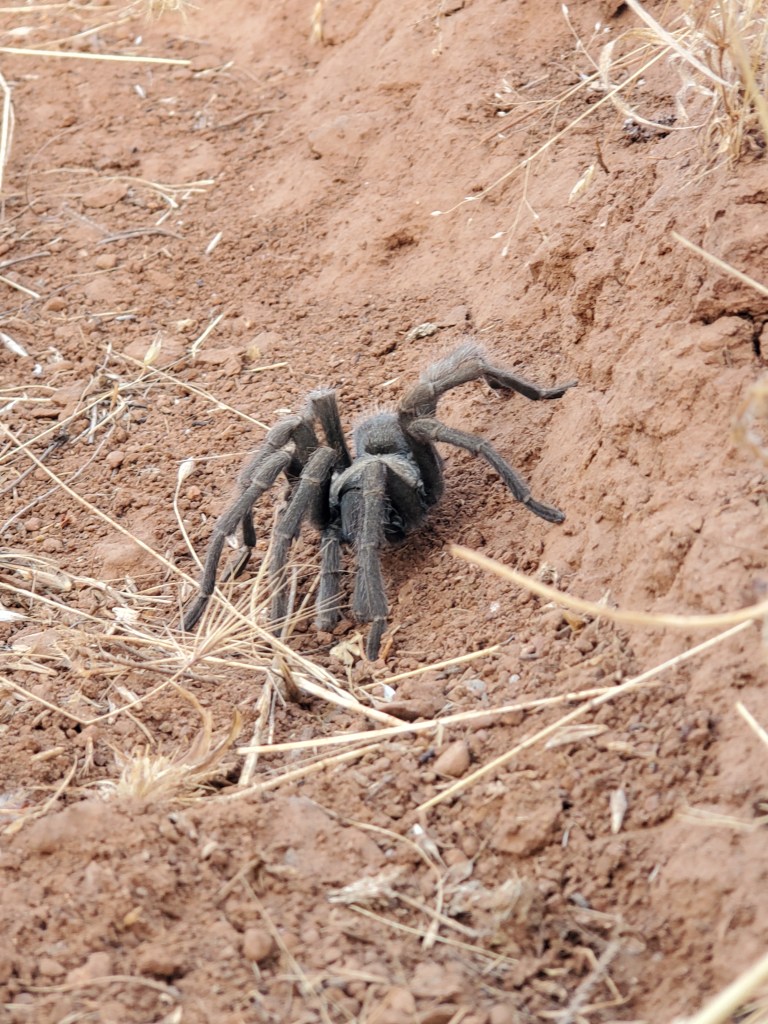
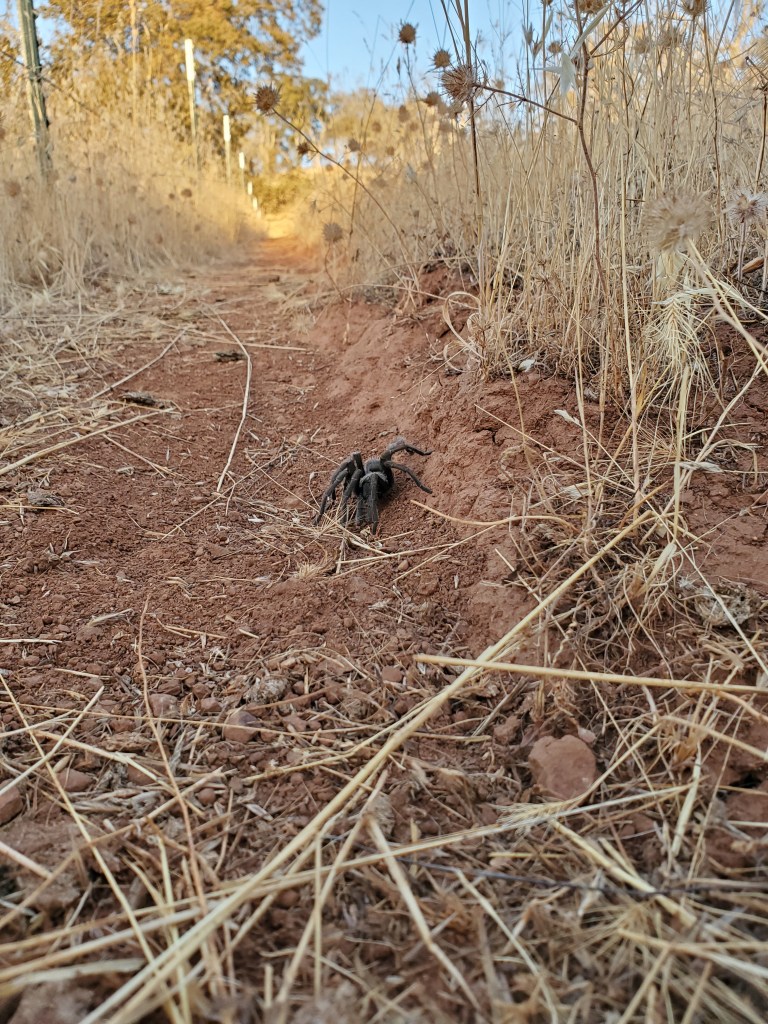
With the exception of the temperature, autumn is all around us. The ground is littered with leaves, webs float through the air only to get tangled among the grass, and tarantulas are out looking for mates. Sadly, the grasshoppers ate much of the tarweed on the west side of the ranch. Consequently, the air is not heavy with their perfume, one of my favorites.

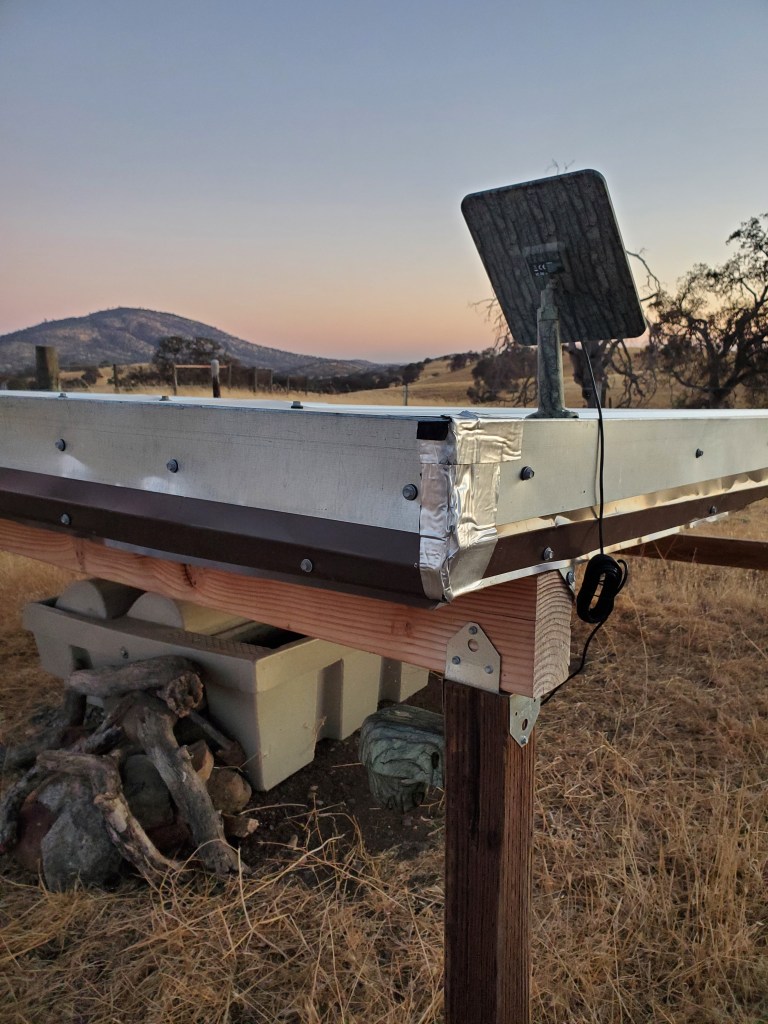
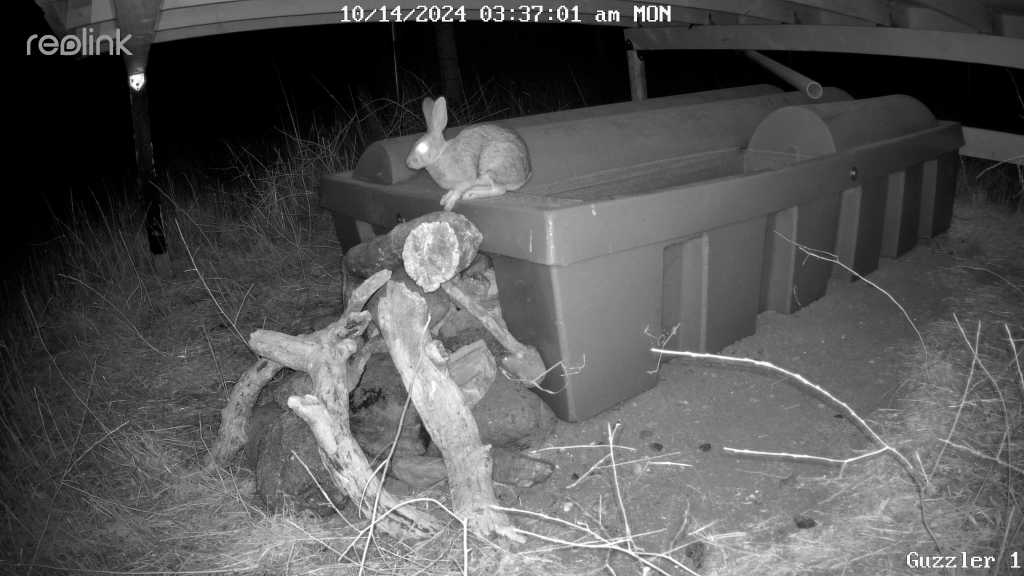
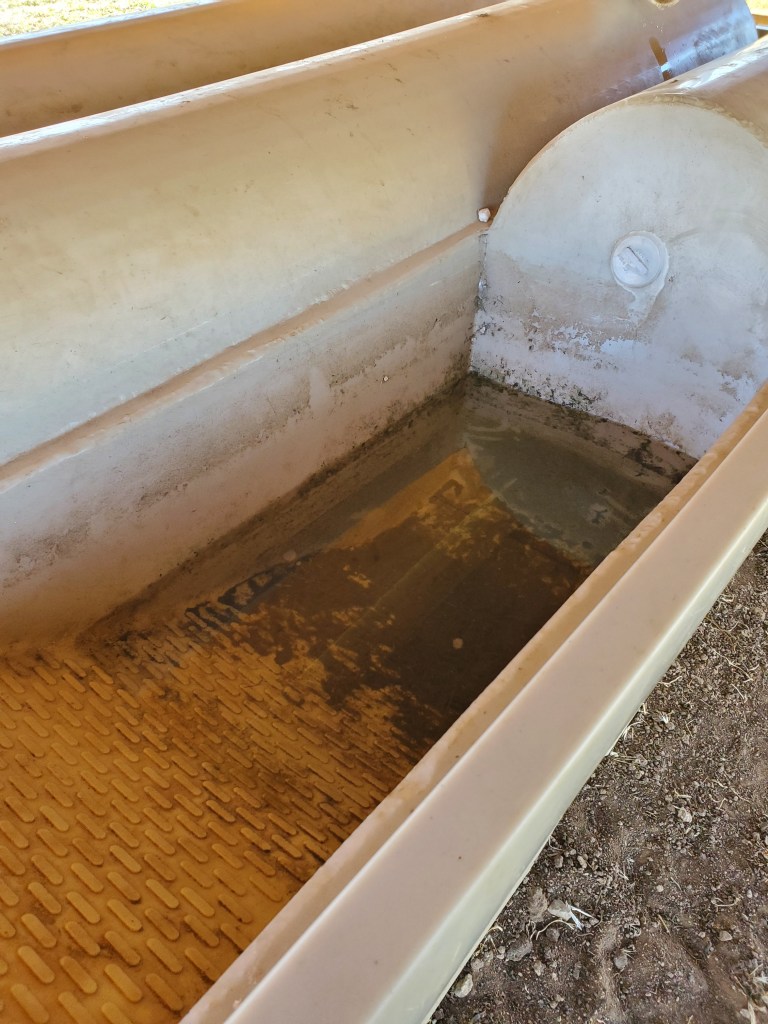
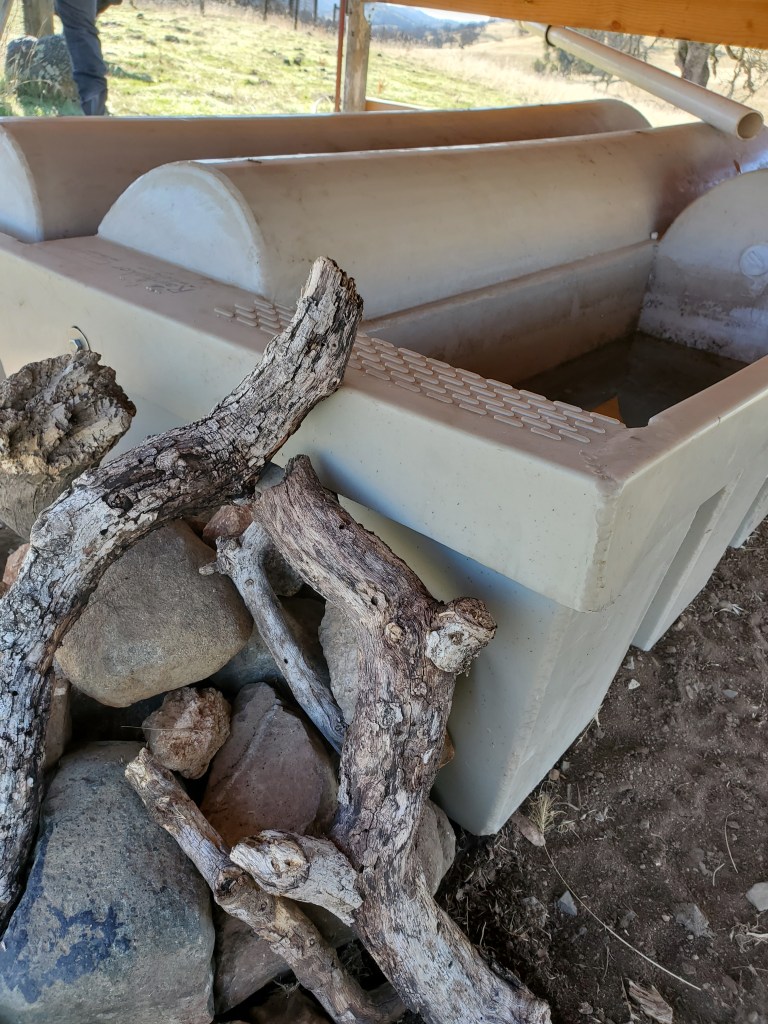
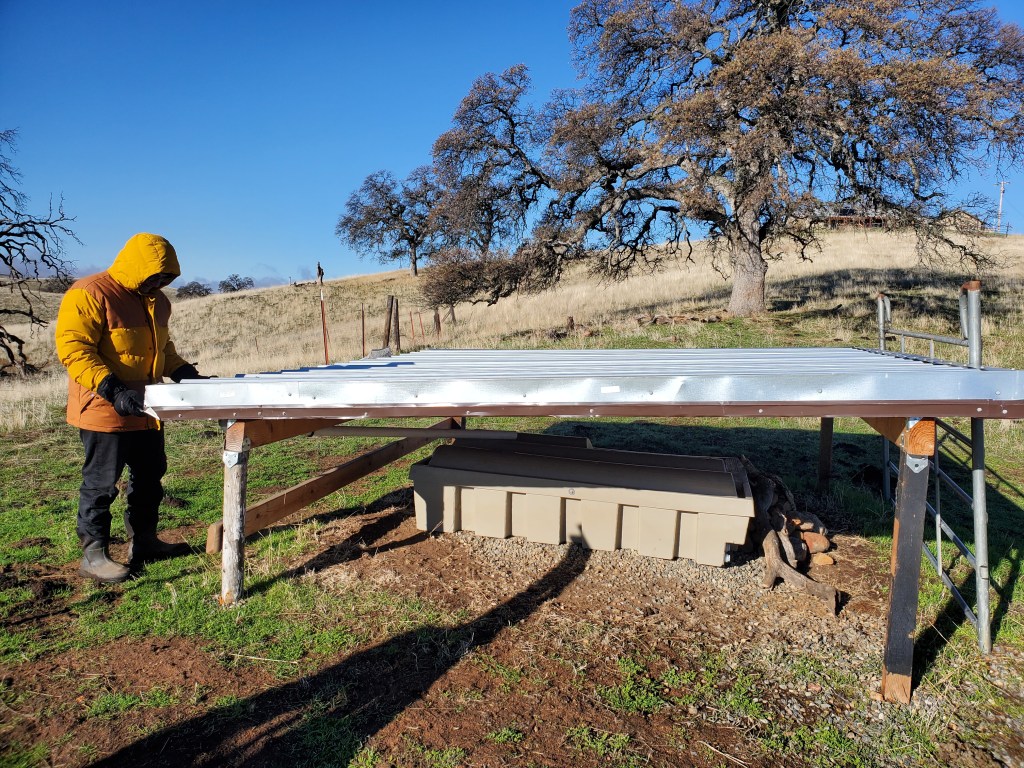
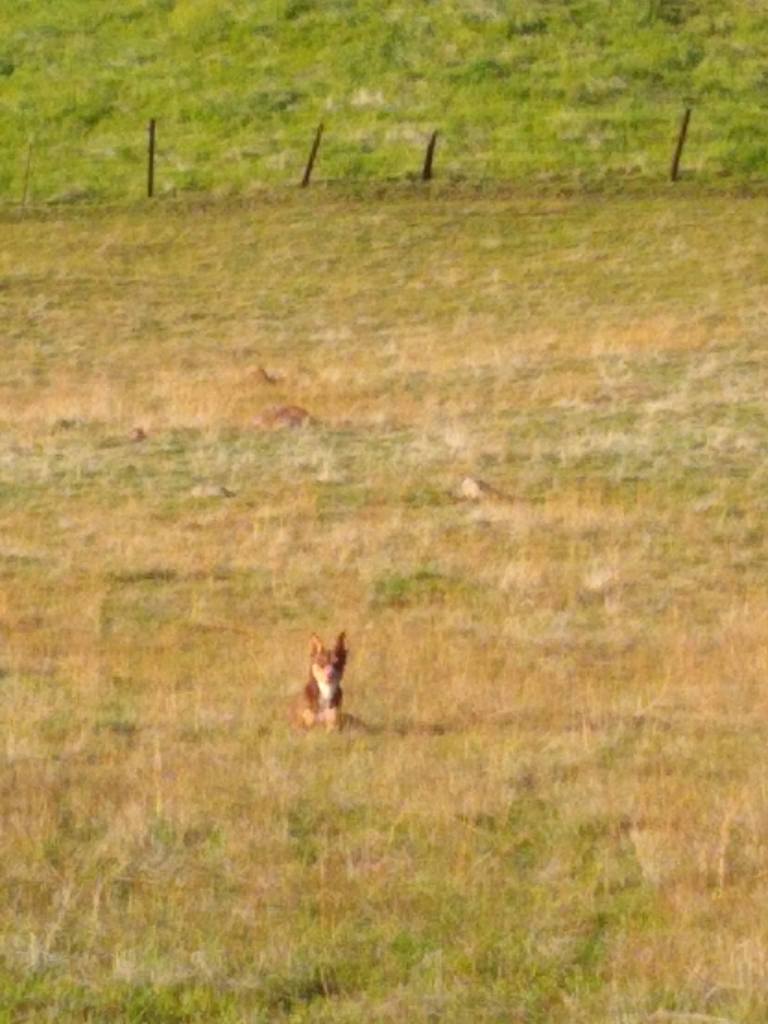
When the temperatures cooled, more animals and insects came out or at least appeared more active. I hear coyotes singing much more since the nights cooled. More raptors in the air, more bees and of course, the spiders. David and I installed a game camera on the wildlife guzzler overhang to see who was using it for water, and a large hare climbed up the wood pile and down the ramp to take a sip. That was exciting.

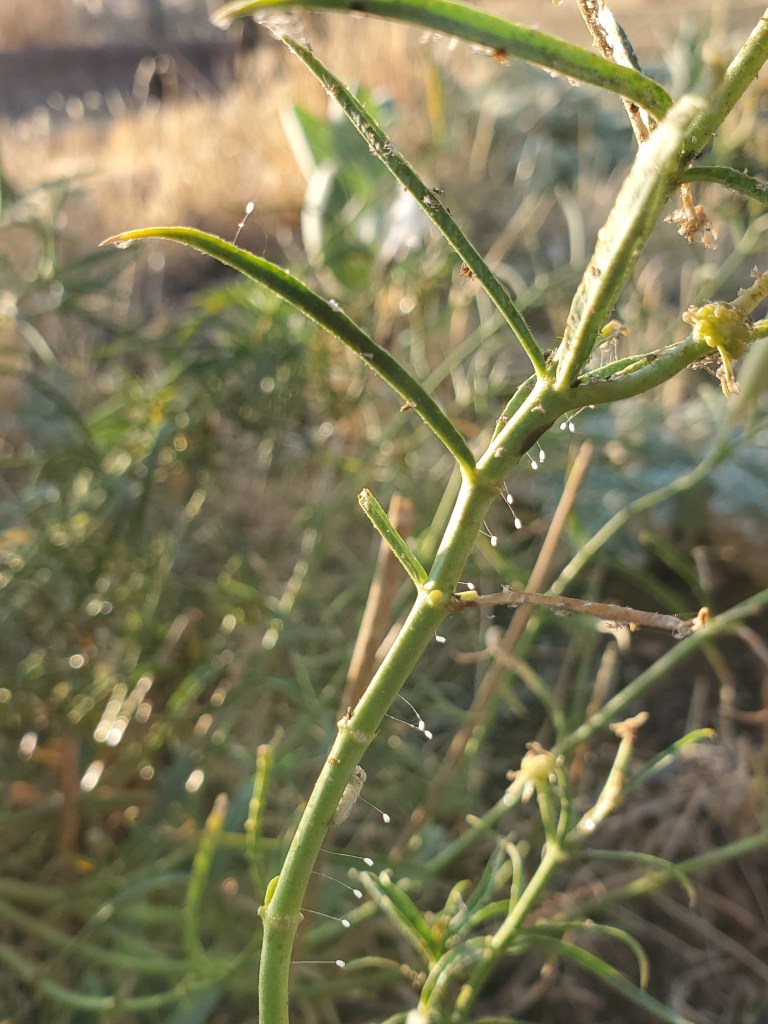
There is also considerable activity on the milkweed plants. I have looked at them daily for signs of monarchs, but there has been nothing. It has been too hot, and now the window is closing. The plants are winding down, and seed pods are opening. I did see a remarkable sight however. It was lacewing eggs. The lacewings love aphids, of which there are many on milkweed. They lay their eggs perpendicular to the stem of the milkweed and place the egg on the very tip. A special shout out to friend and bug knowledge bearer extraordinaire, Sean Werle. He helps identify the many things I do not know.

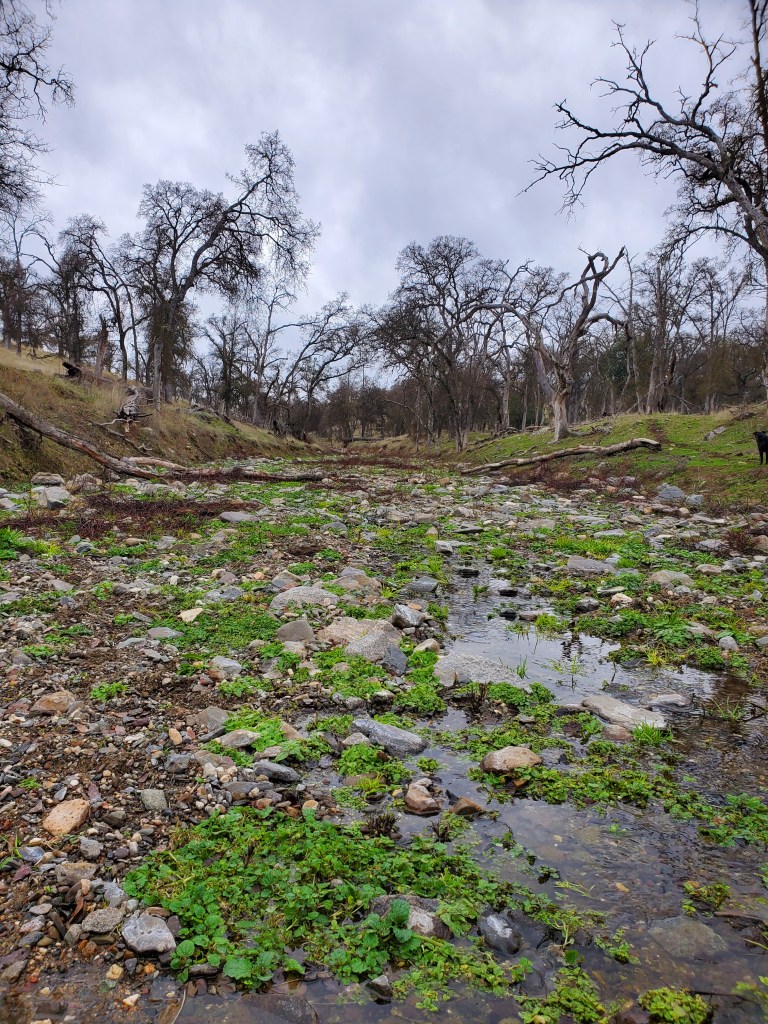
The other day, I was washing dishes and looked out the window to the east. I saw some large black specks on the side of the hill. I thought, “Oh, that’s where the cows are now.” As I looked, I saw them move much more agilely than a cow. Then, the shape was wrong as they made their way further up the hillside. I ran to get my binoculars and confirmed what I thought; it was wild hogs. There were several adults that had to be 400lbs and a lot of babies. My neighbor saw them too, and they counted 20 in the unit. They had been down in the spring creek ravine. I wondered what havoc they were engaged in. After they were well-over the ridge, I walked to the creek and found the entire lower half of it rooted out. All the vegetation was gone and the soil turned up. Where it was dry just the other day, was now wet with the removal of the plants and grasses. On the bright side, there is more space for animals to find water along the creek. On the down side, how can I ever expect to re-vegetate that space with oak saplings and milkweed if the pigs can come in and destroy all vegetation in an hour or less?

Wanderings

Oh the heat. Each year, it seems to get worse on some level. I feel so bad for the nature relatives that depend on us to use our sense in maintaining this beautiful world. I cannot tell if this year is more miserable than the one before. With the grasshopper incursion and my father’s illness, everyday is just something to move through – not much time for soaking up the joy of stewardship.

Although there is a great deal on my to do list, my priority is my family. Dad has been in the hospital twice since I last wrote and the list of medications, doctors, support staff and paperwork grows exponentially. I only have time for the ranch “must dos” and not the “wish list”. With good medicine, a will to survive and a little luck, Dad may get more stable, and a predictable schedule will be established. Until then, I will look longingly across the ranch and at photos of times past wishing for the best of health for all of us – monarchs and mammals, dads and daughters – all of us.

Everything is Gone

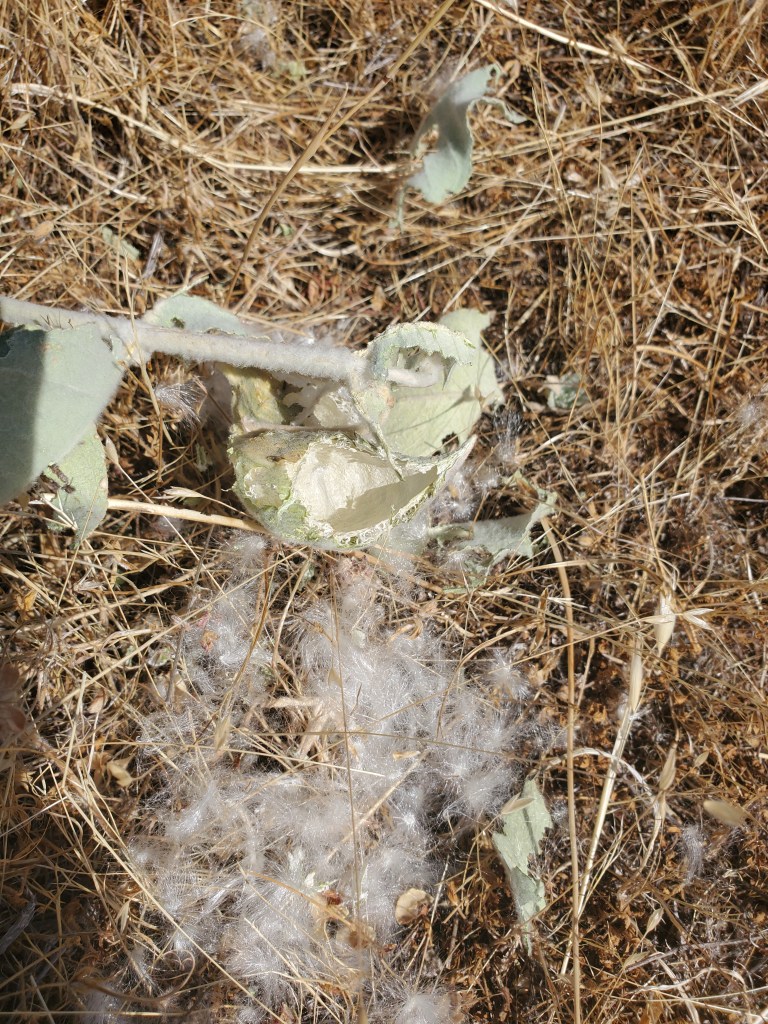
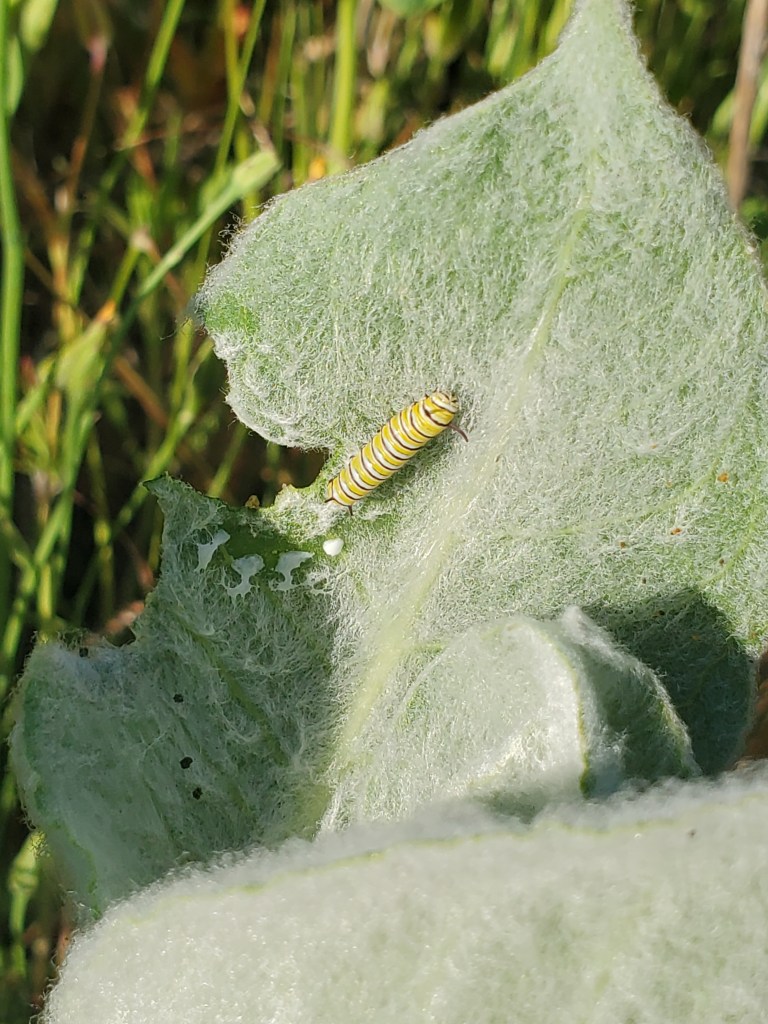
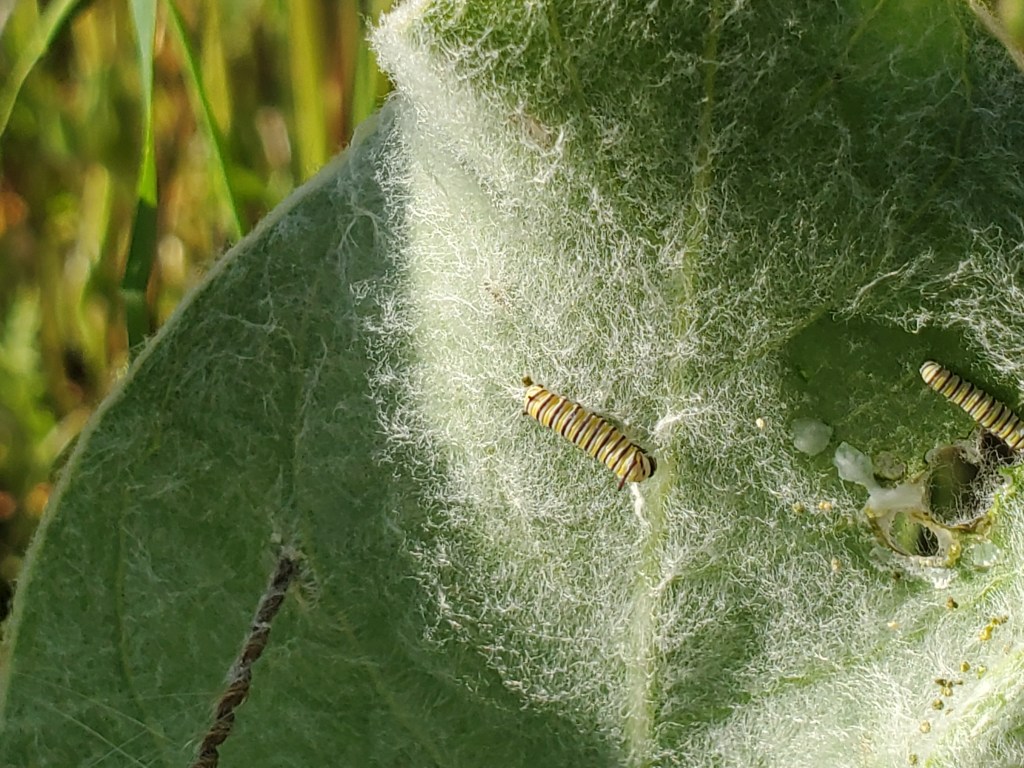
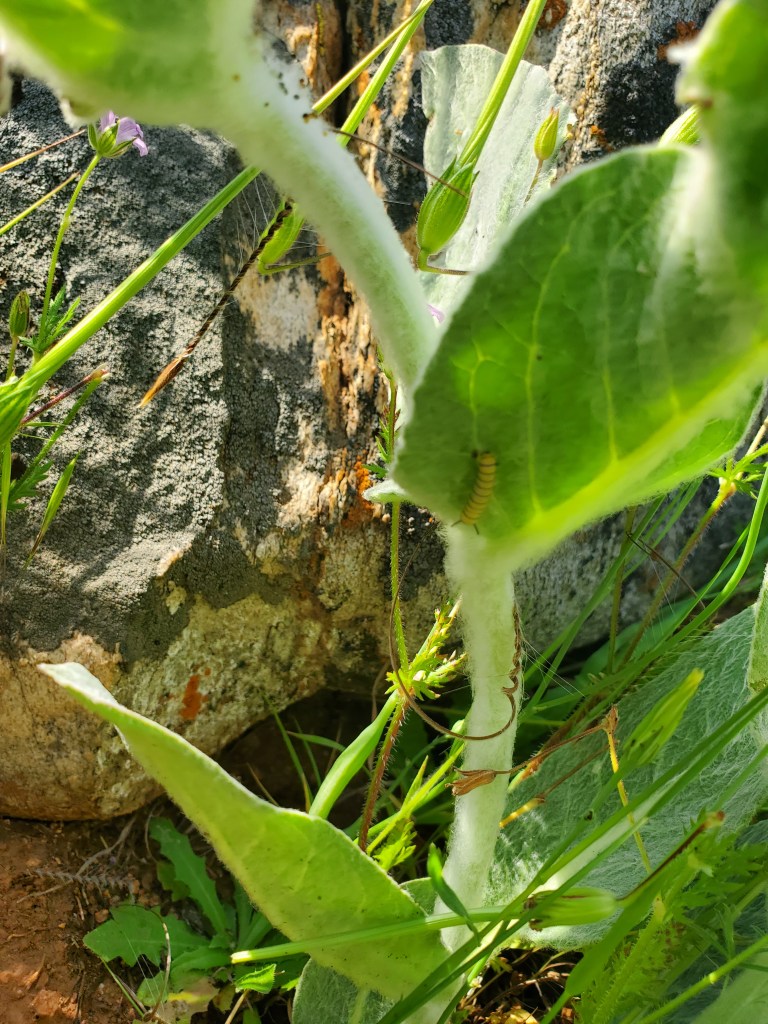
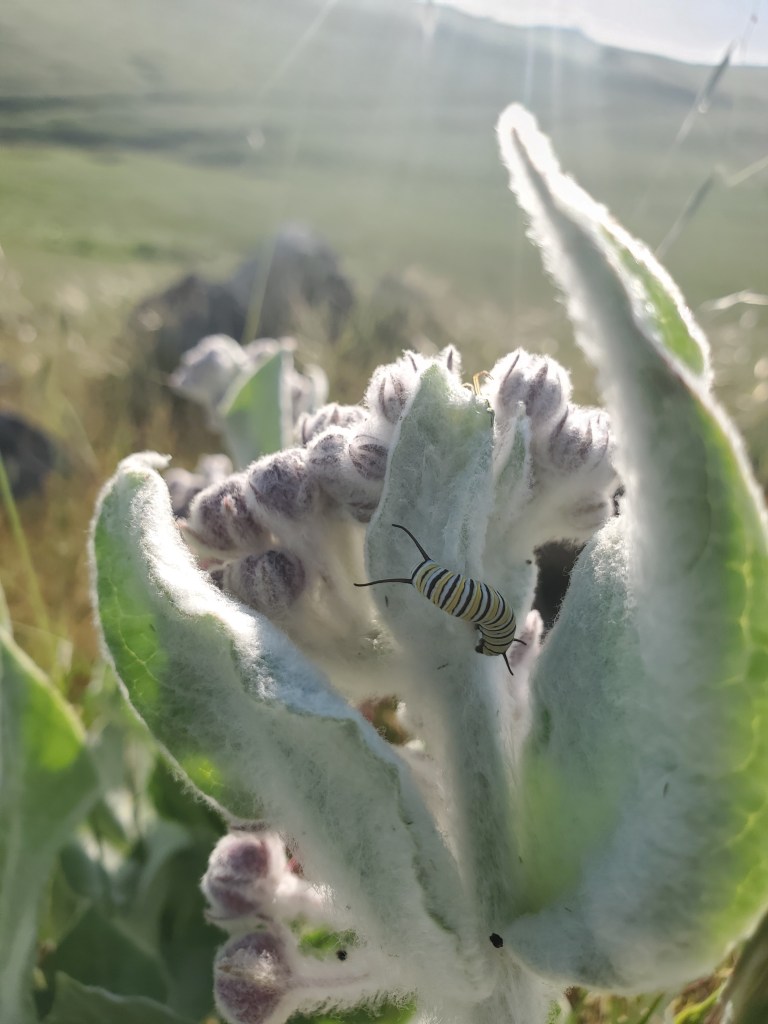
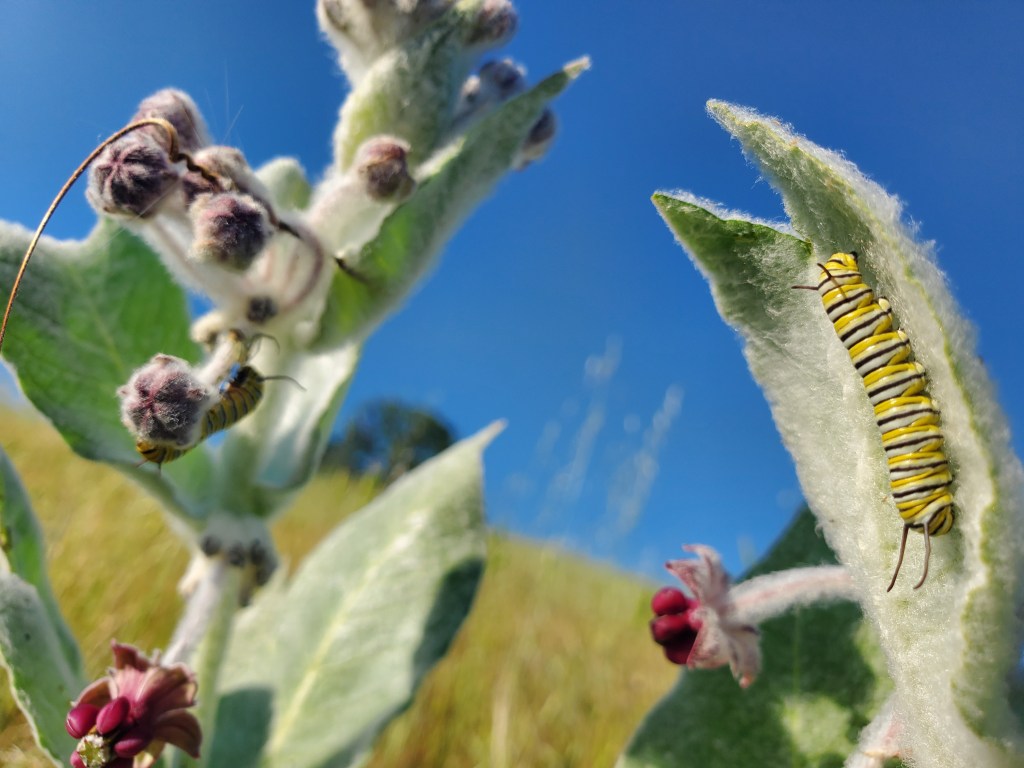
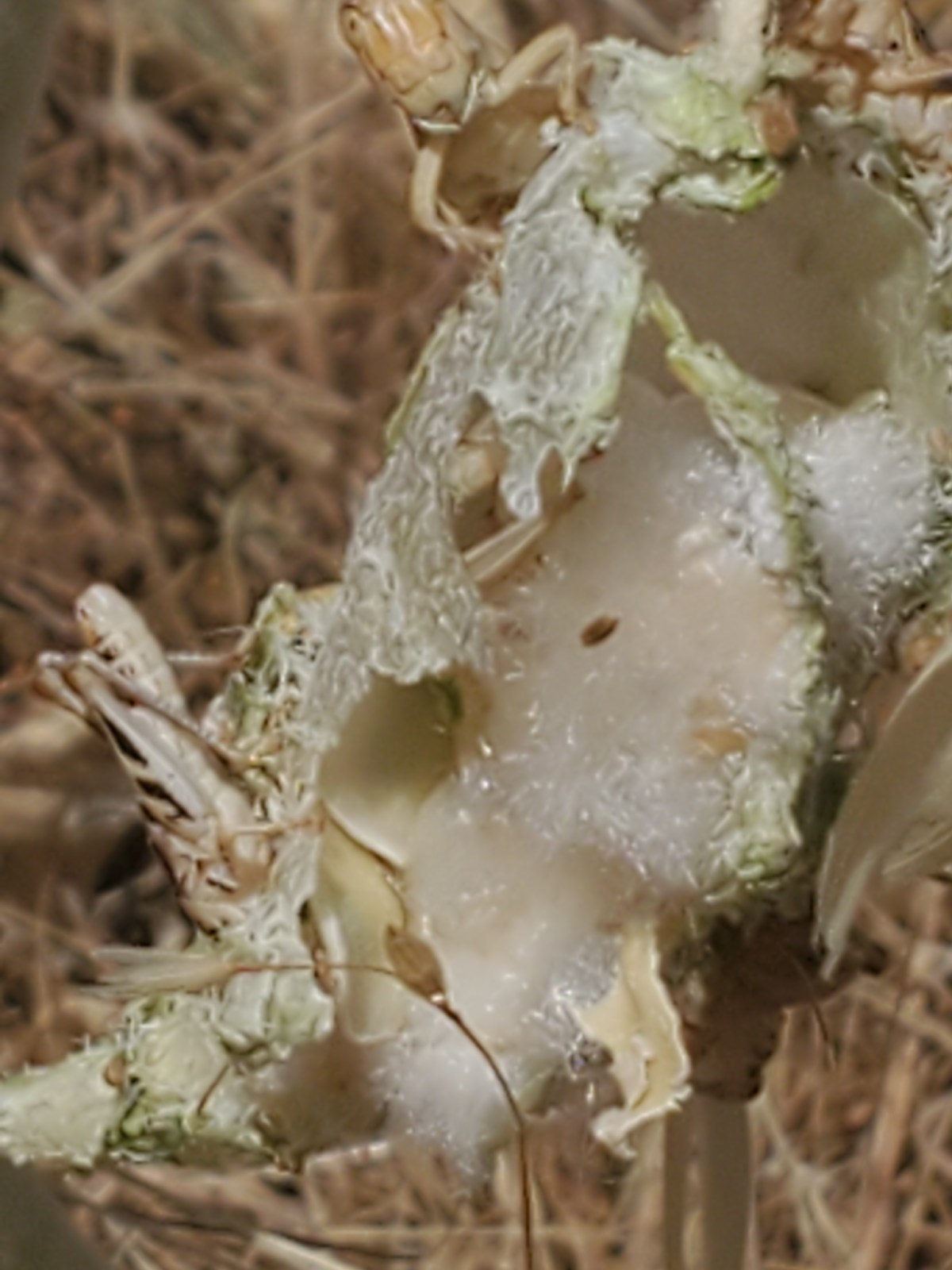
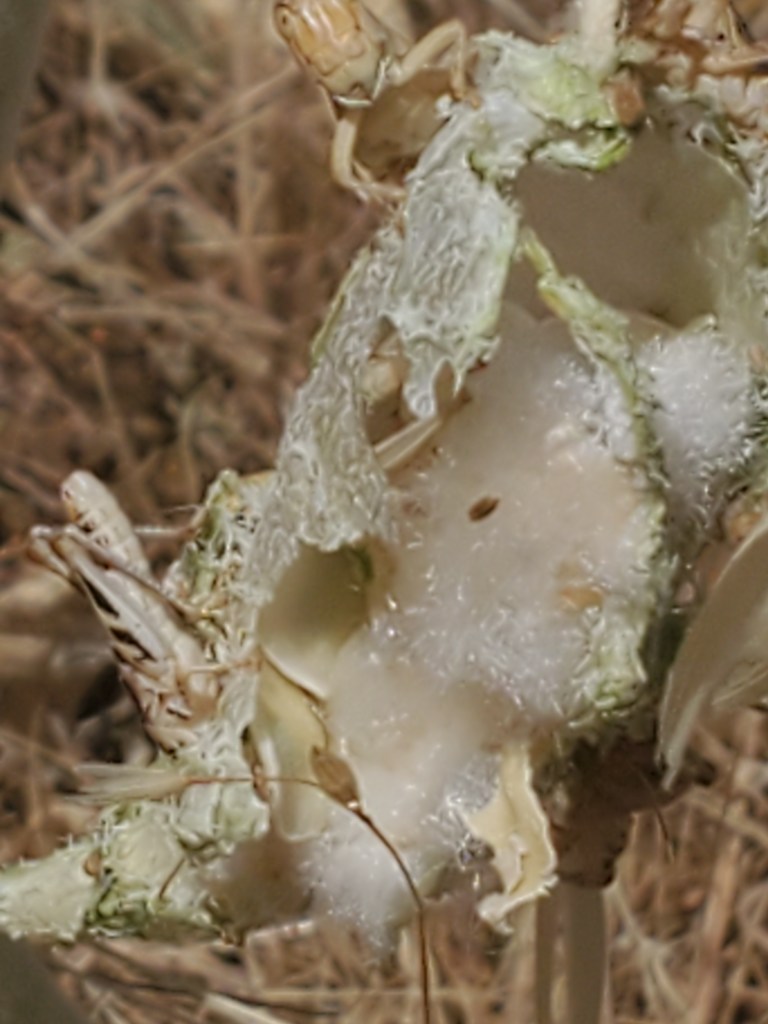
Grasshoppers eat woolly pod milkweed

We knew it was going to be a bad year this year when the grasshopper nymphs would bounce up like a solid wave with each step across the fields. There are billions of them, and I am powerless to do anything about it. The time to plan was several months ago, but I didn’t. I didn’t have time or energy to build screen houses and boxes. It is not an insignificant task – so I resigned myself to the possibility that my beautiful pollinator gardens throughout the ranch would be no more. What I did not expect is that they would also consume the oak seedlings that I painstakingly planted across the front of the ranch. That made me crumple inside.

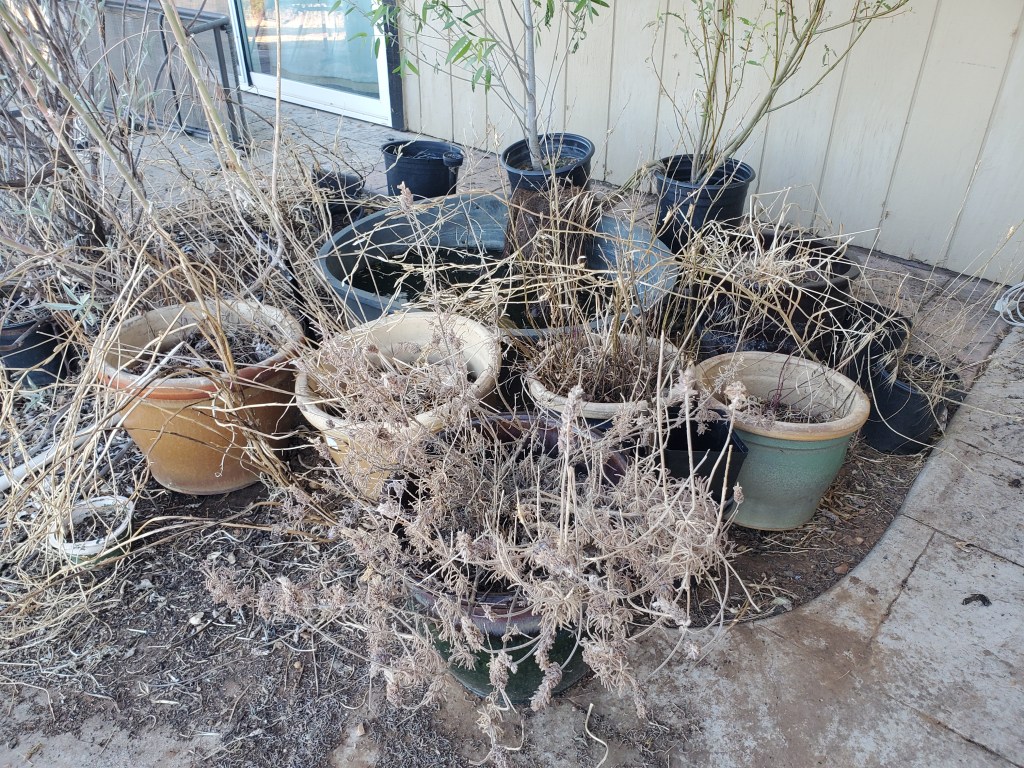
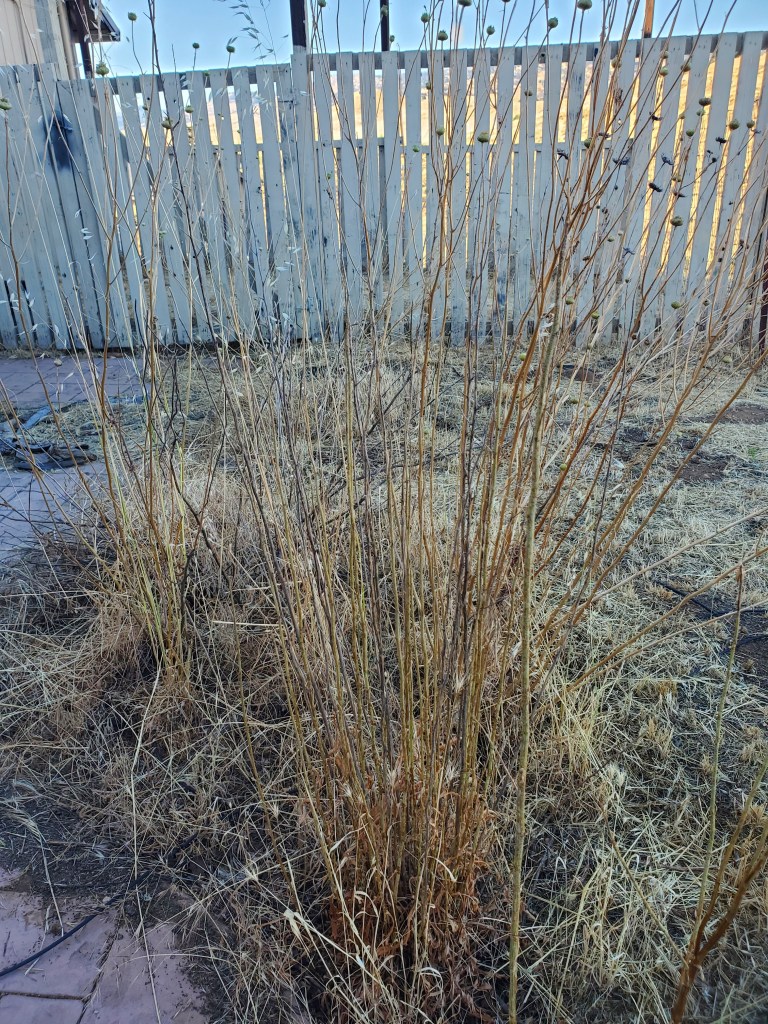
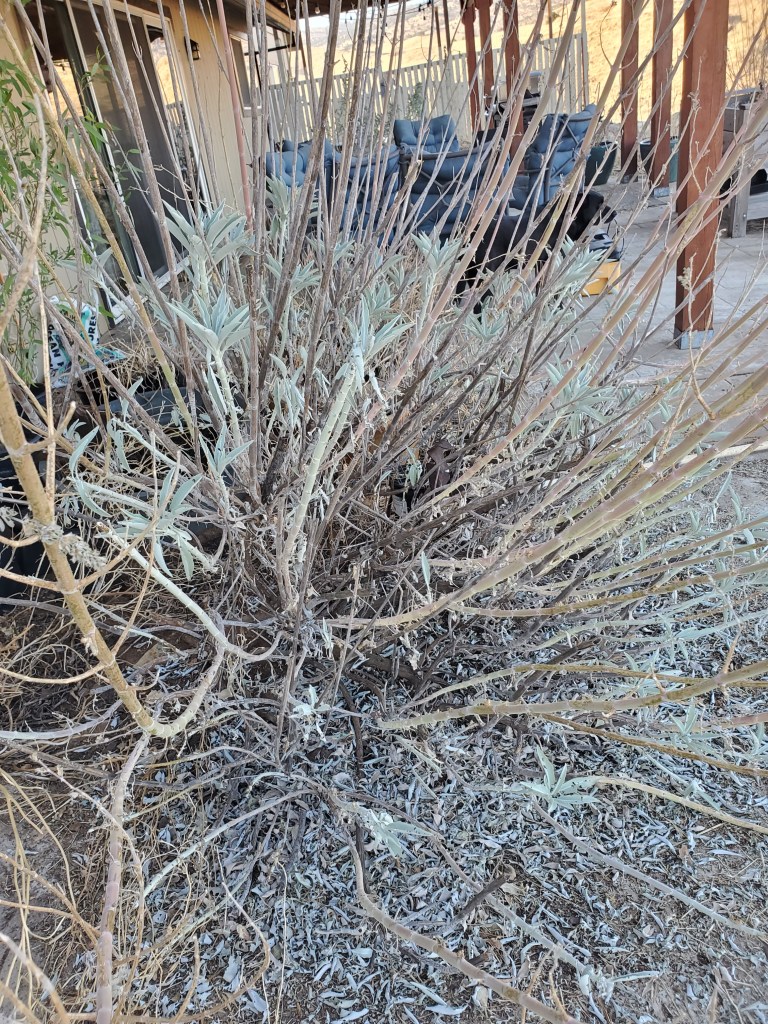
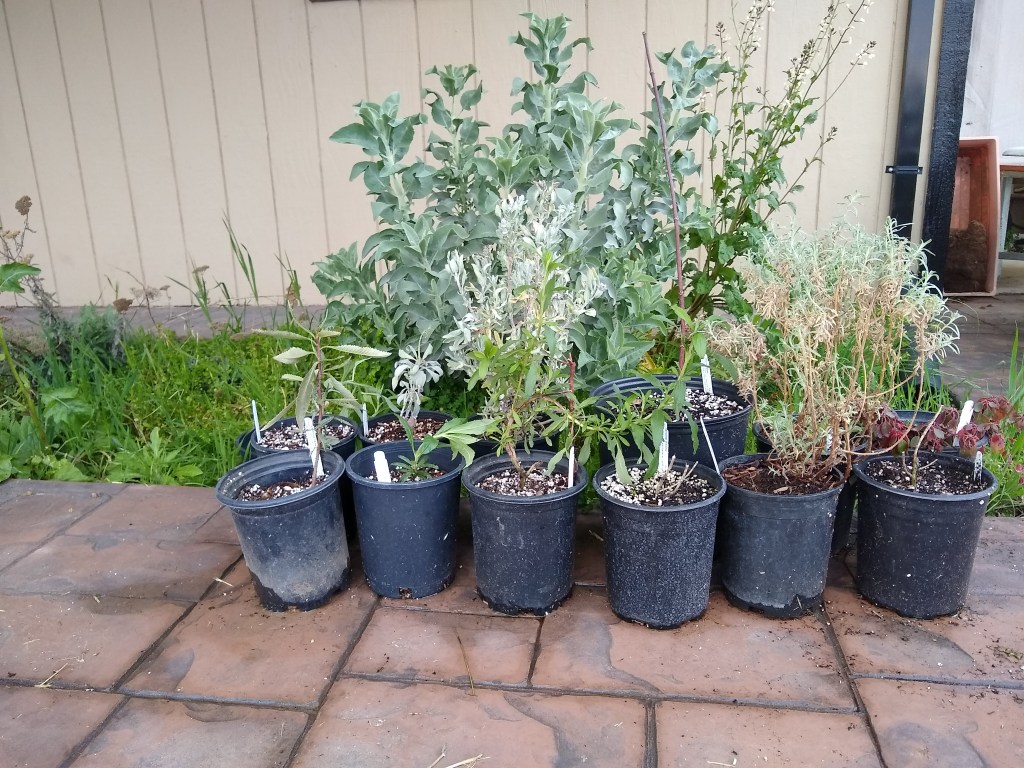
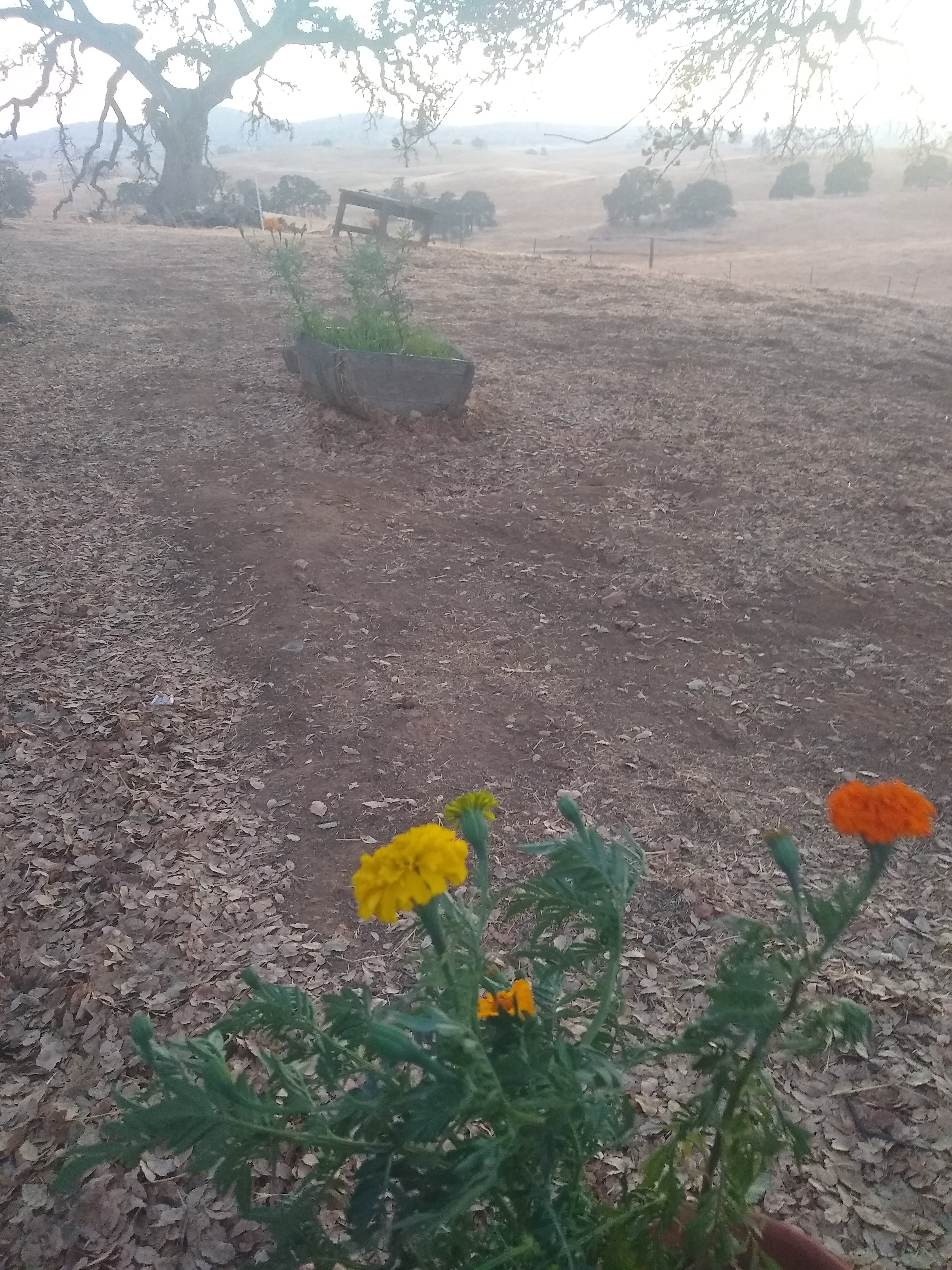
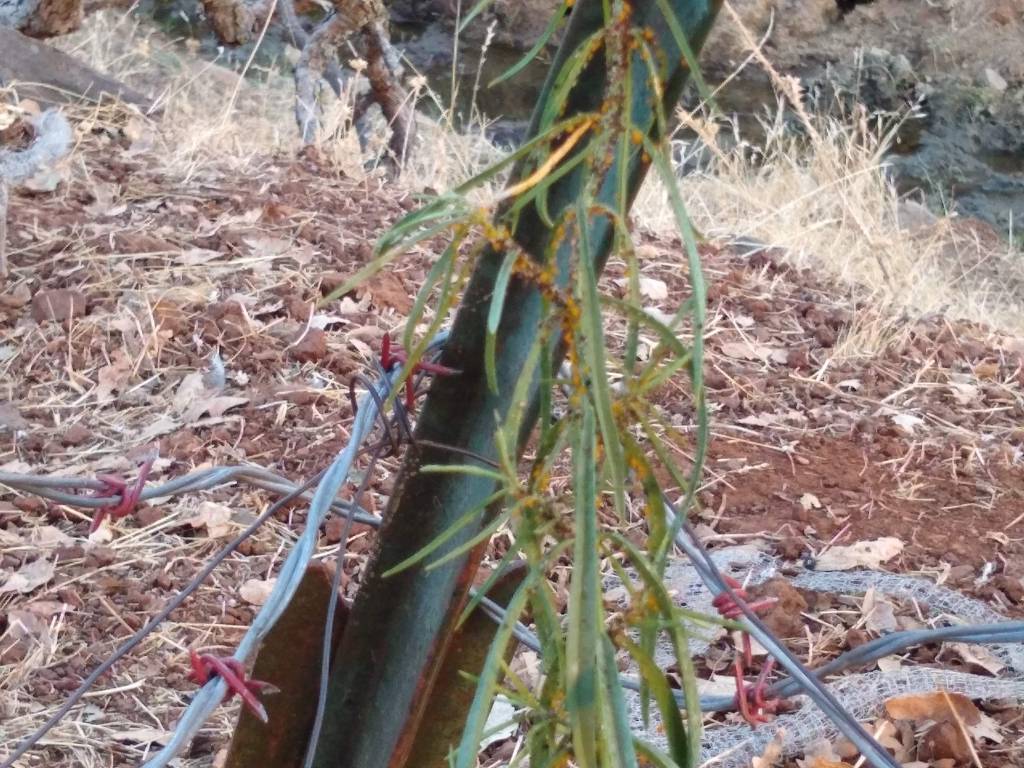
David raced to build me a few screen boxes last week. For him, they take about 3 hours each – much too long to build enough to save plants. In the end, he built two – one with plastic screen and one with metal screen. He used what we had for the window screens. Unfortunately, as you can see in the image above, the plastic is not durable. The hoppers can eat through them. We tried to save a sage, a narrowleaf and two other nectar plants. The purple sage nearly died last year. I figured if it was not covered, it might not live through another ravenous incursion. The narrow leaf is the largest, most mature. Last year, the monarchs chose this one and a few others on which to lay their eggs. I am trying to have something for the monarchs when they come back. The other two nectar plants will likely get eaten. There is no box to hold the structure. The screens are pinned around the plants and thus, open to being shifted by the hoppers. It will likely just slow down the inevitable. I am not sure what I will have by September for monarchs to feed on — maybe tarweed and seep monkey flower if I am lucky.

We are still watering. The roots are alive, and will need strength to make it through this onslaught.

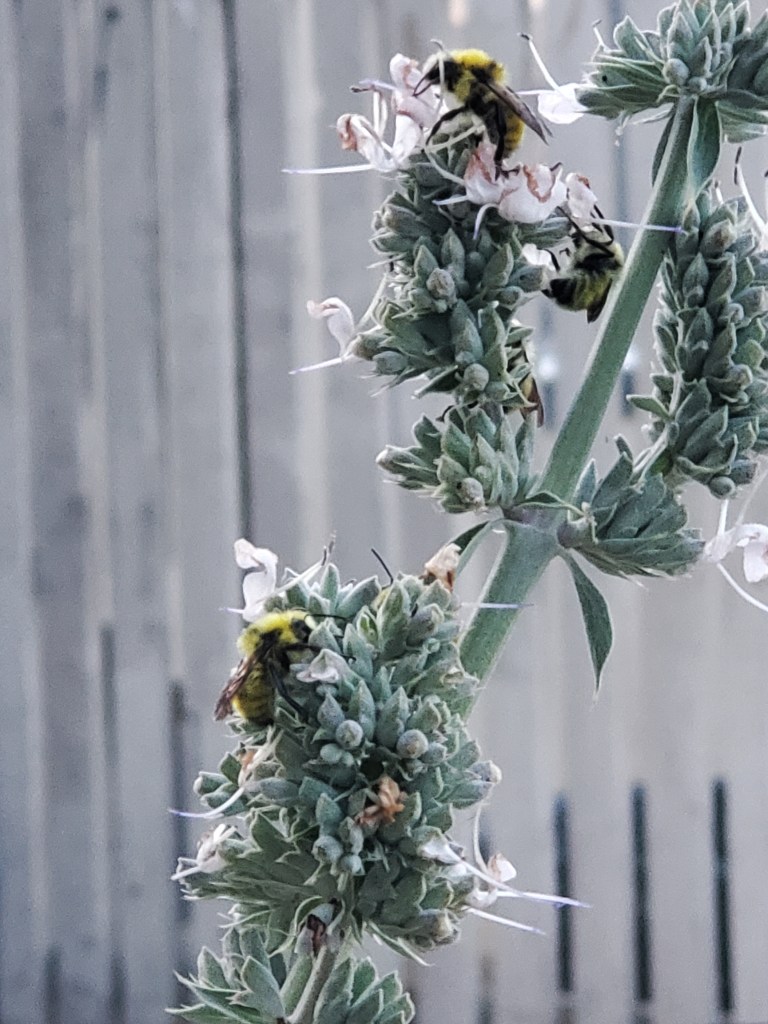
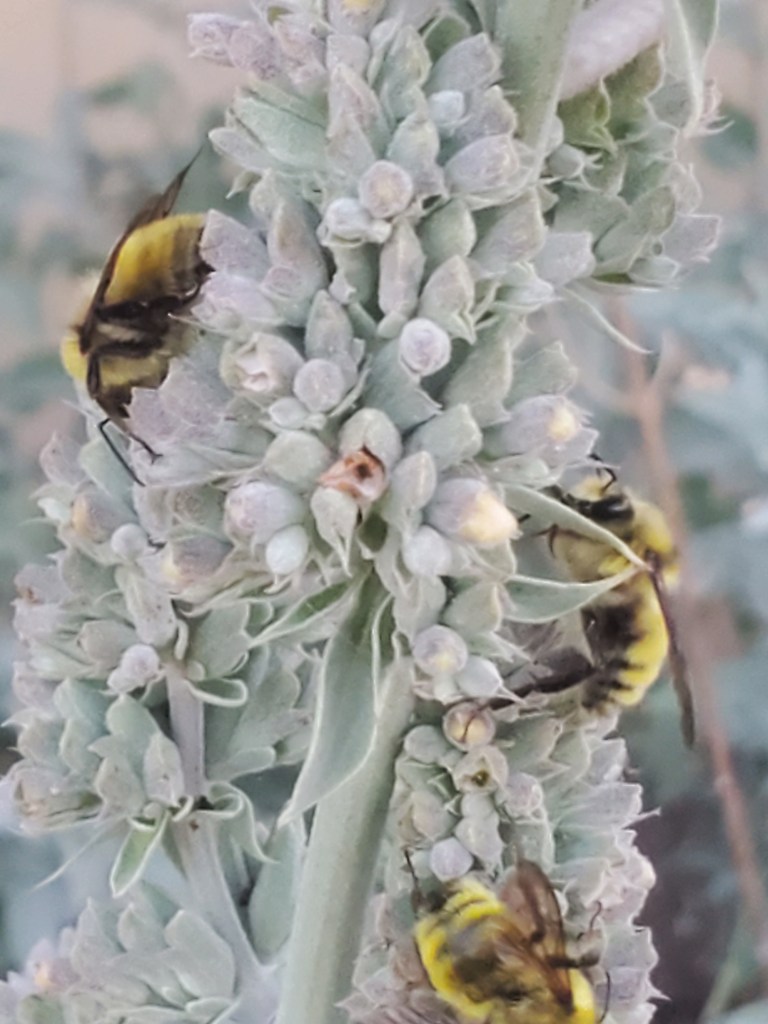
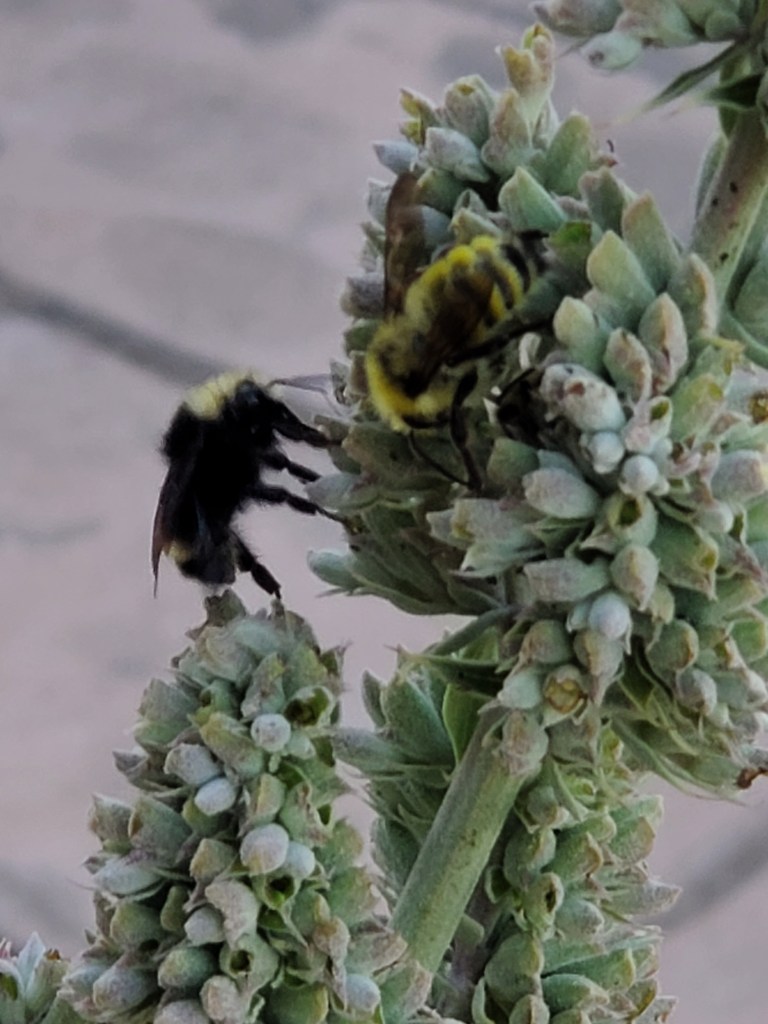
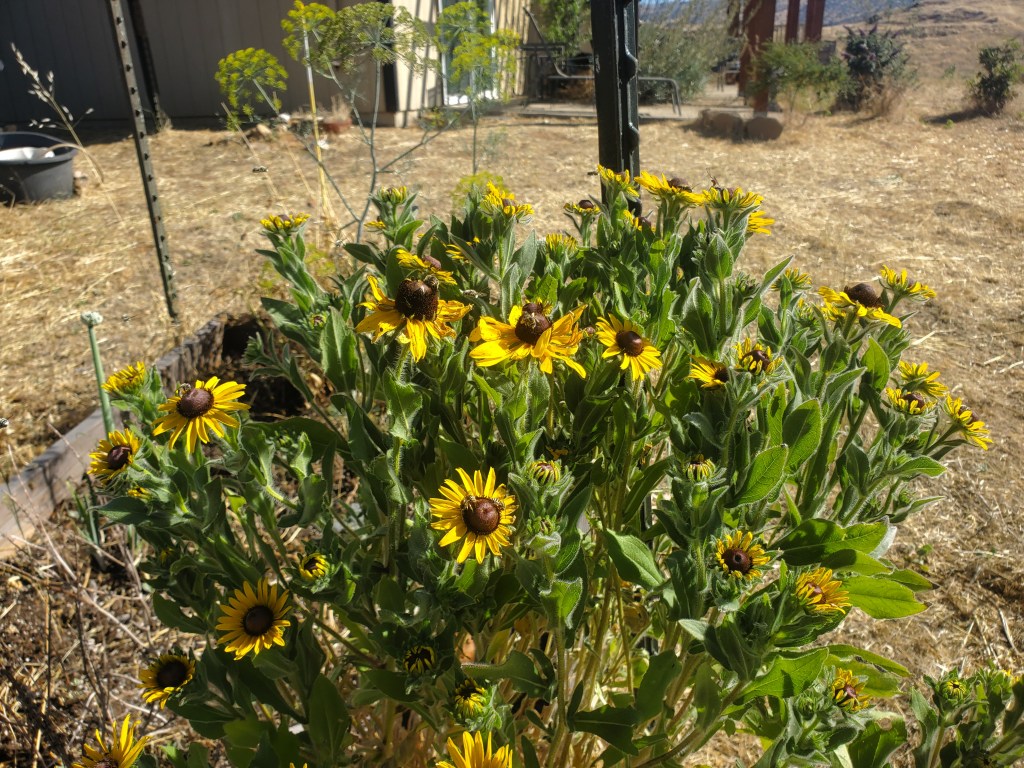
I am loathe to post photos of before this plague. It hurts to see the beauty of this place. I worry about all the bees that used these plants for food and lodging. What will become of them? It is important to see all the life these plants supported before they were ripped to shreds. Again – all of the plants below are now gone.

Milkweed – a Race to Save the Seed Pods

I have been traveling for work much of April and May. As the hoppers continued their death march, all I could do was hope from afar that it would not be as bad as I thought. Over the phone, David would prepare me for the worst. “Hey HB”, he would say. “Don’t freak out, ok? The grasshoppers are taking everything down. Expect that when you get home.” Guilt would creep into my dreams. I was not around to protect the California Milkweed seed pods. When I returned in early June, I ran to the close plot to gather seedpods. To my horror, most of the plants, seedpods and all, were completely gone. Stems were stripped. Please understand that this is early. Last year and the year before, the hoppers did not decimate things until late June and July when the pods were more mature. I thought I had time. Operating off this data, it shocked me to see the California Milkweed like this. My stomach sank as I ran from corpse to corpse looking for any sign of seedpods. I was going off location memory as some places only the absolute bottom of the stems were left. Luckily, I found a few with pods remaining.

It was getting hot, and I was running over the unshaded hillsides. I moved as quick as I could up the steep slope to the large section of California Milkweed. I did not expect to find much – but – to my joy and surprise, several of the older large plants were still intact. And…two had a large number of seed pods. With relief, I harvested them to continue my work of spreading their seed when it was safe.

In all, I gathered 13 pods. I left three immature pods on one stem, and will go back for them in a few days. They might have a chance – but they really were not ready to be pulled off.

Abundance in the Creeks

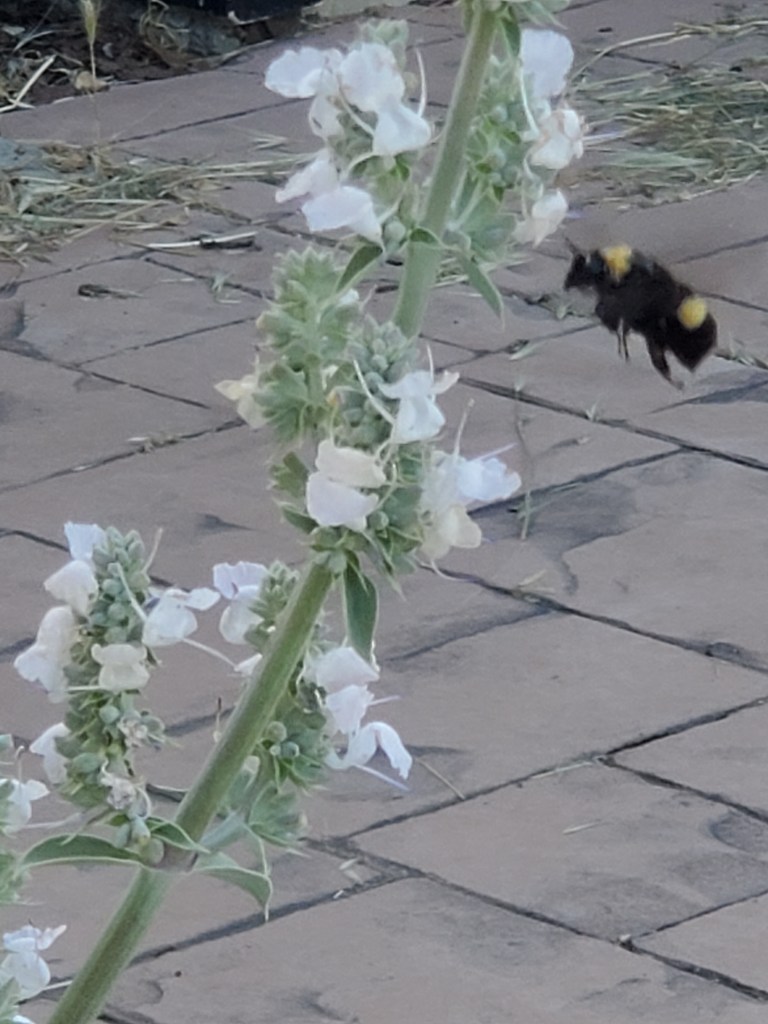
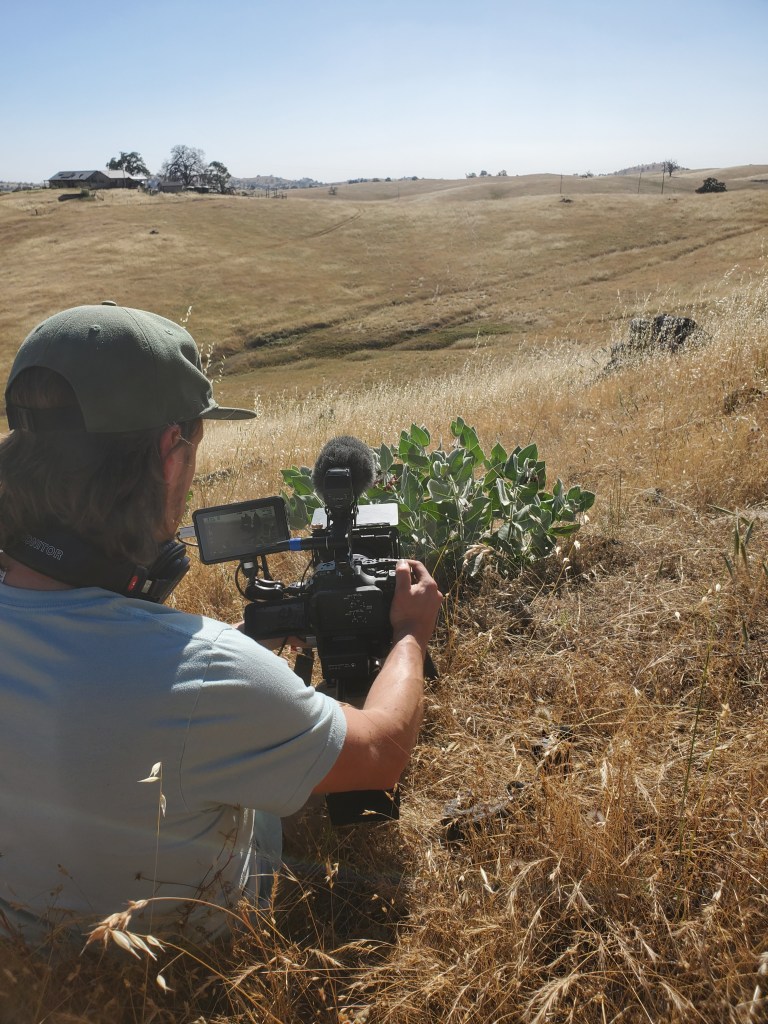
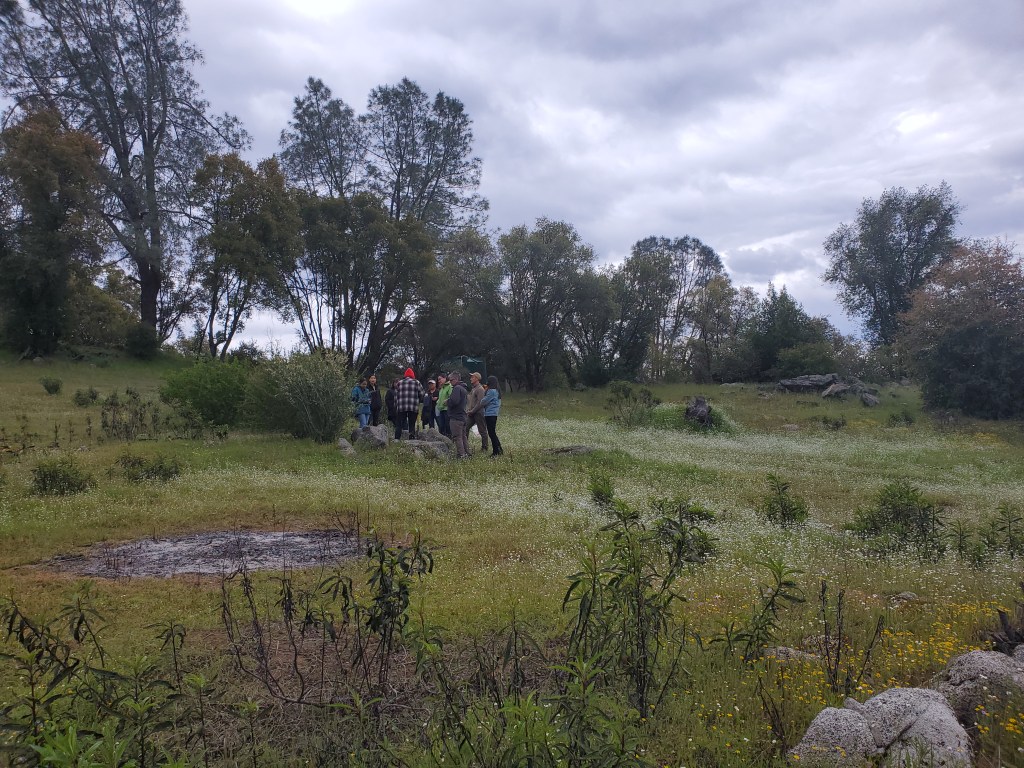
The last few weeks I took several biologists and a documentary filmmaker (Ian Nelson) across the ranch to showcase some of the stewardship work we have been doing. While in the riparian areas, we were able to witness an abundance of buckeye butterflies, great nectar plants, and a new cottonwood seedling. Shockingly, however, the grasshoppers are in the creeks as well. This is highly unusual. They tend to avoid wet places, and the creeks are still flowing with plenty of water. One biologist thought cattle got into the exclusion areas and ate the plants in the creek. I said, “No, this is grasshopper devastation.” She looked closer and saw the filigree in leaves and stems from a billion little mouths taking bites. She was shocked. As such, even in the excluded areas, there is no seep monkey flower, datura, or other riparian broadleaves. Even the thistle is eaten. Fortunately, the buckeye trees were still in bloom and a few other species had blossoms. As we approached some intact plants, we saw a diversity of native bees, including bumbles. My heart swelled. Now I knew that the bumbles had a place to find food. Phew!

Beautiful Reciprocity

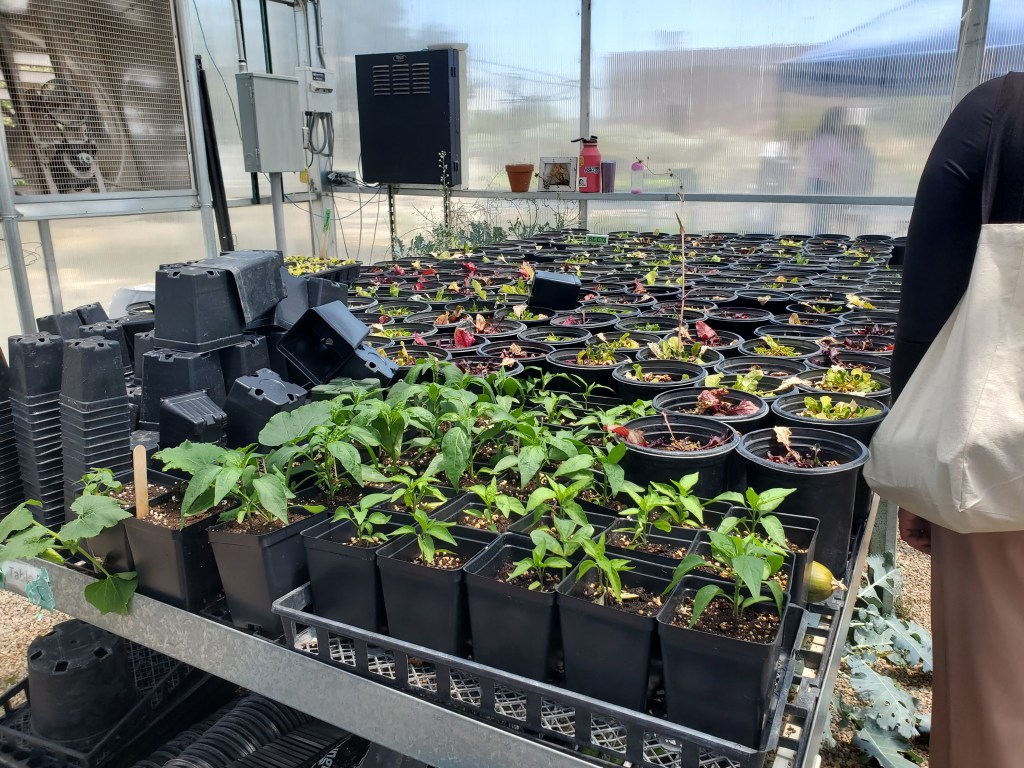
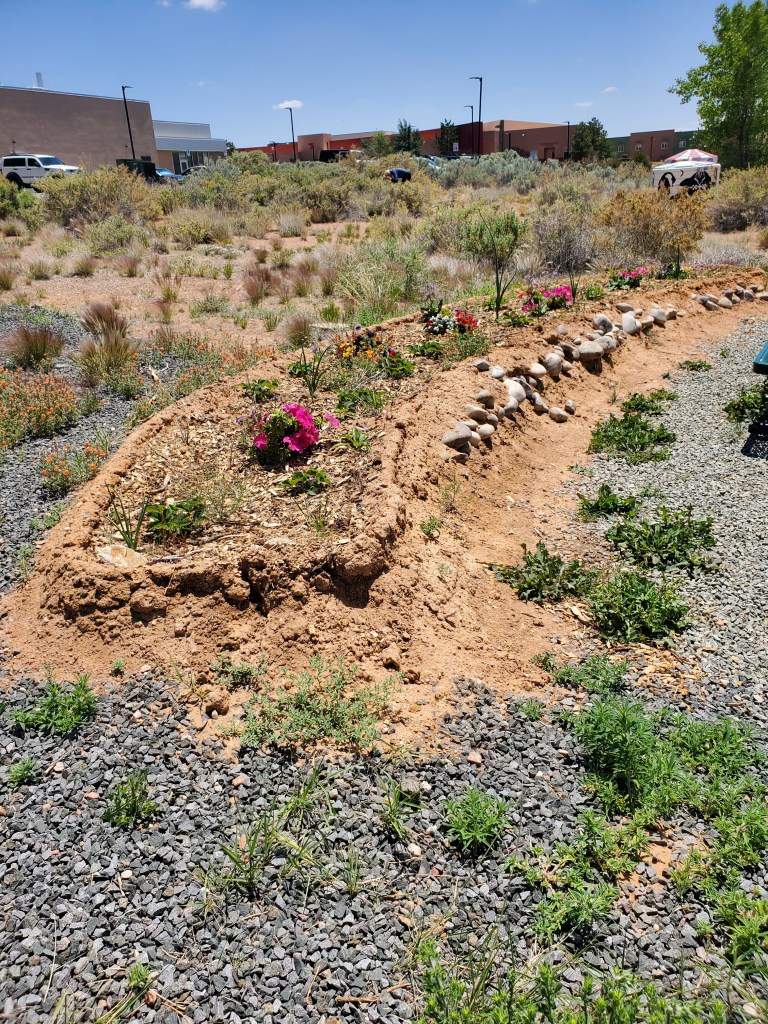
Prior to the destruction, I had the honor to go to New Mexico twice for tribal events. The first time, I went to learn about riparian restoration at the Santa Clara Pueblo – the Poeh. We planted 100 trees and plants on their tribal lands after learning from their work.

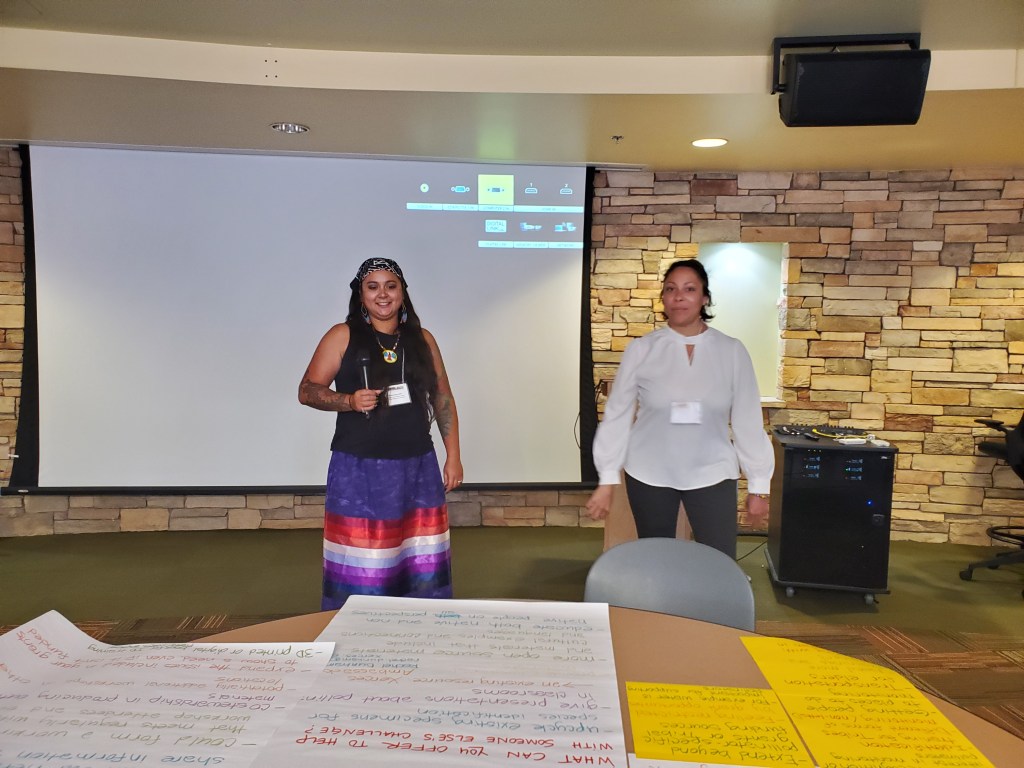
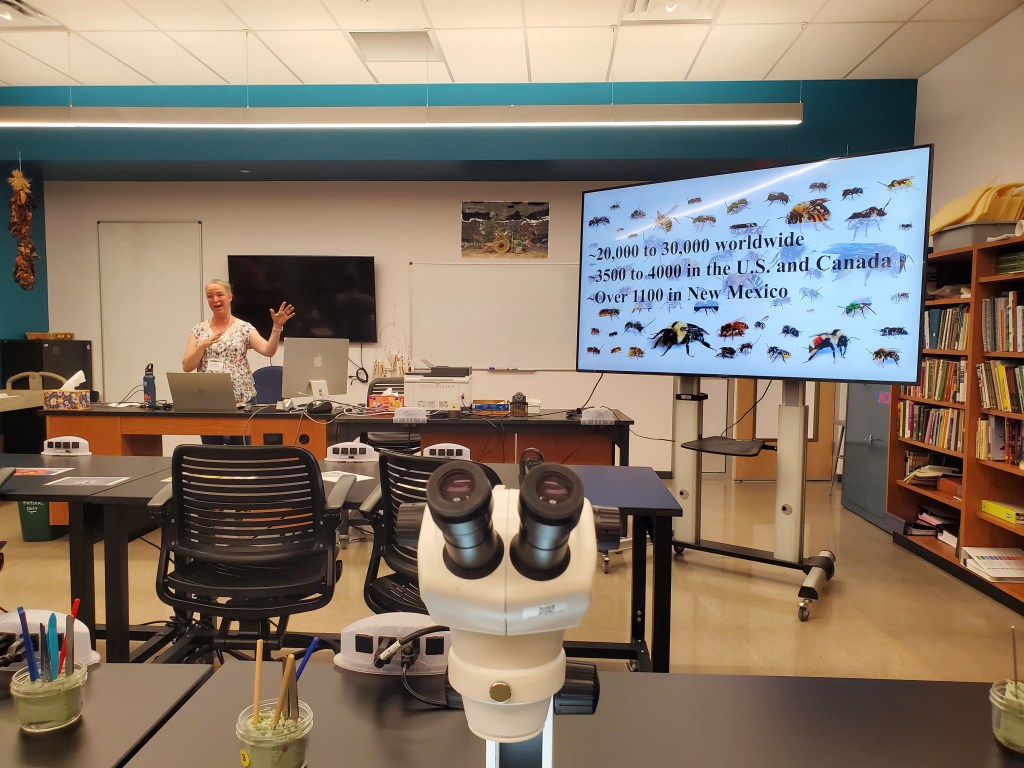
My second trip was incredible, having been invited to present a case study on my pollinator work to a pollinator tribal summit at the campus of the Insititute of American Indian Arts (IAIA). Shana, the Southern Sierra Miwuk Nation Pollinator Coordinator, was invited as well. She presented and did an excellent job. There were US government agency leaders and over 15 tribes working on or wanting to start some type of pollinator habitat work. It was an incredible opportunity and experience. I met so many passionate people and enjoyed the beautiful weather of Santa Fe.

I also attended a ceremony of remembrance for the ancestors slaughtered at the Tubatulabal Tribe on their recently returned lands in April. It was moving. They are working to restore the lands to traditional uses. They want the ducks back, which is the meaning of their name – people of the mud duck. To bring ducks back you need water and insects. I helped them complete their application for a Xerces riparian habitat kit and learned in May that they had been awarded the grant. So grateful to Xerces for this habitat kit program and to the Tutbatulabal Tribe for everything they are doing to live in right relationship with the land.

I am also involved in the California Jobs First initiative and was recently appointed to the California State Fair Board. In all places, I am hoping to ensure an Indigenous perspective is at the table informing decisions – and hopefully, helping resources move to Indian Country, which has, for far too long, suffered from significant under-investment.

To be given guidance, opportunity, learning – they are gifts. They help advance my ability to be of service in this climate changing world. As such, I need to ensure I use these gifts to provide a benefit, to be helpful in a meaningful way – not a way that just I want, but a way that serves a greater good. This is reciprocity.

Don’t Get Down – Get Planting

As the landscape around the house is converted from blooms to straw, I made plans to continue to build habitat in Sacramento. While on a trip, I met Brenda Marsh. As people do, we discussed our work and involvements. When she learned about the severe decline in insects and pollinators, she asked if I would help her make a pollinator garden at her home. Of course I said yes! She lives in Sacramento. Since she is busy working and travels quite a bit, she does not have much landscaping – mostly an unwatered crabgrass lawn and some beautiful trees.

I did a little planning figuring out where the plants would go and in what configuration, and then I asked Ron Allen at Mariposa Native Plants what he had available. In the end, we got 20 plants, seven milkweeds and thirteen nectar plants. I convinced David to help me (I told him there was a great lunch in the deal for him). He is great with irrigation systems. David pulled together some irrigation supplies and off we went.

Much of Brenda’s neighborhood is sterile with lush green lawns and some exotic nectar plants. Still, while we were working there, we saw a big yellow swallowtail butterfly and a white sulfur fly by. Two blocks up and around the corner, there is a house with a wonderful native plant garden. It was bursting with life. This meant that there would be some nice islands pollinators could hop to without fear of pesticide and herbicide use. In all, it took about 4 and a half hours, not counting travel time. Thanks to Brenda for being part of the solution!

My next plan is to help a lady in Clovis plant a large pollinator garden within her nine acres. I met her on the plane on my way back from Santa Fe. She had no idea about the horrific decline in pollinators and was anxious to do something. These are examples of why we need to be talking about this work, what is happening in the world and that there are solutions people can be a part of. Media is great, but the person to person connection is most effective. Those relationships are durable treasures that can spark incredible change. We need to be connected to one another and in reciprocal relationship with the earth now more than ever.

100th Post

Wacky AI generated image

It’s early Sunday morning. The sun is not up. I’ve been up doing chores, feeding animals, opening windows to allow the cool air, laden with scent, into the house. It is barely light, getting lighter. The birds start to sing. First one chirp, which leads to two then it all begins. I step into my boots, dogs at my heels and head out – pulled, then lightly pushed by the cool air now gently swirling in the house.

The ground is soaked from the dew. My boots collect the moisture along with leaves and purple pedals from the thousands of small flowers, close to the earth, lining my path. I check the milkweeds. They are stretched into the air bolstered by days of sun as they break through the invasive grasses that block the light. I examine the space to see if more are there. They are, and I breath, grateful for the resilience of these plants.
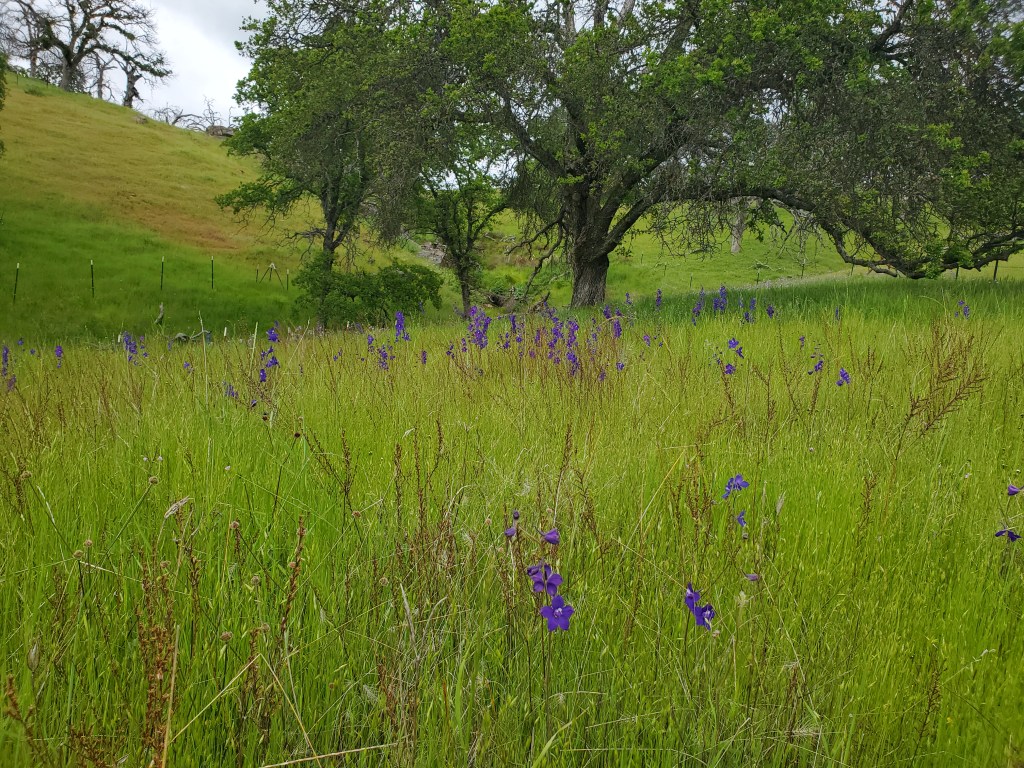
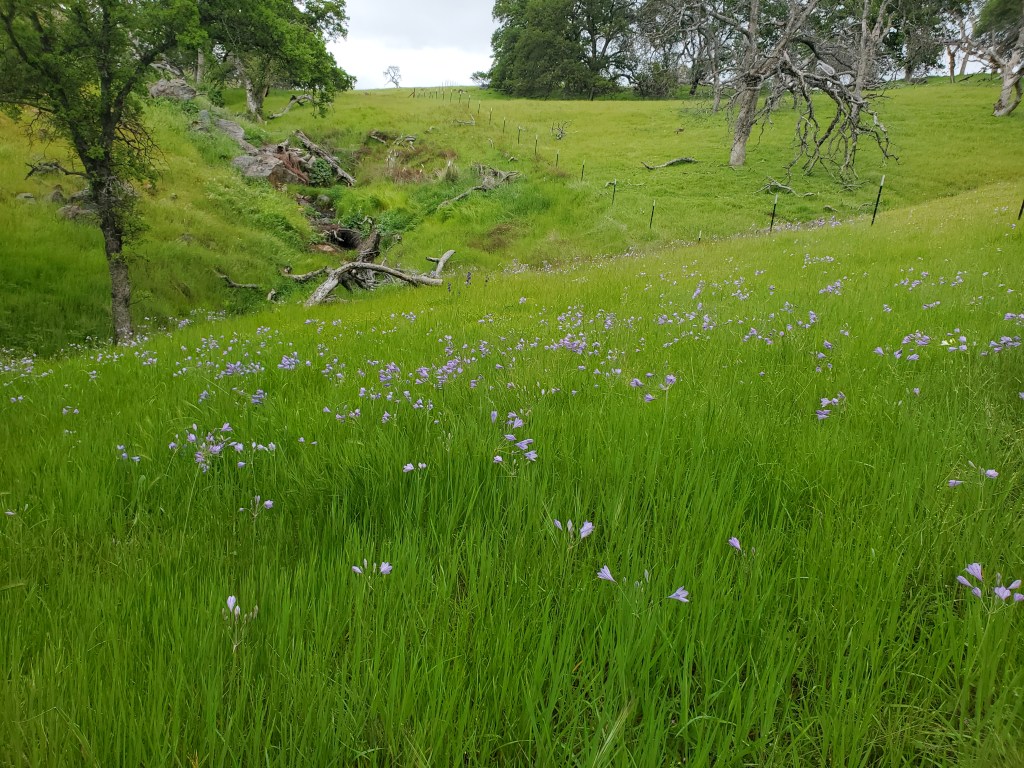
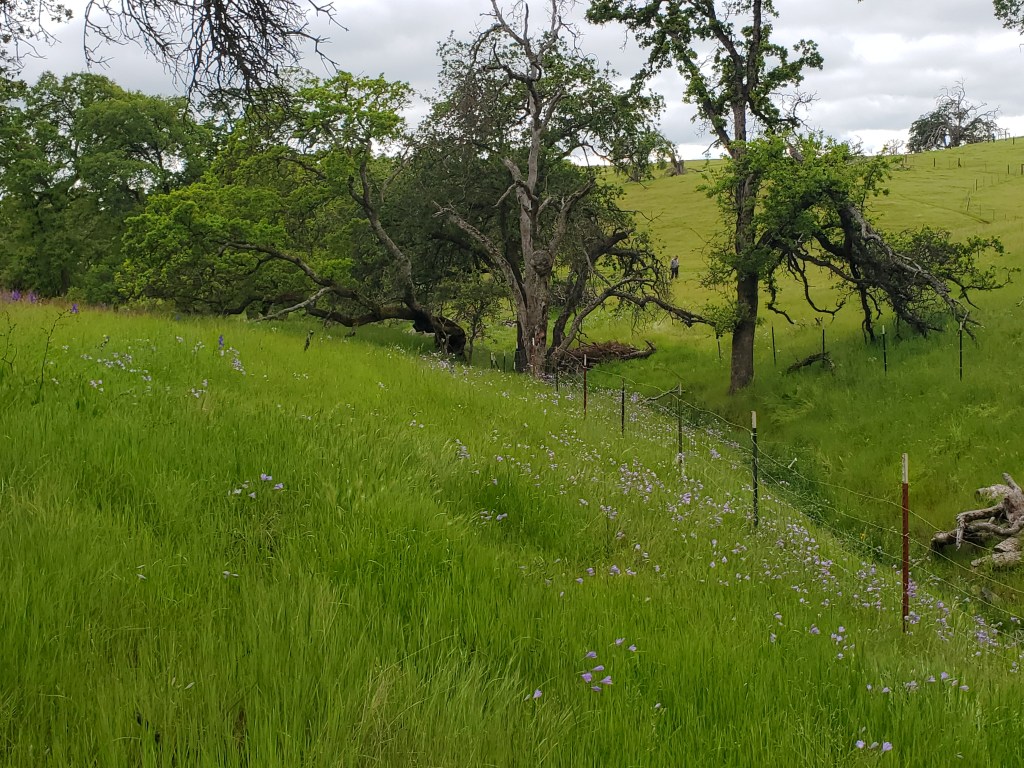
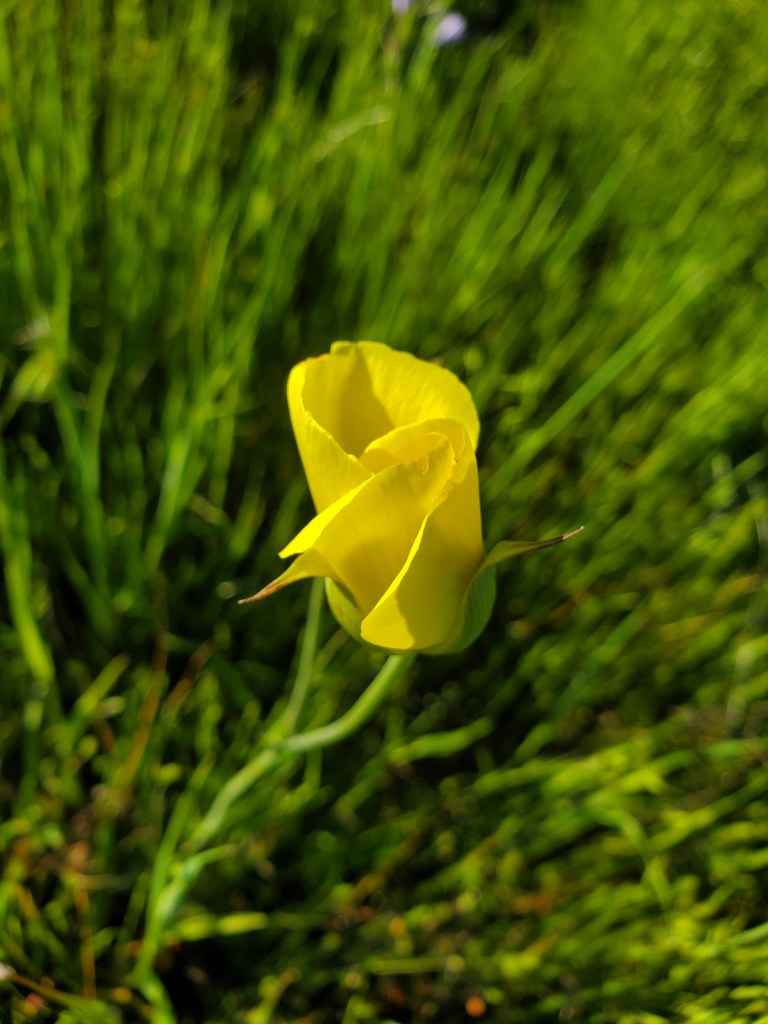
Heading down the hill with the symphony of birdsong the nectar of those thousands of flowers hits me. The grass nut flowers, tall with trumpeted light purple petals in a starburst formation cover the hillside. Among them are hints of dark purple, tall and narrow larkspur. Yellow Mariposa lilies are beginning to dot the hillside – more than I’ve ever seen here. The popcorn flower has nearly abated making room for more purples, filaree and small lupine – the large ones almost ready to burst.

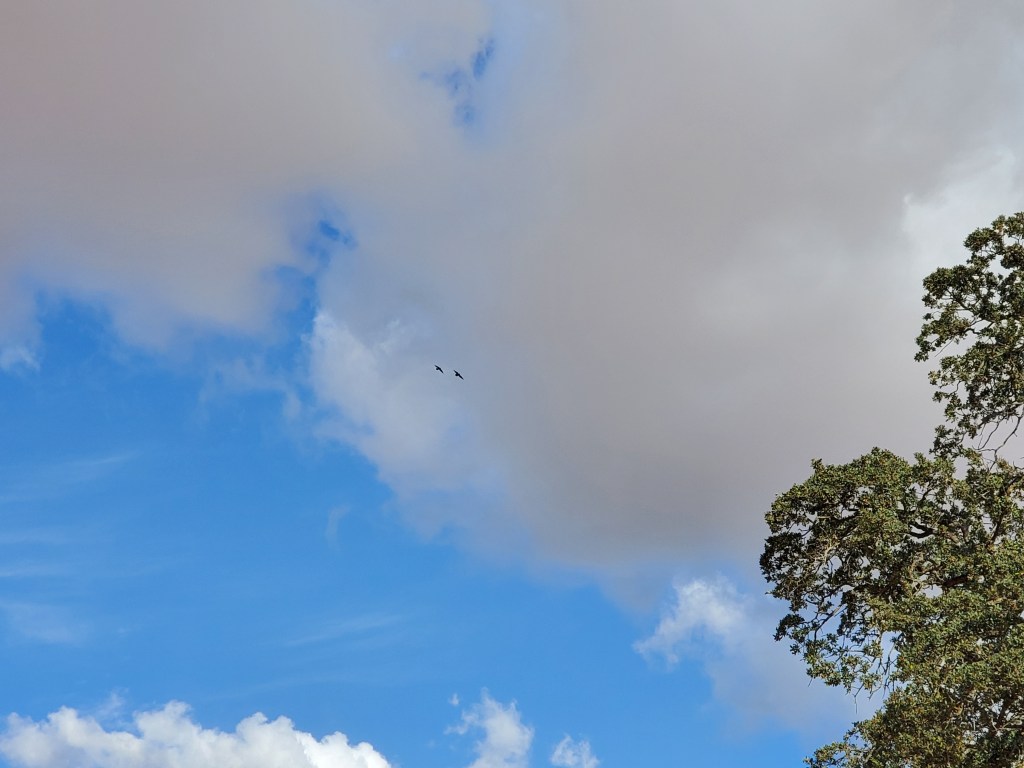
As I get closer to the drainage, the temperature turns cooler, a function of the cold water that soaks the earth and continues to trickle. Walking along the drainage there is more larkspur, orange fiddle neck and now some new yellow seep monkey flower. The birdsong is penetrated by the flap of wings. A single bird flies overhead. Even though it is small, it is quiet enough to hear the displacement of the air with each flap. This is why the morning is magic.

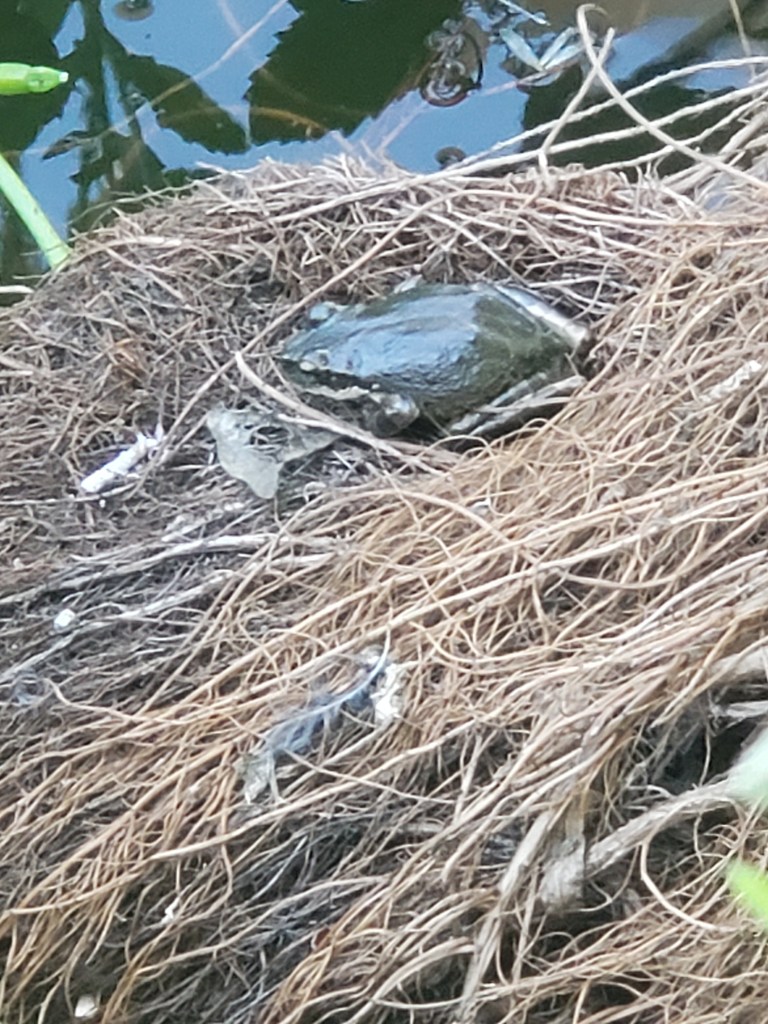
I cross the swale pond and walk into the grove. The bullfrogs floating on the water surface dive beneath the murk, and those on the banks give a chirp as they jump into the water. The nectar scent is replaced by the sweet smell of wet bark and earthen musk. With every step, I stir up more smells of wet soil. The oaks are green, and full of leaves, which I hope portends of a mass of yummy acorn in the Fall. They look happy as I examine the check dams. The soil is still moist in the drainage fork. Good. The water is still running in the spring creek with some nice deep holes. Good. I note invasive thistle growing in my mini wetland and make a mental note to bring the weed eater down there later. With my mother-in-law, I planted milkweed seed. I am hoping to make this new sedimented area more diverse, not just a thicket of Italian thistle. Thistle is nectar rich, and the pollinators love it. There thousands of stalks allover the ranch. Taking out this little section will not impact nectar availability. I hope to get a glimpse of the quail I saw the other day, but I don’t. It is too early for some.

I exit the grove to check the open section of the spring creek. My boots are wet up to mid calf. Despite the work of the cows, the grass has grown taller with last week’s rain. The first section of creek is still running, filled with grass and small, open stands of water. More seep monkey flowers emerge. About halfway down the open section of creek the water stops. I hear the last drips into a small pool just downstream of my old, small, rock check dam. The flow is underground now. It leaves a creek bed of moist soil the rest of the way to my property line.

As I veer back to the trail, turning west now on the open grassland, the sun is up over the east mountains and hits my back. The warmth is a familiar hand across my back comforting me as I walk. I notice the humidity now, so thick. The full force of nectar is back, clinging to the water molecules in the air, which fill my lungs. I think of all those molecules that comprise this Spring cocktail of life and know that my body will know what to do with all the constituent elements as my lungs expand and contract. I breath even deeper now, filling myself with this ancient food.

There are still no raptors, ravens or vultures in the sky. This time is for the songbirds to flit and sing with less concern of being a meal or their eggs being a raven’s meal. I link up with the cattle road and make a turn north, fully surrounded by the large expanse of grassland. I hear the unmistakable song of the meadowlark, deeee, de de de deee, then as the sky brightens, coyotes begin to sing. As I get closer to the driveway, there is the distant rumble of cars on the road, which is a quarter mile away. The sun has woken humans up too. I continue the last leg of my walk, Millie by my side and Beatrix taking the short-cut through the grassy hill. I feel grounded and filled. This walk is a ceremony of connection, an acknowledgement that we are all together, living for one another.

Monarchs Are Back with Babies!

There is no more gratifying symbol of the success of the work here than the habitat being used. This is especially true when monarch caterpillars are present. On Monday, 4/22, I walked the steep hillsides to check on the California Milkweed plots. Fortunately, I had friend and biologist extraordinaire Deedee Soto at the ranch visiting. It was warm that day, even at the end of the day, so we sweated as we made our way up. The first plot, all the plants looked healthy, but there was no evidence of monarch use. We made our way down hill, crossed the drainage, still spongy with water, and then started our ascent. Again, this is a steep slope. Deedee and I walked slowly, taking breaks. Mille and Beatrix were with us, but about halfway up, I turned to say something and did not see Beatrix. Where was she? Evidently, she gave up, went back down to the spongy drainage and laid in the coolness of the grass and soil spectating our ascent. I rolled my eyes, slightly jealous, and the rest of us continued upward.

At the plot, our efforts were rewarded. Six of the 13 plants had caterpillars. I screamed with joy to Deedee. It just came out. Fortunately, she understands and doesn’t think me strange to be so excited about this tiny yellow, black and white creature. Because of Deedee’s high skill, and youthful eyes, we counted 28 caterpillars of varying ages, from the first instar to the third. Caterpillars go through five caterpillar stages, with #5 being the largest, before they transform to chrysalises. Twenty-eight is a great start! There could be more though. Caterpillars are very crafty, having the super power to hide in plain site. Two other plants had evidence of monarch use, but we could not find any caterpillars. I whoo hooed from the hilltop. The monarch mamas had found this patch of California Milkweed a hospitable home once again, trusting this place with their future.

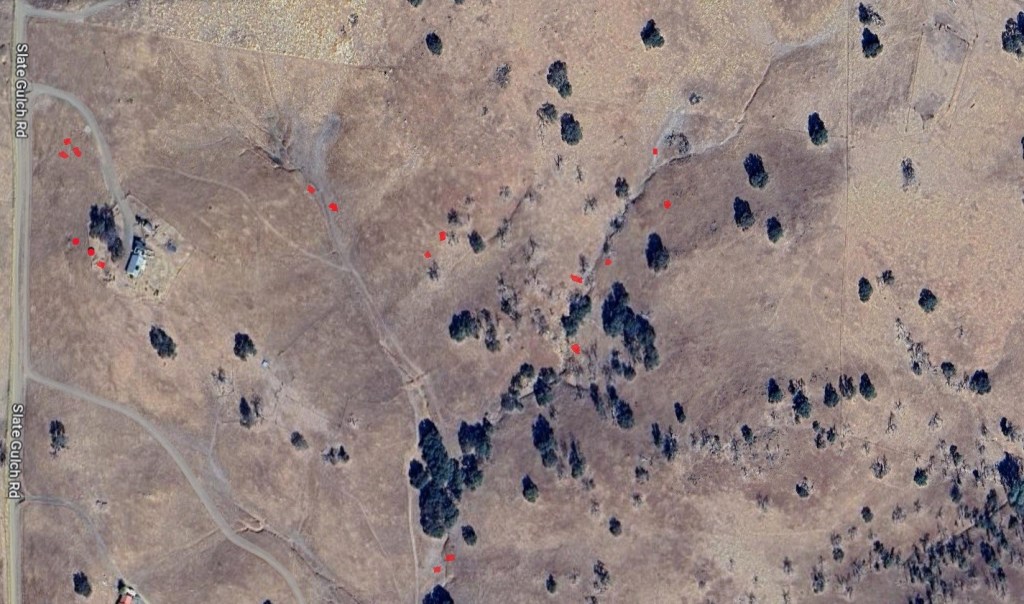
All Oaks Planted

If you are a regular reader of this blog, you may remember that my neighbors, Ric and Kim, are extremely generous, allowing me to use their electric Polaris for my habitat restoration work. Those vehicles are extremely expensive, and we are so grateful for this kindness. It makes life much easier. I was reminded of this last week when Ric had his vehicle back with him for some work, and I was still engaged in blue oak planting. Undeterred, I regressed to using my cart and hand dragging around my tools and plants to continue planting. I got three more blue oaks planted, but goodness, I was sweating.

The good news is that two of the earlier oaks are thriving, and the seedlings I’ve been protecting in the Spring Creek area for 15 years are finally appreciably growing.

Red dots are planted seedlings

Wildflowers and Wildlife

Fire Keeping

Nellie, the previous Pollinator Program Coordinator for the Southern Sierra Miwuk Nation, attended a traditional cultural gathering the other weekend and educated participants on pollinator plants. She gave the group a packet of milkweed seeds with tobacco and sage as part of the mix. Nellie said that when we planted the seeds we would be making an offering at the same time. I nearly cried I was so proud. I agree. Planting is a sacred act; it is bringing us closer to fulfilling our responsibilities as stewards of where we live and connecting us to place in a way that is intimate. She is keeping the fire of knowledge of traditional practices, values and connection and sharing those with others who are continuing on their road back to a reciprocal relationship with all our relations.

Five Years and Three Months

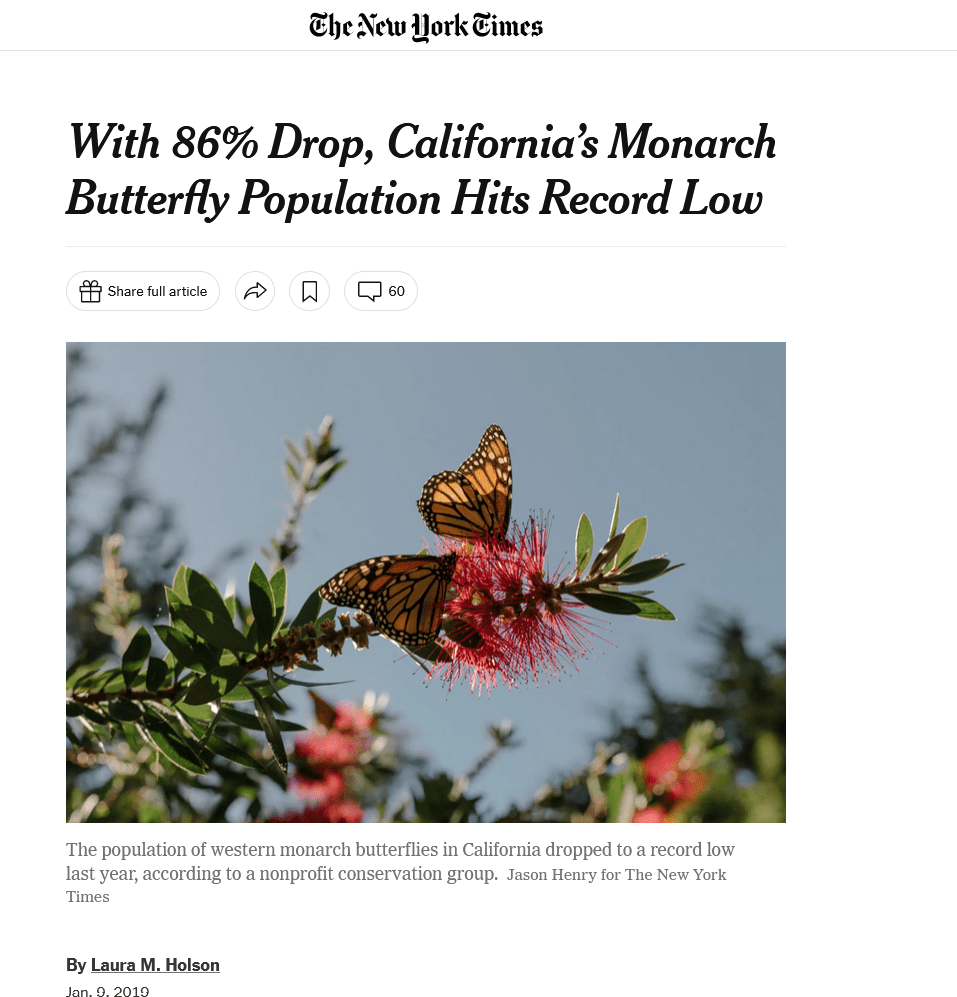
It has been five years and three months since I read the New York Times article about the plummeted numbers of monarch butterflies. It made me sad and angry that monarchs could very well be lost in my lifetime. I did not want to imagine a west without this beautiful and important native animal. I still remember that day in January when I read that article. I thought, “Ok, I am not willing to let that happen without a fight. What can I do about this?” So, I got to work learning as much as I could about monarchs, their migration, lifecycle, what they needed to survive. I learned who the key organizations were leading the charge and that there, gratefully, was a significant focus on this issue. I knew I had seen monarchs before, but it made me consider how long it had been since I’d seen any at the ranch, or even in town. I went back through photos. It had not been for ten years – not since before the 5-year drought.

The first people I reached out to were the Southern Sierra Miwuk tribal elders. I asked them about the monarchs and the western slope of Mariposa County and what they knew of the populations, plants and timing. I then reached out to some older ranchers to gauge how often they had seen monarchs and what they remembered from their grandparent’s stories. It was clear. The elders shared about times of abundance, with fields of butterflies, including monarchs, all over the milkweeds that particularly grew in the riparian and marshy areas. There were more flowers then and more milkweed to support hungry caterpillars and butterflies. The ranchers told me of less abundance – of having seen them as children, but not as many now. With this information, I knew this area had supported flocks of butterflies, and that it could possibly be that way again – at least Taawe Bwia, my ranch, could be an oasis.

To get plants, I reached out to Mariposa Native Plants (Ron Allen and Bev Andalora). I knew them in the community, and Ron had already been gaining a reputation as a “milkweed whisperer”. From the information I gained online, to Ron and Bev’s knowledge, we created milkweed plots. I started with two diversified plots, and both were ravaged by gophers. I started over, placing the plants in mesh baskets instead of chicken wire cages. That worked, but it was expensive. While I was committed to the project, I could never have scaled it as big as I have without the Mariposa County Resource Conservation District (Melinda Barrett). She was a wealth of knowledge, and I changed the composition and structure of the milkweed plots to “pollinator islands” based on her guidance. She was able to help because there was significant funding from the Wildlife Conservation Board, and the California Association of Resource Conservation Districts, as the intermediary administrator.

I was fortunate to have the thought partnership of Xerces Society partner biologist Deedee Soto, who shares my passion and commitment to conservation work. Truly, without her expertise, I would not have as much success. She is a genius with plants – propagation and ID. At this time, Xerces also began their very useful habitat kits (Thank you to Jessa Kay-Cruz and Angela Laws!). Not only did it provide all the plants needed for a successful pollinator island, it taught people about the plants, bloom timing and diversification. I still have the very first plant list with bloom times. It was such a great resource, and what a great idea.

I received tremendous support from the National Resource Conservation Service (NRCS) John Grimes, Jesse Baum, Prospero, and so many others in the NRCS ecosystem. Farm Advisor Fadzayi Mishari provided input on conservation issues early on in my land stewardship and organized important educational opportunities for the ag community where I was able to learn a great deal.

Point Blue Conservation partner biologist Elena Kromer wrote my first conservation plan. While it took a very long time to get done, she listened carefully to what my concerns were and designed a plan that addressed many of them. This process connected me further into Point Blue, where I was able to join their carbon sequestration and wildlife resources study project and access their Roots grant program (Cati Mong). Also of essential help were the classes and resources from Monarch Joint Venture. They offered the first online class I took that brought me from knowing almost “0” to knowing much more. I was able to take that knowledge and advance it through the Pollinator Partnership Pollinator Stewardship Certification program, where I earned my certification in Summer 2023. Most recently, I was also able to qualify for the California Department of Fish and Wildlife Partners Program with many thanks to biologist Rosie Gonzalez and her colleagues for smoothly navigating me through the process.

Last, but not least, I want to acknowledge my dear family, friends and readers of this blog. My dad, Alan, and dear friend Daniel donated funds early on that helped me purchase more plants and supplies. My mother-in-law Sheila sends me fun butterfly-themed gifts. My brother Vance, and sister Sarah, who actually read this blog early on, encouraged me. My neighbors Ric and Kim who let me borrow their Polaris, and early on Ric helped considerably with fencing labor. My nephew Ashtin and niece Desiree have helped with the branch fence early on. My other mother-in-law, Liz, has helped me work the ranch each visit, planting seeds, digging channels and holes. Dear friends Melanie, Molly and Jen have worked side by side with me to build rock and log check dams. Friends in the community and on social media, readers of this blog who have sent words of encouragement, recommendations, shared knowledge, ignored my typos, and encouraged my writing, you all kept me going especially when I had set-backs. Finally, my beloved spouse, David, who without him nothing is possible. From his emotional support to physical labor, and financial partnership, he has been there for me and this dream of changing the course of monarch survival, to create a place where they can be assured of food and shelter along their epic journey. Chiokoe uttesiavu. Si se enchinakiavu. Thank you. I appreciate you all.

Goal accomplished!

Free T-Shirts?

To commemorate my 100th post, I am having a PolliNative t-shirt giveaway. If you like what we are doing here and want to represent via a beautiful organic cotton shirt with a heartfelt message, here is how:

  1. Make a comment on this blog with no more than three sentences sharing about what you are doing to help our pollinators thrive.
  2. Everyone who submits a comment will be entered into a random drawing for a tee-shirt. They are expensive, so I can only give a handful away.
  3. Comments must be in no later than May 24th.

Thank you, reader, for everything you do to make our planet a healthy place for our children and for all our relations. Si enchi nakiavu (I appreciate you all).

My Fourth PolliNative Monarch Season Begins With Emergence of Ca. Milkweed

Take a deep breath. Release. The air is now thick with nectar. The sweet smell is hanging on the moisture molecules of humidified air. With it, comes the scent of grass, freshly grown, and a hint of oak bark still moist from the rains. I hope you can imagine this smell of spring. It invigorates me and lets so many other nature relatives know the time to emerge is near.

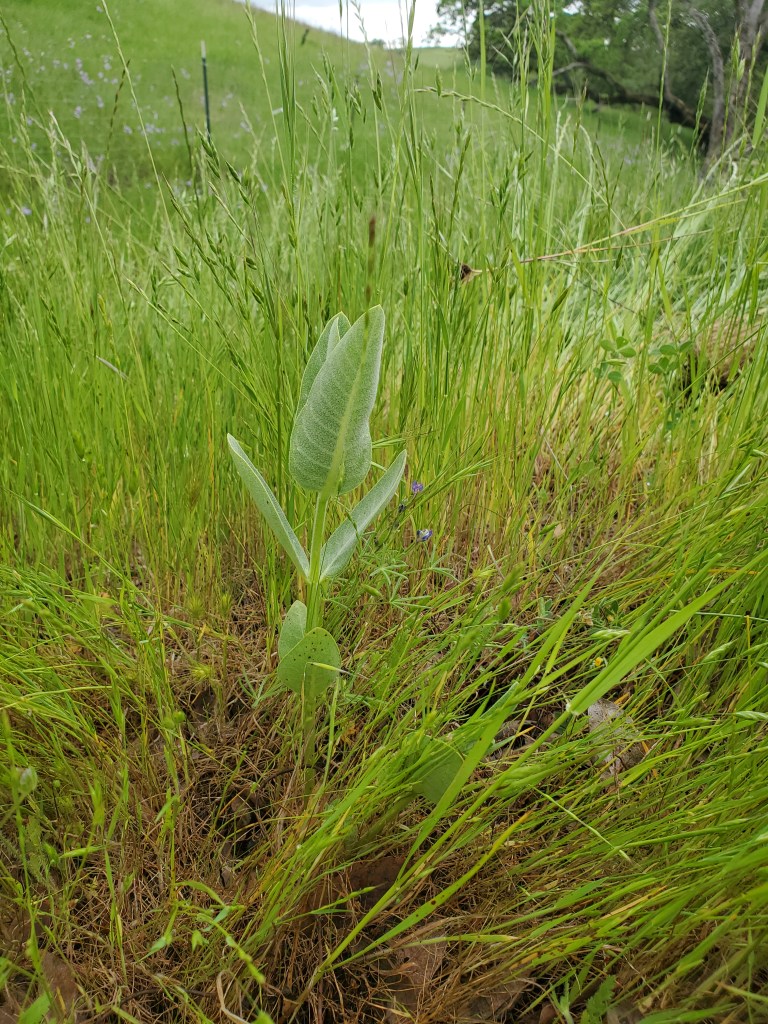
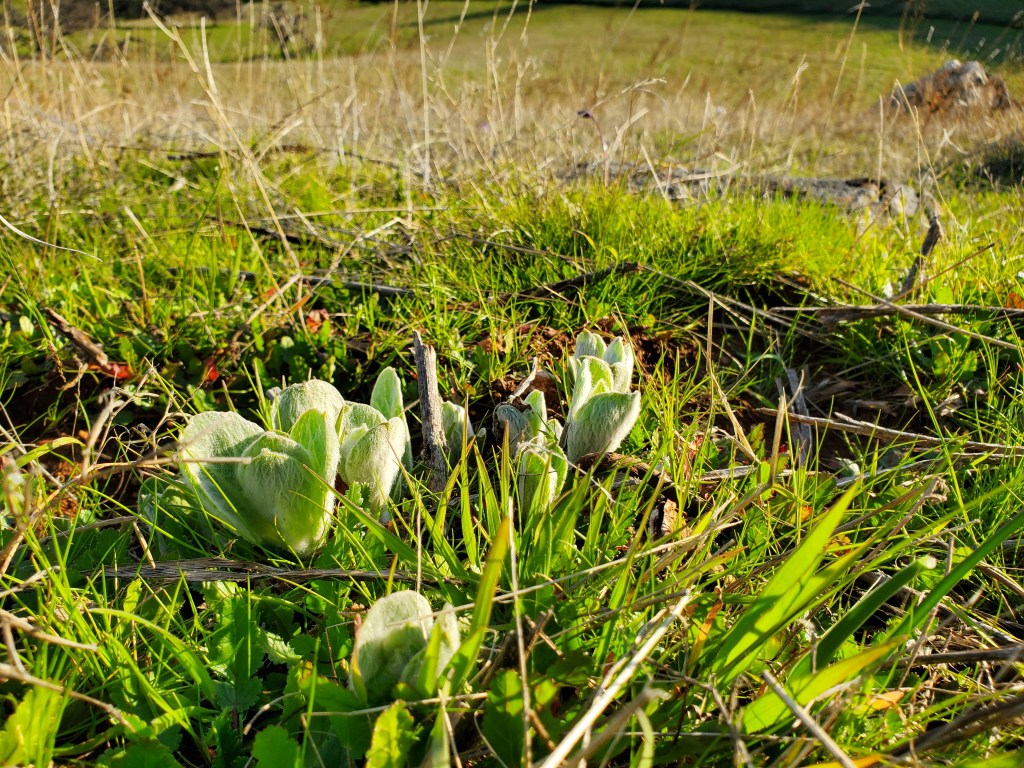
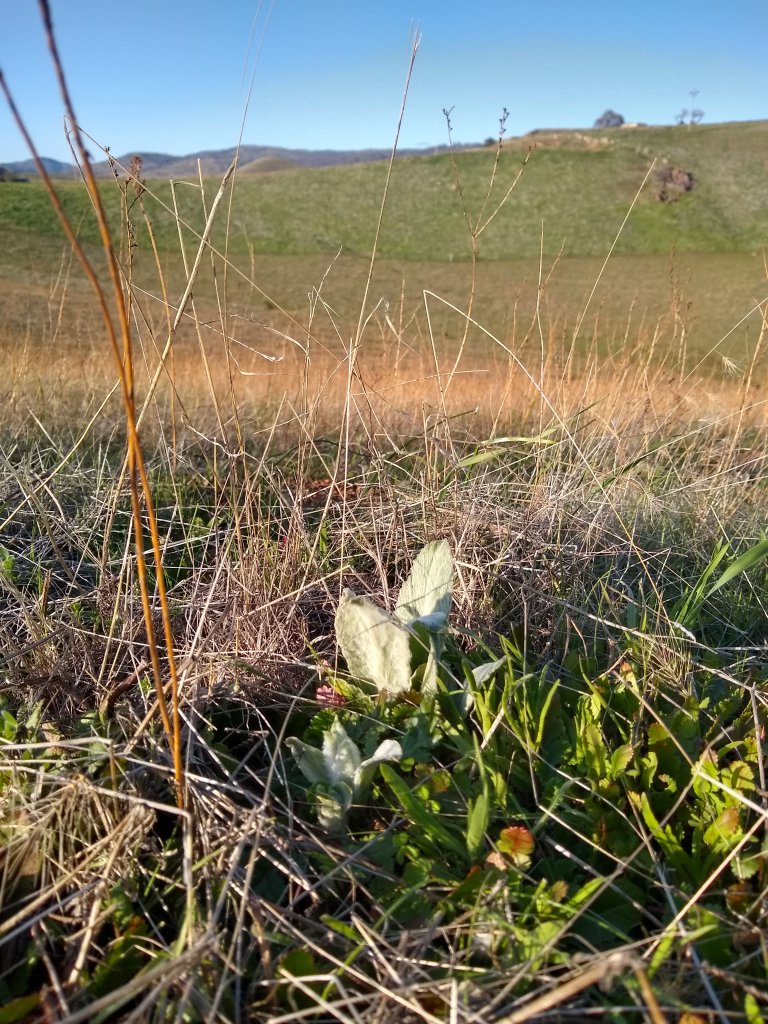
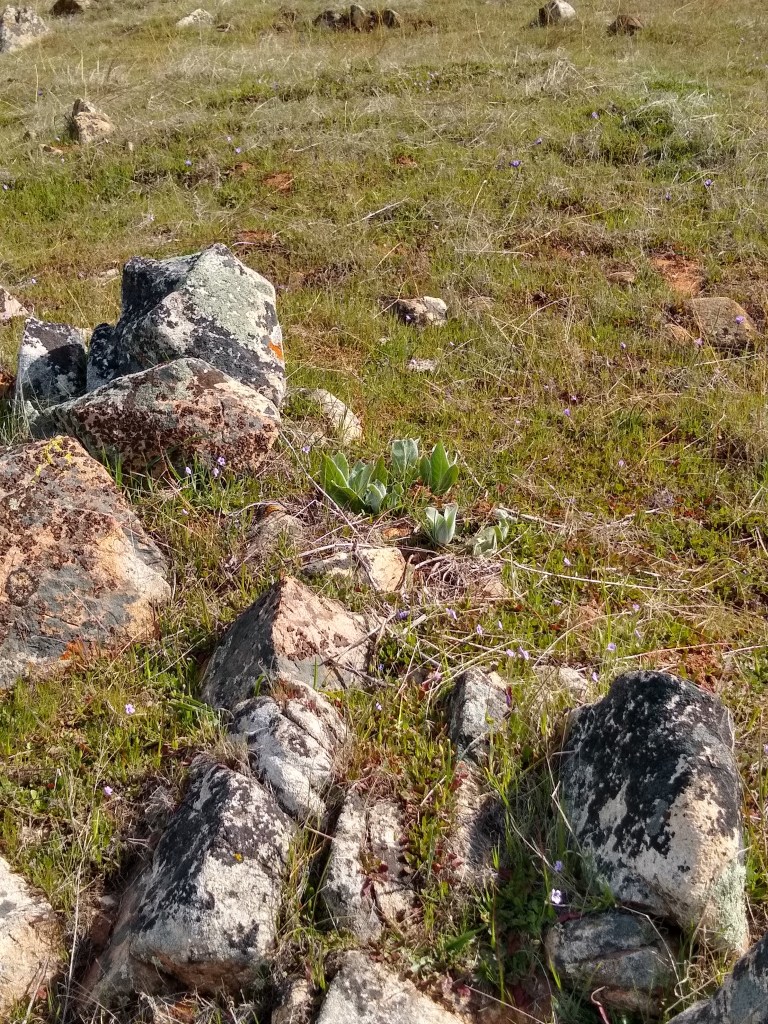
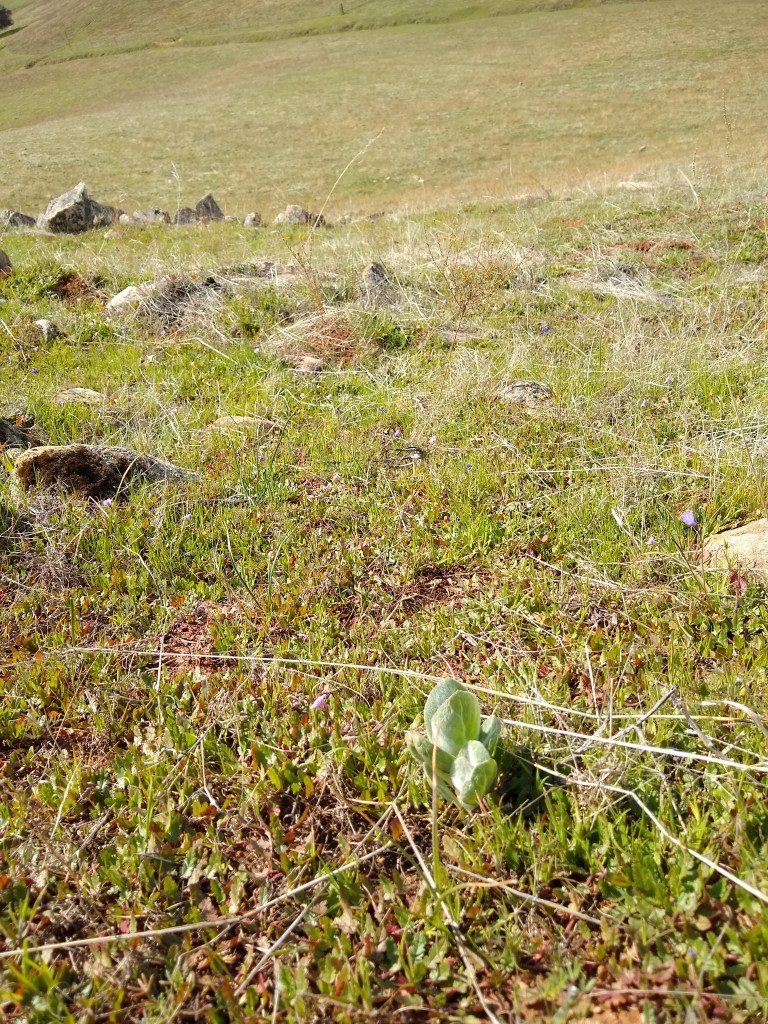
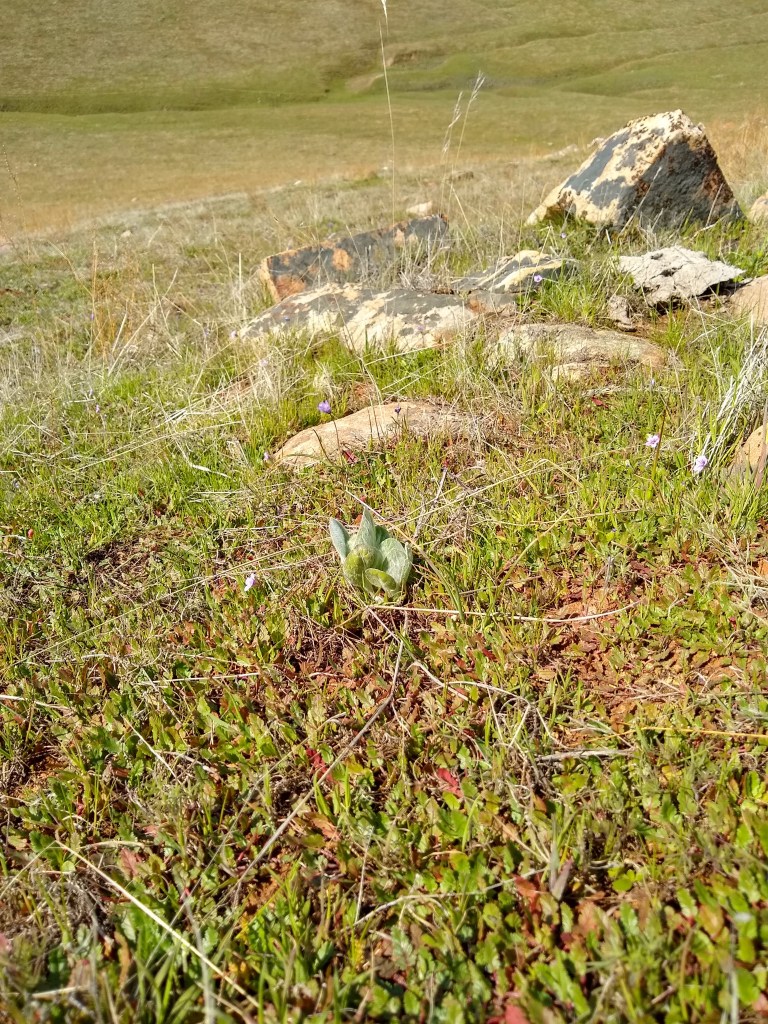
Drinking with my nose, walking up the 60% grade hill to the California Milkweed plots, I begin to look down wondering if my favorite plant has made its way up from underground life. It took a little searching, but I found them early last week, the soft, velvety leaves of A. Californica. I expected to perhaps find emergence on the three most mature plants, but I found a fourth as well. In finding the fourth surprise plant this early, I am feeling like things are continuing to heal, expand, and thrive.

The cattle are toward the end of their rotation on the south side of the ranch. They will be on the north side soon for 2 weeks. If I see signs of monarch usage, I will shut the new gates to the far north field. What a relief! I won’t need to stress about protecting the plants this year. Thank you to John Grimes and the National Resource Conservation Service (NRCS)!

Monitoring Rock and Log Check Dams

We have significant sediment build up behind even the smallest of check dams. Plants are beginning to take root creating a new habitat – from running water to a marshy water filter of plants and sediment that did not exist before. I get to play in the water too, so it is not all work. I added another small rock check dam even further down the drainage to continue the slowing process and make a wide spot that may be supportive of an arroyo willow. I am still considering whether I will plant one there. The water needs of the willows are considerable, even the ones adapted to this drier climate.

Planting More Oaks and Seeding

I am continuing to plant oaks, albeit slowly. The seedlings have green sprouts, so I am going to try to hurry and get them into the ground. Of course, the day I went to plant a couple, the cows were loafing with their babies nearby. I try not to disturb them too much. They look so comfortable and peaceful when they are lying on the ground, taking in the sun or languidly chewing cud. The babies can spook easy, and that can get the entire group alerted. More than the economics of running fat off them, I simply want to respect their peace if I can. As such, it makes more sense to park the vehicle and walk my tools and plants the remaining distance.

The first seedling, I plant in the exclosure near the area where the healthy oak fell over last year. That will be a good place with ample water. I place the tree very straight slightly higher up the hill from the up-turned rootball. For the second seedling, I choose a place near the grinding rock among the skeletons of old trees but near enough to living trees. It is another area near the water with shade and light. I say a prayer for each, welcoming them home and a wish for their wellness.
Mushrooms and Wildflowers

Bees

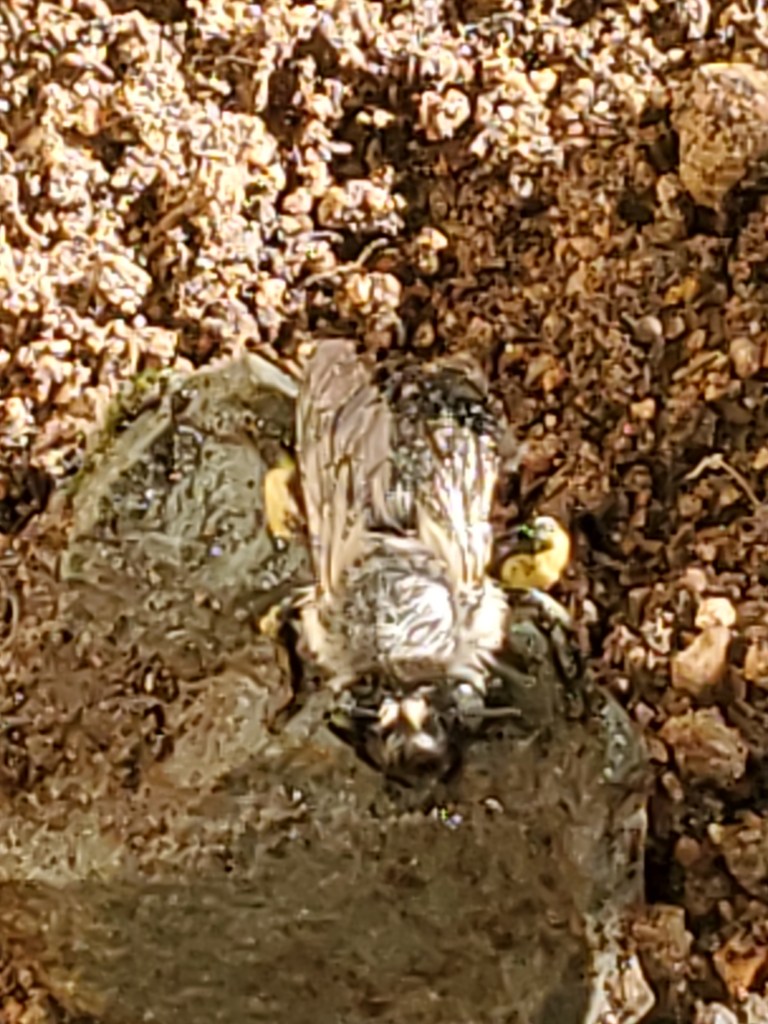
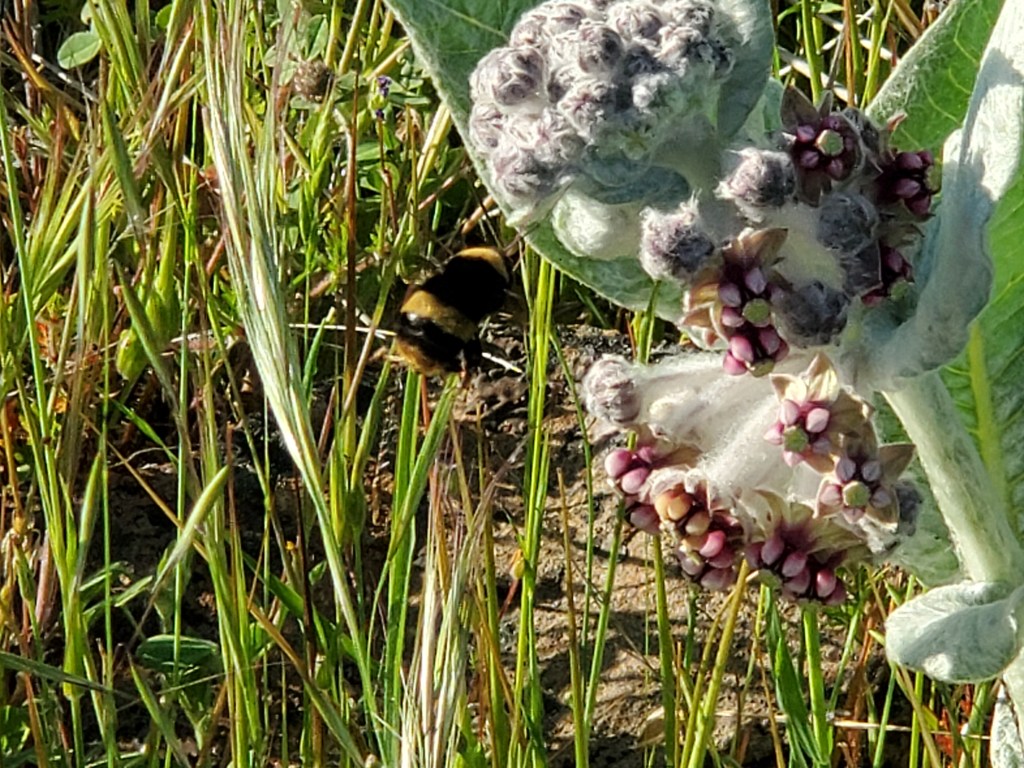
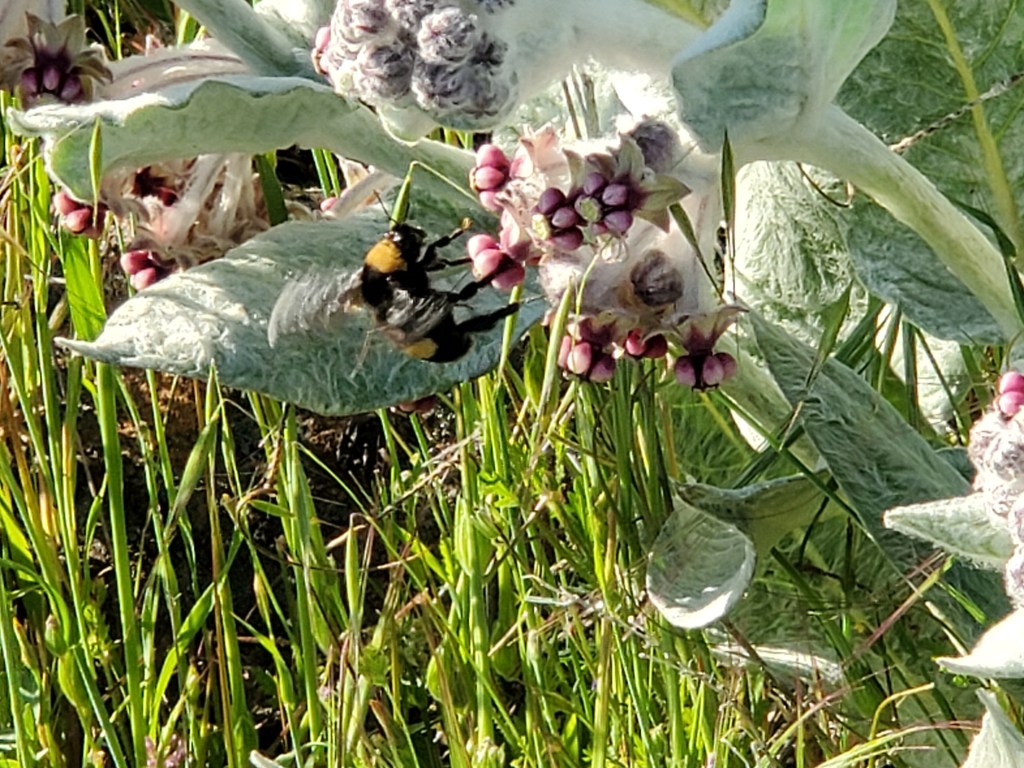
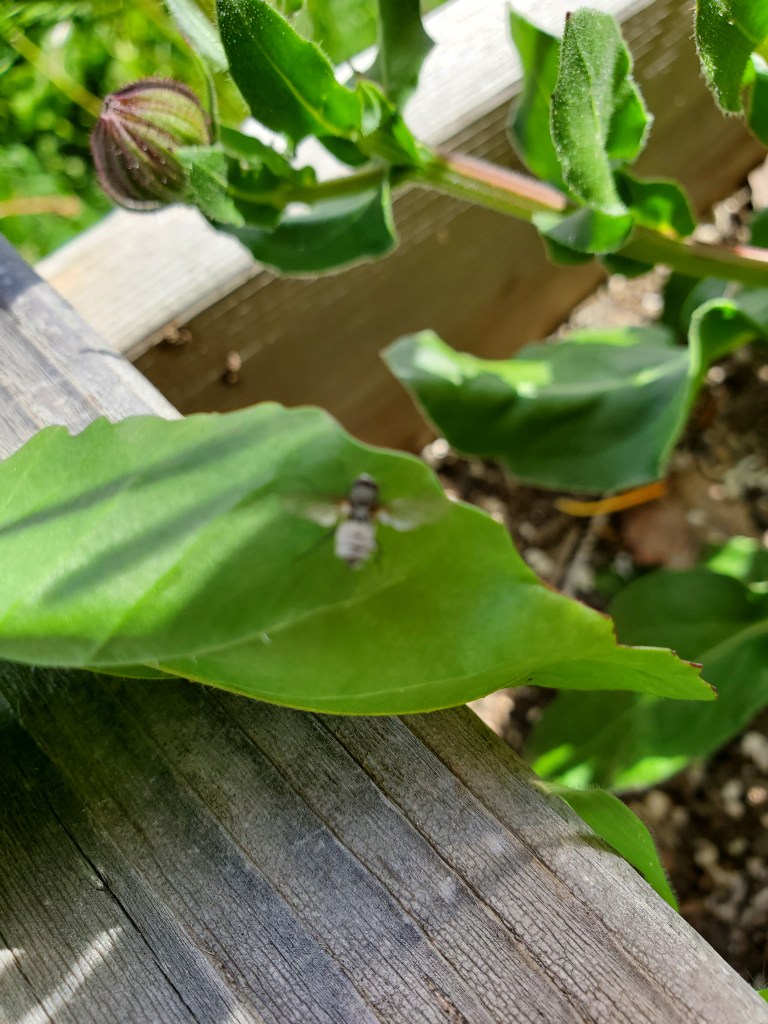
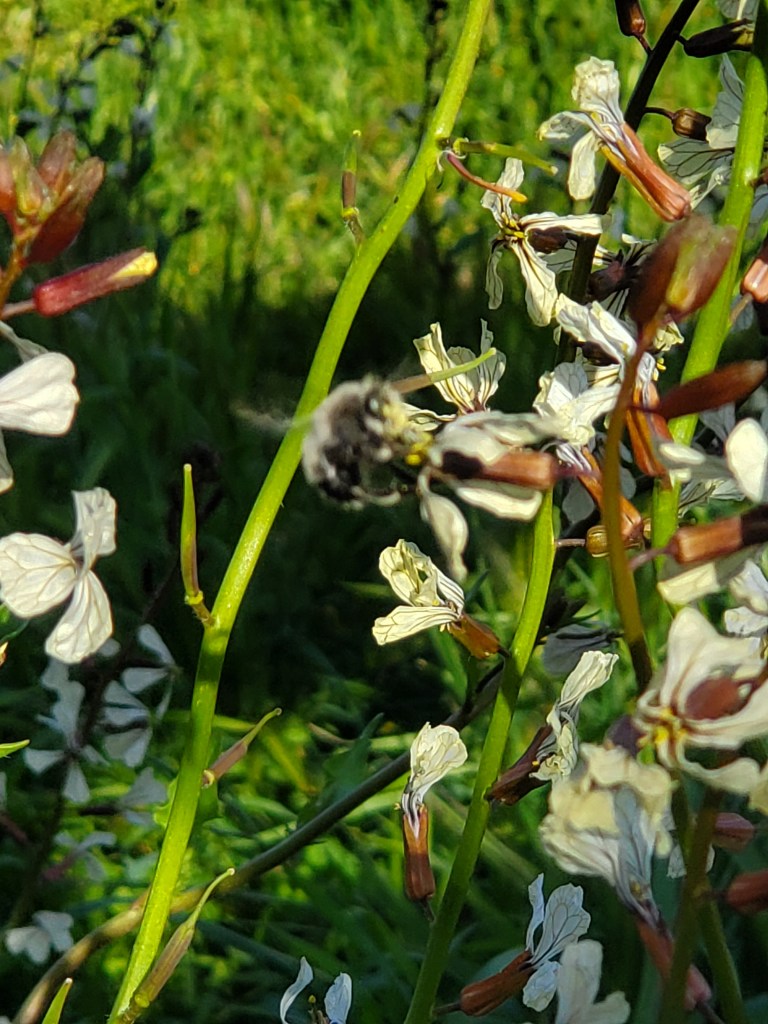
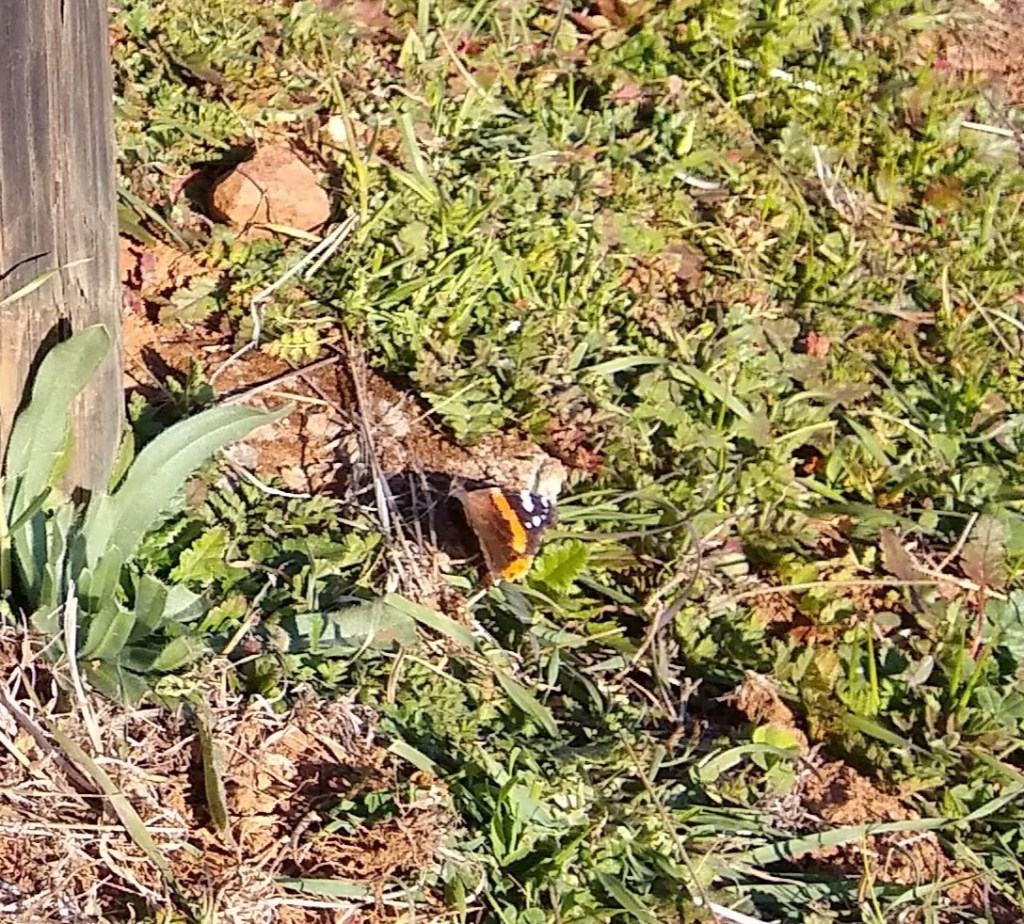
When the sun comes out, we are seeing some significant bee action. Honeybees, a cute silver native bee taking a nap, and fuzzy silver bumble bees have presented themselves. There were some viceroy butterflies just the other day. They are large and orange, so very exciting to see. They move too fast and don’t stay long. It is rare that I get a good look at them let alone a photo.

A very special guest made an appearance twice – a rough legged hawk. They live in the arctic north and fly south for the winter. Mariposa County is near the absolute south portion of their range. According to bird resources and my Stokes bird book, it is rare to see them this far south. I am thanking all the water for staying here and making a compelling habitat for some remarkable raptors this year, including a bald eagle the other day.

Stewardship is Not all Outdoor Work

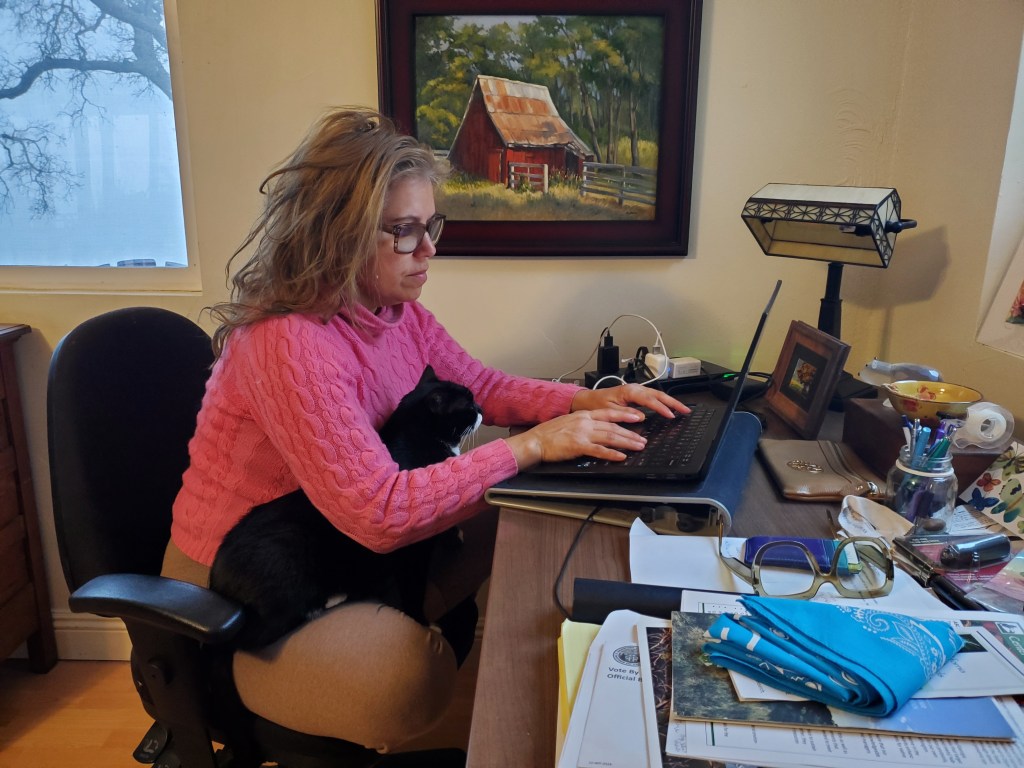
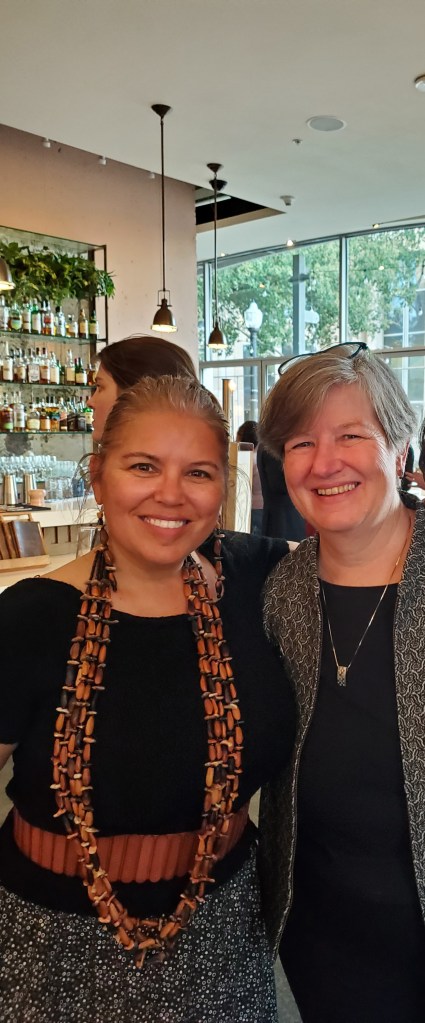
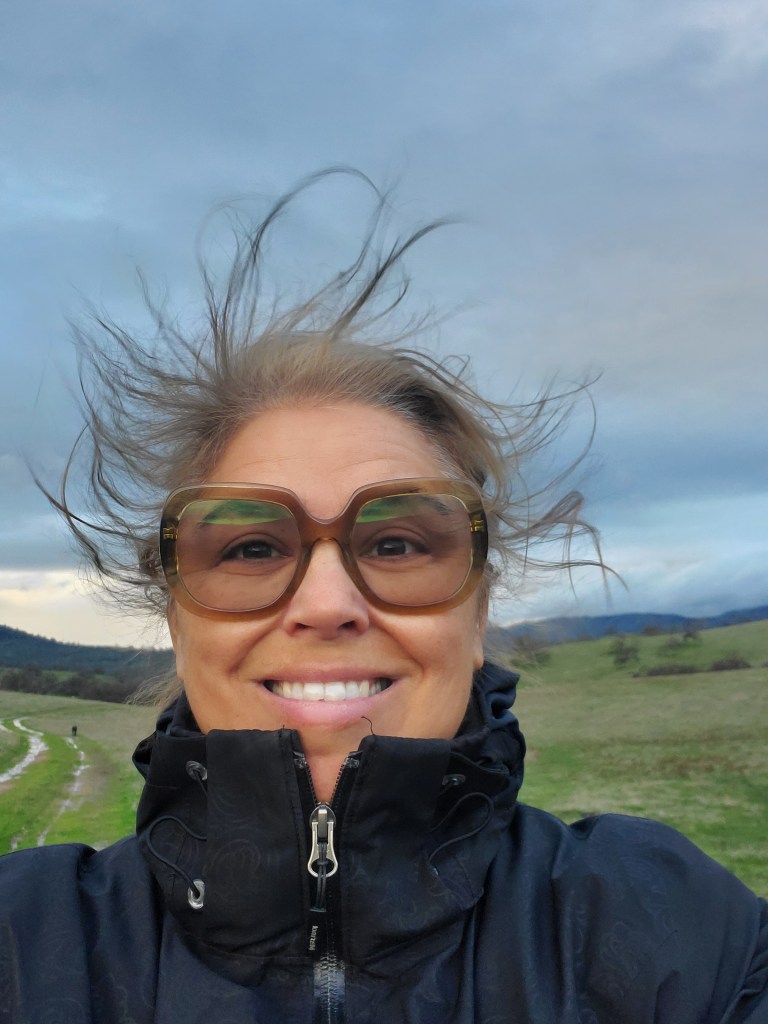
As much as I would like to say that stewardship work is 90% outdoors, it isn’t. I spend probably 70% of my time researching products, information, other programs, funding opportunities, reading articles, writing reports, writing grants, making connections, responding to questions (on email, blog, Facebook, Instagram, on Pollinator Partnership and Women for the Land dedicated communities), planning projects, performing data entry, sifting through photos, following up on conversations, supporting networks, ordering supplies, attending meetings/conferences, traveling to meetings/conferences and writing this blog. For this section, I will show some pictures of me out and about, which I am super uncomfortable with. I am not a selfie person (no judgement on others, just not me), but they are important to the story of this work. I’ve had to get used to it. Please bear with me.

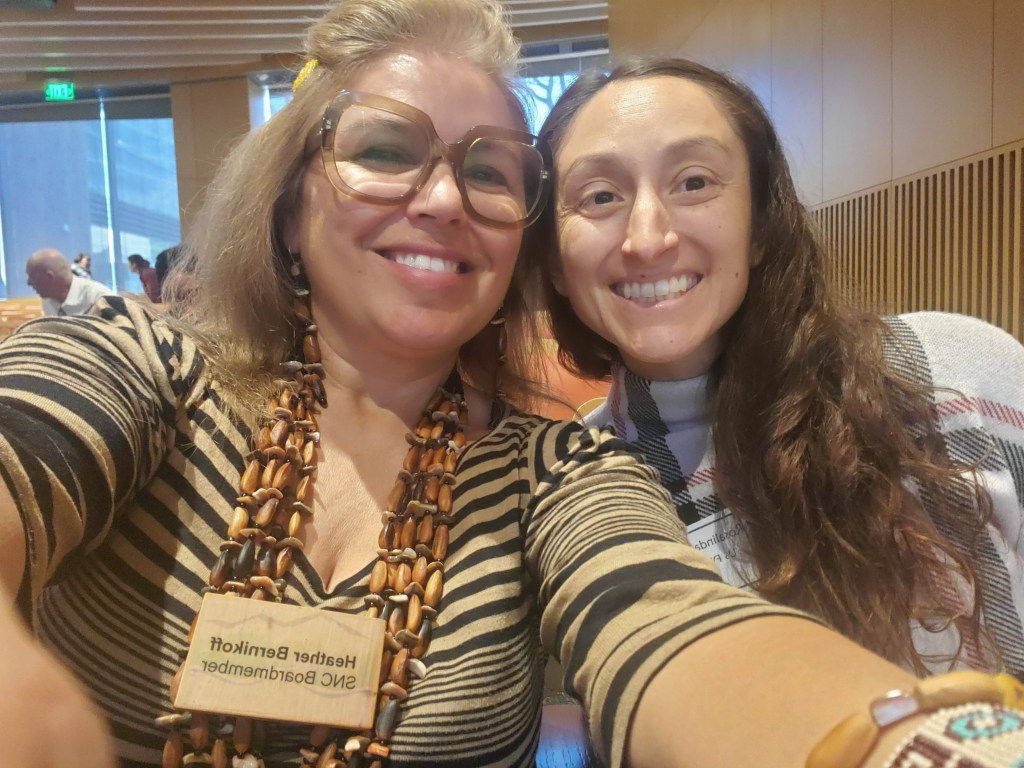
In just the past three weeks, I attended the California Rangeland Conservation Coalition Summit, Community Alliance with Family Farmers Tech Expo in Madera, Xerces Pollinator Program, Native American Fish & Wildlife Society Pollinator Working Group, met with the Farm Advisor, met with NRCS, and attended my last Sierra Nevada Conservancy Board meeting as a board member. There is so much great information to know, people to see and connect with, and input (you hope is helpful) to provide. There is much more to be involved in that is worth my time; I just don’t have the time at this point. I am feeling pretty maxed out.

At the rangeland summit, I finally meet in person two extraordinary women – Nancy and Susie Calhoun. With their other sister, they conserved their large family ranch in Livermore and continue to protect it and make habitat for all the life that exists there. HEROES!!
I saw Fadzayi Mashiri, our Farm Advisor, at the Summit as well. We made a plan for her to visit the ranch. It had been a long time since she was last here. She provided some great recommendations to improve on what I was doing and was one of the people early, early on who helped me think through improvements to this land. HERO!!

SNC Wrap-Up: Bittersweet

My final meeting as a board member of the Sierra Nevada Conservancy (SNC) was last week. California Governor Gavin Newsom appointed me to this role in 2021. I have enjoyed being on the board, working with good people both on staff and as board colleagues. I appreciated the opportunity to learn about forest stewardship and rural community resilience. I learned about the State budget process, which is wildly complex. As the first culturally Indigenous person to sit on that board, I also appreciated the opportunity to ask questions about representation of Tribal governments and Indigenous led organizations, about how inclusive and equitable funds are being distributed, about why some projects call for herbicides, and trail safety and careful placement with regard to Indigenous needs. Safe, inclusive, carefully planned projects make the outdoor experience for all life better.

My last day was bittersweet –sweet in that I am leaving to deeply focus on natural resources, climate and tribes, bitter in that I absolutely love working with the entire staff of the SNC. The staff are so accomplished, professional, competent and devoted to their mission to restore and enhance the extraordinary natural resources and communities of California’s Sierra-Cascade region, while protecting them from wildfire and a changing climate. It has been such a privilege to serve the public, rural communities (which I love), the Newsom Administration and be a voice for my nature relatives. I will miss this work and all of the people.

Wanderings

Even though I am busy every day, I never lose sight of how grateful I am for the opportunities that have come my way to serve, help, make a living, and be a land steward. To know you make a difference is a gift, and it is a gift everyone can access. Whether you plant milkweed where there is none, sit on an advisory committee or board in your community, organize with others to make good, helpful change, you make a difference. Step into life, take opportunities with good intent, be a hero for a butterfly, bumble bee, forest or community. You got this!

Wrapping 2023 and Welcoming 2024

When people ask, “How was your holiday season?”, I reply, “Absolutely fantastic.” Not only did I have waves of family and friends, who I love, visit, but I was out with my Southern Sierra Miwuk Nation pollinator family as well. I can think of few ways more precious to spend my time than helping care for our Maala Bwia (Mother Earth) with others who care deeply about our butterfly, bee and plant relatives. I also love to watch Shana, the Pollinator Program Coordinator, work. She is so knowledgeable, organized, a terrific problem solver and hard worker.

In December, I helped her and several other volunteers plant Xerces Society Habitat Kit plants in the Oak Fire burn scar. Shana has collaborated with several property stewards whose land was burned over, and some whose entire homes burned completely, to repopulate the land with native pollinator plants. It was incredible to see the scale of the fire from the ground. We had to dig through layers of ash to plant – giving the natural world just a little head start and hungry life forms, looking for food, a place they can count on. It was also very encouraging to see so many native plants regrown, including oak seedlings sprouting. Like my people, the plants are resilient.

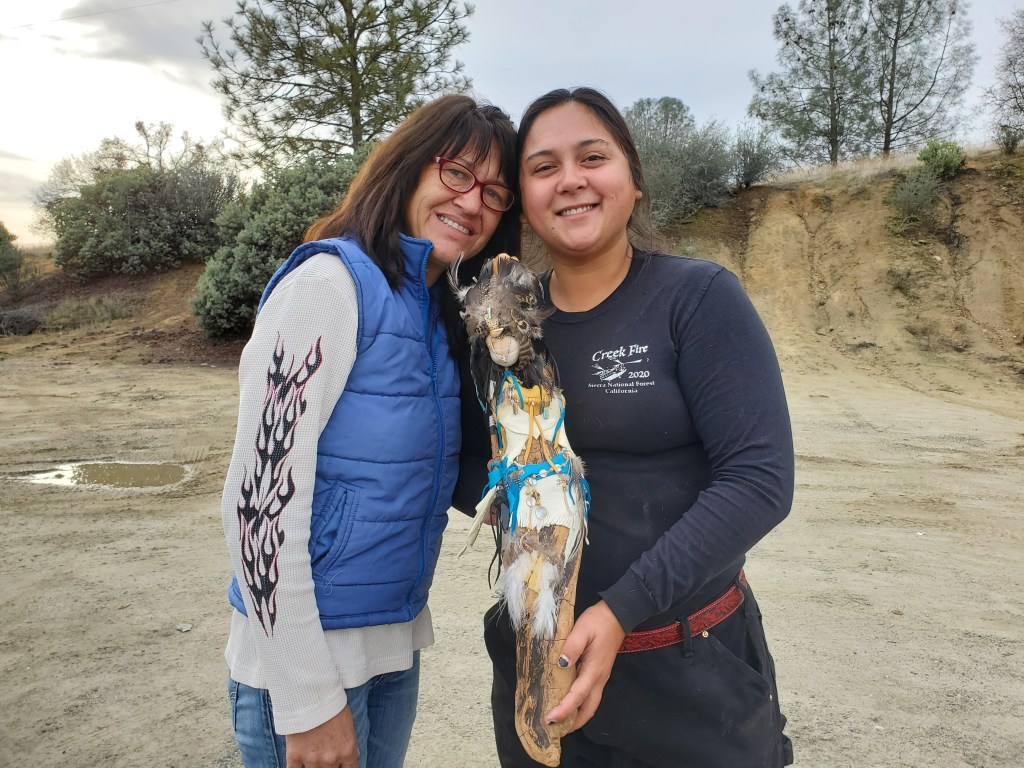
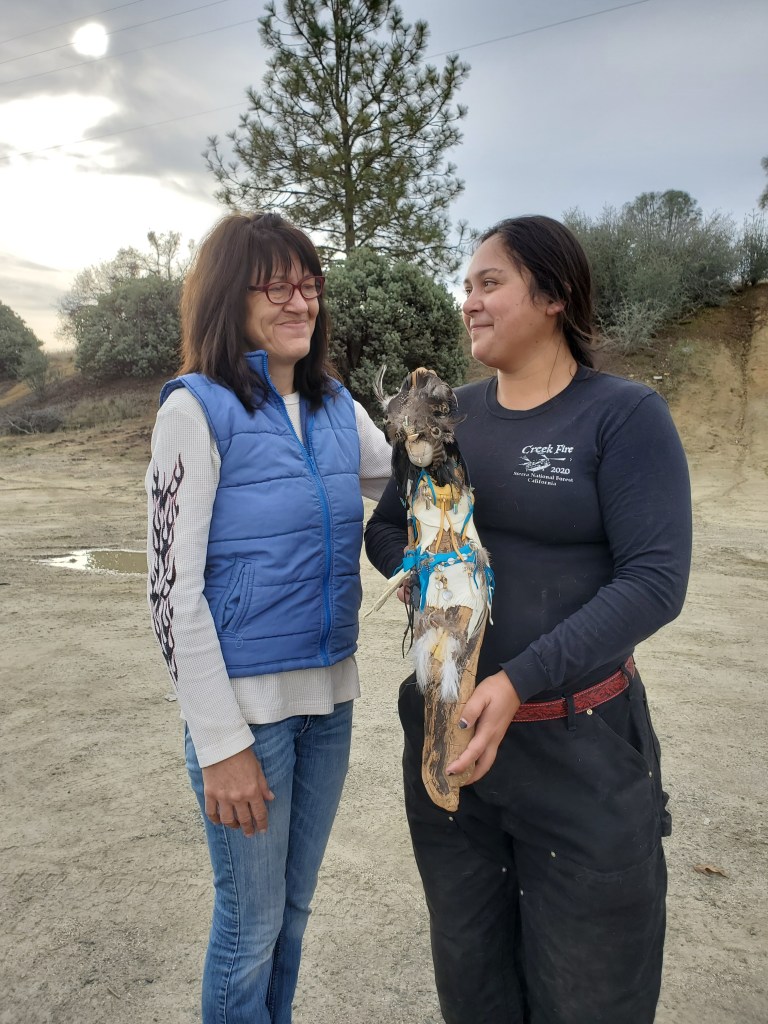
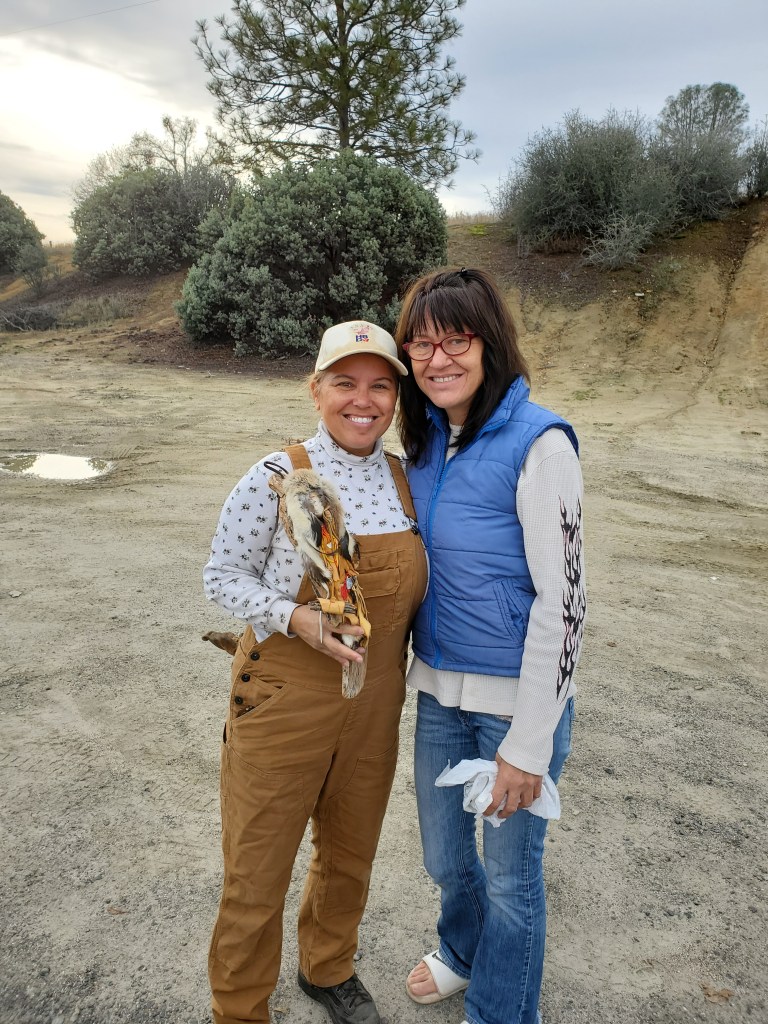
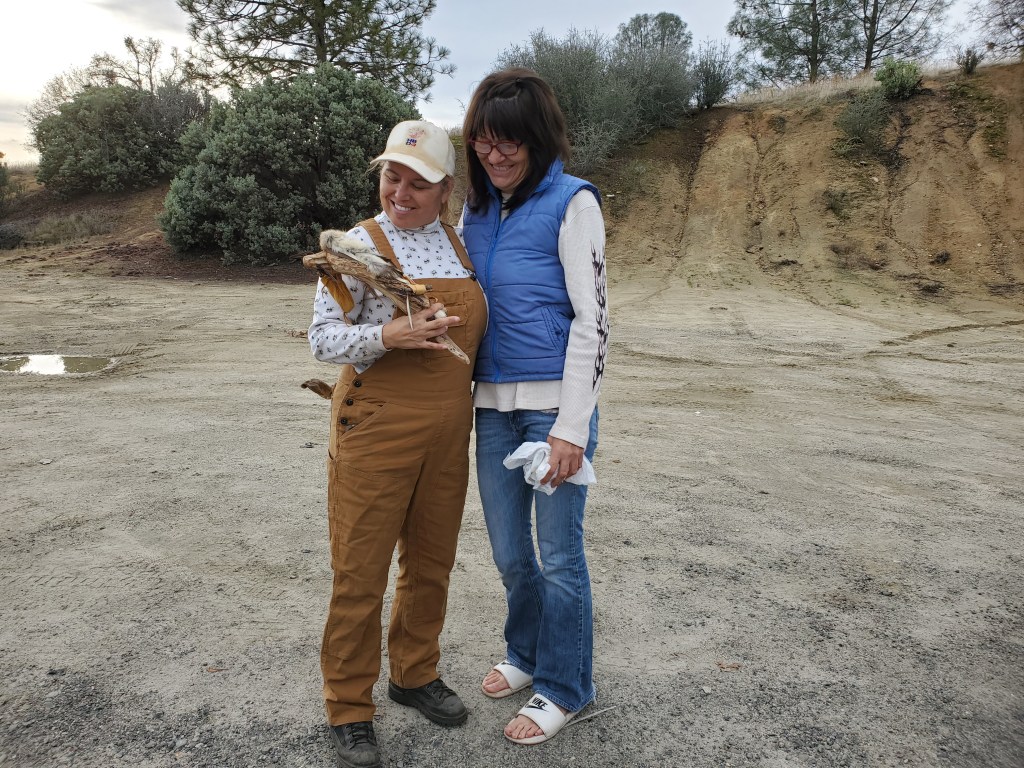
This work is sacred; it is living in reciprocity… giving your time, energy, and attention to supporting the life of others – human, insect, plant, mammal or otherwise – that support you. As Indigenous people, we can feel moved to honor someone for their contributions — and, as a people, we are so talented, creative, resourceful and generous. It was in this context that one of the Pollinator Team members, Trisha, gifted a gorgeous doll to Shana, which Trisha had made. The medicine in the doll was so palpable. Like Shana, the doll is a warrior. Trisha even made a miniature spear of obsidian. Wow.

After taking the photo, I was talking to another volunteer, then turned around to see Trisha extending a doll to me too. I was shocked and so honored that she would gift me such a beautifully made item. The doll she gave to me was a wood gatherer. I love it. She is a powerful piece as well, with her carefully crafted wood bundle on her back, wood wrap on her front and an expertly carved miniature hatchet with a blade of stone on her hip. She is so cool. Thank you Trisha for your thought of me and being moved by the energy we all posses to make things better for our relatives. Aho.

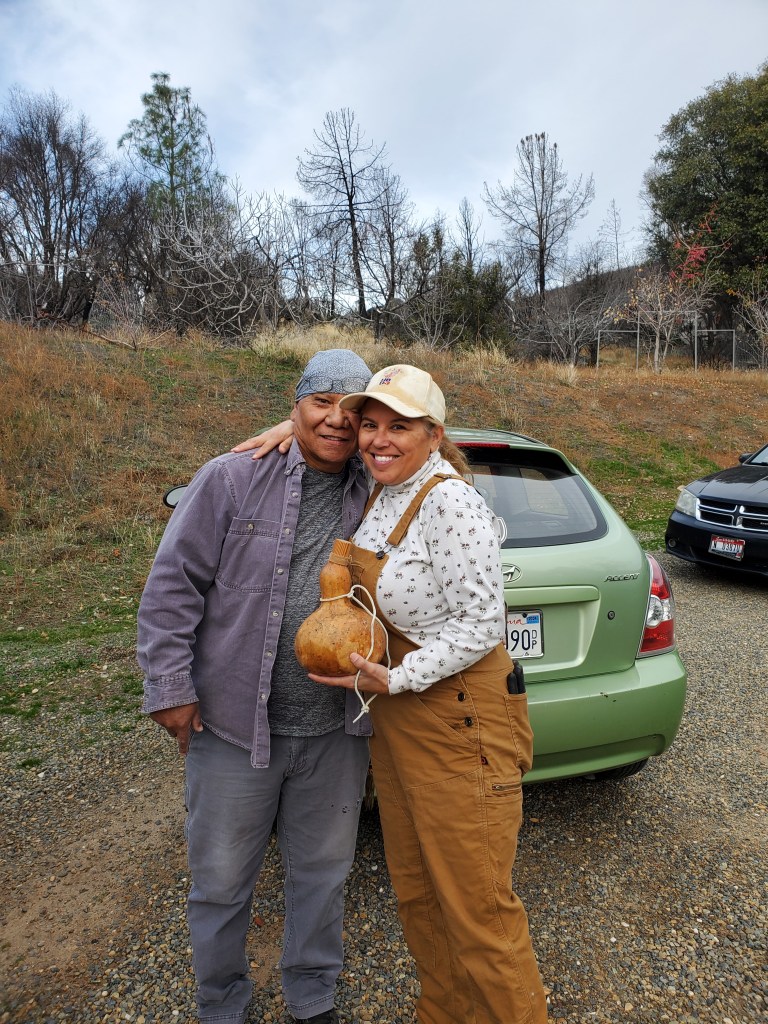
We did this work in December, so gifting was on the mind I suppose. One of my favorite relatives, Pete, surprised me with a gourd canteen gift that he grew and prepared for carrying water. Pete (Mescalero Apache), and his wife Jakki (TX Cherokee), are close friend-family. We are probably even biologically related somewhere. My grandfather told me how Yaquis and Apaches are cousins. I found out later that indeed, my Yaqui people used to hide the children with the Apaches when we were being hunted. Likewise, when the Apaches had their fights, they stored their children with us. How sad that this was necessary, but what a beautiful act to protect one another’s future. Reciprocity again.

It is difficult to express how grateful I was to receive both these gifts; truly, it was overwhelming. Compliments are difficult for me. The work is its own reward. Fortunately, we had a lot of work to do, so I could put the energy from my heart, swollen with joy, into planting. Chiokoe uttesia Pete, in weweria. Thank you Pete, my relative.

Pete and me

The Hilltop Freezes – Finally

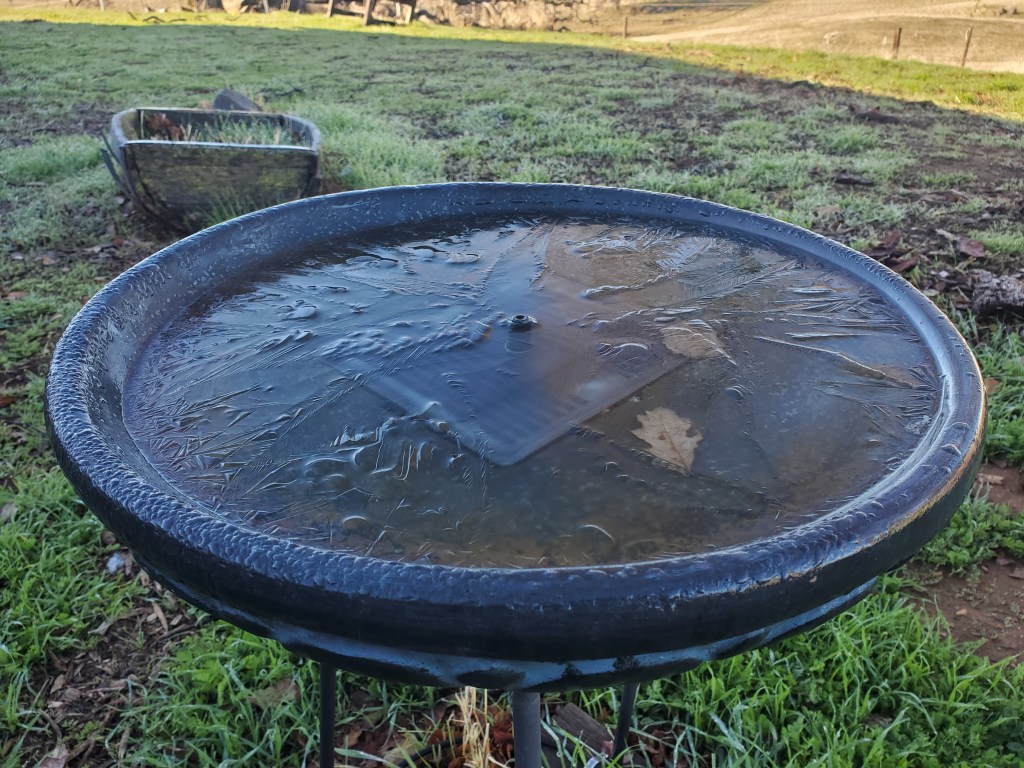
Ice crust on the bird bath

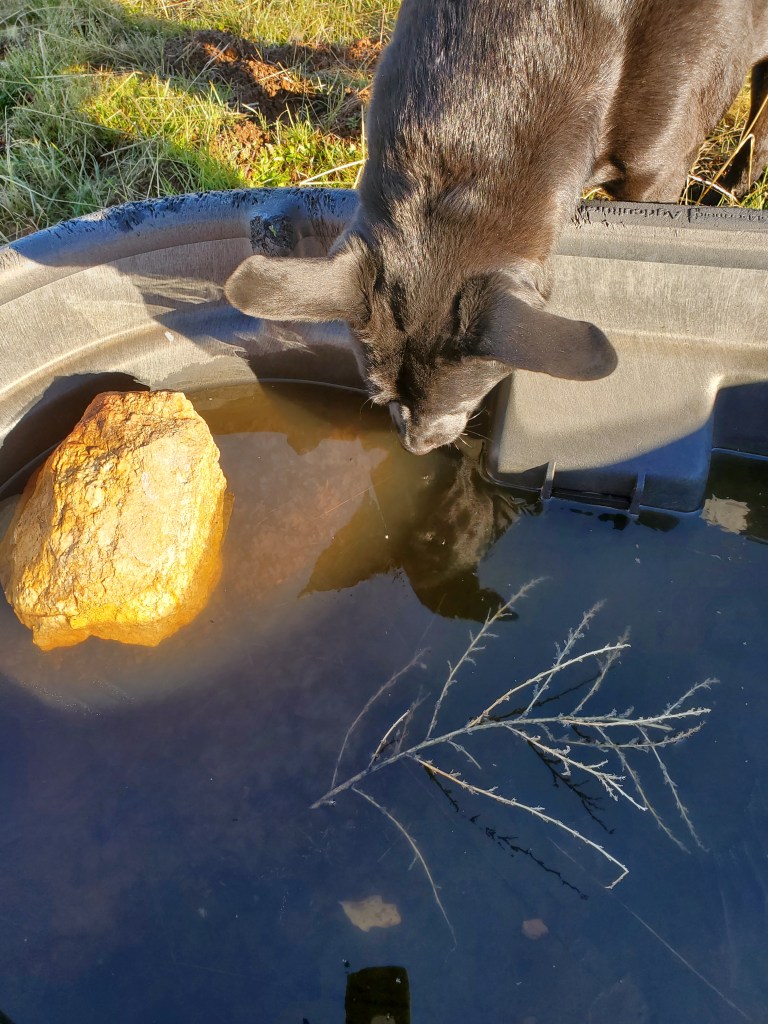
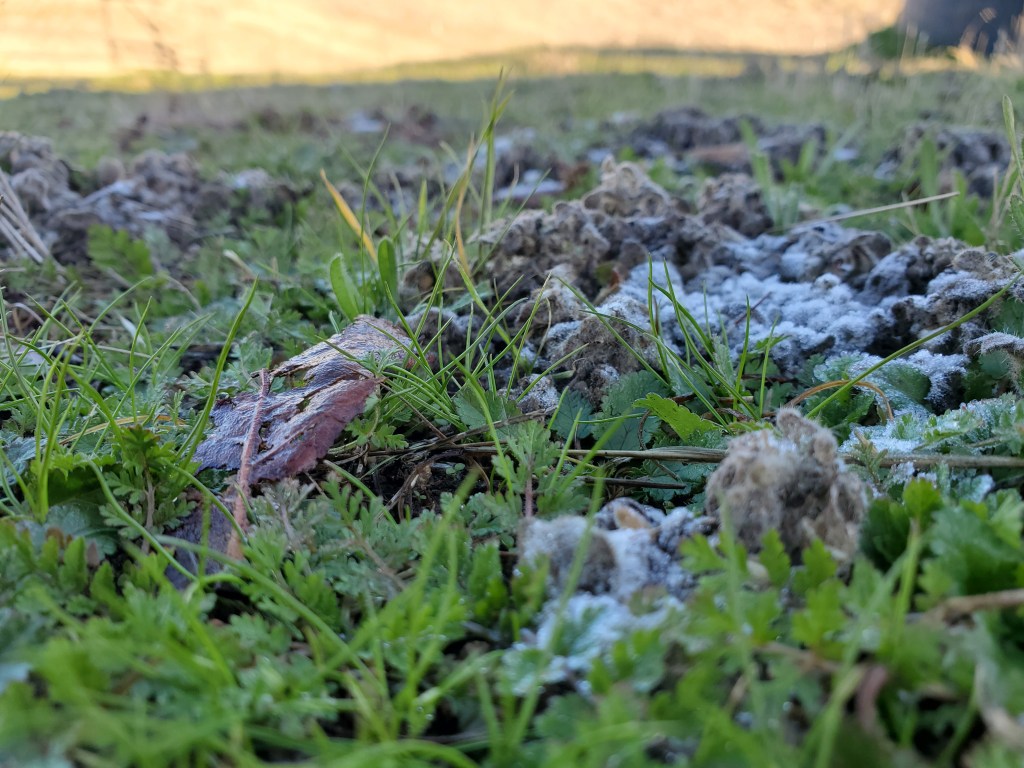
We need things to freeze so life can rest. Freezes also help retain balance by eliminating population overages [Think: grasshoppers]. For the last four days, there has been a crystal white coating of frost on the ground. Troughs and baths have a solid shell at the top. My breath has been visible as I go about doing my morning chores. Just a few weeks ago I could still go outside in a tank top for a little bit, but now a large jacket is required attire. The rain has come more frequently, and I am wishing for snow.

With the cold weather, I will admit that I have felt more sluggish – wanting to curl up with a blanket, book and hot cup of tea. Although the pace is slower, there is still work to be done. I have the cross fence going in to protect the California Milkweed. My cattleman’s son, Chaz, is helping me with that. He does great work. I am still planting a few native plants, and doing quite a bit of seeding. I received 10lbs of narrowleaf milkweed seed that I am sowing. I also just received my order of California seed mix for habitats and meadows, which contain native grasses and wildflower. With the rain and easy ground to work, it is a fantastic time to plant seeds.

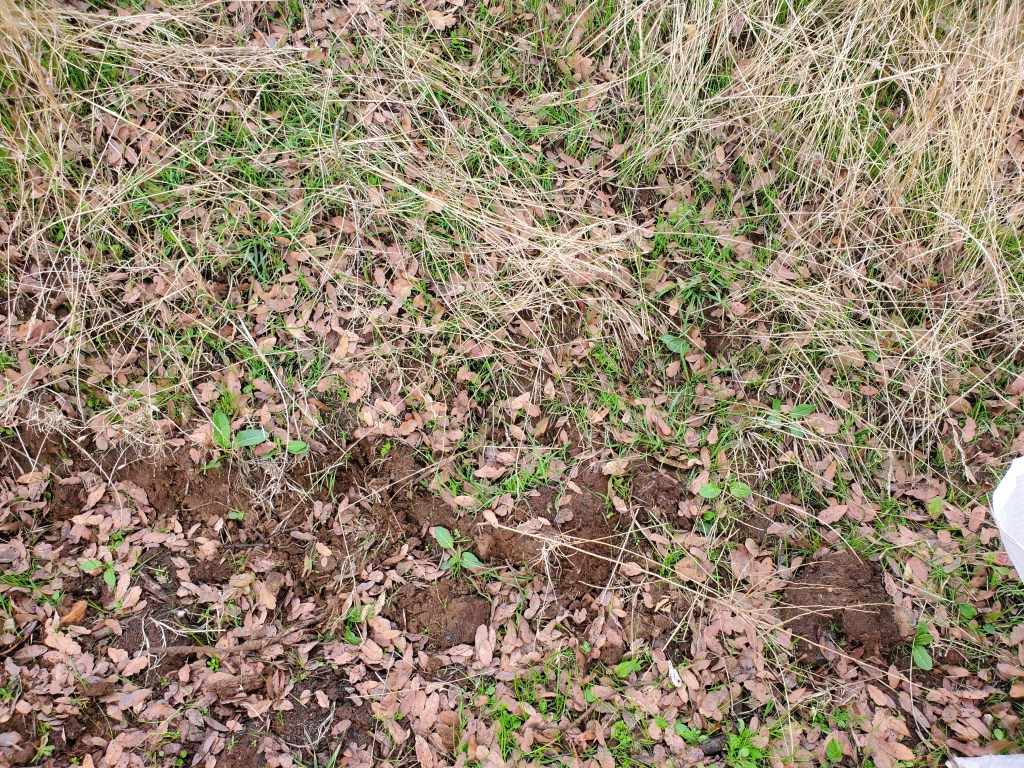
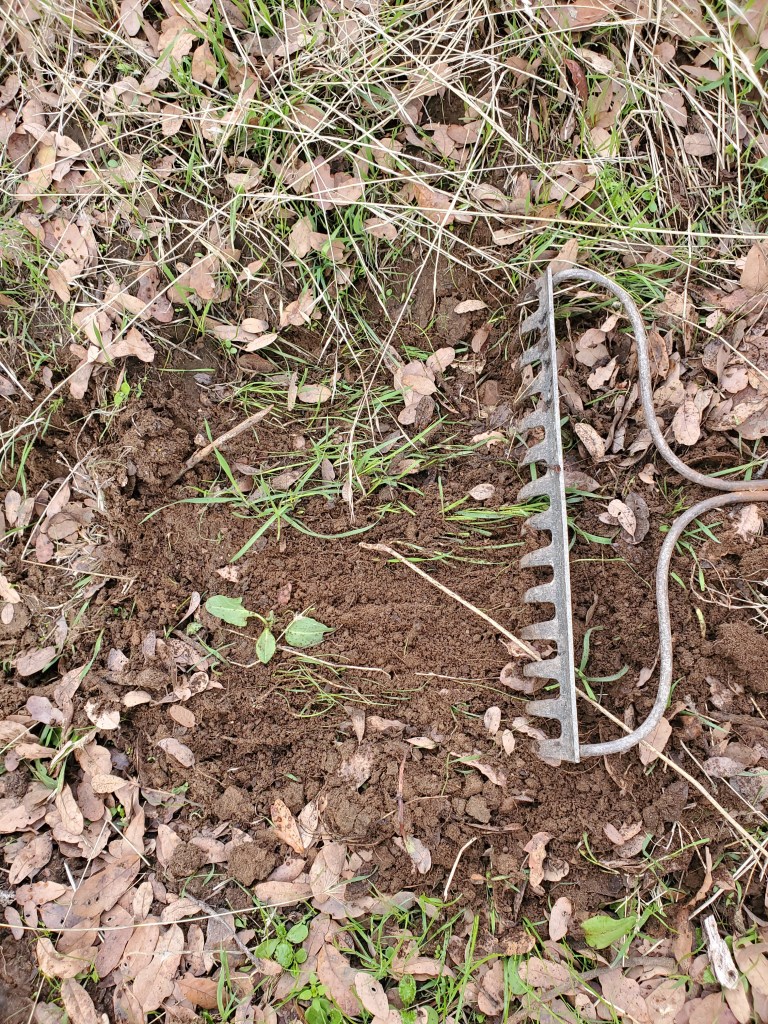
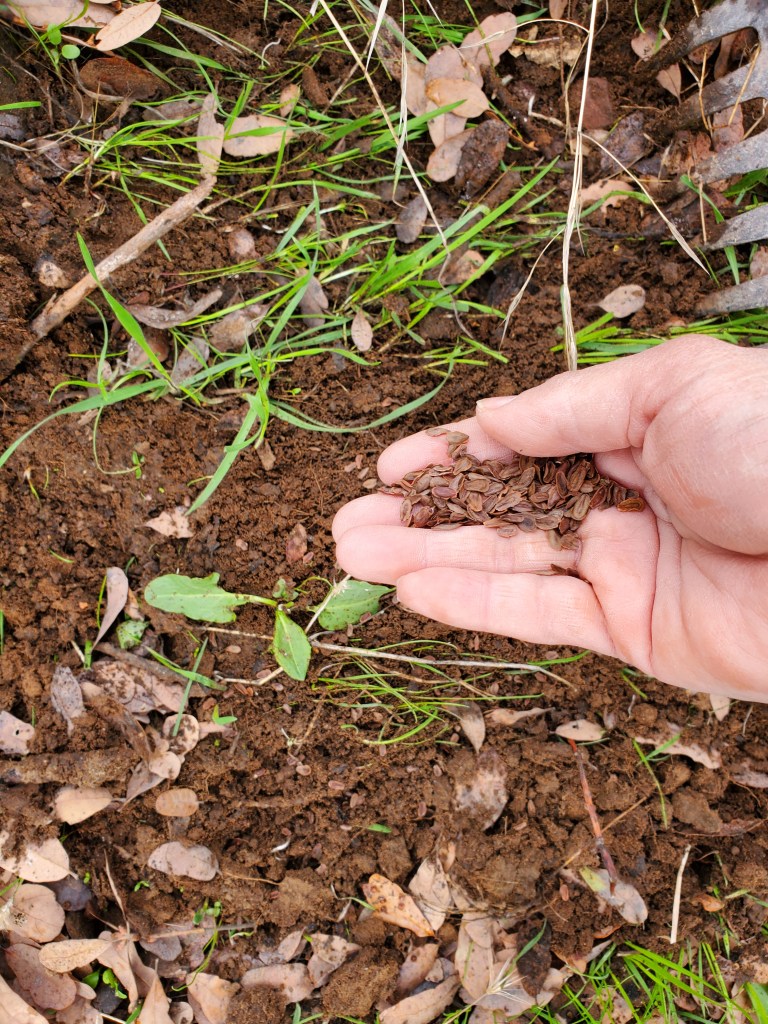
When my mothers-in-law were visiting for the holidays, it was great. I had an extra set of hands to help. For regular readers of this blog, it will seem as though every guest to my home is put to work. I promise; they are always asking to help. Liz is a wonderful helper too. Every time she visits, she is up for working on laborious tasks. She helped dig two trenches one year for rain catchment. She helped build up brush piles and move wood another time. This time, she helped me plant milkweed seeds. It is not too intense of work, but it does take time to give the seeds a quality head start. Sometimes, you can just broadcast seeds, throw them out in the area you want them to grow. This can work, but does provide easy pickings for birds, and you are just hoping there were more seeds than bird pecks. What Liz and I decided to do was to create a small disturbance in the soil with a rake, toss the seeds in the new furrows, then rake back over the soil in the opposite direction. Using this method, the idea is to cover the seeds with soil, decreasing the possibility of “feeding the birds” primarily and planting seeds secondarily.

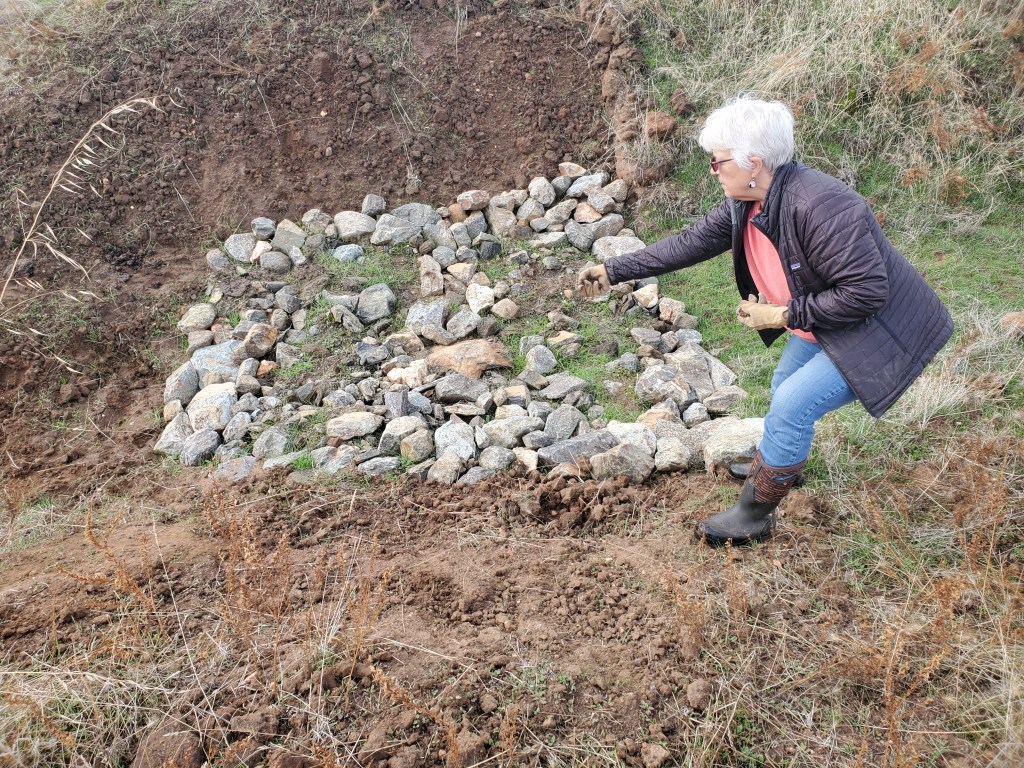
We did broadcast milkweed seeds in the arroyo around the rock and log drop structures given that the seeds would fall into deeper spaces between the rock into the soil – those spaces being like a deeper furrow. We chose this area because the rocks will slow runoff, and soil moisture will last longer in these spaces. This should give the milkweed roots more moisture longer to use for growth.

Monitoring

Monitoring the various conservation practices and the general health of the ranch are my favorite activities. Walking the hills, valleys and cliff sides, crossing creeks and breathing in the smells of the Earth bring me happiness. I make sure the guzzler and catchment system are functioning, the rain return in place and that the rock and branch access “ladder” for small creatures is built up to the top. I look at the creek beds and banks for changes, the health of the trees, the clarity and volume of water, what animals are around, pick up any trash that has floated in (by air or water) and take note of anything else that seems interesting.

Wanderings

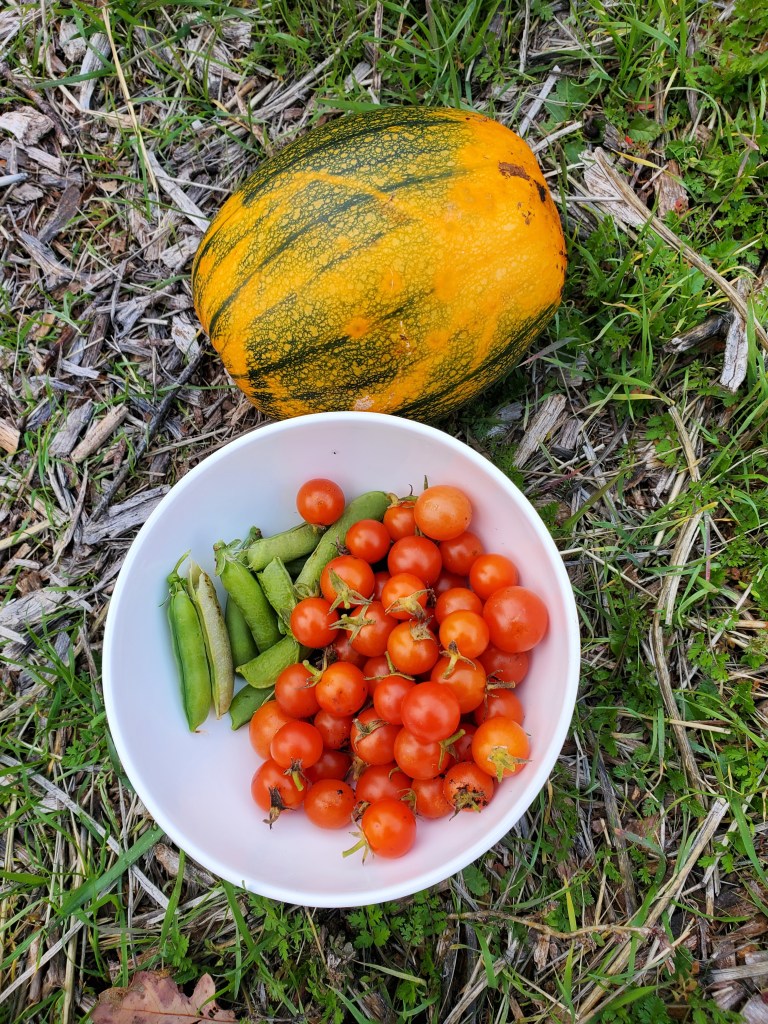
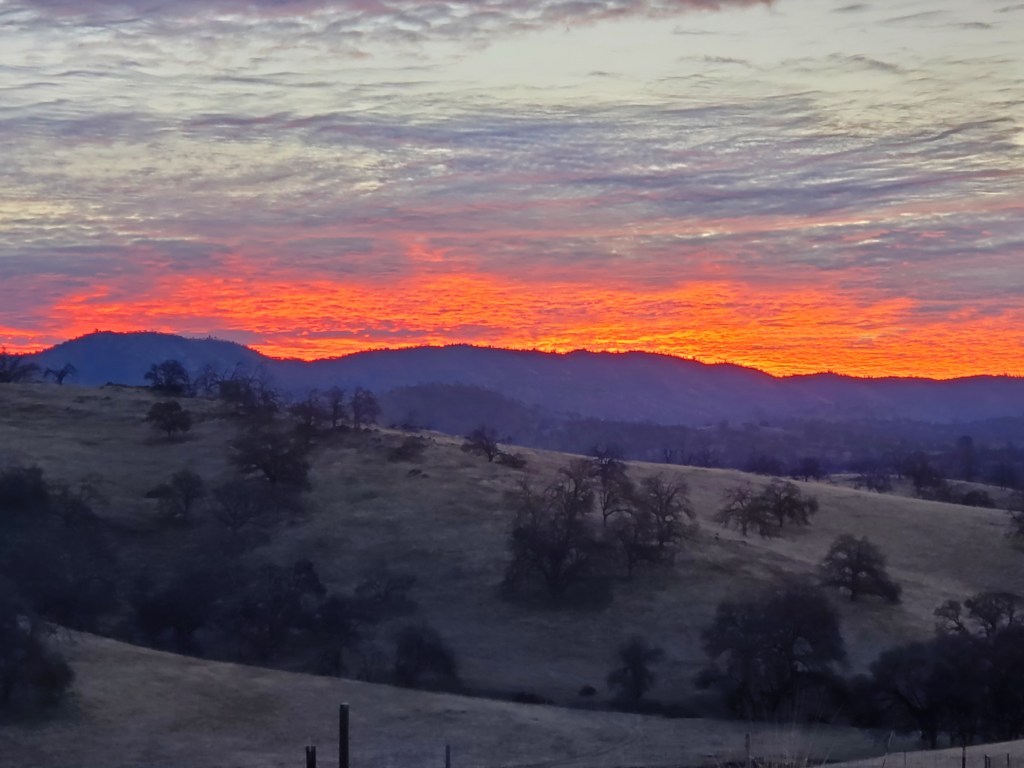
My garden is continuing to provide gifts despite the cold weather. Tomatoes, peas and arugula make for a wonderful salad in January. We still have small tomatoes beginning to grow. I don’t know how that is possible with all the leaves dropped. The peas are still blooming as well. There were two delicate purple flowers, the beginnings of pea pods. Maala Bwia is also continuing to provide a show of magnificence. Every day I am able to capture gorgeous photos.

We live in such a beautiful place, and on a beautiful planet. Daily, I am very conscious of my good luck. As with Yin and Yang, it compels me to consider the struggle, war, hatred and hard times all over the human world. At the very moment I take a deep breath and smile at seeing the sunset, on the other side of the world a woman my age is exhaling through sobs – sobbing for a life, a person, a land she loved now bombed to oblivion.

Each of us have times of suffering – some more than others. We pray, bargain, make wishes for peace. I know each time I make a wish it is for peace. In truth, peace is a difficult concept, even a fool’s errand. A favorite philosopher, Vine Deloria said “Peace is not possible”, that humans were by nature “violent and greedy”, that what we should aspire to is “respect”. If we understand the innate worth of one another and all things, how is it that we can harm or exploit? This concept was transformative for me as a young person. It aligned with my experiences, the hate that I did not understand, the hate that made me hate, which makes me less of what I could, and should, be.

Like the wood gatherer doll Trisha gave me, I would pick up memories, and experiences that would fuel me, things that I could burn to keep going – the lack of resources of my family, one stick; the desire to contribute to my people, another stick; the need to protect my nature relatives, more sticks. But, there was more – whispers from from my ancestors saying, “Never forget they made your mother go to the back door of the restaurant to purchase food to make her feel like she was nothing.” and, “Never forget they told you, as you stood holding your little brown brother next to you, that you couldn’t swim in the pool, which your parent’s rent money helped pay for.” and, “Always remember that things were taken from you – relatives, knowledge, songs, relationships, language – the things you are crying about when you don’t know why you are crying.” and…

My DNA was built both on the resilience that was necessary because of the hardship, as well as the hardship itself. Inside those helices are where the echos “Never forget” live. And, I do…I do remember everything my grandfather told me, my mother, all my other relatives. It is a warning of what’s possible as much as it is a memory. So, yes, I keep it, but I cannot let it define me. I can’t or else it would consume me. It is the kind of power that converts hate to atrocity. I don’t allow it to kill my potential, my joy, optimism and love. This is why the concept of respect is powerful. Peace is perfection, but respect is achievable. Anger is so deep, what weights it down, keeps it diluted, and allows the light inside to beam, is the knowledge that there is value to the pain and, believe it or not, in those who give it.

Respect. Without it, there would be no end to the fighting, the anger and pain — and that is no way to live. You cannot grow things when you are killing them too.

The ABCDs of Walappu’ “Uuchuthuu: a. Californica, Butterflies, Color, and Drought

Purples, whites, oranges, yellows, reds and blues abound!

In the melody of Carole King’s A: Alligators all around.

A: a. Californica comes from the ground.

B: Butterflies flitting around.

C: Colorful flowers abound.

D: Drought crept in without a sound.

And that is the current state of life (and my mind) here at Walappu’ ‘Uuchuthuu (Butterfly Home Place). Old, favorite children’s songs are not enough to comfort me as a moderate drought continues and is likely to get worse. Winter has turned to spring so fast I have hardly had time to write. In fact, today is three weeks since my last post. Rest assured dear monarch lovers, I have continued to be hard at work.

Protecting an oak sapling takes considerable effort.

In my last post, I noted that my friend Maggie spotted a little oak seedling while hiking with me on the ranch. We protected it with downed branches to buy me time until I could get to the site and build a cage around it. Three weekends ago I was able to do so. It took much effort however. Since the ground was still wet from a recent storm, I did not want to disturb the soils with my quad by sliding up and down the hillsides. Instead, I loaded the quad with fencing materials and parked in a flat spot well away from the hillside site and hauled all the material to the site. For those that are not aware, t-posts are solid steel. The roll of no-climb fencing is a thick gauge metal. The t-post pounder itself is weighted steel, about 16.5 lbs. As I trudged across the creek, up hill, then across an arroyo to another hill, then up that hill to the oak seedling site several times with pounder, posts and a huge roll of fencing, I had only one thought in mind…”How am I not a size 6!? Why are my arms not as defined as a body builder?” The only explanation is that I love peanut butter too much.

I also put in t-posts around the cottonwood. I needed to do it anyway, and I was going to be nearby. The no-climb fencing still needs to be attached, but I have it ready alongside the driveway to easily pick up when I have the time. At least Maggie’s oak is going to be ok. There are so few young oaks (and so many that died in the last drought), I need to do a better job of protecting the seedlings I find.

My favorite is back: a. Californica

The first emergence of a. Californica

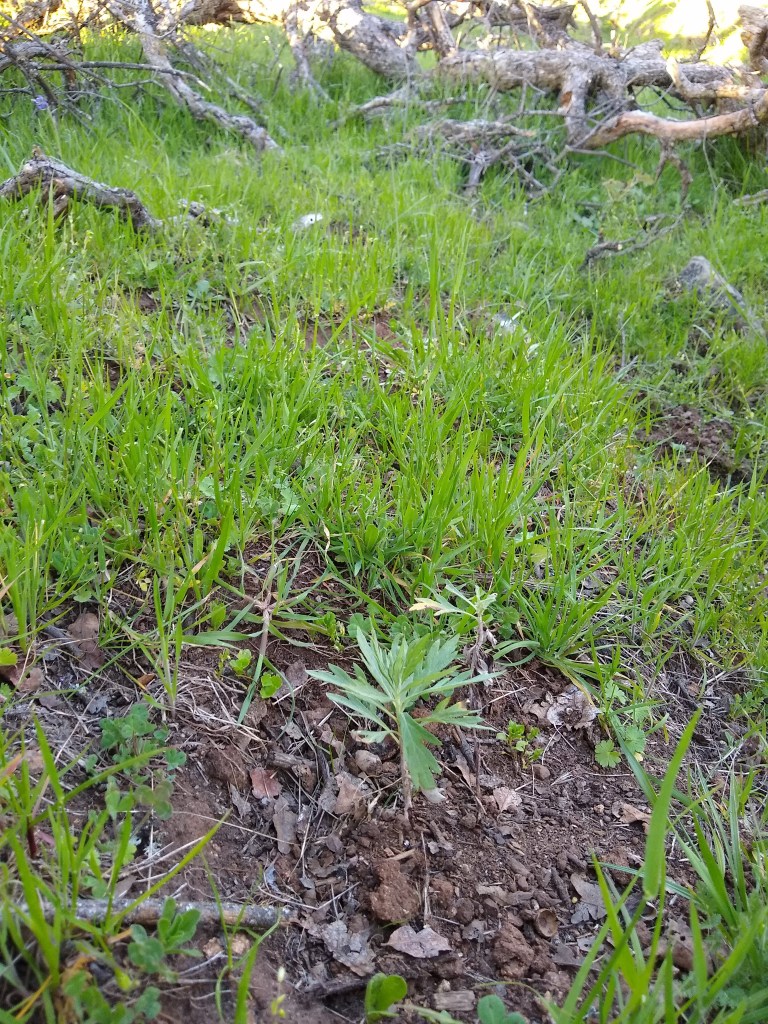
Finally, after weeks of monitoring the a. Californica site, I saw the first leaves emerge.These plants are so gorgeous and look so prehistoric to me. Last year, the site closest to the house had seven individuals. So far, I only see one. I also checked out the north-slope hillside where the thirteen plant community was last year. I found two – one single leaf by itself and another multi-leaf bunch. Both sites have much gopher disturbance. They ate a couple last year. I am hoping that this is only the beginning of their growth and many more plants will emerge so there are some that survive gopher predation. This early milkweed is a crucial source of food for monarchs as they begin their travels from the coast.

Diverse Butterfly Visitors

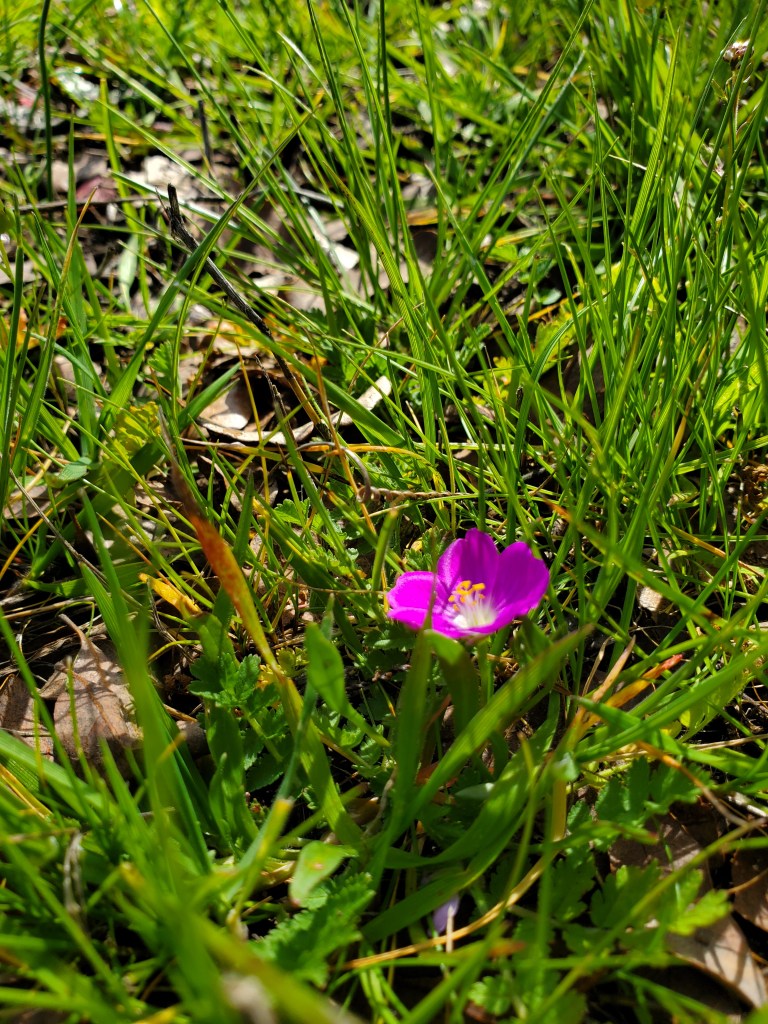
Cutting the grass early has really helped wildflowers proliferate. The little magenta flowers, generally not seen near the house this early, are thriving. We have so many species of flowers blooming that I have seen more than six species of butterflies already this year. They are tricky though. They flit so fast and disappear that it can be difficult to catch a glimpse for an ID or a photo. The butterfly visits began in late February and have grown in March. I was able to identify several using this iNaturalist tool. After being caught without a camera when the viceroy floated by, I now always have my camera/phone with me. So far, I think I’ve had: viceroy, painted lady, american lady, buckeye, white sulfur, brown checker, maybe a spring white and a Sara Orange tip. There have been a few I did not get a good look at, but they were clearly different than the above. Here are some of the butterflies of which I was able to get a photo.

Arroyo – Site 1 Planted!

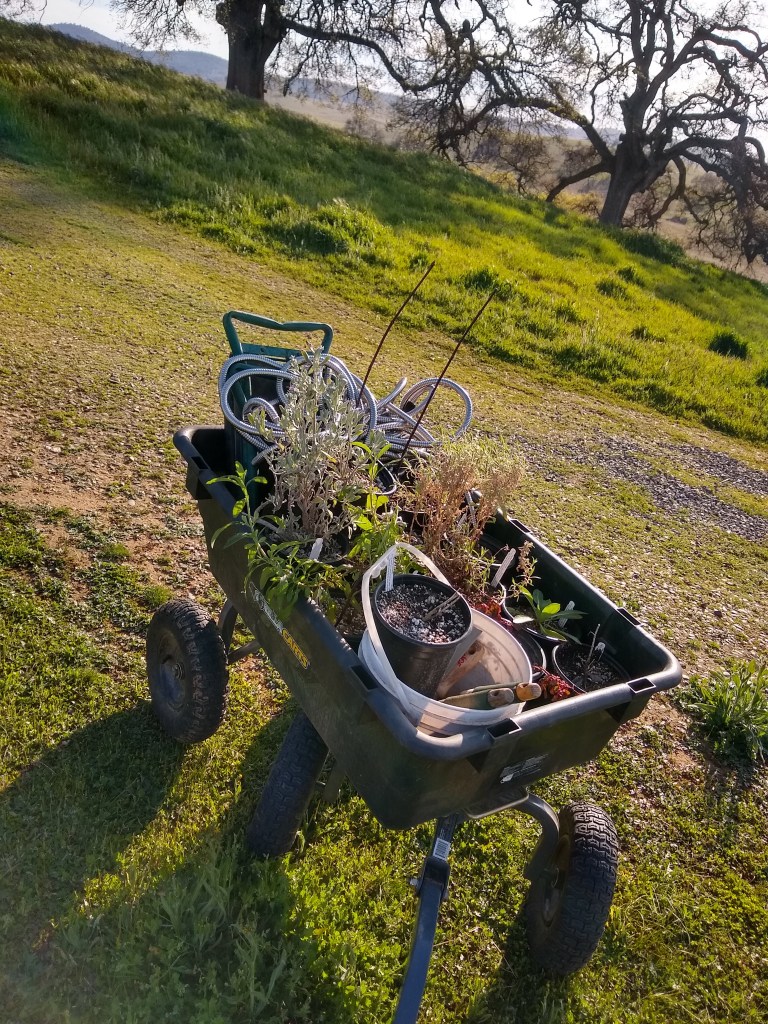
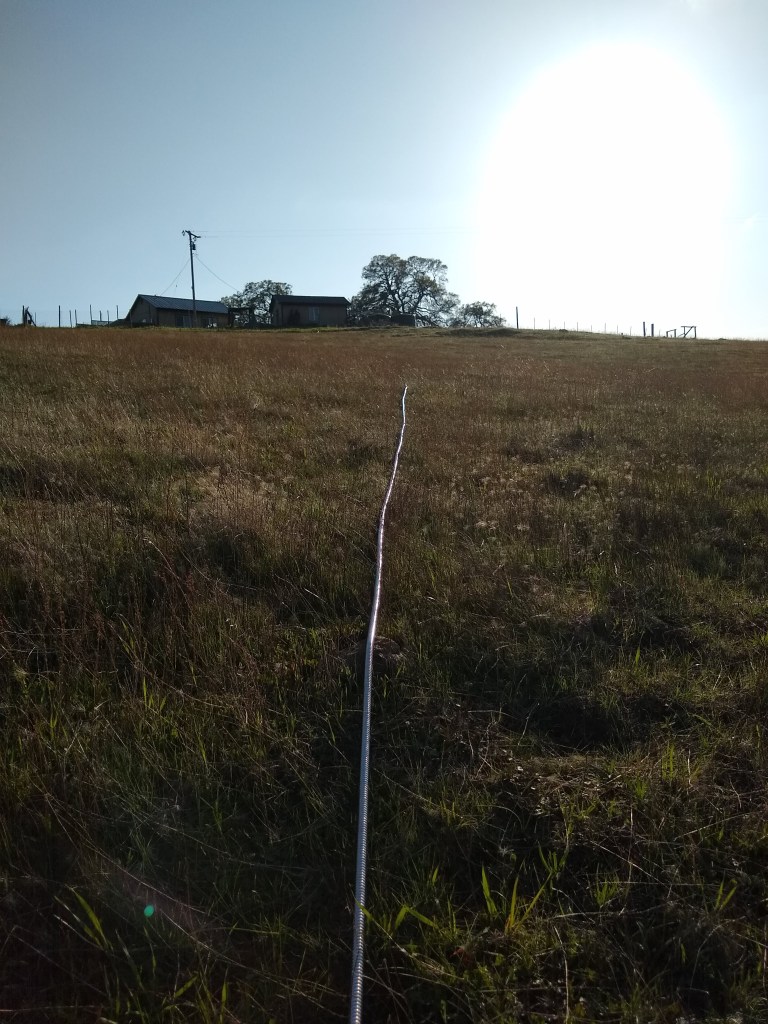
I finally began planting in the arroyo. The soil is so much different there. Even though moist, it is a little tougher to dig. The soil is clay-like but also crumbly with very small rocks. I planted monkey flower, sulfur buckwheat, two narrow leaf milkweeds (I have a hole ready for a third when Ron brings another), white sage, purple sage, black sage, mugwort, yerba santa, two maple trees and one other plant I cannot remember right this moment. I planted one maple higher on the hillside in the path of the spring. In doing this, I am hoping it will have moisture available for longer in the season. The other plants are planted in the area of the arroyo that appears to be at the base of where the hillside spring travels. I also planted most plants on the north-facing slope. My thinking is that this will provide additional moisture as the climate changes. The hillside spring usually dries by late July or August. It is not much water. The spring mostly makes the grass there green longer. You can trace its subterranean trajectory by following the greenness of the grass down to the arroyo. Given its limited production, the plants will need to be irrigated as well over the summer. When helping write the grant, I estimated that it was 1000′ from my rain water tank to the site. I ended up using just under 600′ of the metal hose I purchased. This works out since this will leave me 400′ to use for other far flung locations.

The cows left last Thursday for their southerly rotation. I have another 4 days to a week to get a fence built around Site 1. I already have most of the materials and decided to use t-post diagonal brackets for the corners. I am not trying to make a permanent fence here. The goal is to establish the plants and trees, then remove the fencing. I purchased another 50 posts the other day. The price has gone so far up since I first began building fence. I used to pay $1.50 per post. Now the price is $4.91 – and that is good. Most other places have 6′ t-posts for well over $5/post. Ouch.

Drought Outlook

Not looking good…

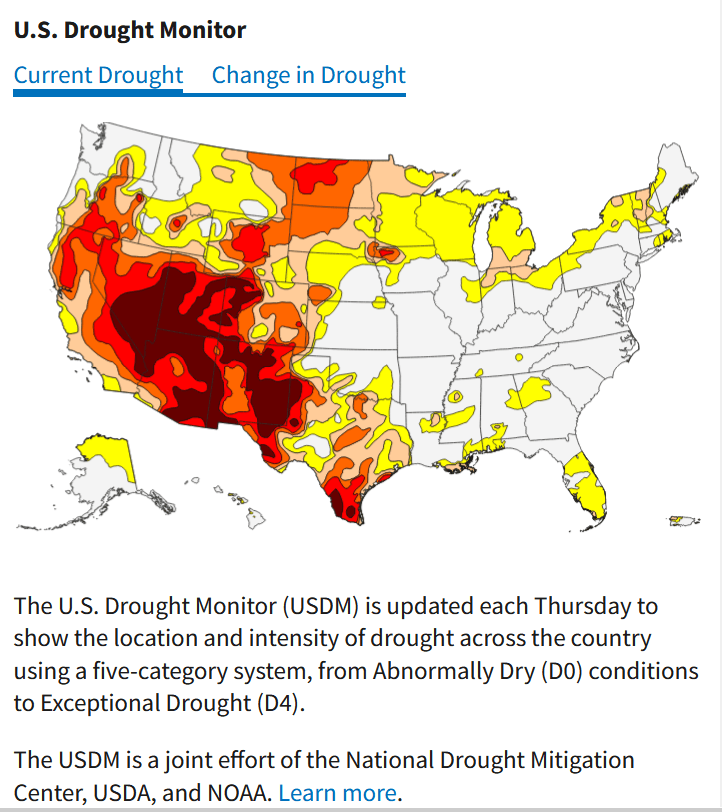
I keep a close watch on the Drought Monitor tool. I am so glad that I captured what I hope will be enough rainwater to get the newest plants through the summer season. I had hoped to add another tank, but did not get a chance to. There is much site work that has to be done. Last time, we hand dug the pad for the tank, built a retaining wall/box from old railroad ties and rebar we had laying around the ranch, and filled the box with sand that we purchased. It has worked well, but takes quite a bit of time. There is also the need to purchase just the right length and corners of Schedule 20 pipe. We just did not have the time or energy. We knew this would be a short winter season, and never received even one blockbuster rainstorm like we did last year. Maybe next year. My calculations say that we should have enough with the 7,000 gallons. I over- estimated water needs, but sometimes you need to water twice per week. Maybe the older native plants will need water. There are many unknowns. Stored rainwater is important because I don’t want to put any pressure on my well. David and I have already been in stricter water conservation mode for several months.

My rainwater gauge

I have been measuring rain for close to 17 years. The worst year of the 5-year drought was 9″ for the year. This year we have just under 10.75″. That concerns me. Last year, we had just over 14″. While 14″ is around the normal precipitation for my area, it does not allow much carry over into the next year. The soil, trees and grasses are thirsty. It shows. The swale pond did not have standing water until January 2021, despite a fairly wet December. Not good for plants and not good for fire resilience. We will do the best we can and hope it is enough.

Maintenance and Milkweed

With the emergence of the sun has come rapid growth of grass and all the other plants. David is mowing, and I am hand weeding to give the plants some light and space. Today, I staked all of the planting areas so we have markers that will keep us from weed-eating the plants if they get overrun by grasses. David does that work, and he does not know where everything is. Even if I am able to stay on top of weeding around the planting areas, it is good to have the stakes.

I have begun to water the plants. It is early, but they are already looking dry. I want to be sure they have a strong start. Maybe we will have some precipitation in April (fingers crossed). I monitor all of my plantings for growth. Sadly, so far, several of the dormant plants that came with the Xerces kits have not sprouted. Most of the bushes are doing very well though. The milkweeds from 2019 and 2020 have sprouts as do the newly planted milkweeds. They look strong and healthy. I am so grateful for that. Hopefully, the other Xerces plants will emerge. Maybe they just need more time.

Reflections

It has been a year since the the beginning of the CA Resource Conservation District grant, which allowed me to scale up the habitat work I was already doing. It was such a high last March when I learned my project had been selected from among many candidates across the State. At the same time, the impacts of the pandemic were just beginning as well. Everything was shutting down. Shock and fear took hold across the globe as we watched the bodies pile up in Italy and the bug make its rapid march, with each new red dot on the Johns Hopkins tracking tool, into every nation across the planet. It was made real when restaurants, schools and office buildings closed their spaces sending all of us home to watch life move forward without us. All most of us could do is watch the truly essential workers battle this disease with limited equipment, limited knowledge, poor national leadership and few options. If you were paying attention, there were some good things too. Here, the air was super clean – like it had not been in years. Wild animals showed themselves more now that they were given more room to be wild. The quiet of far less air traffic and road noise helped provide a level of peace needed as we grappled with the question of “what next?”. For me, not being essential, not being on the front lines of the pandemic able to use my energy to save lives, I chose to throw my energy and passion into helping save the lives of the monarch butterfly. It was good medicine for me.

We will survive this pandemic – but what will be do with our changed lives? Without bird songs, the howl of the coyote, cool breezes of clean air, clear, healthy water babbling across rocks, the smell of billions of blooming wildflowers, places of natural wonder and peace, and, yes, monarch butterflies making their epic migration, spreading their large wings as they surprise you with their beauty — without these, what is life worth anyway?

Branch Fence Bust and the Boys are Back in Town

Bull grazing in the a. Californica milkweed area

I love bulls. They are simply magic to look at with their size, muscles and intense stares. Fortunately, the bulls run by our cattleman here on the ranch are gentle. They would rather walk away than charge. Still…it is good to be real respectful of their presence – especially when they are around the ladies strutting their stuff. Remember, this is an 1,800+ lb animal. On my quad yesterday to do some watering, there was a big guy laying right in the path. I stopped. I looked at him. He looked– no he stared (intensely) — at me. After 45 seconds or so, I decided I would blaze a new trail to the northeast of him. Bull 1, Heather 0.

I have been checking the plantings in the branch fence (Site XR1) about every three days. Over the last six weeks, I saw that pieces of branch fence had fallen or had been tested by the cattle. The fence needed to be monitored and more branches placed every week or so. Last week, I noticed that the cattle had blazed a trail tightly alongside the enclosure. Hummm. This worried me. The fence had been tested just a week earlier resulting in me placing more branches on the east side. Now, it appeared that the cows were developing more than a passing interest. It makes sense that they would. With the limited precipitation, the grass is getting a bit thin on the ranch. By contrast, the creek beds are lush with growth. This is certainly true in the XR1 enclosure. More than grass is growing healthy and tall – quite an inducement to push in.

Cow trail

After seeing the path, I began to use rocks and other branches to block the path. Just up the hill on both sides of the creek are dead oaks with downed branches. In the last drought, we lost about 300 oaks across the ranch. It can be sad to see their ancient bodies in various states of decay. In this case, as I harvested the branches from the ground, I thanked the trees and limbs and told them that their remains will be used to promote new life so important to the health of this place. It is important to be grateful and respect all things.

I hauled the branches down from the hills, some lifted, but if they are large, dragged. Oak branches are tortuous – twisted and gnarled. This is a good thing for the fence. The twists of the branch tangle with the others. My goal is to lock them together as much as possible to promote strength. They also create width in an attempt to keep the cattle as far a distance from the planted area.

West side of branch fence. Note the lengths pushed out toward the trail

Currently, I fit my ranch work in before and after the end of my work day and on weekends. Especially in the fall and winter, when the days are shorter, I do not have much time to get things done. I did as much as I could before sunset, hoping it was enough.

Despite having spent considerable time shoring up the fence, I checked back the next day. What I saw shocked me. There was a cow pie inside the enclosure. Horror!

Evidence! A bovine was inside XR1

I looked around the entire fence. The breech was on the north side. I had built up the south, east and west sides, but felt the north looked fairly solid. Clearly, I was wrong. My heart was in my stomach terrified of what plants I might find gone or trampled. Luck was with me; all the butterfly plants were still there and intact. One had been pulled at, but had not been pulled out. I could breathe again! I tipped that plant back upright and patted tight the soil around its base. It looked like the intruder, enticed by the lush lengths of green, passed the currents and went right for the grass. The cow pie was smaller in size, so I guessed the interloper was an older calf or a young heffer. Usually, you can tell the difference in the poop. Calves have a slicker output since they are still taking milk, but the pie was in the water – so no telling who it was.

No matter, I began hauling branches to shore up the north side. I was not prepared with proper clothing, such was my hubris about the thicket I had installed. If anyone ever wonders why they see people working on the ranch in long sleeve shirts in the summer, it is to protect your skin. I was desperate to fix the hole immediately, so I worked despite having shorter sleeves on. My skin was scratched and bruised, but the hole was filled. Oh well. That is life on the range.

Not the half of it. Scrapes and bruises on my arms

Wildflowers

Pretty low growing wildflowers

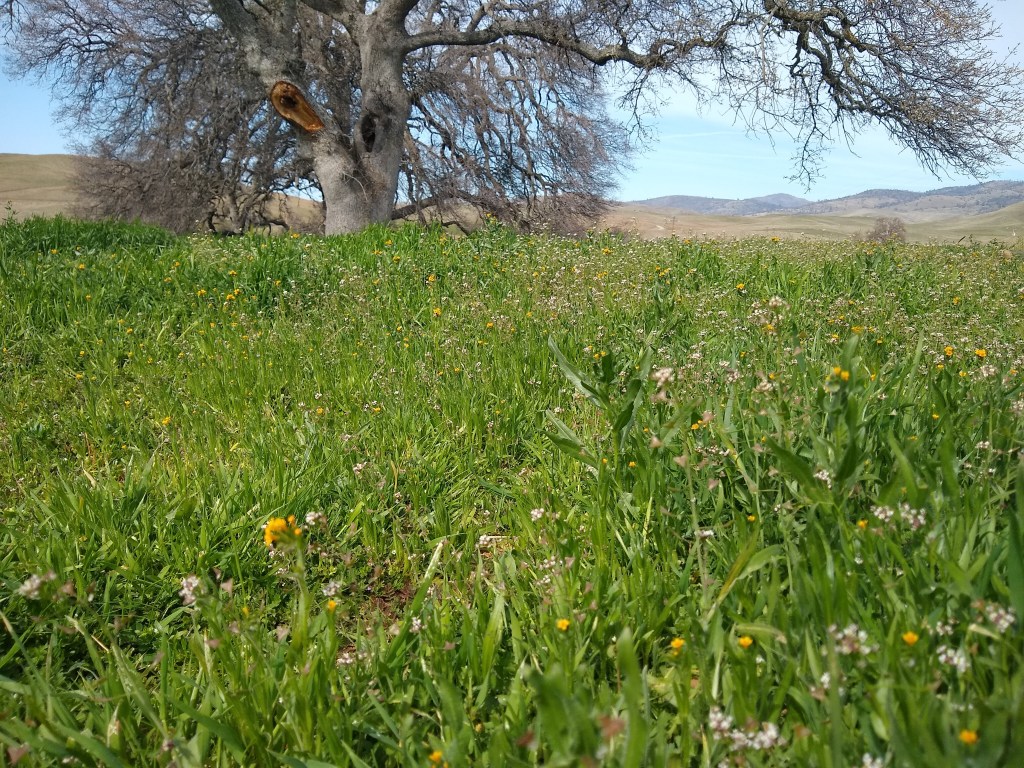
Several blog posts ago I discussed that David and I planned to cut the grass early this year to see what would grow. It was a good idea that David proposed. We typically leave the grass to grow long thinking that it would protect the top soil and help the soil retain moisture by protecting the soil from wind and shading it. We cut the grass in February and found that we had a proliferation of wildflowers.

Proliferation of white flowers with some orange ones mixed in

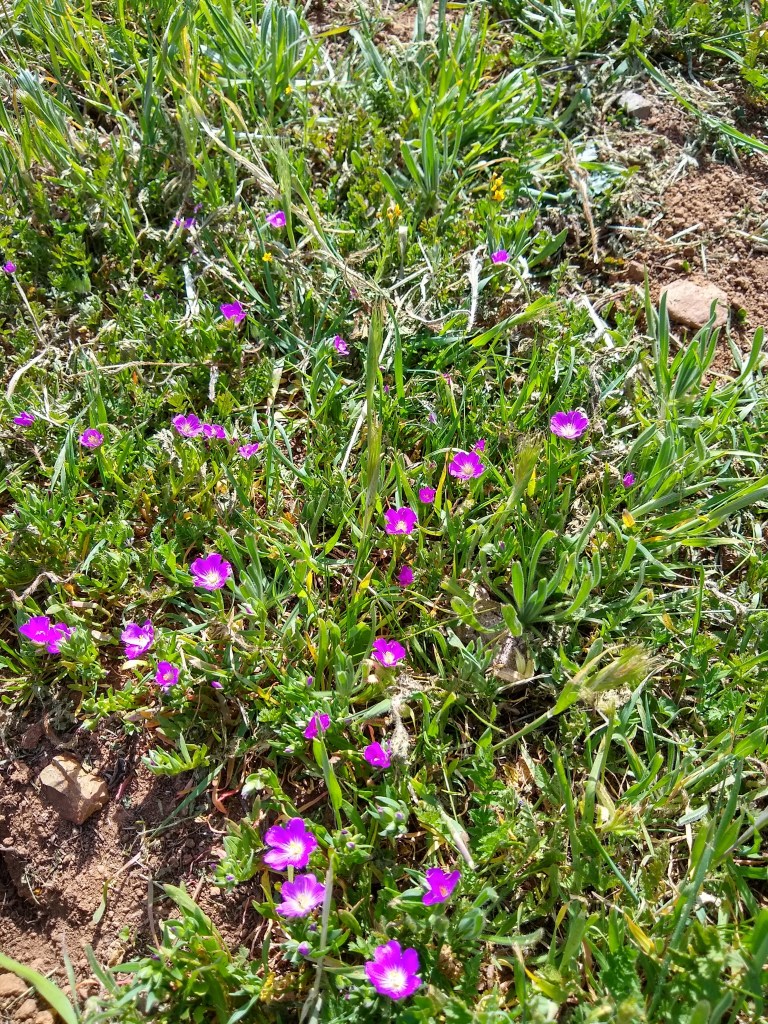
The small white flowers that popped up were the same ones that we always see on the cattle road. They are the first to bloom and fill the air with nectar. How exciting it was to have them in such large numbers near the house. The bees are loving them. We also have a proliferation of the small magenta flowers near the house, which we typically see in smaller amounts. Of course, the timing and amount of rain impacts what grows too. Shortening the grass so that the sun could hit the soil and seed significantly contributed to the larger amount of wildflowers. We will continue this practice.

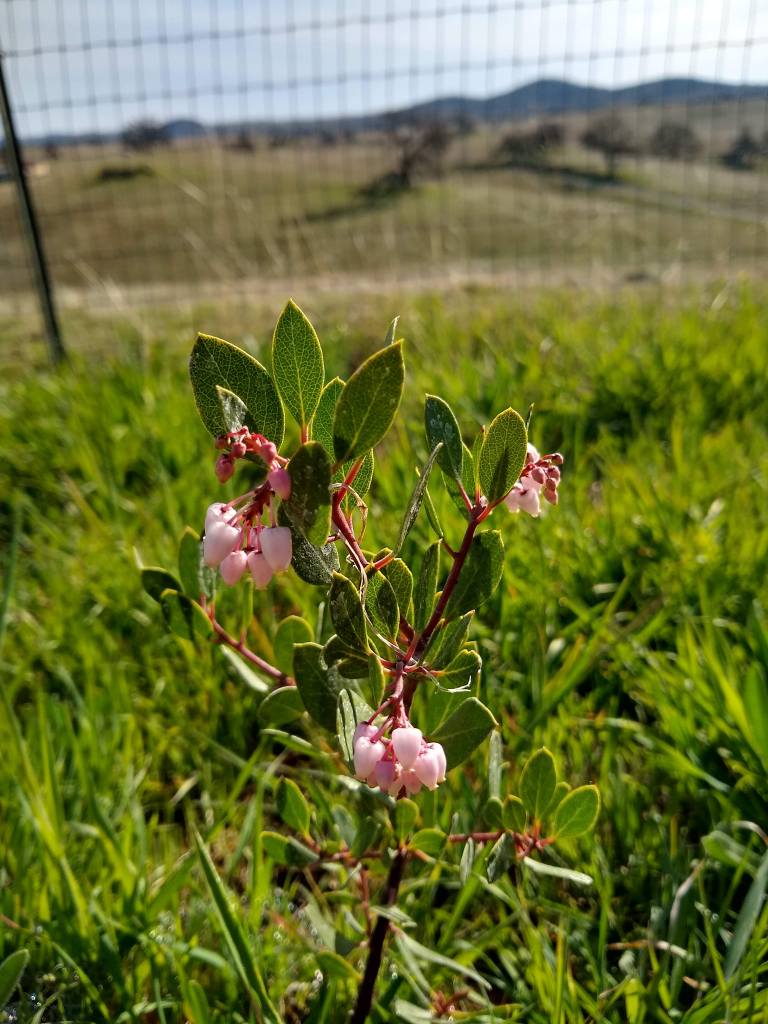
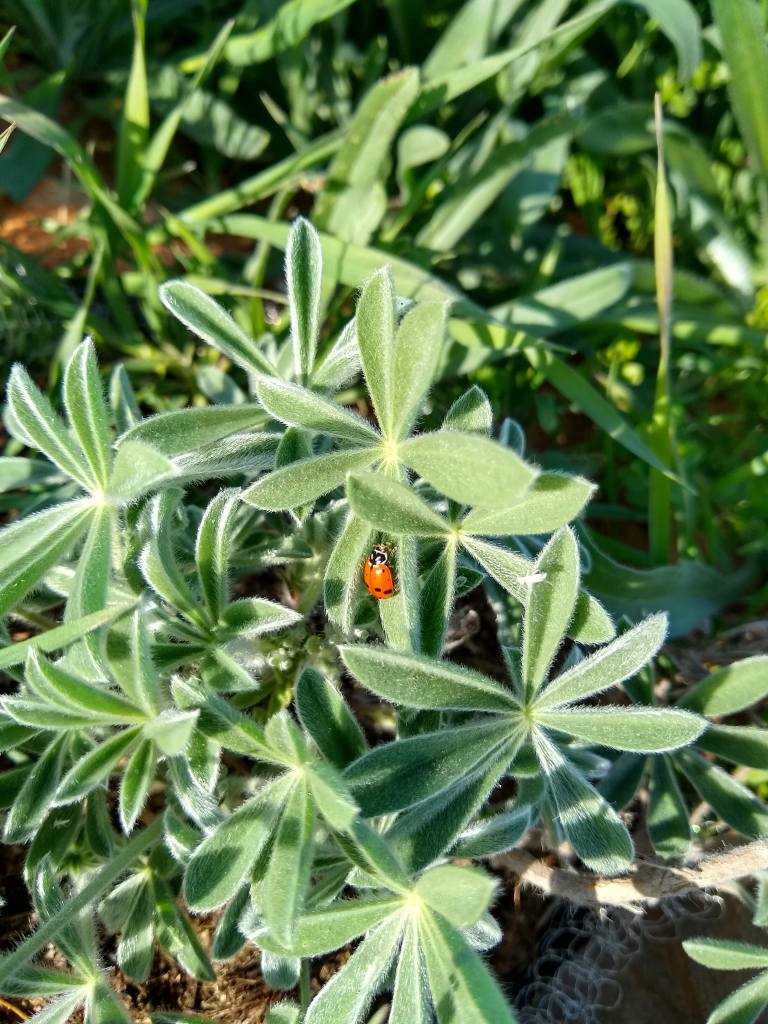
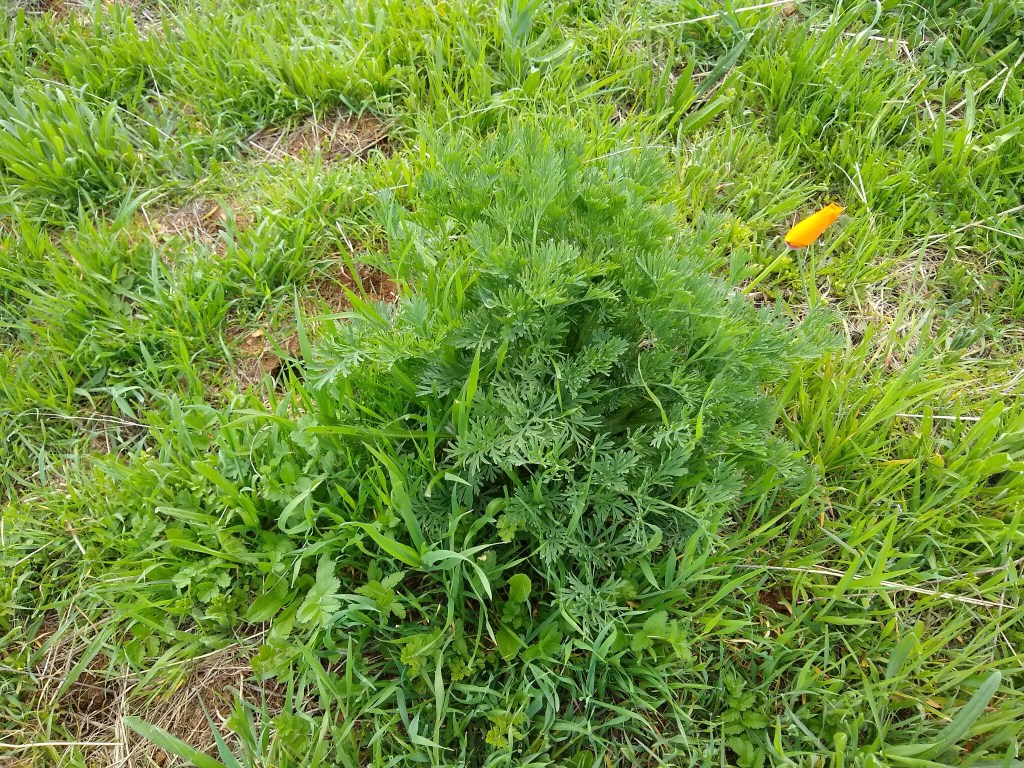
The blue dicks and poppies are blooming. We get both of these regularly. It is so much fun to see the empty stems pop straight up out of nowhere knowing there will be a blanket of purple in a few short weeks. The manzanita planted last year with the Xerces hedgerow kits are blooming. What gorgeous pink blooms. The coyote mint has finally taken off. I am looking forward to their scent. The lupine is growing well, but will not bloom for a little while longer. Lady bugs are all over the plants. What a welcome site. Finally, I found a remarkable surprise – soaproot. I have seen it on the ranch here and there, but the cows always eat it before I can try to protect it. For the first time, I found it in the house enclosure. What a joy. It is a traditional plant my Mi-Wuk cousins used for grooming.

More Butterfly Plants Planted – Milkweeds are Starting to Re-Sprout

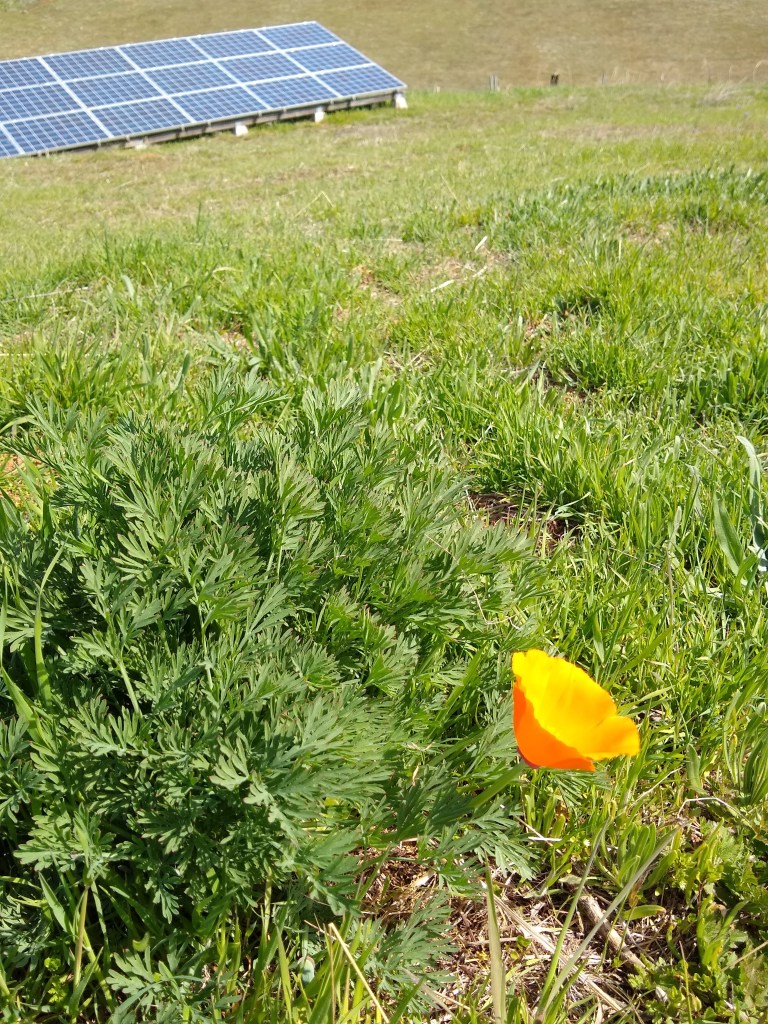
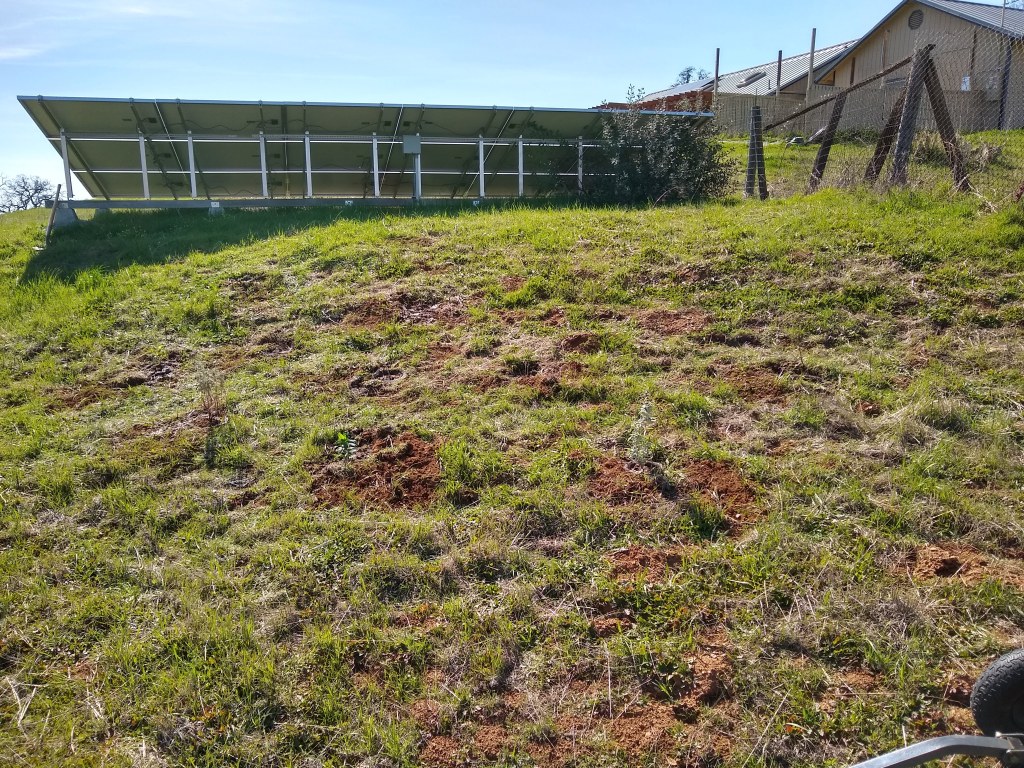
A butterfly pad on the north facing slope near solar panels
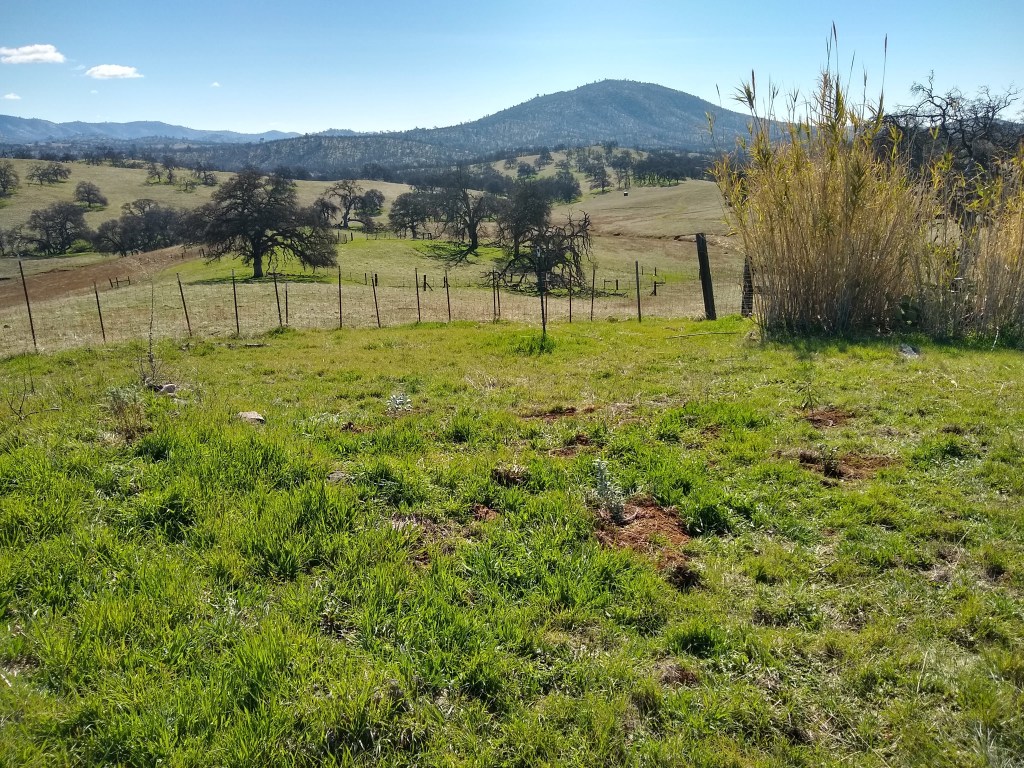
A pad on the east

I have taken delivery of 36 butterfly plants and have planted 24 so far. The concept is to plant nectar and milkweed together in a group so that there is everything the monarchs need to live, and to plant many of those groups. I am attempting to create butterfly “oasis” or “pads” (like lily pads for frogs) for them to flit from one to the next. In the home enclosure we now have four pads, two milkweed patches, disbursed nectar throughout and two hedgerow sections with nectar plants.

Milkweed sprout

We have already seen six species of butterflies – a whitish one, a mostly black one, a viceroy, some painted ladies (we think – they move so fast), brown with some faint orange in the middle of the wing and brown moth like ones.

Brown with black markings
Brownish butterfly

Other Items

Healthy oak seedling with leaves

Over time, I have felt more comfortable that I know how to protect myself from the virus. With this comfort, I have had a handful of friends and family who I know follow good practices over to hike or have a meal on the patio. I was overjoyed to have my friend Maggie come over for a hike this past weekend. She has a well-trained eye and ear as a naturalist. Besides identifying blue bird calls, poison oak and a red tail, on our hike she spotted a healthy oak seedling. Somehow, it had avoided detection by the cattle. Maggie and I quickly made a brush pile to help protect it. I will go back out this weekend and build a cage around it. It is in a good spot to grow without other oak competition for light. How wonderful to have friends over again and to share the land with another person who loves it.
This brush pile is likely not enough to protect it long term. It is fairly small. It may buy me time however to build a cage around it.
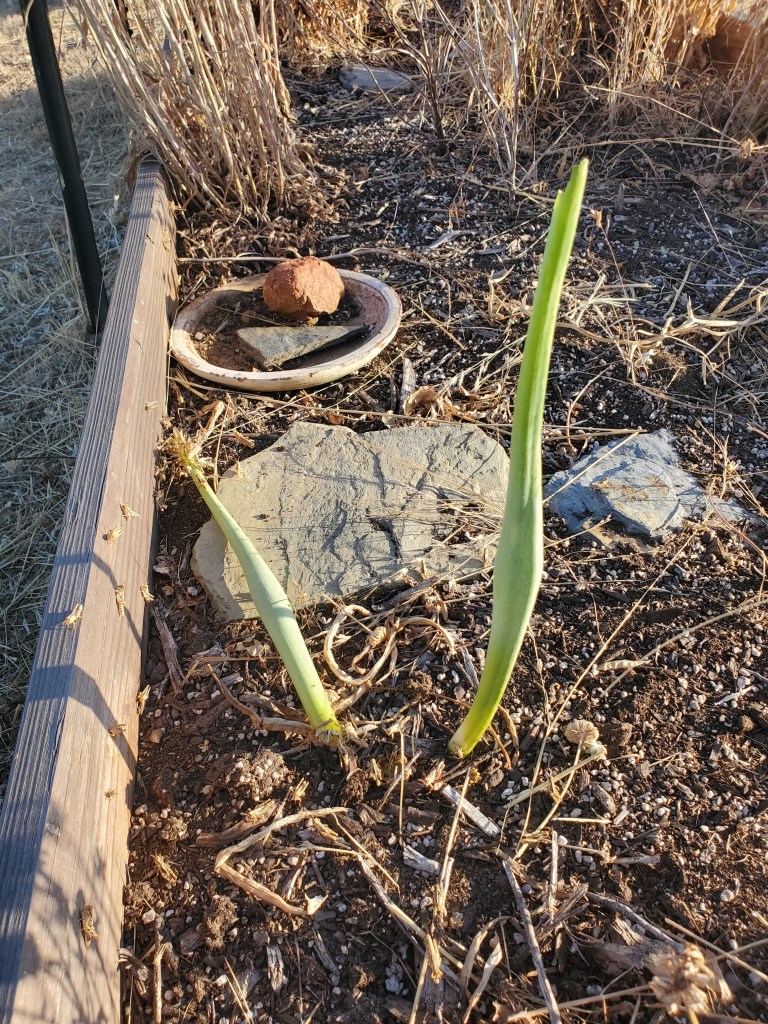
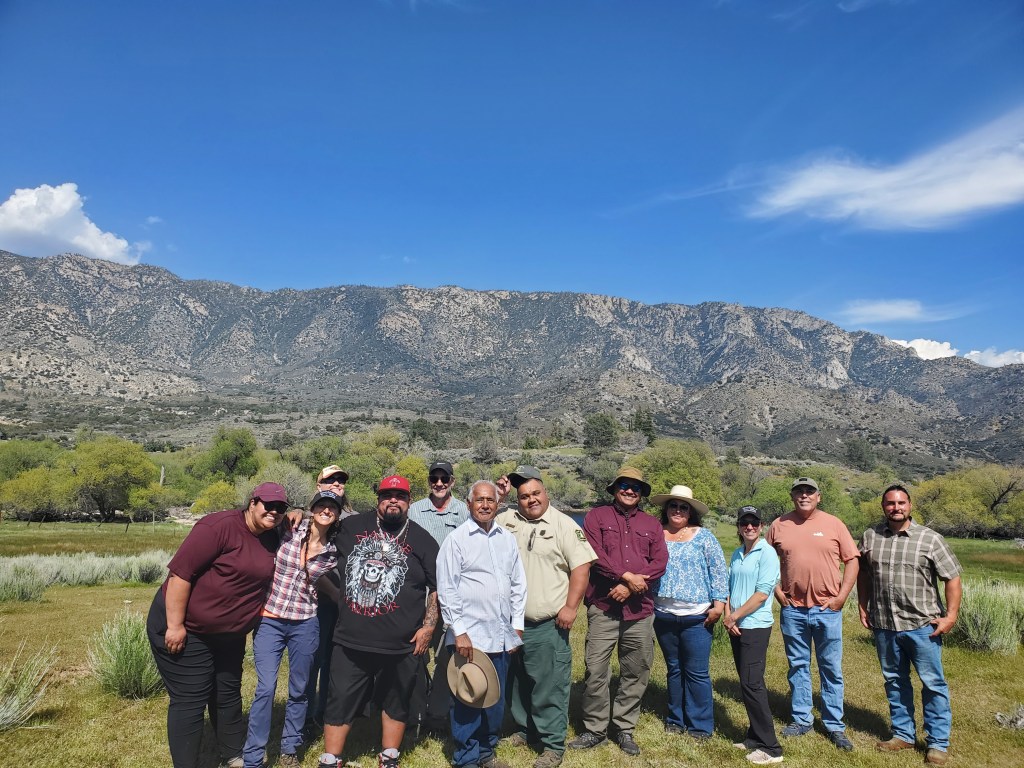
We also had the opportunity to go to Odom Creek and check on the willows and mulefat. All were still there and doing really well.
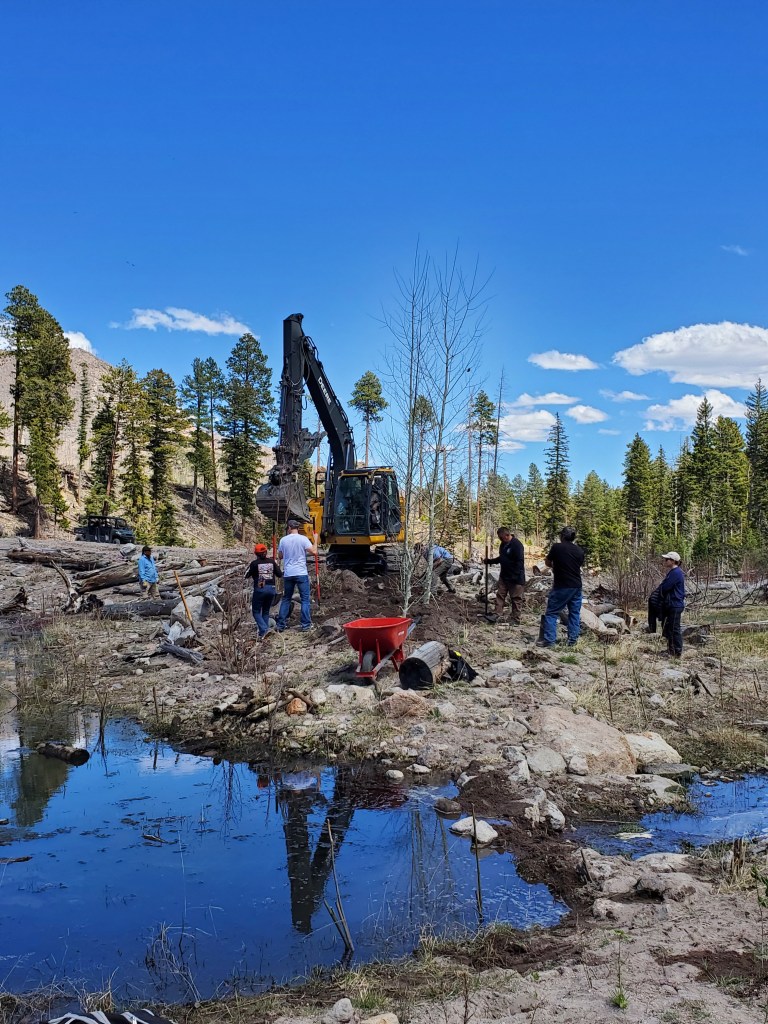
Willow doing well inside the brush pile

In addition to all the planting, I continue to educate myself and participate where I can possibly help. To this end, the CAFF conference was excellent. I leaned about a wide variety of topics that could be helpful to my work, such as financing. I was also asked to join a monarch and rangeland working group tasked with expanding habitat on rangeland. I am not sure what value I will be able to bring, but it was good to meet and learn from so many others. At that meeting, I met Susie Calhoun. She is another land steward building habitat on her family ranch. She and her family are doing a great job. Check out their website to learn more and see some beautiful photos. https://www.3calhounsisters.com/

The Smoke Cleared and Then…

Lilac blue butterfly – wow!

Last week a trough of low pressure came through the area. This pushed the smoke elsewhere. The changes at the ranch were immediate. In addition to clean air for my lungs, there were pollinators everywhere. My father decided to go for a drive the day the smoke cleared and stopped by (Of course, we followed physical distancing requirements and stayed outside). To have him stretch his legs, I took him on a tour of all the butterfly plants and blooms. As we got to the end of the patio, we saw the first group — a swarm or kaleidoscope of small, lilac-blue butterflies!!! They fluttered all around me as I walked through their nectar sources. I was overcome with surprise and joy – so much so, I nearly fell to my knees. My dad chuckled and asked if I was ok, and I said “I really did it. I created a home for butterflies!” All this work paid off. They are here. Maybe not the monarchs, but these beautiful little ones are here!

Butterflies eating or resting. So pretty!

We kept walking, and there were more and more. I couldn’t count them. These little ones seemed to like the dove weed, aster, butterfly bush and the blooms on my stevia herb plant. They were fluttering around the milkweed too. Their coloring was extraordinary, with a bar of orange with black spots just on the end of each wing. In addition to the small lilac-blues, there were the white and bluish sulphur butterflies. I was overjoyed.

Fortunately, they stayed several days, and I was able to collect myself to get the images seen on this blog and one decent video of a couple butterflies fluttering about on the stevia. Here it is, and enjoy these 36 seconds of pure Zen. Sadly, the smoke rolled back in, and the butterflies were gone.

Other Amazing Things

Garter snake – a good friend to the garden and gardener!

The land seems healthy. We have seen snakes, lizards, tarantulas, song birds of all sorts and frogs. There was even a falcon battle in the front yard. The animals are not being shy, which means there is plenty to eat, plenty of habitat, enough space between all of us, and they are feeling comfortable to make a life here.

The marigolds are finally fully in bloom. It took a while, but the smell is lovely, and the sight of their sweet blossoms – beautiful. The sunflowers are fully open and are so joyful. If it was not for the smoke ebbing and flowing, the scene would be a daily respite.

Branch Protection Works

Grass grows where the branches are. Far less grass where there are none (apologies for the blur)

Some notes from Sites 7 and 8: You can really see the difference where we placed branches and where there are none. The cattle has not grazed the branch areas as heavily. This gives me an idea for protecting the creek, which I will vet with the biologists.

I also noticed a mass of aphids (the orange spots) on the narrowleaf milkweed. I have some at Site 9, but only on one milkweed. The aphids do not seem to prefer the showy or woolly pod plants. According to Ron, my native plant vendor, they shouldn’t hurt the plant. Besides, we are nearing the dormant period. It is good that something gets some use from them, since the monarchs did not make it here this time.

Aphids on the narrowleaf milkweed – Site 8

Getting Close to the End of the Season

Rubber boots are shot

We have just one big planting to go before we are at the end of the season. My back is sore, the skin on my fingers cracked, and my boots are completely worn out. It is not a complaint, but a sign that it has been a productive seven months. Just for that one swarm of butterflies…it is all worth it. I think next year will be even better. I just need to get the next set of plants in the ground so we have more early bloomers ready to go for February. Oh, and if anyone has some recommendations on a really good brand of rubber boots, please share them with me. I hope I will need them soon (read: need rain).