More a. Californica Spotted and Wildflower Whiplash

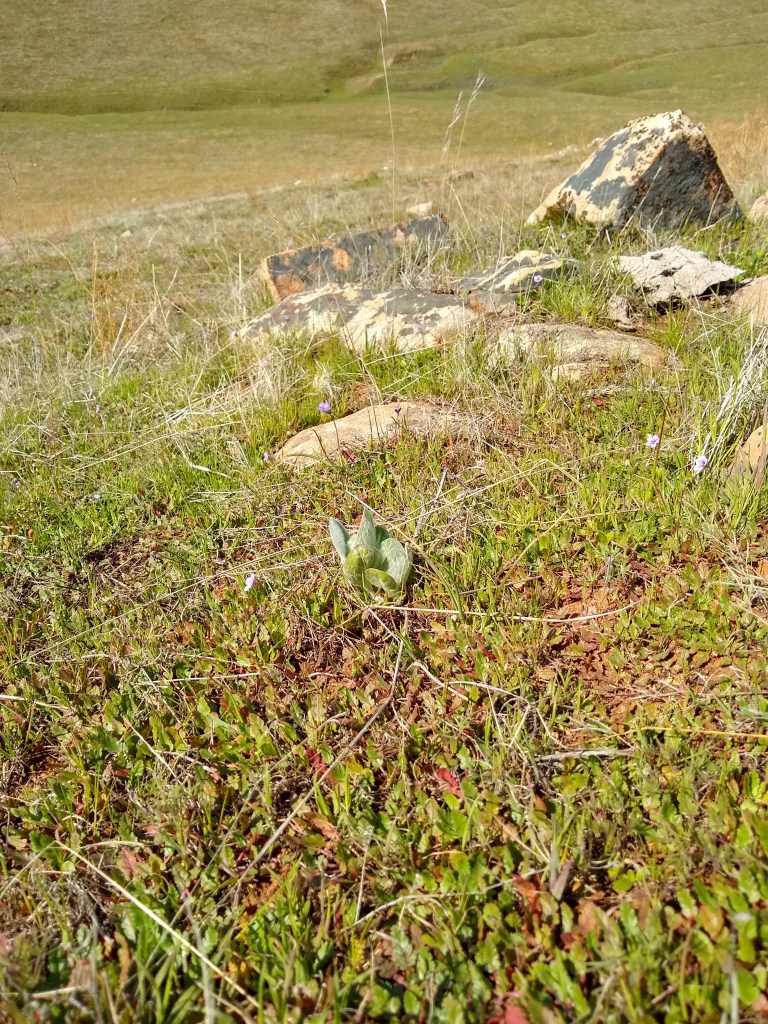
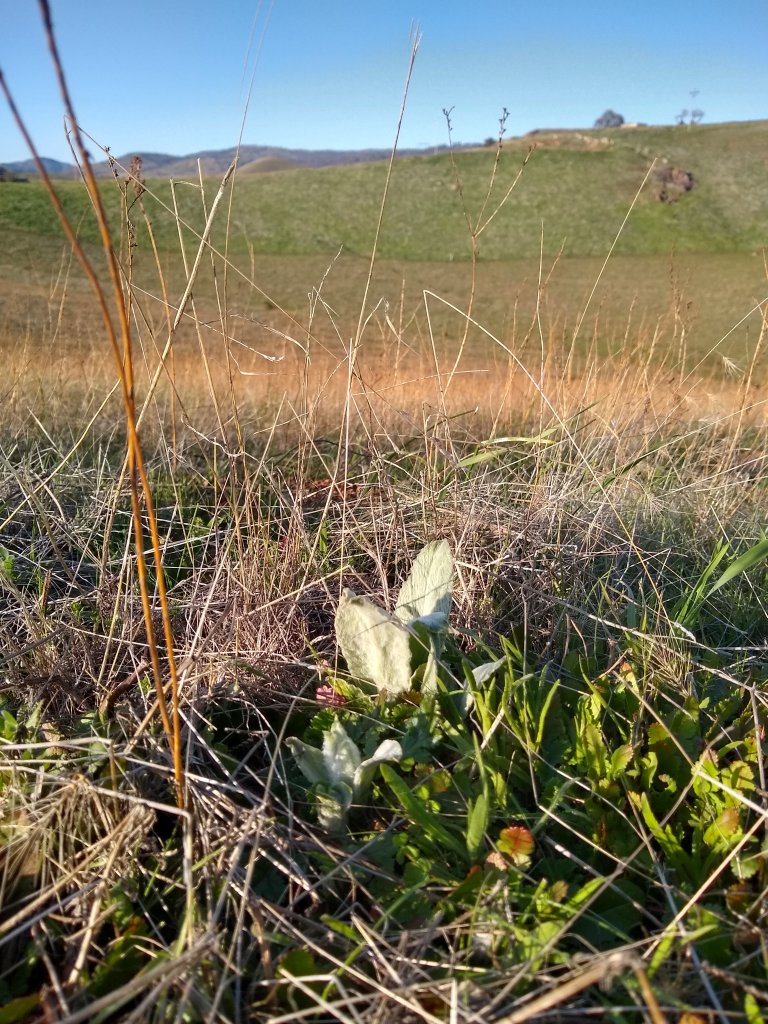
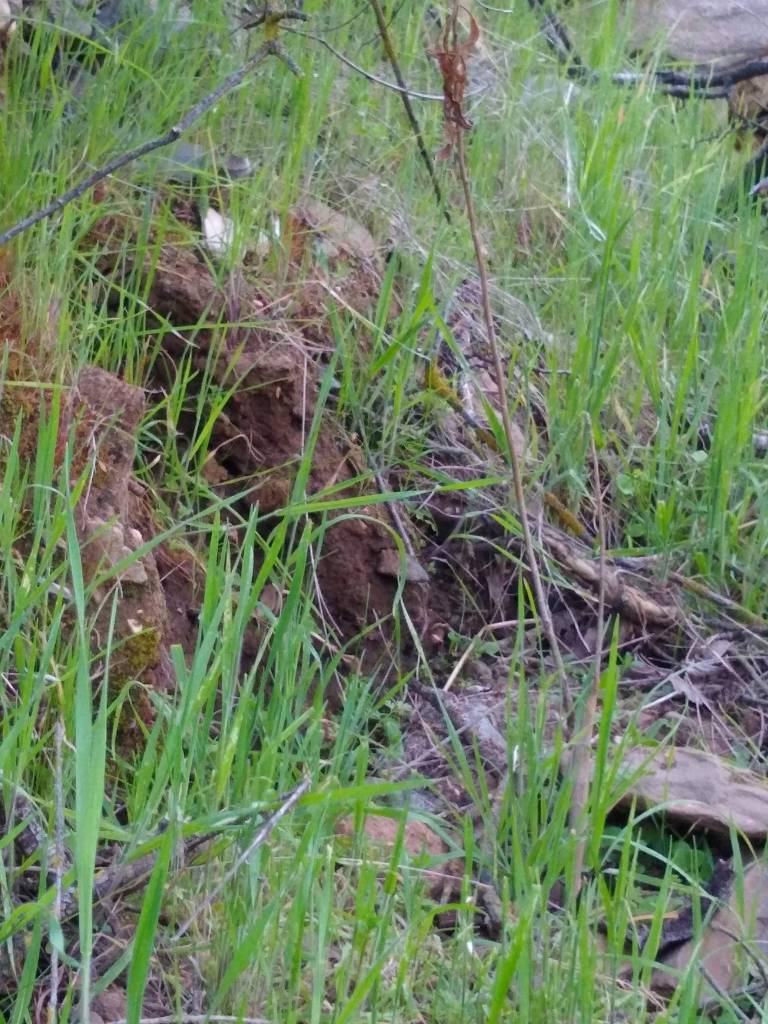
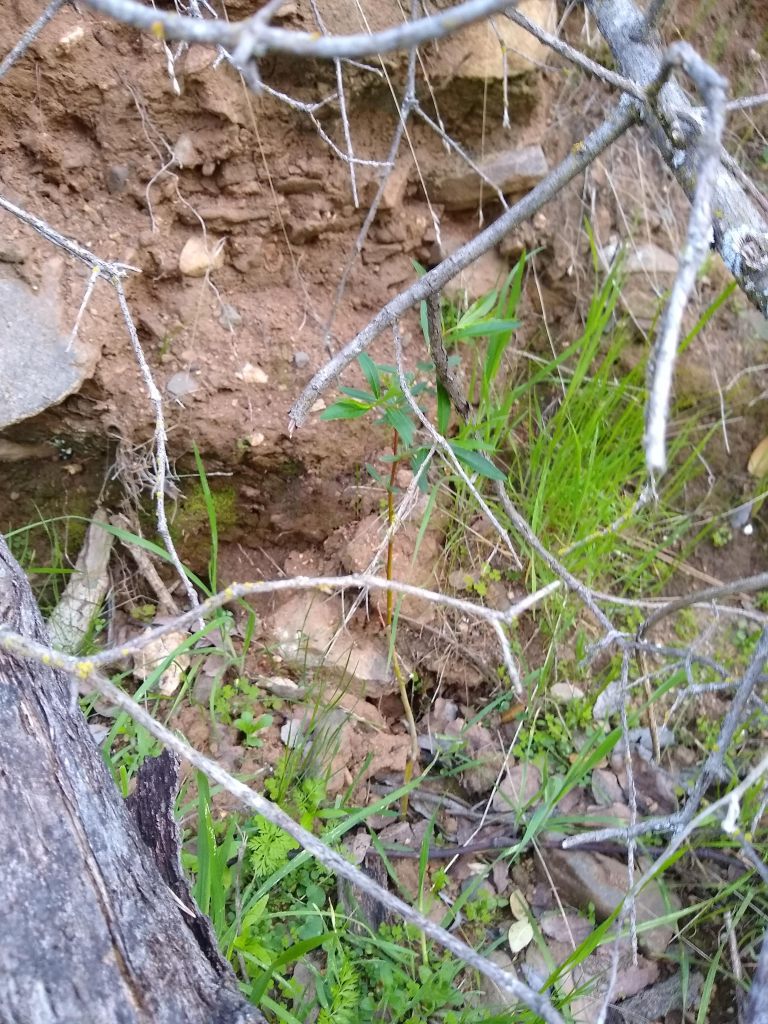
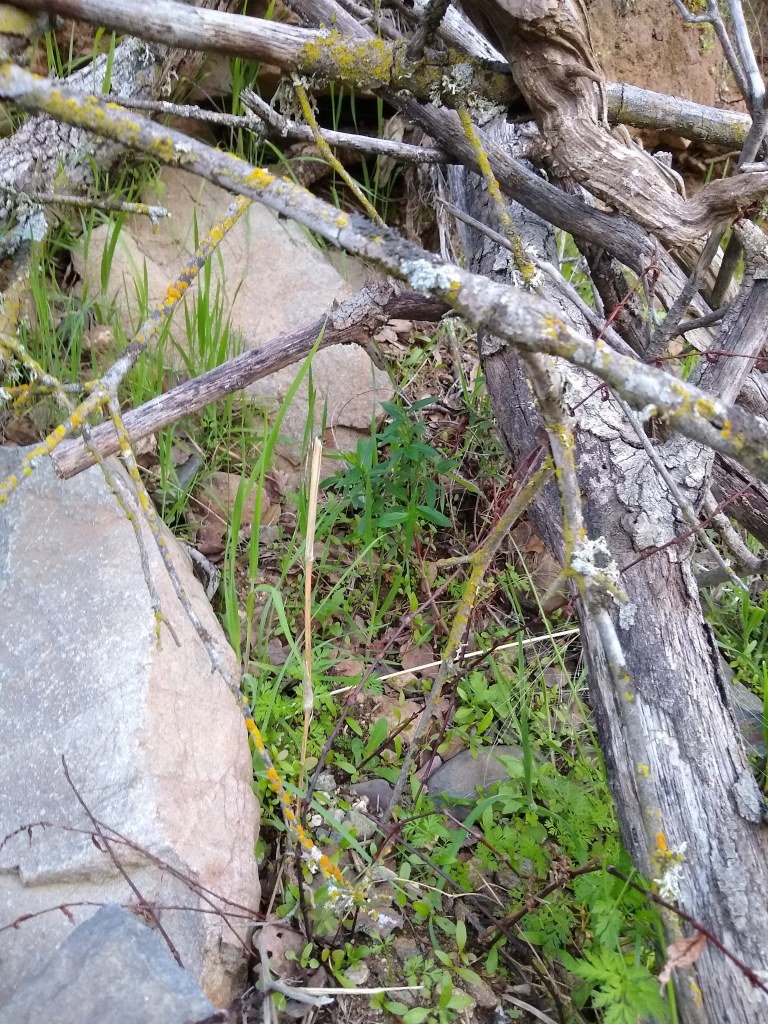
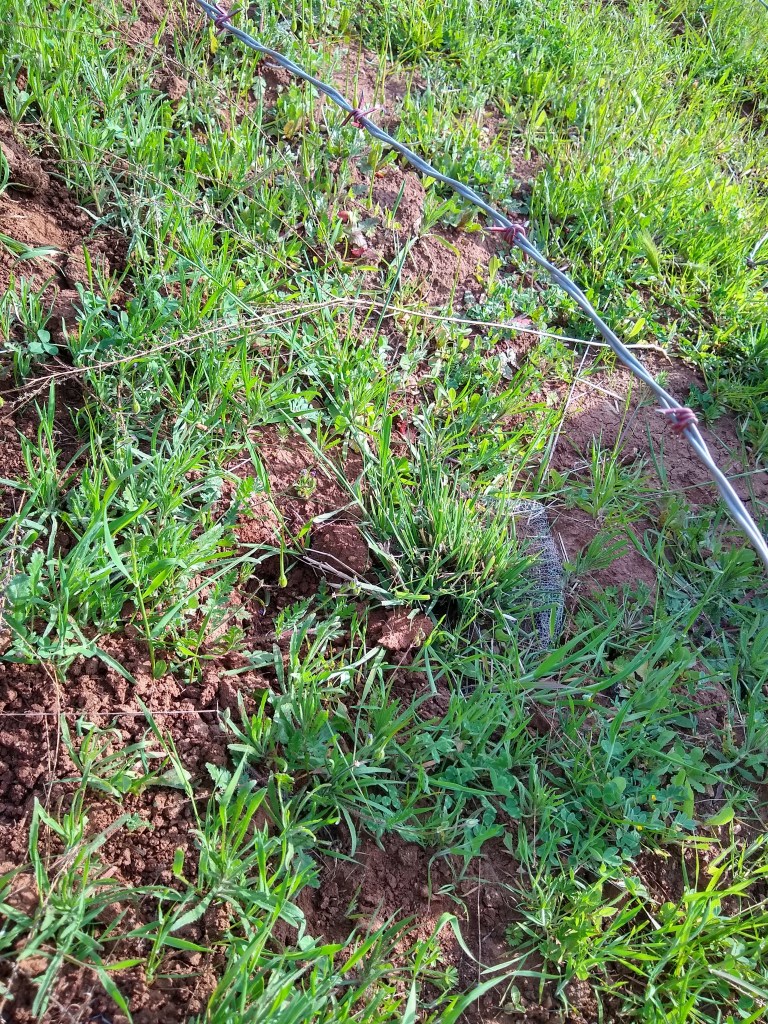
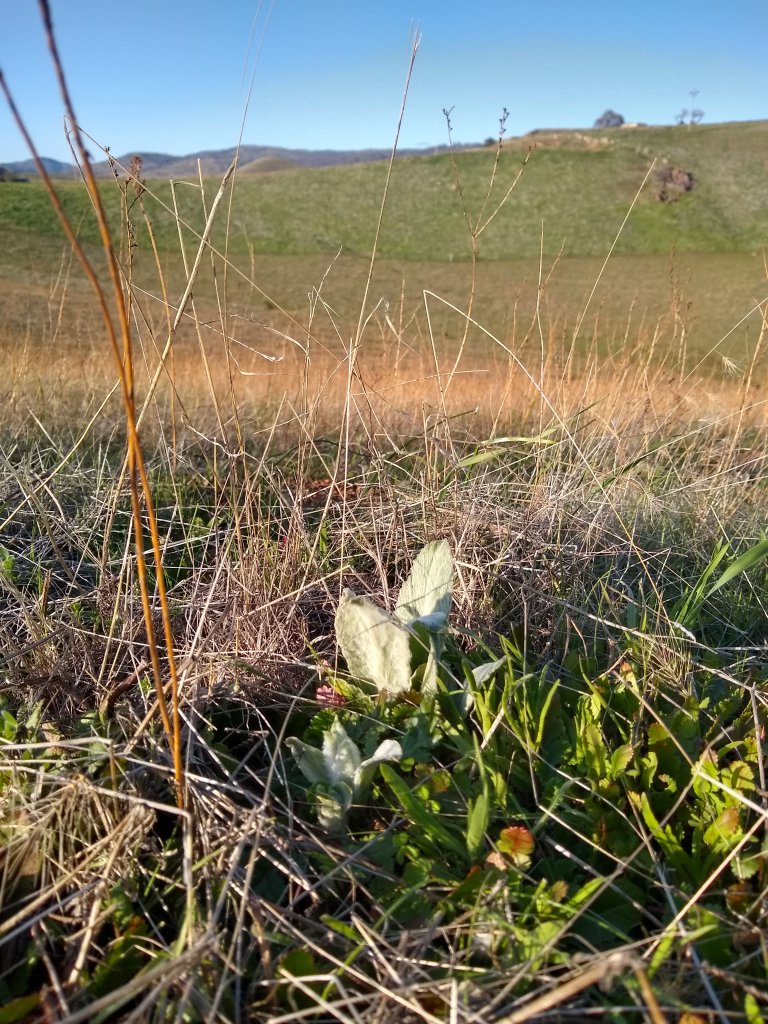
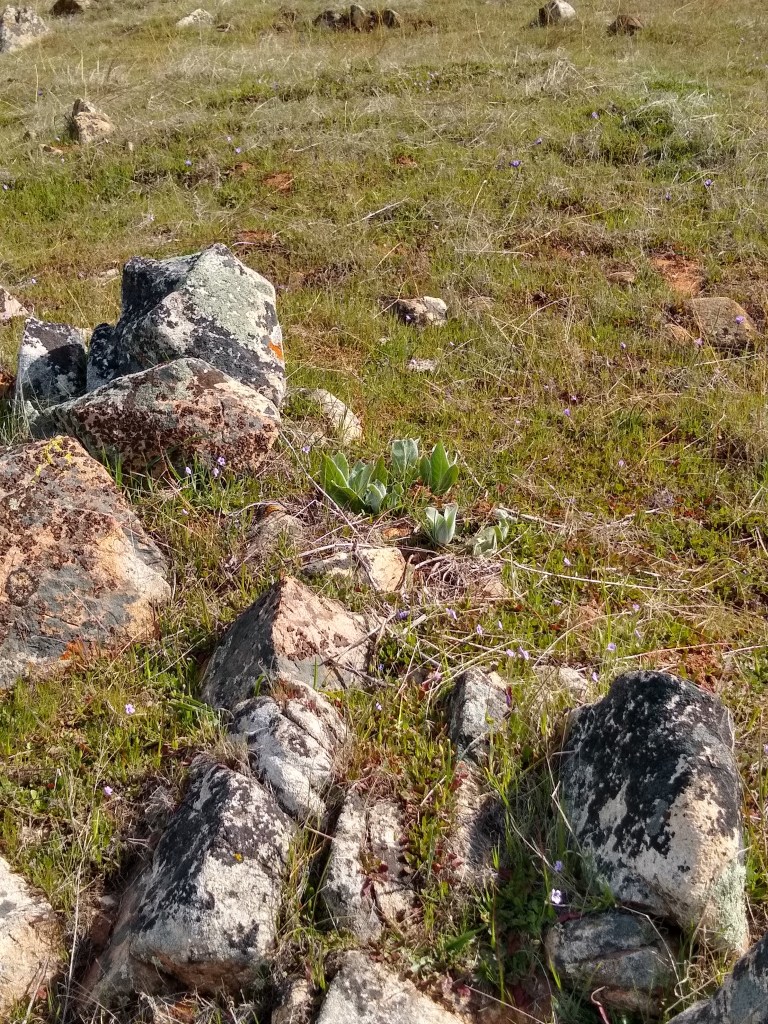
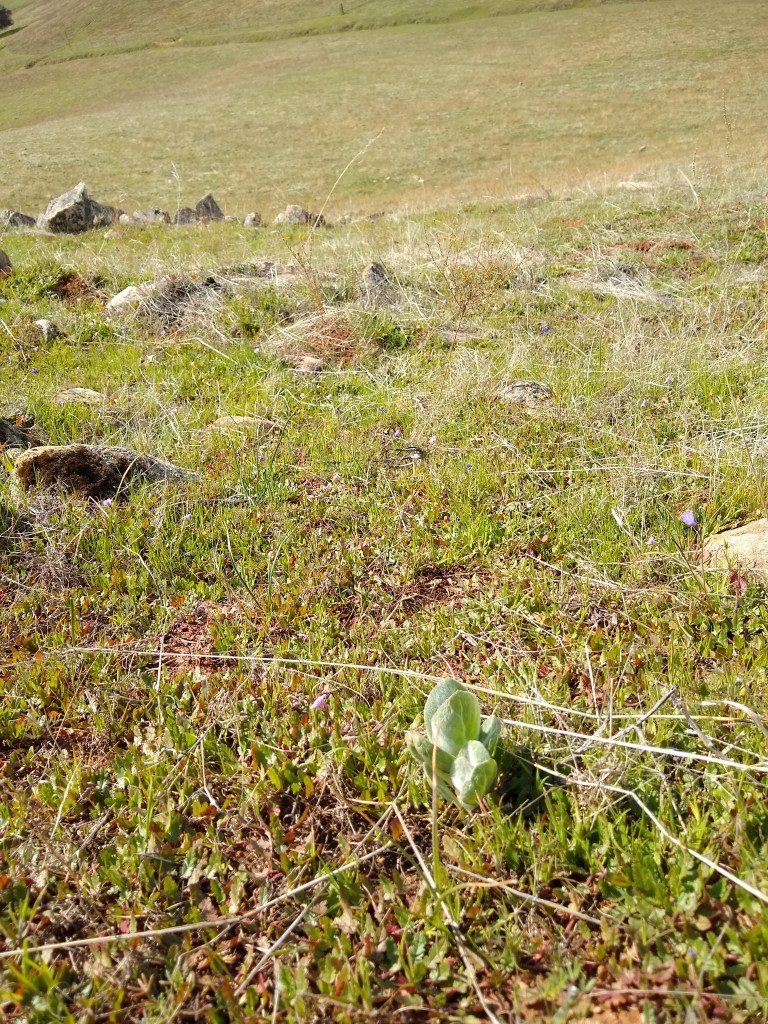
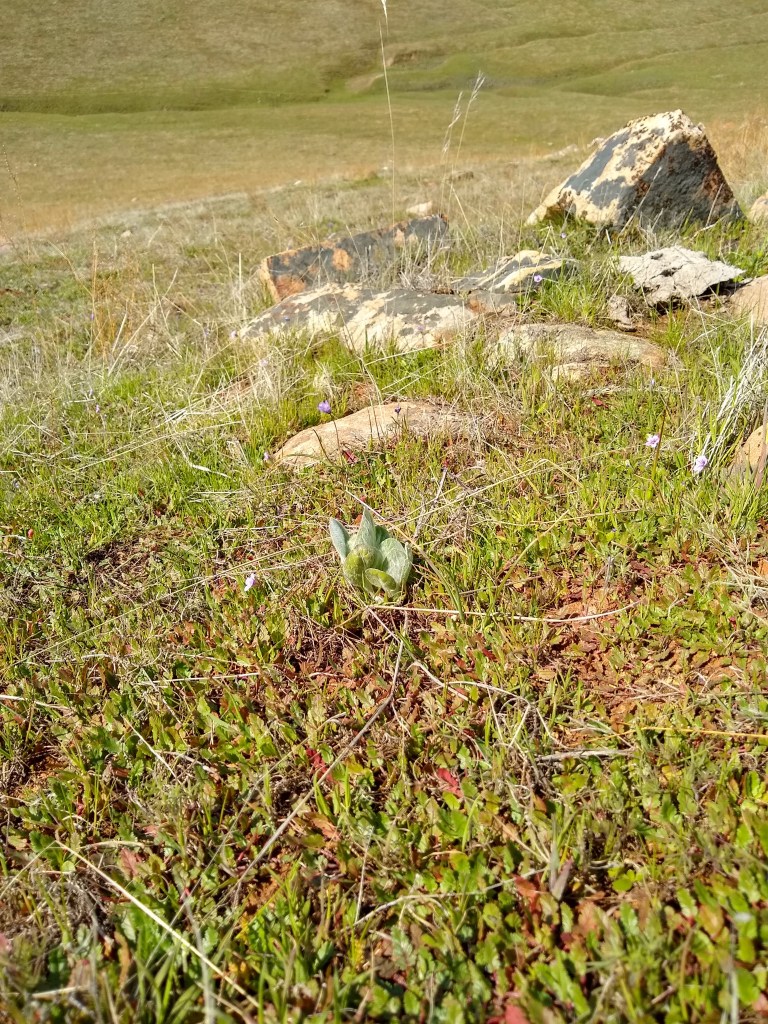
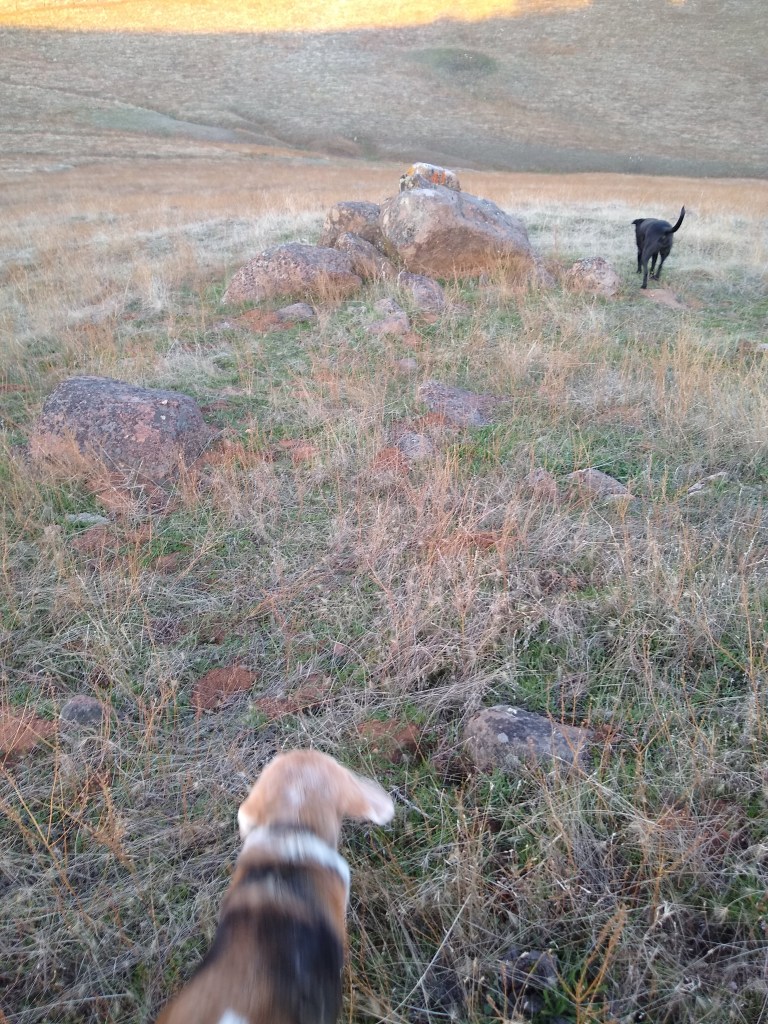
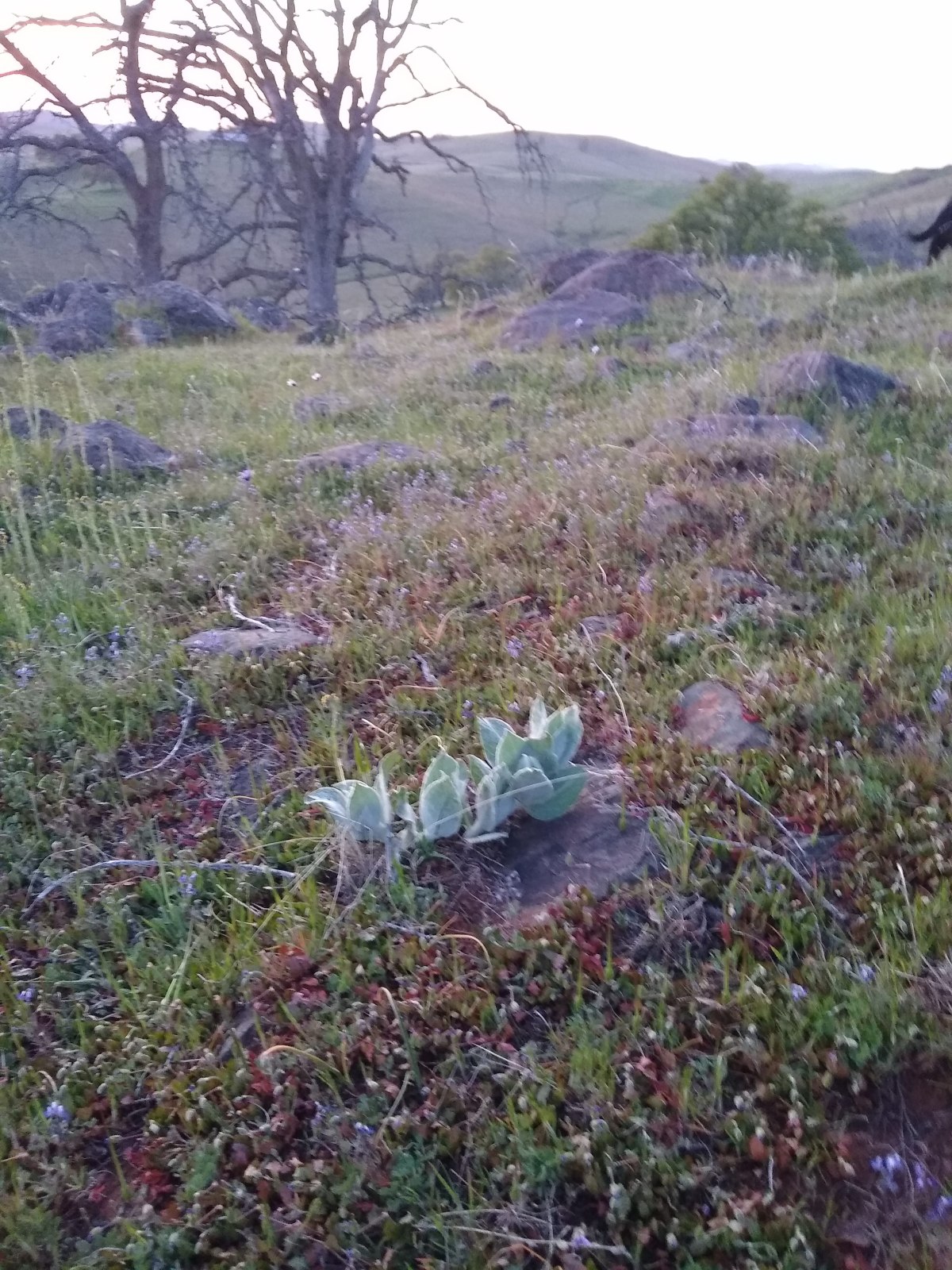
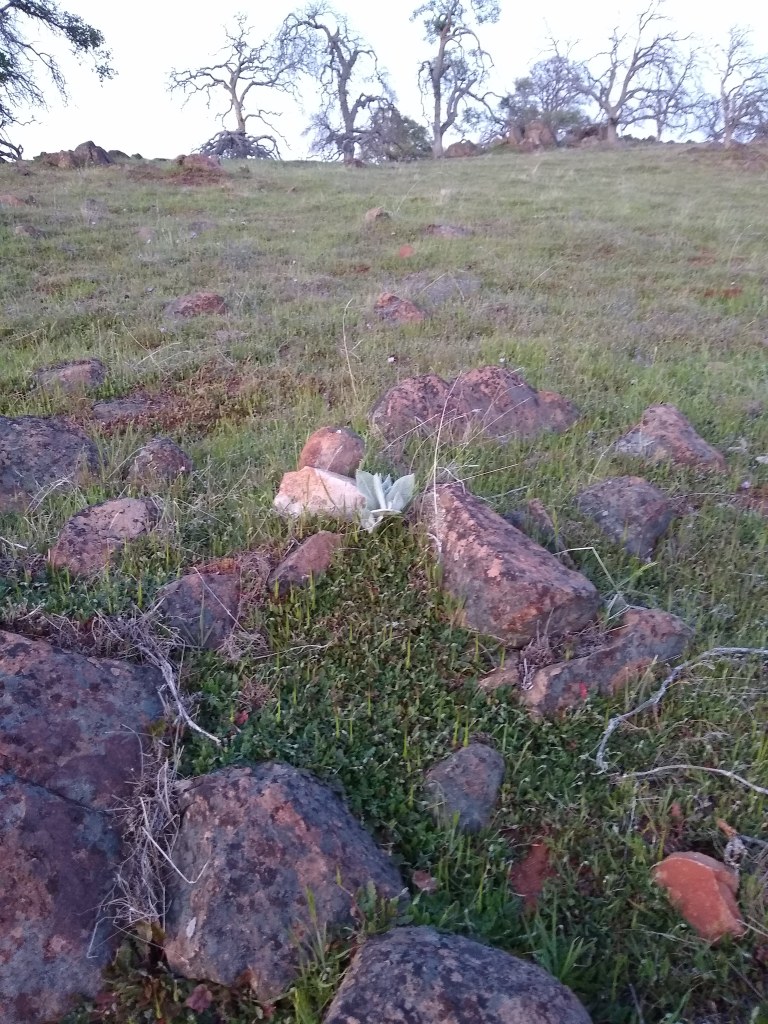
a. Californica on the hill east of the house

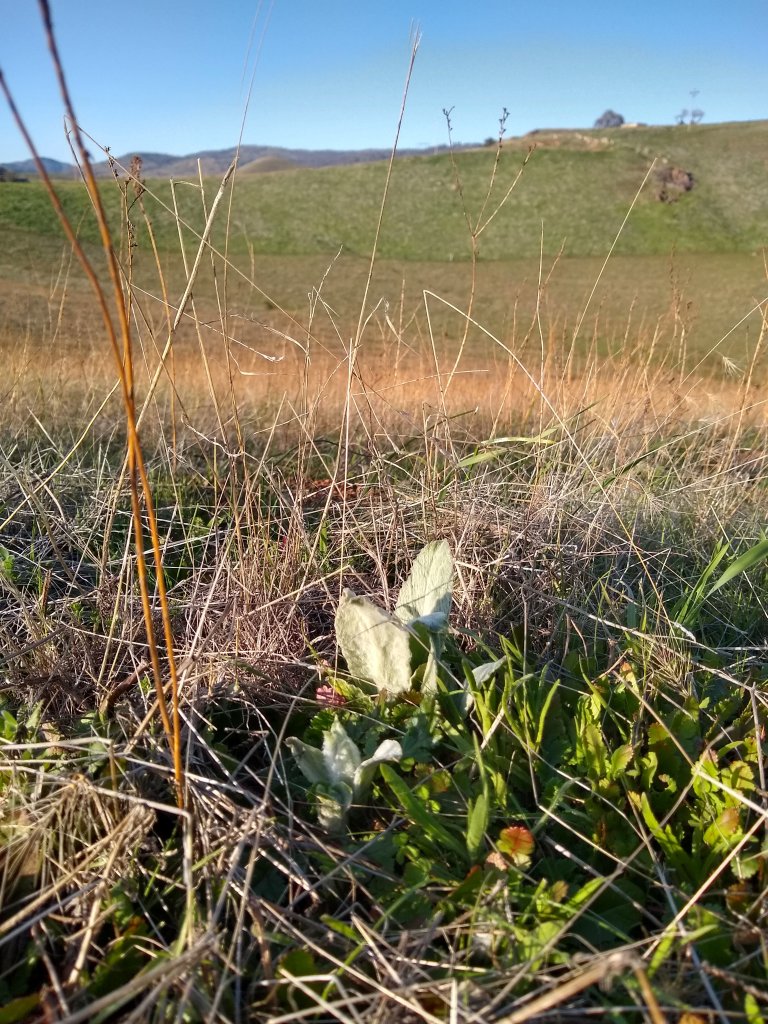
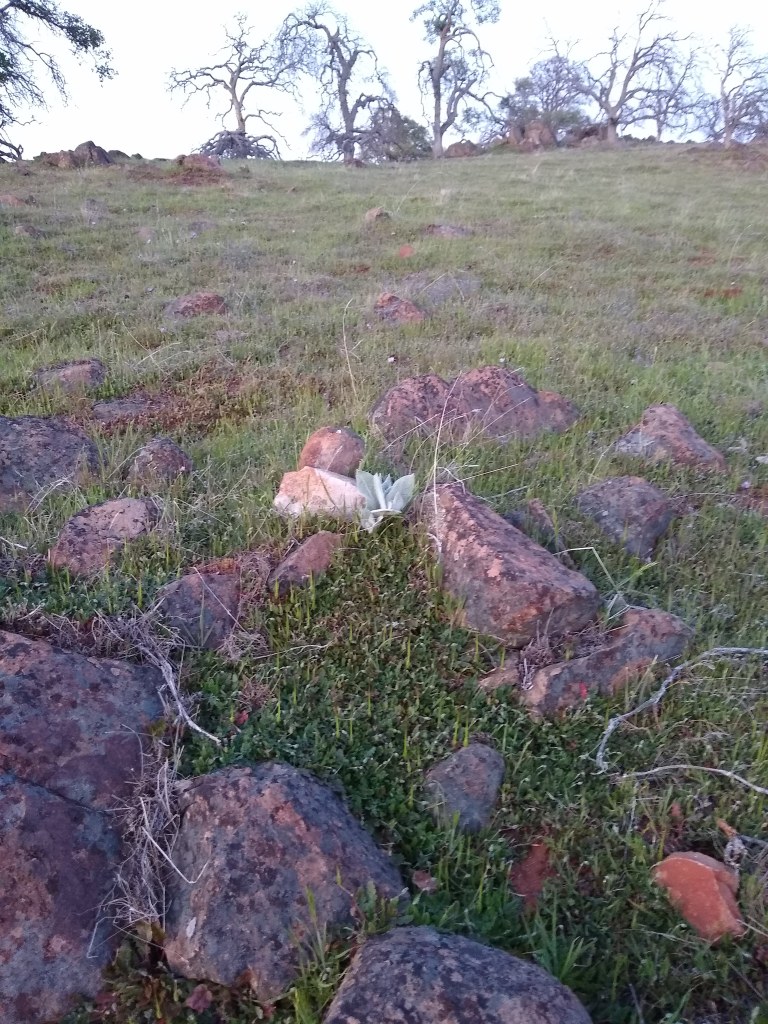
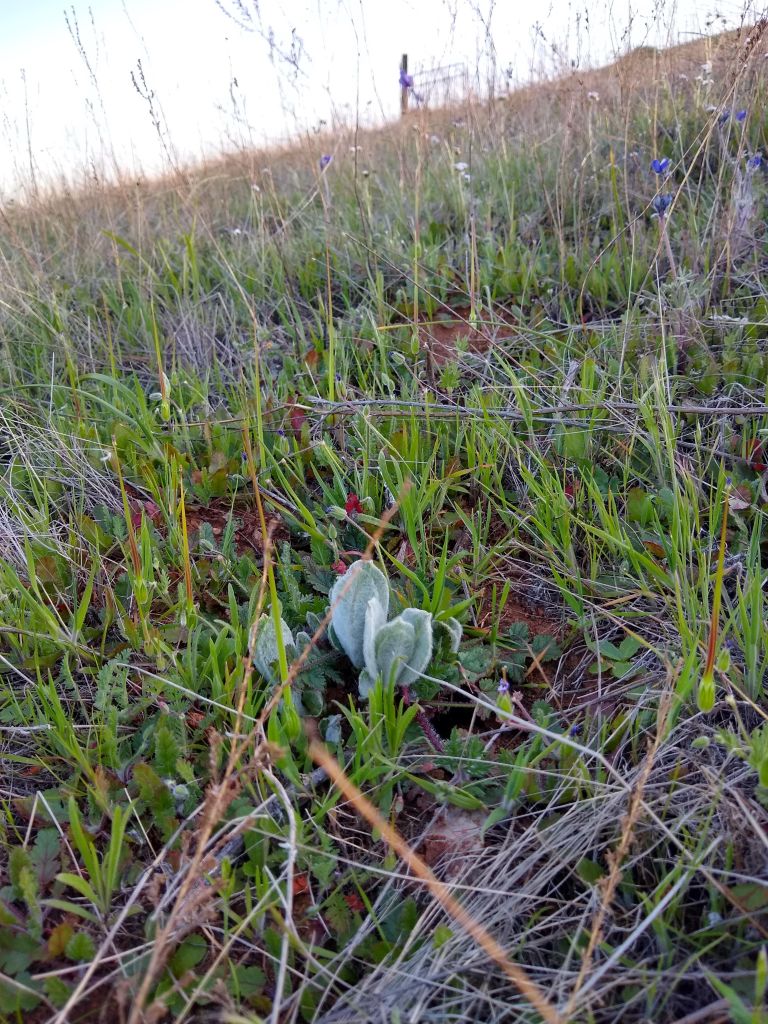
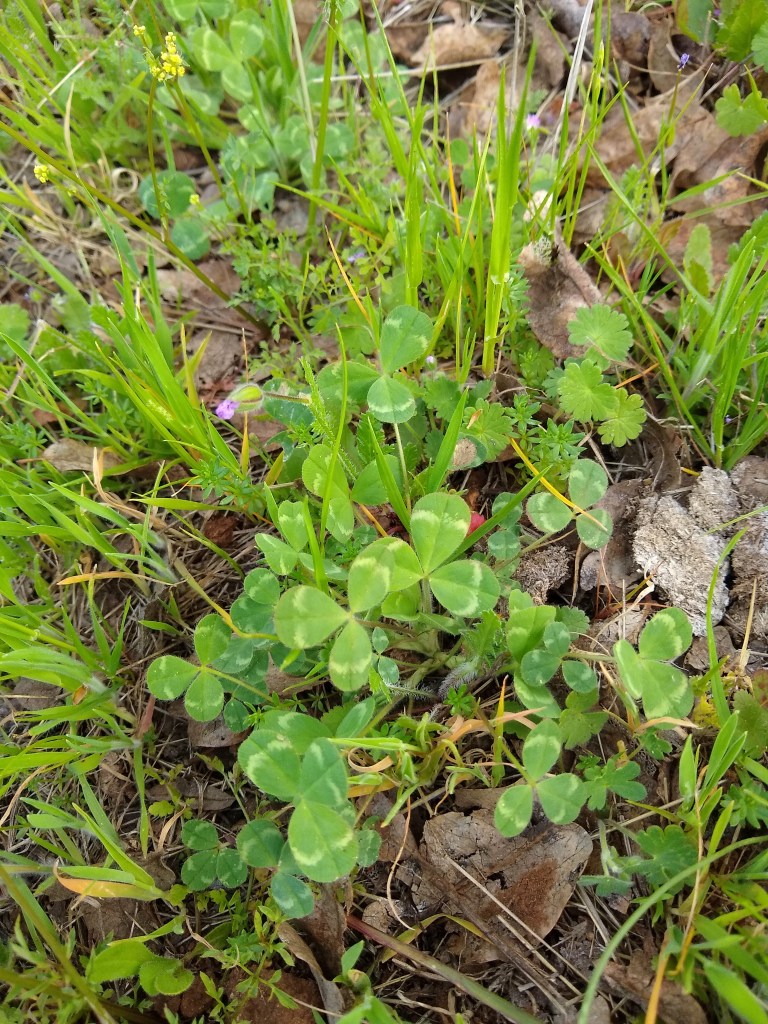
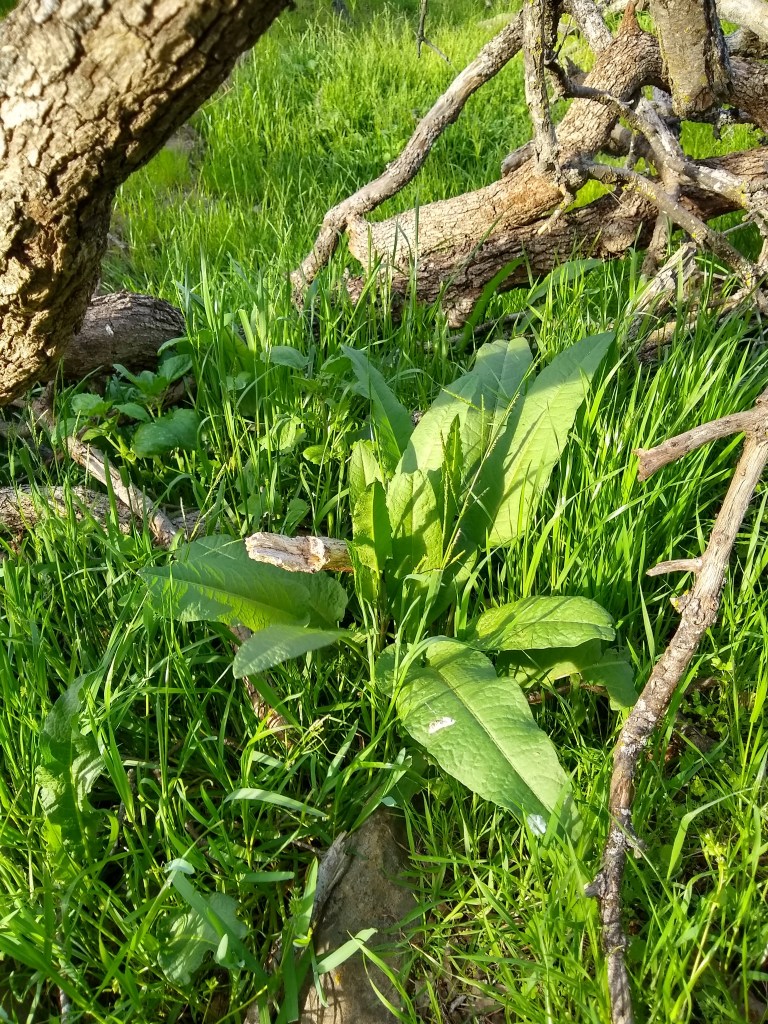
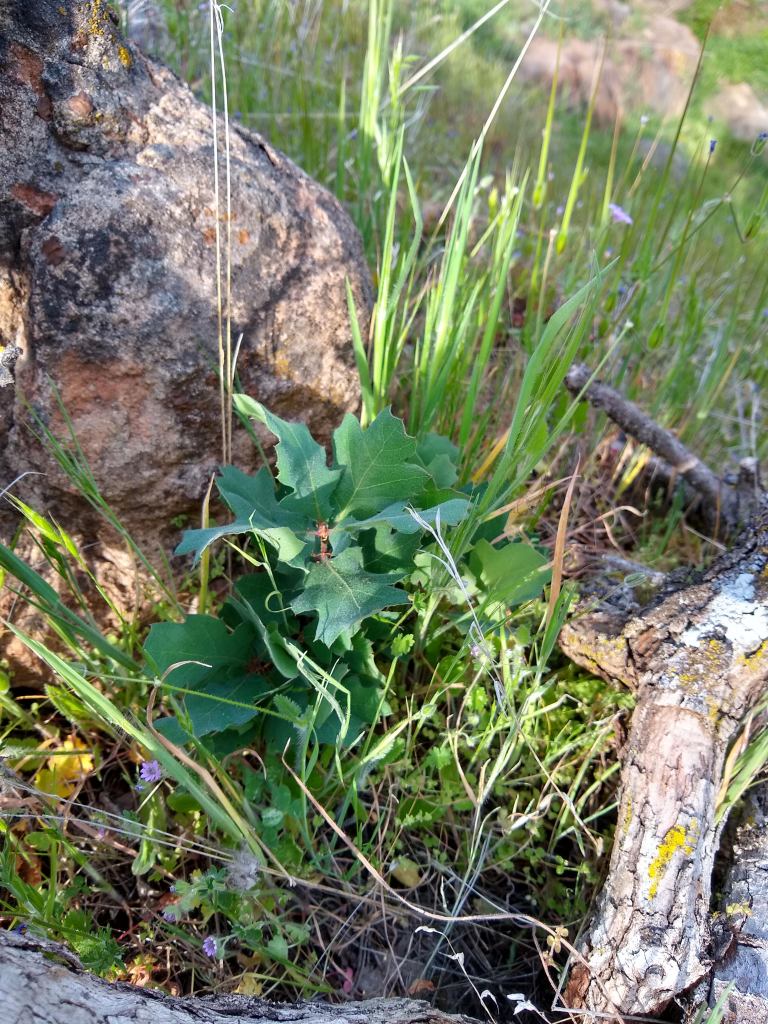
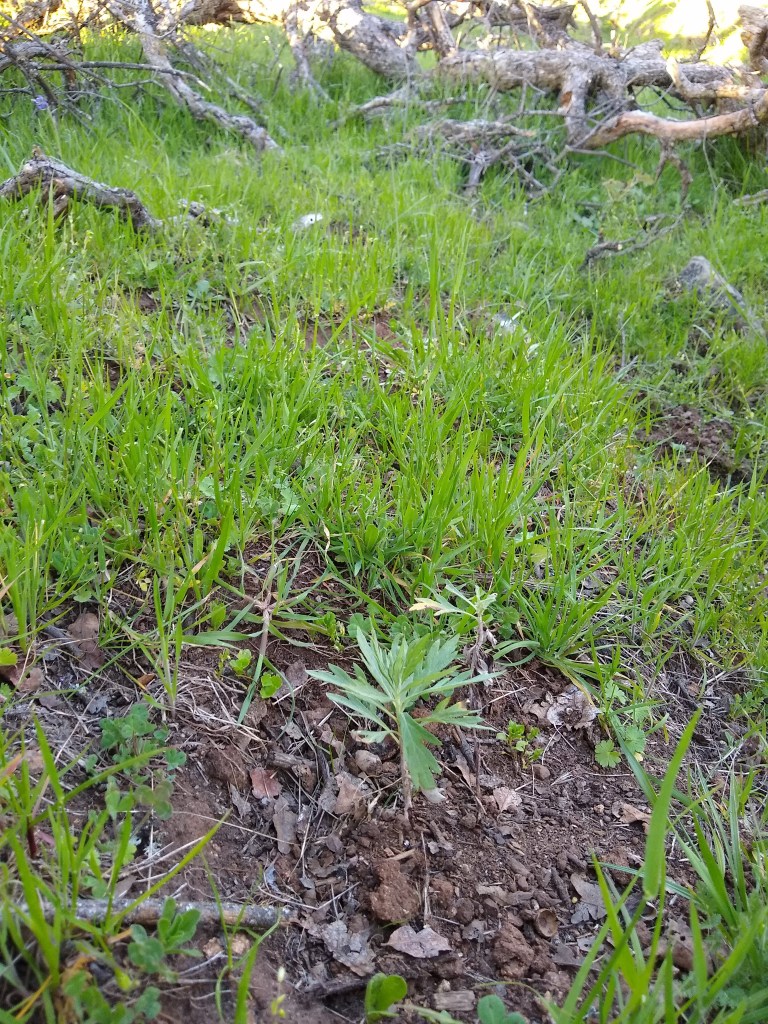
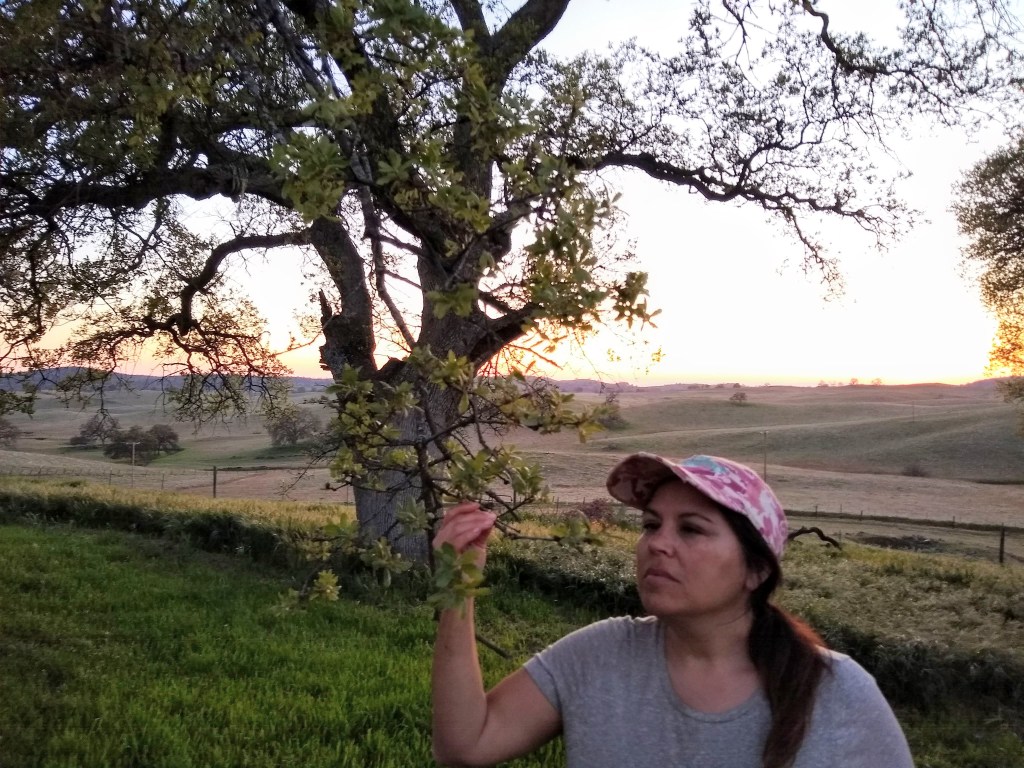
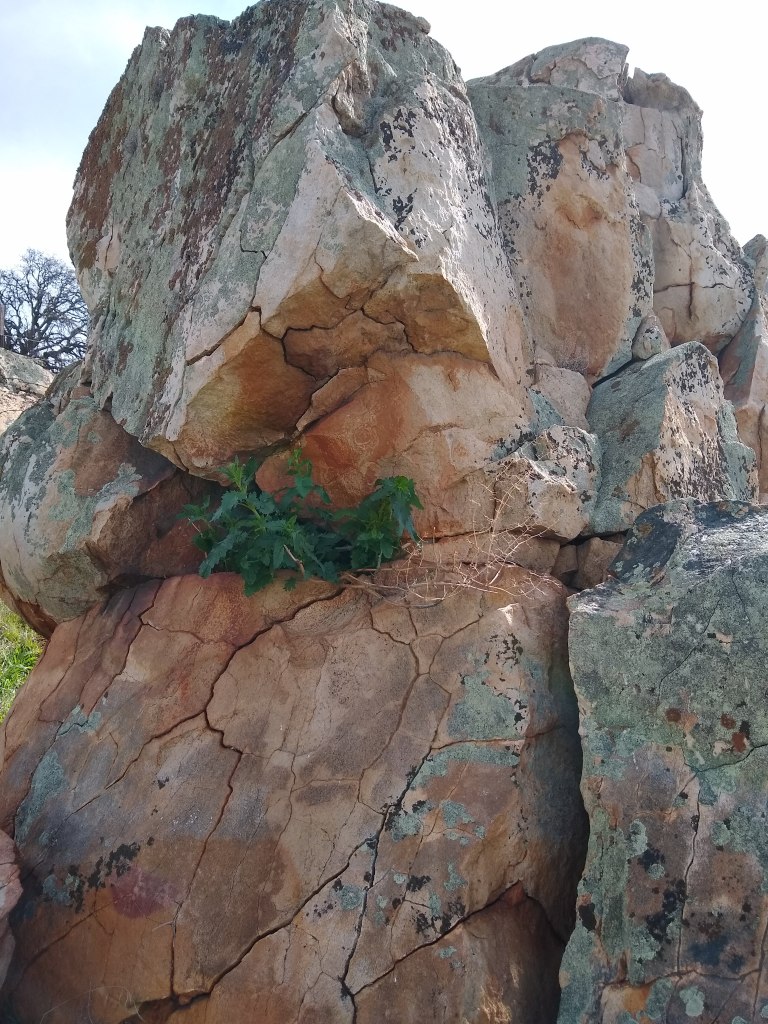
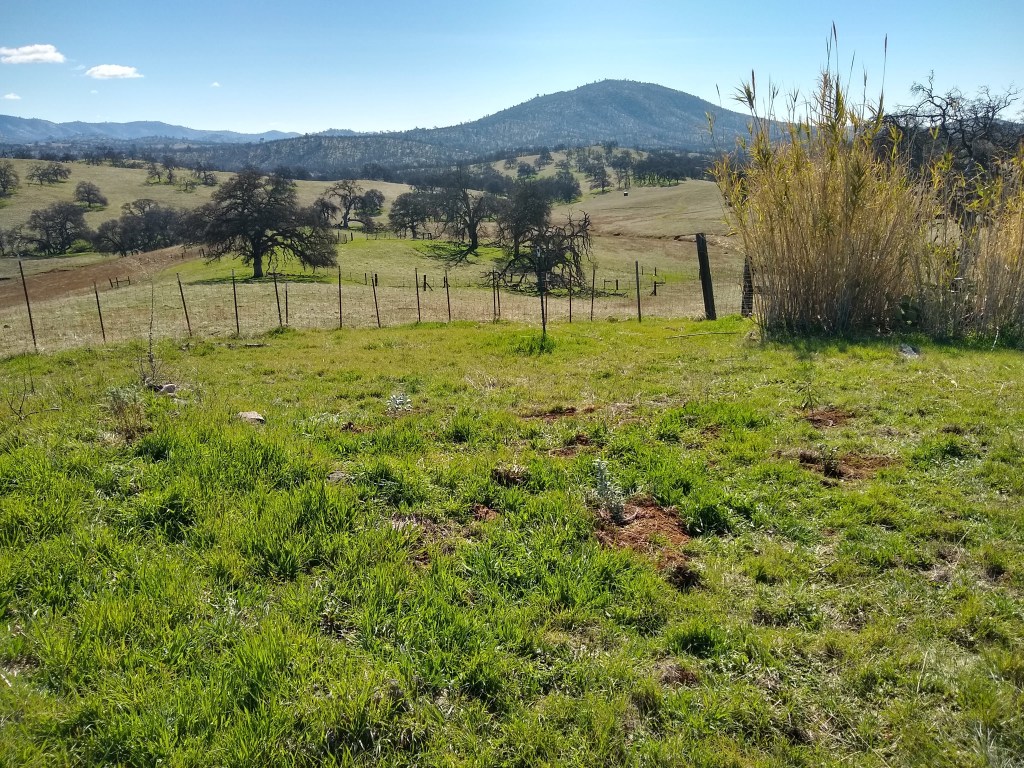
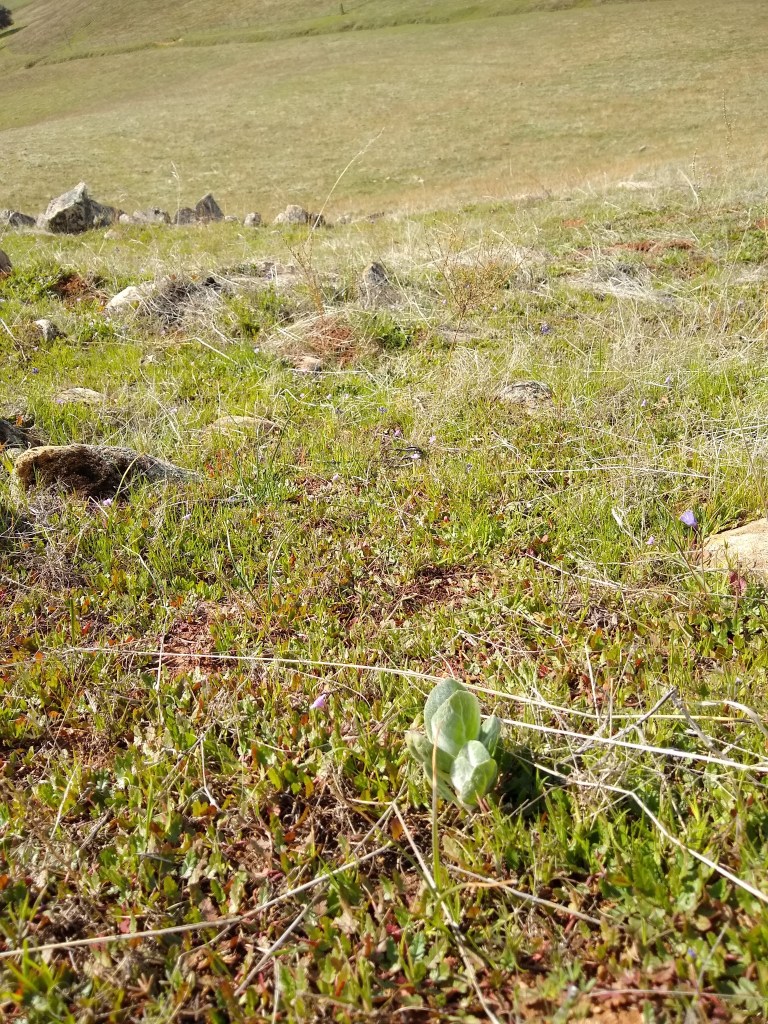
I always let out a whoop of excitement when I see these remarkable a. Californica plants. They look so prehistoric to me, and the smell is heaven. The air of magic around these plants is only enhanced by its rapid “see them out of nowhere” growth. Last year, I shared that I found three communities of these plants – one near the house with seven plants, one on the tall south facing hill to the north of the house with thirteen plants, and one on a hill to the east of the house with two plants. I have been monitoring each location. The east hill has two plants. The site near the house has two plants (so far), and the north hill had two plants. In the last post, I suggested that it may still be early to see many of these plants, and I was right. The plants have been appearing about a week after my first sighting.
Signs of the Drought Apparent

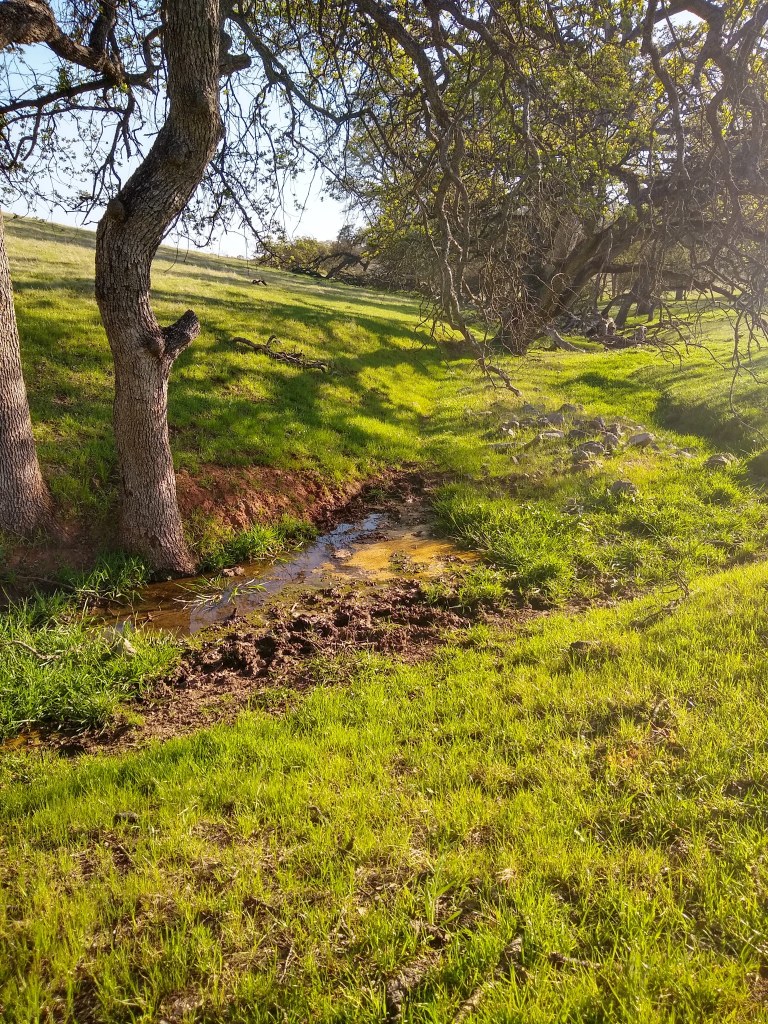
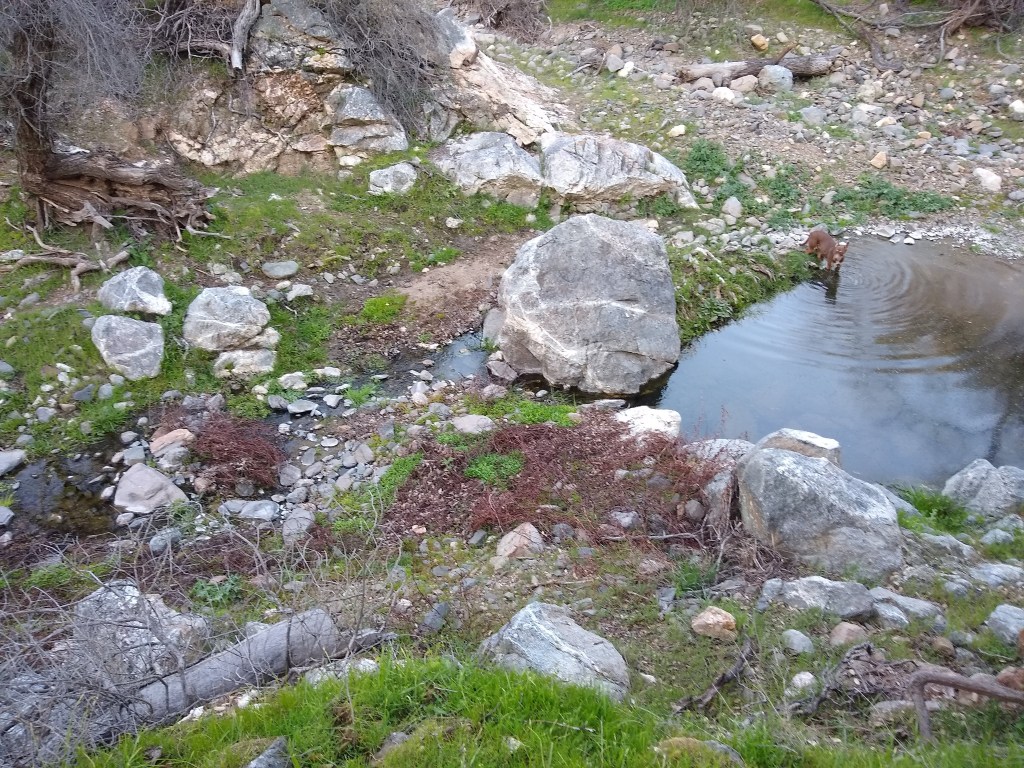
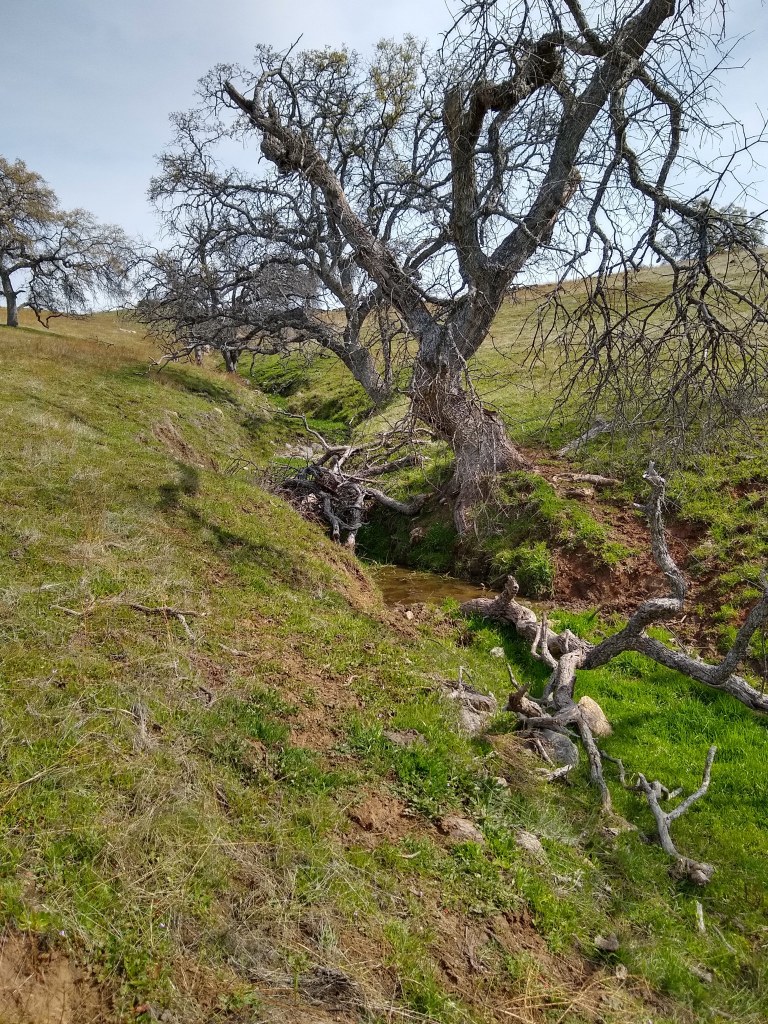
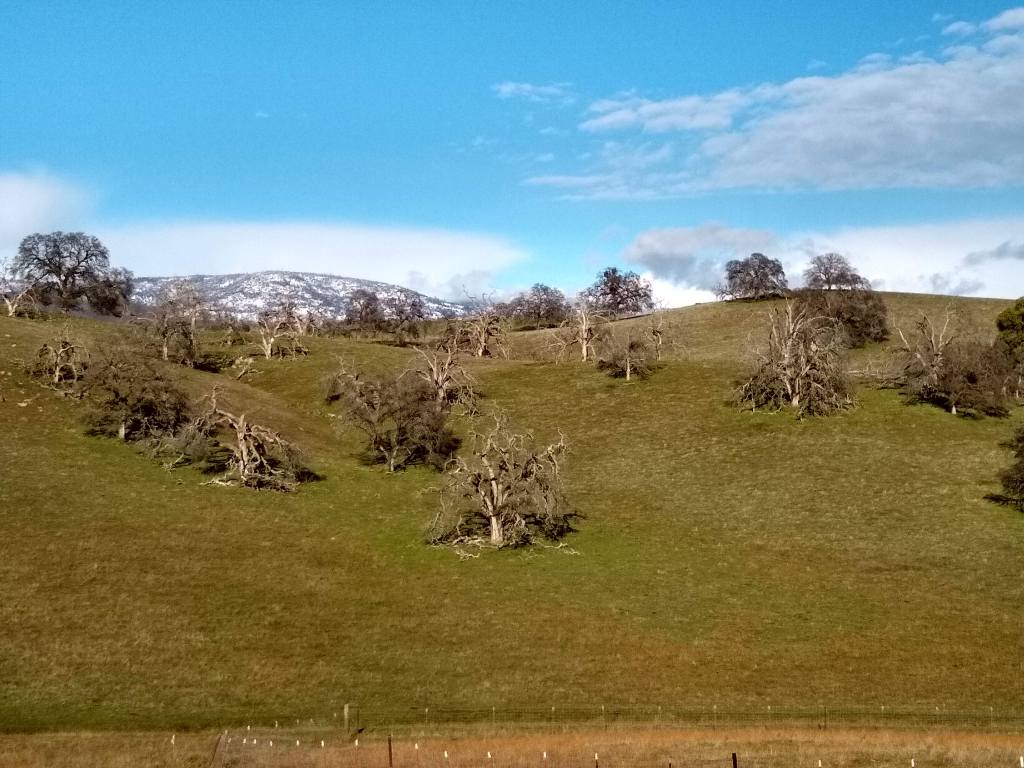
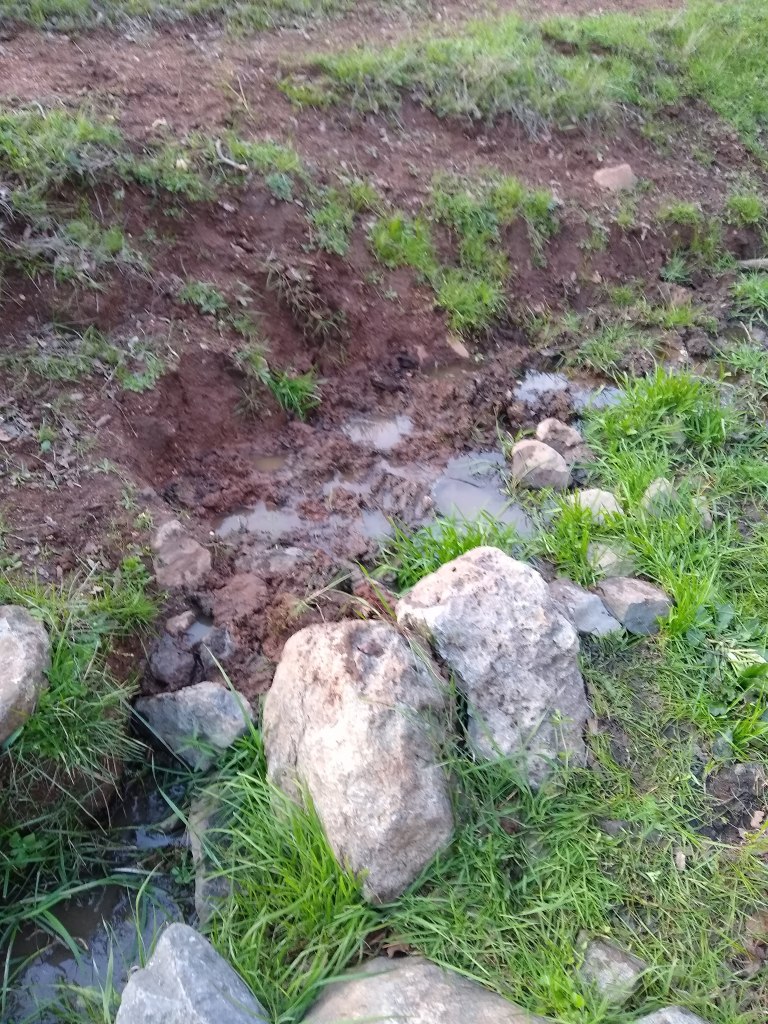
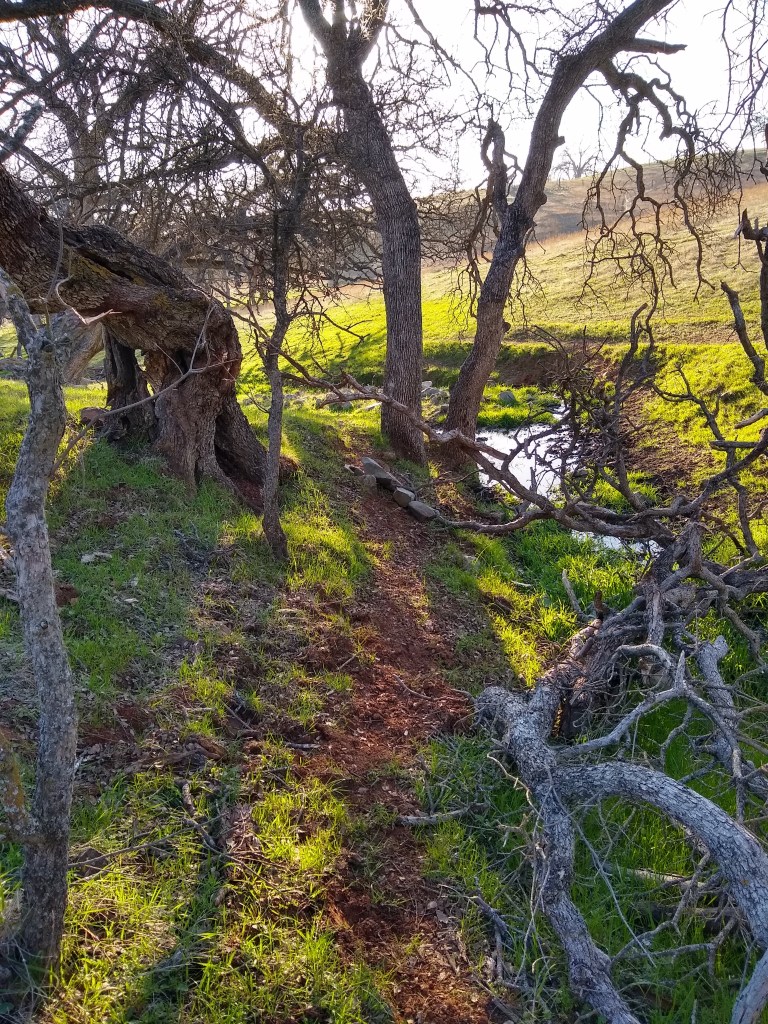
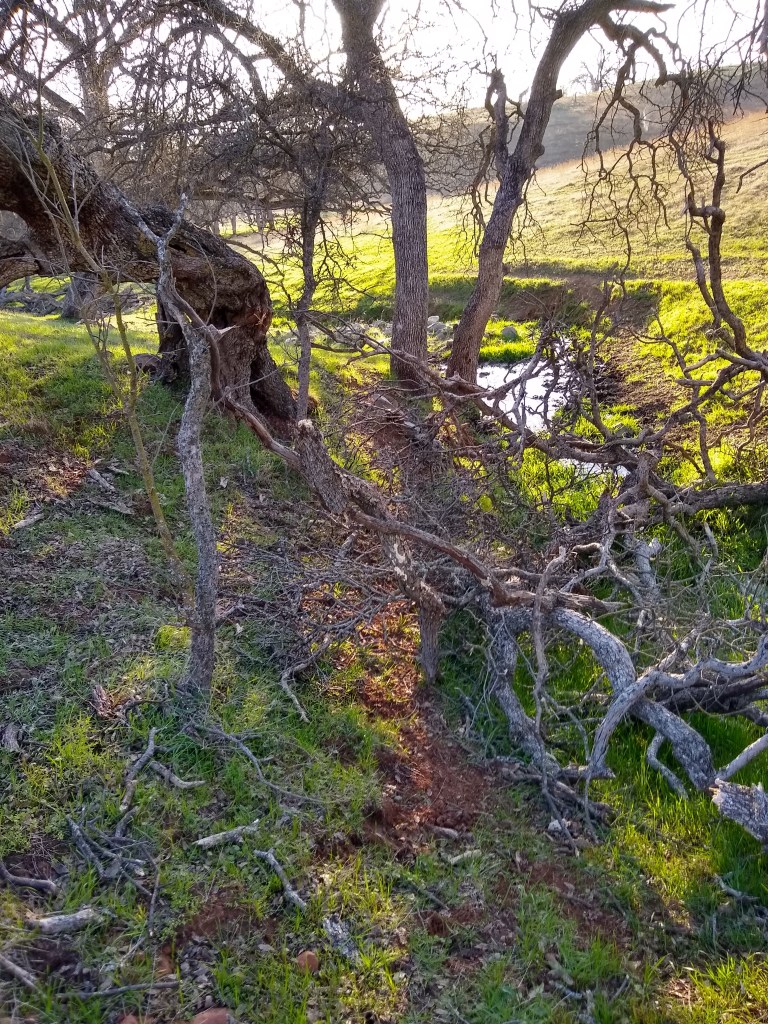
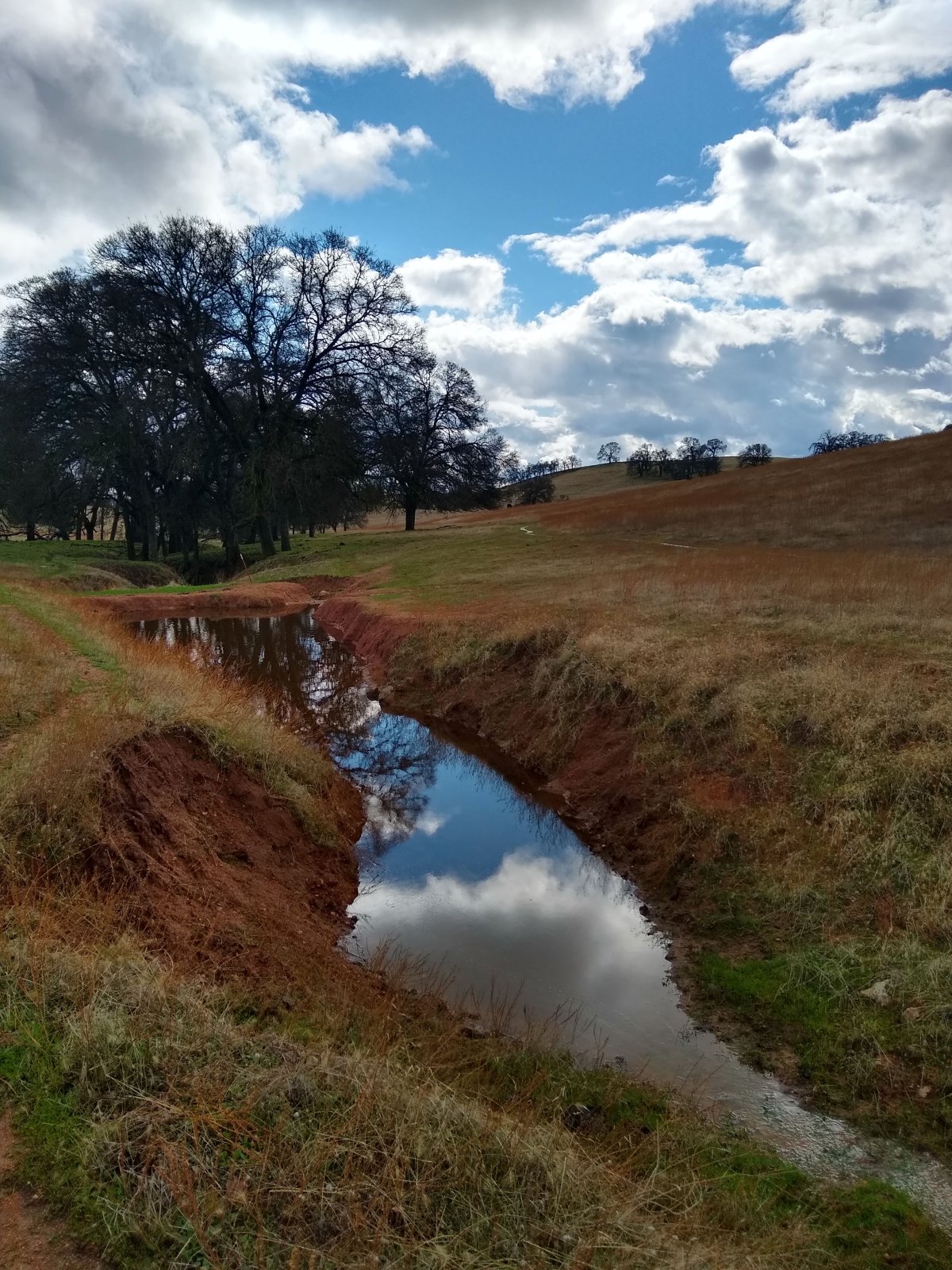
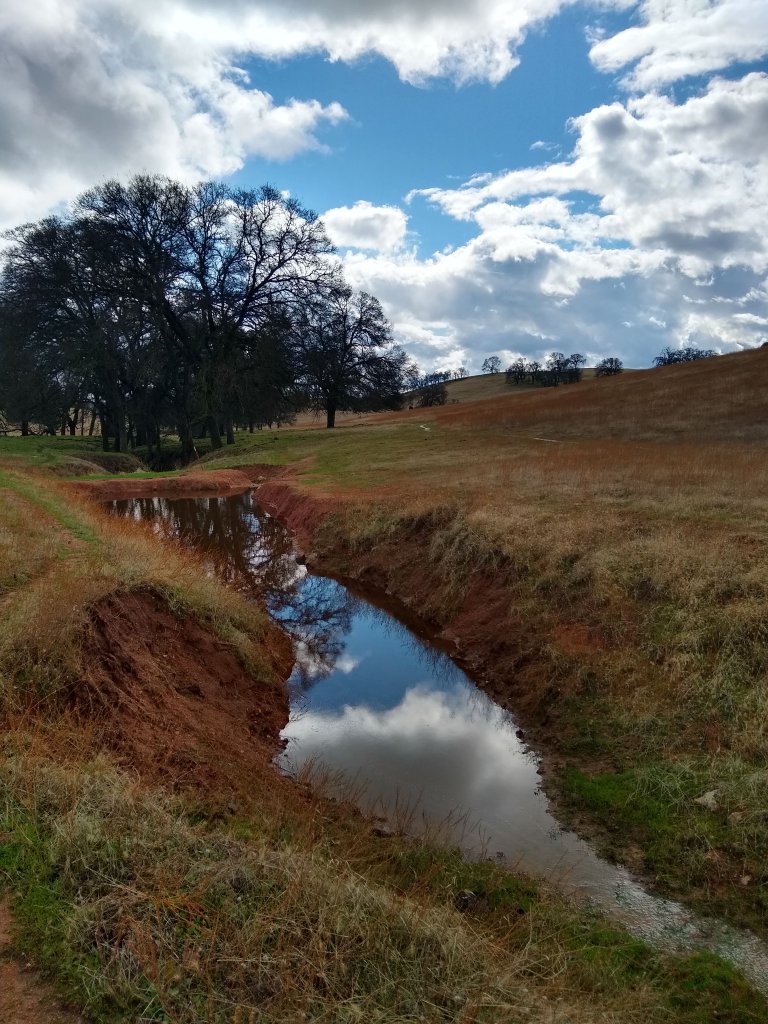
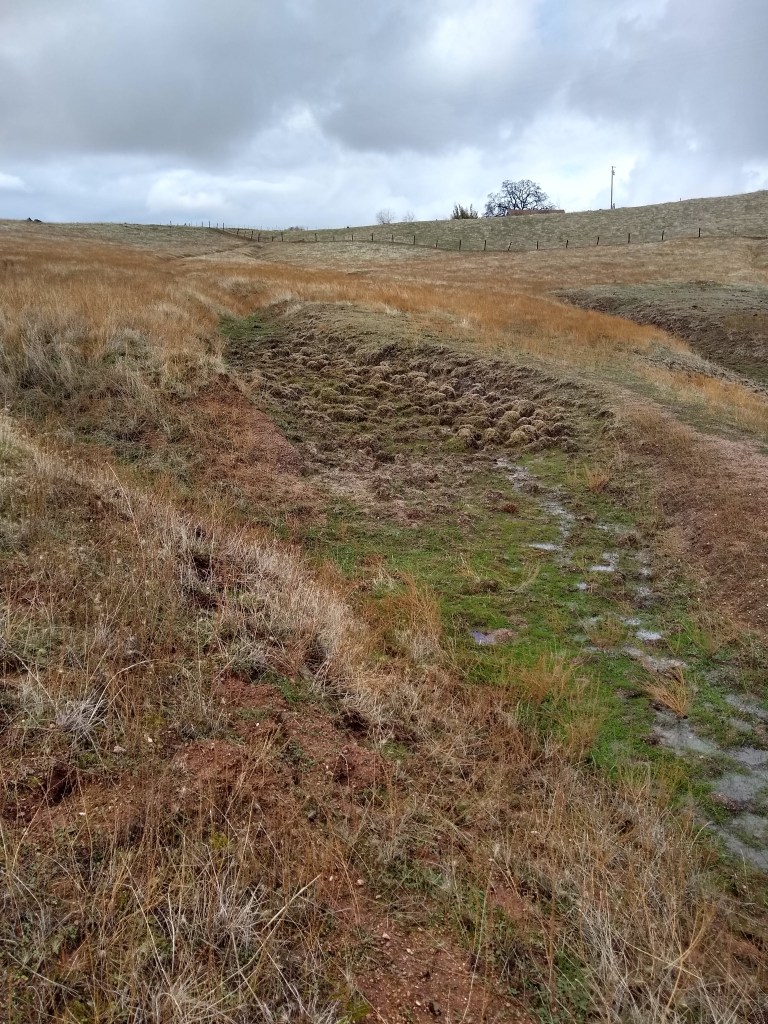
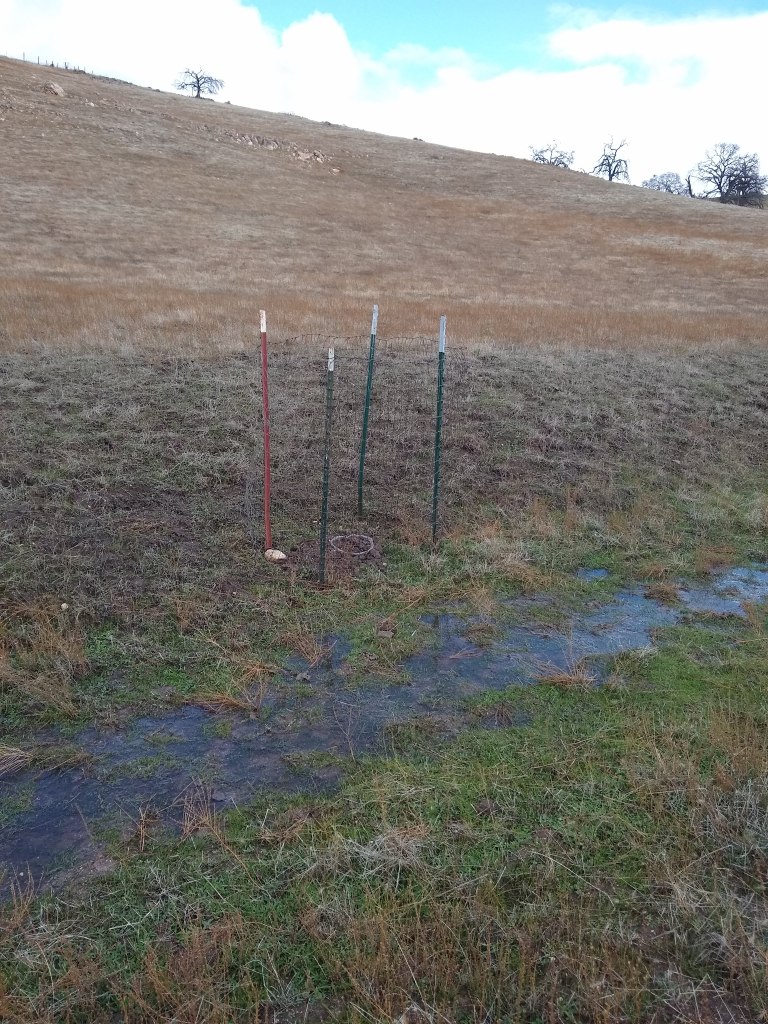
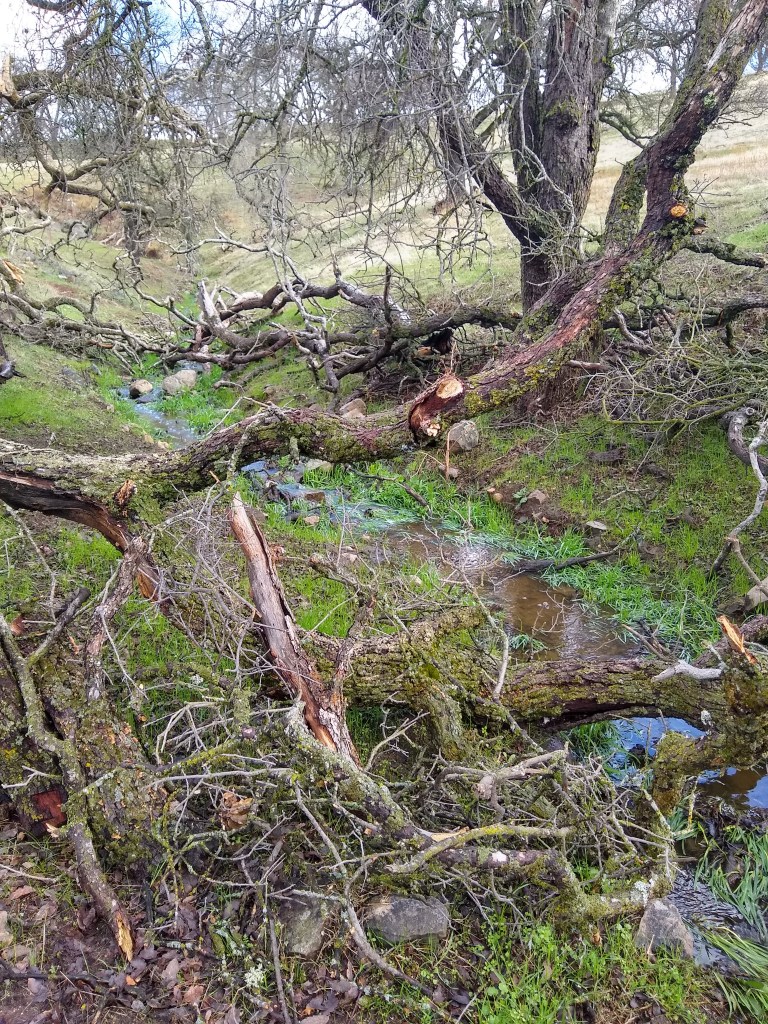
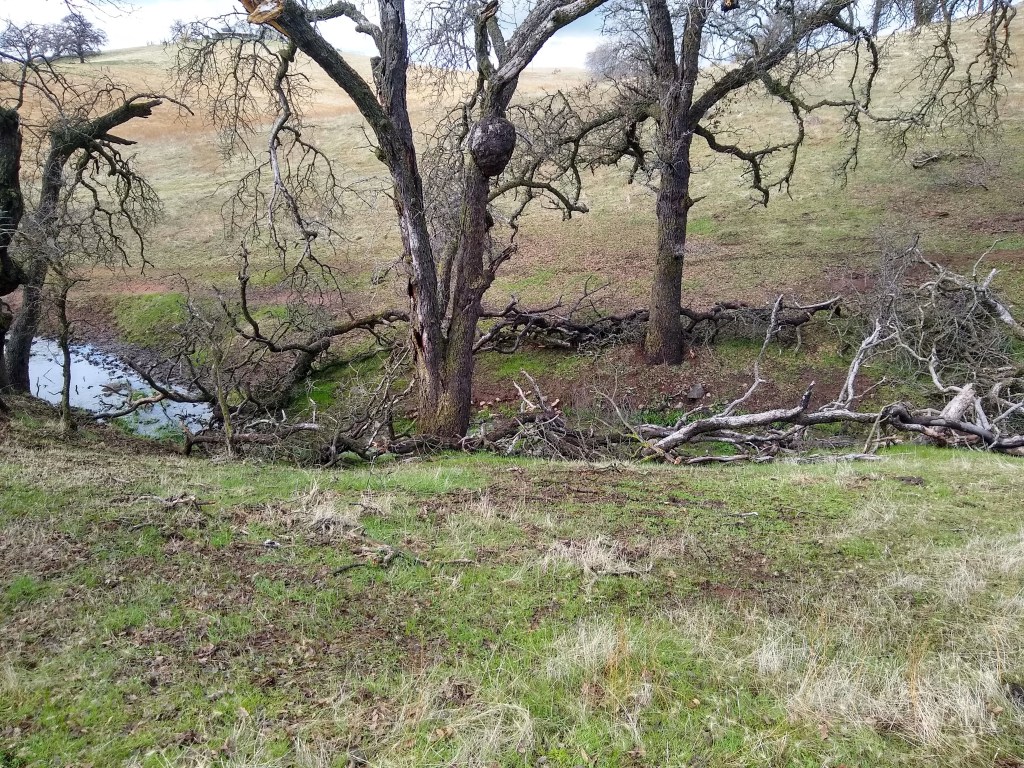
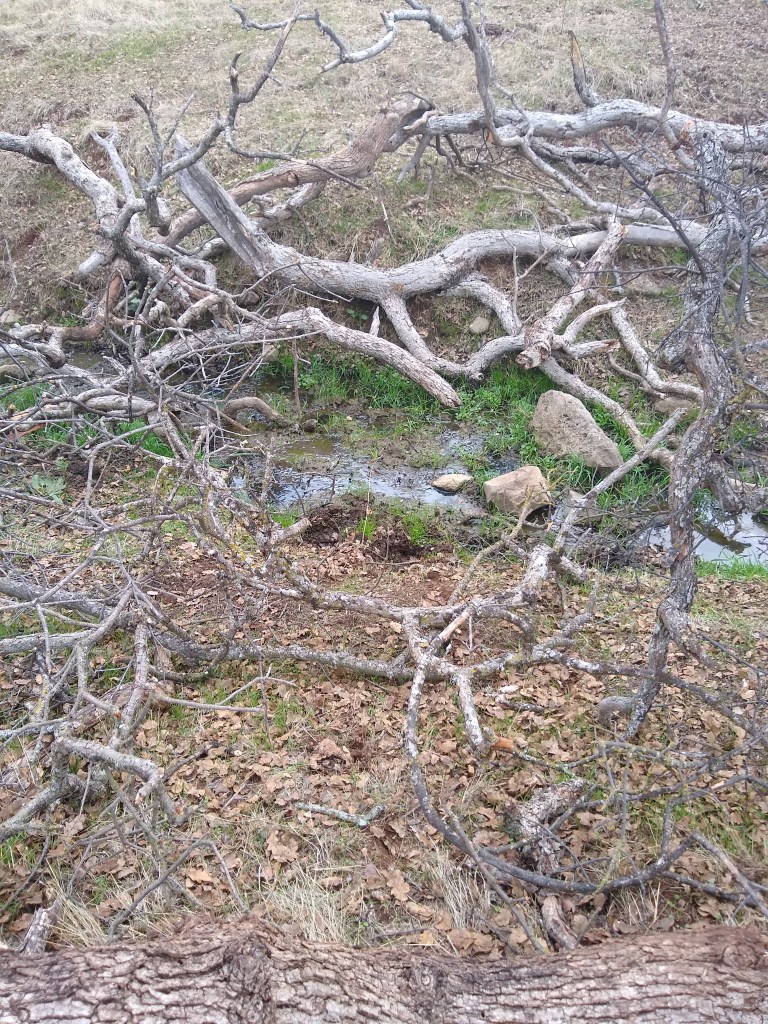
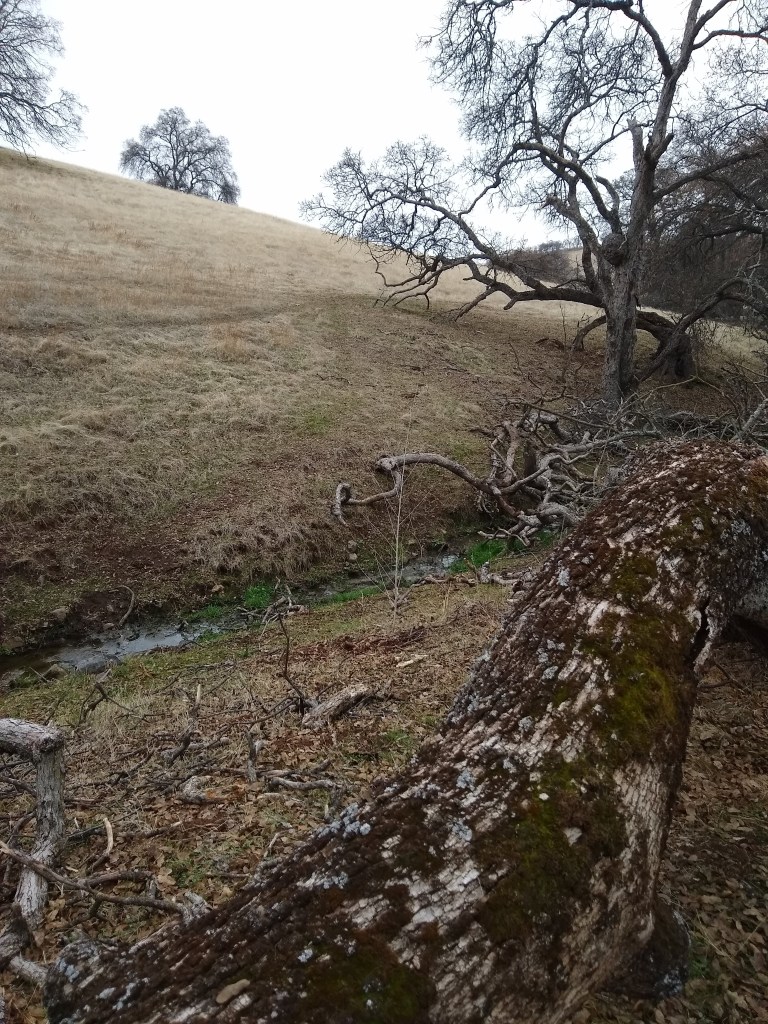
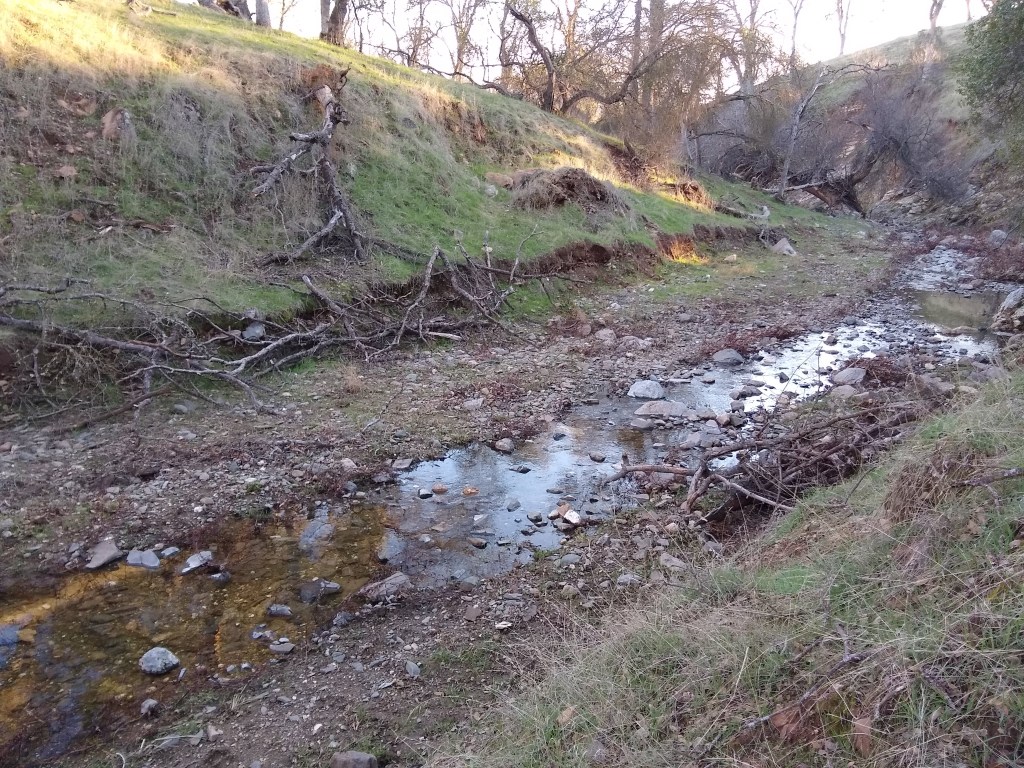
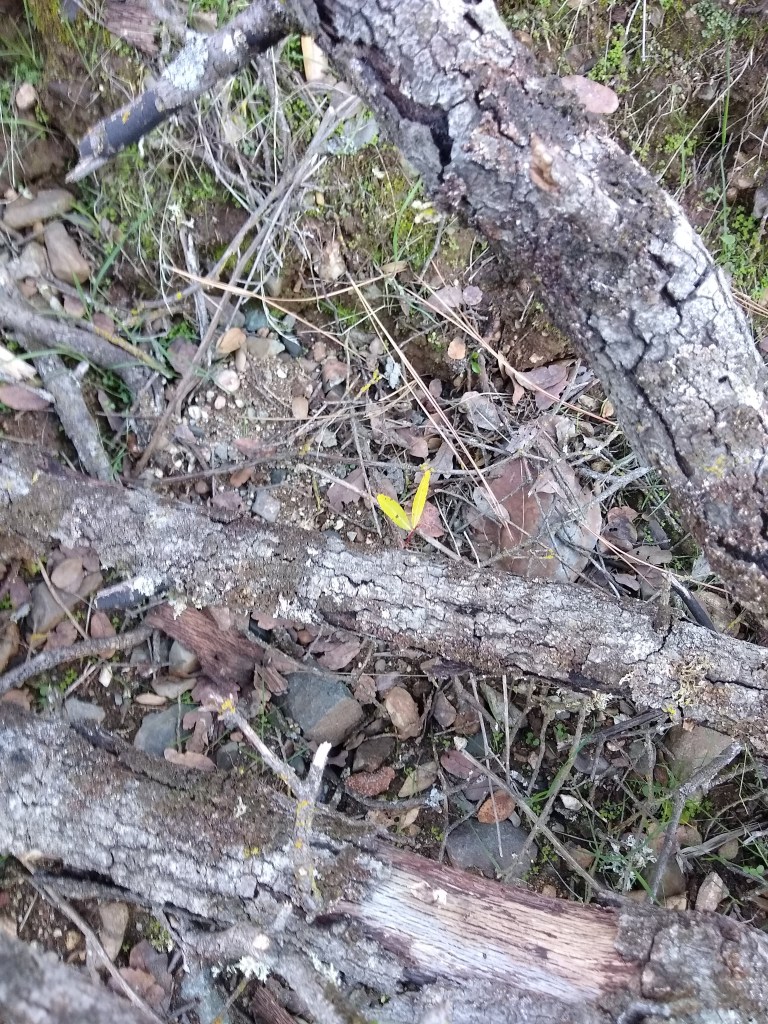
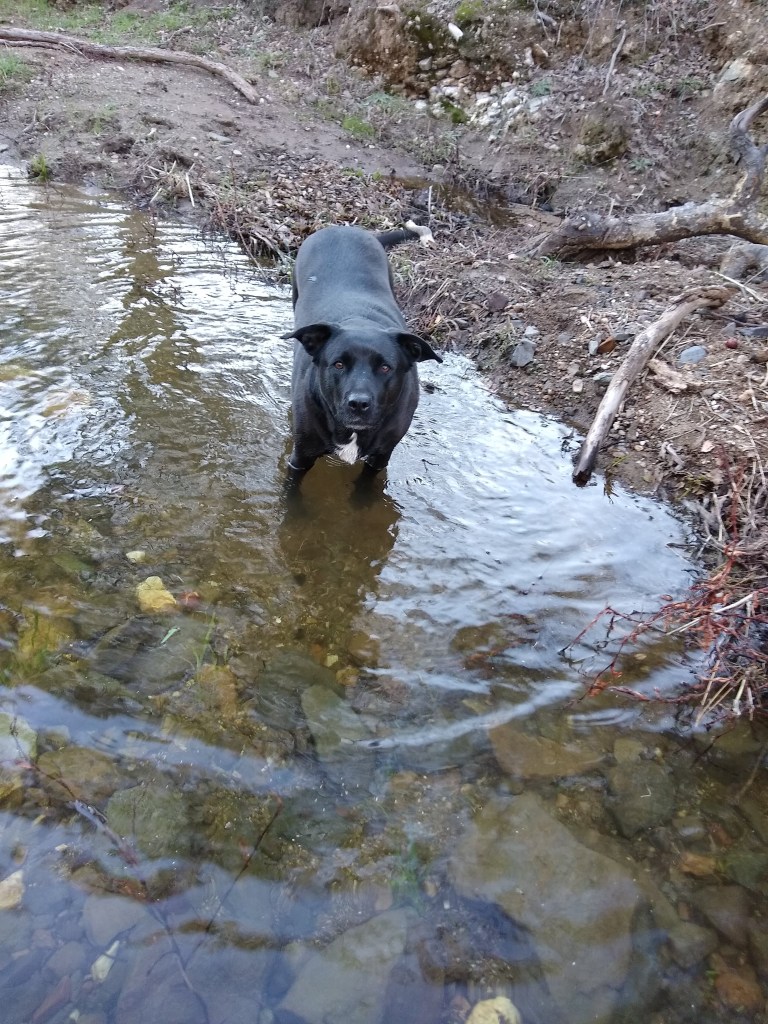
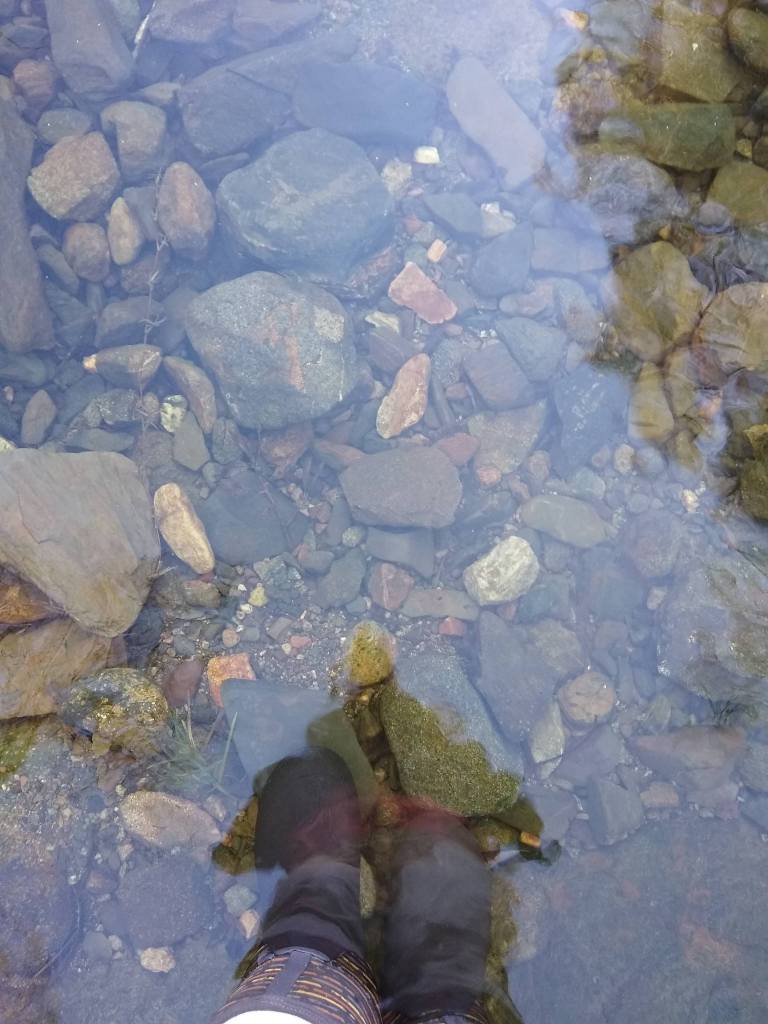
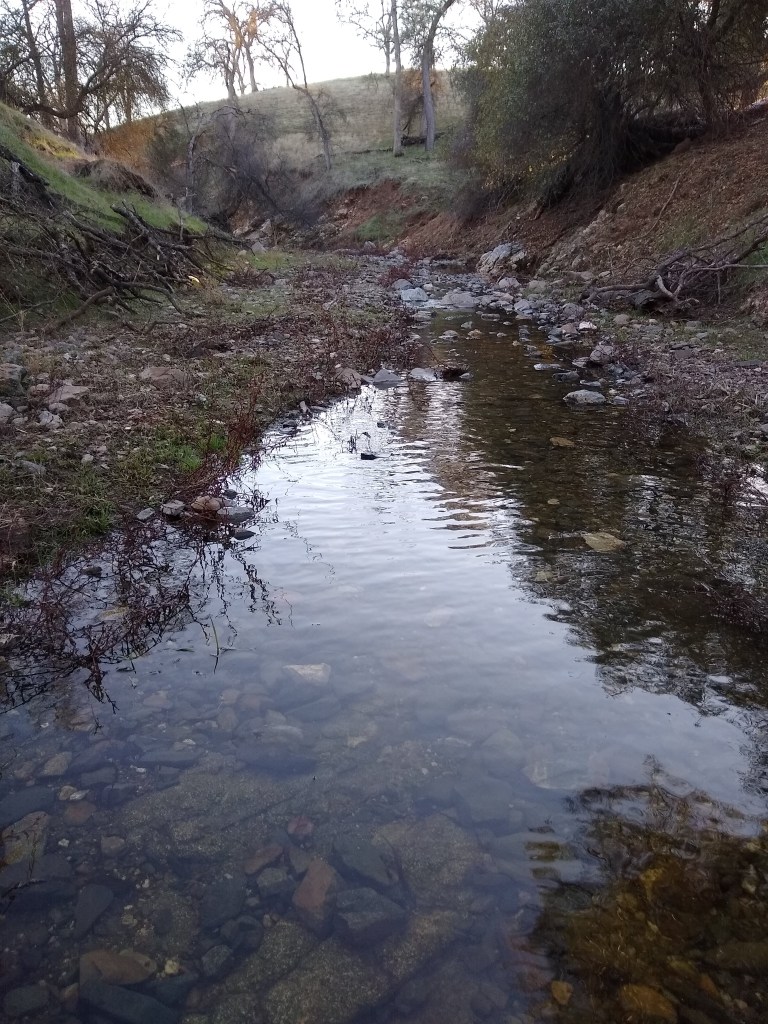
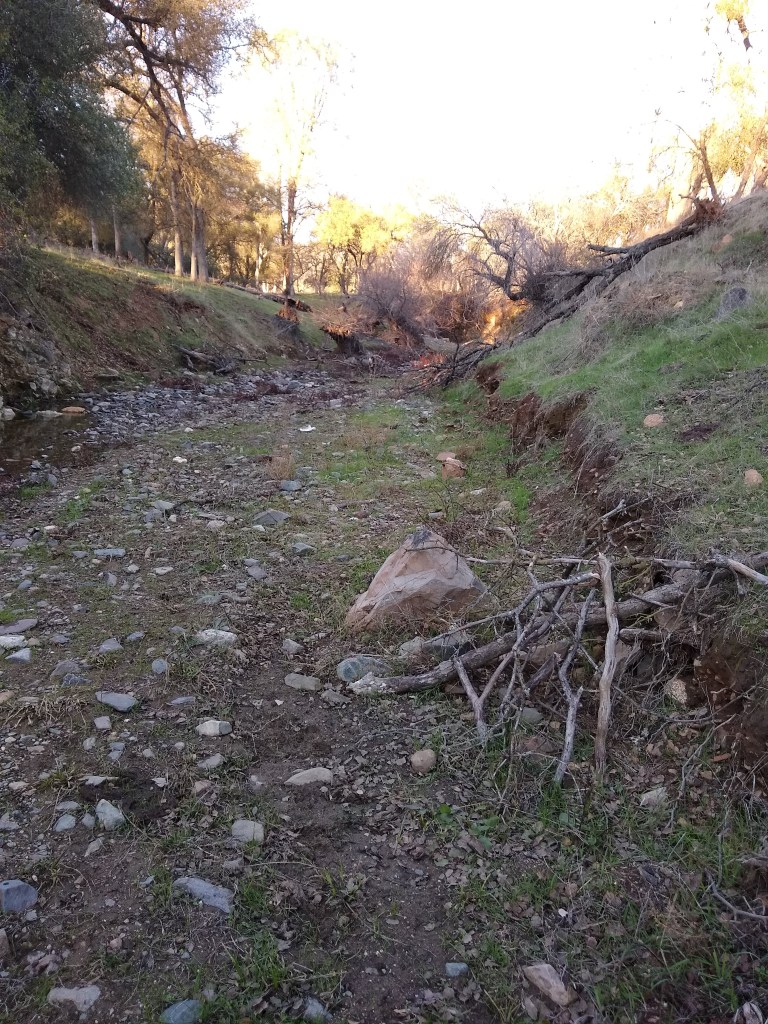
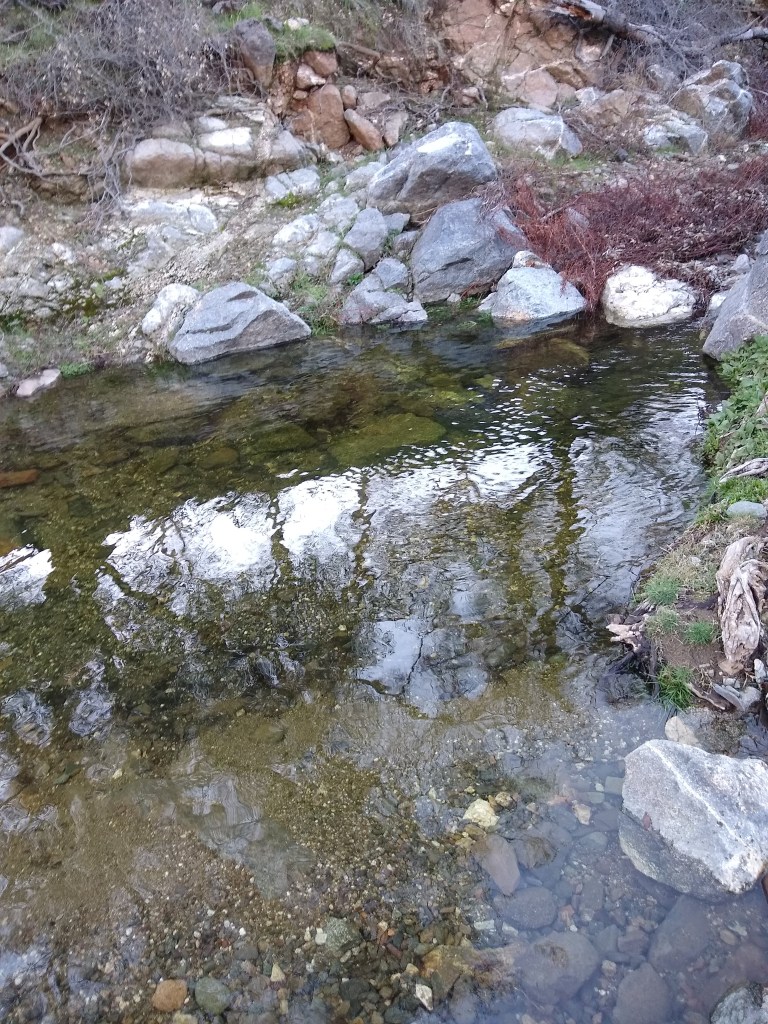
Spring Creek is still running, though just slightly. As visible in the first photo above, the eddy has receded several feet – and this is without cows drinking from it in almost two weeks. My trial mini beaver dam analog did not do much. I will try harder in the future. The Swale Pond receded 10″ in just one day. Note the moist area exposed and the water line in the second photo. The big spring in line on Odom Creek is still full. The creek is running pretty good. It was dry for quite some time in the early winter despite precipitation. The soil was so thirsty that there was little standing (or moving) water until late February. Not pictured are the increasing number of dry spots visible throughout the area. I have already begun irrigating. This is a three weeks earlier than last year.

Wildflower Whiplash – they are everywhere!
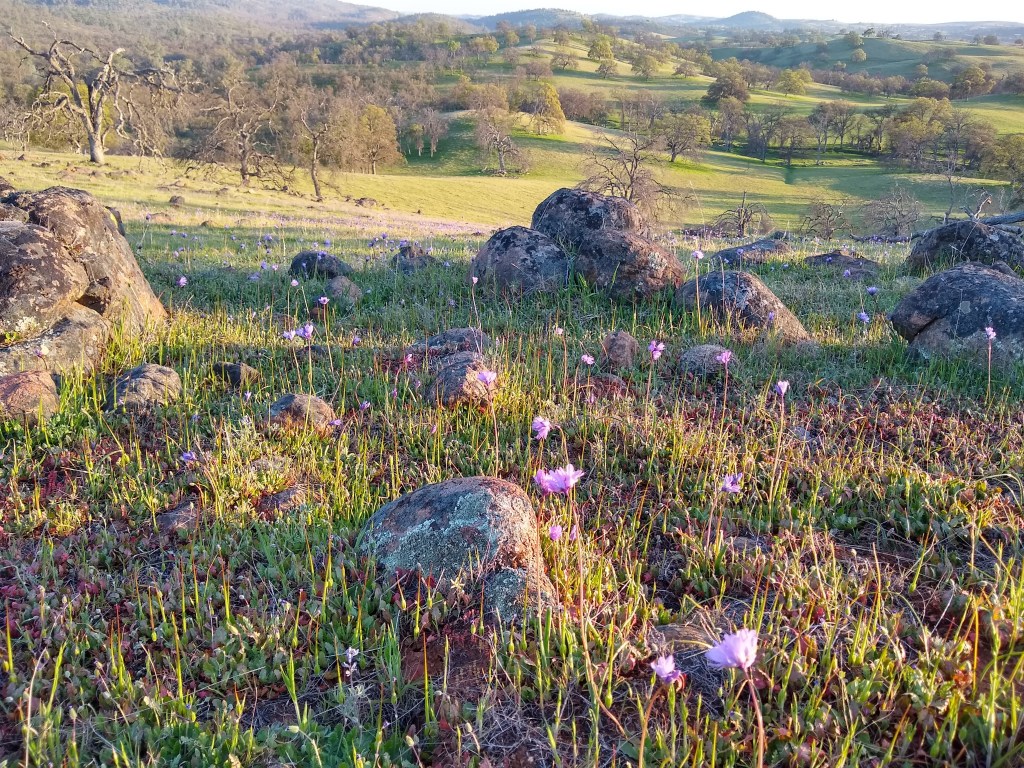
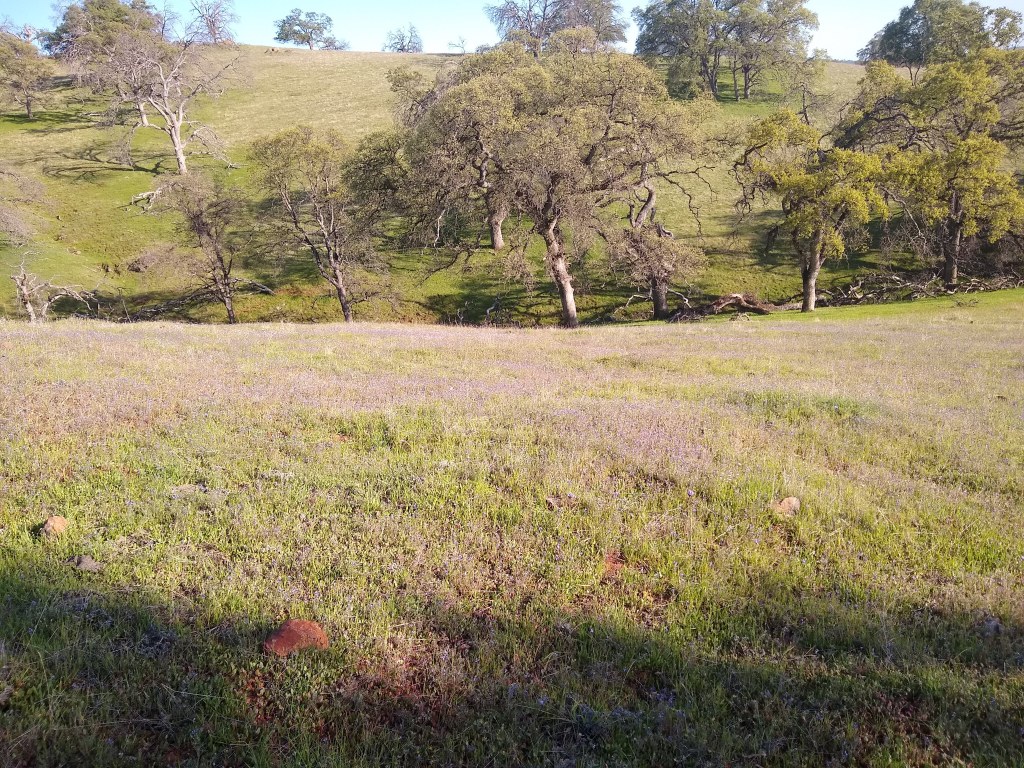
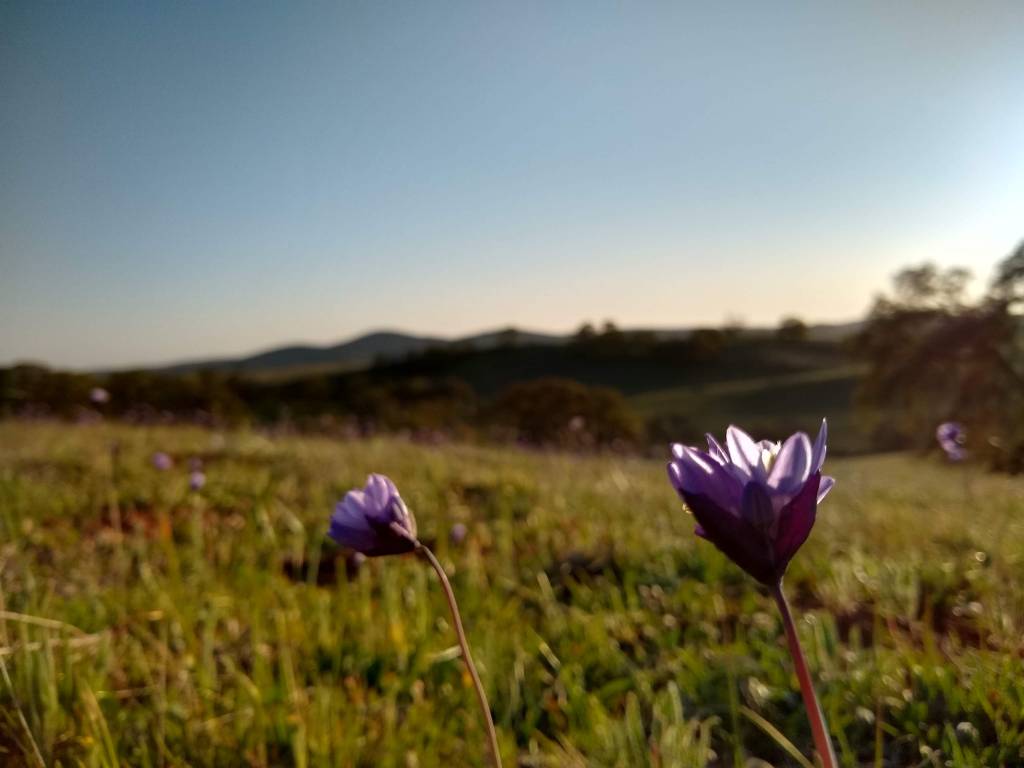
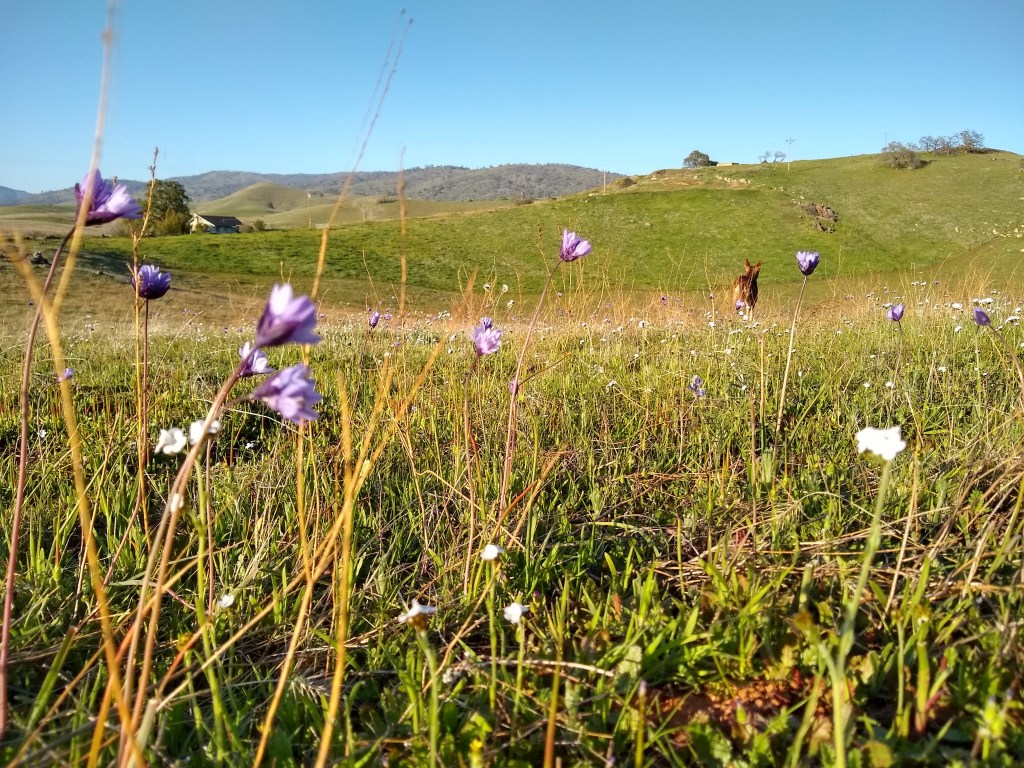
Stunning hill of purple (Blue Dick flowers)

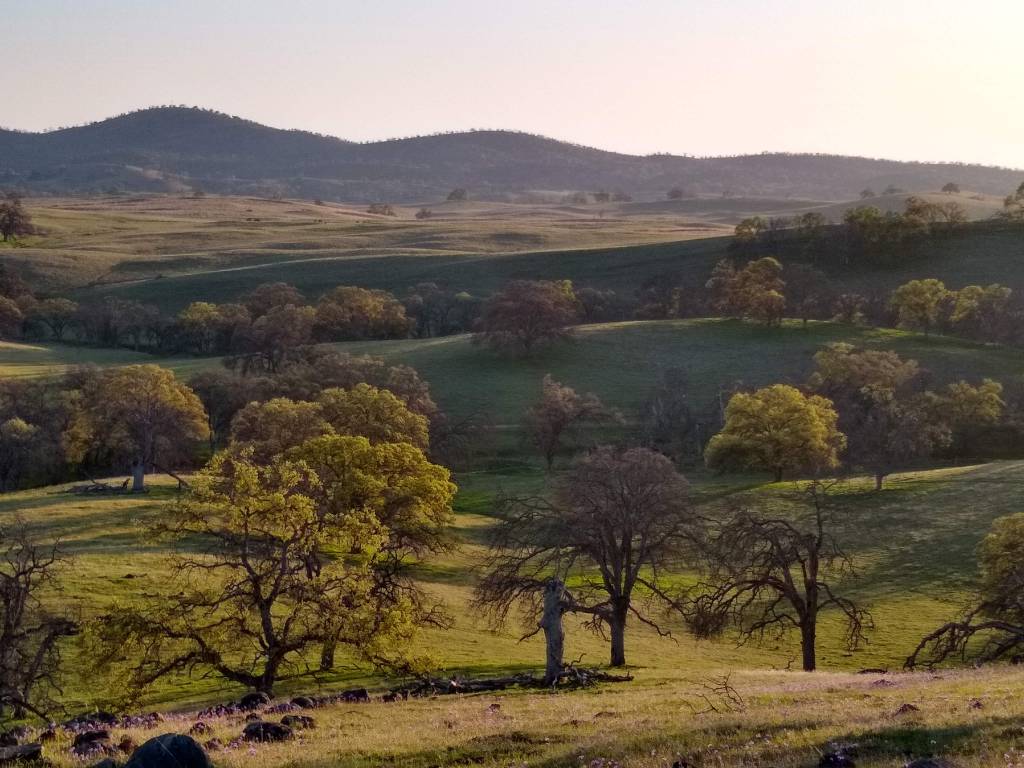
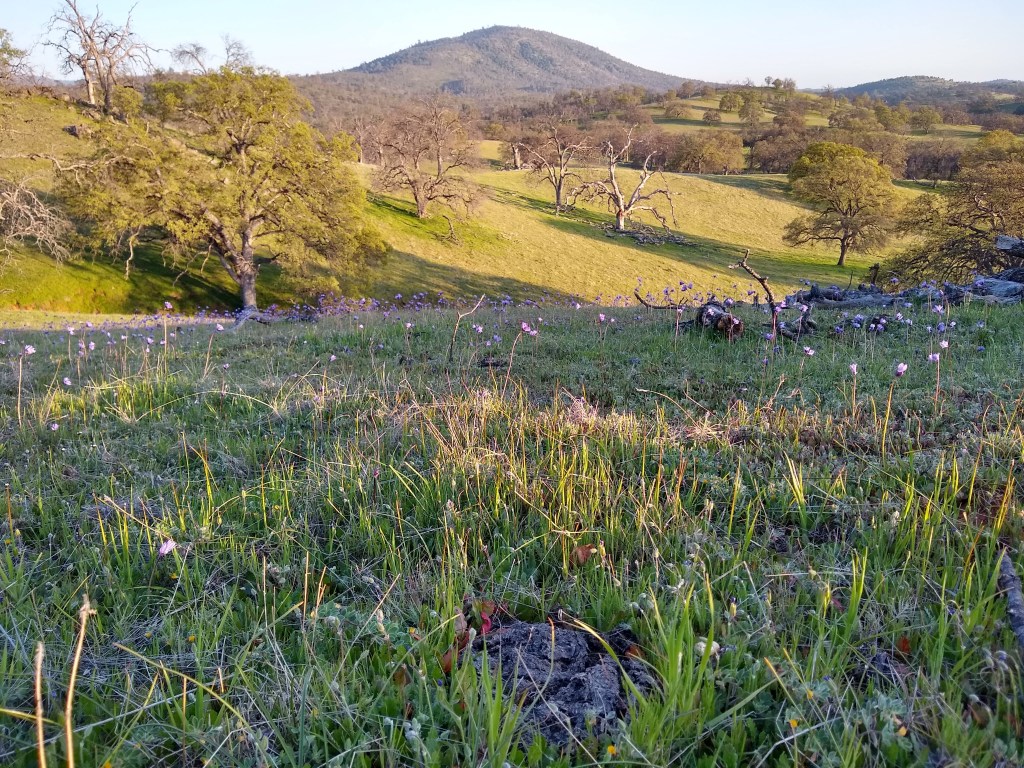
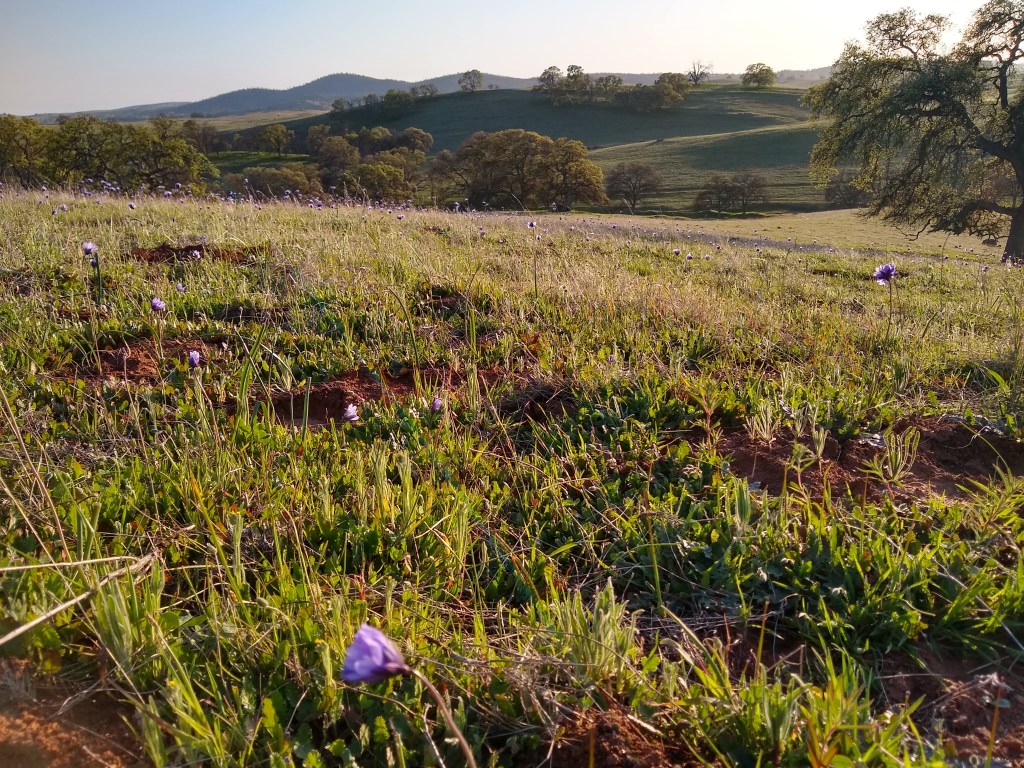
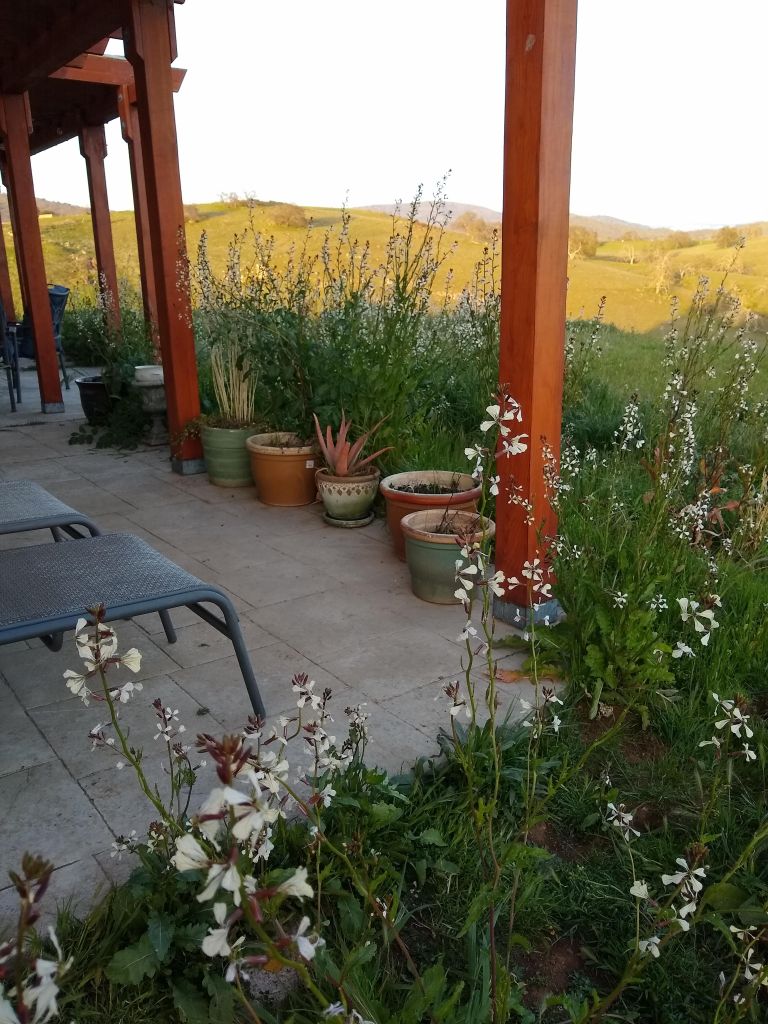
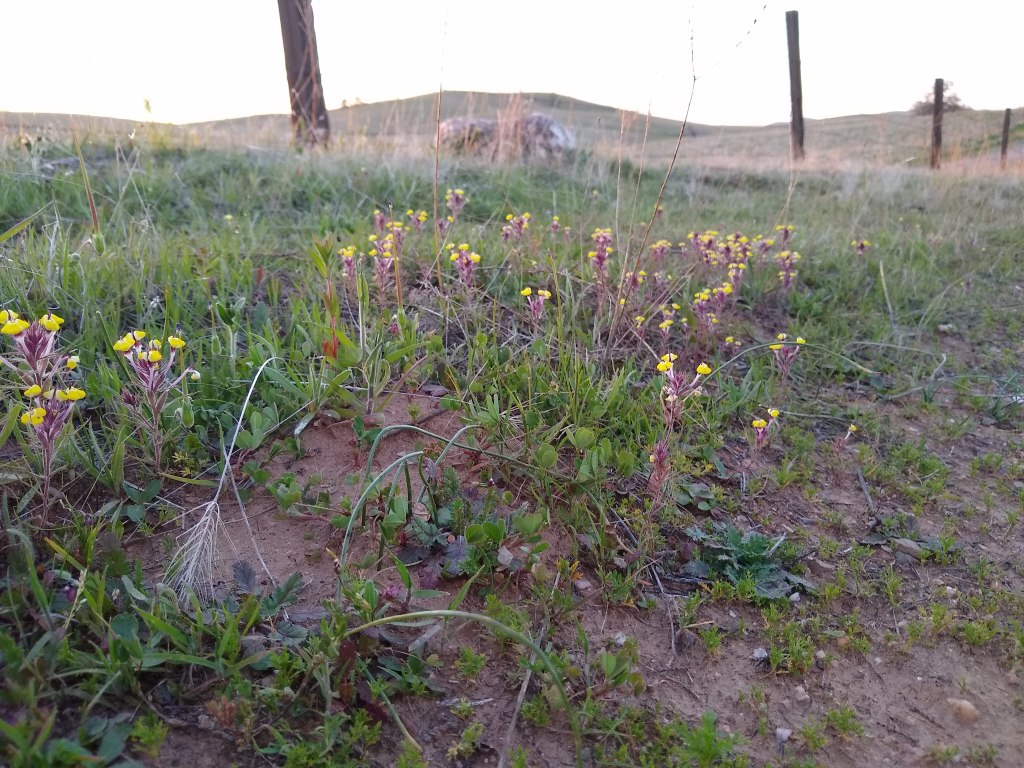
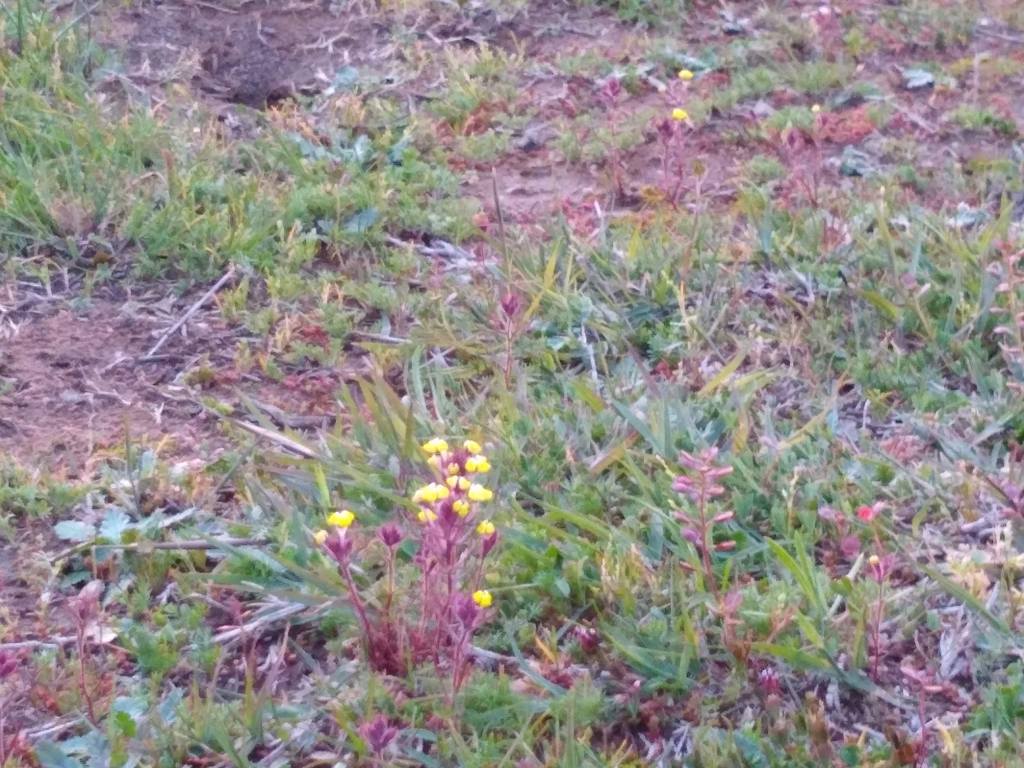
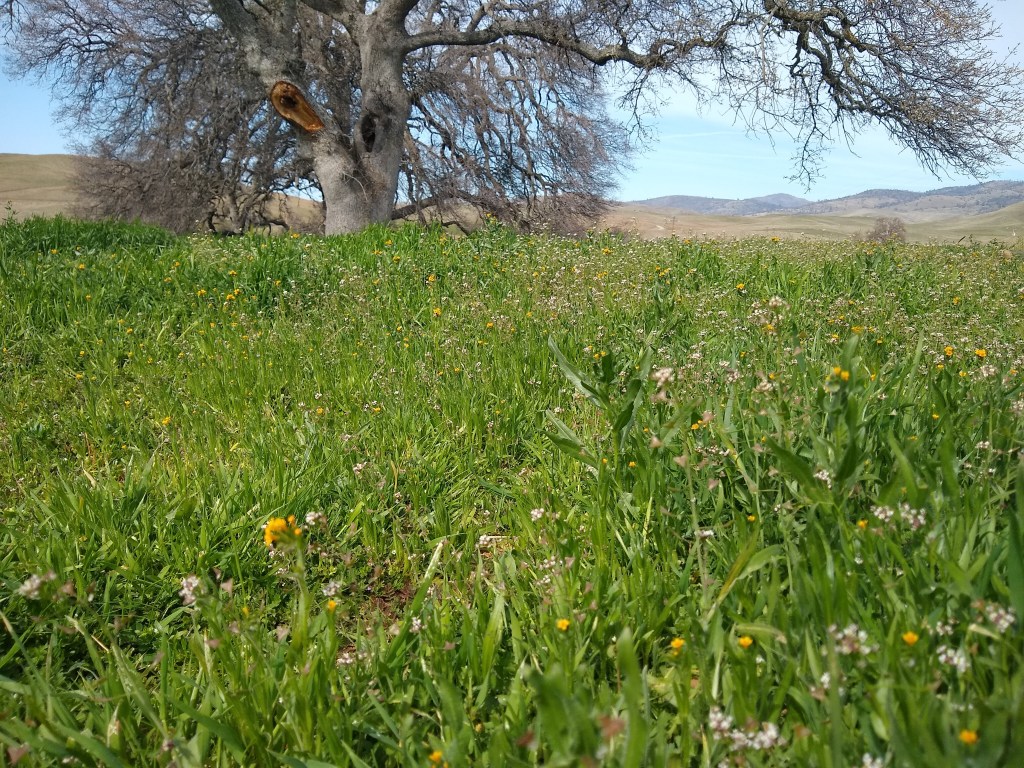
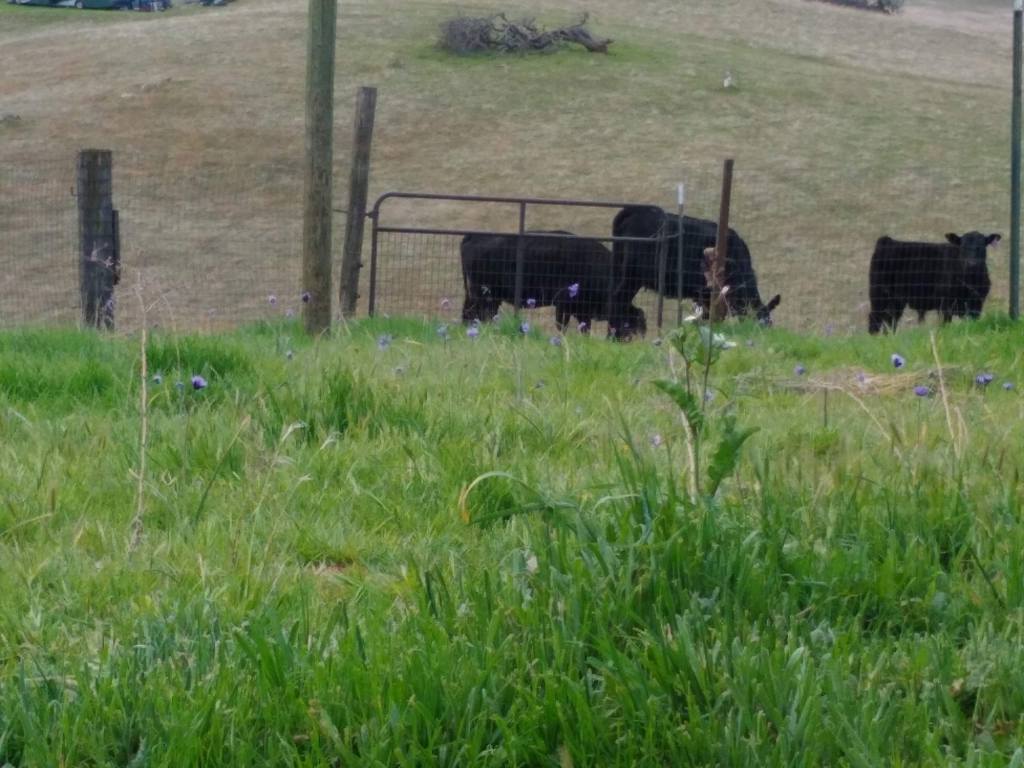
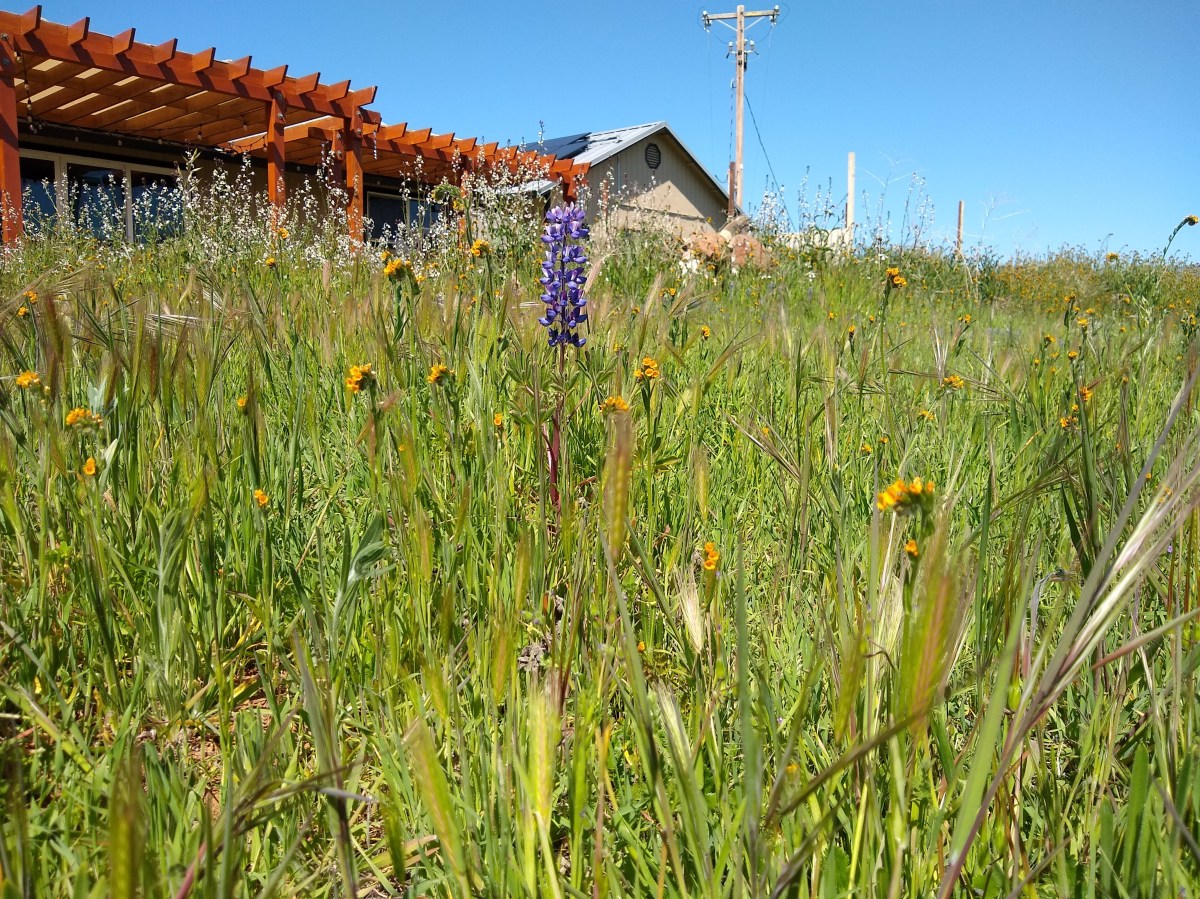
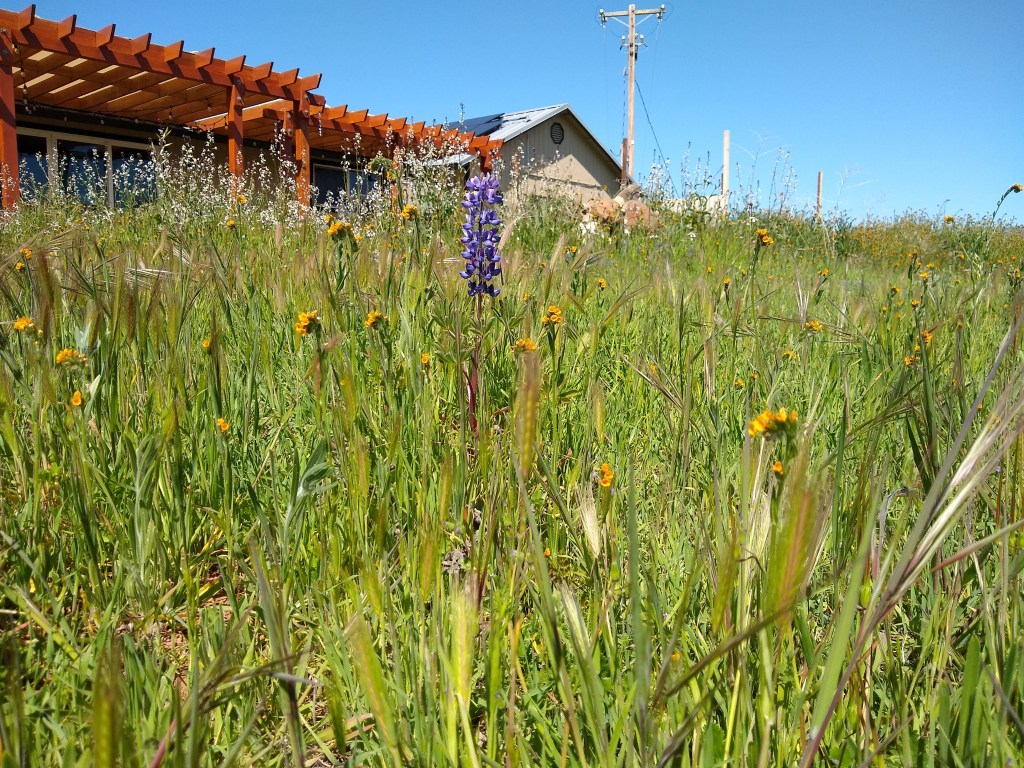
Blue Dicks, Popcorn Flower, Fiddleneck and Lupine proliferate insanely this year. The hills are washed in strokes of color – orange, purple, white, yellow. It is really stunning. You almost get whiplash swinging your head around in every direction to see the colors and flowers. The drought is partly responsible as well as the darker winter we had. The grass did not get the best timing for water and had less sunlight with which to grow. This made room for the wildflowers to sprout and not have to compete/be blocked out by the European grasses. While this is not good for the cattle business, it really is extraordinarily beautiful, amazing for pollinators and quite the olfactory experience. If I could share the smell with you through this blog, I would. Nectar is heavy in the air and the sound of all sorts of bees is an ongoing, loud undulating hum. My photos just do not convey this outlandish beauty.
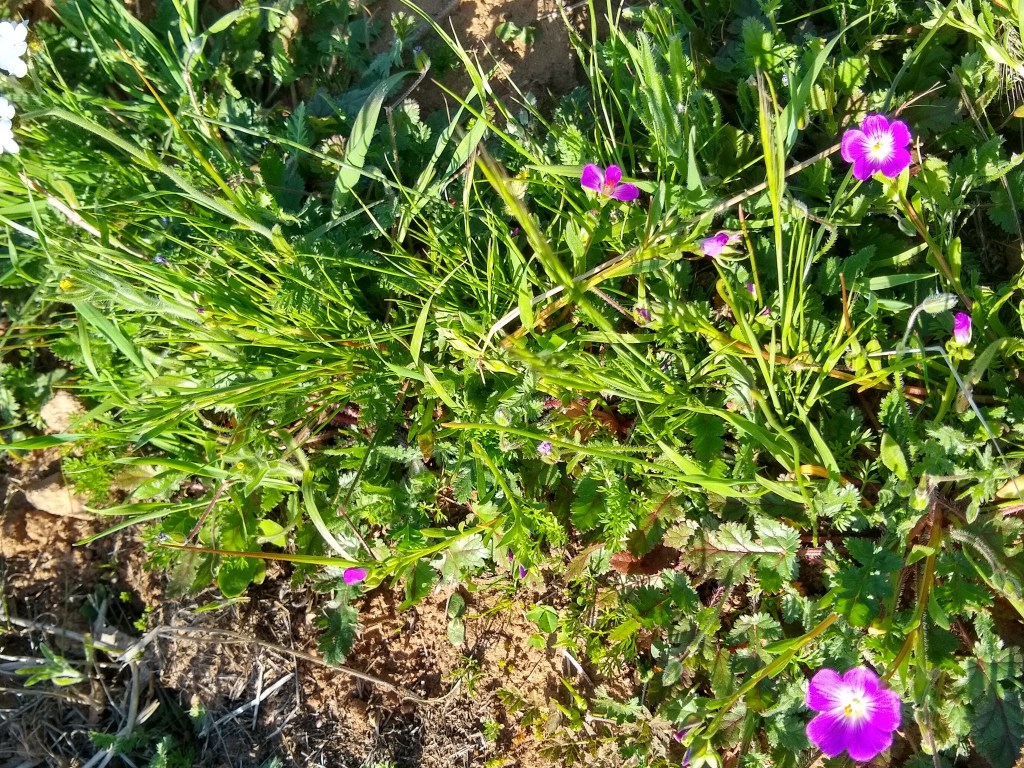
Milkweeds Growing Well

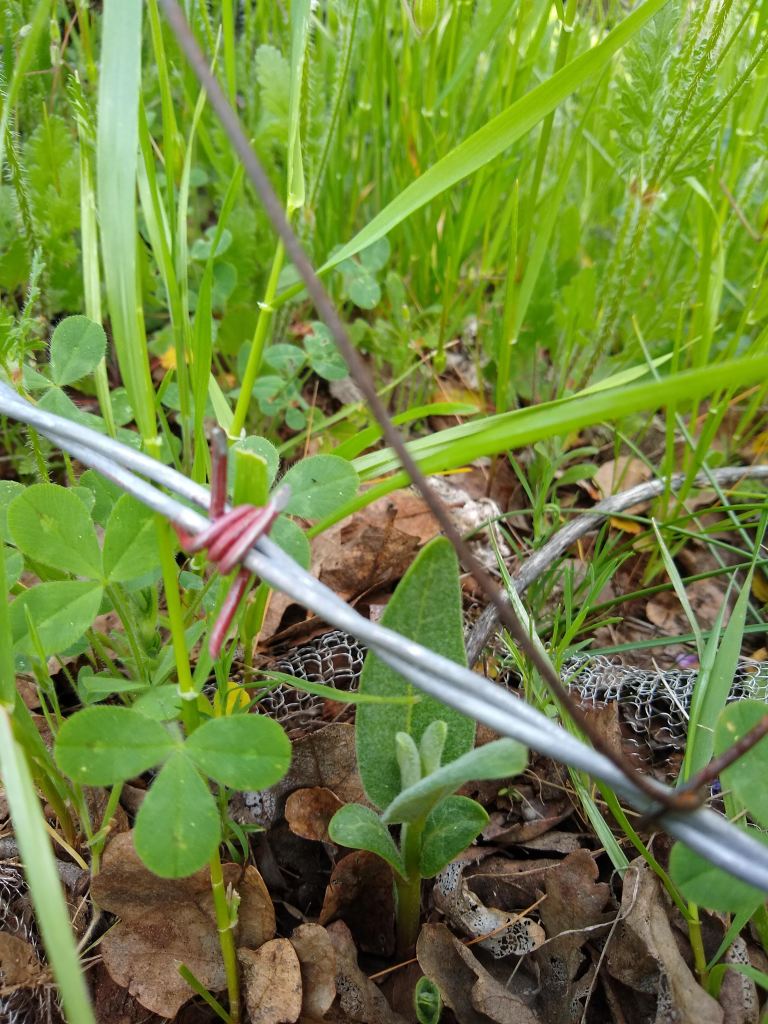
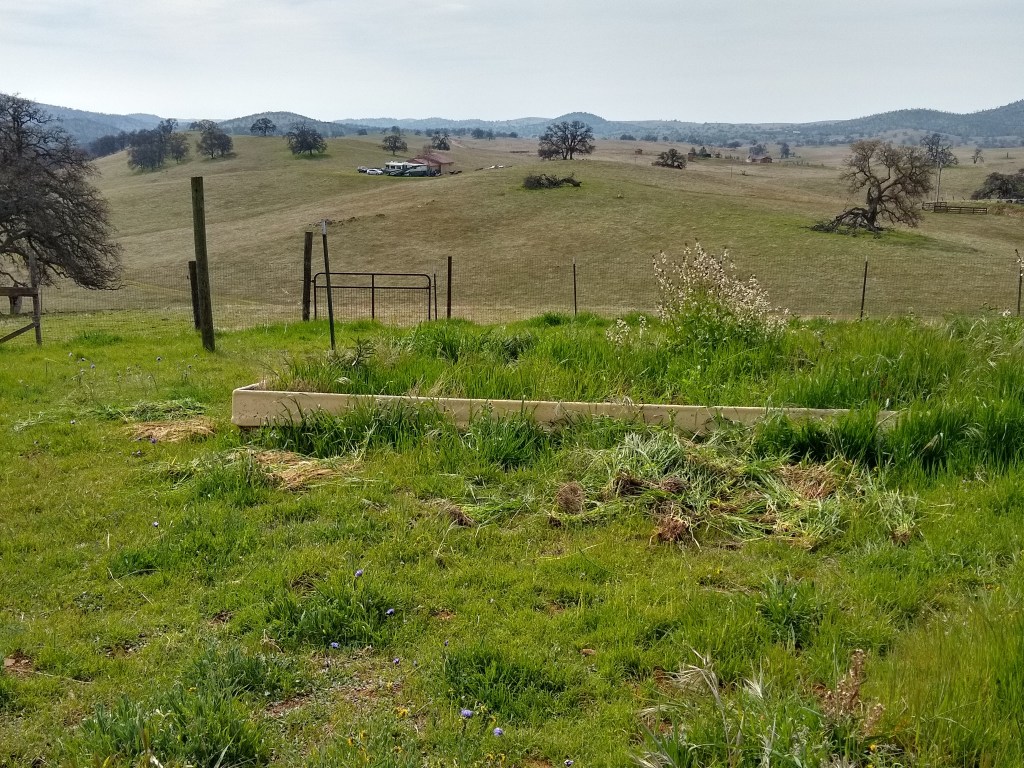
Xerces and Monarch joint Venture each push that milkweed is the most needed plant to be planted for monarch habitat. I am very happy to say that I have many milkweeds emerging strong and healthfully. Most are narrowleafs. However I found one showy coming back at Site 8 and, of course, the a. Californica. I have not seen any of the woolly pods I planted come back this year. The gopher hit them hard twice last year. I was happy to see some narrowleafs come back from the wild pig attack at Site 8. They did not reemerge last year, and I thought I may have lost them completely. I have growth that I can see in four of the seven milkweeds planted there last year. Of the nine I planted in the raised bed, only three have returned from the massacre by the gopher that sneaked into the bed. It does look like the CA fuchsia is reemerging. That would be incredible if so. We still have a deer grass and a yerba santa that survived the attack.

Other Notable Updates
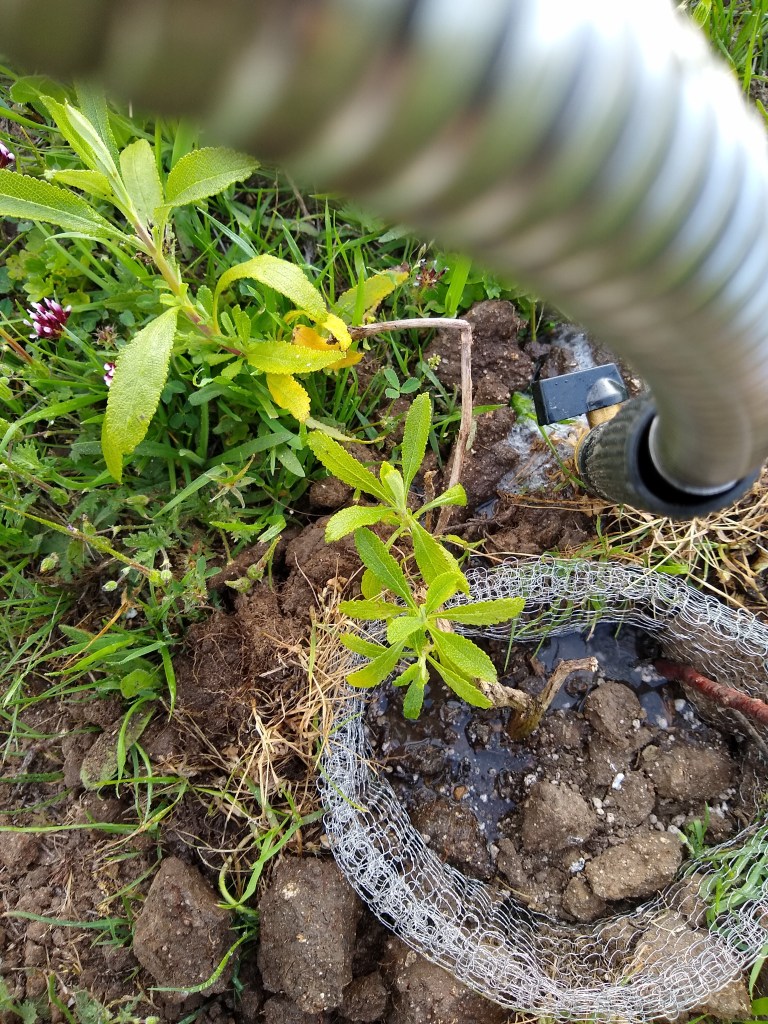
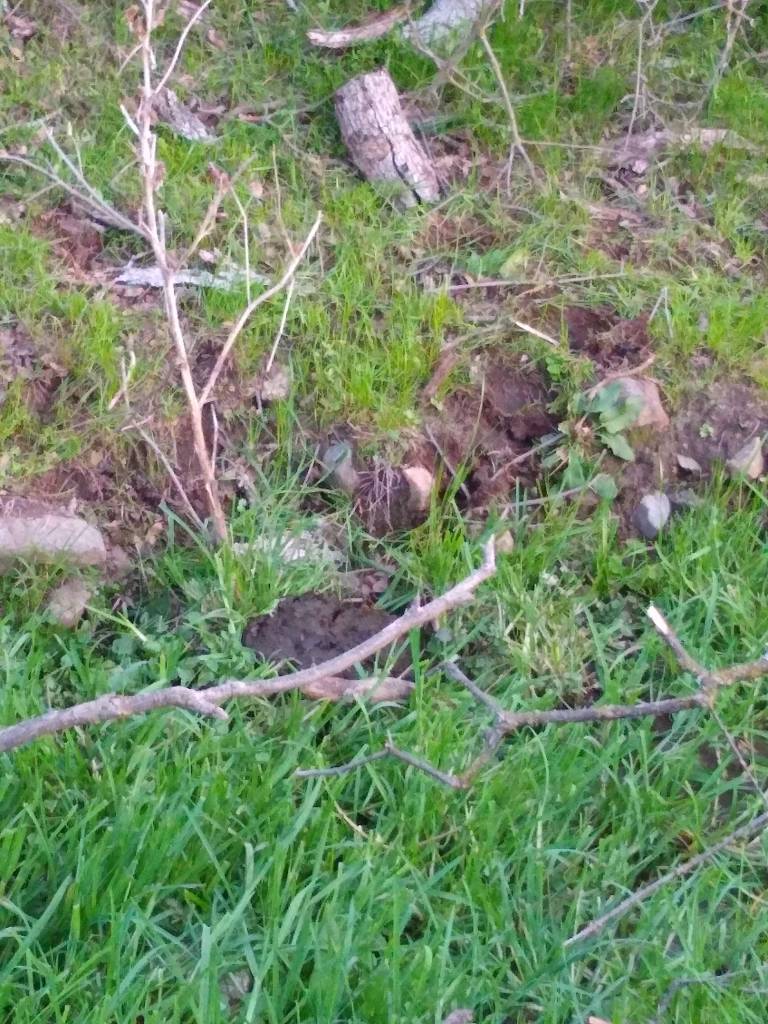
There is a tremendous variety of growth in and around the branch fence area. I have not seen any of the milkweed I planted from the Xerces kits emerge yet. The area is more shaded, and the showy milkweed seems to be taking longer to emerge. It seems as though another creature is making its way into the branch fence area. I’ve seen some of the fencing fallen down and soil disturbance. It isn’t a calf since they are on the south part of the ranch. I did not see any scat or tracks to be able to know. It would be useful and fun to set up a game camera. I have one, but have not gotten around to doing this. It would be interesting to see who is coming around in the night (or day when I am not looking).

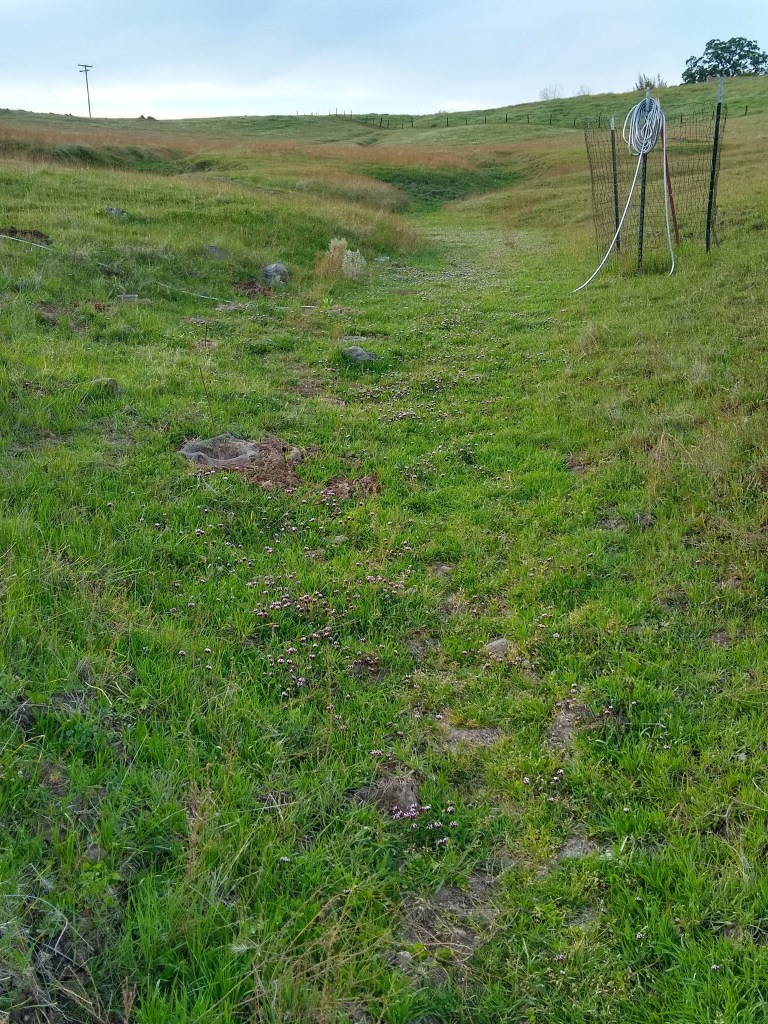
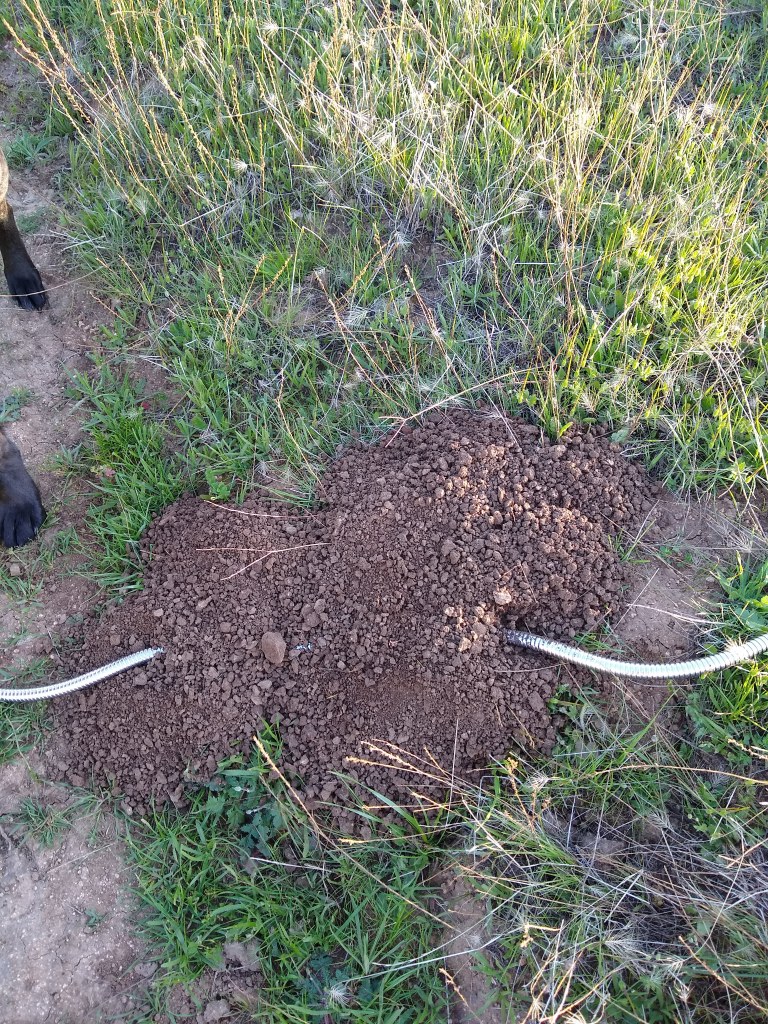
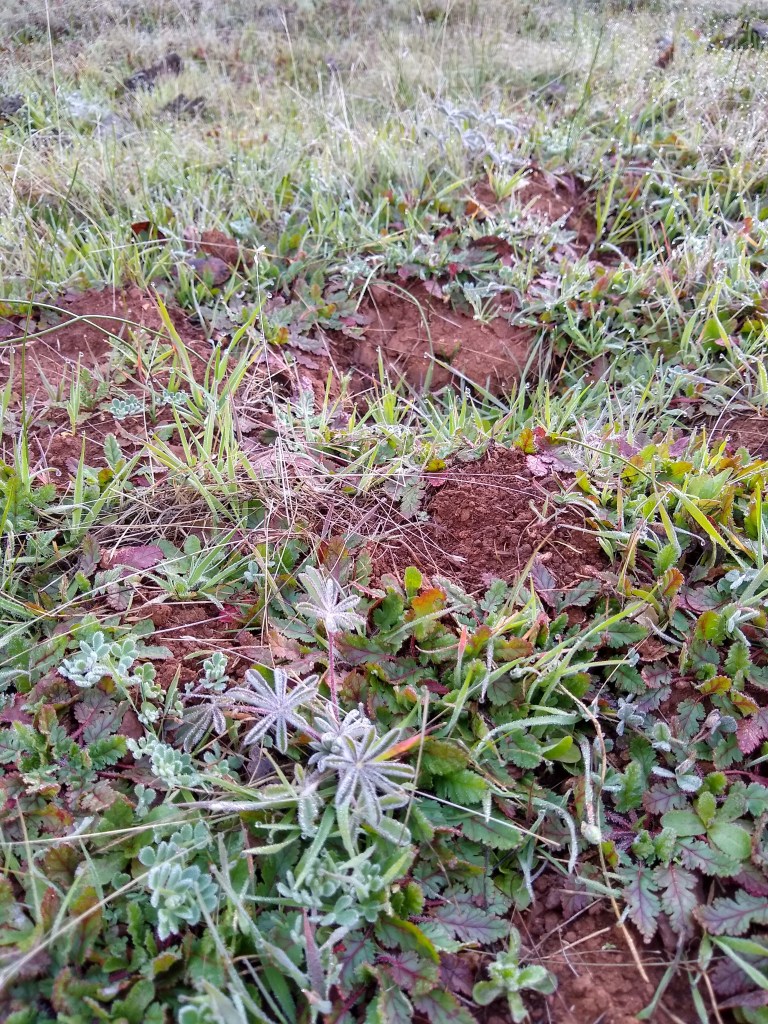
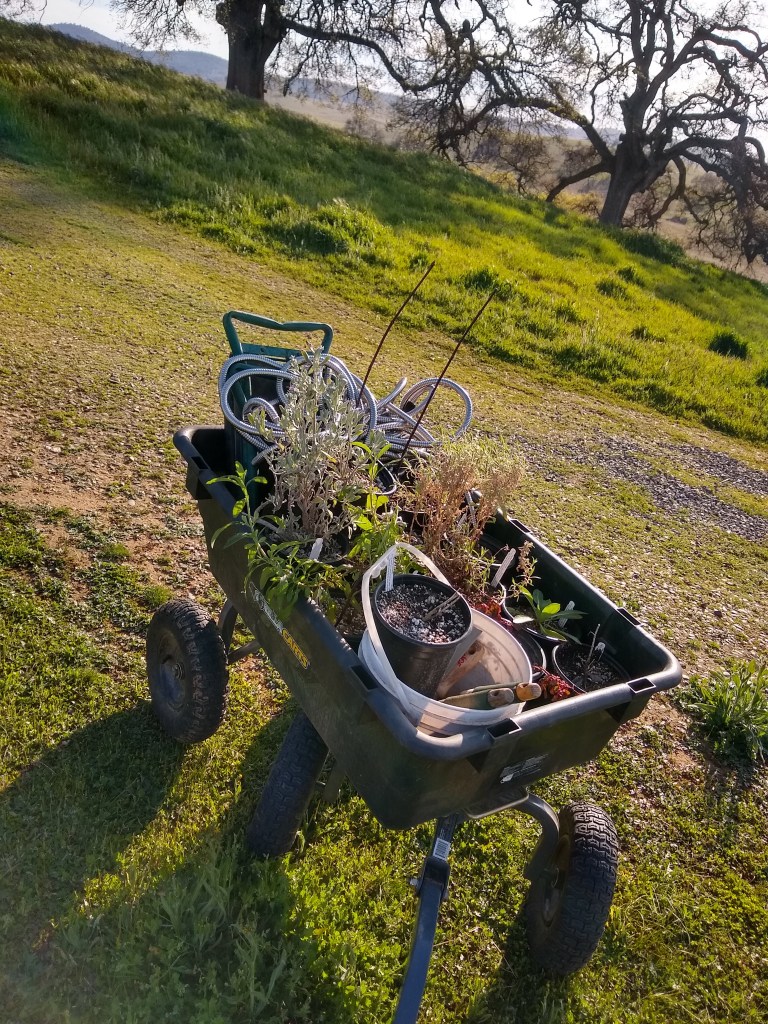
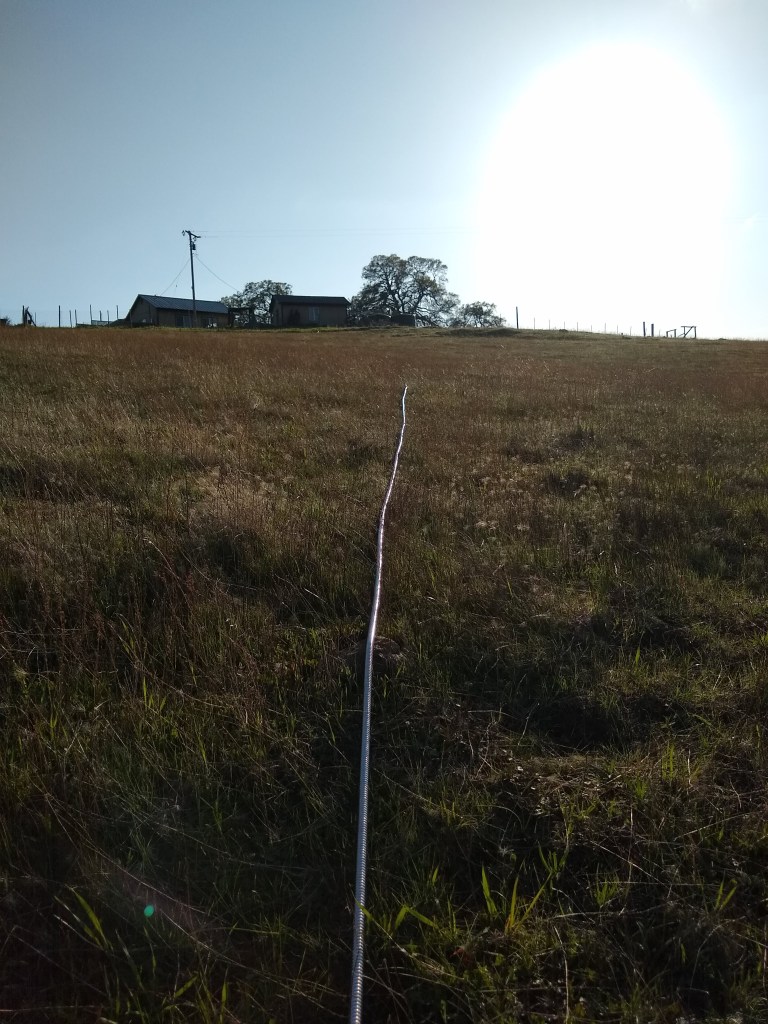
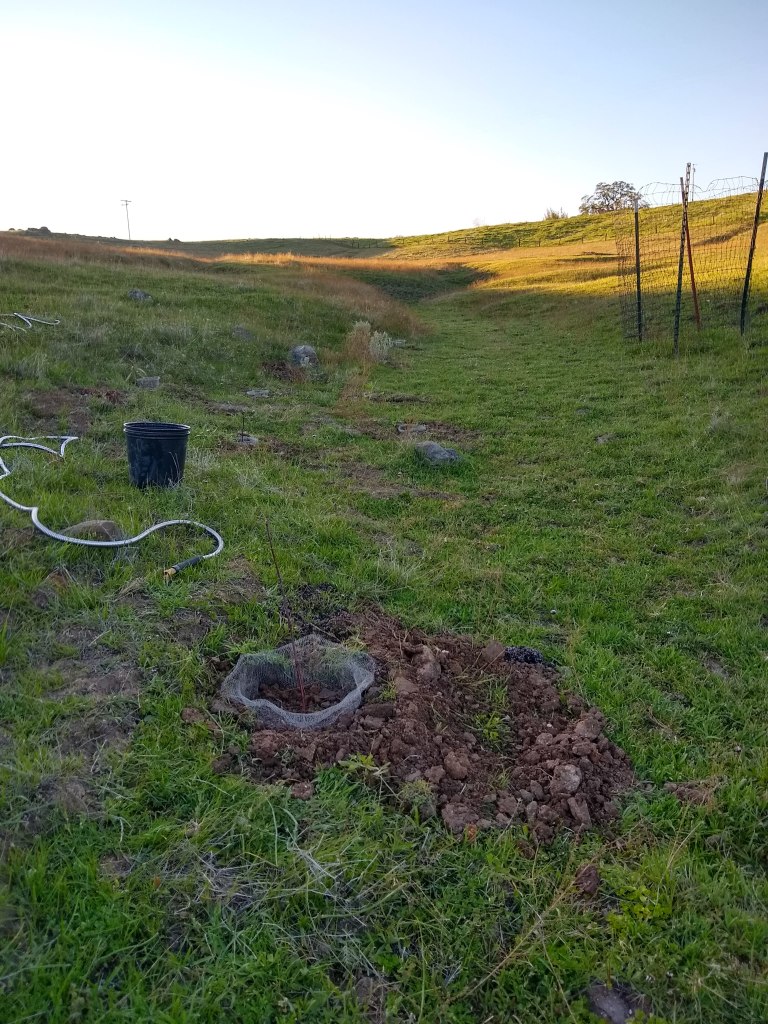
At Site 2 in the arroyo, the plants are off to a good, healthy start. I did see considerable gopher activity near the site. I found the hose covered in gopher mounds in several locations along its route from the water tank to the arroyo. Getting a stainless steel hose was a specifically so gophers could not bite through it and cattle could not crush it. It will be tested now. The cattle are due to return at the end of the week.

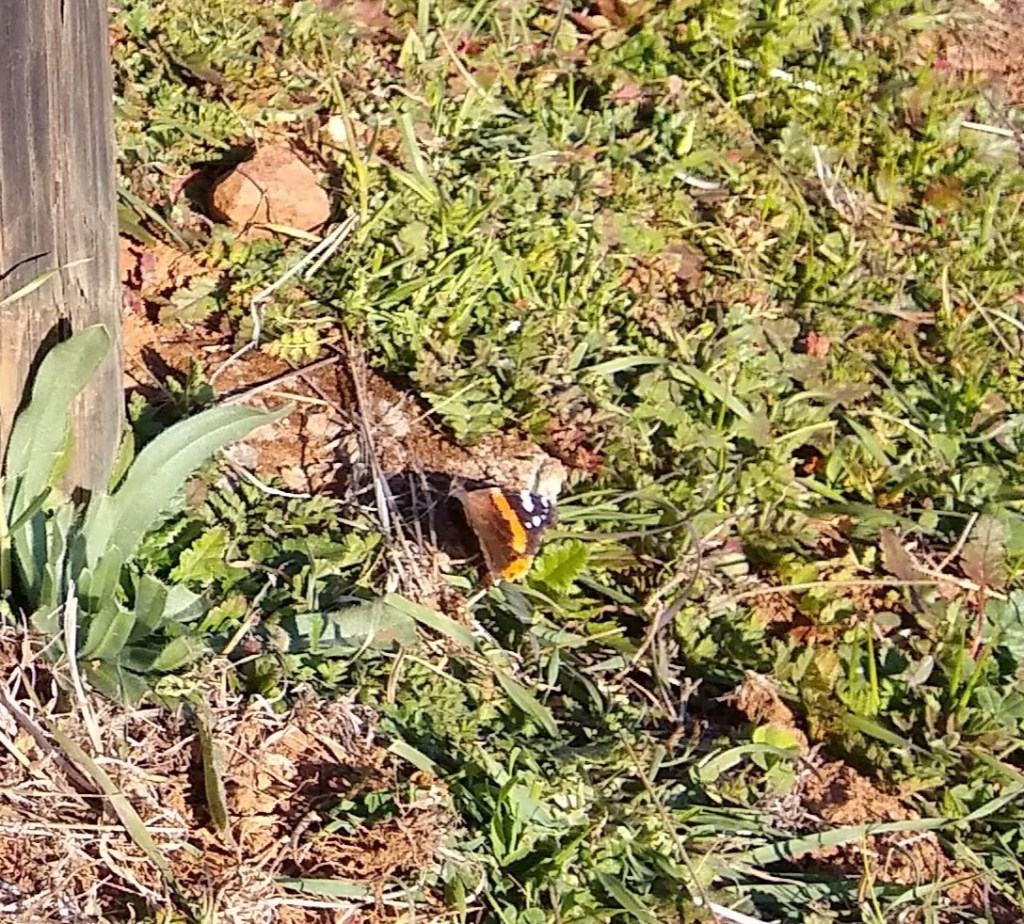
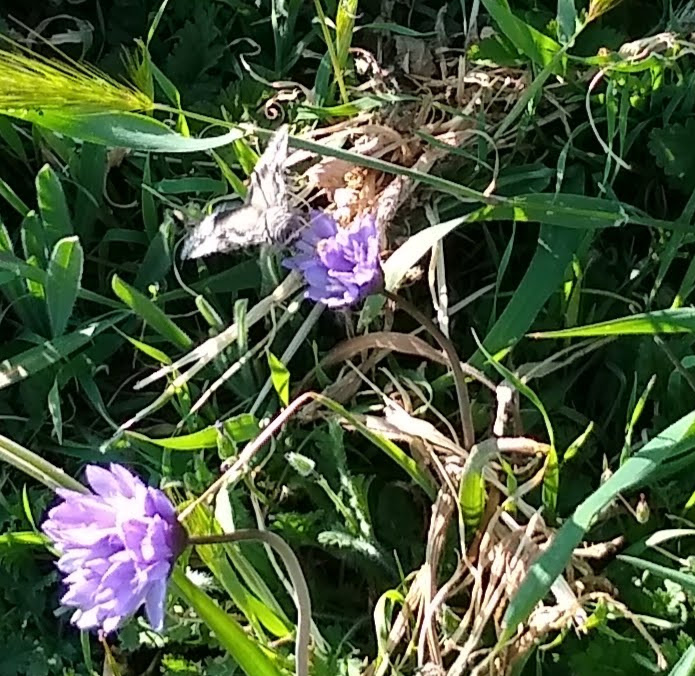
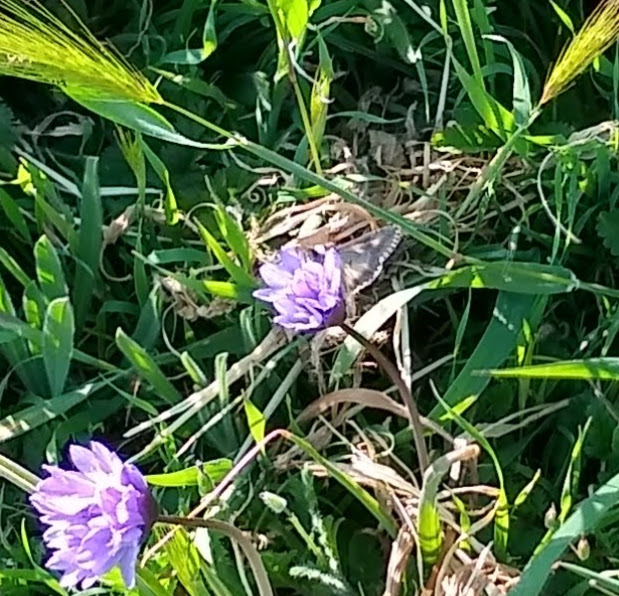
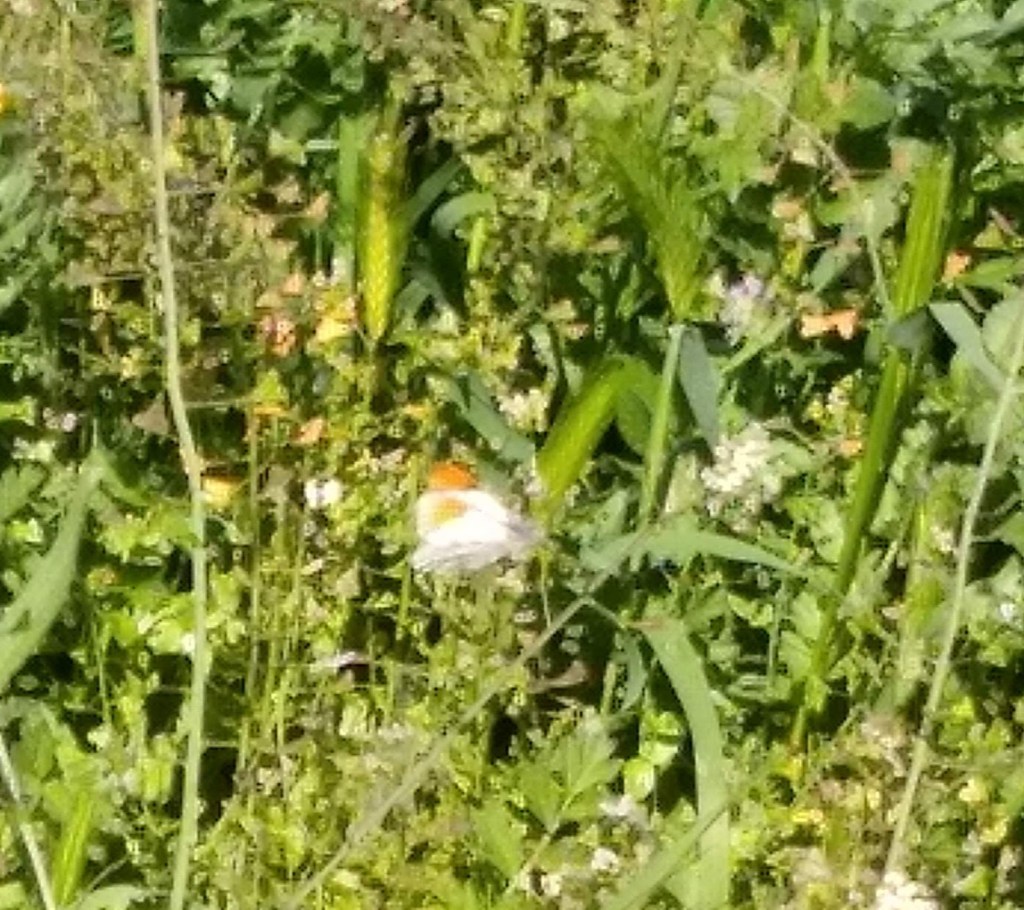
I have been seeing white butterflies with a pale orange throughout their wings. They spook easy, and I do not have a good photo to share. I was able to get two pictures from far away, but the pixelation when blown up is terrible. I did not include them here.

It appears that the cattle pushed their way through the barbed wire to browse the deergrass. I found one of the wires shifted up and the bunch of grass trimmed low. It is possible it could be a deer. I have seen evidence of their presence toward the more forested portion of the ranch. My neighbor said he saw one too the other day. There were no deer droppings or hair on the wire – but it is a possibility.

Spring is always a time of hope. Plants are in the ground and doing well before gophers, heat, pigs or any other misfortune finds them. David and I received our first vaccine shot last Friday. We have hope too that we will be able to do more away from home and see family and friends that we have only seen on a video screen. We miss hugs and being with the people we love. Let us all cling to as much hope as possible and the joy it brings. We do not know what lies ahead, but for now, I will celebrate the possibilities of togetherness and the arrival of the monarchs.
The ABCDs of Walappu’ “Uuchuthuu: a. Californica, Butterflies, Color, and Drought

Purples, whites, oranges, yellows, reds and blues abound!

In the melody of Carole King’s A: Alligators all around.

A: a. Californica comes from the ground.

B: Butterflies flitting around.

C: Colorful flowers abound.

D: Drought crept in without a sound.

And that is the current state of life (and my mind) here at Walappu’ ‘Uuchuthuu (Butterfly Home Place). Old, favorite children’s songs are not enough to comfort me as a moderate drought continues and is likely to get worse. Winter has turned to spring so fast I have hardly had time to write. In fact, today is three weeks since my last post. Rest assured dear monarch lovers, I have continued to be hard at work.

Protecting an oak sapling takes considerable effort.

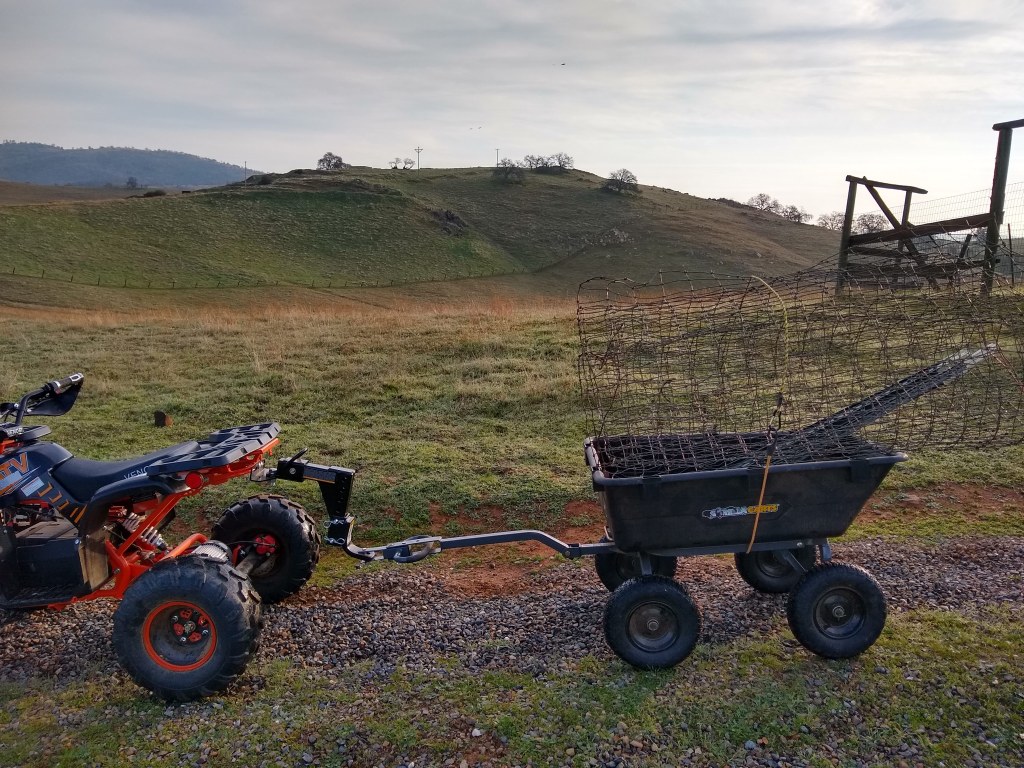
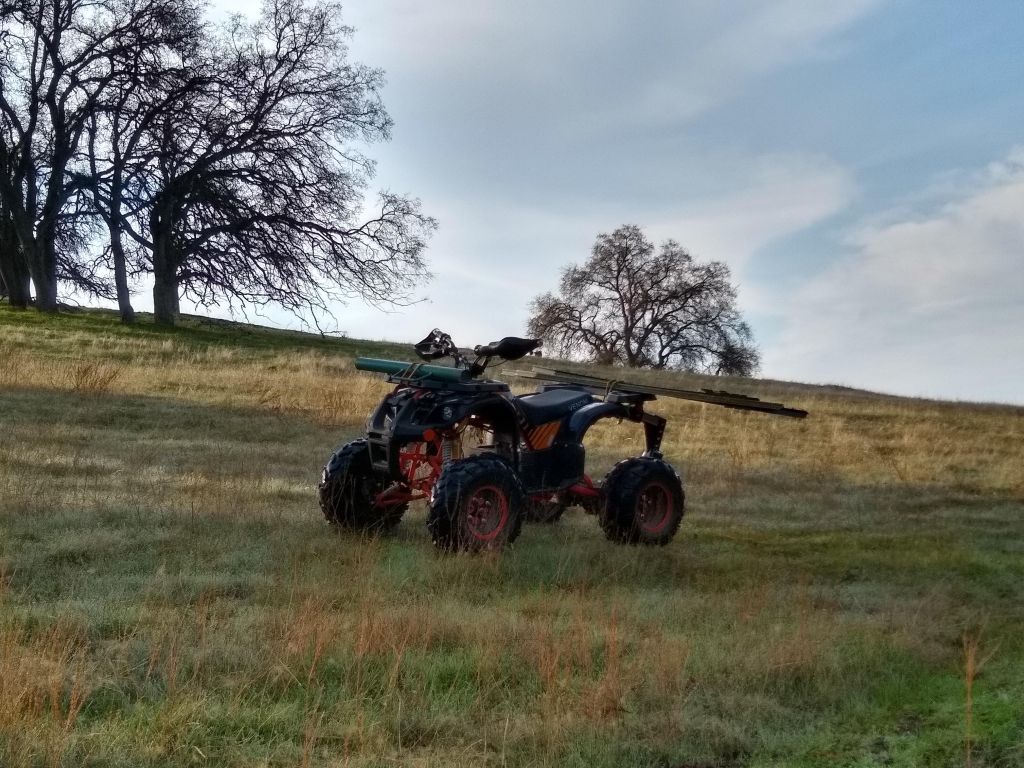
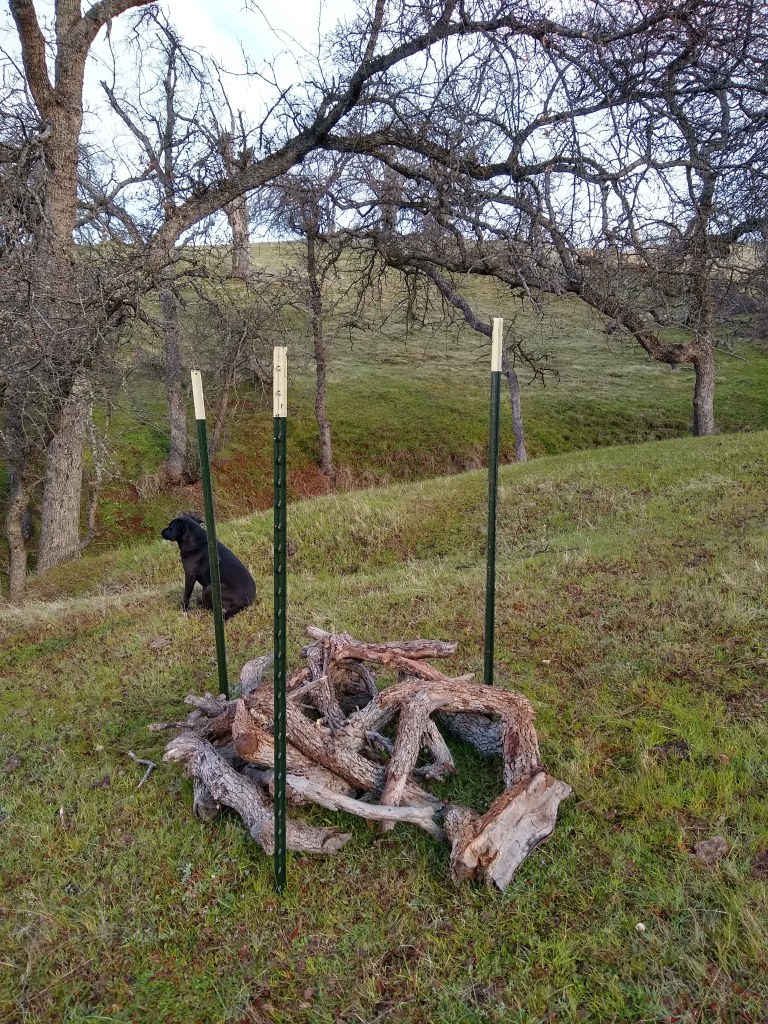
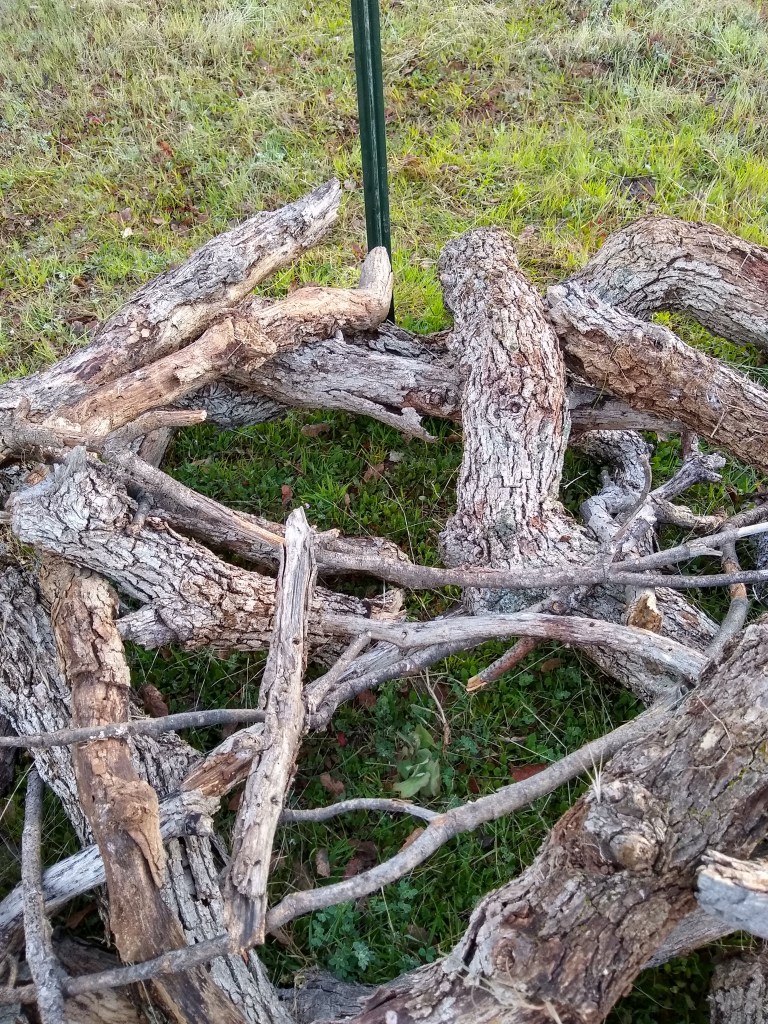
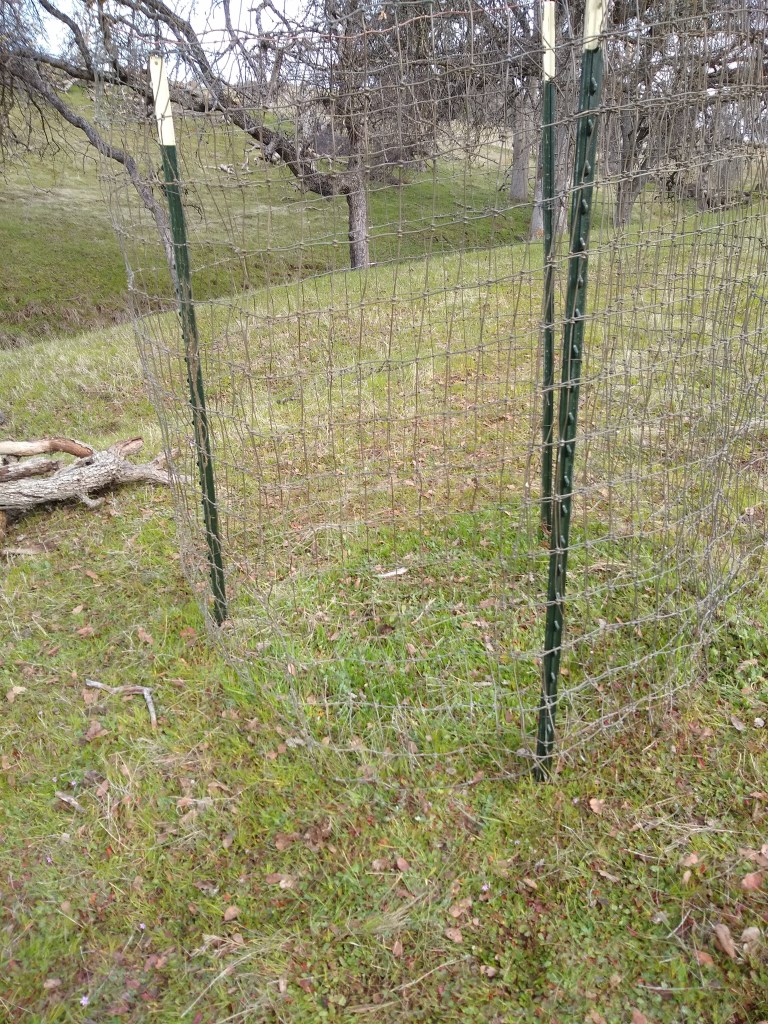
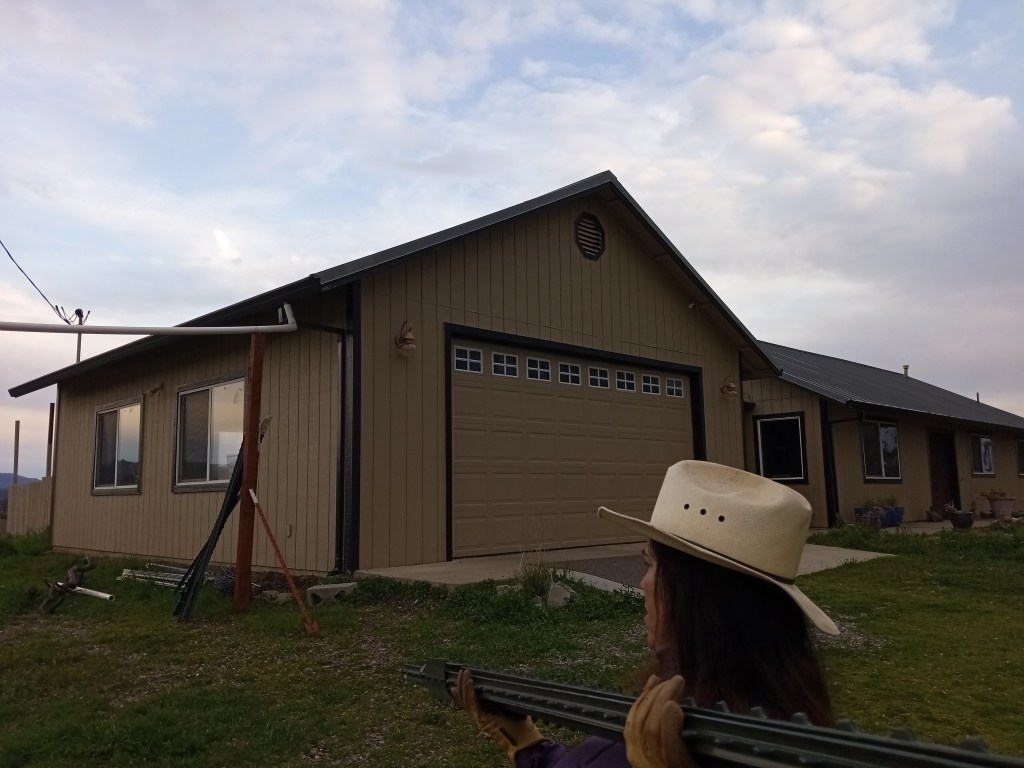
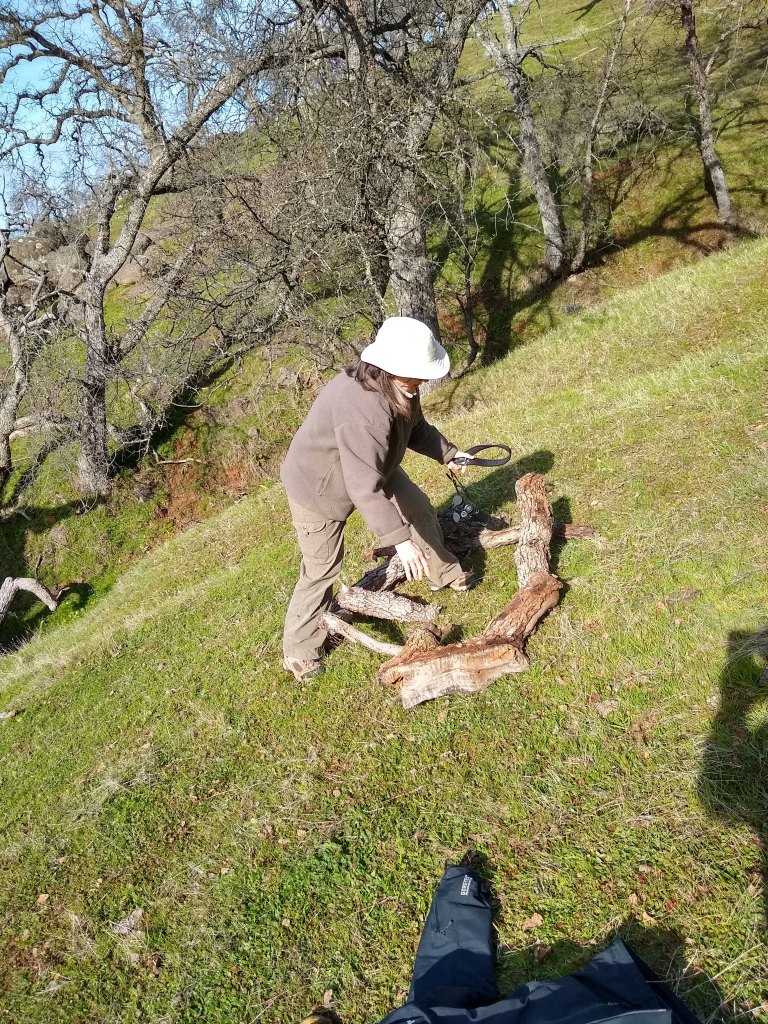
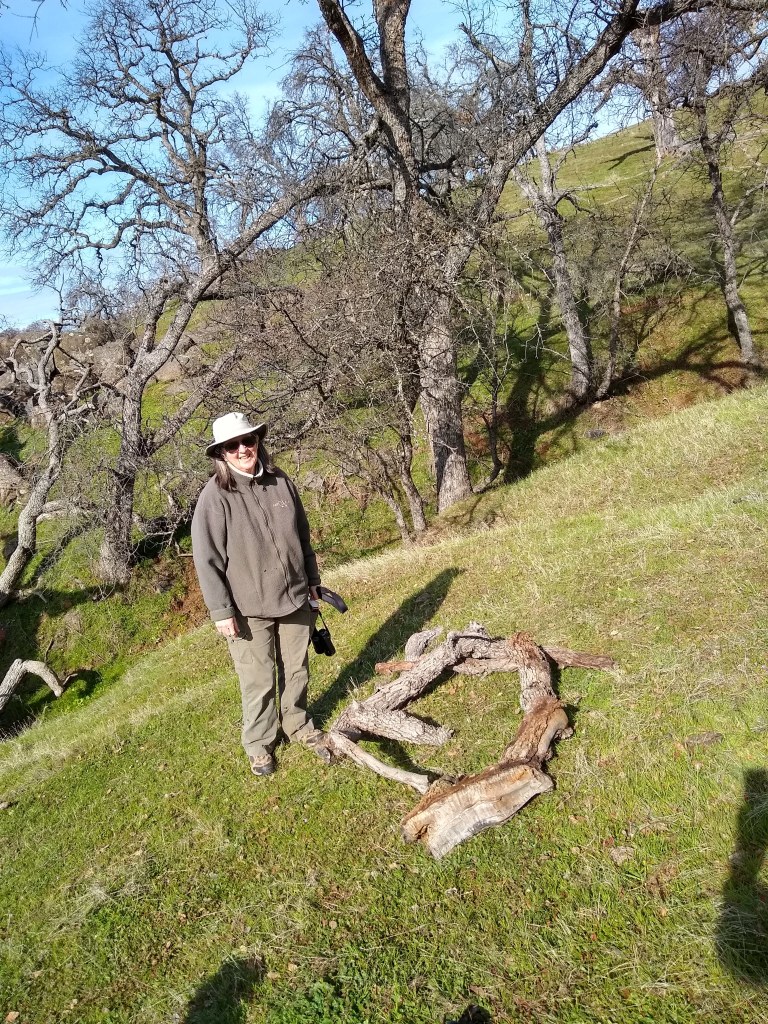
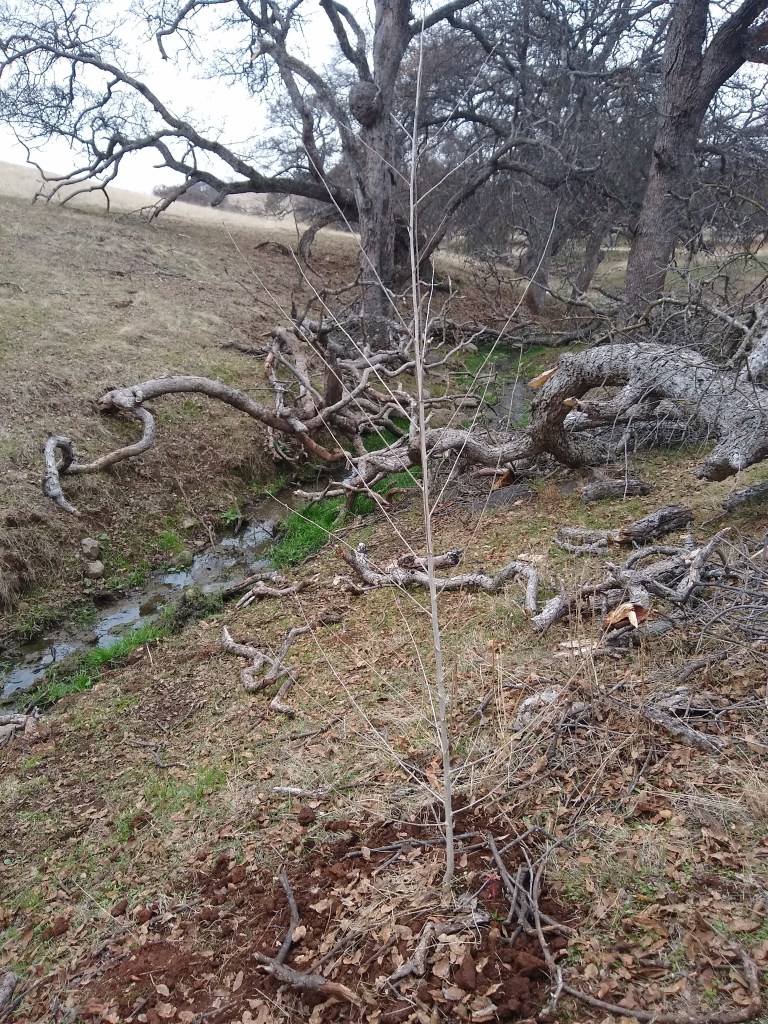
In my last post, I noted that my friend Maggie spotted a little oak seedling while hiking with me on the ranch. We protected it with downed branches to buy me time until I could get to the site and build a cage around it. Three weekends ago I was able to do so. It took much effort however. Since the ground was still wet from a recent storm, I did not want to disturb the soils with my quad by sliding up and down the hillsides. Instead, I loaded the quad with fencing materials and parked in a flat spot well away from the hillside site and hauled all the material to the site. For those that are not aware, t-posts are solid steel. The roll of no-climb fencing is a thick gauge metal. The t-post pounder itself is weighted steel, about 16.5 lbs. As I trudged across the creek, up hill, then across an arroyo to another hill, then up that hill to the oak seedling site several times with pounder, posts and a huge roll of fencing, I had only one thought in mind…”How am I not a size 6!? Why are my arms not as defined as a body builder?” The only explanation is that I love peanut butter too much.

I also put in t-posts around the cottonwood. I needed to do it anyway, and I was going to be nearby. The no-climb fencing still needs to be attached, but I have it ready alongside the driveway to easily pick up when I have the time. At least Maggie’s oak is going to be ok. There are so few young oaks (and so many that died in the last drought), I need to do a better job of protecting the seedlings I find.

My favorite is back: a. Californica

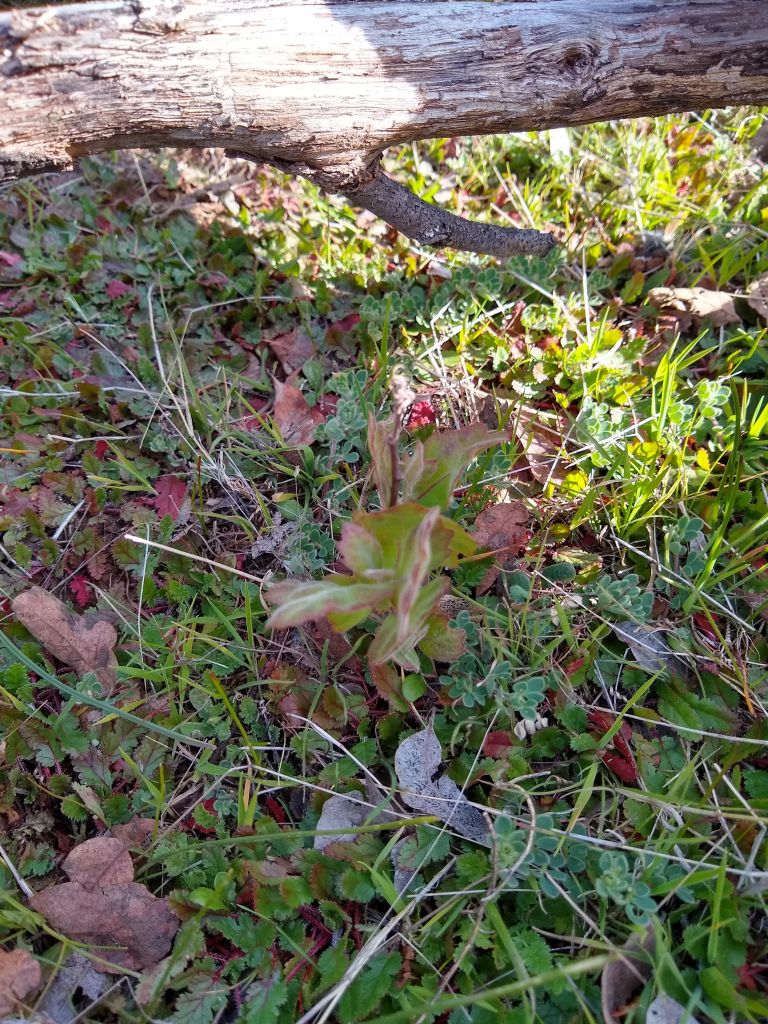
The first emergence of a. Californica

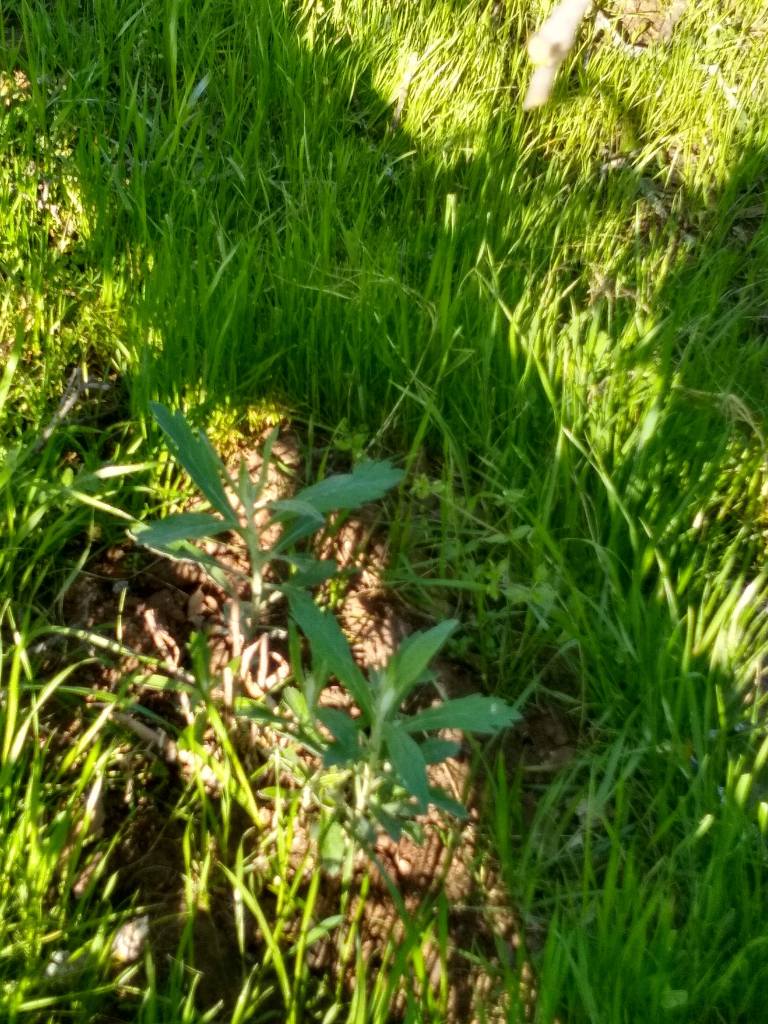
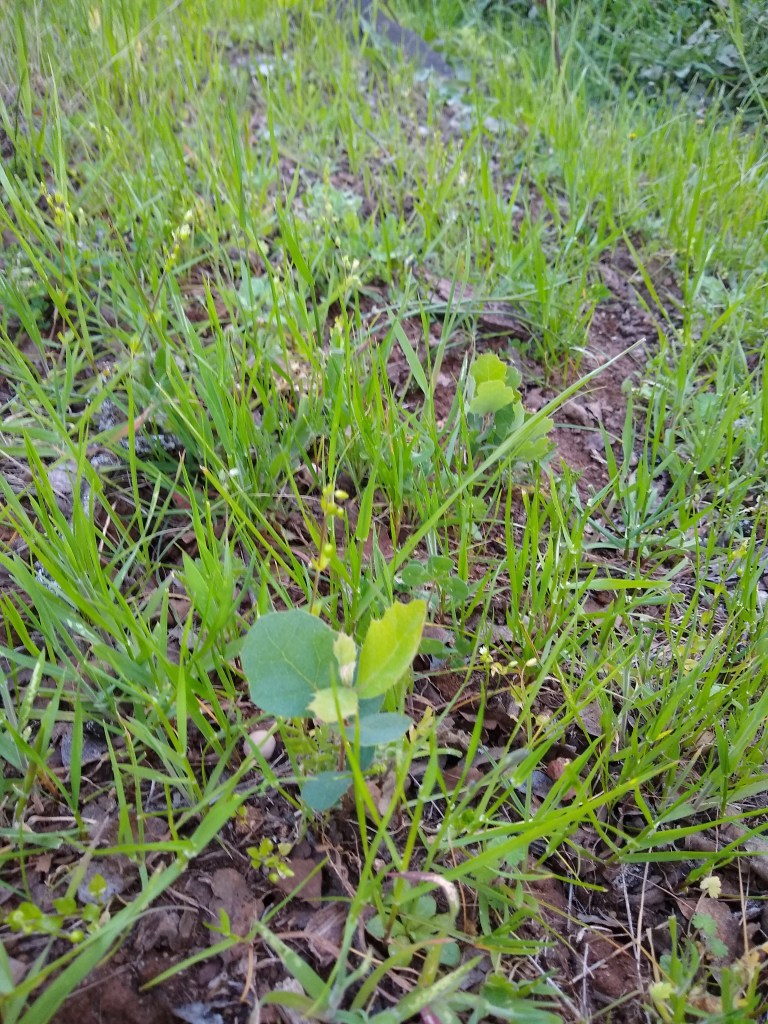
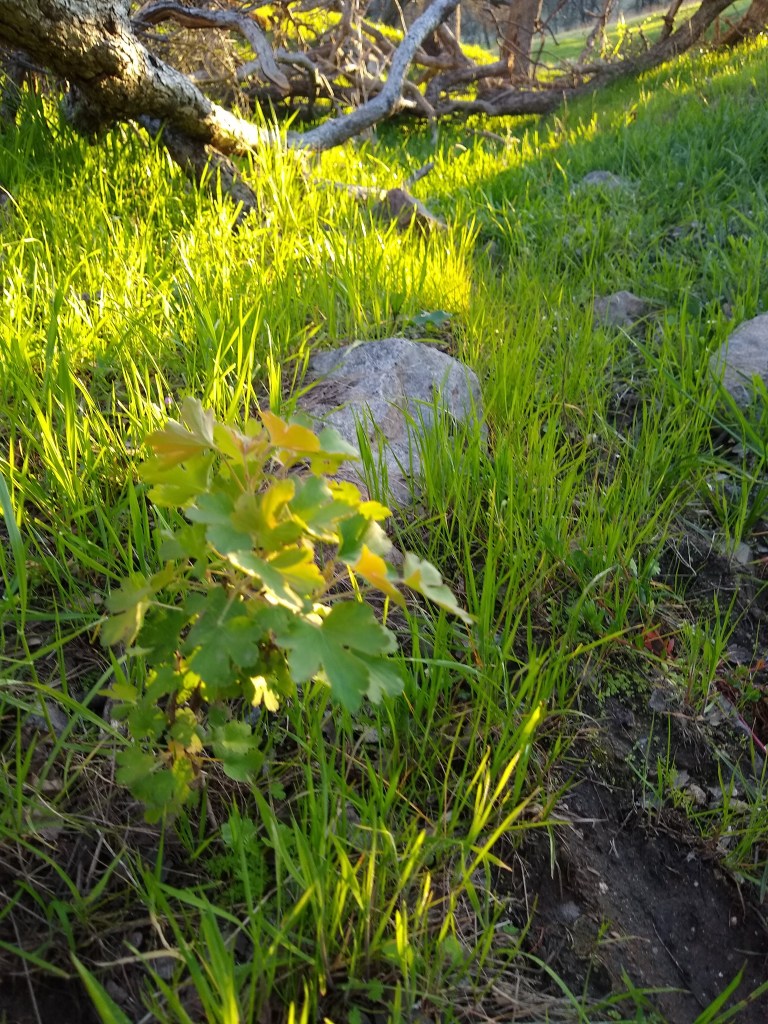
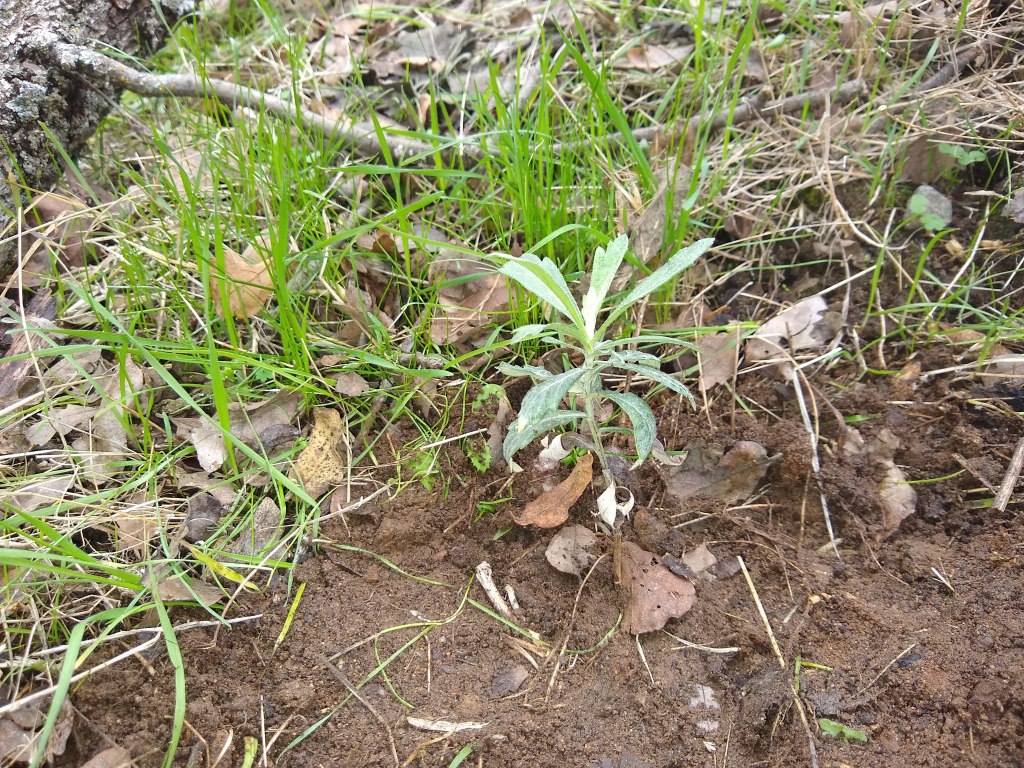
Finally, after weeks of monitoring the a. Californica site, I saw the first leaves emerge.These plants are so gorgeous and look so prehistoric to me. Last year, the site closest to the house had seven individuals. So far, I only see one. I also checked out the north-slope hillside where the thirteen plant community was last year. I found two – one single leaf by itself and another multi-leaf bunch. Both sites have much gopher disturbance. They ate a couple last year. I am hoping that this is only the beginning of their growth and many more plants will emerge so there are some that survive gopher predation. This early milkweed is a crucial source of food for monarchs as they begin their travels from the coast.

Diverse Butterfly Visitors

Cutting the grass early has really helped wildflowers proliferate. The little magenta flowers, generally not seen near the house this early, are thriving. We have so many species of flowers blooming that I have seen more than six species of butterflies already this year. They are tricky though. They flit so fast and disappear that it can be difficult to catch a glimpse for an ID or a photo. The butterfly visits began in late February and have grown in March. I was able to identify several using this iNaturalist tool. After being caught without a camera when the viceroy floated by, I now always have my camera/phone with me. So far, I think I’ve had: viceroy, painted lady, american lady, buckeye, white sulfur, brown checker, maybe a spring white and a Sara Orange tip. There have been a few I did not get a good look at, but they were clearly different than the above. Here are some of the butterflies of which I was able to get a photo.

Arroyo – Site 1 Planted!

I finally began planting in the arroyo. The soil is so much different there. Even though moist, it is a little tougher to dig. The soil is clay-like but also crumbly with very small rocks. I planted monkey flower, sulfur buckwheat, two narrow leaf milkweeds (I have a hole ready for a third when Ron brings another), white sage, purple sage, black sage, mugwort, yerba santa, two maple trees and one other plant I cannot remember right this moment. I planted one maple higher on the hillside in the path of the spring. In doing this, I am hoping it will have moisture available for longer in the season. The other plants are planted in the area of the arroyo that appears to be at the base of where the hillside spring travels. I also planted most plants on the north-facing slope. My thinking is that this will provide additional moisture as the climate changes. The hillside spring usually dries by late July or August. It is not much water. The spring mostly makes the grass there green longer. You can trace its subterranean trajectory by following the greenness of the grass down to the arroyo. Given its limited production, the plants will need to be irrigated as well over the summer. When helping write the grant, I estimated that it was 1000′ from my rain water tank to the site. I ended up using just under 600′ of the metal hose I purchased. This works out since this will leave me 400′ to use for other far flung locations.

The cows left last Thursday for their southerly rotation. I have another 4 days to a week to get a fence built around Site 1. I already have most of the materials and decided to use t-post diagonal brackets for the corners. I am not trying to make a permanent fence here. The goal is to establish the plants and trees, then remove the fencing. I purchased another 50 posts the other day. The price has gone so far up since I first began building fence. I used to pay $1.50 per post. Now the price is $4.91 – and that is good. Most other places have 6′ t-posts for well over $5/post. Ouch.

Drought Outlook

Not looking good…

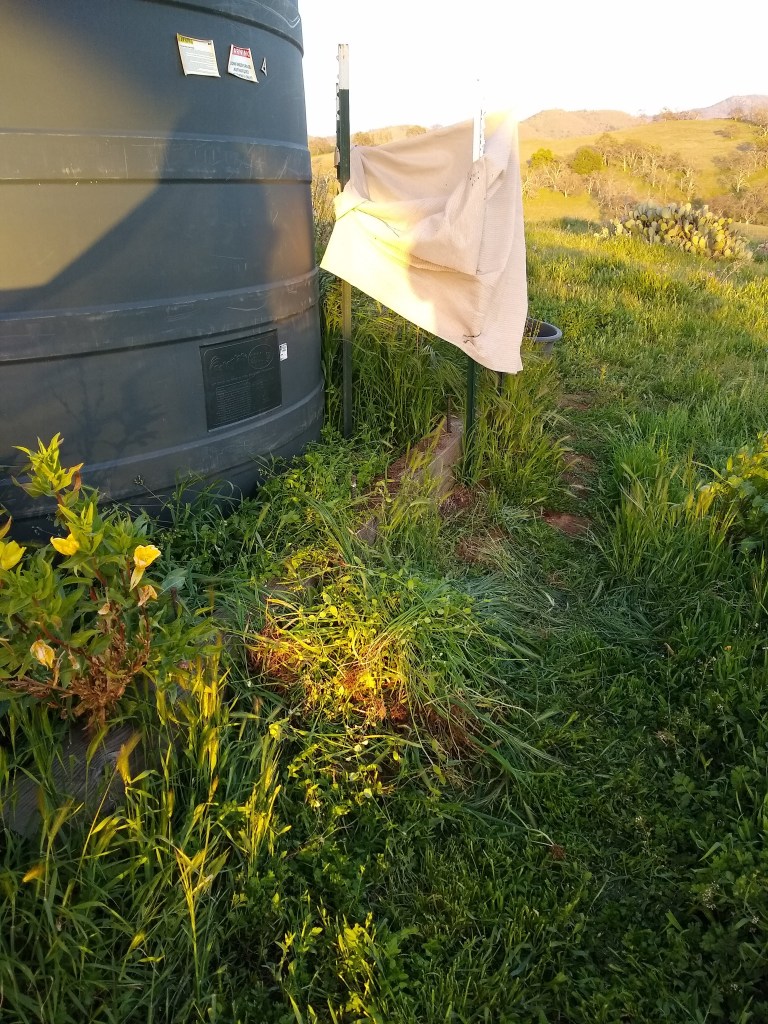
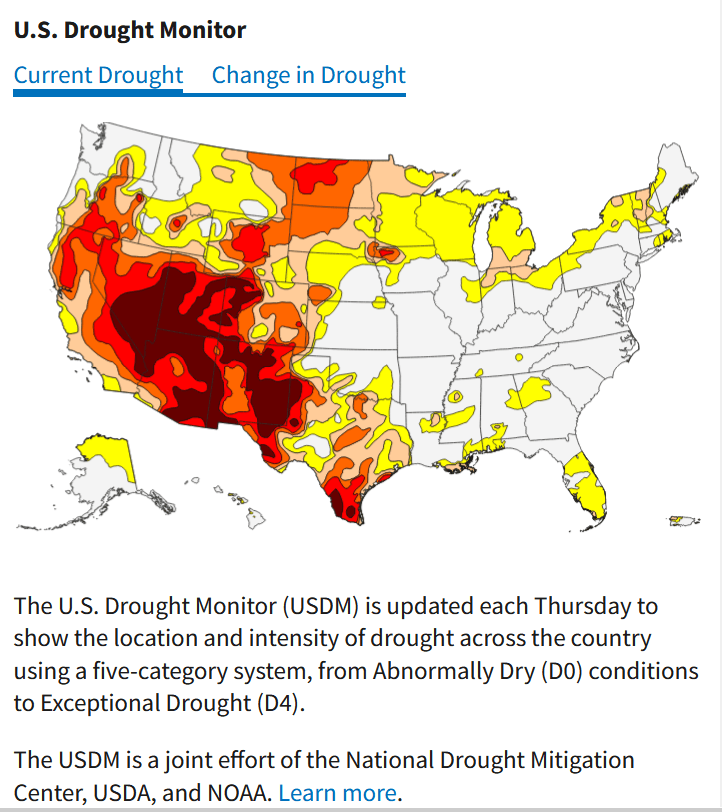
I keep a close watch on the Drought Monitor tool. I am so glad that I captured what I hope will be enough rainwater to get the newest plants through the summer season. I had hoped to add another tank, but did not get a chance to. There is much site work that has to be done. Last time, we hand dug the pad for the tank, built a retaining wall/box from old railroad ties and rebar we had laying around the ranch, and filled the box with sand that we purchased. It has worked well, but takes quite a bit of time. There is also the need to purchase just the right length and corners of Schedule 20 pipe. We just did not have the time or energy. We knew this would be a short winter season, and never received even one blockbuster rainstorm like we did last year. Maybe next year. My calculations say that we should have enough with the 7,000 gallons. I over- estimated water needs, but sometimes you need to water twice per week. Maybe the older native plants will need water. There are many unknowns. Stored rainwater is important because I don’t want to put any pressure on my well. David and I have already been in stricter water conservation mode for several months.

My rainwater gauge

I have been measuring rain for close to 17 years. The worst year of the 5-year drought was 9″ for the year. This year we have just under 10.75″. That concerns me. Last year, we had just over 14″. While 14″ is around the normal precipitation for my area, it does not allow much carry over into the next year. The soil, trees and grasses are thirsty. It shows. The swale pond did not have standing water until January 2021, despite a fairly wet December. Not good for plants and not good for fire resilience. We will do the best we can and hope it is enough.

Maintenance and Milkweed

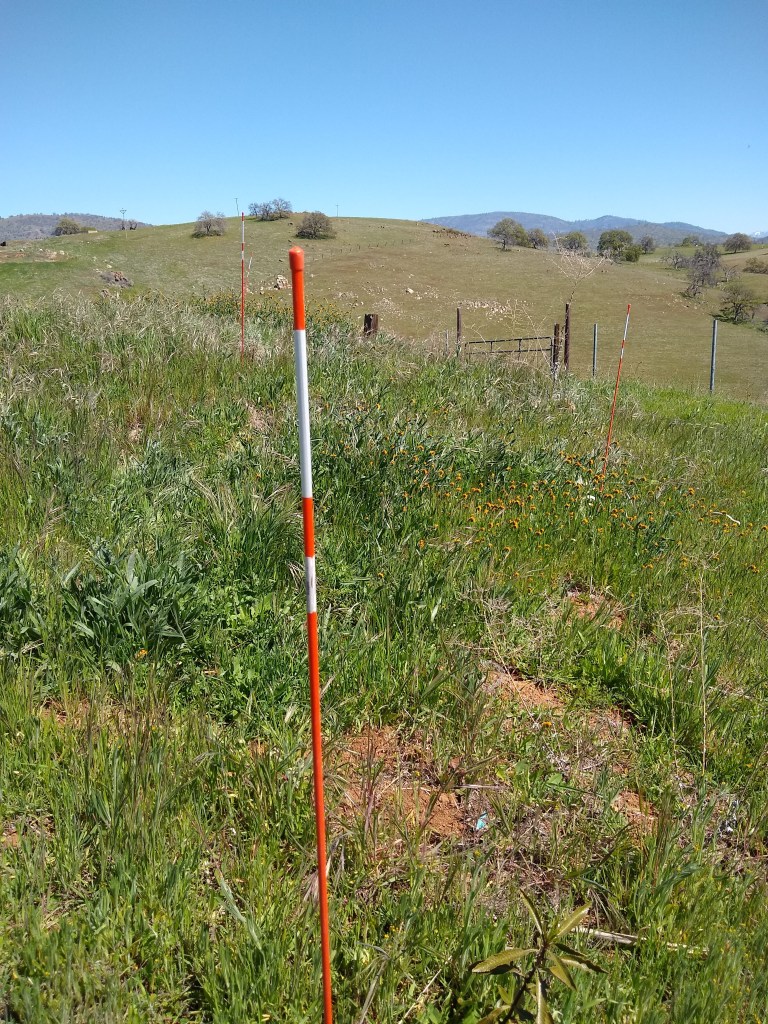
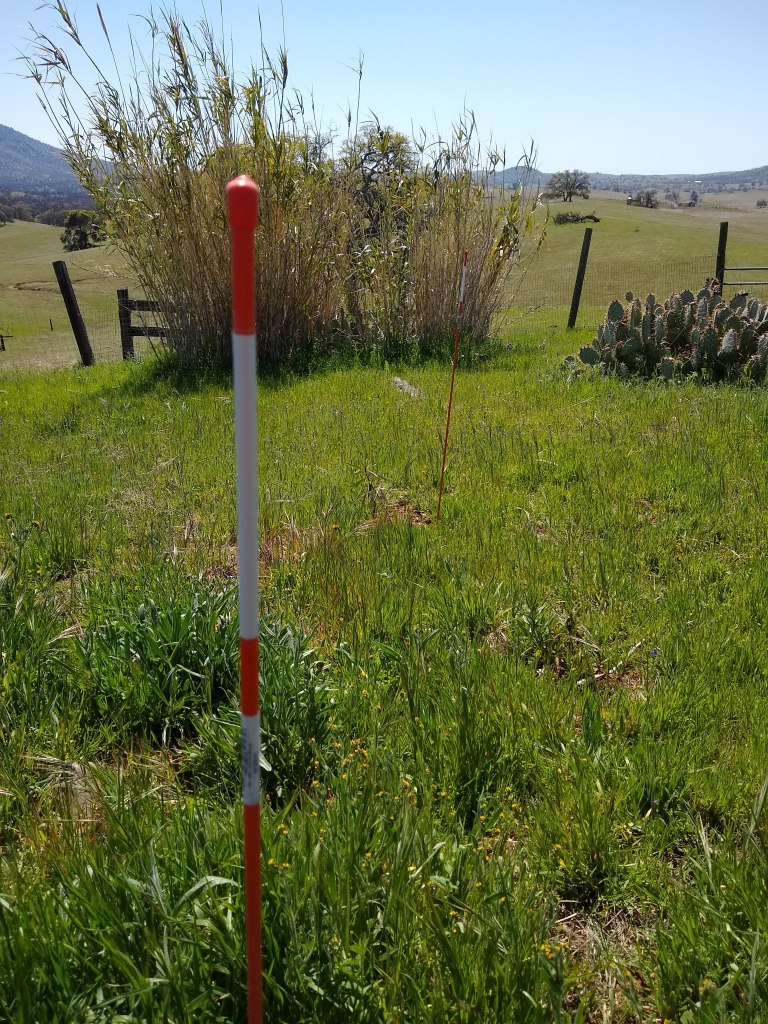
With the emergence of the sun has come rapid growth of grass and all the other plants. David is mowing, and I am hand weeding to give the plants some light and space. Today, I staked all of the planting areas so we have markers that will keep us from weed-eating the plants if they get overrun by grasses. David does that work, and he does not know where everything is. Even if I am able to stay on top of weeding around the planting areas, it is good to have the stakes.

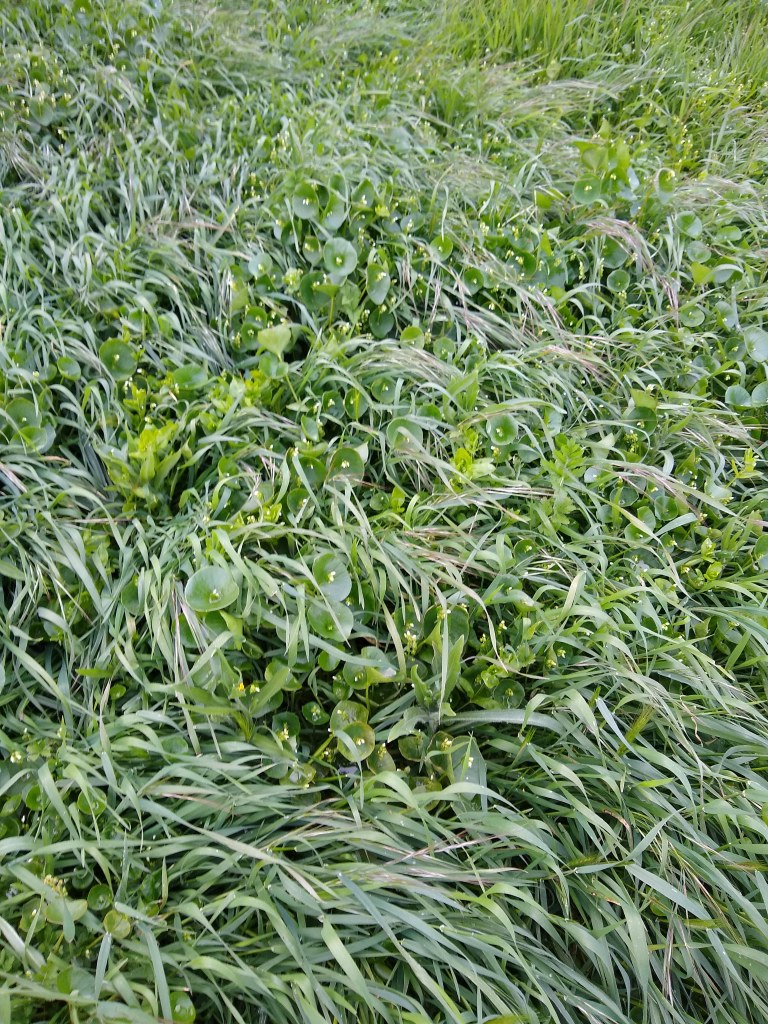
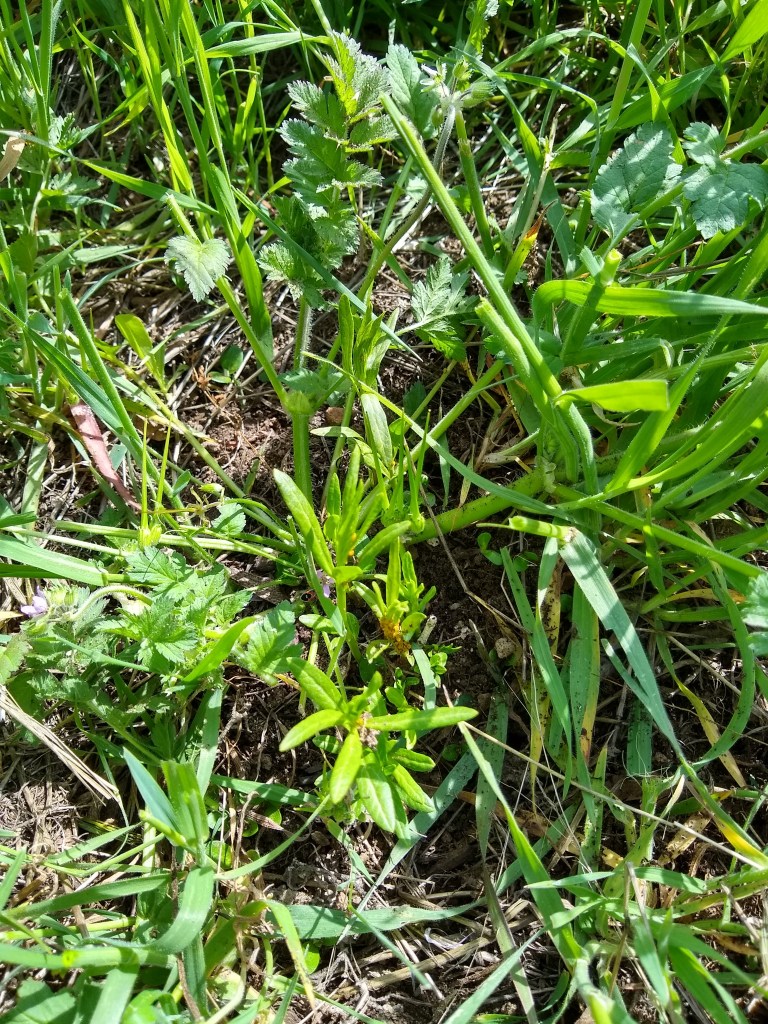
I have begun to water the plants. It is early, but they are already looking dry. I want to be sure they have a strong start. Maybe we will have some precipitation in April (fingers crossed). I monitor all of my plantings for growth. Sadly, so far, several of the dormant plants that came with the Xerces kits have not sprouted. Most of the bushes are doing very well though. The milkweeds from 2019 and 2020 have sprouts as do the newly planted milkweeds. They look strong and healthy. I am so grateful for that. Hopefully, the other Xerces plants will emerge. Maybe they just need more time.

Reflections

It has been a year since the the beginning of the CA Resource Conservation District grant, which allowed me to scale up the habitat work I was already doing. It was such a high last March when I learned my project had been selected from among many candidates across the State. At the same time, the impacts of the pandemic were just beginning as well. Everything was shutting down. Shock and fear took hold across the globe as we watched the bodies pile up in Italy and the bug make its rapid march, with each new red dot on the Johns Hopkins tracking tool, into every nation across the planet. It was made real when restaurants, schools and office buildings closed their spaces sending all of us home to watch life move forward without us. All most of us could do is watch the truly essential workers battle this disease with limited equipment, limited knowledge, poor national leadership and few options. If you were paying attention, there were some good things too. Here, the air was super clean – like it had not been in years. Wild animals showed themselves more now that they were given more room to be wild. The quiet of far less air traffic and road noise helped provide a level of peace needed as we grappled with the question of “what next?”. For me, not being essential, not being on the front lines of the pandemic able to use my energy to save lives, I chose to throw my energy and passion into helping save the lives of the monarch butterfly. It was good medicine for me.

We will survive this pandemic – but what will be do with our changed lives? Without bird songs, the howl of the coyote, cool breezes of clean air, clear, healthy water babbling across rocks, the smell of billions of blooming wildflowers, places of natural wonder and peace, and, yes, monarch butterflies making their epic migration, spreading their large wings as they surprise you with their beauty — without these, what is life worth anyway?

Branch Fence Bust and the Boys are Back in Town

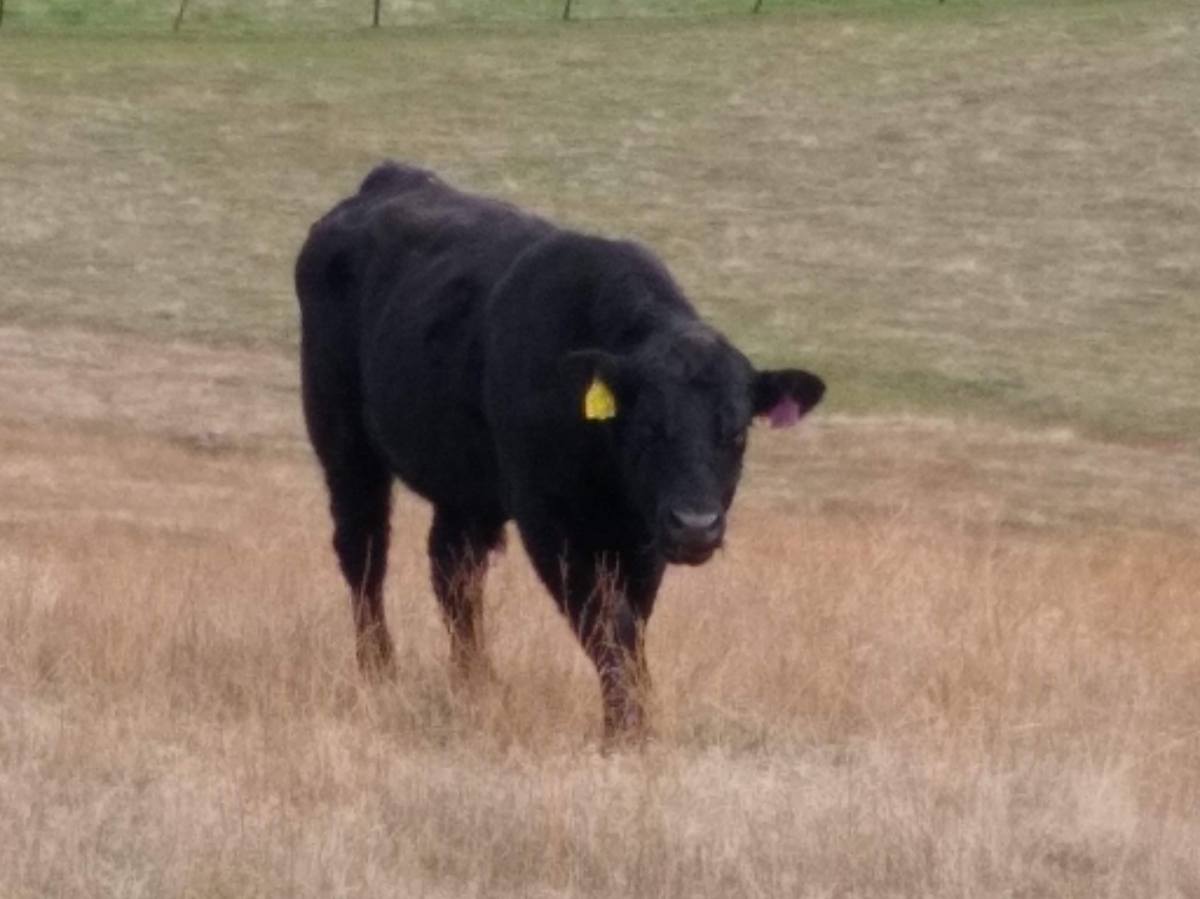
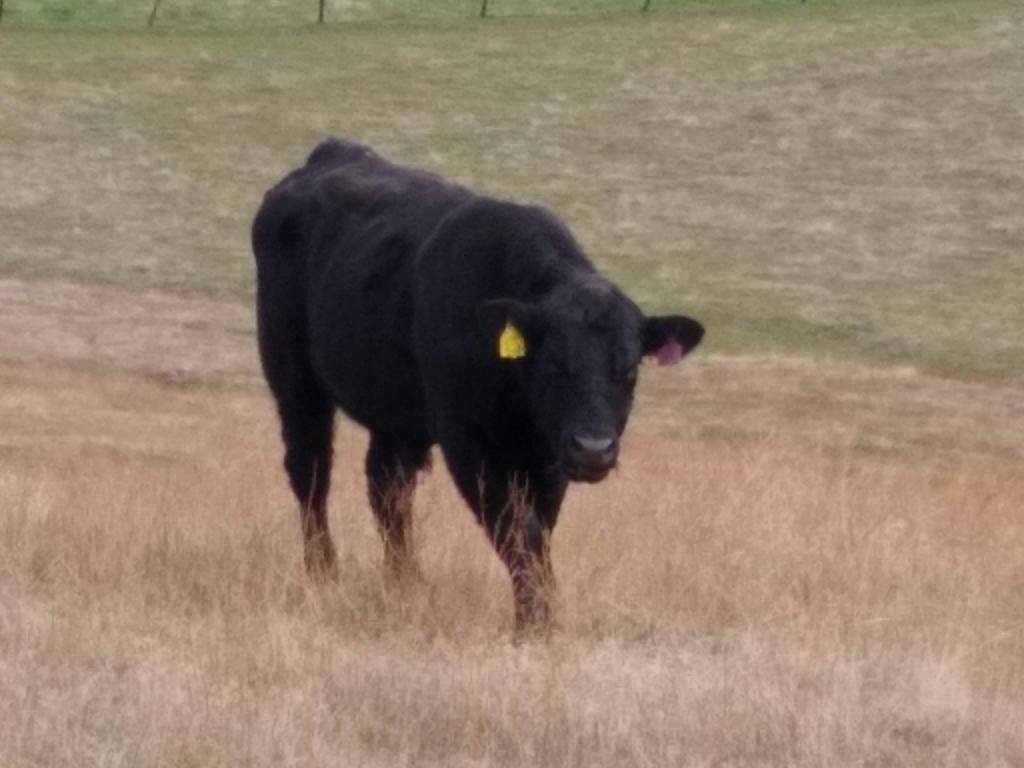
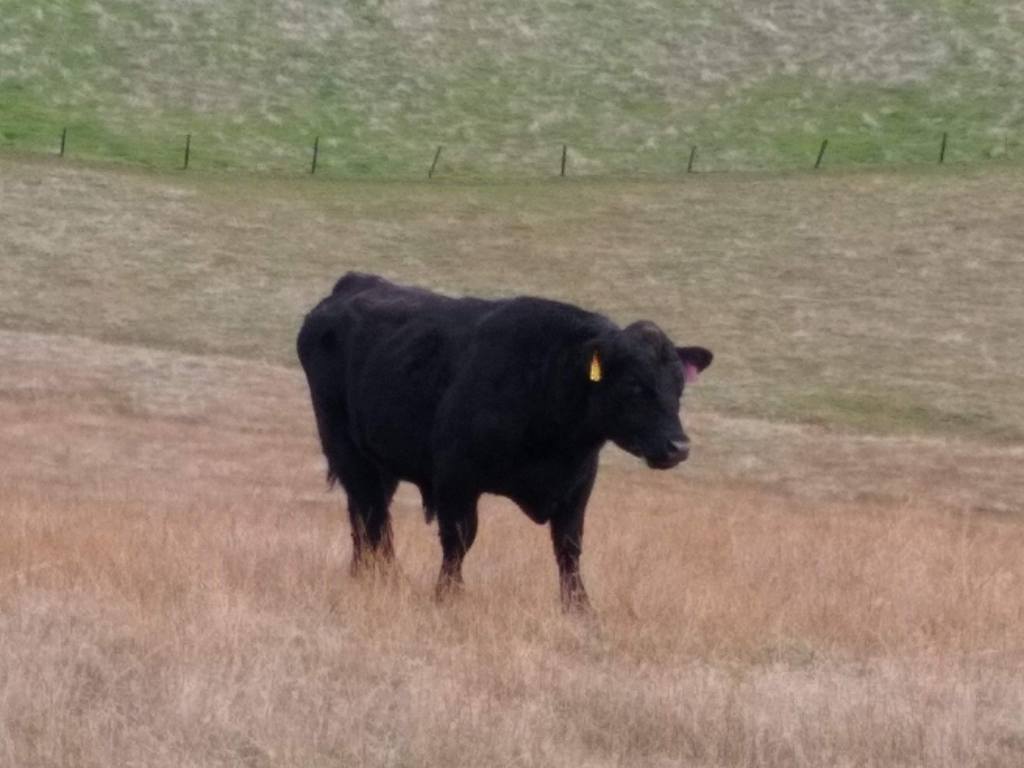
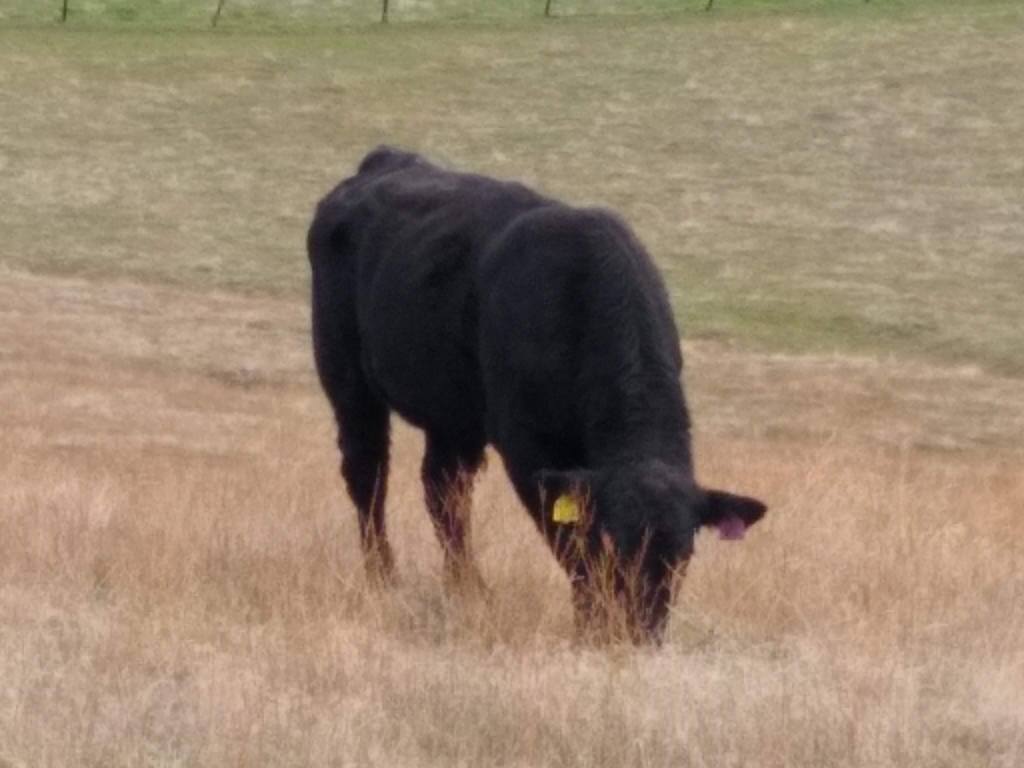
Bull grazing in the a. Californica milkweed area

I love bulls. They are simply magic to look at with their size, muscles and intense stares. Fortunately, the bulls run by our cattleman here on the ranch are gentle. They would rather walk away than charge. Still…it is good to be real respectful of their presence – especially when they are around the ladies strutting their stuff. Remember, this is an 1,800+ lb animal. On my quad yesterday to do some watering, there was a big guy laying right in the path. I stopped. I looked at him. He looked– no he stared (intensely) — at me. After 45 seconds or so, I decided I would blaze a new trail to the northeast of him. Bull 1, Heather 0.

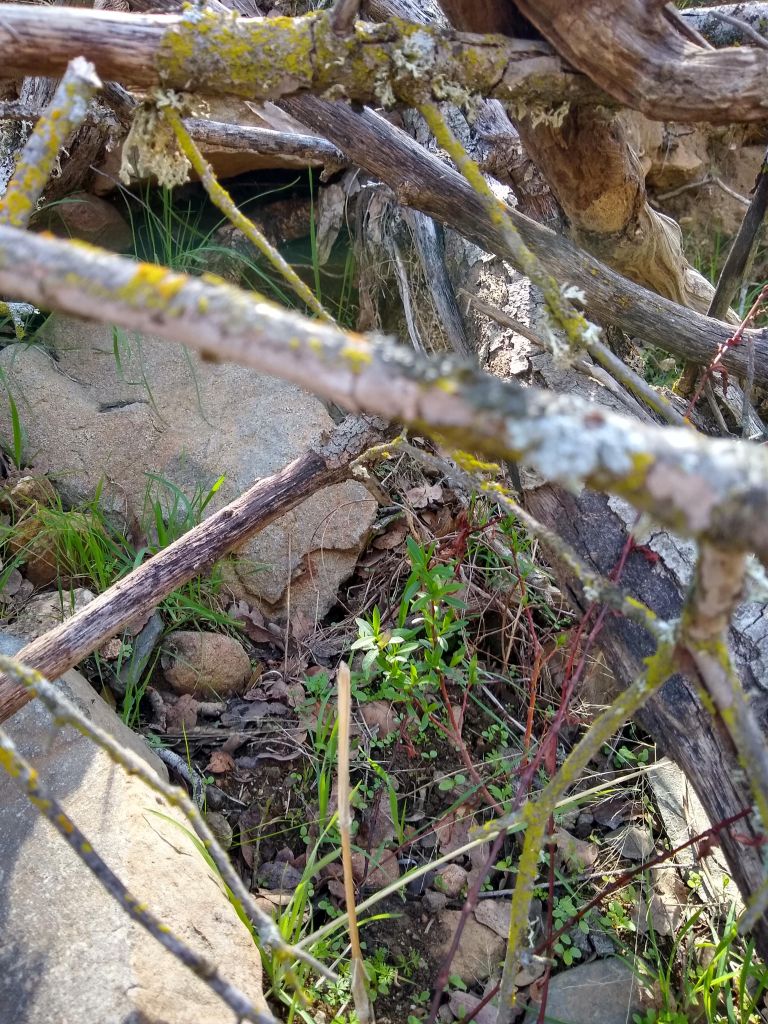
I have been checking the plantings in the branch fence (Site XR1) about every three days. Over the last six weeks, I saw that pieces of branch fence had fallen or had been tested by the cattle. The fence needed to be monitored and more branches placed every week or so. Last week, I noticed that the cattle had blazed a trail tightly alongside the enclosure. Hummm. This worried me. The fence had been tested just a week earlier resulting in me placing more branches on the east side. Now, it appeared that the cows were developing more than a passing interest. It makes sense that they would. With the limited precipitation, the grass is getting a bit thin on the ranch. By contrast, the creek beds are lush with growth. This is certainly true in the XR1 enclosure. More than grass is growing healthy and tall – quite an inducement to push in.

Cow trail

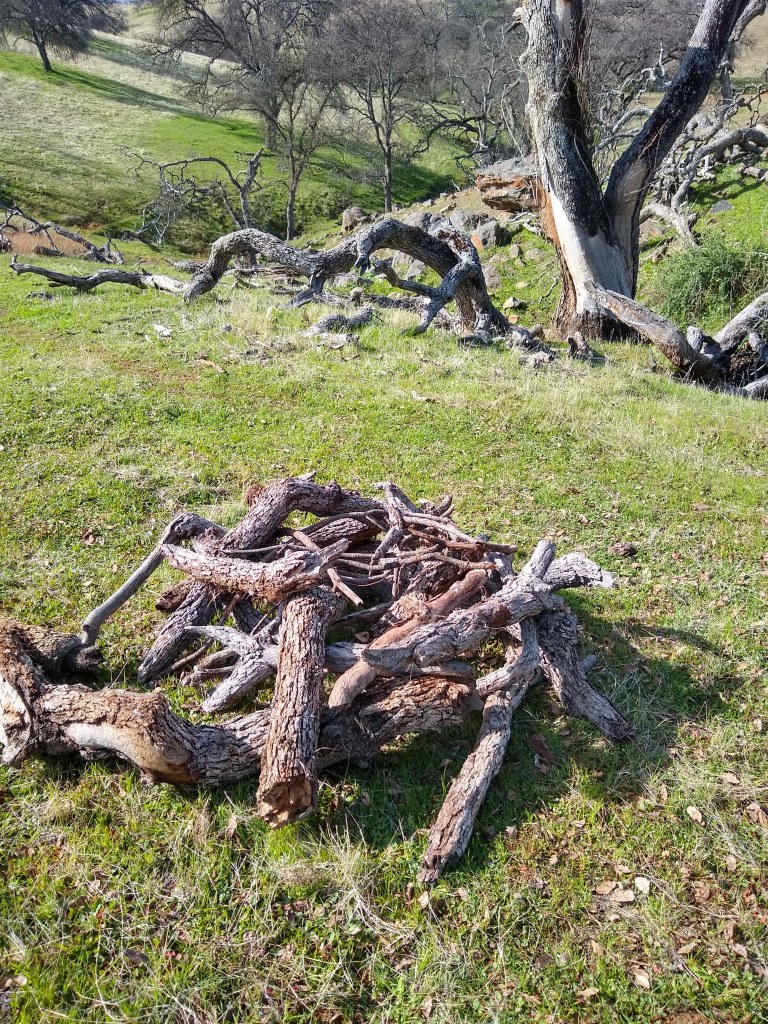
After seeing the path, I began to use rocks and other branches to block the path. Just up the hill on both sides of the creek are dead oaks with downed branches. In the last drought, we lost about 300 oaks across the ranch. It can be sad to see their ancient bodies in various states of decay. In this case, as I harvested the branches from the ground, I thanked the trees and limbs and told them that their remains will be used to promote new life so important to the health of this place. It is important to be grateful and respect all things.

I hauled the branches down from the hills, some lifted, but if they are large, dragged. Oak branches are tortuous – twisted and gnarled. This is a good thing for the fence. The twists of the branch tangle with the others. My goal is to lock them together as much as possible to promote strength. They also create width in an attempt to keep the cattle as far a distance from the planted area.

West side of branch fence. Note the lengths pushed out toward the trail

Currently, I fit my ranch work in before and after the end of my work day and on weekends. Especially in the fall and winter, when the days are shorter, I do not have much time to get things done. I did as much as I could before sunset, hoping it was enough.

Despite having spent considerable time shoring up the fence, I checked back the next day. What I saw shocked me. There was a cow pie inside the enclosure. Horror!

Evidence! A bovine was inside XR1

I looked around the entire fence. The breech was on the north side. I had built up the south, east and west sides, but felt the north looked fairly solid. Clearly, I was wrong. My heart was in my stomach terrified of what plants I might find gone or trampled. Luck was with me; all the butterfly plants were still there and intact. One had been pulled at, but had not been pulled out. I could breathe again! I tipped that plant back upright and patted tight the soil around its base. It looked like the intruder, enticed by the lush lengths of green, passed the currents and went right for the grass. The cow pie was smaller in size, so I guessed the interloper was an older calf or a young heffer. Usually, you can tell the difference in the poop. Calves have a slicker output since they are still taking milk, but the pie was in the water – so no telling who it was.

No matter, I began hauling branches to shore up the north side. I was not prepared with proper clothing, such was my hubris about the thicket I had installed. If anyone ever wonders why they see people working on the ranch in long sleeve shirts in the summer, it is to protect your skin. I was desperate to fix the hole immediately, so I worked despite having shorter sleeves on. My skin was scratched and bruised, but the hole was filled. Oh well. That is life on the range.

Not the half of it. Scrapes and bruises on my arms

Wildflowers

Pretty low growing wildflowers

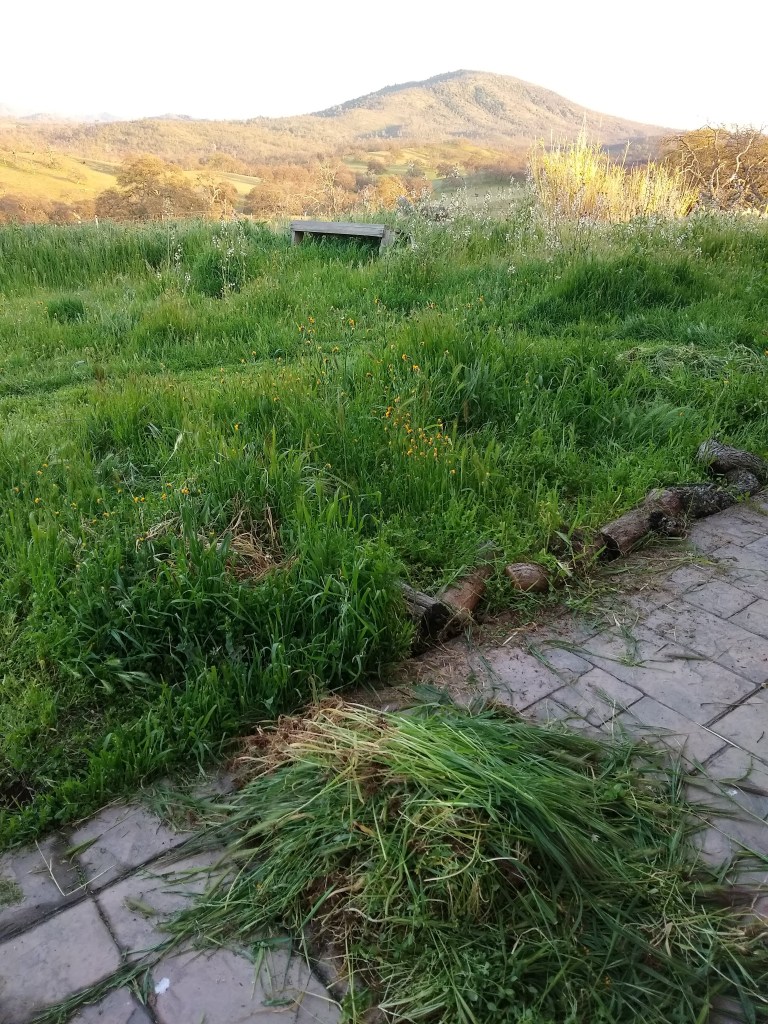
Several blog posts ago I discussed that David and I planned to cut the grass early this year to see what would grow. It was a good idea that David proposed. We typically leave the grass to grow long thinking that it would protect the top soil and help the soil retain moisture by protecting the soil from wind and shading it. We cut the grass in February and found that we had a proliferation of wildflowers.

Proliferation of white flowers with some orange ones mixed in

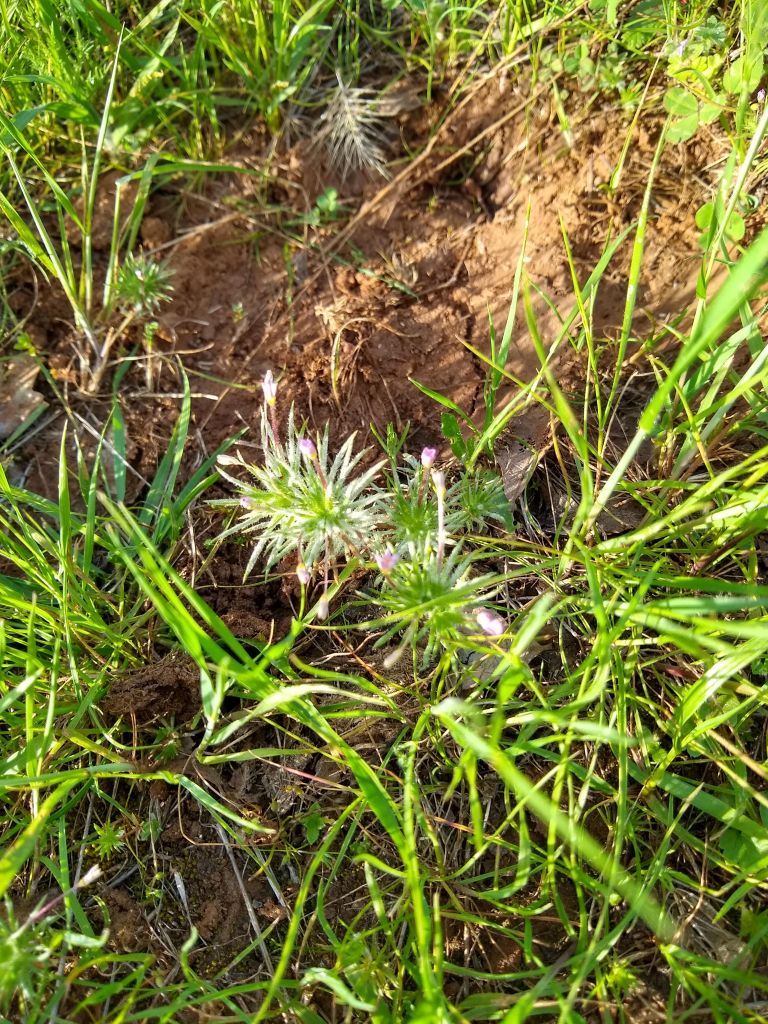
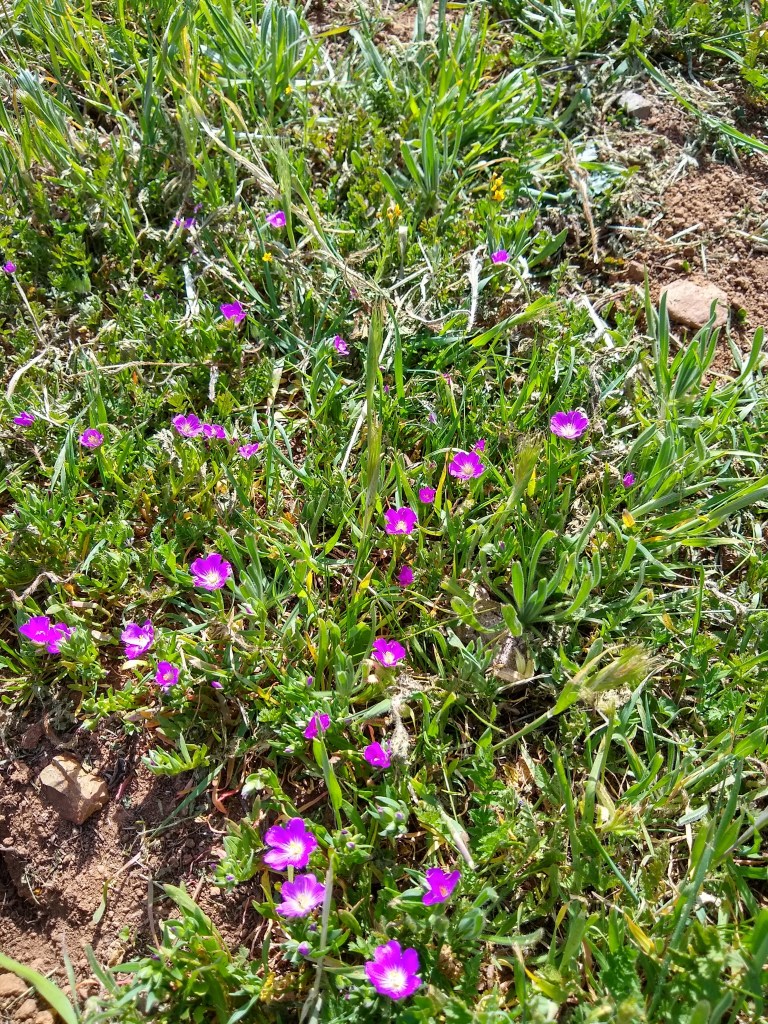
The small white flowers that popped up were the same ones that we always see on the cattle road. They are the first to bloom and fill the air with nectar. How exciting it was to have them in such large numbers near the house. The bees are loving them. We also have a proliferation of the small magenta flowers near the house, which we typically see in smaller amounts. Of course, the timing and amount of rain impacts what grows too. Shortening the grass so that the sun could hit the soil and seed significantly contributed to the larger amount of wildflowers. We will continue this practice.

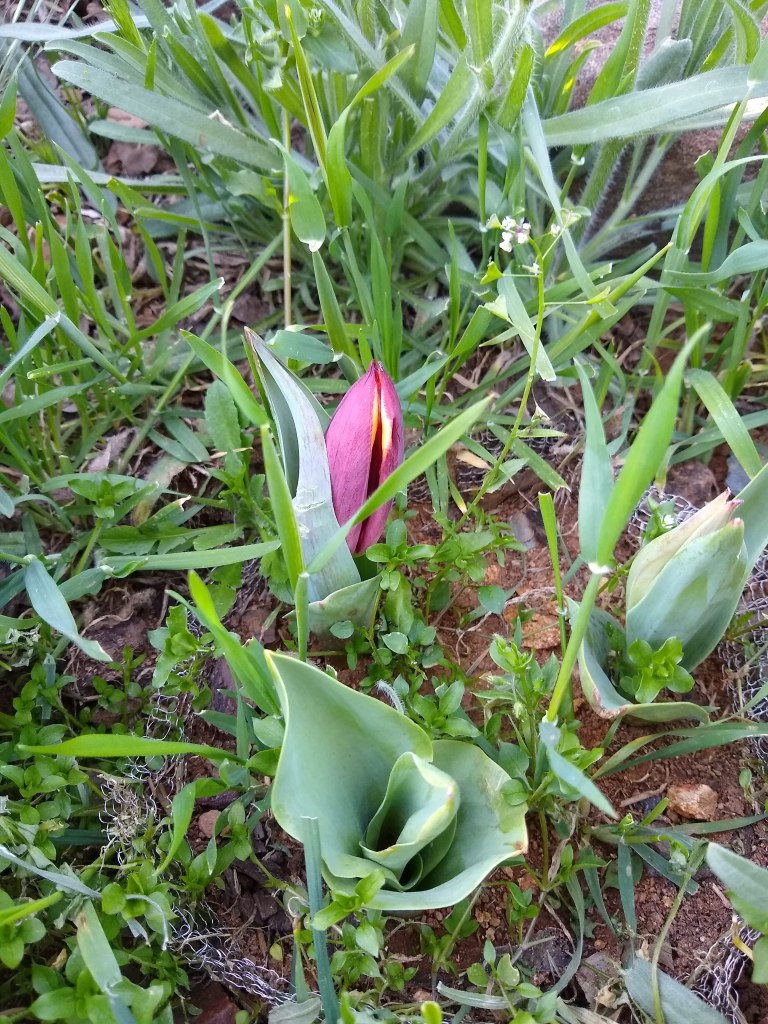
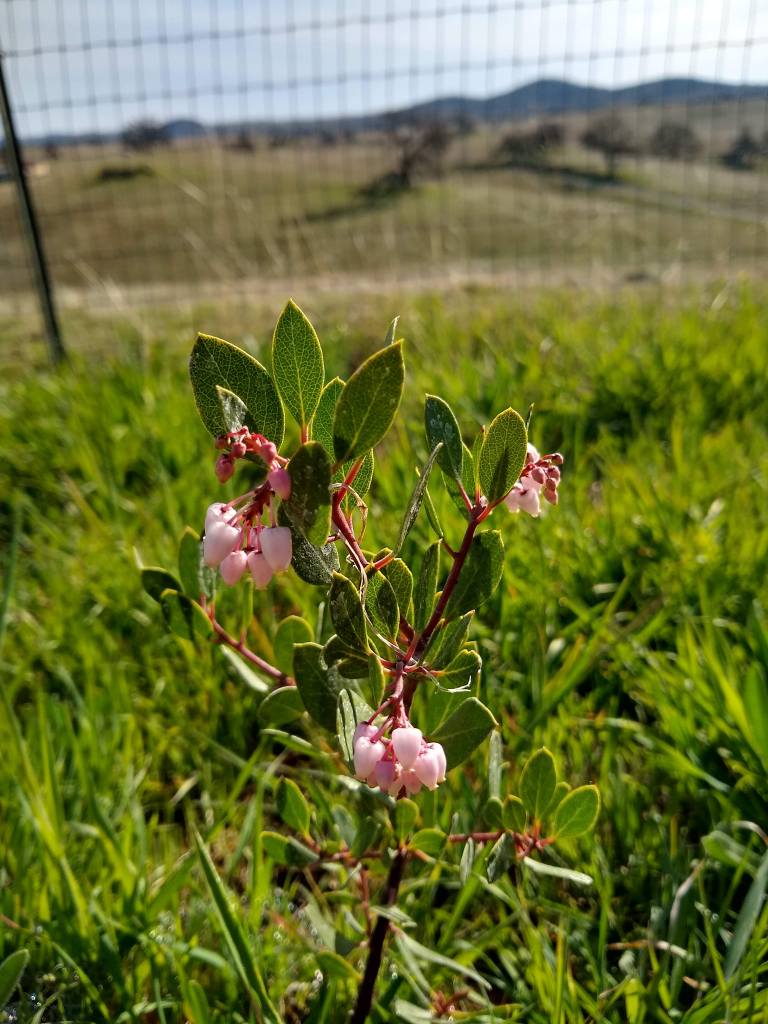
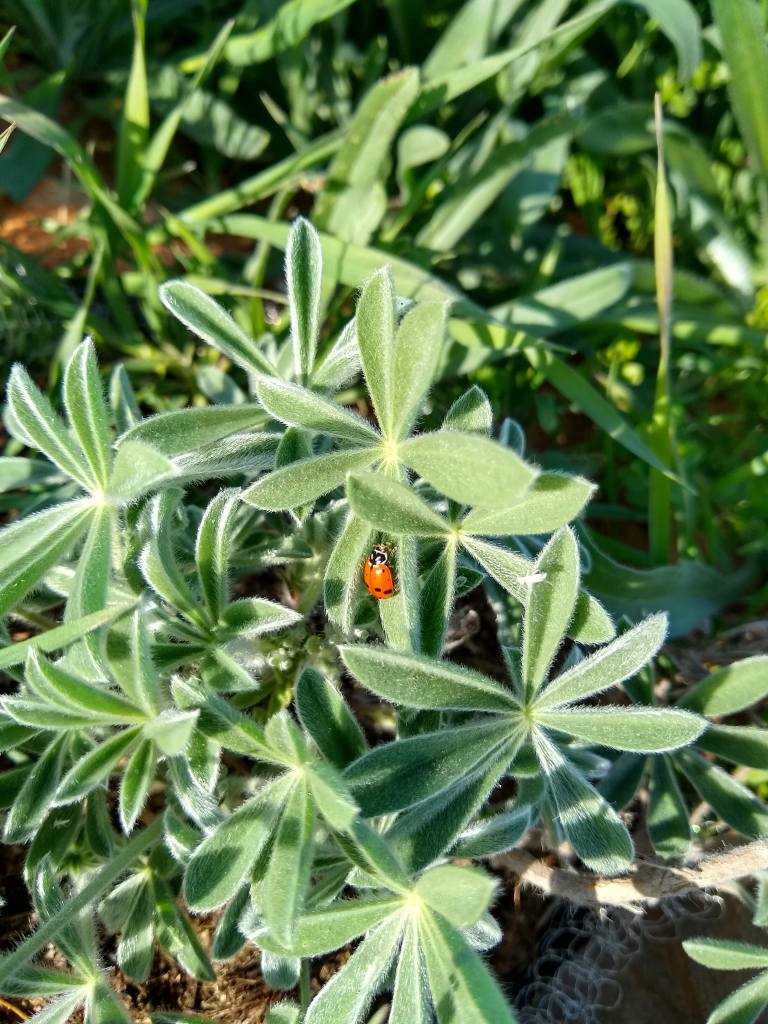
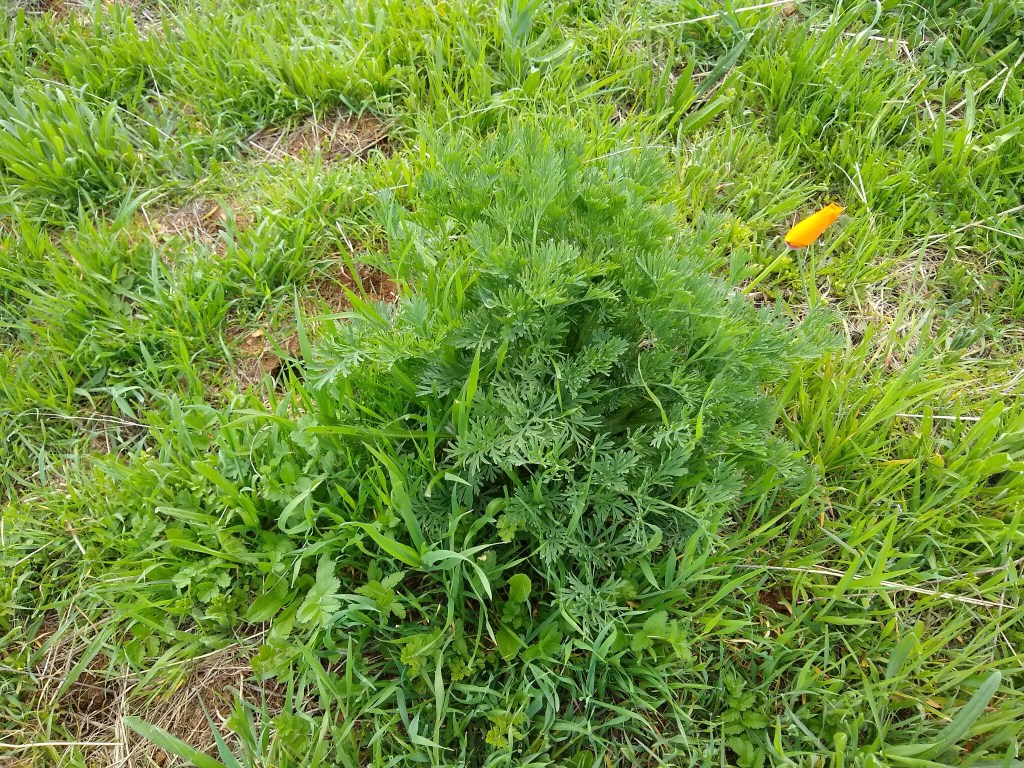
The blue dicks and poppies are blooming. We get both of these regularly. It is so much fun to see the empty stems pop straight up out of nowhere knowing there will be a blanket of purple in a few short weeks. The manzanita planted last year with the Xerces hedgerow kits are blooming. What gorgeous pink blooms. The coyote mint has finally taken off. I am looking forward to their scent. The lupine is growing well, but will not bloom for a little while longer. Lady bugs are all over the plants. What a welcome site. Finally, I found a remarkable surprise – soaproot. I have seen it on the ranch here and there, but the cows always eat it before I can try to protect it. For the first time, I found it in the house enclosure. What a joy. It is a traditional plant my Mi-Wuk cousins used for grooming.

More Butterfly Plants Planted – Milkweeds are Starting to Re-Sprout

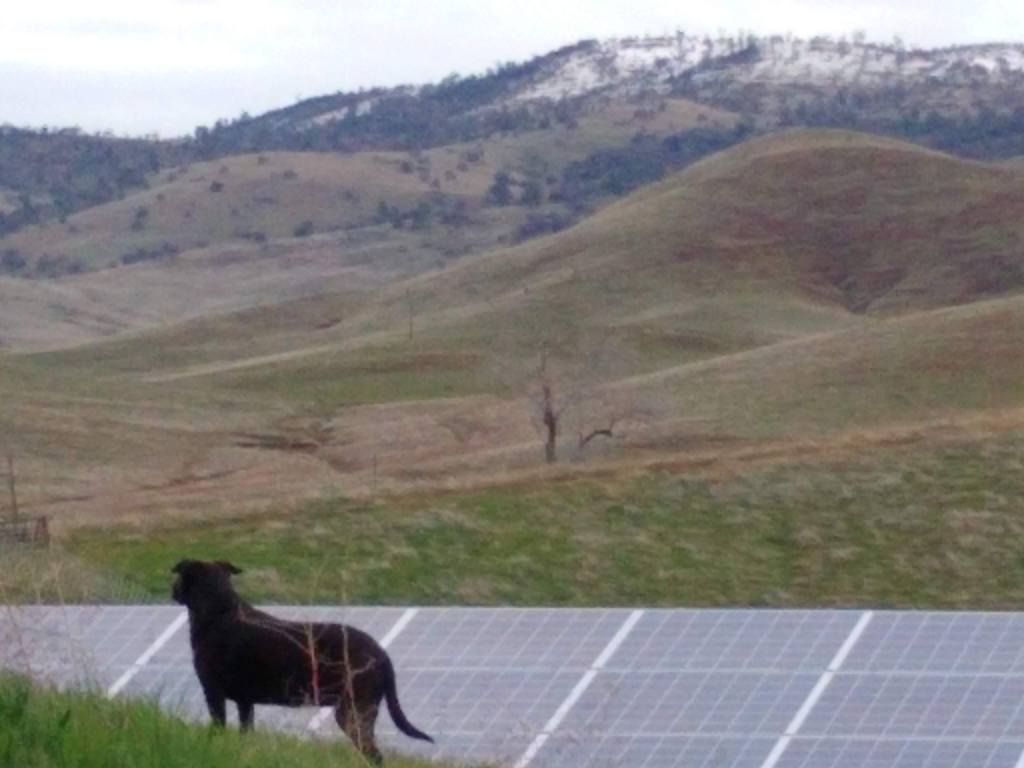
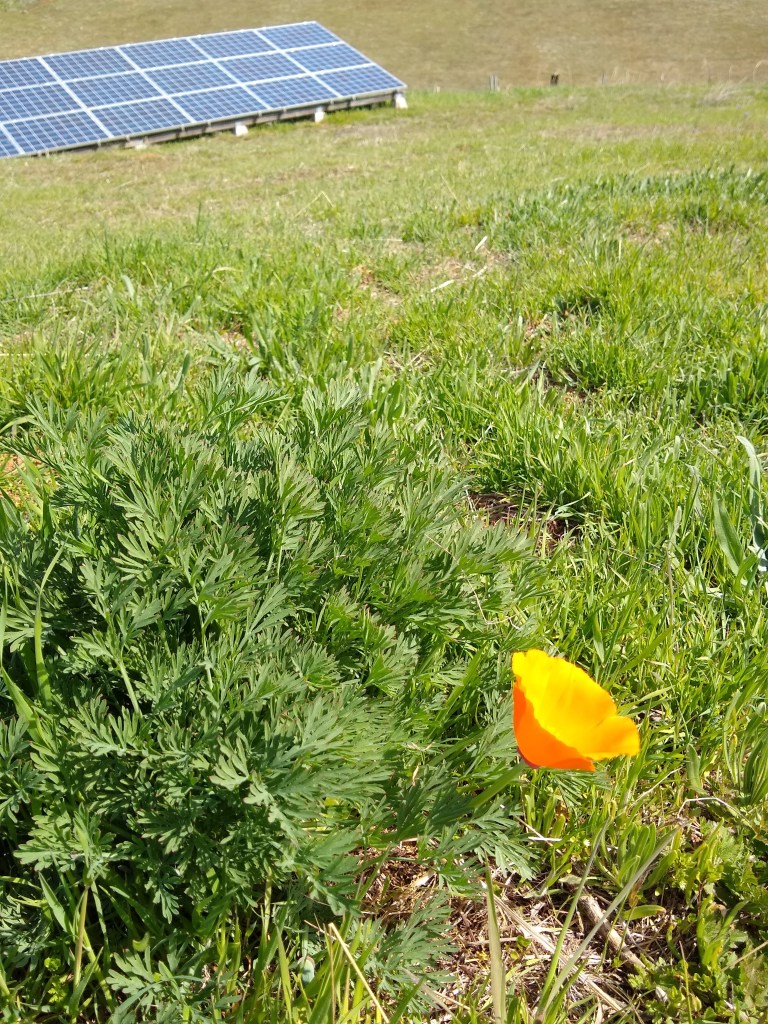
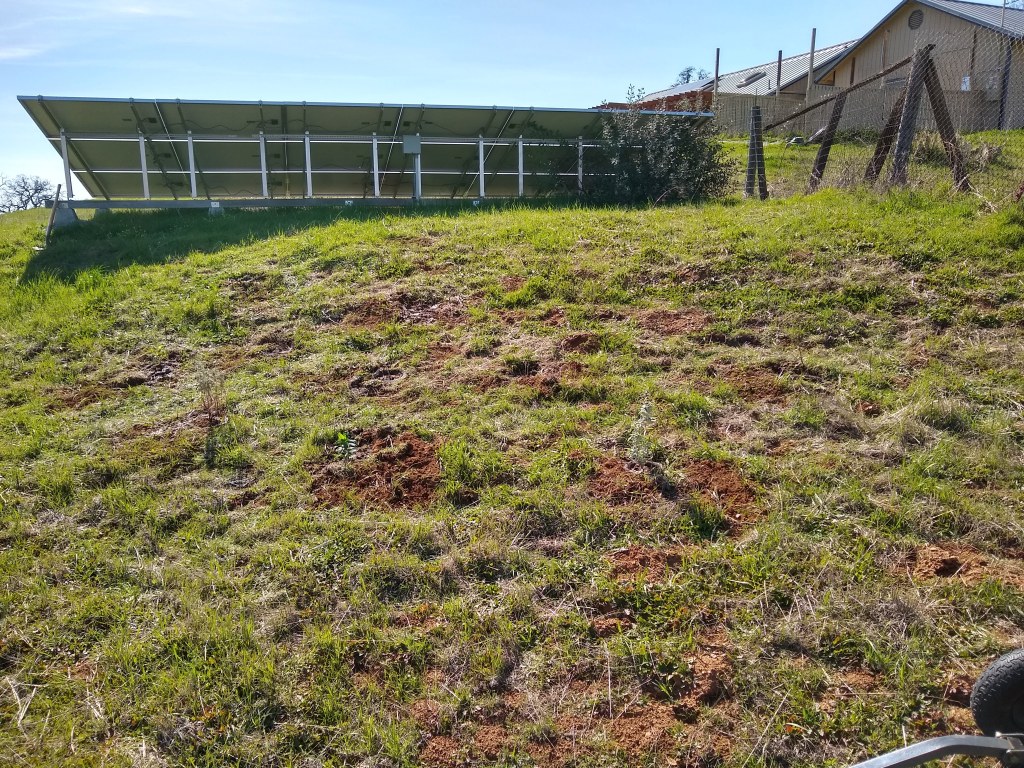
A butterfly pad on the north facing slope near solar panels
A pad on the east

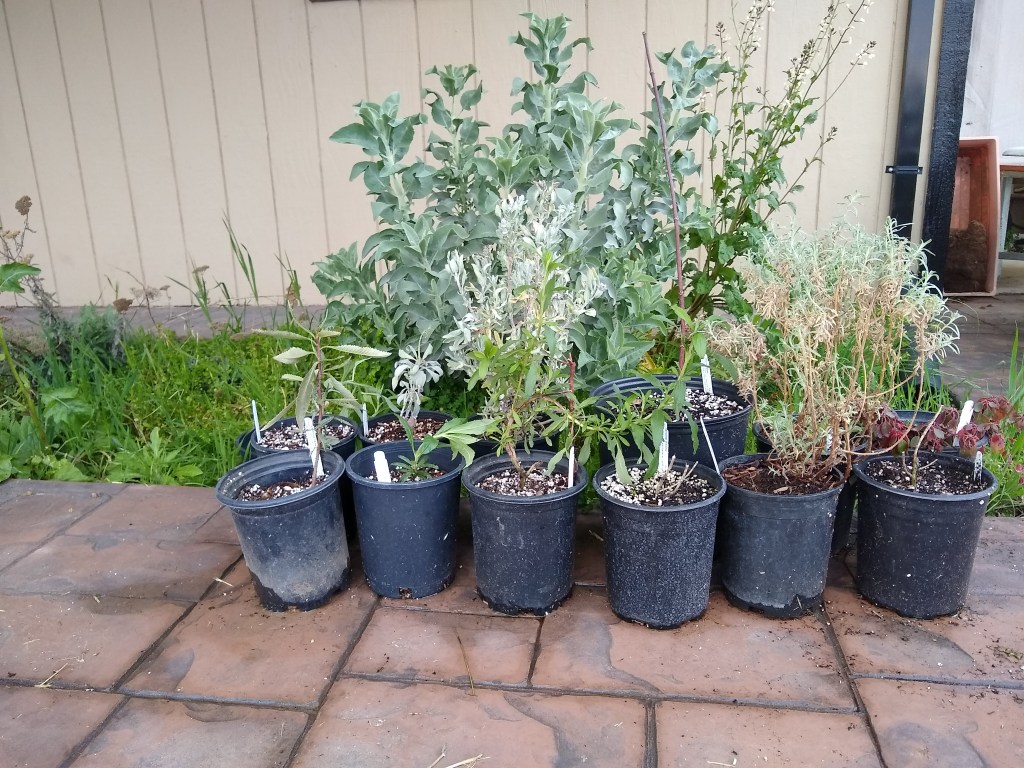
I have taken delivery of 36 butterfly plants and have planted 24 so far. The concept is to plant nectar and milkweed together in a group so that there is everything the monarchs need to live, and to plant many of those groups. I am attempting to create butterfly “oasis” or “pads” (like lily pads for frogs) for them to flit from one to the next. In the home enclosure we now have four pads, two milkweed patches, disbursed nectar throughout and two hedgerow sections with nectar plants.

Milkweed sprout

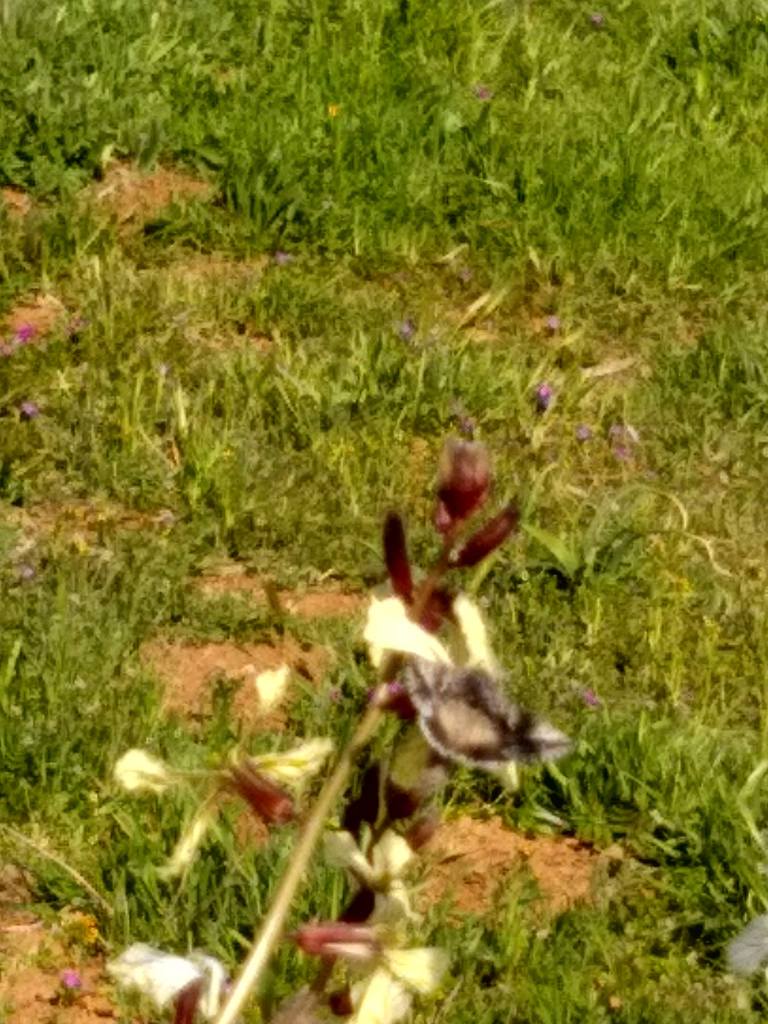
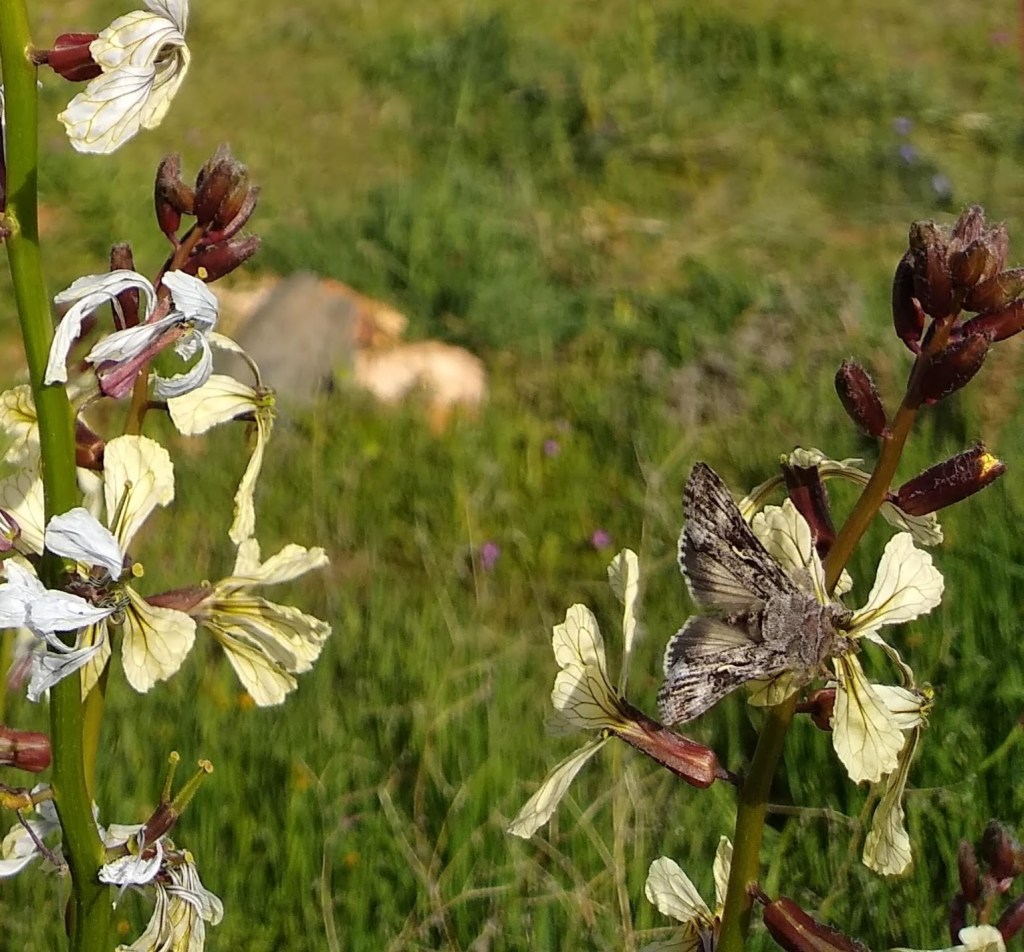
We have already seen six species of butterflies – a whitish one, a mostly black one, a viceroy, some painted ladies (we think – they move so fast), brown with some faint orange in the middle of the wing and brown moth like ones.

Brown with black markings
Brownish butterfly

Other Items

Healthy oak seedling with leaves

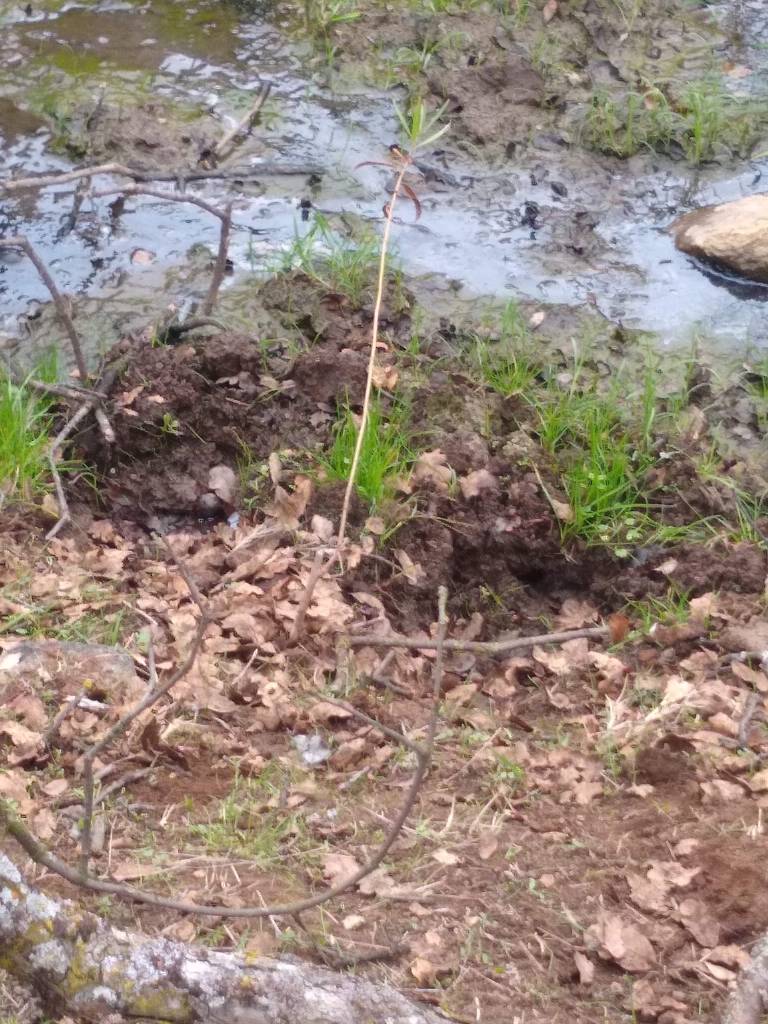
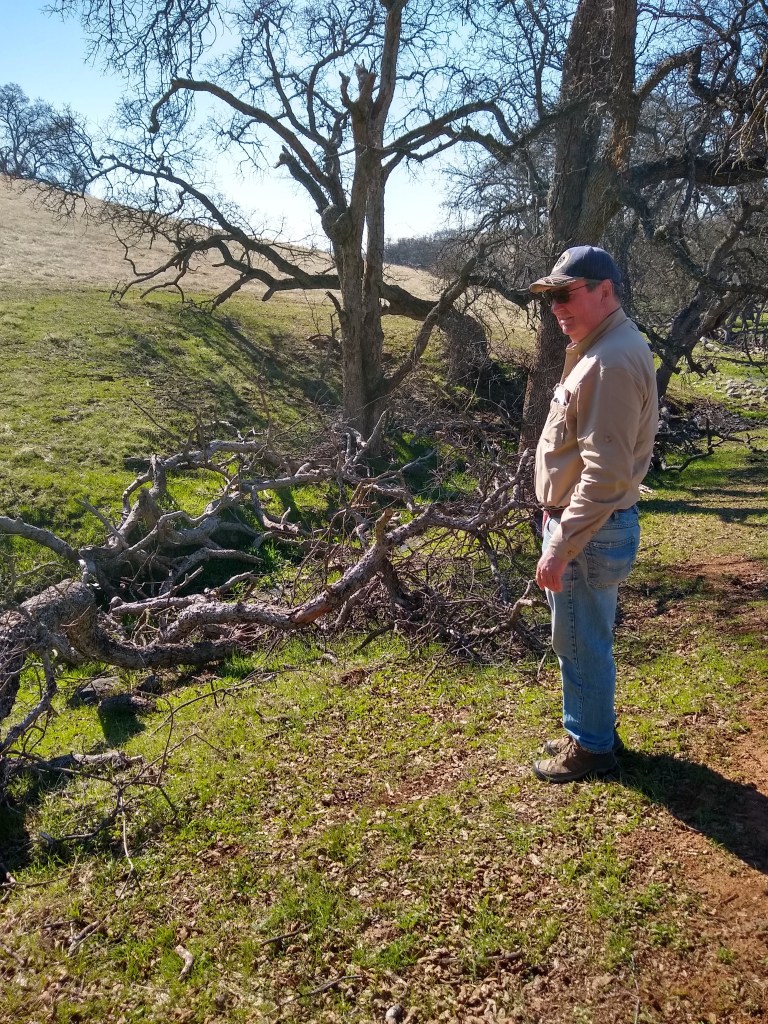
Over time, I have felt more comfortable that I know how to protect myself from the virus. With this comfort, I have had a handful of friends and family who I know follow good practices over to hike or have a meal on the patio. I was overjoyed to have my friend Maggie come over for a hike this past weekend. She has a well-trained eye and ear as a naturalist. Besides identifying blue bird calls, poison oak and a red tail, on our hike she spotted a healthy oak seedling. Somehow, it had avoided detection by the cattle. Maggie and I quickly made a brush pile to help protect it. I will go back out this weekend and build a cage around it. It is in a good spot to grow without other oak competition for light. How wonderful to have friends over again and to share the land with another person who loves it.

This brush pile is likely not enough to protect it long term. It is fairly small. It may buy me time however to build a cage around it.

We also had the opportunity to go to Odom Creek and check on the willows and mulefat. All were still there and doing really well.

Willow doing well inside the brush pile

In addition to all the planting, I continue to educate myself and participate where I can possibly help. To this end, the CAFF conference was excellent. I leaned about a wide variety of topics that could be helpful to my work, such as financing. I was also asked to join a monarch and rangeland working group tasked with expanding habitat on rangeland. I am not sure what value I will be able to bring, but it was good to meet and learn from so many others. At that meeting, I met Susie Calhoun. She is another land steward building habitat on her family ranch. She and her family are doing a great job. Check out their website to learn more and see some beautiful photos. https://www.3calhounsisters.com/

Rain Comes – More Needed

Swale Pond full at last

There were several days of rain over the last two weeks, with two continuous days of rain last week that were the real soakers. In those two days, we received 4.5 inches. It has been much needed. We are still in drought though, with a dry year predicted. Rain years are calculated beginning on October 1. So far, this rain year we have had 7.625 inches of rain. According to historic documentation, the average precipitation is 14 inches in Hornitos. We still have a way to go, and hopefully we go beyond that. The worse year of the five year drought this past decade was 9 inches. I don’t want to see that again. It was horribly dry, and that was the year the large spring on the mid section of the ranch finally dried up. I never thought I would see that. Our cattleman even had to haul in water.

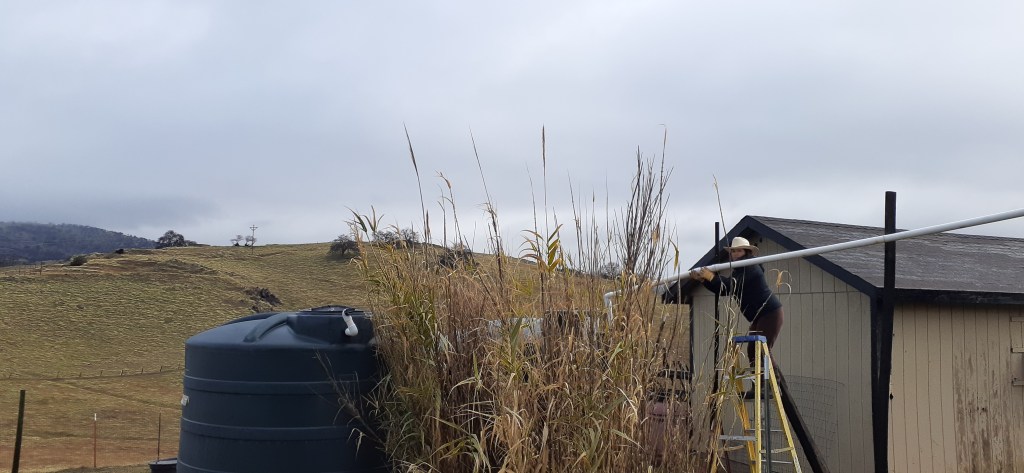
Heather reconnects pipe that had become disconnected

The winds were so terrible that my rain water catchment system failed. My husband and I went out three times to fix it. In a storm where the tank should have been full, it is only at half its capacity. So disappointing! The first occasion, the pipe had split in its mid section. The second occasion, the pipe had blown away from the downspout in one place and had disconnected in the mid section again. The third time, I found that the tank exit pipe had somehow gotten unglued and had been leaking the entire time. When I banged on it, it came completely off and the precious water collected began gushing out. I re-nested the pipe back over the other with all my strength. I got soaked in the process. Fortunately, my husband was out there with me that time, and ran to get the wet glue, which can still stick pipe together even when wet. He ultimately fixed it. The ground was soggy, and it was difficult to balance the ladder on the decline, especially in the wind. I almost fell off one time. I was able to keep the ladder upright as I followed the inertia and “walked” it down hill to a solid place before getting off. I got soaked on that one too. All I can do is hope that we get more rain without ferocious winds to fill the tank. I will need this water to keep the plants alive through the long, dry time.

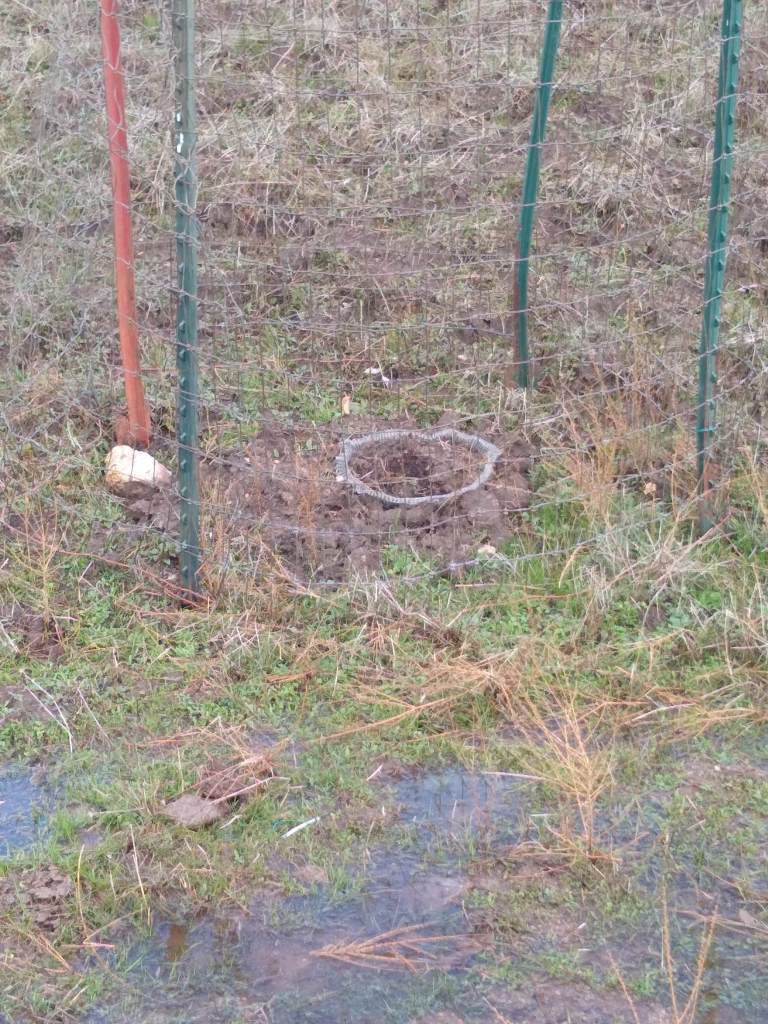
Cottonwood and cage still there

After the storm, I hiked around the property to check on the plantings. With the two straight days of rain and wind, I wanted to be sure the cottonwood and cage were alright as well as the plantings and branch fence and Odom Creek plantings with brush pile protections. I planted most of the plants close enough to the creek bed to get a soaking during high water, but not so close that the roots were in water all the time in the winter. I looked at the neighbor’s cottonwoods and my own buckeyes to see where they were successful in relation to the creek bed and followed that example.

Fortunately, the two days of rain did not flood the spring creek and take the branch fence with it. There were a couple filler branches that moved downstream with the flow. I ended up replacing only three branches to fill a couple bare spots in the fence. Overall, I was really happy with the outcome. There are a few bulls on the ranch now along with the cows (It is that time of year for love.), and I have some concerns that the bulls will just push through it to get to the long blades of grass on the other side. I will keep watching.

I also checked Odom Creek. There, I thought the flow would be greater with more of a chance that the brush piles over the willows would be washed away. To my surprise, it did not look as though the water reached the plants on the east side. Although the ground was wet, the dirt did not look dark as if the water line reached them. The water clearly soaked the willow on the west side. Each brush pile was intact. All plants were present and accounted for – four willows and one mule fat.

Other Monitoring

Looking for a. California sprouts with Andy and Bibi

I have also been checking the a. Californica site closest to the house for sprouts. Last year, there was no rain in February, which I am thinking stunted grass grown allowing the a. California milkweed to get a head start on growing. This year, with rains in February, I am concerned that the grass may grow faster than the milkweed. I want to watch for its remarkable leaves and trim the grass in that area to give it a chance. That early milkweed will be important for the monarchs.
Planning for Spring Planting

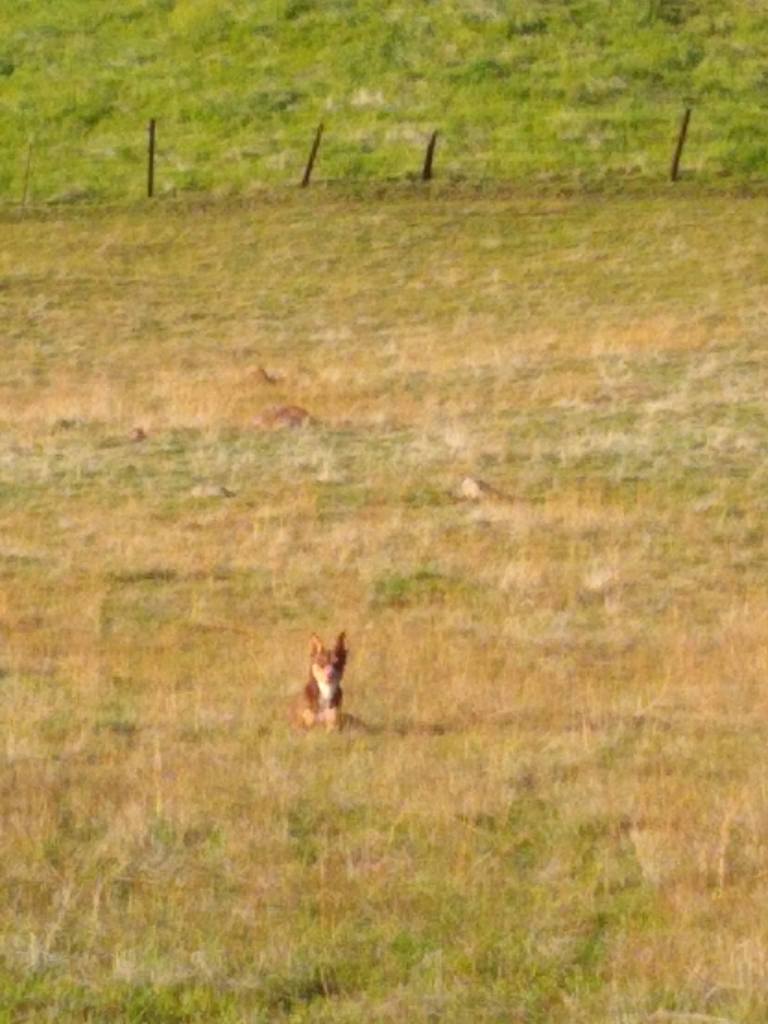
Ron Allen, UC Master Gardener and Co-Owner of Mariposa Native Plants

Ron came over to discuss the next plant order. I asked for his guidance on my plan and showed him the areas where I was thinking of focusing this Spring. He also got a chance to see what was doing well, and what didn’t make it. Overall, things looked good. I placed an order for 89 plants. We are continuing to go big for the monarchs.
Already wildflowers have bloomed. I see blue dick stems and poppy leaves sprouted. The primrose never stopped blooming. Spring is around the corner. I am going to plant anything I can for February. The milkweeds won’t be ready, but there should be some nectar plants available then.

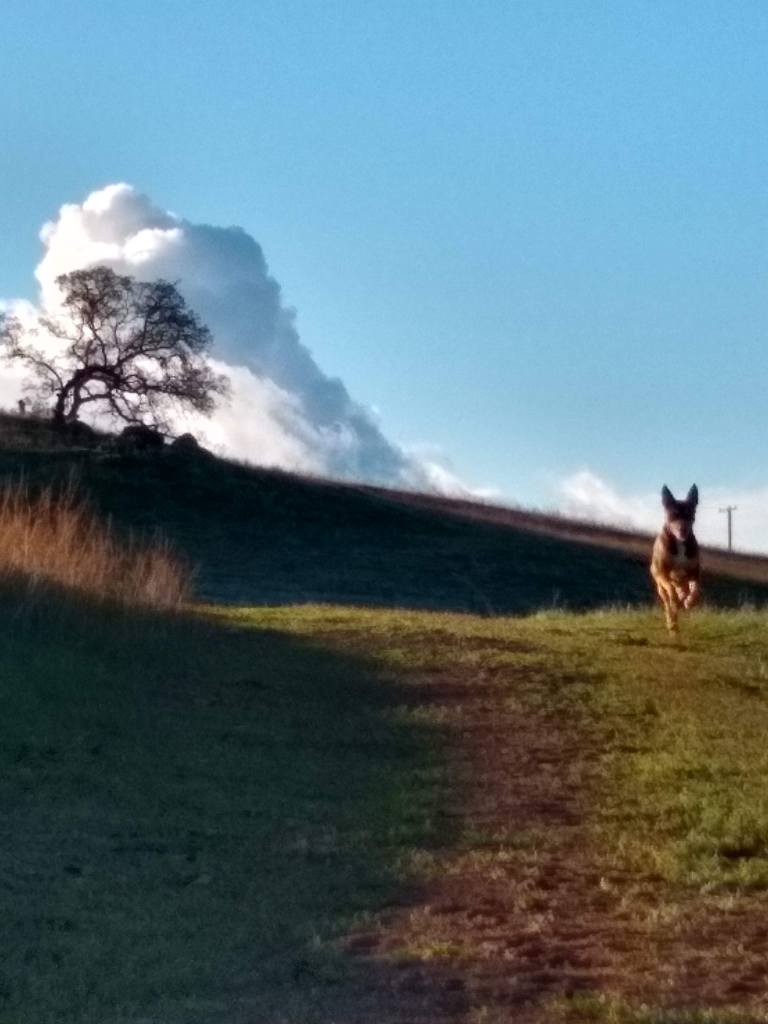
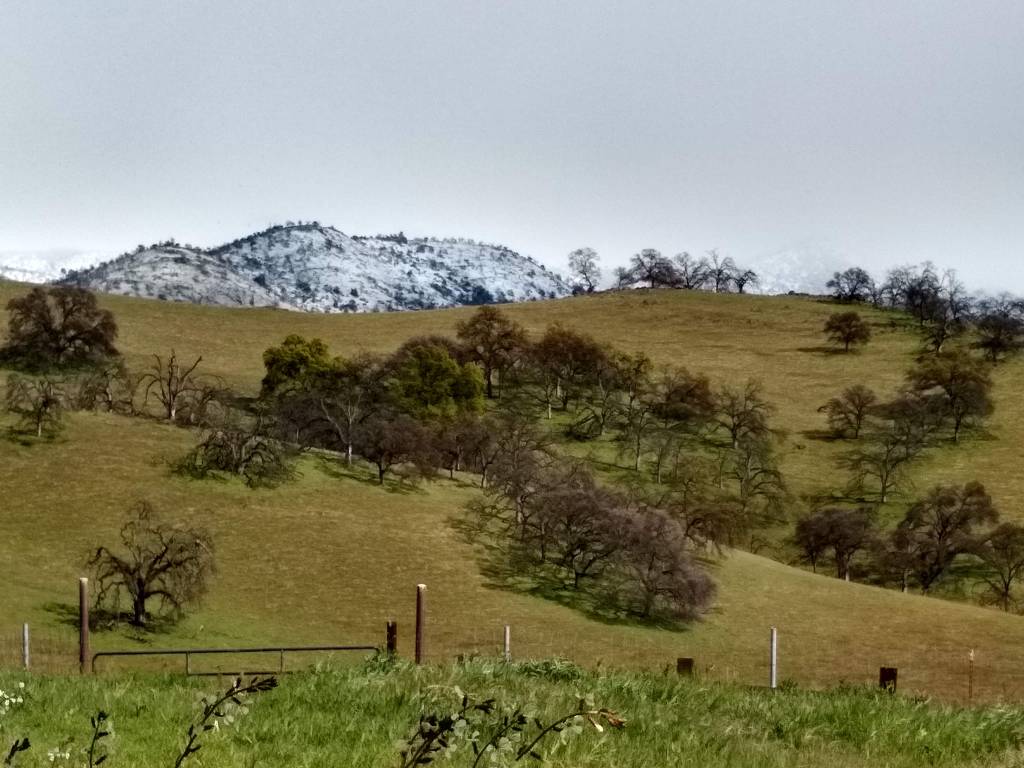
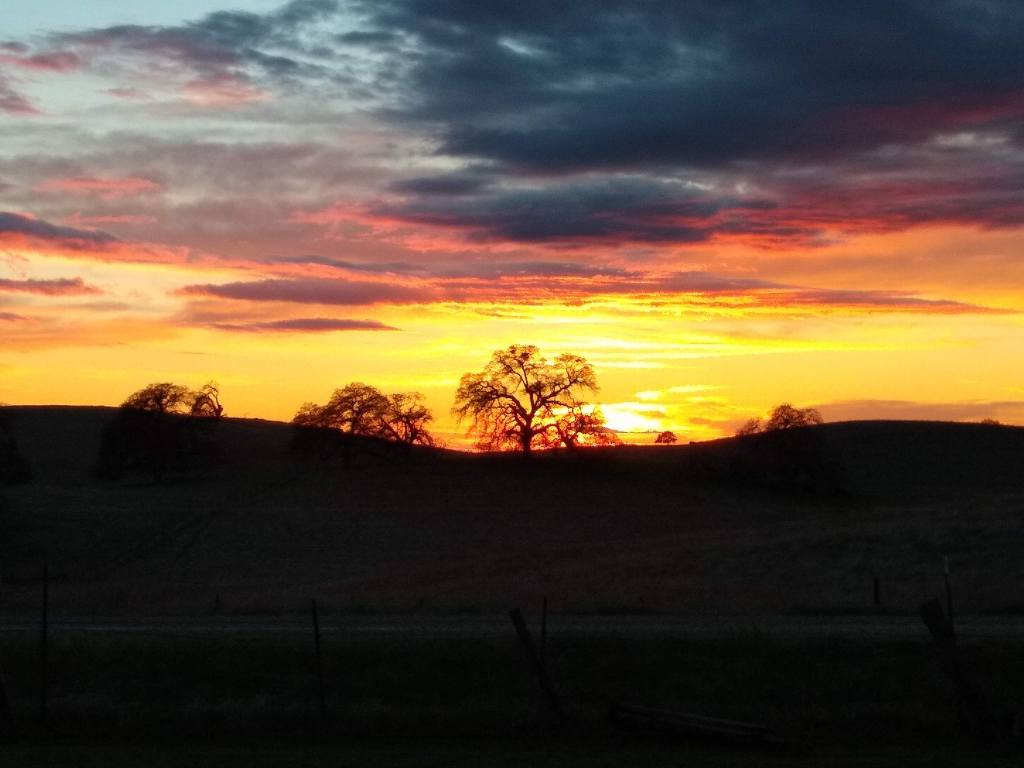
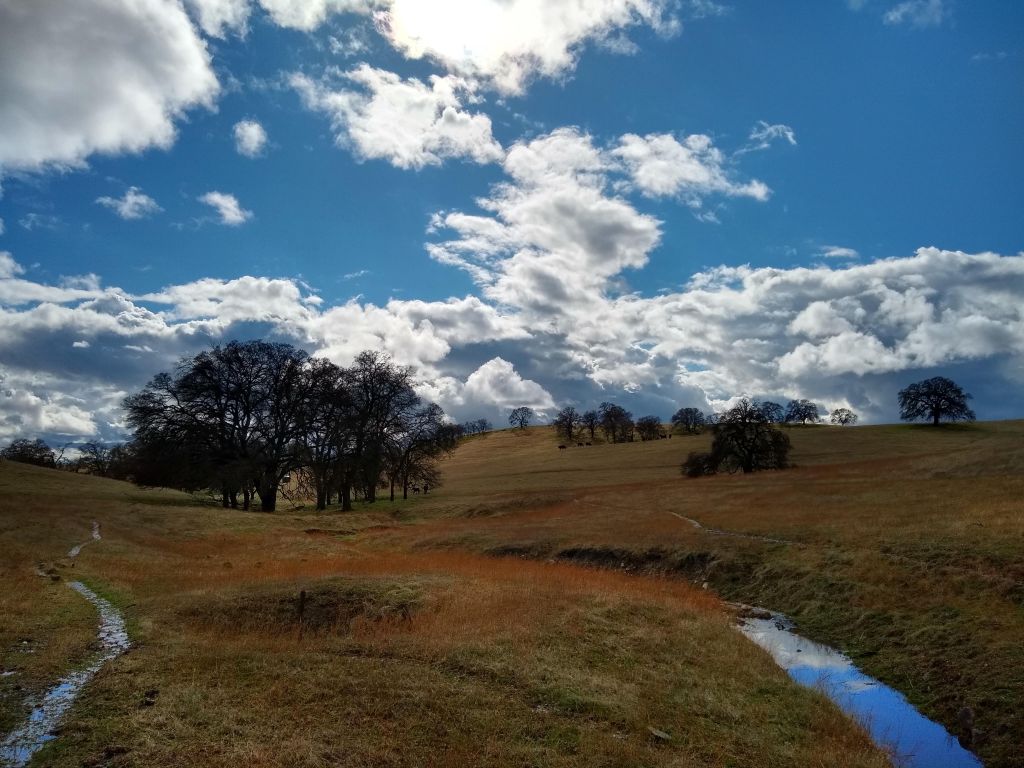
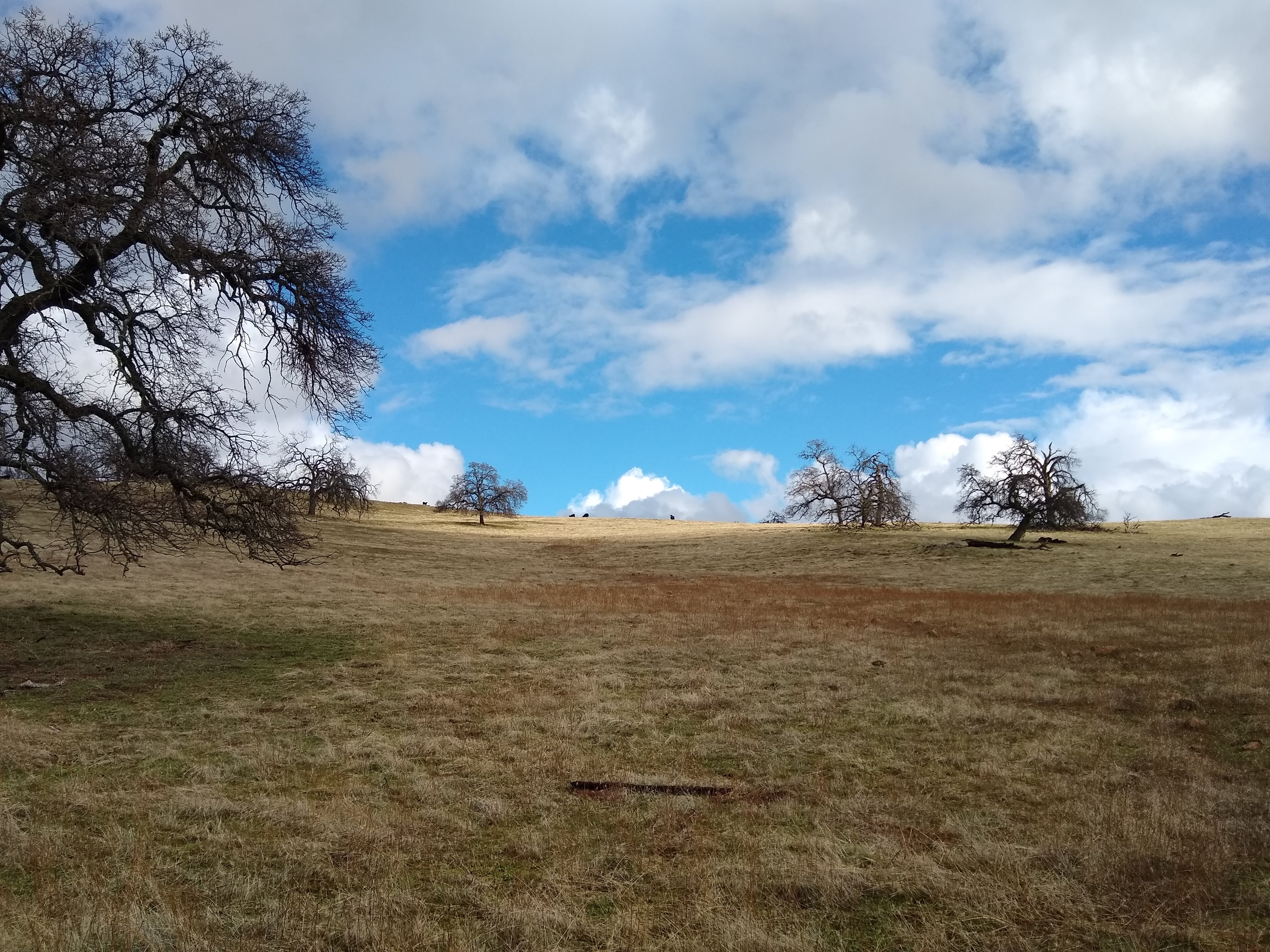
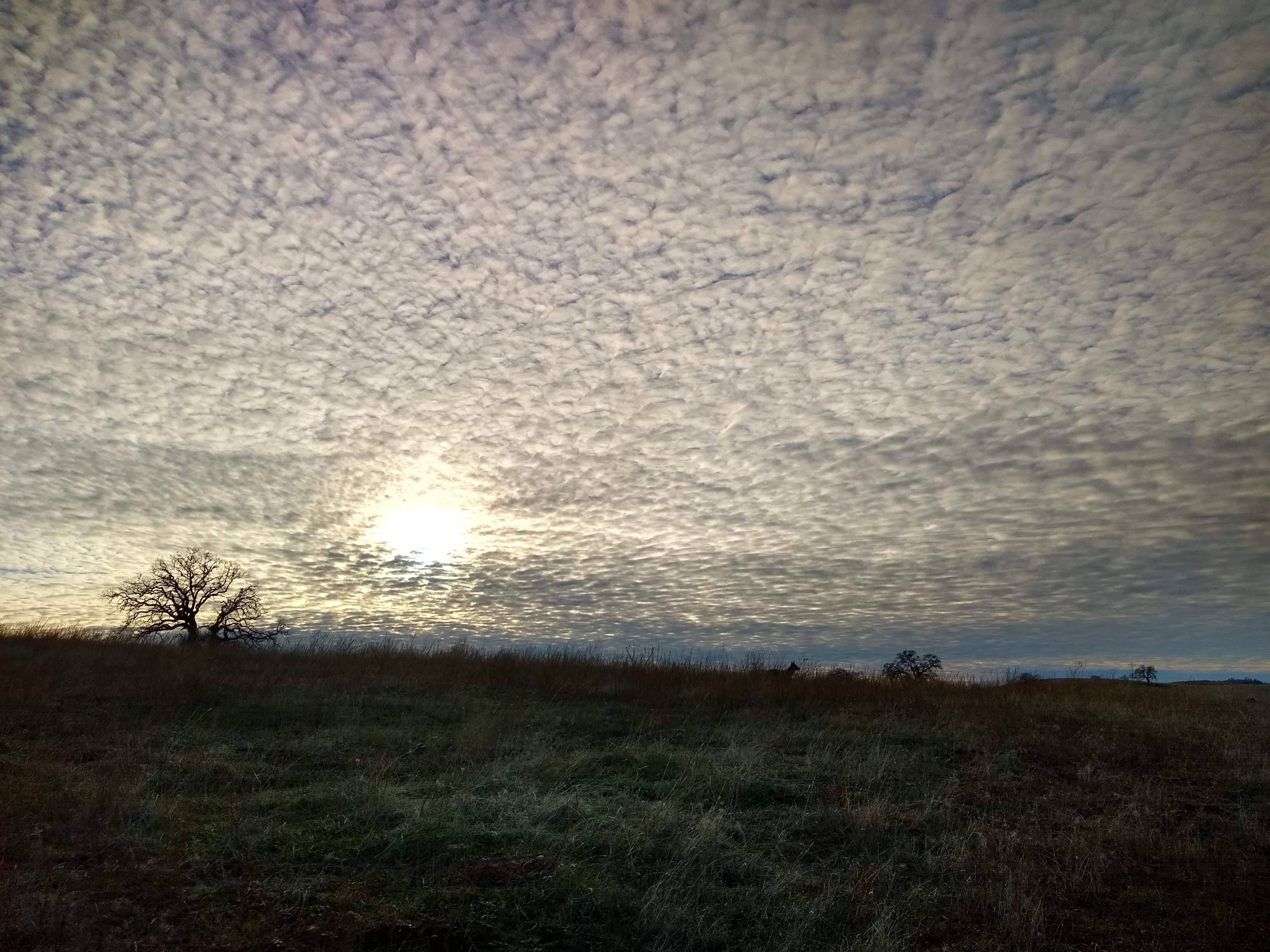
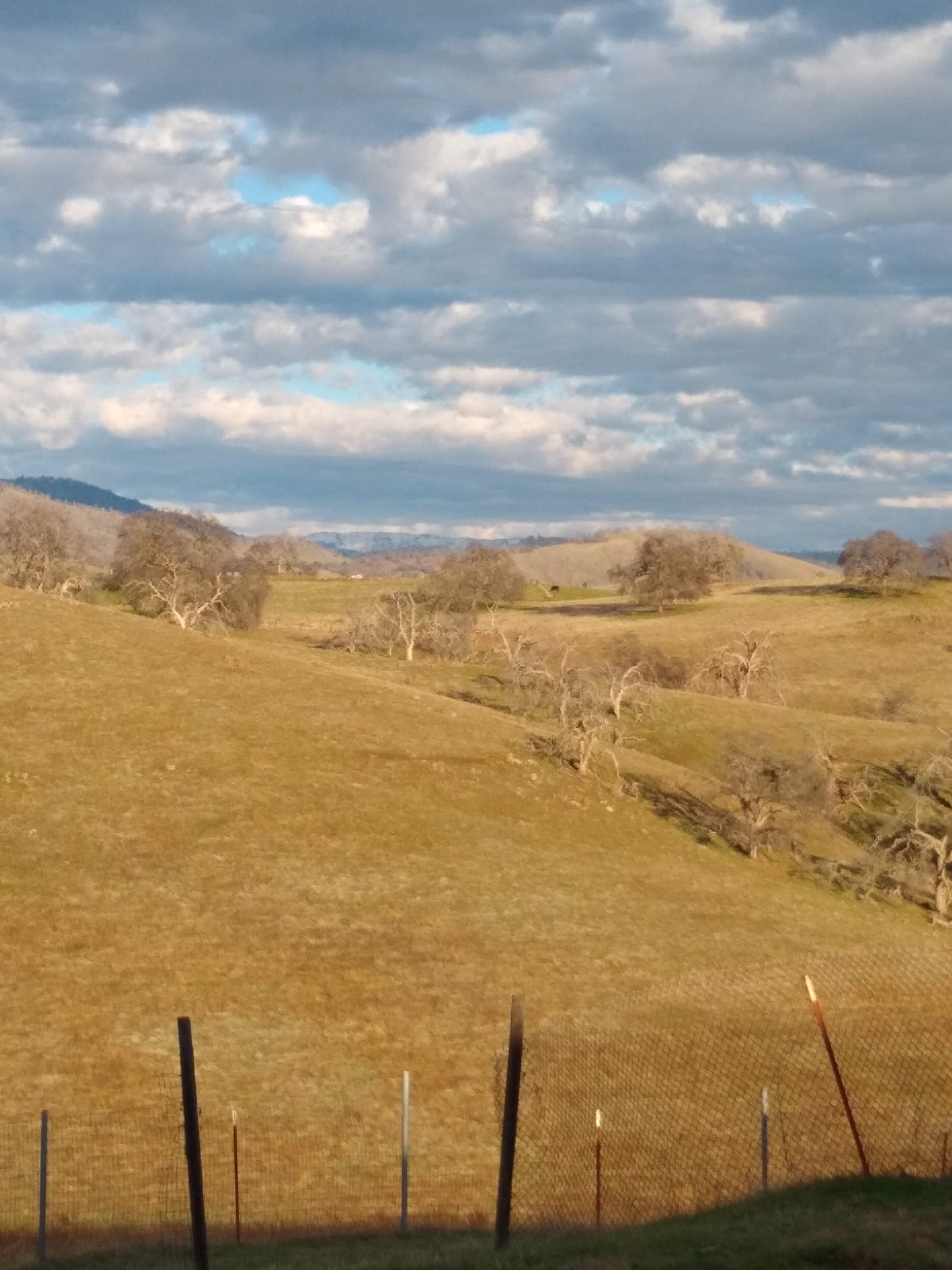
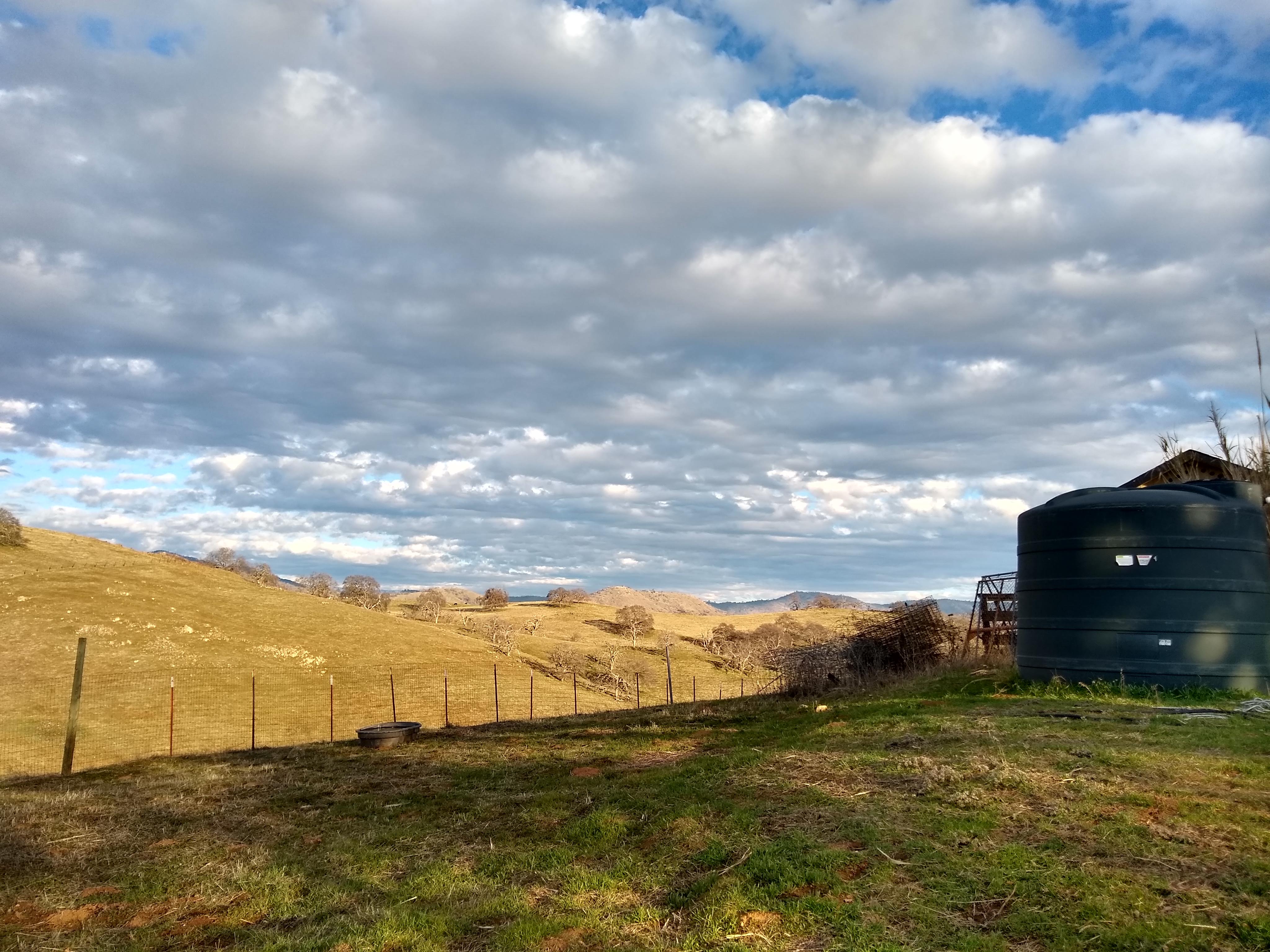
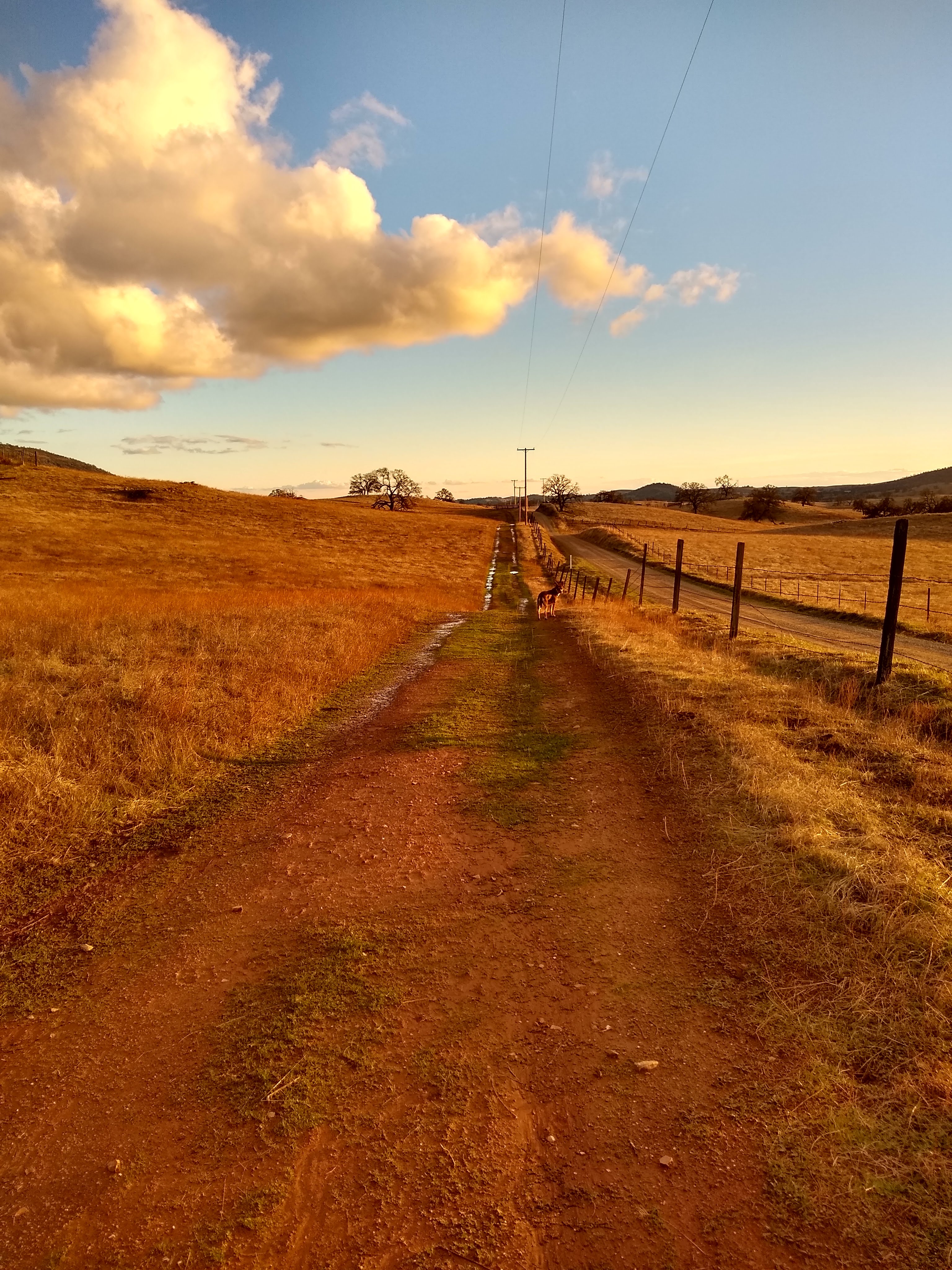
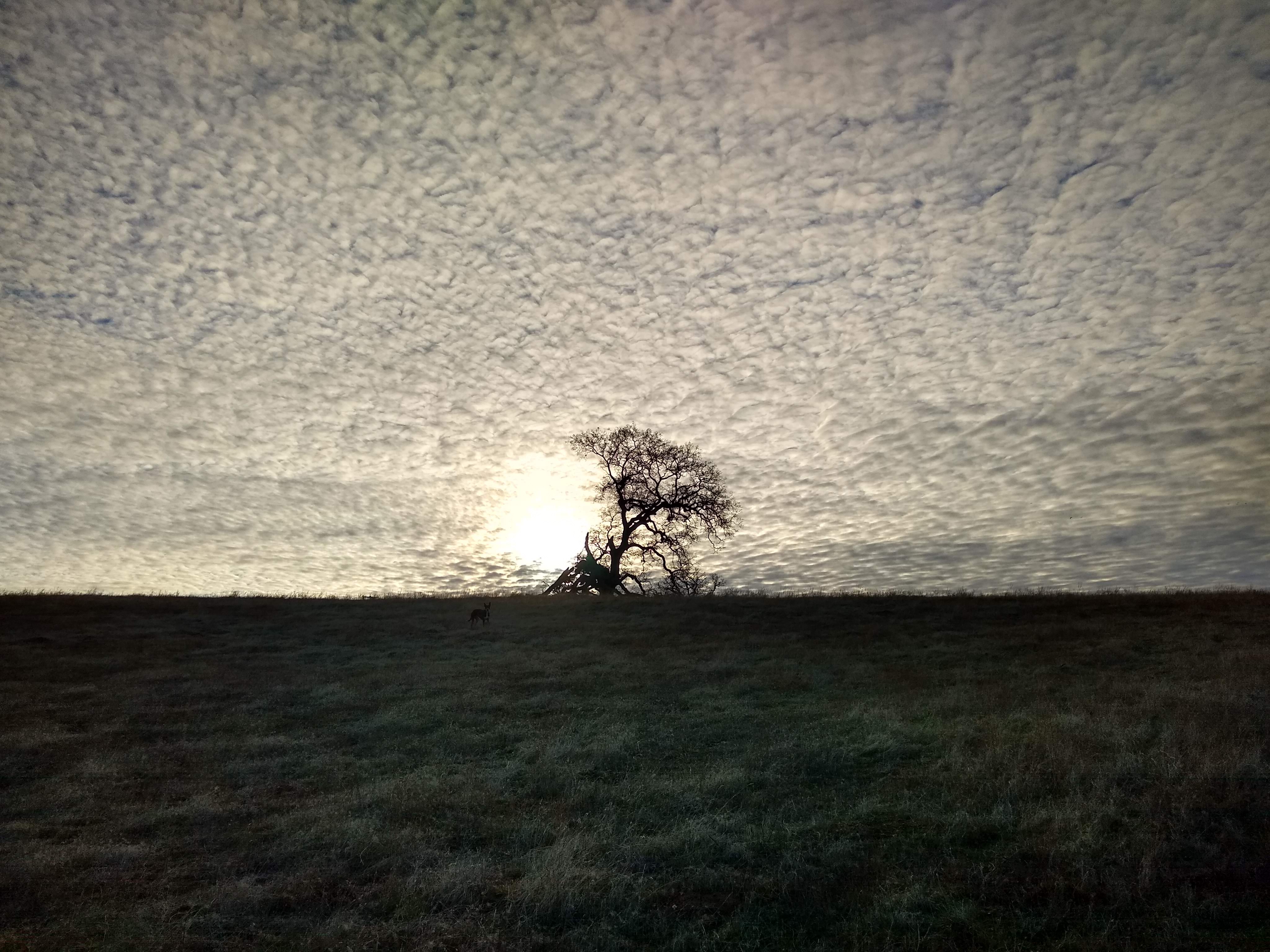
The storm made for some dramatic photos and clouds. I end my blog with some select shots that I hope you enjoy.